What is the role of family medicine in providing palliative care in Africa?
Abstract
Although palliative care is known to effectively relieve serious health-related suffering (SHS), it is not yet widely available, particularly in Africa. Primary health care has been recognised as an effective means to enhance access to palliative care and achieve universal health coverage. As family physicians play an important role in the delivery of primary health care, this article seeks to illustrate how the family medicine speciality is contributing to efforts to ensure palliative care services are provided throughout the African continent. The World Health Organization recommends three tiers of training for healthcare providers to enhance competencies in palliative care. This training has played out differently in various African countries. This article focuses on the countries represented by the authors, namely South Africa, Ethiopia, Sudan and Ghana. In providing continuous, coordinated, holistic care to patients along the life course, family physicians can anticipate and relieve suffering in a timely manner in ways that no other specialities have been trained to do. We propose that all family physicians' training programmes in Africa prioritise palliative care training along with other leading clinical areas, to ensure that the significant numbers of people dying from SHS receive holistic care and die with dignity.
family medicine; palliative care; family physician; undergraduate training; postgraduate training
Introduction
It is estimated that by 2060, 47% of all deaths globally will be attributed to illnesses associated with serious health-related suffering (SHS) such as cardiovascular diseases, dementia and cancer.112,3
Primary health care has been recognised as an effective means to enhance access to palliative care and achieve universal health coverage.4
The principles of family medicine and palliative care exhibit significant overlap as both adopt a person-centred, family-orientated, biopsychosocial, and spiritual approach to care throughout the life course regardless of age, gender, diagnosis or prognosis. The emphasis on clear communication, thorough clinical examination and a collaborative team-based approach, essential for addressing palliative care needs, aligns closely with the foundational principles of family medicine.5,6
Family physicians are best placed to lead clinical services, teams, and advocacy efforts in palliative care.7
Primary care functions as the first point of contact for individuals seeking healthcare services within the community. It plays a critical role in maintaining continuity of care, facilitating efficient communication, and encouraging active community participation. Through these mechanisms, primary care enables individuals to assess and address their own palliative care needs, ensuring timely intervention and reducing delays in care.4
Furthermore, family physicians bridge gaps between primary and specialised care, advocate for resources, and implement culturally sensitive practices. Equipping these generalists with palliative care skills enables healthcare systems to improve the reach and quality of care, particularly in underserved African regions.8
Family physicians, by nature of the level at which they optimally function in the healthcare system, should be the most accessible specialists in Africa. They are uniquely positioned to provide basic and intermediate palliative care in all areas of the continent. Family physicians are still small in number and not as widely available as they could be. Through their networks, they can reach many people and can supervise many healthcare workers (HCWs). They need the skills to provide and to support others in their provision of palliative care.
Service delivery
In many areas of Africa, specialists are in the minority. All HCWs need an understanding of palliative care, and they should have basic palliative care training.22
The WHO recommends three tiers of training for HCWs to enhance competencies in palliative care: (1) basic palliative care training for all HCWs; (2) intermediate-level training for healthcare professionals who frequently encounter palliative care patients, although it is not their primary clinical focus; and (3) specialist-level training for healthcare professionals dedicated exclusively to palliative care.2
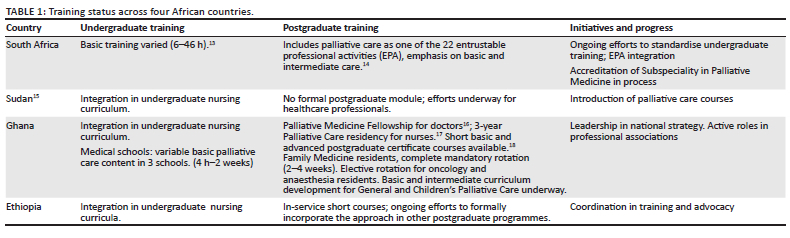
This has played out differently in various African countries. This article focuses on the countries represented by the authors. Table 1 summarises the current palliative care training in the four countries represented by the authors. For example, in Ghana, family medicine has led palliative care development through education and service provision since 2011, setting up units in four tertiary level hospitals.9
Family physicians are fast becoming leaders and advocates for our vulnerable patients.710,11
The absence of a formal palliative care framework in some countries, for example Sudan, means that many patients suffering from chronic and terminal conditions do not receive the compassionate, holistic care that palliative care offers. This lack of recognition often results in fragmented care, with patients being referred to general healthcare providers who may lack the specialised skills needed for effective palliative management.12
Advocacy and lessons learned in palliative care recognition
Across Africa, significant strides have been made through partnerships between family medicine and palliative care advocates, policymakers, and regulatory authorities. In South Africa, advocacy efforts through the Health Professions Council of South Africa (HPCSA) have approved a new sub-speciality in palliative medicine (MPhil PM) within the framework of family medicine. This initiative will not only enhance training but also formalise recognition and integration of palliative care into healthcare systems. Advocacy within the Colleges of Medicine of South Africa has resulted in five specialities planning to enrol fellows in the new MPhil fellowship course.
In Ghana, family physicians played a pivotal role in establishing the Palliative Medicine Fellowship and contributing to national policy frameworks. Their involvement in curriculum development and research has strengthened palliative care education and service delivery across multiple disciplines.
Sudan and Ethiopia are making progress in integrating palliative care into training curricula.
Reflecting back on the success of these initiatives, a pan-African approach involving sustained engagement with policymakers, structured training, alignment with existing healthcare frameworks and interdisciplinary collaboration are essential to strengthen education, policy, and service delivery as well as accelerate progress.
Conclusion
The superpower of combining palliative medicine with family medicine lies in the fact that our multifaceted training gives us unique insights into the patient's illness journey and their family dynamics. In providing continuous, coordinated, holistic care to patients along the life course,6
References
-
1. Sleeman K, Brito M, Etkind S, et al. The escalating global burden of serious health-related suffering: Projections to 2060 by world regions, age groups and health conditions. Lancet. 2019;7(7):e883-e892. https://doi.org/10.1016/S2214-109X(19)30172-X
» https://doi.org/10.1016/S2214-109X(19)30172-X -
2. World Health Organization. Strengthening of palliative care as a component of comprehensive care throughout the life course [homepage on the Internet]. Geneva: World Health Organisation; 2014 [cited 2024 Dec 30]. Available from: http://apps.who.int/gb/ebwha/pdf_files/wha67/a67_r19-en.pdf
» http://apps.who.int/gb/ebwha/pdf_files/wha67/a67_r19-en.pdf -
3. Knaul FM, Farmer PE, Krakaver EL, et al. Alleviating the access abyss in palliative care and pain relief - An imperative of universal health coverage: The Lancet commission report. Lancet. 2018;391(10128):1391-1454. https://doi.org/10.1016/S0140-6736(17)32513-8
» https://doi.org/10.1016/S0140-6736(17)32513-8 -
4. World Health Organisation. Why palliative care is an essential function of primary health care [homepage on the Internet]. Geneva: World Health Organisation; 2018 [citied 2024 Dec 30]. Available from: https://www.who.int/publications/i/item/WHO-HIS-SDS-2018.39
» https://www.who.int/publications/i/item/WHO-HIS-SDS-2018.39 - 5. McWhinney I, Freeman T. Textbook of family medicine. 3rd ed. New York, NY: Oxford University Press Inc; 2009.
-
6. World Health Organization. Palliative care [homepage on the Internet]. 2020 [cited 2024 Dec 30]. Available from: https://www.who.int/news-room/fact-sheets/detail/palliative-care
» https://www.who.int/news-room/fact-sheets/detail/palliative-care -
7. South African Academy of Family Physicians. The contribution of family physicians to district health services in South Africa: A national position paper by the South African Academy of Family Physicians. S Afr Fam Pract. 2022;64(1):a5473. https://doi.org/10.4102/safp.v64i1.5473
» https://doi.org/10.4102/safp.v64i1.5473 -
8. Tiwari R, Mash R, Karangwa I, Chikte U. A human resources for health analysis of registered family medicine specialists in South Africa: 2002-2019. Fam Pract. 2020;38(2):88-94. https://doi.org/10.1093/fampra/cmaa084
» https://doi.org/10.1093/fampra/cmaa084 - 9. Gyakobo M, Opare-Lokko E. Palliative care in Ghana. Die Hospiz-Zeitschrift. 2015;3:36-41.
- 10. Mamo Y, Habte A, W/Giorgis N, et al. The evolution of hospice and palliative care in Ethiopia: From historic milestones to future directions. Ethiop J Health Dev. 2020;34(4):310-312.
-
11. Reid E, Abathun E, Gebre N, et al. It takes a village: Bringing palliative care to Ethiopia. J Palliat Med. 2024;27(7):840-841. https://doi.org/10.1089/jpm.2023.0632
» https://doi.org/10.1089/jpm.2023.0632 -
12. Bastos F, Garralda E, Montero A, et al. Comprehensive scoping review of palliative care development in Africa: Recent advances and persistent gaps. Front Health Serv. 2024;4:1425353. https://doi.org/10.3389/frhs.2024.1425353
» https://doi.org/10.3389/frhs.2024.1425353 -
13. Burger H, Krause R, Blanchard C, et al. Position paper on undergraduate palliative medicine education for doctors in South Africa. Afr J Prim Health Care Fam Med. 2022;14(1):a3202. https://doi.org/10.4102/phcfm.v14i1.3202
» https://doi.org/10.4102/phcfm.v14i1.3202 -
14. The College of Family Physicians. Entrustable professional activities for postgraduate family medicine training in South Africa [homepage on the Internet]. 2024 [cited 2025 Feb 07]. Available from: https://cmsa.co.za/wp-content/uploads/2024/12/Appendix-B-Preamble-and-22-EPAs-1.pdf
» https://cmsa.co.za/wp-content/uploads/2024/12/Appendix-B-Preamble-and-22-EPAs-1.pdf - 15. Damanhuri G, Marhoom M. Republic of Sudan - Palliative care - Hope for the future. In: Silbermann M, editor. Palliative care for chronic cancer patients in the community. Cham: Springer, 2020; p. 231-239.
-
16. Faculty of Family Medicine Fellowship Curriculum. Palliative medicine [homepage on the Internet]. 2021 [cited 2025 Feb 07]. Available from: https://gcpsedugh-my.sharepoint.com/personal/ict_gcps_edu_gh/_layouts/15/onedrive.aspx?id=%2Fpersonal%2Fict%5Fgcps%5Fedu%5Fgh%2FDocuments%2FFaculty%20Curricula%202023%2FFellowship%2FDivision%20of%20Physicians%2FFamily%20Medicine%2FGCPS%20PallMed%20Fellowship%20Curriculum%2Epdf&parent=%2Fpersonal%2Fict%5Fgcps%5Fedu%5Fgh%2FDocuments%2FFaculty%20Curricula%202023%2FFellowship%2FDivision%20of%20Physicians%2FFamily%20Medicine&ga=1
» https://gcpsedugh-my.sharepoint.com/personal/ict_gcps_edu_gh/_layouts/15/onedrive.aspx?id=%2Fpersonal%2Fict%5Fgcps%5Fedu%5Fgh%2FDocuments%2FFaculty%20Curricula%202023%2FFellowship%2FDivision%20of%20Physicians%2FFamily%20Medicine%2FGCPS%20PallMed%20Fellowship%20Curriculum%2Epdf&parent=%2Fpersonal%2Fict%5Fgcps%5Fedu%5Fgh%2FDocuments%2FFaculty%20Curricula%202023%2FFellowship%2FDivision%20of%20Physicians%2FFamily%20Medicine&ga=1 -
17. Ghana College of Nursing and Midwives. Nursing and adult health membership programmes [homepage on the Internet]. 2024 [cited 2025 Feb 07]. Available from: https://hcmcf.knust.edu.gh/short-courses/
» https://hcmcf.knust.edu.gh/short-courses/ -
18. African Health Collaborative. Application eligibility and details [homepage on the Internet]. 2025 [cited 2025 Feb 07]. Available from: https://gcnm.edu.gh/membership-programmes-ah/
» https://gcnm.edu.gh/membership-programmes-ah/

Accepted: 20 Feb. 2025
Published: 14 Apr. 2025