A comparative study of postnatal depression and associated factors in Gauteng and Free State provinces, South Africa
Abstract
BACKGROUND: The factors contributing to probable postnatal depression (PND), a type of clinical depression that can affect woman after childbirth, are socially derived. Therefore, variations among groups of women necessitate studies in different communities AIM: This study compared the prevalence of PND and associated factors among women attending postnatal services facilities SETTING: The study setting included Tshwane Municipal district in Gauteng province (GP) and Fezile Dabi District (FS) in Free State province (FSP), South Africa METHODS: A total of 477 mothers within 12 weeks of giving birth were recruited by convenient sampling in health facilities. A self-developed questionnaire was used to obtain information on socio-demographics, obstetric history, and children's characteristics. The Edinburgh Postnatal Depression Scale (EPDS) was used to collect data on depression symptoms, with a score of ≥ 13 used as a cut-off for probable PND. Data were analysed using STATA 14. Multivariate logistic regression was used to determine association between probable PND and various covariates RESULTS: The overall mean age of women was 28 ± 6 years. The overall prevalence rate of PND was 22%, slightly higher in FS (23%) than in GP (21%). Most participants living in GP were married, had tertiary education, were employed and from the households with income of more than R8000.00. A chi-square test showed that planned pregnancy was significantly higher in GP compared with FS (p ≤ 0.001). Multivariate logistic regression showed that support from a partner or husband decreased the odds of a probable PND in GP (adjusted odd ratio [AOR] 0.37; 95% confidence interval [CI] [95%CI: 0.14-0.96; p = 0.041] and in the FS [AOR = 0.14, 95%CI: 0.05-0.40; p ≤ 0.001]). Significant associations of probable PND with several factors - planned pregnancy, baby age, support in difficult times, partner or husband drinking alcohol and stressful events - were more common in the FSP than in the GP CONCLUSION: The prevalence of probable PND and its associated risk factors in the GP and the FS indicates the need for routine screening and targeted interventions in both urban and rural settings CONTRIBUTION: The results confirm that the prevalence of PND is similar in both rural and urban areas, and that pregnancy planning remains a challenge in the FS, which calls for increased efforts to revive family planning programmes in primary health care facilities
postnatal depression; Edinburgh postnatal depression scale; free state; Gauteng; South Africa
Introduction
Maternal and child health are priority areas for public health interventions globally, including in South Africa.1213,4,5,6,78
Postnatal depression affects some women in the immediate postpartum stage, thereby impacting the ability of the mother to care for herself, her baby, and her family.910,11
Although the prevalence of PND varies widely and has been reported to be high globally,11213141516,1718,1920
Although the negative impact of PND on both mother and child is well documented,21222324
There are contradictory findings regarding the association between PND and rural settings, with some studies reporting an association between rural living as a risk factor for PND,25,262727
The prevalence of PND in South Africa has been reported to be higher than in other African countries,282930311332,33,3435
Because of the wide variations in prevalence estimates in different communities and because South Africa does not have frequently routinely collected data on PND, which would provide country estimates, it is necessary to conduct studies in different areas of the country. This study aimed to compare the prevalence of PND and its associated factors among women attending primary healthcare clinics in Gauteng province (GP) and Free State province (FSP), South Africa, to advocate for better screening procedures.
Research methods and design
Study design, population and setting
A cross-sectional survey was conducted among women who had delivered a live infant within 12 weeks of data collection. The participants were attending postnatal care at health facilities in GP and FSP in South Africa. Thirteen health facilities formed part of the study; six were located in GP (Tshwane Metropolitan Municipality) and seven in Fezile Dabi District (FS).
Gauteng is the smallest of South Africa's provinces in terms of size, although it is one of the most densely populated.3637238394041
Sample size and sampling techniques
A sample size was calculated using Rao software size calculator.42
Data collection, tool and recruitment
Data were obtained from mothers who had delivered a live infant within 12 weeks of the time of data collection, and were attending postnatal care in the identified health care facilities. Mothers were individually recruited as they were waiting to be attended to by health professionals for their postnatal check-up, as well as for well-baby clinic. Upon agreeing to participate, detailed information about the purpose and value of the study and how the results will be used was given. The participants were encouraged to ask questions or clarifications about the study, which was followed by a request to provide informed consent. The questionnaire was administered by trained research assistants in a private room allocated by the facility manager. Demographic data collected included personal information (i.e. age, marital status, education level and employment status) and household information, such as living arrangements, income and child care grant, as well as obstetric history and children's characteristics.
The EPDS, a globally validated tool for screening for PND across cultures,23,43,44454647,48
The validity in the study was enhanced by the use of the EPDS, which is an already valid, reliable, and standardised tool for screening of PND.2213,30,4922
Data analysis
Raw data were captured on excel spreadsheet and exported to STATA version 15 for analysis. Complete case analysis was used to identify participants with missing data during analysis. Questionnaires with more than 10% missing data were excluded from the study (i.e. three questionnaires), and questionnaires with less than 10% missing data were used in data analysis. Descriptive statistics (i.e., frequency [n] and percentage [%]) was computed. A score of 13 and above was used to classify women with and without significant PND symptoms. A Chi-square test was used to compare the sociodemographic status between women with and without PND symptoms; presented as n and %. Fisher's exact was applied to variables with expected values less than 5 in a cell. Univariate and multivariate logistic regression analyses were used to determine the association of PND symptoms with covariates. A purposeful selection process began with a univariate analysis of each variable. Any variable having a significant univariate test at some arbitrary level (p < 0.200) was selected as a candidate for the multivariate analysis. Results are presented as adjusted odds ratio (AOR) (95% CI). A significance level of p < 0.050 was applied.
Ethical considerations
Ethical clearance of the study was obtained from the Research and Ethics Committee of Sefako Makgatho Health Sciences University (SMUREC), (No. SMUREC/H/101/2016:IR), as well as from the Provincial Ethics Committees of the two provinces. Permission to conduct the study was obtained from the management of the health facilities, and written consent was obtained from all participants who were above 18 years old. For those aged below 18 years, a written informed consent was sought from their caregivers, and if caregivers were not available, they were excluded from the study. If, during the interview, a participant expressed emotional distress or showed signs of distress, the researcher was ready to stop with the interview and refer the participant to the South African Depression and Anxiety Group (SADAG) who can be reached telephonically between 08:00 and 20:00. The research assistants provided all participants with the contact information of SADAG for future needs. All participants were given information brochures on PND.
Results
Socio-demographic characteristics of mothers
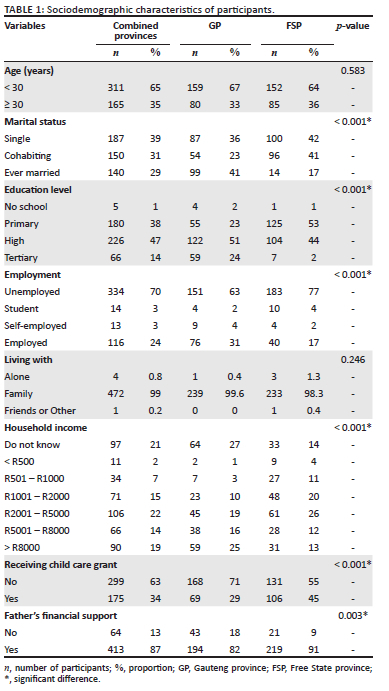
As shown in Table 1, the sociodemographic variables of mothers are discussed. The overall mean age of mothers was 28 ± 6 years, with the mean age for GP being 27 ± 6 years, ranging from 16 to 43, while for FSP mean age was 28 ± 6 years ranging from 13 to 44 years. Significant differences of marital status (p < 0.001), education level (< 0.001), employment (< 0.001), household income (< 0.001), receiving child care grant (< 0.001), and father's financial support (p = 0.003) were observed between GP and the FSP. Although the sociodemographic status was poor, many women who were ever married, with tertiary education, employed and household income of more than R8000.00 were living in the GP compared with the FSP. The FSP was characterised by significant proportions of mothers with primary education, cohabiting, unemployed, living in households with income of R2001.00 - R5000.00, receiving child care grant, and father's financial support.
Characteristics of mothers and babies
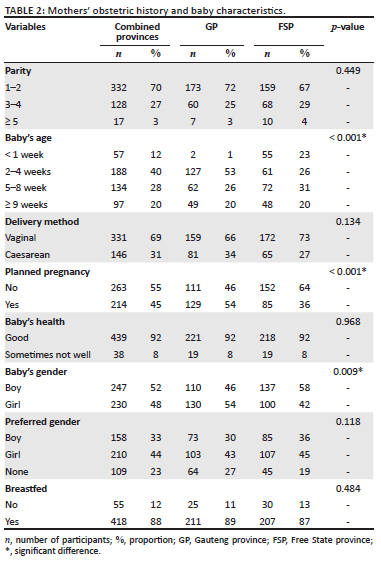
Most babies in GP were aged between 2 and 4 weeks compared with the FSP (p < 0.001). Planned pregnancy was significantly high in the GP compared with the FSP (p < 0.001, Table 2).
Factors associated with the likelihood of developing postnatal depression
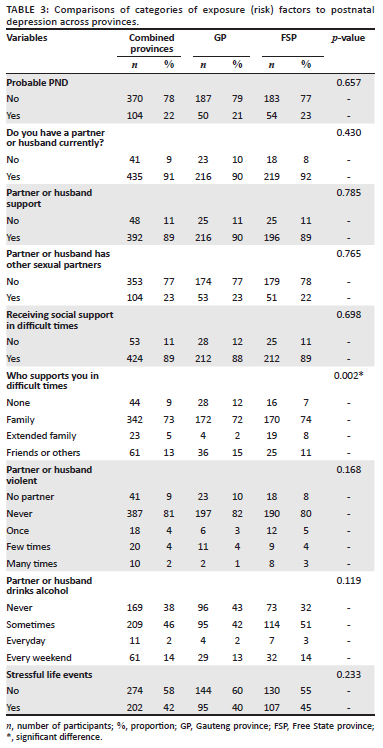
Table 3 shows the prevalence of probable PND and comparison of categories of exposure to PND across provinces. The overall prevalence rate of probable PND in the study was 22%. The FSP (23%) had a slightly high prevalence rate of PND compared with GP (21%), although not significantly different (p = 0.657). The results further showed a significant difference of who support participants in difficult times between the two provinces (p = 0.002). Support came mostly from family members.
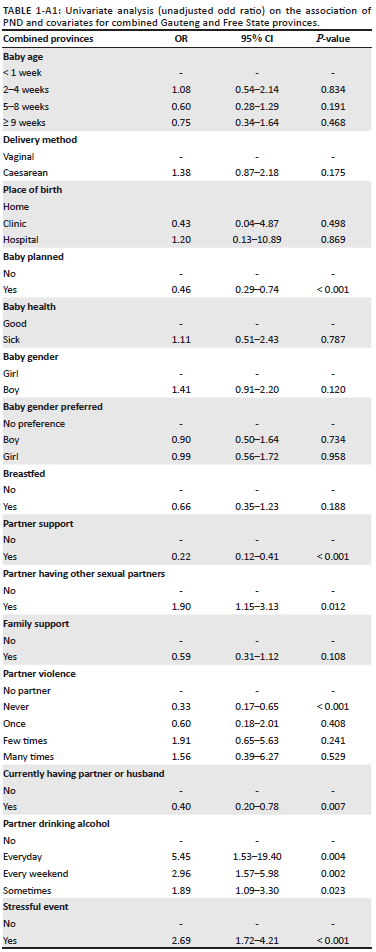
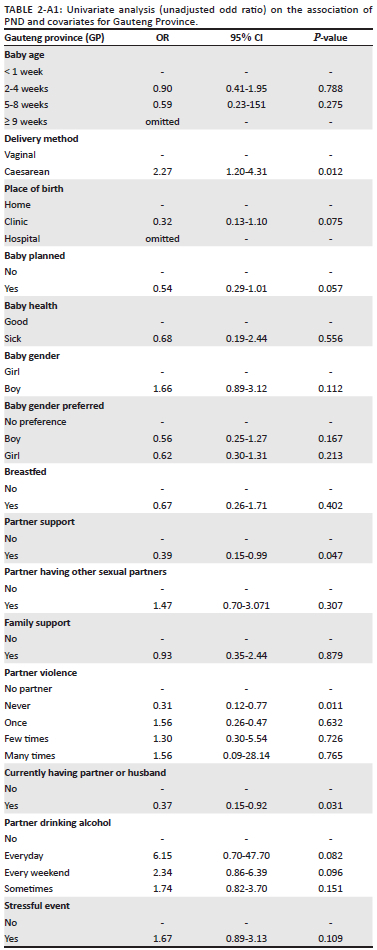
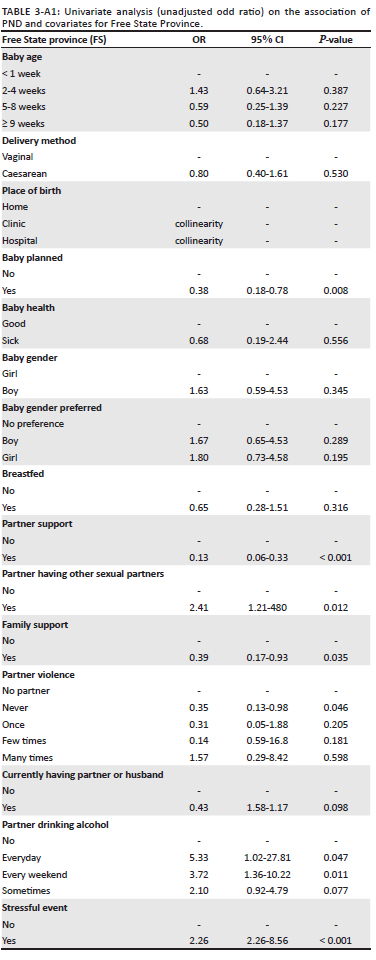
The crude odds ratio (OR), 95% CI, and p-values for the association of PND with covariates by province are presented in Table 1-A1, Table 2-A1 and Table 3-A1. In overall, univariate analysis showed association (p < 0.200) of PND with method of delivery, baby planned, baby gender, breastfeeding, partner support, family support, partner having other sexual partners, currently having a partner or husband, partner drinking alcohol and stressful events (see TABLE 1-A1). For GP, univariate analysis showed association (p < 0.200) of PND with the method of delivery, place of delivery, baby planned, baby gender, partner support, currently having a partner or husband, partner drinking, and stressful events (see TABLE 2-A1). For FSP, univariate analysis showed association (p < 0.200) of PND with baby planned, partner support, family support, partner having other sexual partners, currently having a partner or husband, partner drinking alcohol and stressful events (see TABLE 3-A1).
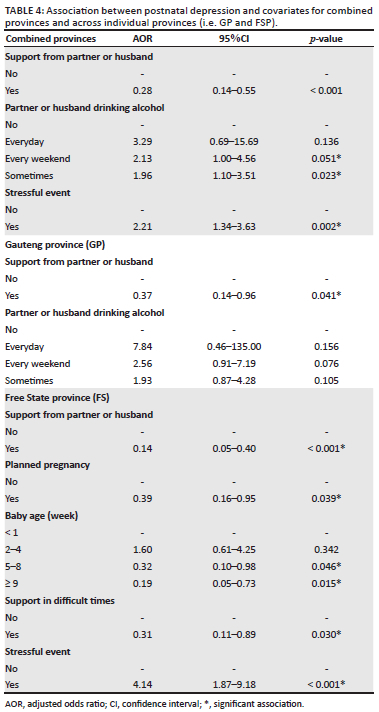
The AOR, 95% CI and p-values for the association of PND with covariate by provinces are presented in Table 4. After controlling for all independent variables (in combined provinces), mothers who received support from partners or husbands were less likely to have PND than those who did not receive support [AOR = 0.28, 95%CI: 0.14-0.55; p < 0.001]. Mothers who had partners/husband drinking alcohol every weekend [AOR = 2.1, 95%CI: 1.00-4.56; p = 0.050] and drinking alcohol sometimes [AOR = 1.96, 95%CI: 1.10-3.51; p = 0.023] were more likely to have PND than mothers who had partners/husbands who were not drinking. Stressful event [AOR = 2.21, 95%CI: 1.34-3.63; p = 0.002] increased the odds of having PND compared to mothers who had not experienced stressful event. Support from a partner or husband was the common factor in GP [AOR = 0.37, 95%CI: 0.14-0.96; p = 0.041] and FSP [AOR = 0.14, 95%CI: 0.05-0.40; p < 0.001] associated with decreased having PND. In the FSP, several factors were associated with PND than in GP. Such factors were planned pregnancy [AOR = 0.39, 95%CI: 0.16-0.95; p = 0.039], baby age of 5 to 8 weeks [AOR = 0.32, 95%CI: 0.10-0.98; p = 0.046] and ≥ 9 weeks [AOR = 0.19, 95%CI: 0.05-0.73; p = 0.015], support in difficult times [AOR = 0.31, 95%CI: 0.11-0.89; p = 0.030] and stressful event [AOR = 4.14, 95%CI: 1.87-9.18; p < 0.001].
Discussion
The current study compared the prevalence of PND and its associated factors among women attending primary healthcare clinics in GP and FSP, South Africa. The overall prevalence rate of PND in this study was 22%. Furthermore, the study showed that the prevalence of PND was slightly high in the FSP (23%) than in the GP (21%), with no statistically significant differences observed between the districts. The factors associated with PND included planned pregnancy, support from a partner or husband baby age, support in difficult times and stressful events, which were more observed among mothers in the FSP than in the GP. In addition, significant differences in the socio-demographic variables were observed between the two provinces, with better living conditions in the GP compared with the FSP.
The prevalence of PND recorded in this study Is comparable with several studies conducted in South Africa5051,525313,22,30305425,52,55
The consequences of PND transcend beyond the mother, therefore, including the family and communities, helps to understand the factors that place postnatal women at risk of PND.25,565050,57,581,12
In the FSP, several factors were associated with PND than in GP, which included planned pregnancy, baby age, support in difficult times and stressful events. The current study showed that planned pregnancy was significantly high in GP compared with the FSP. Nonetheless, 46.0% of mothers in the GP and 64.0% in the FSP still did not plan their pregnancy. In the FSP, mothers who have planned pregnancy were less likely [AOR = 0.39, 95%CI: 0.16-0.95] to have PND, while in GP there was no association with planned pregnancy. South African studies have reported that unplanned pregnancies are associated with PND.13,30596061
Multivariate analysis in the current study showed that support from partners or husbands was associated with the decreased odd of having PND than those who did not receive support. Support from a partner or husband was the common factor in GP [AOR = 0.37, 95%CI: 0.14-0.96] and FSP [AOR = 0.14, 95%CI: 0.05-0.40] associated with a lesser likelihood of having PND. Therefore, having support from spouses was protective against the likelihood of developing PND in the current study. A lack of support has been implicated in the development of PND in South Africa1,3462,63,6465
Stressful event [AOR = 2.21, 95%CI: 1.34-3.63] increased the odds of having PND in mothers compared with those who had not experienced stressful events in this study. As with other studies,53,666768,6970
Limitations
Firstly, this study was conducted in the health facilities, which makes it difficult to generalise the results to the community. Secondly, the cross-sectional nature of the study meant that all women were assessed for PND only once and could not establish a causal relationship. Future studies could adopt a longitudinal approach, which can track the development of PND from the antenatal period. Thirdly, although purposive sampling was relevant to identify women in the postpartum period in this study, and use of convenient sampling (based on their accessibly and availability), use of non-probability sampling has a tendency of introducing bias and inhibits drawing inferences about a population. Fourthly, we acknowledge a slight variation of a sample size as a limitation in the study, therefore, to avoid the possibility of reducing the power of the study and increasing the margin of error, we could not remove participants with missing data of less than 10% following complete case analysis. Fifthly, we acknowledge the limitation of not testing the reliability of the questionnaire statistically, as one of the characteristics of a valid questionnaire.717213,22,5045
Conclusions
We conclude that the prevalence of PND among women in the two provinces (GP and FSP) of South Africa are high comparable with some studies,50,52,55
The study showed that support from a male partner or husband was the common factor in the two provinces, which reduced the odds of probable PND. Although the inclusion of male partners in the prevention and treatment intervention might offer a holistic approach to caring for women who are experiencing a probable PND, the evidence remains underdeveloped, as suggested by Noonan et al.73
Competing interests
The authors declare that they have no financial or personal relationships that may have inappropriately influenced them in writing this article.
Authors' contribution
We confirm that both authors worked on the manuscript and both approved the final version.
Funding information
This study was jointly funded by the National Research Foundation (NRF) through the Research Chair in Substance Abuse and Population Mental Health grant, and the South African Medical Research Council through the Research Capacity Development grant.
Data availability
Data can be available if requested according to the data availability policy of Sefako Makgatho Health Sciences University
Disclaimer
The views and opinions expressed in this article are those of the authors and do not necessarily reflect the official policy or position of any affiliated agency of the authors, and the publishers.
Acknowledgements
The following research assistants are acknowledged for data collection: Memory Ntuli, Khomotso Maaga, Mulalo Salane and Gugu Mabaso.
References
-
1. Kathree T, Selohilwe OM, Bhana A, et al. Perceptions of postnatal depression and health care needs in a South African sample: The 'mental' in maternal health care. BMC Womens Health. 2014;14:140. https://doi.org/10.1186/s12905-014-0140-7
» https://doi.org/10.1186/s12905-014-0140-7 -
2. Chopra M, Daviaud E, Pattinson R, et al. Saving the lives of South Africa's mothers, babies, and children: Can the health system deliver? Lancet. 2009;374(9692):835-846. https://doi.org/10.1016/S0140-6736(09)61123-5
» https://doi.org/10.1016/S0140-6736(09)61123-5 - 3. Abdollahi F, Rezai Abhari F, Zarghami M. Post-partum depression effect on child health and development. Acta Med Iran. 2017;55(2):109-114.
-
4. Ali NS, Mahmud S, Khan A, et al. Impact of postpartum anxiety and depression on child's mental development from two peri-urban communities of Karachi, Pakistan: A quasi-experimental study. BMC Psychiatry. 2013;13:274. https://doi.org/10.1186/1471-244x-13-274
» https://doi.org/10.1186/1471-244x-13-274 -
5. Goodman SH, Rouse MH, Connell AM, et al. Maternal depression and child psychopathology: A meta-analytic review. Clin Child Fam Psychol Rev. 2011;14(1):1-27. https://doi.org/10.1007/s10567-010-0080-1
» https://doi.org/10.1007/s10567-010-0080-1 -
6. Makrides M, Gibson RA, McPhee AJ, et al. Effect of DHA supplementation during pregnancy on maternal depression and neurodevelopment of young children: A randomized controlled trial. JAMA. 2010;304(15):1675-1683. https://doi.org/10.1001/jama.2010.1507
» https://doi.org/10.1001/jama.2010.1507 -
7. Parsons CE, Young KS, Rochat TJ, et al. Postnatal depression and its effects on child development: A review of evidence from low-and middle-income countries. Br Med Bull. 2012;101:57-79. https://doi.org/10.1093/bmb/ldr047
» https://doi.org/10.1093/bmb/ldr047 - 8. Quevedo LA, Silva RA, Godoy R, et al. The impact of maternal post-partum depression on the language development of children at 12 months. Child Care Health Dev. 2012;38(3):420-424.
-
9. Netsi E, Pearson RM, Murray L, et al. Association of persistent and severe postnatal depression with child outcomes. JAMA Psychiatry. 2018;75(3):247-253. https://doi.org/10.1001/jamapsychiatry.2017.4363
» https://doi.org/10.1001/jamapsychiatry.2017.4363 -
10. Chen YH, Tsai SY, Lin HC. Increased mortality risk among offspring of mothers with postnatal depression: A nationwide population-based study in Taiwan. Psychol Med. 2011;41(11):2287-2296. https://doi.org/10.1017/s0033291711000584
» https://doi.org/10.1017/s0033291711000584 -
11. Wachs TD, Black MM, Engle PL. Maternal depression: A global threat to children's health, development, and behavior and to human rights. Child Dev Perspect. 2009;3(1):51-59. https://doi.org/10.1111/j.1750-8606.2008.00077.x
» https://doi.org/10.1111/j.1750-8606.2008.00077.x -
12. Coast E, Leone T, Hirose A, et al. Poverty and postnatal depression: A systematic mapping of the evidence from low and lower middle income countries. Health Place. 2012;18(5):1188-1197. https://doi.org/10.1016/j.healthplace.2012.05.004
» https://doi.org/10.1016/j.healthplace.2012.05.004 - 13. Mokwena K, Shiba D. Prevalence of postnatal depression symptoms in a primary health care clinic in Pretoria, South Africa: Management of health care services. Afr J Phys Health Educ Recreat Dance. 2014;20(Suppl. 1):116-127.
-
14. Alkar ÖY, Gençöz T. Critical factors associated with early postpartum depression among Turkish women. Contemp Fam Ther. 2005;27:263-275. https://doi.org/10.1007/s10591-005-4043-5
» https://doi.org/10.1007/s10591-005-4043-5 -
15. Gjerdingen D, McGovern P, Attanasio L, et al. Maternal depressive symptoms, employment, and social support. J Am Board Fam Med. 2014;27(1):87-96. https://doi.org/10.3122/jabfm.2014.01.130126
» https://doi.org/10.3122/jabfm.2014.01.130126 -
16. Guintivano J, Sullivan PF, Stuebe AM, et al. Adverse life events, psychiatric history, and biological predictors of postpartum depression in an ethnically diverse sample of postpartum women. Psychol Med. 2018;48(7):1190-1200. https://doi.org/10.1017/s0033291717002641
» https://doi.org/10.1017/s0033291717002641 -
17. Iwata H, Mori E, Sakajo A, et al. Prevalence of postpartum depressive symptoms during the first 6 months postpartum: Association with maternal age and parity. J Affect Disord. 2016;203:227-232. https://doi.org/10.1016/j.jad.2016.06.002
» https://doi.org/10.1016/j.jad.2016.06.002 - 18. Fisher J, Mello MCD, Patel V, et al. Prevalence and determinants of common perinatal mental disorders in women in low-and lower-middle-income countries: A systematic review. Bull World Health Organ. 2012;90(2):139-149.
-
19. Prabhu S, George LS, Shyamala G, Noronha JA, Hebbar S. Prevalence and associated risk factors of postnatal depression in south asian region - A systematic review. Indian J Public Health Res Dev. 2019;10(5):329-333. https://doi.org/10.5958/0976-5506.2019.01022.2
» https://doi.org/10.5958/0976-5506.2019.01022.2 -
20.Redinger S, Norris SA, Pearson RM, et al. First trimester antenatal depression and anxiety: Prevalence and associated factors in an urban population in Soweto, South Africa. J Dev Orig Health Dis. 2018;9(1):30-40. https://doi.org/10.1017/s204017441700071x
» https://doi.org/10.1017/s204017441700071x -
21. Canadian Paediatric Society. Maternal depression and child development. Paediatr Child Health. 2004;9(8):575-598. https://doi.org/10.1093/pch/9.8.575
» https://doi.org/10.1093/pch/9.8.575 -
22. Mokwena K, Masike I. The need for universal screening for postnatal depression in South Africa: Confirmation from a sub-district in Pretoria, South Africa. Int J Environ Res Public Health. 2020;17(19):6980. https://doi.org/10.3390/ijerph17196980
» https://doi.org/10.3390/ijerph17196980 -
23. Novotney J, Maurer D. Is the Edinburgh postnatal depression scale an effective way to screen for postpartum depression? Evid Based Practice. 2017;20:E7-E8. https://doi.org/10.1097/01.EBP.0000541776.26600.35
» https://doi.org/10.1097/01.EBP.0000541776.26600.35 -
24. Maternal, Newborn, Child and Women's Health (MNCWH). Strategic plan for maternal, newborn, child and women's health (MNCWH) and nutrition in South Africa [homepage on the Internet]. 2012-2016 [cited 2021 Feb 01]. Available from: https://extranet.who.int/nutrition/gina/sites/default/filesstore/ZAF%202012%20MNCWHstratplan.pdf
» https://extranet.who.int/nutrition/gina/sites/default/filesstore/ZAF%202012%20MNCWHstratplan.pdf -
25. January J, Mutamba N, Maradzika J. Correlates of postnatal depression among women in Zimbabwean semi-urban and rural settings. J Psychol Afr. 2017;27(1):93-96. https://doi.org/10.1080/14330237.2016.1268299
» https://doi.org/10.1080/14330237.2016.1268299 -
26. Villegas L, McKay K, Dennis CL, et al. Postpartum depression among rural women from developed and developing countries: A systematic review. J Rural Health. 2011;27(3):278-288. https://doi.org/10.1111/j.1748-0361.2010.00339.x
» https://doi.org/10.1111/j.1748-0361.2010.00339.x -
27. Ashaba S, Kaida A, Coleman JN, et al. Psychosocial challenges facing women living with HIV during the perinatal period in rural Uganda. PLoS One. 2017;12(5):e0176256. https://doi.org/10.1371/journal.pone.0176256
» https://doi.org/10.1371/journal.pone.0176256 -
28. Sawyer A, Ayers S, Smith H. Pre-and postnatal psychological wellbeing in Africa: A systematic review. J Affect Disord. 2010;123(1-3):17-29. https://doi.org/10.1016/j.jad.2009.06.027
» https://doi.org/10.1016/j.jad.2009.06.027 -
29. Tomlinson M, Cooper P, Stein A, et al. Post-partum depression and infant growth in a South African peri-urban settlement. Child Care Health Dev. 2006;32(1):81-86. https://doi.org/10.1111/j.1365-2214.2006.00598.x
» https://doi.org/10.1111/j.1365-2214.2006.00598.x -
30. Stellenberg EL, Abrahams JM. Prevalence of and factors influencing postnatal depression in a rural community in South Africa. Afr J Prim Health Care Fam Med. 2015;7(1):1-8. https://doi.org/10.4102/phcfm.v7i1.874
» https://doi.org/10.4102/phcfm.v7i1.874 -
31. Govender D, Naidoo S, Taylor M. Antenatal and postpartum depression: Prevalence and associated risk factors among adolescents' in KwaZulu-Natal, South Africa. Depress Res Treat. 2020;2020:5364521. https://doi.org/10.1155/2020/5364521
» https://doi.org/10.1155/2020/5364521 -
32. Mbatha NL, Mokwena KE, Madiba S. Clinical and obstetric risk factors for postnatal depression in HIV positive women: A cross sectional study in health facilities in rural KwaZulu-Natal. Int J Environ Res Public Health. 2020;17(22):8425. https://doi.org/10.3390/ijerph17228425
» https://doi.org/10.3390/ijerph17228425 -
33. Mokwena KE, Mbatha NL. Social and demographic factors associated with postnatal depression symptoms among HIV-positive women in primary healthcare facilities, South Africa. Healthcare (Basel). 2021;9(1):65. https://doi.org/10.3390/healthcare9010065
» https://doi.org/10.3390/healthcare9010065 -
34. Peltzer K, Shikwane M. Prevalence of postnatal depression and associated factors among HIV-positive women in primary care in Nkangala district, South Africa. S Afr J HIV Med. 2011;12(4):24-28. https://doi.org/10.4102/sajhivmed.v12i4.168
» https://doi.org/10.4102/sajhivmed.v12i4.168 -
35. Rodriguez VJ, Matseke G, Cook R, et al. Infant development and pre- and post-partum depression in rural South African HIV-infected women. AIDS Behav. 2018;22(6):1766-1774. https://doi.org/10.1007/s10461-017-1925-0
» https://doi.org/10.1007/s10461-017-1925-0 -
36. Municipalities. Gauteng municipalities [homepage on the Internet]. 2021 [cited 2021 Aug 30]. Available from: https://municipalities.co.za/provinces/view/3/gauteng
» https://municipalities.co.za/provinces/view/3/gauteng -
37. Municipalities. Free state municipalities [homepage on the Internet]. 2021 [cited 2021 Aug 30]. Available from: https://municipalities.co.za/provinces/view/2/free-state
» https://municipalities.co.za/provinces/view/2/free-state -
38. SouthAfricami. South Africa's population density map [homepage on the Internet]. c2018 [updated 2020 July 27; cited 2022 Apr 24]. Available from: http://www.southafricanmi.com/population-density-map.html
» http://www.southafricanmi.com/population-density-map.html -
39. NDoH. Health [homepage on the Internet]. [cited 2022 Apr 24]. Available from: https://www.gov.za/about-sa/health#:~:text=Gauteng%20still%20comprises%20the%20largest,%25)%20living%20in%20this%20province
» https://www.gov.za/about-sa/health#:~:text=Gauteng%20still%20comprises%20the%20largest,%25)%20living%20in%20this%20province -
40. Malakoane B, Heunis JC, Chikobvu P, et al. Public health system challenges in the Free State, South Africa: A situation appraisal to inform health system strengthening. BMC Health Serv Res. 2020;20(1):58. https://doi.org/10.1186/s12913-019-4862-y
» https://doi.org/10.1186/s12913-019-4862-y -
41. Statistic South Africa. Provincial projection by sex and age (2002-2018). Statistics South Africa: 2018. [cited n.d.]. Available from: https://southafrica.opendataforafrica.org/topryig/provincial-projection-by-sex-and-age-2002-to-2018?province=1000000-south-africa
» https://southafrica.opendataforafrica.org/topryig/provincial-projection-by-sex-and-age-2002-to-2018?province=1000000-south-africa -
42. RaosoftCom. Sample size calculator [homepage on the Internet]. 2004 [cited 2019 Dec]. Available from: http://www.raosoft.com/samplesize.html
» http://www.raosoft.com/samplesize.html - 43. Abdollahi F, Lye M-S, Md Zain A, et al. Postnatal depression and its associated factors in women from different cultures. Iran J Psychiatry Behav Sci. 2011;5(2):5-11. PMID: 24644441; PMCID: PMC3939973.
-
44. Smith-Nielsen J, Matthey S, Lange T, et al. Validation of the Edinburgh postnatal depression scale against both DSM-5 and ICD-10 diagnostic criteria for depression. BMC Psychiatry. 2018;18(1):393. https://doi.org/10.1186/s12888-018-1965-7
» https://doi.org/10.1186/s12888-018-1965-7 -
45. Shrestha SD, Pradhan R, Tran TD, et al. Reliability and validity of the Edinburgh postnatal depression scale (EPDS) for detecting perinatal common mental disorders (PCMDs) among women in low-and lower-middle-income countries: A systematic review. BMC Pregnancy Childbirth. 2016;16:72. https://doi.org/10.1186/s12884-016-0859-2
» https://doi.org/10.1186/s12884-016-0859-2 - 46. Javalkar SR, Vanitha SS. A study on postnatal depression among women attending tertiary care hospital in Davanagere, Karnataka. Natl J Community Med. 2018;9(3):167-171.
-
47. Howard LM, Ryan EG, Trevillion K, et al. Accuracy of the whooley questions and the Edinburgh postnatal depression scale in identifying depression and other mental disorders in early pregnancy. Br J Psychiatry. 2018;212(1):50-56. https://doi.org/10.1192/bjp.2017.9
» https://doi.org/10.1192/bjp.2017.9 -
48. Judd F, Lorimer S, Thomson RH, et al. Screening for depression with the Edinburgh postnatal depression scale and finding borderline personality disorder. Aust N Z J Psychiatry. 2019;53(5):424-432. https://doi.org/10.1177/0004867418804067
» https://doi.org/10.1177/0004867418804067 -
49. Brittain K, Mellins CA, Phillips T, et al. Social support, stigma and antenatal depression among HIV-infected pregnant women in South Africa. AIDS Behav. 2017;21(1):274-282. https://doi.org/10.1007/s10461-016-1389-7
» https://doi.org/10.1007/s10461-016-1389-7 -
50. Modjadji P, Mokwena K. Postnatal depression screening among postpartum women attending postnatal care at selected community health centres situated in the Nkangala District of South Africa. Open Public Health J. 2020;13(1):696-704. https://doi.org/10.2174/1874944502013010696
» https://doi.org/10.2174/1874944502013010696 -
51. Adamu AF, Adinew YM. Domestic violence as a risk factor for postpartum depression among Ethiopian women: Facility based study. Clin Pract Epidemiol Mental Health. 2018;14:109. https://doi.org/10.2174/1745017901814010109
» https://doi.org/10.2174/1745017901814010109 -
52. Shamu S, Zarowsky C, Roelens K, et al. High-frequency intimate partner violence during pregnancy, postnatal depression and suicidal tendencies in Harare, Zimbabwe. Gen Hosp Psychiatry. 2016;38:109-114. https://doi.org/10.1016/j.genhosppsych.2015.10.005
» https://doi.org/10.1016/j.genhosppsych.2015.10.005 -
53. Ramchandani PG, Richter LM, Stein A, et al. Predictors of postnatal depression in an urban South African cohort. J Affect Disord. 2009;113(3):279-284. https://doi.org/10.1016/j.jad.2008.05.007
» https://doi.org/10.1016/j.jad.2008.05.007 -
54. Tsai AC, Tomlinson M, Comulada WS, et al. Intimate partner violence and depression symptom severity among South African women during pregnancy and postpartum: Population-based prospective cohort study. PLoS Med. 2016;13(1):e1001943. https://doi.org/10.1371/journal.pmed.1001943
» https://doi.org/10.1371/journal.pmed.1001943 -
55. January J, Chimbari MJ. Prevalence and factors associated with postnatal depression among women in two rural districts of Manicaland, Zimbabwe. S Afr J Psychiatr. 2018;24:1176-1176. https://doi.org/10.4102/sajpsychiatry.v24i0.1176
» https://doi.org/10.4102/sajpsychiatry.v24i0.1176 -
56. Bauer A, Knapp M, Parsonage M. Lifetime costs of perinatal anxiety and depression. J Affect Disord. 2016;192:83-90. https://doi.org/10.1016/j.jad.2015.12.005
» https://doi.org/10.1016/j.jad.2015.12.005 -
57. Kathree T, Petersen I. South African Indian women screened for postpartum depression: A multiple case study of postpartum experiences. S Afr J Psychol. 2012;42(1):37-50. https://doi.org/10.1177/008124631204200105
» https://doi.org/10.1177/008124631204200105 -
58. Ogbo FA, Eastwood J, Hendry A, et al. Determinants of antenatal depression and postnatal depression in Australia. BMC Psychiatry. 2018;18:49. https://doi.org/10.1186/s12888-018-1598-x
» https://doi.org/10.1186/s12888-018-1598-x -
59. Adeniyi OV, Ajayi AI, Moyaki MG, et al. High rate of unplanned pregnancy in the context of integrated family planning and HIV care services in South Africa. BMC Health Serv Res. 2018;18(1):140. https://doi.org/10.1186/s12913-018-2942-z
» https://doi.org/10.1186/s12913-018-2942-z -
60. Aventin Á, Robinson M, Hanratty J, et al. PROTOCOL: Involving men and boys in family planning: A systematic review of the effective components and characteristics of complex interventions in low- and middle-income countries. Campbell Syst Rev. 2021;17(1):e1140. https://doi.org/10.1002/cl2.1140
» https://doi.org/10.1002/cl2.1140 -
61. Manikkam L, Burns JK. Antenatal depression and its risk factors: An urban prevalence study in KwaZulu-Natal. S Afr Med J. 2012;102(12):940-944. https://doi.org/10.7196/SAMJ.6009
» https://doi.org/10.7196/SAMJ.6009 -
62. Dadi AF, Akalu TY, Baraki AG, et al. Epidemiology of postnatal depression and its associated factors in Africa: A systematic review and meta-analysis. PLoS One. 2020;15(4):e0231940. https://doi.org/10.1371/journal.pone.0231940
» https://doi.org/10.1371/journal.pone.0231940 -
63. Mohamad Yusuff AS, Tang L, Binns CW, et al. Prevalence and risk factors for postnatal depression in Sabah, Malaysia: A cohort study. Women Birth. 2015;28(1):25-29. https://doi.org/10.1016/j.wombi.2014.11.002
» https://doi.org/10.1016/j.wombi.2014.11.002 -
64. Shrivastava SR, Shrivastava PS, Ramasamy J. Antenatal and postnatal depression: A public health perspective. J Neurosci Rural Pract. 2015;6(1):116-119. https://doi.org/10.4103/0976-3147.143218
» https://doi.org/10.4103/0976-3147.143218 -
65. Al Dallal F, Grant I. Postnatal depression among Bahraini women: Prevalence of symptoms and psychosocial risk factors. EMHJ East Mediterranean Health J. 2012;18(5):439-445. https://doi.org/10.26719/2012.18.5.432
» https://doi.org/10.26719/2012.18.5.432 -
66. Wittkowski A, Gardner PL, Bunton P, et al. Culturally determined risk factors for postnatal depression in Sub-Saharan Africa: A mixed method systematic review. J Affect Disord. 2014;163:115-124. https://doi.org/10.1016/j.jad.2013.12.028
» https://doi.org/10.1016/j.jad.2013.12.028 -
67. Docrat S, Besada D, Cleary S, et al. Mental health system costs, resources and constraints in South Africa: A national survey. Health Policy Plan. 2019;34(9):706-719. https://doi.org/10.1093/heapol/czz085
» https://doi.org/10.1093/heapol/czz085 -
68. Andersson LMC, Twum-Antwi A, Staland-Nyman C, et al. Prevalence and socioeconomic characteristics of alcohol disorders among men and women in the Eastern Cape Province, South Africa. Health Soc Care Community. 2018;26(1):e143-e153. https://doi.org/10.1111/hsc.12487
» https://doi.org/10.1111/hsc.12487 -
69. Davis EC, Rotheram-Borus MJ, Weichle TW, et al. Patterns of alcohol abuse, depression, and intimate partner violence among township mothers in South Africa over 5 years. AIDS Behav. 2017;21(Suppl. 2):174-182. https://doi.org/10.1007/s10461-017-1927-y
» https://doi.org/10.1007/s10461-017-1927-y -
70. Gibbs A, Dunkle K, Jewkes R. Emotional and economic intimate partner violence as key drivers of depression and suicidal ideation: A cross-sectional study among young women in informal settlements in South Africa. PLoS One. 2018;13(4):e0194885. https://doi.org/10.1371/journal.pone.0194885
» https://doi.org/10.1371/journal.pone.0194885 -
71. De Yébenes Prous MAJG, Salvanés FR, Ortells LC. Validation of questionnaires. Reumatol Clín. 2009;5:171-177. (In English). https://doi.org/10.1016/S2173-5743(09)70115-7
» https://doi.org/10.1016/S2173-5743(09)70115-7 - 72. Lawrie TA, Hofmeyr GF, deJager M, Berk M. Validation of the Edinburgh postnatal depression scale on a cohort of South African women. SAMJ. 1998;88(10):1340-1344.
-
73. Noonan M, Jomeen J, Doody O. A review of the involvement of partners and family members in psychosocial interventions for supporting women at risk of or experiencing perinatal depression and anxiety. Int J Environ Res Public Health. 2021;18(10):5396. https://doi.org/10.3390/ijerph18105396
» https://doi.org/10.3390/ijerph18105396

Accepted: 08 May 2022
Published: 30 Sept. 2022