Mothers' knowledge, attitude and home management of diarrhoea among children under five years old in Lagos, Nigeria
Abstract
BACKGROUND: Diarrhoea is a leading cause of death among children under five years old globally. It remains a major cause of morbidity and mortality among this age group in Nigeria. Using simple home management, mothers play important roles in the prevention and control of diarrhoea among these children AIM: This study aimed to assess mothers' knowledge, attitude and practice in the prevention and home management of diarrhoeal diseases among children under five years old in Lagos, Nigeria SETTING: This study was conducted within the communities of Kosofe local government area of Lagos State, Nigeria METHODS: A descriptive cross-sectional study design was conducted using a multistage sampling technique. Data were collected using a structured interviewer-administered questionnaire and analysed using EPI info version 7.2.1. Chi-square statistic was used to test the association between variable at the level of significance of 5% RESULTS: A total of 360 respondents participated in this study. The mean age of the respondents was 32.5 ± 5.5 years. About 59.2% of respondents had good knowledge, 59.2% of them had positive attitude, and 53.1% of them had good practice towards prevention and home management of diarrhoea. Age (p = 0.007), occupation (p = 0.008) and level of education (p = 0.001) were significantly associated with practice of home management of diarrhoea among children under five years old CONCLUSION: Educated, employed, and married mothers were more likely to have good prevention and home management practices towards diarrhoea in their children under five years old
knowledge; home management; diarrhoea; children; mothers; Nigeria
Introduction
According to the World Health Organization (WHO), diarrhoea is defined as the passage of three or more loose or liquid stools per day.112,3 The prevention methods focus on some main elements, which are indicated by an acronym 'WASH' by the WHO meaning water, sanitation and hygiene.145,6
Globally, diarrhoea is a leading cause of death among children, accounting for approximately 8% of all deaths among children under five years old worldwide in 2016.1262234
In Nigeria, the 2013 demographic health survey revealed that 10% of children under five years old had diarrhoea in the 2-week period prior the survey.78
Diarrhoea is one of the commonest illnesses that has the greatest negative impact on the growth and development of infants and young children.59101112
Home management of diarrhoea has been recognised and advocated for by WHO, United Nations Children's Fund (UNICEF) and Integrated Management of Childhood Illness to reduce the impact of diarrhoea, especially in children.1,2,4,6 Diarrhoeal diseases among children under five years old can be prevented at both primary and secondary levels by improving sanitation, water quality, early recognition of dehydration and prompt oral rehydration therapy with the use of ORS or other appropriate fluids that are available at home.55
The aim of this study was to assess the knowledge, attitude, and practice of mothers towards prevention and home management of diarrhoea among children under five years old, in Kosofe local government area (LGA) of Lagos State, Nigeria. Specific objectives included the following:
To determine the knowledge of mothers of children under five years old regarding diarrhoea in Kosofe LGA of Lagos State, Nigeria.
To assess the attitude of mothers of children under five years old towards diarrhoea in Kosofe LGA of Lagos State, Nigeria.
To assess the prevention practices and home management of diarrhoea of mothers of children under five years old in Kosofe LGA of Lagos State, Nigeria.
To identify the factors associated with the prevention practices and home management of diarrhoea among mothers of children under five years old in Kosofe LGA of Lagos State, Nigeria.
Methods
Study design
This was a descriptive cross-sectional study.
Setting
Kosofe LGA is an urban LGA located in the Northern part of Lagos State, Nigeria. It is bounded by three other LGAs namely, Ikeja, Ikorodu and Somolu LGAs. It also shares a boundary with Ogun State.1313,14 with a projected population of 1 321 627 in 2017.15213
Study population
The study population included mothers of children under five years old who are permanent residents of Kosofe LGA of Lagos State, Nigeria.
Inclusion Criteria
The study included all mothers who:
Have lived within Kosofe LGA for at least one year.
Gave consent to participate.
Exclusion Criteria
The study excluded:
Mothers who were very ill or sick
Mothers whose children were very ill or sick
Sample size determination
The sample size for this study was calculated using the Cochran formula

with a precision of 5% at 95% level of confidence interval. For this study, p (proportion of women with good knowledge of diarrhoeal disease) was assumed to be 62.5% based on a previous study.5
Sampling techniques
A multistage sampling technique was used to select respondents in the study. This was done in five different stages. Initially two wards were selected using simple random sampling from the 10 wards in Kosofe LGA. Secondly, 10 streets were selected using simple random sampling from each of the selected wards, from the list of streets obtained from the local government development authority. Thirdly, systematic sampling method was used to select 20 houses in each street after the appropriate sampling interval was calculated. Then fourthly in each house, a household was selected by simple random sampling, when more than one household met the selection criteria. However, when a selected household had no eligible respondent, another household was selected within the same house using simple random sampling. In cases where no household met the selection criteria in a house, the next house was then chosen. This continued until 20 households were selected per street. The fifth stage was the selection of respondents. Only one eligible respondent was interviewed from each household. If there were more than one eligible respondent in a household, a respondent was selected by simple random sampling. The sampling was done until the required 400 respondents were recruited to the study.
Data collection tool
The instrument for data collection was an interviewer-administered questionnaire, adapted and modified from previous literature.16,17,18,19 The questionnaire contained four sections. Section A contained questions on sociodemographic status of the respondents, Section B contained questions which assessed knowledge, Section C contained questions which assessed attitude and finally Section D contained questions which assessed the practice of mothers regarding prevention and home management of diarrhoea among children under five years old.
The questionnaire was pre-tested to assess for reliability on 40 mothers of children under five years old using simple random sampling method in Surulere LGA. Surulere was chosen due to its similar demographic characteristics with the study area. The questionnaire was revised afterwards for completeness, clarity, consistency and uniformity. Content adjustments were made accordingly.
Data scoring and grading
There were 14 questions on knowledge; some of the questions had multiple answers; 28 was the highest possible score. Each correct answer was scored 1 mark while a wrong answer was scored zero. A total score > 14 was considered as good knowledge, while a total score of ≤ 14 was considered as poor knowledge.
Nine positive and negative statements on opinion and attitude of mothers towards diarrhoea were stated. The rating scale was measured as follows: positive statement with strongly agree, agree, indifferent, disagree, and strongly disagree was scored 5, 4, 3, 2, and 1, respectively, and vice versa for negative statements. The scores ranged from 23 to 41. Each score was summed up and means of each calculated. Overall mean score was found to be 31.9 ± 3.20 standard deviation (s.d.). This was classified into two namely, positive attitude ≥ mean (32-41), and negative attitude < mean (23-31).
Eighteen questions on practice were asked. Some of the questions had multiple answers; 26 was the highest possible score. Each correct answer was scored 1 mark while a wrong answer was scored zero. A total score > 13 was considered as good practice, while a total score of ≤ 13 was considered as poor practice.
Data analysis
Immediately after the data collection was completed, each questionnaire was thoroughly reviewed for completeness and consistency. The collected data were entered and analysed using EPI info computer software version 7.2.1 (CDC, Atlanta, GA, United States). Descriptive statistical analysis was used to compute frequency, percentages, and means of the study variables. Chi-square analysis was used to test for the association between categorical variables. The level of significance was set at 5%.
Ethical considerations
Ethical clearance number ADM/DCST/HREC/APP/3046 was granted and obtained from the Health Research Ethics and Committee of the College of Medicine, University of Lagos, Lagos Nigeria. Informed verbal consent was also obtained directly from the respondents before the interview. This was received after the purpose of study, the envisaged benefits and harm was explained to them. Privacy was ensured during interviews. Voluntary withdrawal was also allowed for participants.
Results
In the 20 houses surveyed, 408 mothers met all the inclusion criteria, five mothers were very ill, while 14 mothers had sick children. Twenty-nine questionnaires were incompletely filled and removed from analysis. Only 360 completely filled questionnaires were analysed.
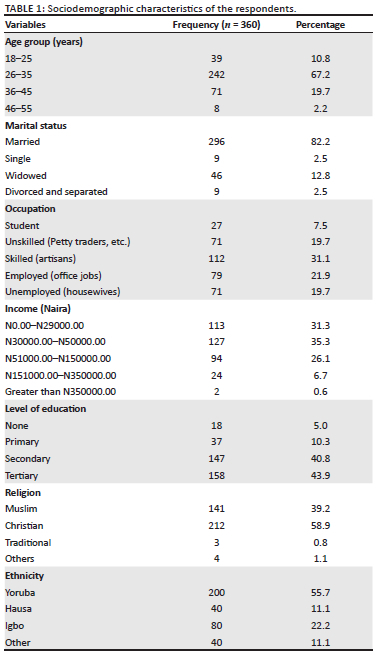
The mean age of the respondents were 32 ± 5.5 years and 242 (67.2%) of them were within the age group of 26 and 35 years. A total of 296 (82.2%) were married, 112 (31.1%) were skilled (artisans), while 27 (7.5%) were students. Almost half 158 (43.9%) of the respondents had tertiary education and 127 (35.3%) had monthly income of N 30000.00 (Nigerian Naira) and N50000.00 ($73.00 and $121.00) at N411.00/$1.00. The predominant ethnic group was Yoruba (n = 200, 55.6%). Most of the respondents were Christians 212 (58.9%), and 141 (39.2%) were Muslims (Table 1).
Knowledge about diarrhoea
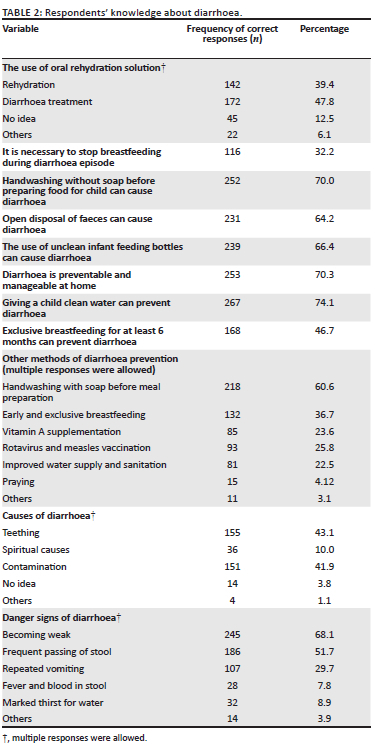
Table 2 shows that less than half (n = 145, 47.8%) knew that ORS is used to treat diarrhoea while 116 (32.2%) knew that it is not necessary to stop breastfeeding during diarrhoea episodes. More than half 252 (70.0%) knew that handwashing without soap, before preparing meals for a child can cause diarrhoea, while 231 (64.2%) knew that open dumping of faeces can cause diarrhoea. A total of 239 (66.40%) and 118 (55.2%) knew that using unclean feeding bottles for a child and contaminated food or water, respectively, can cause diarrhoea; 253 (70.3%) knew that diarrhoea is preventable and manageable at home. More than half 154 (43.0%) of the respondents attributed teething as the cause of diarrhoea while 245 (68.1%) knew that becoming weak was one of the danger signs of diarrhoea.
Overall knowledge towards prevention and home management of diarrhoea
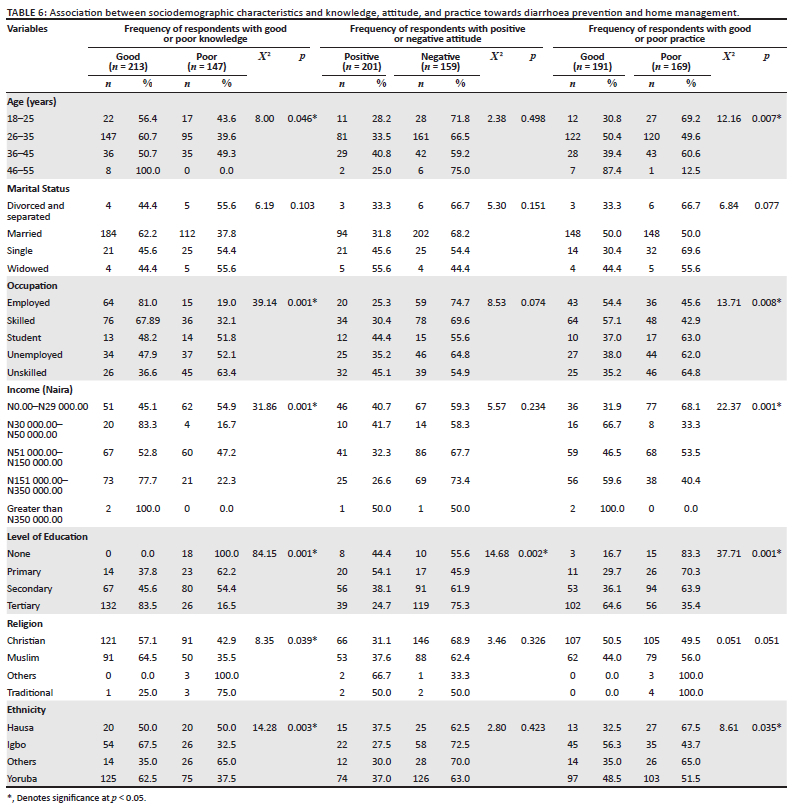
Overall, 213 (59.2%) had good knowledge while 147 (40.8%) had poor knowledge about diarrhoea.
Attitude towards Diarrhoea
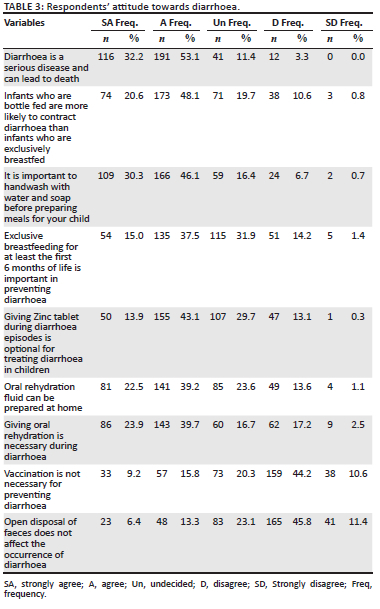
A total of 307 (85.3%) agreed that diarrhoea is a serious disease that can lead to death, 247 (68.6%) agreed that it is important to handwash before preparing meals for their children, while 275 (76.40%) agreed that exclusive breastfeeding for at least the first 6 months of life is important in preventing diarrhoea. About half 189 (52.5%) wrongly agreed that giving zinc tablet during diarrhoea episodes is optional for treating diarrhoea, 222 (61.7%) agreed that ORS can be prepared at home, while 229 (63.6%) agreed that giving ORS is necessary during diarrhoea. More than half 197 (54.7%) rightly disagreed to the statement, that vaccination is not necessary for preventing diarrhoea; 206 (57.2%) rightly disagreed to the statement that, open disposal of faeces does not affect the occurrence of diarrhoea (Table 3).
Overall attitude towards prevention and home management of diarrhoea
Overall, 201 (55.8%) had positive attitude, while 159 (44.2%) had negative attitude towards diarrhoea.
Preventive practices against diarrhoea in children under five
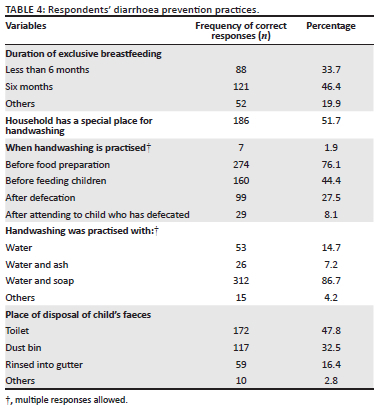
A total of 261 (72.50%) practised exclusive breastfeeding. However only 104 (28.90%) breastfed exclusively for up to 6 months. More than half 186 (51.7%) had a special place for handwashing and 274 (76.1%) washed their hands before preparing food. Most 312 (86.7%) washed their hands with soap and water, while 53 (14.7%) washed their hands with water only. Less than half 172 (47.8%) disposed their child's faeces in the toilet, 117 (32.5%) disposed child's faeces in the dustbin outside their houses, while 59 (16.40%) simply rinsed faeces into the gutter while washing (Table 4).
Home management practices for the diarrhoea
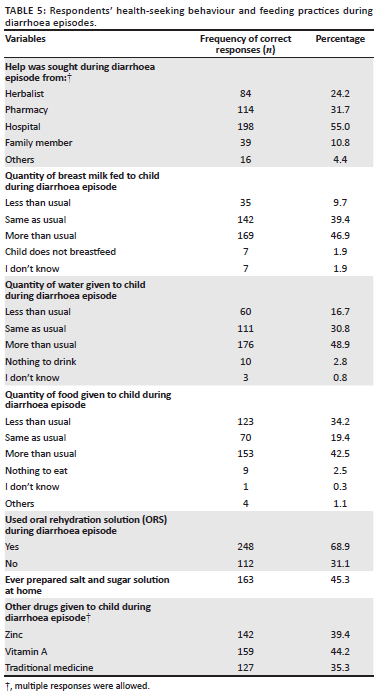
The health-seeking behaviour and feeding practices of respondents about their children, 198 (55.0%) sought help from the hospital, while 114 (31.7%), 84 (24.2%) and 39 (10.9%) sought help from the pharmacy, traditional medicine sellers and a family member, respectively (Table 5). Less than half 169 (46.9%) gave more breast milk than usual during diarrhoea, 142 (39.4%) gave the same amount of breast milk, while 35 (9.7%) gave less milk than usual. Almost half 176 (48.9%) gave more water than usual during diarrhoea, 111 (30.83%) gave same water as usual, while 60 (16.7%) gave less water than usual. Less than half 153 (42.5%) gave more food than usual during diarrhoea, while 123 (34.2%) gave less food than usual during diarrhoea episodes. Less than half 163 (45.3) had ever prepared salt and sugar solution before the study. More than half 248 (68.90%) had given ORS to their children; 142 (39.4%) also gave zinc; 159 (44.2%) also gave vitamin A; and 127 (35.3%) gave traditional or herbal medicine.
Overall practice towards prevention and home management of diarrhoea
Overall, 191 (53.1%) had good practice, while 169 (46.9%) had poor practice towards diarrhoea prevention and home management.
Factors Associated with Knowledge, Attitude, and Practice towards Diarrhoea Prevention and Home Management
There was statistically significant association between knowledge and all sociodemographic characteristics excluding marital status. There was a statistically significant association between attitude and level of education (χ2p = 0.002). There was also statistically significant association between practice and age (χ2p = 0.007), occupation (χ2p = 0.008), income (χ2p = 0.001), level of education (χ2p = 0.001), and ethnicity (χ2p = 0.035) (Table 6).
Multivariate analysis
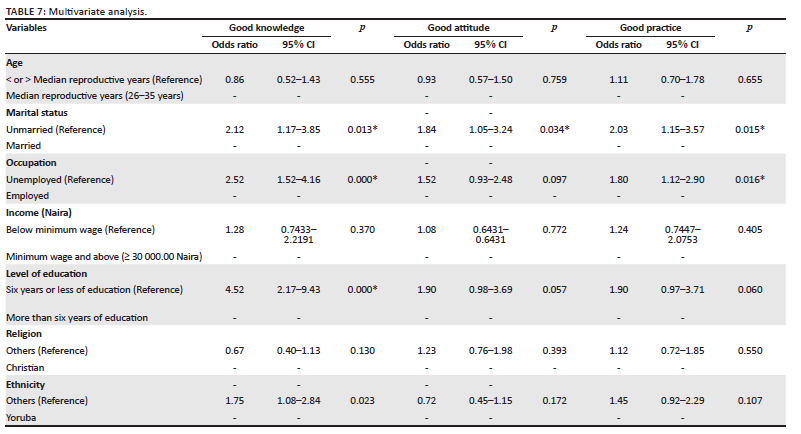
Mothers who had more than six years of education, who were employed and those who were married (odds ratio [OR] = 4.52, p = 0.000), (OR= 2.52, p = 0.000), (OR = 2.12, p = 0.013), respectively, were more likely to have good knowledge about diarrhoea, than mothers who had six years of education or less, who were unemployed or unmarried.
Mothers who were married were 1.8 times more likely to have positive attitude towards diarrhoea, than mother who were unmarried (OR = 1.84, p = 0.034).
Respondents who had more than six years of education were 1.9 times more likely to have good practice towards diarrhoea than respondents who had less than six years of education.
Also, mothers who were married and those who were employed (OR = 2.03, p = 0.015), (OR = 1.80, p = 0.016), were more likely to have good practice towards diarrhoea prevention and home management than mothers who were unmarried or unemployed (Table 7).
Discussion
All respondents in this study fell within reproductive ages of 18 to 55 years. More married mothers than unmarried mothers took part in the study. This may be because married women are usually more willing to bear children than women who are not married. A higher proportion of participants were low-income earners with secondary and tertiary education. This is similar to the study done in Uyo.19
Oral rehydration solution is one of the most important medical advances of the 20th century and the cornerstone of fluid replacement.202020212223
Handwashing with soap can reduce the occurrence of diarrhoeal disease, especially when carried out at critical moments, such as after using the toilet, after cleaning a child's bottom and before handling food.2124,25,26,27 Soap is effective in breaking down grease and dirt that carry germs and disease-causing pathogens. Using soap also lengthens the amount of time spent washing hands, compared to using water alone.24,25 Seventy percent of the respondents knew that handwashing without soap before preparing meals for a child can cause diarrhoea. Attitude wise 46% of respondents agreed that it is important to wash hands with water and soap before meals. And as regards practice, 51% had a special place for handwashing in their houses, 76% washed their hands before food preparation, and more than 86% washed their hands with soap and water. This result is similar to a study conducted in Sudan2829
Exclusive breastfeeding is defined as no other food or drink, not even water, except breast milk (including milk from a milk bank or wet nurse) for the first six months of life, but allows the infant to receive ORS, drops and syrups (vitamins, minerals and medicines).202930
In this study, 24% sought help from traditional healers while 55% sought help from the hospital during diarrhoea episodes. Some sought help from both hospitals and herbalists. This is more than a study carried out in Ibadan2131
Good feeding practices with appropriate fluids such as salt and sugar solutions, soups and weaning foods that are readily available at home can prevent dehydration and replace electrolytes that are lost during diarrhoea episodes.53233
In this study there was statistically significant association between practice and age, occupation, income, level of education, and ethnicity. Further analysis revealed that respondents who had more than six years of education were 1.9 times more likely to have good practice towards diarrhoea than respondents who had less than six years of education. Also, mothers who were married and those who were employed were more likely to have good practice towards diarrhoea prevention and home management than mothers who were unmarried or unemployed. This is similar to a study conducted in Ethiopia18
The study can be used as a baseline for other studies. There are few studies on home management of diarrhoea from the same study in the study area. Firstly, it can also be a blueprint to conduct an interventional study in the particular area. Secondly, the design was community-based descriptive cross-sectional study where probability sampling was used. One of the limitations of this study design is that the establishment of a temporal relationship between the exposure and outcome variables are impossible. Thirdly, the study area was chosen through convenience sampling as a result of time constraint.
Female education should be encouraged, because it can improve the understanding of mothers, on how to prevent and manage diarrhoea, thereby reducing the fatality of diarrhoea in children. Secondly, female empowerment should be prioritised because they are the primary care givers in a family. Women should be encouraged to get jobs and earn an income. Women who are empowered are better placed to make decisions that lead to better outcomes for their children. Finally, male involvement and support should be encouraged. Men who are involved and supportive of their wives are more likely to take better care of their children during diarrhoea episodes.
Conclusion
A woman's health behaviour has an immediate impact on the health of her family. Therefore, a woman's health literacy is a crucial factor in determining her ability to adopt proper health promotion and preventive behaviours both for herself and her children.34
The study shows that knowledge, attitude and practice of respondents were above average. However, there were still specific poor practices such as not giving ORS during diarrhoea episodes, seeking help and advice from herbalists instead of a hospital, not washing hands with soap and water after cleaning a child who defecated, or before preparing food for the child, and giving less food and fluid than usual during diarrhoea episodes.
Mothers who had over six years of education, who were employed, or married were more likely to have good prevention and home management practices regarding diarrhoea than mothers who had six years or less of education, who were unemployed or unmarried.
Competing interests
The authors declare that they have no financial or personal relationship that may have inappropriately influenced them in writing this article.
Authors' contributions
M.F.E., O.E.O., A.A.A., E.O.O., A.A.R., O.O.A. and A.T.O. contributed to the design and implementation of the research, to the analysis of the results, and to the writing of the manuscript.
Funding information
This research received no specific grant from any funding agency in the public, commercial or not-for-profit sectors.
Data availability
The data sets generated and analysed during the study are available from the corresponding author, A.A.A., upon reasonable request.
Disclaimer
The views and opinions expressed in this article are those of the authors and do not reflect the official position of any affiliated agency of the authors.
Acknowledgements
The authors would like to acknowledge the Department of Community Health and Primary Care, College of Medicine, University of Lagos, Nigeria for facilitating the programme for this project. The author's sincere gratitude goes to this project supervisors for their expert guidance, supervision, and mentorship throughout this project. The authors are grateful to the Network on Behavioural Research for Child Survival (NETBRECSIN) for their technical support, corrections and immense contribution to the study. Finally, the authors would like to acknowledge the participants of the study for their cooperation.
References
-
1. WHO. Diarrhoea fact sheet [homepage on the Internet]. 2017 [cited 2019 Jun 01]. Available from: https://www.who.int/news-room/fact-sheets/detail/diarrhoel-disease
» https://www.who.int/news-room/fact-sheets/detail/diarrhoel-disease -
2. UNICEF DATA. Diarrhoea [homepage on the Internet]. 2018 [cited 2019 Apr 30]. Available from: https://data.unicef.org/topic/child-health/diarrhoeal-disease/
» https://data.unicef.org/topic/child-health/diarrhoeal-disease/ -
3. Christa L, Fischer W, Jamie P, Martin JA, Cynthia BP, Robert EB. Diarrhoea incidence in low- and middle-income countries in 1990 and 2010: A systematic review. BMC Public Health. 2012;12(220):1479-2458. https://doi.org/10.1186/1471-2458-12-220
» https://doi.org/10.1186/1471-2458-12-220 -
4. Peter AK, Umar U. Combating diarrhoea in Nigeria: The way forward. J Microbiol Exp. 2018;6(4):191-197. https://doi.org/10.15406/jmen.2018.06.00213
» https://doi.org/10.15406/jmen.2018.06.00213 -
5. Hailemariam MW, Abdilahi SS, Esubalew MA. Mothers' knowledge, attitude and practice towards the prevention and home-based management of diarrhoea among under-five children in Diredawa, Eastern Ethiopia. BMC Pediatr. 2018;18(1):358. https://doi.org/10.1186/s12887-018-1321-6
» https://doi.org/10.1186/s12887-018-1321-6 -
6. CDC. Global Diarrhoea Burden [homepage on the Internet]. [cited 2019 Jun 02]. Available from: https://www.cdc.gov/healthywater/global/diarrhoea-burden.html
» https://www.cdc.gov/healthywater/global/diarrhoea-burden.html -
7. Nigeria demographic and health survey 2013 [homepage on the Internet]. [cited 2019 Apr 29]. Available from: https://dhsprogram.com/pubs/pdf/FR293/FR293.pdf
» https://dhsprogram.com/pubs/pdf/FR293/FR293.pdf -
8. Nigerian Demographic health survey [homepage on the Internet]. 2018 [cited 2019 Apr 30]. Available from: https://dhsprogram.com/pubs/pdf/PR118/PR118.pdf
» https://dhsprogram.com/pubs/pdf/PR118/PR118.pdf -
9. Ajoke OA, Solayide AA, Mary Theresa N, Akitoye OC. Cholera in Nigeria, an overview. Pan Afr Med J. 2012;(12):59. https://doi.org/10.4103/1596-3519.108243
» https://doi.org/10.4103/1596-3519.108243 - 10. Gyou SK. Cholera epidemics in Nigeria: An indictment of the shameful neglect of government. Afr Health. 2011;33(1):5.
- 11. Molbak K. The epidemiology of diarrhoeas in early childhood: A review of community studies in Guinea-Bissau. Dan Med Bull. 2000;47(5):340-358.
- 12. Patwari AK. Diarrhoea and malnutrition interaction. Indian J Pediatr. 1999;66(1 Suppl):S124-S134.
-
13. ABOUT-KOSOFE [homepage on the Internet]. 2017 [cited 2019 Apr 30]. Available from: http://kosofelocalgovtarea.blogspot.com/2017/09/about-kosofe.html
» http://kosofelocalgovtarea.blogspot.com/2017/09/about-kosofe.html -
14. National Bureau of Statistics. 2011 Annual abstract of statistics. Federal republic of Nigeria [homepage on the Internet]. [cited 2019 Jun 02]. Available from: http://istmat.info/files/uploads/53129/annual_abstract_of_statistics_2011.pdf
» http://istmat.info/files/uploads/53129/annual_abstract_of_statistics_2011.pdf -
15. Abstract of Lagos State statistics [homepage on the Internet]. [cited 2019 May 30]. Available from: https://mepb.lagosstate.gov.ng/wp-content/uploads/sites/29/2018/06/Abstract-of-LG-Statistics-2017editted.pdf
» https://mepb.lagosstate.gov.ng/wp-content/uploads/sites/29/2018/06/Abstract-of-LG-Statistics-2017editted.pdf -
16. Molbak K, Jensen H, Ingholt L, Risk factors for diarrhoea incidence in early childhood: A community cohort study from Guinea-Bissau. Am J Epidemiol. 1997;146(3):273-282. https://doi.org/10.1093/oxfordjournals.aje.a009263
» https://doi.org/10.1093/oxfordjournals.aje.a009263 -
17. Mengistie B, Berhane Y, Worku A. Prevalence of diarrhea and associated risk factor among children under five years of age in eastern Ethiopia. Open J Med. 2013:3(7):446. https://doi.org/10.4236/ojpm.2013.37060
» https://doi.org/10.4236/ojpm.2013.37060 -
18. Bogale KD, Nega TA, Tesfaye DA. Knowledge, practice, and associated factors of home-based management of diarrhea among caregivers of children attending under-five clinic in Fagita Lekoma District, Awi Zone, Amhara Regional State, Northwest Ethiopia. Nurs Res Pract. 2017;91(3):555-562. https://doi.org/10.1155/2017/8084548
» https://doi.org/10.1155/2017/8084548 -
19. Mkpouto UA. Knowledge and home management of diarrhoeal disease among mothers with under-five children attending university of Uyo teaching hospital, Nigeria. IJOPR. 2018;5(4):162-168. https://doi.org/10.17511/ijpr.2018.i04.02
» https://doi.org/10.17511/ijpr.2018.i04.02 -
20. UNICEF. National Nutrition and Health Survey (NNHS). Report on the Nutrition and Health Situation of Nigeria 2018 [homepage on the Internet]. [cited 2019 Sept 30]. Available from: https://www.unicef.org/nigeria/reports/national-nutrition-and-health-survey-nnhs-2018
» https://www.unicef.org/nigeria/reports/national-nutrition-and-health-survey-nnhs-2018 -
21. Olubunmi OO, Bolaji E. Awareness and knowledge of diarrhoeal home management among mothers of underfive in Ibadan, Nigeria. Univers J Public Health. 2017;5(1):40-45. https://doi.org/10.13189/ujph.2017.050106
» https://doi.org/10.13189/ujph.2017.050106 -
22. Melese DA, Liknaw BZ, Yonas LO, Yohannes MA. Diarrhea prevention practice and≈associated factors among caregivers of under-five children in Enemay District, Northwest Ethiopia. J Environ Public Health. 2019;2019:8. https://doi.org/10.1155/2019/5490716
» https://doi.org/10.1155/2019/5490716 - 23. Zainab SS, Kazi EH, Bello MA. Mothers' knowledge practices in home management of childhood diarrhea in kano state: A cross sectional study. MRER. 2018;12(2):196-219.
-
24. UNICEF. Launch of hand washing campaign in Abuja [homepage on the Internet]. 2010 [cited 2019 Jun 02]. Available from: http://www.sciepub.com/reference/142949
» http://www.sciepub.com/reference/142949 -
25. Rehydrate project [homepage on the Internet]. 2019 [cited 2019 Sept 25]. Available from: https://rehydrate.org/diarrhoea/
» https://rehydrate.org/diarrhoea/ - 26. UNICEF, WHO. Diarrhea: Why children are still dying and what can be done. Geneva: WHO; 2009.
-
27. Encyclopedia of Children health [homepage of the Internet]. 2019 [cited 2019 Sept 25]. Available from: http://www.healthofchildren.com/D/Diarrhea.html#ixzz5ycv6gBzS
» http://www.healthofchildren.com/D/Diarrhea.html#ixzz5ycv6gBzS - 28. Panom PDK, Ying-Chun D. Mothers knowledge attitude and practice on preventing diarrhoea in Juba, South Sudan. S Sudan Med J. 2018;11:60-64.
- 29. Suganya V, Bibitha B, Revathi D, Ramya K, Indira S, Naveen KMR. Knowledge on home management of diarrhoea among mothers of under five children. Int J Appl Res. 2017;3(5):376-380.
- 30. Ogbeyi GO, Onyemocho A, Ogbonna C. Assessment of caregivers knowledge of diarrhoea and practice of home management of diarrhoea disease among under two children in Opialu, a rural community in Benue State, Nigeria. Glob J Med Public Health. 2016;5:3-13.
-
31. Ozioma EJ, Nwamaka Chinwe OA. Herbal medicines in African traditional medicine. In: Builders PF, editor. Herbal Medicine. London: IntechOpen; 2019. https://doi.org/10.5772/intechopen.80348
» https://doi.org/10.5772/intechopen.80348 -
32. Okunribido OO, Brirger WR, Omotade OO, Adeyemo AA. Cultural perceptions of diarrhoea and illness management choices among Yoruba mothers in Oyo state, Nigeria. Int Q Community Health Educ. 1997;17(3):309-318. https://doi.org/10.2190/W07W-B4FX-TEX7-WC3K
» https://doi.org/10.2190/W07W-B4FX-TEX7-WC3K -
33. Pantenburg B, Ochoa TJ, Ecker L, Ruiz J. Feeding of young children during diarrhea: Caregivers' intended practices and perceptions. Am J Trop Med Hyg. 2014;91(3):555-562. https://doi.org/10.4269/ajtmh.13-0235
» https://doi.org/10.4269/ajtmh.13-0235 -
34. Lee SD, Tsai T, Tsai Y, Kuo KN. Health literacy and women's health-related behaviors in Taiwan. Health Educ Behav. 2012;39(2):210-218. https://doi.org/10.1177/1090198111413126
» https://doi.org/10.1177/1090198111413126
Accepted: 20 Jan. 2022
Published: 27 May 2022