From dreamers to doers: Navigating the doctoral journey in family medicine and primary care
Abstract
This article examines the transformative journey of pursuing a Doctor of Philosophy (PhD) in family medicine and primary care through the lived experiences of four African scholar-practitioners. Using the Hero's Journey framework, the authors reflect on the emotional, intellectual and structural aspects of doctoral education, highlighting the unique challenges faced by clinician-researchers in resource-limited settings. Each vignette illustrates the transition from dreaming to doing by navigating identity shifts, funding obstacles, methodological complexities, as well as the need to balance clinical service with academic development. The article offers practical insights for prospective doctoral degree candidates, including the importance of defining one's purpose, building supportive networks, and adopting adaptable strategies. It also calls for institutional reforms to enhance supervisory capacity and funding mechanisms. By merging personal narratives with reflective analysis, the authors aim to inspire and equip future doctoral candidates in family medicine and primary care, encouraging them to view their journey not just as an academic endeavour but as a pathway to leadership, thereby strengthening the discipline's knowledge foundation and enhancing primary care. This contribution serves as a guide for moving from aspiration to action, offering practical wisdom for navigating the complexities of doctoral education in African primary care contexts.
PhD journey; primary care research; doctoral experiences; education; graduate; primary health care; Hero's Journey; African PhD graduates
Introduction
Despite the growing need for established researchers, especially in sub-Saharan Africa, which contributes only 1% of global research output, the doctoral journey remains daunting for many.12,3
High attrition rates and emotional strain discourage potential candidates, even as institutions hope that students will find the process fulfilling. A significant number of doctoral students, in some cases as high as 70%, never complete their degrees.4567
The evolving role of family medicine and primary care in healthcare systems underscores the growing importance of developing researchers and academic leaders in the discipline. Family medicine PhD students often occupy unique positions as clinicians, educators and researchers. Despite their increasing presence, there is a limited body of literature capturing the lived experiences of family medicine PhD students. Generic guides, such as Brennan's '100 Rules of PhD', offer useful advice but often lack the lived experience and contextual nuance needed to support students.8
Why this guide matters
This article aims to provide a reflective, supportive and practical guide for navigating the PhD journey, drawing on the authors' lived experiences. It seeks to normalise the highs and lows of the PhD experience while inspiring and equipping future candidates and guiding supervisors. We would like to remind readers that embracing the complexity of family medicine doctoral journeys differs from those in other disciplines and even within the same discipline (e.g. dual clinical-academic roles, decentralised and rural settings and a low supply of experienced doctoral-level supervisors).9African Journal of Primary Health Care & Family Medicine (PHCFM) special collection with a specific audience in mind: those colleagues who are dreaming of pursuing a PhD and would now like to find out how best to transition from dreaming to doing.
Introducing the approach to unpacking our stories
To support prospective African PhD candidates in family medicine and primary care, we adopted a reflective narrative approach based on the Hero's Journey Framework, as conceptualised by Joseph Campbell and applied to doctoral education by Salter.10,11
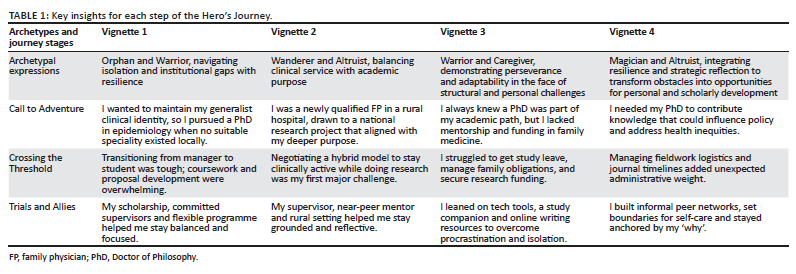
To bring these archetypes to life, we share four personal vignettes (Box 1 - Box 4), each structured around the early stages of the Hero's Journey: the Call to Adventure (beginning the PhD); Crossing the Threshold (major challenge); and Trials and Allies (supervisors, peers and tools). These stories reveal how identity, purpose and resilience evolve through the doctoral process.
The stages of the PhD journey
The narrative arc outlined in our vignettes emphasises the PhD as a transformative journey rather than a simple academic task.15,16
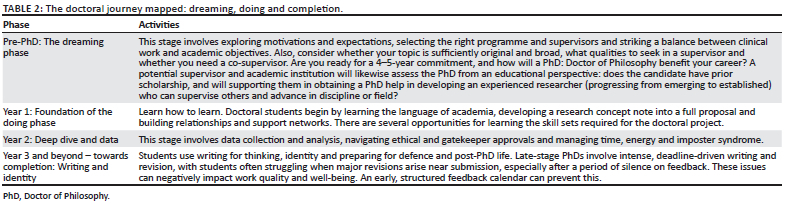
Table 1 summarises the key insights from the authors' journeys, aligned with the archetypes and early stages of the Hero's Journey. Table 2 represents general stages or phases of a PhD, ranging from dreaming to doing to completing.
Practical tips for success
We reflected on key tips (summarised in Box 5) that we would have offered our younger selves as we approached the threshold of commencing our PhD journey. Successfully navigating the PhD journey starts with understanding your core motivation. Even if your 'why' is not immediately clear, remaining receptive to discovering it is essential. Think of defining your rhumb line - a steady, guiding purpose that helps you stay grounded, especially when clinical work complements your research. A hybrid approach to balancing your 'day job' and PhD project work can help maintain continuity and focus. These include using the early morning slot, writing and working before usual hours, taking leave for dedicated writing and working or buying out time and splitting the week between part-time clinical and research work. Establishing healthy boundaries and practising self-compassion are essential for well-being.17

Persistent challenges in many doctoral programmes include inconsistent funding disbursement and delays in supervisory feedback, which can lead to financial insecurity, slow progress and psychological stress. Students should pursue scholarships, grants and institutional aid to address funding issues. Clear communication and alignment through Memoranda of Understanding (MOUs) can ease supervisory pressures. Institutions should consider mechanisms to streamline scholarship payments, ensure timely supervisor feedback and build supervisory capacity at the doctoral level.
Remember, progress is rarely linear; pace, milestones and planning are essential. Globally, there is a trend towards a more structured and collaborative approach to doctoral education.18organisation, such as setting milestone goals and using digital tools to monitor progress. Managing time effectively involves prioritising high-impact tasks using techniques such as compiling writing blocks and scheduled breaks, following the Pomodoro technique, a reliable and sustainable method developed in the 1980s.19
Academic growth is supported by attending coursework (if offered), academic meetings and conferences, engaging in critical reading and maintaining a research journal. Writing is often viewed as a source of negative emotions, such as frustration and confusion, which frequently dominate the doctoral writing experience. Collaborative writing enhances self-regulation, motivation, emotional well-being, writing quality and completion rates. The doctoral reading process is closely linked to effective writing. Academic and professional identity is formed through activities such as writing and attending academic meetings and conferences. The lack of curriculated support, such as coursework or departmental seminars, has been linked to South Africa's high doctoral dropout rates.1817
Building support networks and selecting the right allies - such as supervisors, peers and mentors - is vital. International trends favour more structured, collaborative doctoral methods, which may boost success.
Conclusion: From dreamers to doers
Reflecting on our journeys, we offer lived insights to those contemplating a PhD, guiding them from dreaming to doing and to embarking on their own Hero's Journey. In terms of reflexivity, we acknowledge the diversity of our backgrounds, disciplines and contexts. We are three male and one female scholar-practitioners, with varied timelines of PhD completion and professional trajectories across African academic and clinical settings. Our lived experiences shape our reflections on navigating our doctoral work while balancing service, teaching and personal commitments. We recognise that our positionality - as insiders within the discipline and as recent graduates - offers both proximity and hindsight. This dual lens enables us to speak candidly to the emotional, intellectual and structural dimensions of the PhD journey. By applying the Hero's Journey Framework, we seek to honour the transformative essence of doctoral education while recognising the challenges and enabling factors that have shaped our paths. We strive to provide prospective candidates with a grounded, empathetic and contextually relevant guide, rooted in both collective wisdom and individual experience. While our insider perspectives offer depth, we acknowledge that our specific contexts shape our reflections and may not represent all doctoral experiences in Africa. In line with previous regional-level discussions, we propose forming a scholarly core of emerging and established researchers at departmental, national and regional levels to help strengthen the discipline of family medicine and raise its profile.20
A PhD journey is a challenging process, with each step a possible cause of anxiety - from uncertain beginnings to integrating work and discoveries. Despite the difficulties, it is a rewarding experience that makes a significant contribution to society and one's disciplinary knowledge base. We hope this reflective essay inspires prospective candidates to begin their journey with confidence, clarity and a sense of community. Future candidates should see themselves not just as students, but as future leaders in family medicine and primary care.
The authors of this publication received research funding from the National Institute for Health and Care Research (NIHR) (Grant Number: NIHR158451) under the project 'Improving the core functions of primary care in sub-Saharan Africa'. The terms of this arrangement have been reviewed and approved by the NIHR in accordance with its policy on objectivity in research. The author, I.K.B., serves as an editorial board member of this journal.
K.B.v.P. led the conceptualisation, design and drafting of the manuscript. K.B.v.P., M.M., A.T.L. and I.K.B. provided intellectual input and critical revisions.
This work was supported by the NIHR (Grant Number: NIHR158451) under the project 'Improving the core functions of primary care in sub-Saharan Africa'.
The views and opinions expressed in this article are those of the authors and are the product of professional research. They do not necessarily reflect the official policy or position of any affiliated institution, funder, agency or that of the publisher. The authors are responsible for this article's results, findings and content.
References
-
1. Mash RJ, Von Pressentin K. Family practice research in the African region 2020-2022. Afr J Prim Health Care Fam Med. 2024;16(1):8. https://doi.org/10.4102/phcfm.v16i1.4329
» https://doi.org/10.4102/phcfm.v16i1.4329 -
2. CHE. The Higher Education Qualifications Sub-Framework (HEQSF) [homepage on the Internet]. Pretoria: Council on Higher Education (CHE); 2013 [cited n.d.]. Available from: https://www.che.ac.za/sites/default/files/inline-files/PUB_Higher%20Education%20Qualifications%20Sub-Framework%20%28HEQSF%29%202013.pdf
» https://www.che.ac.za/sites/default/files/inline-files/PUB_Higher%20Education%20Qualifications%20Sub-Framework%20%28HEQSF%29%202013.pdf - 3. Inter-University Council for East Africa. Standards and guidelines for postgraduate studies in Inter-University Council for East Africa. Kampala: Inter-University Council for East Africa; 2018.
-
4. Jones M, editor. Issues in doctoral studies-forty years of journal discussion: Where have we been and where are we going? Proceedings of the Informing Science and Information Technology Education Conference; 2013 Jun 30 - Jul 06; Porto, Portugal. Informing Science and Information Technology Education (InSITE); 2013. https://doi.org/10.28945/1871
» https://doi.org/10.28945/1871 -
5. Castelló M, Pardo M, Sala-Bubaré A, Suñé-Soler N. Why do students consider dropping out of doctoral degrees? Institutional and personal factors. Higher Educ. 2017;74(6):1053-1068. https://doi.org/10.1007/s10734-016-0106-9
» https://doi.org/10.1007/s10734-016-0106-9 -
6. Omoya O, Jacob US, Odeyemi OA, Odeyemi OA. Exploring perspectives: A scoping review of the challenges facing doctoral training in Africa. Higher Educ. 2025;89(4):1103-1127. https://doi.org/10.1007/s10734-024-01264-4
» https://doi.org/10.1007/s10734-024-01264-4 -
7. Van Rooij E, Fokkens-Bruinsma M, Jansen E. Factors that influence PhD candidates' success: The importance of PhD project characteristics. Stud Contin Educ. 2021;43(1):48-67. https://doi.org/10.1080/0158037X.2019.1652158
» https://doi.org/10.1080/0158037X.2019.1652158 -
8. Brennan NM. 100 PhD rules of the game to successfully complete a doctoral dissertation. Account Audit Account J. 2019;32(1):364-376. https://doi.org/10.1108/AAAJ-01-2019-030
» https://doi.org/10.1108/AAAJ-01-2019-030 -
9. Von Pressentin KB. Embracing complexity in primary care. S Afr Fam Pract. 2022;64(2): 5519. https://doi.org/10.4102/safp.v64i1.5519
» https://doi.org/10.4102/safp.v64i1.5519 -
10. Salter DW. An archetypal analysis of doctoral education as a heroic journey. Int J Doct Stud. 2019;14:525. https://doi.org/10.28945/4408
» https://doi.org/10.28945/4408 -
11. Taylor WN. Comparative analytic autoethnography: Situating the doctoral journey and the Hero's Journey. Qualit Rep. 2024;29(6):1565-1583. https://doi.org/10.46743/2160-3715/2024.6660
» https://doi.org/10.46743/2160-3715/2024.6660 - 12. Brooks AC. The happiness files: Insights on work and life. Boston: Harvard Business Review Press, 2025; 272p.
-
13. Gray-Grant D. Publication coach [homepage on the Internet]. 2025 [cited 2025 Aug 28]. Available from: https://www.publicationcoach.com/
» https://www.publicationcoach.com/ -
14. Oakley B. Learning how to learn: Powerful mental tools to help you master tough subjects [homepage on the Internet]. Coursera; 2025 [cited 2025 Aug 28]. Available from: https://www.coursera.org/learn/learning-how-to-learn
» https://www.coursera.org/learn/learning-how-to-learn -
15. Batty C, Ellison E, Owens A, Brien D. Mapping the emotional journey of the doctoral 'hero': Challenges faced and breakthroughs made by creative arts and humanities candidates. Arts Hum Higher Educ. 2020;19(4):354-376. https://doi.org/10.1177/1474022219844986
» https://doi.org/10.1177/1474022219844986 - 16. Castle J. I had no time to bleed: Heroic journeys of PhD students in a South African school of education. J Educ. 2013;57:103-125.
-
17. Sverdlik A, Hall NC, McAlpine L, Hubbard K. The PhD experience: A review of the factors influencing doctoral students' completion, achievement, and well-being. Int J Doct Stud. 2018;13:361-388. https://doi.org/10.28945/4113
» https://doi.org/10.28945/4113 -
18. McKenna S, Van Schalkwyk S. A scoping review of the changing landscape of doctoral education. Compare J Compar Int Educ. 2024;54(6):984-1001. https://doi.org/10.1080/03057925.2023.2168121
» https://doi.org/10.1080/03057925.2023.2168121 - 19. Cirillo F. The Pomodoro technique: The life-changing time-management system. New York, NY: Random House; 2018.
-
20. Von Pressentin KB, Mash R, Ray SC, Fina Lubaki J-P, Besigye IK. Identifying research gaps and priorities for African family medicine and primary health care. Afr J Prim Health Care Fam Med. 2024;16(1): 4534. https://doi.org/10.4102/phcfm.v16i1.4534
» https://doi.org/10.4102/phcfm.v16i1.4534
Accepted: 02 Oct. 2025
Published: 09 Nov. 2025