Electronic cigarettes use in COVID-19 era among students of a tertiary institution in Nigeria
Abstract
BACKGROUND: Electronic cigarette (e-cigarette) use is becoming popular among undergraduate students in Nigeria with a tendency for escalation because of the coronavirus disease 2019 (COVID-19) pandemic AIM: The aim of this study was to assess electronic cigarette use in COVID-19 era among undergraduate students of a tertiary institution in Lagos state, Southwestern Nigeria SETTING: A tertiary institution in Southwestern Nigeria METHODS: The study design was a descriptive cross-sectional study with a pretested, structured, close- and open-ended self-administered questionnaire used for collection of data on knowledge, attitude and use of e-cigarettes RESULTS: Data from 183 respondents were analysed. The mean age of respondents was 24.8 ± 3.38 years, most (63%) of whom were males. The prevalence of ever-use of e-cigarettes was 15.3% of which 60.7% reported increased use of e-cigarettes since the COVID-19 pandemic. Age, education, tribe and religion (p < 0.001) were significantly associated with higher odds of use of e-cigarettes CONCLUSION: This study found an increase in the quantity of e-cigarettes used and online purchase of the same by respondents since the COVID-19 pandemic. Paying attention to the rate of use and having control measures in place for online purchase of e-cigarettes by youths in Nigeria may be necessary in the years to come CONTRIBUTION: This study addresses a gap in the availability of knowledge of use of e-cigarettes among a growing population of youths in Nigeria
use of electronic cigarettes; knowledge of e-cigarettes; COVID-19; e-cigarettes; Nigeria; students
Introduction
In the year 2020, the world experienced a major public health issue after the report of a cluster of cases of atypical pneumonia in Wuhan, China. It was subsequently discovered to be as a result of a contagious viral infection, initially tagged a novel corona virus (2019-nCoV), but thereafter named severe acute respiratory syndrome coronavirus 2 (SARS-CoV-2) by the World Health Organization (WHO).112,3,4
Worldwide, tobacco smoking is a major cause of preventable deaths.56778,9 The vapour may contain nicotine, the active ingredients of marijuana, flavoured propylene glycol, flavoured vegetable glycerin and other flavours (bubble gum and milk chocolate cream), which are likely to be attractive to younger teens.88,10 Electronic non-nicotine devices (ENNDS) on the other hand do not contain nicotine.11
The use of any form of tobacco product, as well as e-cigarettes can be further aggravated when youths are idle, such as the scenario presented by the coronavirus disease 2019 (COVID-19) lockdown, resulting in bulk purchase particularly from online stores.223
Globally, there are approximately 367 million users of smokeless tobacco.1213141214,15,16 This study set out to identify and provide relevant data on e-cigarette use by adolescents and young adults who constitute 31% of the Nigerian population,17
Research methods and design
Study design
The study design was a descriptive cross-sectional study on the knowledge, attitude and use of e-cigarettes among undergraduate students of a tertiary institution in Southwestern Nigeria.
Setting
The institution where the sample was drawn from was established in 1947 as a quick successor to a higher college but attained an autonomous and independent status in 1969. It has nine schools, 46 departments and about 40 academic programmes offered as full time and part time courses. It currently has a population of approximately 20 000 students. Data collection was completed within two weeks in July 2021.
Study population and sampling strategy
Sample size of 178 participants was determined using the Cochran's formula. The level of significance was set at 5% and the prevalence based on a previous study was 12%.5
Data collection tool
Data collection was carried out using a pretested, structured, close- and open-ended self-administered questionnaire. It was validated and prepared from the Youth Tobacco Survey (YTS) 2011 Questionnaire,18
Scoring and grading of knowledge and attitude responses
Each correct response to the knowledge questions scored one mark while incorrect response and no response scored zero. The total score for each respondent was calculated, converted to percentage and graded as poor (< 50%) and good (≥ 50%). The 5-point Likert scale was used to score the attitude responses. Responses to positive attitude statements were scored as follows: (1) strongly agree = 5; (2) agree = 4; (3) indifferent = 3; (4) disagree = 2; (5) strongly disagree = 1, while responses to negative attitude statements were scored as: (1) strongly agree = 1; (2) agree = 2; (3) indifferent = 3; (4) disagree = 4 and (5) strongly disagree = 5. The total attitude score for each respondent was calculated, converted to percentage and graded as poor (≤ 60%) and good (> 60%).
Data analysis
The data obtained from respondents were coded, entered in a computer system in a Microsoft Excel spreadsheet. EPI INFO 7 software was used for data analysis except regression analysis for which IBM SPSS Statistics for Windows, Version 20.0. Armonk, NY: IBM Corp. was used. Descriptive statistics was used to summarise the data. Independent t-test was utilised to determine the differences between continuous quantitative variables. Pearson chi-square test and Fisher Exact test (2-tailed) were used, where applicable to show the association and relationship between categorical variables. Regression analysis was conducted to assess the relationship between statistically significant socio-demographic characteristics and knowledge, attitude and use of e-cigarettes. P-value ≤ 0.05 was considered statistically significant.18
Ethical considerations
Ethical approval from the Health Research Ethics Committee of the Lagos University Teaching Hospital was sought and gotten with approval number ADM/DCST/HREC/APP/4264. The consent of the rector of institution where research was conducted was obtained as well as verbal and written informed consent from the participants. Anonymity was maintained during data collection and analysis.
Results
Sociodemographic characteristics
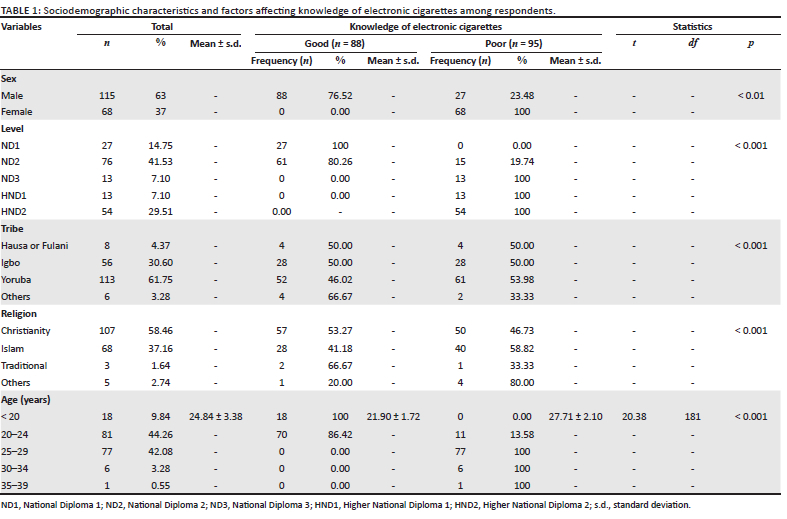
All the administered 183 questionnaires were retrieved and analysed giving a response rate of 100%. The mean age of the respondents was 24.84 ± 3.38 years with majority 81 (44.26%) of the respondents being within the age range of 21-25 years. Sixty three per cent (115) were males while 37% (68) were females. A large number came from the faculty of art, design and printing 59 (32.24%) with most participants in ND2 78 (42.62%) and belonging to the Yoruba tribe 113 (61.75%). The predominant religion among respondents was Christianity 107 (58.47%) and most respondents 102 (55.74%) resided off-campus. Most of the respondents 91 (49.73%) had smoking friends while only three (1.60%) of them had smoking mothers (Table 1).
Knowledge of electronic cigarettes
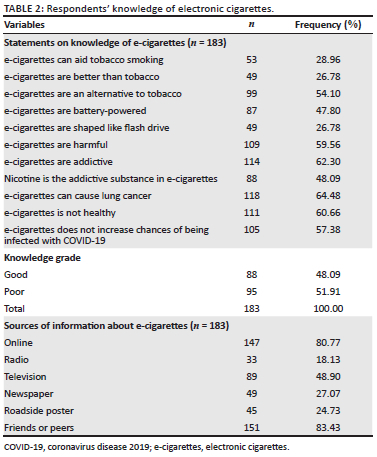
Fifty-three (28.96%) respondents were of the view that e-cigarettes could aid tobacco smoking, 49 (26.78%) respondents were of the view that e-cigarettes were better than tobacco while majority 99 (54.10%) were of the view that they were an alternative to tobacco smoking. Of the respondents, 87 (47.80%) knew that e-cigarettes could be shaped like a flash drive and 109 (59.56%) were of the view that they were harmful. Majority (62.30%) of the respondents were of the view that e-cigarettes were addictive. The opinion that nicotine is the addictive substance in e-cigarette was held by 88 (48.09%) of the respondents with 118 (64.48%) participants who knew that electronic cigarettes could cause lung cancer. A total of 111 respondents (60.66%) thought that e-cigarettes were not healthy while majority 105 (57.38%) of the respondents felt that e-cigarettes were unlikely to increase an individual's chances of contracting COVID-19. A total of 95 (51.91%) of the respondents had overall poor knowledge of e-cigarettes while 88 (48.09%) of the respondents had overall good knowledge of e-cigarettes. The respondents' source of information about e-cigarette was mainly online. However, 151 (83.43%) of the respondents learned about e-cigarettes from friends/peers (Table 2).
There were statistically significant relationships (p < 0.05) between sex, level of education, tribe, religion as well as age and knowledge of e-cigarettes (Table 1).
Attitudes towards electronic cigarettes
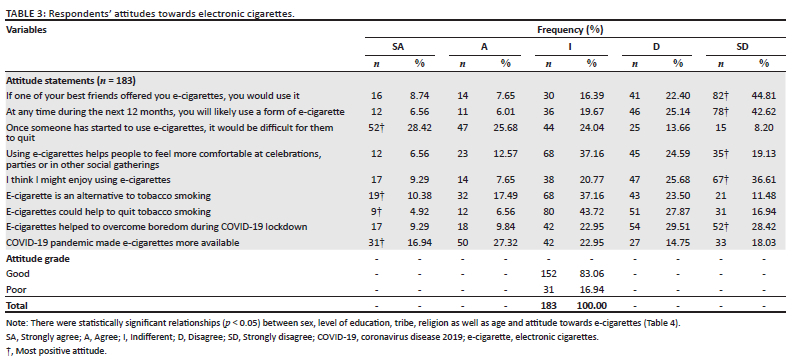
Among the respondents, 82 (44.81%) strongly disagreed that they would use e-cigarettes if offered by one of their best friends, 78 (42.62%) were not likely to use e-cigarettes in any form in the next 12 months. A total of 52 (28.42%) respondents felt that once someone had started to use e-cigarettes, it would be difficult for the person to quit, 35 (19.13%) respondents strongly disagreed with the opinion that using e-cigarettes made people more comfortable at celebrations, parties and other social gatherings. A total of 67 (36.61%) respondents strongly disagreed that they might enjoy using e-cigarettes, 19 (10.38%) strongly agreed that e-cigarette was an alternative to tobacco smoking and nine (4.92%) strongly agreed that e-cigarettes could help to quit tobacco smoking. Fifty-two (28.42%) of the respondents strongly disagreed that e-cigarettes helped to overcome boredom during the COVID-19 lockdown and 31 (16.94%) respondents thought that COVID-19 pandemic increased the accessibility of e-cigarettes. Thirty-one (16.94%) of the respondents had overall poor attitude towards e-cigarettes, while 152 (83.06%) of the respondents had overall good attitude towards e-cigarettes (Table 3).
Use of electronic cigarettes
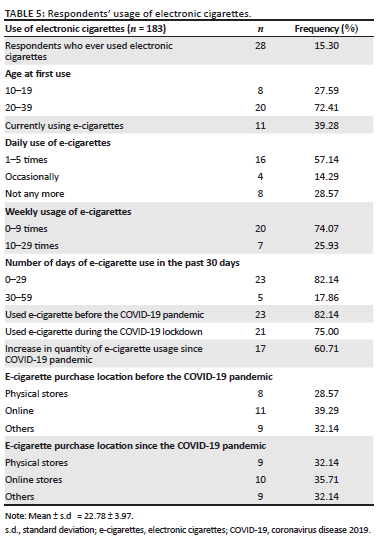
Only 28 (15.30%) of the respondents had ever used e-cigarettes. Among the ever used, 20 (72.41%) were within the age range of 20-39 years. Eleven (39.28%) of the respondents were current users. Most of the respondents who used e-cigarettes 16 (57.14%) used e-cigarettes 1-5 times daily while 20 (74.07%) used e-cigarettes 0-9 times weekly. Majority (82.14%) of the users had used e-cigarettes for 0-29 days within the past 30 days. Most (82.14%) of the respondents used e-cigarettes before the COVID-19 pandemic, while 21 (75%) used e-cigarettes during the lockdown. An increase in the quantity of e-cigarettes used since the COVID-19 pandemic was noticed among majority 17 (60.71%) of the users. The purchase of e-cigarettes was done online by most 11 (39.29%) users before COVID-19 pandemic and 10 (35.71%) of the respondents usually purchased e-cigarettes online since the COVID-19 pandemic (Table 5).
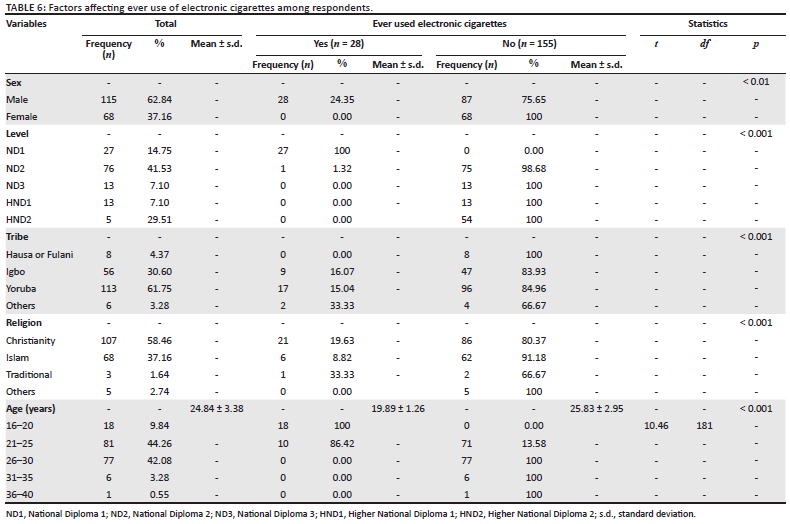
There were statistically significant relationships (p < 0.05) between sex, level of education, tribe, religion as well as age and ever use of e−cigarettes (Table 6).
Determinants of knowledge, attitude and use of electronic cigarettes
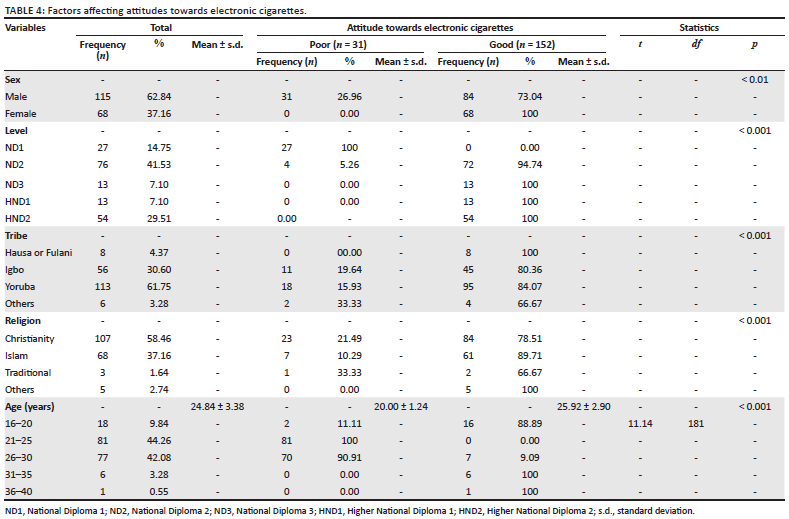
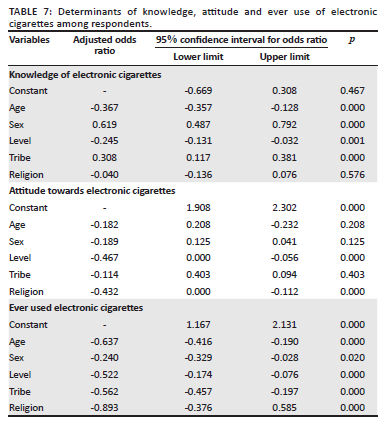
Logistic regression analysis showed that age < 20 years (odds ratio [OR]: −0.37; 95% confidence interval [CI]: −0.36, −0.17; p < 0.01), male sex (OR: 0.62; 95% CI: 0.49,0.80; p < 0.001), National Diploma (ND) 2 education level (OR −0.25; 95% CI: −0.13, −0.03; p < 0.001) and Yoruba tribe (OR: 0.31; 95% CI: 0.11, 0.38; p < 0.001) significantly influenced the knowledge of e-cigarettes (Table 7). The attitude towards e-cigarettes was significantly influenced by ND2 education level (OR: −0.47; 95% CI: 0.00, −0.06; p < 0.001) and religion (OR: −0.43; 95% CI: 0.00, −0.11; p < 0.001) of respondents (Table 7). Furthermore, the use of e-cigarettes was significantly influenced by age < 20 years (OR: −0.64; 95% CI: −0.42, −0.19; p < 0.001), ND1 education level (OR −0.52; 95% CI: −0.17, −0.08; p < 0.001), Yoruba tribe (OR: −0.56; 95% CI: −0.46, −0.20; p < 0.001) and Christianity (OR: −0.89; 95% CI: −0.38, 0.59; p < 0.001) (Table 7).
Discussion
This study was designed to determine the knowledge, attitude and use of e-cigarettes during the COVID-19 era among undergraduate students of a tertiary institution in Nigeria. The respondents were mainly 21-25 years of age (81%). This followed a similar trend to what was reported in a previous study.1920,21 Furthermore, the predominant tribe of respondents was Yoruba. This could be attributable to the study being carried out in Lagos State, which is in the Southwestern part of Nigeria owned by and occupied majorly by the Yoruba tribe who are largely Christians. In addition, most of the respondents had friends who smoked.
In this study, the knowledge of e-cigarettes was assessed using open- and close-ended questions. The knowledge of respondents differed on the various aspects of e-cigarette assessed with most people knowing that e-cigarettes can cause lung cancer. Overall, there was a limited knowledge of e-cigarettes among most of respondents. This is contrary to the findings of studies conducted in the USA, Canada, Great Britain, Australia, China and Rwanda, which found a high level of awareness of e-cigarettes up to 90.1%, 76.6%, 54,%, 73%, 88.4% and 74.9%, respectively, among youths in the population.22,23,24 Although there is paucity of research on e-cigarettes in Nigeria, the findings of this study was higher than that in a previous study in Nigeria where 40% of respondents demonstrated adequate knowledge of e-cigarettes.2552627,28 This can be explained by increased influence of mass media on youths, which was further heightened by the COVID-19 pandemic by keeping people indoors especially during the lockdown, thus increasing the availability.15,16 Numerous brands were identified by respondents with Shisha being the brand with the highest frequency contrary to the findings of another study in Nigeria, which found Hookahs as the common brand known because it is considered safe.25
The assessment of attitude towards e-cigarettes in this study was assessed using a Likert scale with five responses. Overall, most respondents had a positive attitude towards electronic cigarette with an understanding of its risks. As a result of the increasing popularity of e-cigarettes worldwide, many youths have been found to ignore their potential harmful effects according to a study conducted in the United States of America. Therefore, contrary to the findings of this study, more American youths were found to have a negative attitude towards e-cigarettes by perceiving it as harmless and popular.293025253113,32
With respect to availability of e-cigarettes before and during COVID-19 era, this study demonstrates that there was increased availability because of the COVID-19 restrictions relative to what obtained before the COVID-19 era. This finding was unlike that of a study conducted in Indonesia which reported a usual availability of e-cigarettes in physical and online stores.815,16
Few participants reported ever use of e-cigarettes in this study. This is similar to the findings of 15.4% of a Canadian population in a cross-sectional study of those more than 15 years who reported to have ever used e-cigarettes.28333428353625373382
The factors affecting the knowledge, attitude and use of e-cigarettes were assessed based on some selected socio-demographic characteristics which include sex, level, tribe, religion, and age of respondents. Sex was identified in some studies as a factor contributing to knowledge, attitude, and use of e-cigarettes. In this study, more males had good knowledge (100%), better attitude (100%) as well as a higher use (100%) of e-cigarettes. As more males used tobacco and by extension e-cigarettes, they were found to pay more attention to advertisements for e-cigarettes than the female population.242411112438
A regression analysis of determinants of knowledge of e-cigarettes showed statistically significant association with higher age, male sex, Yoruba tribe and higher educational level. Some studies found an association between age and knowledge of e-cigarettes with older adolescents found to possess a better knowledge of e-cigarettes compared with younger adolescents.20,39 A strong association was also found in a study in India with more males having a better knowledge of e-cigarettes than females. A study in China found an association between knowledge of e-cigarettes and level of education with better knowledge among the undergraduates and poor knowledge among the less educated.27,35,39 Furthermore, increased awareness about e-cigarettes was found to be more common in males than females according to a South African study.4024,31,35 The regression analysis for the determinants of use of e-cigarettes found a significant influence of age, education level, tribe and religion of respondents.
Limitations
This study only included students from one tertiary institution hence might not be generalised to the entire student population of other tertiary institutions in Nigeria.
Recommendation
While the potential health effects of electronic cigarette use on COVID-19 appear unclear, adequate implementation of existing policies is important to prevent possible yet undetermined consequences of its use among the young population who are becoming increasingly aware of the product.
Conclusion
This descriptive cross-sectional study to assess the knowledge, attitude, and use of e-cigarettes among undergraduate students of a tertiary institution in Nigeria depicted poor knowledge of e-cigarettes, positive attitudes towards e-cigarettes as well as a low usage of e-cigarettes. The determinants of knowledge, attitude and use of e-cigarettes were found to be mainly younger age (< 20 years), male sex, ND education level, Yoruba tribe and Christian adherents. Numerous brands of e-cigarettes exist and are gradually gaining popularity in the Nigerian market.
The COVID-19 pandemic played a role particularly during the lockdown in influencing the knowledge, attitude and use of e-cigarettes among undergraduate students in Nigeria. There was found to be increased quantity of e-cigarettes use during the lockdown along with increased online purchase by the young population who engaged themselves with their mobile devices during the lockdown. A cohort study would however be needed to establish a direct association of this increased use with COVID-19 pandemic. Statistically significant associations were identified in this study between knowledge, attitude and use of e-cigarettes and the socio-demographic characteristics that were assessed in this study.
Competing interests
The authors declare that they have no financial or personal relationships that may have inappropriately influenced them in writing this article.
Authors' contributions
O.A.O. and A.O.A. designed the work while data collection involved O.A.O. and O.D.O., O.A.O., A.O.A., and O.J.K.-O. carried out data analysis and interpretation with all the authors involved in drafting and critical revision of the article.
Funding information
This research received no specific grant from any funding agency in the public, commercial or not-for-profit sectors.
Data availability
The data sets used and analysed during this study are available from the corresponding author upon reasonable request.
Disclaimer
The views and opinions expressed in this article are those of the authors and do not necessarily reflect the official policy or position of any affiliated agency of the authors.
Acknowledgements
The authors would like to acknowledge the intellectual contributions of Mr Ayokunle Saba, Pharm Aderonke Saba, Dr Margaret Ilomuanya and Dr Eno Akarawak.
References
-
1. World Health Organization. Timeline: WHO's COVID-19 response [homepage on the Internet]. 2020 [cited 2021 Feb 16]. Available from: https://www.who.int/emergencies/diseases/novel-coronavirus-2019/interactive-timeline
» https://www.who.int/emergencies/diseases/novel-coronavirus-2019/interactive-timeline -
2. Soule EK, Mayne S, Snipes W, Guy MC, Breland A, Fagan P. Impacts of COVID-19 on electronic cigarette purchasing, use and related behaviors. Int J Environ Res Public Health. 2020;17(18):6762. https://doi.org/10.3390/ijerph17186762
» https://doi.org/10.3390/ijerph17186762 -
3. Stokes AC. Declines in electronic cigarette use among US youth in the era of COVID-19 - A critical opportunity to stop youth vaping in its tracks. JAMA Netw Open. 2020;3(12):e2028221 https://doi.org/10.1001/jamanetworkopen.2020.28221
» https://doi.org/10.1001/jamanetworkopen.2020.28221 -
4. United States Food and Drug Administration. Youth tobacco use: Results from the National Youth Tobacco Survey [homepage on the Internet]. 2020 [cited 2021 Feb 16]. Available from: https://www.fda.gov/tobacco-products/youth-and-tobacco/youth-tobacco-use-results-national-youth-tobacco-survey
» https://www.fda.gov/tobacco-products/youth-and-tobacco/youth-tobacco-use-results-national-youth-tobacco-survey -
5. Nansseu JRN, Bigna JJR. Electronic cigarettes for curbing the tobacco-induced burden of non-communicable diseases: Evidence revisited with emphasis on challenges in sub-Saharan Africa. Pulm Med 2016;2016:4894352. https://doi.org/10.1155/2016/4894352
» https://doi.org/10.1155/2016/4894352 -
6. World Health Organization. Electronic cigarettes (e-cigarettes) or electronic nicotine delivery systems [homepage on the Internet]. 2015 [cited 2020 Feb 20]. Available from: https://www.who.int/news/item/30-03-2015-electronic-cigarettes-(e-cigarettes)-or-electronic-nicotine-delivery-systems
» https://www.who.int/news/item/30-03-2015-electronic-cigarettes-(e-cigarettes)-or-electronic-nicotine-delivery-systems -
7. Nguyen D, Aamodt G. Electronic cigarettes the past, present and future [homepage on the Internet]. 2017 [cited 2020 Mar 13]. Available from: https://silo.tips/download/electronic-cigarettes-the-past-present-and-future
» https://silo.tips/download/electronic-cigarettes-the-past-present-and-future -
8. Centers for Disease Control and Prevention. Quick facts on the risks for kids, teens and young adults [homepage on the Internet]. 2018 [cited 2020 Mar 13]. Available from: https://www.cdc.gov/tobacco/basic_information/e-cigarettes/Quick-Facts-on-the-Risks-of-E-cigarettes-for-Kids-Teens-and-Young-Adults.html
» https://www.cdc.gov/tobacco/basic_information/e-cigarettes/Quick-Facts-on-the-Risks-of-E-cigarettes-for-Kids-Teens-and-Young-Adults.html -
9. Johns Hopkins Medicine. Facts about electronic cigarettes [homepage on the Internet]. 2018 [cited 2020 Mar 13]. Available from: https://www.hopkinsmedicine.org/kimmel_cancer_center/centers/lung_cancer_program/ecigarette_facts.html#:~:text=E%2Dcigarette%20vapor%20contains%20lower,as%20nitrosamines%2C%20than%20regular%20cigarettes
» https://www.hopkinsmedicine.org/kimmel_cancer_center/centers/lung_cancer_program/ecigarette_facts.html#:~:text=E%2Dcigarette%20vapor%20contains%20lower,as%20nitrosamines%2C%20than%20regular%20cigarettes -
10. Centers for Disease Control and Prevention. E-cigarettes shaped like USB flash drives: Information for parents, educators and health care providers [homepage on the Internet]. 2017 [cited 2020 Mar 13]. Available from: https://www.cdc.gov/tobacco/basic_information/e-cigarettes/factsheet/index.html
» https://www.cdc.gov/tobacco/basic_information/e-cigarettes/factsheet/index.html -
11. Centers for Disease Control and Prevention. 2016 surgeon general's report: E-cigarettes use among youth and young adults [homepage on the Internet]. 2016 [cited 2020 Mar 13]. Available from: http://www.cdc.gov/tobacco/data_statistics/sgr/e-cigarettes/
» http://www.cdc.gov/tobacco/data_statistics/sgr/e-cigarettes/ -
12. Laino T, Tuma C, Moor P, Martin E, Stolz S, Curioni A. Mechanisms of propylene glycol and triacetin pyrolysis. J Phys Chem A 2012;116(18):4602-4609. https://doi.org/10.1021/jp300997d
» https://doi.org/10.1021/jp300997d -
13. Mbulo L, Ogbonna N, Olarewaju I, et al. Preventing tobacco epidemic in LMICs with low tobacco use - Using Nigeria GATS to review WHO MPOWER tobacco indicators and prevention strategies. Prev Med 2016;91(S):S9-S15. https://doi.org/10.1016/j.ypmed.2016.04.005
» https://doi.org/10.1016/j.ypmed.2016.04.005 -
14. Food and Drug administration. FDA warns of health risks posed by e-cigarettes [homepage on the Internet]. 2009 [cited 2020 Mar 13]. Available from: https://www.casaa.org/wp-content/uploads/FDA-Press-Release-2009.pdf
» https://www.casaa.org/wp-content/uploads/FDA-Press-Release-2009.pdf -
15. Chido-Amajuoyi OG, Mantey DS, Clendennen SL, Perez A. Association of tobacco advertising, promotion and sponsorship (TAPS) exposure and cigarette use among Nigerian adolescents: Implications for current practices, products and policies. BMJ Glob Health. 2017;2(3):e000357. https://doi.org/10.1136/bmjgh-2017-000357
» https://doi.org/10.1136/bmjgh-2017-000357 -
16. Nwhator SO. Nigeria's costly complacency and the global tobacco epidemic. J Public Health Policy. 2012;33:16-33. https://doi.org/10.1057/jphp.2011.58
» https://doi.org/10.1057/jphp.2011.58 -
17. The National Agency for the Control of AIDS. National HIV strategy for adolescents and young people. [homepage on the Internet]. 2016 [cited 2020 Mar 14]. Available from: https://www.ilo.org/wcmsp5/groups/public/---ed_protect/---protrav/---ilo_aids/documents/legaldocument/wcms_532857.pdf
» https://www.ilo.org/wcmsp5/groups/public/---ed_protect/---protrav/---ilo_aids/documents/legaldocument/wcms_532857.pdf -
18. Centers for Disease Control and Prevention. Youth Tobacco Survey (YTS) [homepage on the Internet]. 2011 [cited 2020 Mar 13]. Available from: https://www.cdc.gov/tobacco/data_statistics/surveys/yts/index.htm
» https://www.cdc.gov/tobacco/data_statistics/surveys/yts/index.htm -
19. Jones RD, Asare M, Lanning B. A retrospective cross-sectional study on the prevalence of e-cigarette use among college students. J Community Health. 2021;46(1):195-202. https://doi.org/10.1007/s10900-020-00869-x
» https://doi.org/10.1007/s10900-020-00869-x -
20. Wang X, Zhang X, Xu X, Gao Y. Perceptions and use of electronic cigarettes among young adults in China. Tob Induc Dis. 2019;17:17. http://doi.org/10.18332/tid/102788
» http://doi.org/10.18332/tid/102788 -
21. Choudhury Y, Roy H, Das S. Awareness of electronic cigarettes among the youth of the north-eastern region of India. Northeast Bioline [serial online]. 2016 [cited 2021 Jun 15];(2):46-48. Available from https://www.researchgate.net/publication/321860240_AWARENESS_OF_ELECTRONIC_CIGARETTES_AMONG_THE_YOUTH_OF_THE_NORTH-EASTERN_REGION_OF_INDIA
» https://www.researchgate.net/publication/321860240_AWARENESS_OF_ELECTRONIC_CIGARETTES_AMONG_THE_YOUTH_OF_THE_NORTH-EASTERN_REGION_OF_INDIA -
22. Greenhill R, Dawkins L, Notley C, Finn MD, Turner JJ. Adolescent awareness and use of electronic cigarettes: A review of emerging trends and findings. J Adolesc Health. 2016;59(6):612-619. https://doi.org/10.1016/j.jadohealth.2016.08.005
» https://doi.org/10.1016/j.jadohealth.2016.08.005 -
23. Centers for Disease Control and Prevention. Smoking and tobacco use: Data and statistics [homepage on the Internet]. 2021 [cited 2021 Jun 14]. Available from: https://www.cdc.gov/tobacco/data_statistics/index.htm
» https://www.cdc.gov/tobacco/data_statistics/index.htm -
24. Action on smoking and health. Use of e-cigarettes among young people in Great Britain. [Online]. 2022 [Accessed 2022 Oct 11]. Available from: https://ash.org.uk/uploads/Use-of-e-cigarettes-among-young-people-in-Great-Britain-2022.pdf
» https://ash.org.uk/uploads/Use-of-e-cigarettes-among-young-people-in-Great-Britain-2022.pdf -
25. Osibogun O, Odukoya OO, Odusolu YO, Osibogun A. Knowledge and risk perception of e-cigarettes and hookah amongst youths in Lagos State, Nigeria: An exploratory study. Niger Postgrad Med J. 2020;27(4):384. https://doi.org/10.4103/npmj.npmj_261_20
» https://doi.org/10.4103/npmj.npmj_261_20 -
26. European Commission. Attitudes of Europeans towards tobacco and electronic cigarettes [homepage on the Internet]. 2015 [cited 2021 Jun 16]. Available from: https://www.drugsandalcohol.ie/24004/2/Eurobarometer%20attitudes%20to%20tobacco%20summary.pdf
» https://www.drugsandalcohol.ie/24004/2/Eurobarometer%20attitudes%20to%20tobacco%20summary.pdf -
27. Gupta V, Sharma M, Srikant N, Manaktala N. Assessment of knowledge of use of electronic cigarette and its harmful effects among young adults. Open Med. 2020;15(1):796-804. https://doi.org/10.1515/med-2020-0224
» https://doi.org/10.1515/med-2020-0224 -
28. Cho JH, Shin E, Moon SS. Electronic-cigarette smoking experience among adolescents. J Adolesc Health. 2011;49(5):542-546. https://doi.org/10.1016/j.jadohealth.2011.08.001
» https://doi.org/10.1016/j.jadohealth.2011.08.001 -
29. Li J, Yuan B, Zeng G. The attitude towards e-cigarettes, disengagement belief, e-cigarette health literacy and susceptibility among youths and adolescents. Int J Adolesc Youth. 2020;25(1):849-860. https://doi.org/10.1080/02673843.2020.1758174
» https://doi.org/10.1080/02673843.2020.1758174 -
30. Qanash S, Alemem S, Mahdi E, Softah J, Touman AA, Alsulami A. Electronic cigarettes among health science students in Saudi Arabia. Ann Thorac Med. 2019;14(1):56-62. https://doi.org/10.4103/atm.ATM_76_18
» https://doi.org/10.4103/atm.ATM_76_18 -
31. Walley SC, Wilson KM, Winickoff JP, Groner J. A public health crisis: Electronic cigarettes, vape, and JUUL. Pediatrics. 2019;143(6):e20182741. https://doi.org/10.1542/peds.2018-2741
» https://doi.org/10.1542/peds.2018-2741 -
32. Pepper JK, Reiter PL, McRee AL, Cameron LD, Gilkey MB, Brewer NT. Adolescent males' awareness of and willingness to try electronic cigarettes. J Adolesc Health. 2013;52(2):144-150. https://doi.org/10.1016/j.jadohealth.2012.09.014
» https://doi.org/10.1016/j.jadohealth.2012.09.014 -
33. Silva AL, Moreira JC. The ban of electronic cigarettes in Brazil: Success or failure? Ciênc Saúde Coletiva. 2019;24(8):3013-3024. https://doi.org/10.1590/1413-81232018248.24282017
» https://doi.org/10.1590/1413-81232018248.24282017 -
34. Tobacco Control Laws. Legislation by country Nigeria [homepage on the Internet]. 2020 [cited 2020 Mar 13]. Available from: https://www.tobaccocontrollaws.org/legislation/country/nigeria/summary#:~:text=The%20law%20prohibits%20the%20sale,under%20the%20age%20of%2018
» https://www.tobaccocontrollaws.org/legislation/country/nigeria/summary#:~:text=The%20law%20prohibits%20the%20sale,under%20the%20age%20of%2018 -
35. Wang W, Lu M, Cai Y, Feng N. Awareness and use of e-cigarettes among university students in Shanghai, China. Tob Induc Dis. 2020;18:76. https://doi.org/10.18332/tid/125748
» https://doi.org/10.18332/tid/125748 -
36. Yahoota! Shisha & smoking accessories [homepage on the Internet]. Jumia; 2019 [updated 2019 Jun 12; cited 2022 Aug 24]. Available from: https://yaoota.com/en-ng/product/fashion-snoop-dogg-g-pen-dry-herbs-vaporizer-price-from-jumia-nigeria
» https://yaoota.com/en-ng/product/fashion-snoop-dogg-g-pen-dry-herbs-vaporizer-price-from-jumia-nigeria -
37. Gao M, Aveyard P, Lindson N, et al. Association between smoking, e-cigarette use and severe COVID-19: A cohort study. Int J Epidemiol. 2022;51(4):1062-1072. https://doi.org/10.1093/ije/dyac028
» https://doi.org/10.1093/ije/dyac028 -
38. Palipudi KM, Mbulo L, Morton J, et al. Awareness and current use of electronic cigarettes in Indonesia, Malaysia, Qatar, and Greece: Findings from 2011-2013 global adult tobacco surveys. Nicotine Tob Res. 2015;18(4):501-507. https://doi.org/10.1093/ntr/ntv081
» https://doi.org/10.1093/ntr/ntv081 -
39. Kinnunen JM, Ollila H, El-Amin SE, Pere LA, Lindfors PL, Rimpelä AH. Awareness and determinants of electronic cigarette use among Finnish adolescents in 2013: A population-based study. Tob Control. 2015;24(e4):e264-e270. https://doi.org/10.1136/tobaccocontrol-2013-051512
» https://doi.org/10.1136/tobaccocontrol-2013-051512 -
40. Mhazo P. Knowledge, perceptions and attitudes of young adults towards electronic cigarettes [dissertation on the Internet]. Cape Town: University of Cape Town; 2019 [cited 2021 Jun 14]. Available from: https://open.uct.ac.za/handle/11427/31094
» https://open.uct.ac.za/handle/11427/31094

Accepted: 02 Sept. 2022
Published: 17 Jan. 2023