Nurse managers' experiences regarding the use of key performance indicators in developing work plans
Abstract
BACKGROUND: Apart from monitoring and evaluation, key performance indicators (KPIs) are used for planning of quality healthcare services and are essential for ensuring that work plans are strategic. Nurse managers (NMs) are required to use reports on the KPIs from the District Health Barometer to prepare work plans. AIM: The aim of the study was to explore the experiences of NMs regarding the use of KPIs in developing work plans. SETTING: The study was conducted in one of the four local municipalities of iLembe district in KwaZulu-Natal. METHODS: A qualitative research design was used. Data were collected through semistructured interviews with 20 NMs from seven primary health care clinics between 16 November 2020 and 24 December 2020; data were then thematically analysed RESULTS: Nurse managers experienced challenges related to knowledge creation, knowledge sharing and knowledge application regarding the use of KPIs in developing work plans. Possible strategies which, according to NMs, could facilitate the use of KPIs in developing work plans included support in the management role, skills development and orientation, provision of resources and participative management CONCLUSION: Relevant knowledge management practices, including knowledge sharing, are essential for knowledge creation so that individuals develop task knowledge to fulfil role expectations. In the case of this study, knowledge creation for NMs could facilitate their appropriate use of KPIs in developing work plans. CONTRIBUTION: It is recommended that NMs receive ongoing training on, and be actively involved in, data management and that mentoring and support be made available for NMs to facilitate the use of KPIs in developing work plans.
clinic; key performance indicators; knowledge; KwaZulu-Natal; nurse managers; primary health care; target; work plans
Introduction
The overarching aim of universal health coverage is for all people who need health services to be able to access and receive high-quality care. The World Health Organization defines quality of care as 'the degree to which health services for populations increase the likelihood of desired health outcomes and are consistent with evidence-based professional knowledge'.11123
The PHC clinics have several data sets, referred to as key performance indicators (KPIs), with some specific targets attached to them for monitoring and evaluation.455
The KPIs for PHC clinics are determined based on the key performance areas for each PHC clinic. Coupled with these KPIs are performance targets to meet, which are a guiding tool for performance measurement of quality of healthcare services.67
Nurse managers (NMs) are responsible for leading the process of developing and implementing work plans that outline day-to-day activities for the PHC clinics that are aimed at facilitating achievement of the set target for each KPI.8,93,10,11
Several previous iLembe district annual reports reflected underperformance for various KPIs, thus making underperformance a constant problem in this district.6262
There is research evidence that poor planning is often responsible for failure to achieve goals and targets.1213
Individual-level knowledge management practices and the task knowledge outcomes model14
Research aim and objectives
The aim of the study was to explore the experiences of NMs regarding the use of KPIs in developing work plans. The objectives of the study were to describe the current practices of NMs in developing work plans; identify and describe the challenges, if any, experienced by NMs with the use of KPIs in developing work plans; and explore strategies that can facilitate the use of KPIs by NMs to develop work plans.
Research methods and design
A qualitative research design using an exploratory descriptive approach was employed. In line with the description by Grove, Burns and Gray,1515
Setting
The study was conducted in one of the four local municipalities within the iLembe district in KwaZulu-Natal. This local municipality has a total of 14 healthcare clinics, comprising one district hospital, one community health centre, seven fixed and five mobile PHC clinics. The focus of the study was on the seven fixed PHC clinics. All other healthcare institutions were excluded, as operations in these were managed differently to the fixed PHC clinics.16
Study population and sampling strategy
The participants were the NMs from the fixed PHC clinics. All NMs except those who were reliefs while the NM was on leave were targeted. A purposive sampling method was used to select NMs who were either acting or permanently appointed as NMs. There were 28 NMs in the selected PHC clinics at the time of the study (four in each PHC clinic), out of which 20 met the inclusion criteria and were all sampled. Eight NMs were excluded based on the exclusion criterion, which was being a relief while the NM was on leave.
Sample size
A minimum of one and a maximum of four NMs per PHC met the inclusion criteria and were all included in the study. In total, 20 NMs were included in the study, which was a census of all NMs who met the inclusion criteria.
Data collection
All data were collected by one researcher who was working as a monitoring and evaluation manager in another local municipality within iLembe in KwaZulu-Natal, different to the one where the study was conducted. One-on-one semistructured interviews that were guided by an interview guide were used to collect data. Face-to-face interviews were conducted in a suitable venue, which was either at the PHC clinic or the subdistrict office, depending on the participants' choice. The researcher ensured that the venue preferred was a private room with no distractions, such as people moving, noise or ringing telephones, and that the room was comfortable, appropriately ventilated with good light and with comfortable seating arrangements. The interview guide was prepared by the researcher in English and organised around a set of open-ended questions which assisted to narrow the interview to specific aspects of the phenomenon being studied while remaining open to how the participants respond.15
The interview sessions were scheduled on a first-come, first-served basis. However, the researcher ensured that she rotated scheduling interview sessions from one PHC to the next to ensure that all PHC clinics were included.
Before commencement of the interview, participants were screened for possible coronavirus disease 2019 (COVID-19) infection or exposure. The screening questions included whether the participant had recently been diagnosed with COVID-19 or had signs and symptoms of possible COVID-19 infection such as cough, sneezing, sore throat, and so on, or had recently been in contact with persons infected with COVID-19. The plan was to either cancel or postpone the interview sessions with all persons confirmed or suspected to be infected until it was safe. No such persons were identified during data collection. The COVID-19 preventative measures that applied during the interview sessions included the use of hand sanitiser, wearing of masks throughout the interview session (both supplied by the researcher) and the seating arrangement ensuring a distance of 1 m between the interviewer and the interviewee, who were seated squarely to avoid breathing onto each other's faces.
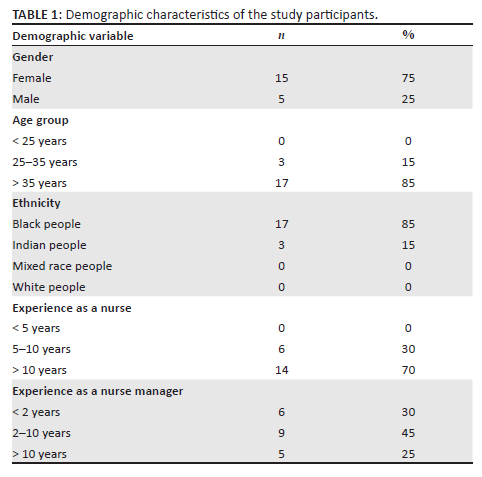
Data saturation was reached after 16 participants were interviewed. Four additional interviews were conducted to confirm data saturation, thus giving a total of 20 NMs interviewed and a census of NMs who met the inclusion criteria. Nine NMs were overall in-charge for the PHC clinics and 11 were NMs for selected sections within the PHC clinic (acute illness, chronic illness and mother-and-child sections).
Data analysis
Data analysis was done concurrently with data collection, preferably on the same day as the interview or within three days but ideally before the next interview. The reason for this was to ensure that each interview's information was analysed as soon as possible while the session was still fresh in the mind of the interviewer. This facilitated comprehension and interpretation. Data were analysed using content analysis guided by Tesch's open coding approach.17
Ethical considerations
Ethical clearance to conduct this study was obtained from the Institutional Review Board of Durban University of Technology (IREC 102/20). Gatekeeper permission was granted by relevant managers from the KwaZulu-Natal Provincial Department of Health, which included the research unit manager, the iLembe district manager, the PHC services general manager and NMs in charge of the seven PHC clinics in the selected local municipality.
Results
The findings on demographic characteristics of the study participants are presented in Table 1.
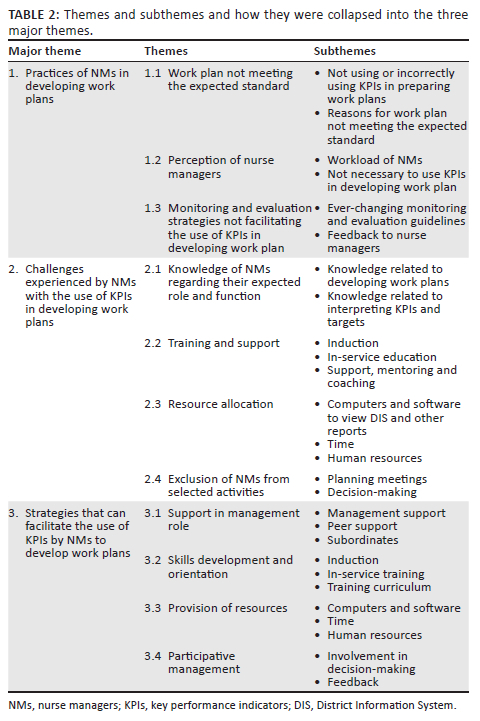
Eleven themes and several subthemes emerged from the study. Because the majority of the themes and subthemes were interrelated, they were grouped together and collapsed into three major themes in line with the three study objectives. The three major themes included the practices of NMs in developing work plans, the challenges experienced by NMs in the use of KPIs in developing work plans and the strategies that, according to the NMs, could facilitate the use of KPIs in developing work plans. Table 2 presents the themes and subthemes and how they were collapsed into the three major themes.
Major theme 1: Practices of nurse managers in developing work plans
In healthcare services, including PHC clinics, NMs are responsible for planning, organising and directing health services in their departments to ensure that the goals and objectives are achieved consistently and that the services provided to the community are of the highest quality and standard.103
'My major concern is interpretation of the KPIs. You will think you understand them, yet you are completely off the point; they are not written in simple language that is easy to understand.' (PHC Clinic A, NM2)
However, some participants stated that the majority of NMs were reluctant to use the KPIs when preparing the work plan because they perceived this as unnecessary and just another senior management strategy to increase the workload for NMs:
'Truly speaking, I am not even convinced why they are forcing us to these KPIs in developing work plans; it is just another strategy to increase our workload.' (PHC Clinic F, NM1)
Major theme 2: Challenges experienced by nurse managers with the use of key performance indicators in developing work plans
The management role of a NM in a PHC setting is to ensure that the resources required to execute daily activities are available, safe and fairly distributed. Nurse managers often experience a number of challenges in leadership roles that affect the effectiveness of their leadership and the quality of primary PHC services rendered.18
'I must be honest; the task of using the KPIs in developing work plans is not an easy one, especially because most of us were never taught how to do this. Most of us were never inducted; you are just thrown into the deep end and you are expected to deliver.' (PHC Clinic E, NM2)
However, they commended their peers for support, mentoring and coaching:
'What has kept us going is having each other as NMs. We are always there for each other; we support and mentor each other.' (PHC Clinic F, NM3)
As contributory factors in their inability to use KPIs in developing work plans, almost all study participants flagged the shortage of resources such as computers and software to view the District Information System and other reports, knowledge and skills to operate the computers, time and human resources:
'One huge problem is the network. The clinic where I am working the network is most of the time down. Therefore, rather than being late in submitting my reports and the work plan, I use whatever little information I have to compile and submit these.' (PHC Clinic F, NM2)
Furthermore, the participants indicated that excluding them from selected activities such as platforms where decisions were made and staff development forums such as workshops and in-service education training sessions affected their ability to use the KPIs in developing work plans:
'As NMs, we work like machines; decisions are made for us. This is very frustrating and demotivating.' (PHC Clinic C, NM1)
Major theme 3: Strategies that can facilitate the use of key performance indicators by nurse managers in developing work plans
There is global recognition that competent managers are essential for ensuring that priority health needs are met, quality health services are delivered, and that resources are used effectively.1919
Receiving support from selected people in the organisation such as management, peers and subordinates could facilitate the NMs' use of KPIs in developing work plans:
'… If senior managers can standardise and make regular their visits to PHC clinics for support and guidance.' (PHC Clinic A, NM1)
Induction, in-service education and including KPIs and development of work plans in the training curriculum for the post-basic nursing management course were strategies that, according to the participants, could improve NMs' knowledge and skill in the appropriate use of KPIs when developing work plans:
'We cannot avoid frequent changing of KPIs and their targets due to ever-changing disease patterns, but it would be better that in-service trainings are provided every time the new KPIs are introduced and provision of ongoing support thereafter.' (PHC Clinic C, NM1)
Equitable provision and allocation of resources such as computers and related software, Internet access, time and human resources for all PHC clinics, irrespective of location, whether urban or rural, was also listed among strategies to facilitate the use of KPIs in developing work plans:
'Unlike the urban clinics that are well resourced, in our sub district we have huge resources constraints with one clinic having just one or two computers, no printer, and no fax machine.' (PHC Clinic F, NM3)
The participants also highlighted participative management as another important strategy that in their opinion could facilitate the use of KPIs in developing work plans. All NMs should be involved in decision-making pertaining to the operations in the PHC clinics, including revision of current and deciding on new KPIs and targets, and should be given timeous composite feedback regarding PHC clinic operations:
'It would be wise to invite NMs in meetings for KPIs revisions, as we are the ones who are at an operational level and who understands community dynamics.' (PHC Clinic D, NM1)
Discussion
The discussion focuses on the three objectives of the study, which were to describe the current practices of NMs in developing work plans; identify and describe the challenges, if any, experienced by NMs with the use of KPIs in developing work plans; and to explore strategies that can facilitate the use of KPIs by NMs to develop work plans. The three objectives incidentally correspond to the three major themes that emerged as the interrelated themes and subthemes were collapsed.
Practices of nurse managers in developing work plans
Quality of submitted work plans
The work plans submitted by the NMs were reported to be of poor quality. Nurse managers' inadequate knowledge regarding how to use the KPIs in developing work plans was reported as one of the major reasons responsible for this. Nurse managers should have capabilities to retrieve, analyse and interpret reports on clinic performance from the District Information System in order to be able to use KPIs effectively in preparing work plans.32021
Monitoring and evaluation strategies
Monitoring and evaluation strategies used in the PHC clinics were reported as not facilitating the use of KPIs in developing work plans because of the ever-changing monitoring and evaluation guidelines and inappropriate and sometimes delayed feedback given to NMs. The problem of ever-changing guidelines was compounded by delays in communicating changes to NMs, which left them misinformed regarding new developments. Monitoring and evaluation aims to provide managers, decision-makers and other stakeholders with regular feedback on progress in implementation, results and early indicators of problems to be corrected through reporting on actual performance against what was planned or expected.422
South Africa uses the National Department of Health Data Dictionary as a guideline to support the district health management information system policy. The Data Dictionary provides a reference point for selected health information standards to support healthcare activities and the most up-to-date version of data set specifications, particularly data elements, indicators and data validation rules and the organisational unit hierarchies.8232425
Poor and delayed feedback regarding PHC performance and submitted reports was another practice that negatively influenced the use of KPIs in developing work plans. Several researchers look at feedback together with audit and regard these as strategies for improving performance and supporting quality and safety in healthcare systems.26,2727
Perceptions of nurse managers
This study identified that the perception of NMs influenced their use of KPIs in developing work plans. Self-efficacy is one's belief in one's ability to succeed in specific situations.2829
A number of NMs had negative perceptions about the use of KPIs in developing work plans. In their opinion, it was not necessary that the department be prescriptive that they should use KPIs in developing the work plans. According to the participants, an NM as the custodian of the work plan should be allowed liberty on how best to prepare the plan. Attitudes towards the behaviour, subjective and descriptive norms and perceived behavioural control are in part a function of an individual's characteristics and past experiences.3020
Challenges experienced by nurse managers with the use of key performance indicators in developing work plans
Four key challenges identified as impeding the use of KPI in developing work plans included the knowledge of NMs regarding their expected role and function, training and support, resource allocation and exclusion of NMs from selected activities.
Knowledge of nurse managers regarding their expected role and function
The use of KPIs in developing work plans requires that NMs are able to interpret the KPIs. The current study identified that NMs lacked the knowledge regarding how to interpret the KPIs, which resulted in them developing substandard work plans. As alluded to by Muhammed, Doll and Deng, knowledge creation drives the behavioural processes related to knowledge management, such as knowledge application, which in turn impacts the individuals' task-related knowledge.1431
Training and support
All persons involved in health information are required to have the ability to appropriately collect, consistently define, accurately aggregate, link, relate to knowledge and machine process health data accurately.32
Although under normal circumstances, NMs are supposed to have undergone a nursing management training course to prepare them for the management role, a number of NMs were promoted based on experience as a professional nurse without going through a formal course.33
Training is an act that plays a positive role in the success of the organisation that increases the skills and knowledge of the employees for the required purpose or task and allows the employees to obtain new skills and knowledge and become more effective and productive for the organisation.3435
It is also compulsory that employees assuming new positions are subjected to a full induction programme.3634
Furthermore, in order to keep staff members abreast with practice and new development, staff members in the healthcare establishment are subjected to a series of workshops and in-service education sessions coordinated at various operational levels, such as national, provincial or district levels. The participants in the current study stated that NMs are often not invited to the in-service training sessions related to data management, or when invited, they are unable to attend because they are too busy in the clinics. In-service training is an important undertaking in improving the performance of employees, simply because it has several positive effects on performance, which include self-development and gaining of new skills that enable employees to perform their tasks better with timely completion of tasks, all of which have a direct contribution towards better performance.37
Participants also mentioned that they did not get adequate support from their senior managers. When an individual is engaged in knowledge creation, this knowledge is typically applied by the individual in his or her work if he or she has all the resources necessary to put the new idea into practice.14
Resource allocation
Data sources from the District Health Information System and other sources such as surveillance, population surveys and management information are integrated in the National Health Information Repository and Data Warehouse and are made available to managers for future planning.38393940
The shortage of human resources has resulted in NMs spending most of their time attending to patients instead of focusing on management duties. The provision of health services is largely dependent on the sufficiency of the health workforce in terms of numbers, the quality of skills they possess, how and where they are deployed and how they are managed.41243842
Exclusion of nurse managers in selected activities
This study identified that NMs are often excluded from selected activities which are meant to be part of their role, such as planning and decision-making. Thus, the participants in the current study stated that their exclusion resulted in missed opportunities to make their input and voices heard on these platforms. Managers are persons who are formally appointed to positions of authority in an organisation and decision-making, which is part of problem-solving and problem analysis, which is an inherent activity of managers, allowing them to make decisions within and among the different management functions such as planning, organising, directing, controlling and staffing - all of which are brought to life and connected by decision-making.43
Strategies that could facilitate the use of key performance indicators by nurse managers in developing work plans
The researcher sought the opinions of the study participants regarding strategies that could facilitate the use of KPIs by NMs to develop work plans. The proposed revision of the curriculum for post-basic training for nurses, induction of newly appointed NMs on data management, involvement of NMs in decision-making, management support to NMs and equitable distribution of resources in health facilities, irrespective of their geographical location, are the key strategies that could facilitate the use of KPIs by NMs to develop work plans.
Revision of curriculum for post basic training for nurses
Nurse managers are required to possess specific knowledge to be able to perform their role expectation, and knowledge is gained through education and training or experience in the field.444546
Induction of newly appointed nurse managers
Despite the importance of the role of NMs, a number of new NMs received little, if any, formal preparation, yet they were expected to lead the operations in their units, including development of work plans.3147
Involvement of nurse managers in decision making
In South Africa, the healthcare system remains centralised, with narrow decision space over most matters such as finance and human resources, policies, etc., for managers from district level downwards.4646
Management support for nurse managers
Lack of support is a significant work-related problem that NMs are often exposed to. This results in NMs who are unproductive, discontented and more vulnerable to burnout and depersonalisation.484950
Equitable distribution of resources in health facilities
The study participants recommended that equal allocation of all resources in PHC facilities, including computers and network systems, would assist PHC facilities to access their data timeously for planning. In order to provide quality services, a number of basic resources need to be available, regardless of how well-utilised the service is.5152
Limitations
This study was carried out on a very small scale involving one small district with a limited number of participants, and thus the results are not generalisable. The involvement of senior management in the study and a retrospective review of work plans would have enriched the findings from the study.
Recommendations
Recommendations are made in relation to service delivery, nursing education and training and further research to address the challenges experienced by NMs. These recommendations are aimed at the different tiers of management, including the ward or unit, line manager or senior manager and human resources levels.
Despite the importance of the role of NMs, a number of new NMs receive little, if any, formal preparation, yet they are expected to lead the operations in their units including development of work plans.31
The line manager or senior manager should ensure that support is available for NMs in the form of in-service training, workshops on data management and ensuring that NMs are actively involved in decision-making. Training is an act that plays a positive role in the success of the organisation, increasing the skills and knowledge of the employees for the required purpose or task and allowing the employees to obtain new skills and knowledge and become more effective and productive for the organisation.3253
At the ward or unit level, NMs should support each other, identify mentors and benchmark good practices from each other to facilitate the execution of the use of KPIs in developing work plans and other management tasks. The dedicated guidance that is received through mentoring and coaching is more beneficial than formal teaching because they inspire, energise and facilitate learning and are deemed to be a highly effective way to help people, through talking and increasing self-direction, self-esteem, efficacy and accomplishments in the new millennium.54,55,56
In addition, a broader study involving more districts and provinces is recommended. The current study identified gaps in areas such as knowledge of NMs regarding their role, support received by NMs and resource allocation to PHC clinics located in rural areas. These are critical areas requiring further research, as they negatively impact the performances of NMs and therefore service delivery and management.
Conclusion
Relevant knowledge management practices are essential for the development of task knowledge (NMs' knowledge regarding the use of KPIs in developing work plans) to ensure that tasks are appropriately executed. Although several other challenges such as inadequate resources allocation impacted the NMs' use of KPIs in developing work plans, this study identified a knowledge gap which could be filled through training, in-service education, induction, mentoring and support as the major cause of this problem. Therefore, as alluded by Muhammed, Doll and Deng, knowledge creation and knowledge sharing can facilitate knowledge application and improve the practice of NMs in the use of KPIs in developing work plans.
Competing interests
The authors declare that they have no financial or personal relationships that may have inappropriately influenced them in writing this article.
Authors' contributions
T.S.P.N. and J.N.M.M. both contributed to the design and implementation of the research, to the analysis of the results and to the writing of the manuscript.
Funding information
This research received no specific grant from any funding agency in the public, commercial or not-for-profit sectors.
Data availability
The data that support the findings of this study are available on request from the corresponding author, T.S.P.N. The data are not publicly available due to it containing information that could compromise the privacy of research participants.
Disclaimer
The views and opinions expressed in this article are those of the authors and do not necessarily reflect the official policy or position of any affiliated agency of the authors.
Acknowledgements
The authors would like to acknowledge Institutional Review Board of Durban University of Technology in KwaZulu-Natal for granting ethical approval to conduct the research project; the iLembe District Department of Health for granting gatekeeper permission for data collection; and the participants of this research, the PHC NMs from the selected local municipality of iLembe district, for sharing their experiences.
References
-
1.World Health Organization. World health statistics 2020: Monitoring health for the SDGs, sustainable development goals [homepage on the Internet]. Geneva: World Health Organization; 2020 [cited 2020 Apr 03]. Available from: https://www.who.int/publications/i/item/9789240005105
» https://www.who.int/publications/i/item/9789240005105 -
2.South Africa. Department of performance monitoring and evaluation. The state of management practices in the public service [homepage on the Internet]. 2013 [2020 cited Apr 11]. Available from: https://www.dpme.gov.za/keyfocusareas/mpatSite/MPAT%202013/MPAT%20report.pdf
» https://www.dpme.gov.za/keyfocusareas/mpatSite/MPAT%202013/MPAT%20report.pdf -
3.Solman A. Nursing leadership challenges and opportunities. J Nurs Manag. 2017;25(6):405-406. https://doi.org/10.1111/jonm.12507
» https://doi.org/10.1111/jonm.12507 -
4.South Africa. National department of health. National core standards for health establishments in South Africa [homepage on the Internet]. 2017 [cited 2020 Apr 09] Available from: http://phisa.co.za/wp-content/uploads/2019/01/National-Core-Standards.pdf
» http://phisa.co.za/wp-content/uploads/2019/01/National-Core-Standards.pdf -
5.Dickens C, Smakhtin V, McCartney M, O'Brien G, Dahir L. Defining and quantifying national-level targets, indicators and benchmarks for management of natural resources to achieve the sustainable development goals. Sustain J. 2019;11(2):462. https://doi.org/10.3390/su11020462
» https://doi.org/10.3390/su11020462 -
6.Massyn N, Barron P, Day C, Ndlovu N, Padarath A, editors. District health barometer 2018/19 [homepage on the Internet]. Durban: Health Systems Trust; 2020 [cited 2021 Jan 29]. Available from: https://www.hst.org.za/publications/Pages/District-Health-Barometer-201819.aspx
» https://www.hst.org.za/publications/Pages/District-Health-Barometer-201819.aspx -
7.Marr B. What is a KPI? [homepage on the Internet]. 2019 [cited 2020 Sep 11]. Available from: https://www.bernardmarr.com/default.asp?contentID=762
» https://www.bernardmarr.com/default.asp?contentID=762 -
8.Kautzky K, Tollman SM. A perspective on primary health care in South Africa. S Afr Health Rev [serial online]. 2008 [cited 2020 April 9];1:17-30. Available from: https://journals.co.za/doi/pdf/10.10520/EJC35514
» https://journals.co.za/doi/pdf/10.10520/EJC35514 - 9.South African National Department of Health. Annual performance plan 2018/19-2020/21 [homepage on the Internet]. 2017.
-
10.Joseph ML, Huber DL. Clinical leadership development and education for nurses: Prospects and opportunities. J Healthc Leadersh. 2015;2015(7):55-64. https://doi.org/10.2147/JHL.S68071
» https://doi.org/10.2147/JHL.S68071 -
11.Williams K. The role and responsibilities of nurse managers [homepage on the Internet]. 2010 [cited 2021 Feb 26]. Available from: https://ezinearticles.com/?The-Role-and-Responsibilities-of-NurseManagers&id=4657072
» https://ezinearticles.com/?The-Role-and-Responsibilities-of-NurseManagers& id=4657072 - 12.Damoah IS, Akwei C, Mouzughi Y. Causes of government project failure in developing countries - Focus on Ghana. British Academy of Management (BAM) Conference Proceedings; 2015 Sep 8-10; Portsmouth University; 2015. United Kingdom.
-
13.Yuan J, Wang C, Skibniewski MJ, Li Q. Developing key performance indicators for public-private partnership projects: Questionnaire survey and analysis. J Manage Eng. 2012;28(3):252-264. https://doi.org/10.1061/(ASCE)ME.1943-5479.0000113
» https://doi.org/10.1061/(ASCE)ME.1943-5479.0000113 -
14.Muhammed S, Doll WJ, Deng X. Impact of knowledge management practices on task knowledge: An individual level study. Int J Knowl Manag. 2011;7(4):1-21. https://doi.org/10.4018/jkm.2011100101
» https://doi.org/10.4018/jkm.2011100101 - 15.Grove SK, Burns N, Gray JR. The practice of nursing research, appraisal, synthesis and generation of evidence. 7th ed. St. Louis, MO: Elsevier; 2013.
-
16.South Africa: KwaZulu-Natal cooperative governance and traditional affairs. Municipal profile - Ilembe District Municipality [homepage on the Internet]. 2018. [cited 2020 April 11]. Available from: http://www.KwaZulu-Natalcogta.gov.za/wp-content/uploads/2018/01/Ilembe-District-Profile-Dec-2017.pdf
» http://www.KwaZulu-Natalcogta.gov.za/wp-content/uploads/2018/01/Ilembe-District-Profile-Dec-2017.pdf - 17.Tesch R. Qualitative research: Analysis types and software tools. New York, NY: Falmer; 1992.
-
18.Nene SE. Exploring the challenges in leadership roles experienced by nurse managers in a mining primary healthcare setting in South Africa. Curationis. 2021;44(1):a2196. https://doi.org/10.4102/curationis.v44i1.2196
» https://doi.org/10.4102/curationis.v44i1.2196 -
19.Munyewende PO, Rispel LC. Using diaries to explore the work experiences of primary health care nursing managers in two South African provinces. Glob Health Action. 2014;7(1):25323. https://doi.org/10.3402/gha.v7.25323
» https://doi.org/10.3402/gha.v7.25323 -
20.Jeseviciute-Ufartiene L. Importance of planning in management developing organization. J Adv Manag Sci. 2014;2(3):176-180. https://doi.org/10.12720/joams.2.3.176-180
» https://doi.org/10.12720/joams.2.3.176-180 - 21.Syed SHS, Ahsan RJ, Jabran A, Wasiq E, Ihsan U-H, Syed NR. Workload and performance of employees. Interdiscip J Contemp Res. 2011;3(5):256-267.
-
22.World Health Organization. Primary health care systems (PRIMASYS): Case study from South Africa, abridged version [homepage on the Internet]. Geneva: World Health Organization; 2020 [cited 2020Apr 03]. Available from: https://apps.who.int/iris/handle/10665/341144
» https://apps.who.int/iris/handle/10665/341144 - 23.Almazrou MSH. Expected benefits of clinical practice guidelines: Factors affecting their adherence and methods of implementation and dissemination. J Health Serv Res Policy. 2013;1(3):141-147.
-
24.Melnyk BM. Important information about clinical practice guidelines: Key tools for improving quality of care and patient outcomes. Evid Based Nurs. 2015;12(1):1-2. https://doi.org/10.1111/wvn.12079
» https://doi.org/10.1111/wvn.12079 -
25.South Africa. National Department of Health. Towards quality of care: National core standards for health establishments in South Africa [homepage on the Internet]. 2011 [cited 2020 Apr 11]. Available from: https://static.pmg.org.za/docs/120215abridge_0.pdf
» https://static.pmg.org.za/docs/120215abridge_0.pdf -
26.Flottorp SA, Jamtvedt G, Gibis B, Martin McKee M. Using audit and feedback to health professionals to improve the quality and safety of health care [homepage on the Internet]. 2010 [cited 2021 Feb 26] Available from: https://www.euro.who.int/__data/assets/pdf_file/0003/124419/e94296.pdf
» https://www.euro.who.int/__data/assets/pdf_file/0003/124419/e94296.pdf -
27.Ivers N, Jamtvedt G, Flottorp S, et al. Audit and feedback: Effects on professional practice and healthcare outcomes. Cochrane Database Syst Rev. 2012;(6):1-227. https://doi.org/10.1002/14651858.CD000259.pub3
» https://doi.org/10.1002/14651858.CD000259.pub3 -
28.Achterkamp R, Hermens HJ, Vollenbroek-Hutten MMR. The influence of vicarious experience provided through mobile technology on self-efficacy when learning new tasks. Comput Hum Behav. 2016;67:327-332. https://doi.org/10.1016/j.chb.2016.04.006
» https://doi.org/10.1016/j.chb.2016.04.006 -
29.Reimer AP, Weinkauf DK, Prokopy LS. The influence of perceptions of practice characteristics: An examination of agricultural best management practice adoption in two Indiana watersheds. J Rural Stud. 2012;28(1):118-128. https://doi.org/10.1016/j.jrurstud.2011.09.005
» https://doi.org/10.1016/j.jrurstud.2011.09.005 - 30.Situmorang EF, Sinulingga S, Iskandarini. Analysis of the factors influence employee performance of the production in CV Bandabags unit work Lhoksemauwe. J Bus Manag. 2019;21(3):57-63.
-
31.Verboncu I, Corcodel S. Managerial performance: Factors of influence. Int J Comp Manag [serial online]. 2014 [cited 2021 Feb 26];15(3):273-283. Available from: http://www.rmci.ase.ro/no15vol3/02.pdf
» http://www.rmci.ase.ro/no15vol3/02.pdf - 32.Hovenga EJS, Grain H, editors. Health information governance in a digital environment. Volume 193 of studies in health technology and informatics. Amsterdam: IOS Press; 2013.
-
33.DeCampli P, Kirby KK, Baldwin C. Beyond the classroom to coaching: Preparing new NMs. Crit Care Nurs Q. 2010;33(2):132-137. https://doi.org/10.1097/CNQ.0b013e3181d913db
» https://doi.org/10.1097/CNQ.0b013e3181d913db -
34.Afsheen M, Sidra S. Importance of training and development in the workplace. Int J Sci Eng [serial online]. 2017 [cited 2020 Apr 03];8(4):498-504. Available from: https://www.ijser.org/researchpaper/Importance-of-training-and-development-in-the-workplacE.pdf
» https://www.ijser.org/researchpaper/Importance-of-training-and-development-in-the-workplacE.pdf -
35.Rivera-Romano LS, Fresno C, Hernández-Lemus E, Martinez-Garcia M, Vallejo M. Gender imbalance in executive management positions at the Mexican National Institutes of Health. Hum Resour Health. 2020;18(1):21. https://doi.org/10.1186/s12960-020-0463-4
» https://doi.org/10.1186/s12960-020-0463-4 -
36.Mchete T, Shayo F. The role of induction training on performance of new employees at workplace: Case study of the open university of Tanzania. J Bus Econ Manag. 2020;3(1):285-300. http://doi.org/10.35409/IJBMER.2020.3158
» http://doi.org/10.35409/IJBMER.2020.3158 -
37.Mshila RM. Effects of in-service training on the performance of secondary school teachers in Kiambu West District [Master's thesis] [homepage on the Internet]. Nairobi: Kenyatta University; 2013 [cited 2021 Feb 27] Available from: http://www.ku.ac.ke/schools/business/images/stories/research2/in_service.pdf
» http://www.ku.ac.ke/schools/business/images/stories/research2/in_service.pdf -
38.World Health Organization. World health statistics 2016: Monitoring health for the SDGs [homepage on the Internet]. 2016 [cited 2020 Apr 03]. Available from: https://www.who.int/publications/i/item/9789241565264
» https://www.who.int/publications/i/item/9789241565264 -
39.Angelis A, Kanavos P, Montibeller G. Resource allocation and priority setting in health care: A multi-criteria decision analysis problem of value? Glob Policy. 2017;8(2):76-83. https://doi.org/10.1111/1758-5899.12387
» https://doi.org/10.1111/1758-5899.12387 -
40.Scott PA, Harvey C, Felzmann H, et al. Resource allocation and rationing in nursing care: A discussion paper. Nurs Ethics. 2019;26(5):1528-1539. https://doi.org/10.1177/0969733018759831
» https://doi.org/10.1177/0969733018759831 - 41.Mahlathi P, Dlamini J. Minimum data sets for human resources for health and the surgical workforce in South Africa's health system: A rapid analysis of stock and migration [homepage on the Internet]. African Institute for Health and Leadership Development; 2015.
-
42.Welsh S, Kersten C. Where are women in the expatriate workforce? Leveraging female talent to increase global competitiveness [homepage on the Internet]. SHRM; 2014 [cited 2021 Feb 26]. Available from: https://www.shrm.org/ResourcesAndTools/hr-topics/global-hr/Pages/Women-Expatriate-Workforce.aspx
» https://www.shrm.org/ResourcesAndTools/hr-topics/global-hr/Pages/Women-Expatriate-Workforce.aspx -
43.Durr K. Introductions to management and leadership concepts, principles and practices [homepage on the Internet]. Jones and Bartlett Learning; no date [cited 2021 Jan 31]. Available from: http://samples.jbpub.com/9780763742911/42910_CH02_007_024.pdf
» http://samples.jbpub.com/9780763742911/42910_CH02_007_024.pdf -
44.Conrad S, Sherrod D. Nurse managers as knowledge workers nursing management. J Nurs Manag. 2011;42(2):47-48. https://doi.org/10.1097/01.NUMA.0000393010.34127.44
» https://doi.org/10.1097/01.NUMA.0000393010.34127.44 -
45.Figueroa CA, Harrison R, Chauhan A, Meyer L. Priorities and challenges for health leadership and workforce management globally: A rapid review. BMC Health Serv Res. 2019;19:239. https://doi.org/10.1186/s12913-019-4080-7
» https://doi.org/10.1186/s12913-019-4080-7 -
46.Morgan LA. Nurse manager requirements [homepage on the Internet]. 2022. [cited 2020 April 17]. Available from: https://work.chron.com/nurse-manager-requirements-14606.html
» https://work.chron.com/nurse-manager-requirements-14606.html -
47.Kunene MP. The effectiveness of the induction and orientation programme in the Nkangala health district of Mpumalanga Province, 2006 to 2007 [MPH thesis] [homepage on the Internet]. Durban: University of KwaZulu-Natal; 2010 [cited 2021 Mar 09]. Available from: http://hdl.handle.net/10413/4786
» http://hdl.handle.net/10413/4786 -
48.Gab Allah AR, Elshrief HA, Ageiz MH. Developing strategy: A guide for nurse managers to manage nursing staff's work-related problems. Asian Nurs Res. 2020;14(3):178-187. https://doi.org/10.1016/j.anr.2020.07.004
» https://doi.org/10.1016/j.anr.2020.07.004 -
49.Wu Y, Zhu W. An integrated theoretical model for determinants of knowledge sharing behaviours. Kybernetes. 2012;41(10):1462-1482. https://doi.org/10.1108/03684921211276675
» https://doi.org/10.1108/03684921211276675 - 50.Kanaan R, Masa'deh R, Gharaibeh A. The impact of knowledge sharing enablers on knowledge sharing capability: An empirical study on Jordanian telecommunication firms. Eur Sci J. 2013;9(22):237-258.
-
51.Fernandes JC, Cordeiro BC. The management of basic health units from the point of view of nursing managers. J Nurs [serial online]. 2018 [cited 2020 Aug 07];12(1):194-202. Available from: https://periodicos.ufpe.br/revistas/revistaenfermagem/article/viewFile/23311/25978
» https://periodicos.ufpe.br/revistas/revistaenfermagem/article/viewFile/23311/25978 -
52.Fallon N. The benefits of benchmarking in business operations. Business News Daily [serial online]. 2021 [cited 2021 Mar 03]. Available from: https://www.businessnewsdaily.com/15960-benchmarking-benefits-small-business.html
» https://www.businessnewsdaily.com/15960-benchmarking-benefits-small-business.html -
53.South Africa: KwaZulu-Natal. Department of Health. ILembe District health plan 2015/16 [homepage on the Internet]. 2015 [cited 2021 Feb 05]. Available from: https://www.kznhealth.gov.za/Strategic/DHP/2015-16/Ilembe.pdf
» https://www.kznhealth.gov.za/Strategic/DHP/2015-16/Ilembe.pdf - 54.Serrat O. Coaching and mentoring. In: Serrat O, editor. Knowledge solutions: Tools, methods, and approaches to drive organizational performance. Springer, 2017; p. 897-902. Singapore.
-
55.Pritchard E, Gidman J. Effective mentoring in the community setting. Br J Community Nurs. 2012;17(3):119-124. https://doi.org/10.12968/bjcn.2012.17.3.119
» https://doi.org/10.12968/bjcn.2012.17.3.119 -
56.Kim SC, Oliveri D, Riingen M, Taylor B, Rankin L. Randomized controlled trial of graduate-to-undergraduate student mentoring program. J Prof Nurs. 2013;29(6):e43-e49. https://doi.org/10.1016/j.profnurs.2013.04.003
» https://doi.org/10.1016/j.profnurs.2013.04.003

Accepted: 21 Aug. 2022
Published: 30 Nov. 2022