Distinguishing trans women in men who have sex with men populations and their health access in East Africa: A Tanzanian study
Abstract
BACKGROUND: Few data are available on the presence and characteristics of transgender populations in sub-Saharan Africa (SSA), which makes the provision of health services for key populations difficult. AIM: This study aimed to ascertain the presence and characteristics of trans women in seven cities in Tanzania, East Africa. SETTING: Tanzania, East Africa. METHODS: Outreach to men who have sex with men (MSM) in seven large cities in Tanzania was carried out by non-governmental organisation (NGO) staff familiar with this community. Survey questions administered via interviews were used to identify participants who self-identify as trans. From the self-identification data, an estimate of the relative size of the trans women population in this sample was calculated. RESULTS: In the sample of 300 participants, 17.0% of participants were identified as 'transsexual or transgender' (survey wording); 70.1% of these trans participants indicated that they identify themselves as a woman. Of those identifying themselves as transsexual or transgender, 43.1% reported living part- or full-time as a woman and eight (15.0%) reported hormone use. The highest percentage of hormone use (40.0%) was found in those living as a woman full-time. Notably, there was significant ignorance amongst the sample of the terms 'transsexual and transgender' or their explanation in Swahili, reported by interviewers. CONCLUSION: In this study, it is clear that trans women populations exist in Tanzania, with high levels of stigmatisation and threats to their lives. They should be included in health outreach and services to key populations. One in six self-identified as trans women, although the lack of knowledge of this concept in Swahili or English may have inaccurately represented numbers.
trans women; transgender; Tanzania; Africa; stigma; prevalence; gender spectrum; healthcare
Introduction
The literature on transgender and gender-diverse people in sub-Saharan Africa (SSA) is relatively sparse, partly because of the wide variation across cultures and traditions in the 46 countries that comprise SSA. It is also partly because the legal, religious, health and medical traditions that were introduced by colonial powers from the 19th century up to independence widely varied with regard to sexuality and have left their mark on subsequent legal and medical training.1
-
Definitional issues
We will use the current terminology, trans woman, to refer to a person who identifies as a woman and whose sex assigned at birth was male, based on the World Health Organization's (WHO) definition: '[t]ransgender is an umbrella term that describes a diverse group of people whose internal sense of gender is different than that which they were assigned at birth'.23
Even though [trans and intersex] people are often discussed as a single group, the complex intersectionality of for example class, religion, ethnicity, skin colour, income, and so on, places individuals at very different positions in life and lets them inhabit this 'single' category in very diverse ways. (p. 17)
Klein's acknowledgement that there are a number of complex intersectionalities with trans identities is important to appreciate how research findings may differ depending on historical, geographical and cultural contexts.
The African situation
Klein (p. 18) cited Donham4
We also know that some MSM (including in Africa) may consider themselves to be feminine or even use feminine terms for themselves, but actually identify as cis men, whereas there are others who don't identify as men or who consider themselves at some intermediate point on the gender spectrum. The distinction between MSM and trans women, and the reference to trans women as 'MSM' in some studies in SSA, makes research focused on trans women specifically crucial to understand the separate political, health and social issues that trans women encounter. Their invisibility or misclassification as MSM makes it challenging to provide separate services tailored to trans women's needs as a separate key population. One cannot assume that definitions and needs of trans women are identical in different countries or cultures in SSA. It is thus important to understand the history, culture and linguistic settings (including social and structural ones) of trans women or people on the gender spectrum in the specific context of any study.
Historical issues in East Africa
We need to be alert to cultural differences in terminology and tradition before imposing Western definitions and concepts regarding sexuality and gender. Moen et al.5gay, whilst 23% called themselves bisexual, 16% homosexual and 12% shoga. However, he also noted that direct comparisons between Dar es Salaam and Nairobi may not necessarily be appropriate, because English is more widely spoken in Kenya than in Tanzania. Hersi,6shoga, ssenge and Malaya (homo, pervert, whore) and that most people conflate sexual orientation and gender identity, making no distinction between them. We cannot assume that shoga and related terms have any clear equivalence to Western categories.
Recent African research
Recent studies have provided more information on transgender populations in the continent. Poteat et al.7
Sandfort et al.89n = 300), 77.7% identified as cisgender men, 14.7% as trans feminine and 7.0% as nonbinary individuals. Similarly, Rwema et al.10n = 736) in Kigali, Rwanda, and noted that 14.0% of their sample were transgender women.
It is not surprising that there is a lack of understanding of trans women as being distinct from MSM. In a qualitative study in KwaZulu-Natal, Luvuno et al.11
In Nairobi, Kenya, Smith et al.121314
Definitions and sampling in many studies of trans people in SSA have used differing definitions and sampling approaches. The dearth of knowledge in the area is because of many factors, such as those intersectionalities identified by Klein,3
Furthermore, there is a lack of awareness in healthcare and administrative areas that trans women are a key population with health needs that are different in many ways from those of MSM. This can include professionals not distinguishing trans women and gay and bisexual men (and confusing sexual orientation and gender identity). Thus, an investigation into the population and community access to trans women will allow planning and providing services to this key population.
Methods
Design
We carried out an interview-based study with a sample of 300 MSM, and the study was primarily on gender and sexual orientation-related stigma.15
Setting
The study was carried out in seven of the major cities in Tanzania. Participants were interviewed in six of the 10 largest cities in Tanzania (i.e. Dar es Salaam, Mwanza, Arusha, Mbeya, Tanga, and Unguja, Zanzibar), plus Iringa, a city in the southern highlands. Census populations in 2012 were Dar es Salaam (4 364 541), Mwanza (706 543), Arusha (416 442), Mbeya (385 279), Tanga (273 332), Unguja, Zanzibar (223 033), and Iringa (151 345).16
Sampling
Participants were recruited through peer educator links, social media, phone call appointments, the Community Health Education Services & Advocacy (CHESA) database, MSM groups and organisations working with and for MSM or gay and bisexual men, organisers of a community-based organisation (CBO) and snowball contacts. Administration of the interview survey was conducted at agreed-upon safe locations where the participant felt most comfortable and made the choice of place themselves, including bars, bus stations, garages, workplaces, accommodation, colleges or universities and in cars. Interviewing took place at participant-chosen locations (instead of at specific NGOs), given the political situation at the time of data collection, including condemnatory speech and incitement against MSM from community leaders and negative media exposure. Research took place from December 2017 to August 2018 (the period went longer than expected because of the anti-gay political and media issues). Interviews took up to about 30 min to complete but typically took about 15 min (the time available was open-ended).
Data collection
Bilingual (in at least Kiswahili and English) research assistants trained community outreach workers and members of a CBO providing services to key populations (CHESA) to administer the interview-based questionnaire. Interviews were completed with 300 cisgender men and transsexual or transgender individuals over age 18 who reported having sex with men in the past five years. All survey administration took place in Kiswahili or English, as the participant preferred. The study was introduced as being about MSM, and transgender or transsexual identification was not mentioned in recruitment, thus not creating a participation bias. Interviewers asked questions, clarified responses and recorded interviewee information on the 21-item questionnaire, including both quantitative and open-ended responses, which was pretested with five members of the MSM community (including individuals who self-identify within the trans and gender diverse spectrum). At the time of the interview administration, which involved quantitative and open-ended questions, the interviewers explained the purpose of the research, and participants gave verbal informed consent. No incentive was provided.
One of the first three questions for participants was, 'Do you consider yourself: gay or homosexual; bisexual; straight or heterosexual; transsexual or transgender; other (specify)…' Participants were instructed to select one category. The participant's response to questions was accepted without any additional questioning, unless the participant indicated that the question was unclear, or their answer was unclear. All interviewer training specifically indicated that transsexual or transgender people and people who considered themselves on the gender spectrum were part of the target population.
The questionnaire collected data on age; education level; sexual identity; sexual activity over the past five years; how masculine or feminine the participant thought of themselves (5-point Likert scale from 'very feminine' to 'very masculine'); whether the participant had ever been the victim of physical violence or abuse, verbal abuse, discrimination or humiliation, sexual abuse or abuse from a healthcare worker (HCW) (Yes or No); whether the participant had ever visited an HCW because of a sexually or genitally related condition; whether the HCW was told (or found out) that the participant had sex with other men; and the types of abuse encountered in a healthcare setting. Depending on language, the two terms 'transsexual' and 'transgender' were used (in English), and the expression mtu aliyebadilisha/wabadili jinsia ('someone who changed gender') was used in Kiswahili. These terms and this expression were used together if there seemed to be any confusion. Based on our pilot work, the term 'transsexual' was the only English term that was understood in Tanzania to refer to what in Western societies is referred to as transgender, so we used those terms and a Kiswahili translation: 195 interviews were in Kiswahili, with only five being conducted in English. A copy of the questionnaire appears in the Appendix.
Data analysis
Data were entered into Statistical Package for Social Sciences (SPSS) version 27 for analysis. For demographic data, means, SDs, medians and modes were calculated for linear data, and frequencies and percentages were calculated for categorical data. Comparisons between trans women and MSM were calculated for interval data by t-tests (separate variance estimates, two-tailed) and for ordinal data by χ2
Total sample demographics
The parent study sample15
Ethical considerations
Ethical clearance to conduct this study was obtained from the Institutional Review Board (IRB) of the University of Minnesota (ref. no. STUDY00001617). No details that might identify any participant were recorded. Quantitative data were entered into SPSS and checked against the original paper interview copy during data cleaning.
Results
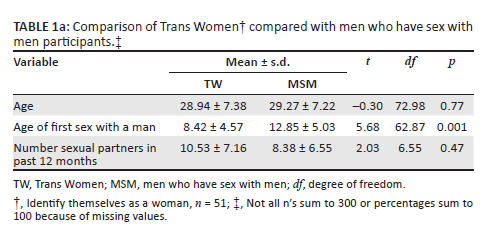
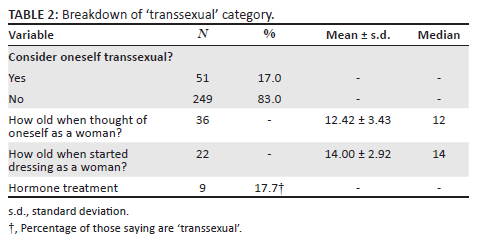
Results are illustrated in Tables 1 and 2 and Figure 1. In Table 1, trans women reported that they were significantly younger at the age of first sex with a man and had fewer sexual partners in the past 12 months than the MSM in the sample. Trans women reported significantly higher experiences of physical, verbal and healthcare-related abuse than the MSM sample, but there were no significant differences in age, education level, sexual abuse or city of interview.

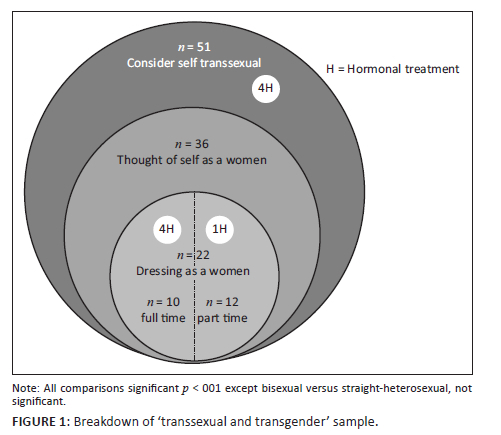
Table 2 indicates that of the 17.0% considering themselves 'transsexual or transgender' (the words used in the interview), about two-thirds (70.1%) thought of themselves as women, and of those considering themselves transsexual or transgender, 43.1% reported living part- or full-time as women. Eight of those indicating that they were transsexual or transgender (15.0%) reported hormone use. The highest percentage of hormone use (40.0%) was found in those living as women full-time (Figure 1).
Debriefing of interviewers was carried out by the first author (J.K.). In his notes, the interviewers reported (accounts are from interviewers and in their words, describing spontaneous verbal comments made by interviewees) that many (about a quarter or less) participants had to have the interviewer explain the terms transsexual, transgender and/or mtu aliyebadilisha/wabadili jinsia to them and were not familiar with the term or the concept.
From this hearsay information, fear of discrimination and rejection was a major reason that some transsexual or transgender participants did not wear women's clothes, as fully dressing as a woman would make their life much more dangerous compared with hiding it. From the debriefing notes:
'Some of the participants were actually telling us [interviewers] off the cuff that they make sure that they have even just one piece of women on her body, or accessories, and that makes her feel confidence and a natural woman.' (Interviewer, no date)
So they may wear women's underwear or carry lipstick in their bags or anything else that helps them feel like women. But publicly, they cannot show their identities or dress like women. In debriefing notes, an interviewer explained:
'One of the participants told us that "I bought high heeled shoes and kept them in my wardrobe, and every day I came home I made sure that I touched them or was wearing them in my room. Sometimes I slept with them on till morning and I took them off."' (Interviewer, no date)
An interviewer also wrote that another participant 'showed the wedding gown she bought five years back; she told us that she "usually wears it whenever she feels down or when she hears negativity from society"'. The interviewer further described that the participant:
'Just waited for that moment where she could be free to choose who to love, get married and live as husband and wife of someone, and if that won't happen when she is alive, she asked friends to put that dress on her body during her funeral as to fulfil her dreams.' (Interviewer, no date)
Discussion
Whilst there are data from other studies in SSA that report on trans women or gender non-binary populations within MSM sampling, few explicitly distinguish them, and the definitions are not always similar. Historical studies confirm the existence of trans women or nonbinary people prior to European colonisation. This study investigates the situation in a large MSM sample in seven Tanzanian cities and identifies the presence of trans women within the greater MSM population.
These data are amongst the few studies in East Africa to explore the existence of transsexual or transgender women within an MSM population. Our interviewers noted that many participants did not know what 'transsexual or transgender' meant, and it had to be explained to them: the fact that it was possible to change one's sex or gender was unknown to a significant number of the sample. This suggests that even within MSM communities, trans women are a hidden population. Several interviewers also commented in their field notes that they thought that some of the samples believed that 'thinking of themselves as a woman' referred to sexual positioning as a 'bottom'. This confusion and lack of a word to describe it undoubtedly raised the number of responses identifying as transsexual or transgender. However, this was not a random sample, and the figures here cannot be used to accurately estimate the number of transsexual, transgender or trans feminine people in this population. Nevertheless, it does document the existence of a number of trans and gender diverse people assigned male at birth in Tanzania. Nearly half of those who identified themselves as transsexual or transgender acknowledged that they had part- or full-time dressed or lived as women, and a small proportion reported taking hormones (of unknown provenance but possibly black market). There are no surgical interventions known for transsexual people in Tanzania, and no participant reported them.
As previously mentioned, the concept or vocabulary of transsexual or transgender was not consistently known to the MSM community we surveyed in Tanzanian cities: this was the major challenge we encountered during data collection. Interviewers took time to explain this concept so as to help people understand and to categorise themselves and be able to respond to the questions. However, despite these explanations, we could not be sure if respondents thought this was referring to culturally perceived gender-role appropriate mannerisms or sexual positioning, so their responses may be more likely based on the roles they played in society and/or sexually. Thus, we used a combination of markers to consider the size of this key population.
As the interviewer debriefing notes showed, there was a general recognition amongst those who did identify as 'transsexual or transgender' that to wear women's clothing was to risk their lives or livelihoods. Thus, it is not surprising that there was a lack of recognition in this population of transsexual or transgender women assigned male at birth. From Figure 1, that may be because one in six of those who consider themselves transsexual or transgender live full-time or part-time as women and would most likely very carefully protect their identity given the probability of negative, indeed fatal, consequences if there was gossip. Hersi6
Nevertheless, there was a core of participants who we believe did understand the term and justify the description of transgender or transsexual (Figure 1). Despite the cultural, religious and legal discrimination and risk associated with being sexual and gender minorities in Tanzania, some participants still reported living as women, nine participants reported taking hormones and of these, five dressed full-time or part-time as women. As Figure 1 illustrates, as we increase the possible combination of criteria to identify a transsexual or transgender population, numbers decrease.
We believe that we made assumptions about the knowledge level of some participants: the concepts of transsexual or transgender people seem not to be universally recognised. On the contrary, in the positive responses we did get, we can identify a clear gender continuum inclusive of trans and gender diverse people assigned male at birth, despite the lack of use of terminologies such as transgender or transsexual.
In our opinion, using the terms transsexual, transgender or their Kiswahili explanation underlies an issue that may occur in many countries in SSA: the use of a Western term where there is no understanding of that term or no cultural equivalent to that status. Lorway,17
Our data indicate that 17.0% of an MSM sample identified as transsexual or trans women, compared with 20.0% in Poteat's7891012146
On the contrary, our data also identify a group who identify themselves as 'transsexual or transgender', female and women; they may dress or live (fully or partially) as women in the face of discrimination and high personal risk and use hormone therapy where available (from whatever source). From our data and interviewer debriefing comments, it appears that there is indeed a small group who in a Western context would be considered 'transsexual or transgender' and were assigned male at birth. Using the criterion of the WHO,2t]ransgender is an umbrella term that describes a diverse group of people whose internal sense of gender is different than that which they were assigned at birth', we identified three possible indicators (identifying as a woman; living as a woman, including by wearing female clothing part- or full-time; and using hormone therapy) that constitute about 7% of the MSM sample in this study. A further significant proportion appears to identify themselves as being on a gender continuum. We believe that a wider range of indicators, including sex assigned at birth, gender role identity, gender identity (as a woman, man or nonbinary), gender of sexual partners, living to any extent publicly or privately as a woman or use of hormone treatment, can provide helpful information of these key populations, as opposed to simply being defined by researchers as 'MSM'.14
Abuse based on sexuality or gender role was reported as being physical abuse by nearly half of all participants, verbal abuse as nearly two-thirds, discrimination or humiliation by half, sexual abuse by one in five and healthcare abuse by one in six; this was significantly higher for trans women for physical, verbal and healthcare-related abuse. A large majority (eight out of 10) had sought healthcare for a sexually related condition, so it is possible that some participants may face a difficult choice between getting medical treatment and being abused. In our earlier work on this study,1618
Limitations
This study has several significant limitations. These include a small (by international standards) sample of people assigned male at birth and who have had sex with a man in the past five years, which in previous research contexts may have been described as 'MSM' and confined to the larger cities in Tanzania. We cannot, given our sampling and methodology, estimate a population figure for trans women and gender diverse people assigned male at birth. It became apparent that there was a substantial proportion of the sample who were not familiar with the term 'transsexual or transgender' and could have misunderstood its meaning. This could have underestimated our assessment. The term 'nonbinary' was not familiar to the interview designers, and no participants noted it in the 'other' self-identification category. Nevertheless, it is possible that the term 'transsexual' covered people who might define themselves as 'nonbinary' in the West if they were familiar with the term. Nor is there good agreement on classification criteria for trans women, particularly in the social, political, cultural and linguistic context of East Africa; other researchers may prefer different combinations of criteria. This will no doubt be a matter of continuing investigation across SSA.
Conclusion
It is clear that there are trans and gender diverse people assigned male at birth in Tanzania who identify as and report that they live as women, as well as a larger number who because of the risks cannot safely live as women but may identify as such. Without doubt, there are identifiable 'transsexual and transgender' populations in Tanzania, as the terms are used in North America and Western Europe; they need to be identified as a key population separate from MSM, in health and healthcare education. This is especially so given the consistent evidence from African research noted that these key populations have been conflated. Importantly, there are recent South African gender-affirming standards of care, including for transgender or transsexual key populations, which are available and applicable to SSA healthcare settings.19
Competing interests
The authors declare that they have no financial or personal relationships that may have inappropriately influenced them in writing this article.
Authors' contributions
The study was conceptualised and designed by J.K. and M.R., administered and carried out by J.K., analysed and funding acquired by M.R. and original drafts written, edited and reviewed by M.R., J.K. and N.R.
Funding information
This study was funded by a seed grant from the University of Minnesota.
Data availability
The authors confirm that the data supporting the findings of this study are available within the article.
Disclaimer
The views and opinions expressed in this article are those of the authors and do not necessarily reflect the official policy or position of any affiliated agency of the authors.
Acknowledgements
References
-
1.Moen K, Aggleton P, Leshabari MT, Middelthon, A-L. Same-sex practicing men in Tanzania from 1860 to 2010. Arch Sex Behav. 2014;43(6):1065-1082. https://doi.org/10.1007/s10508-014-0286-2
» https://doi.org/10.1007/s10508-014-0286-2 -
2.World Health Organization. International classification of diseases for mortality and morbidity statistics (11th rev.) [homepage on the Internet]. 2018 [cited 2021 Sep 29]. Available from: https://icd.who.int/browse11/l-m/en
» https://icd.who.int/browse11/l-m/en - 3.Klein T. Intersex and transgender activism in South Africa. Liminalis J Sex Gender Emanc Resist. 2009;3:15-41.
- 4.Donham DL. Freeing South Africa: The 'modernization' of male-male sexuality in Soweto. In: Inda JX, Rosaldo R, editors. The anthropology of globalization: A reader. Oxford: Blackwell, 2002; p. 410-427.
-
5.Moen K, Aggleton P, Leshabari MT, Middelthon AL. Gays, guys, and mchicha mwiba: Same-sex relations and subjectivities in Dar es Salaam. J Homosex. 2014;61(4): 511-539. https://doi.org/10.1080/00918369.2014.865457
» https://doi.org/10.1080/00918369.2014.865457 -
6.Hersi A. Tanzania: One transgender woman's pain amid fears of arrest [homepage on the Internet]. 2018 [cited 2020 Mar 12]. Available from: https://www.amnesty.org/en/latest/campaigns/2018/11/tanzania-one-transgender-womans-pain-amid-fears-of-arrest/
» https://www.amnesty.org/en/latest/campaigns/2018/11/tanzania-one-transgender-womans-pain-amid-fears-of-arrest/ -
7.Poteat T, Ackerman B, Diouf D, et al. HIV prevalence and behavioral and psychosocial factors among transgender women and cisgender men who have sex with men in 8 African countries: A cross-sectional analysis. PLoS Med. 2017;14(11):e1002422. https://doi.org/10.1371/journal.pmed.1002422
» https://doi.org/10.1371/journal.pmed.1002422 -
8.Sandfort TGM, Dominguez K, Kayange N, et al. HIV testing and the HIV care continuum among sub-Saharan African men who have sex with men and transgender women screened for participation in HPTN 075. PLoS One. 2019;14(5):e0217501. https://doi.org/10.1371/journal.pone.0217501
» https://doi.org/10.1371/journal.pone.0217501 -
9.Fearon E, Tenza S, Mokoena C, et al. HIV testing, care and viral suppression among men who have sex with men and transgender individuals in Johannesburg, South Africa. PLoS One. 2020;15(6):e0234384. https://doi.org/10.1371/journal.pone.0234384
» https://doi.org/10.1371/journal.pone.0234384 -
10.Twahirwa Rwema JO, Lyons CE, Herbst S, et al. HIV infection and engagement in HIV care cascade among men who have sex with men and transgender women in Kigali, Rwanda: A cross-sectional study. J Int AIDS Soc. 2020;23(S6):e25604. https://doi.org/10.1002/jia2.25604
» https://doi.org/10.1002/jia2.25604 -
11.Luvuno ZPB, Ncama B, Mchunu G. Transgender population's experiences with regard to accessing reproductive health care in Kwazulu-Natal, South Africa: A qualitative study. Afr J Prim Health Care Fam Med. 2019;11(1):1-9. https://doi.org/10.4102/phcfm.v11i1.1933
» https://doi.org/10.4102/phcfm.v11i1.1933 -
12.Smith AD, Kimani J, Kabuti R, Weatherburn P, Fearon W, Bourne A. HIV burden and correlates of infection among transfeminine people and cisgender men who have sex with men in Nairobi, Kenya: An observational study. Lancet HIV. 2021;8(5):E274-E283. https://doi.org/10.1016/S2352-3018(20)30310-6
» https://doi.org/10.1016/S2352-3018(20)30310-6 -
13.Chakrapani V. Need for transgender-specific data from Africa and elsewhere. Lancet HIV. 2021;8(5):E249-E250. https://doi.org/10.1016/S2352-3018(20)30344-1
» https://doi.org/10.1016/S2352-3018(20)30344-1 -
14.Kimani M, Van Der Elst EM, Chiro O, et al. PrEP interest and HIV-1 incidence among MSM and transgender women in coastal Kenya. J Int AIDS Soc. 2019;22(6):e25323. https://doi.org/10.1002/jia2.25323
» https://doi.org/10.1002/jia2.25323 -
15.Ross MW, Kashiha J, Mgopa LR. Stigmatization of men who have sex with men in health care settings in East Africa is based more on perceived gender role-inappropriate mannerisms than having sex with men. Glob Health Action. 2020;13(1):1816526. https://doi.org/10.1080/16549716.2020.1816526
» https://doi.org/10.1080/16549716.2020.1816526 -
16.Wikipedia. List of cities in Tanzania [homepage on the Internet]. No date [cited 2021 Sep 29]. Available from: https://en.wikipedia.org/wiki/List_of_cities_in_Tanzania
» https://en.wikipedia.org/wiki/List_of_cities_in_Tanzania - 17.Lorway R. Namibia's rainbow project. Gay rights in an African nation. Bloomington, IN: Indiana University Press; 2015.
-
18.Mujugira A, Kasiita V, Bagaya M, et al. 'You are not a man': A multi-method study of trans stigma and risk of HIV and sexually transmitted infections among trans men in Uganda. J Int AIDS Soc. 2021;24(12):e25860. https://doi.org/10.1002/jia2.25860
» https://doi.org/10.1002/jia2.25860 -
19.Tomson A, McLachlan C, Wattrus C, et al. Southern African HIV clinicians society gender-affirming healthcare guideline for South Africa. South Afr J HIV Med. 2019;22(1):1299. https://doi.org/10.4102/sajhivmed.v22i1.1299
» https://doi.org/10.4102/sajhivmed.v22i1.1299
Accepted: 27 May 2022
Published: 11 Aug. 2022