Knowledge and use of emergency contraceptives amid women seeking termination of pregnancy in the North West province
Abstract
BACKGROUND: Despite acceptable contraceptive coverage rates in South Africa, the rise in the number of termination of pregnancies is worrisome and suggests that family planning services are not yet optimal. Emergency contraceptives are underutilised in South Africa AIM: To assess the knowledge and use of emergency contraceptives among women presenting to a termination of pregnancy (TOP) facility SETTING: The study was conducted in the JB Marks sub-district, North West province, South Africa METHODS: This cross-sectional study was based at the TOP clinic at Potchefstroom Hospital, North West province. One hundred and ninety-six women completed self-administered questionnaires. Completion of the questionnaire was considered consent. Descriptive statistics were performed, and Chi2 and Fischer exact test were used to determine relationships between variables RESULTS: The mean age of participants was 26.5 years (standard deviation [s.d.] = 5.87), with 114 (58.2%) participants being single women in their 20s. Among 162 participants who had never used emergency contraceptives, 64.8% cited a lack of knowledge as the primary barrier to use. Only 34 (17.4%) of participants have previously used emergency contraceptives. The main reason for poor uptake among the women who never used emergency contraceptives could be attributed to poor knowledge CONCLUSION: This study highlighted that knowledge and usage of emergency contraception are low in women presenting for TOP in the health sub-district. Emergency contraceptives can reduce the number of unintended pregnancies and its associated trauma significantly. Community intervention should be of utmost importance to improve the knowledge and usage of emergency contraception CONTRIBUTION: This study emphasised the need to make young adults aware of emergency contraceptives to avoid the trauma of unintended pregnancy for women
emergency contraceptives; termination of pregnancy; unintended pregnancy; life orientation; unplanned pregnancy; knowledge of emergency contraceptives
Introduction
Reproductive health policies and laws in South Africa are among the most progressive laws worldwide since the end of the apartheid era.11Choice on Termination of Pregnancy (TOP) Act was gazetted pertaining to women's choice of terminating a pregnancy up to 12 weeks of gestation (first trimester); up to 20 weeks of gestation for certain criteria and after 20 weeks only in selective circumstances.2,3,4556
As much as 66% of all pregnancies in South Africa are unintended.76,8,9101111
Emergency contraceptives, a contraceptive method that can be used to prevent pregnancy in the event of method failure, unprotected intercourse or the incorrect use of an existing contraceptive method,81,8,1289,12
The current South African literature on the knowledge and use of emergency contraceptives, among women, including women presenting for a TOP, shows that this population has poor knowledge and low use of emergency contraceptives.9,12,13,14,15,16,17,19,20,2112,17,1812,13,2013
Therefore, this study aimed to assess the knowledge and use of emergency contraceptives among women presenting to a TOP facility in the JB Marks sub-district, North West province, South Africa.
Research methods and design
Study design
This was a cross-sectional analytical study design. It was an appropriate design as it reflects a moment in time for participants who do not frequent the facility routinely.
Setting
The study was based at Potchefstroom Hospital's TOP clinic, Potchefstroom, South Africa. This is an urban-based regional hospital serving the community of JB Marks sub-district and performs about 500 TOPs annually.2223
Study population and sampling strategy
A minimum sample size of 235 was calculated with a 5% margin of error and a 95% confidence interval.24
Data collection tool
The self-administered questionnaire was based on the questionnaire used in a 2014 study conducted in the KwaZulu-Natal province that investigated the self-reported knowledge and use of emergency contraceptives among women presenting for TOP,13
Data collection
Participants were provided with a study information sheet and a sealed self-administered questionnaire. If the participant consented to participate, she then completed the anonymous questionnaire in a private room, sealed the completed questionnaire in an envelope and placed it in a sealed box. If the participant wished not to participate, the incomplete questionnaire was placed in a sealed envelope and put in the same sealed box. The principal investigator and research assistant were available outside the room for any questions or queries, such as difficulty understanding the questions or being not read or write. Data were collected from November 2020 to July 2021. The local and national COVID-19 precautionary guidelines were followed throughout this process. The planned data collection period of 4 months was extended by another 5 months to reach the sample size within the limitations set by the COVID pandemic.
Data analysis
The data were analysed using SAS (SAS Institute Inc., Carey NC, US), Release 9.4. Descriptive statistics were used to describe the findings for all the variables. The Chi-square test was used to look at associations between area of residence and emergency contraceptive knowledge. The Fisher exact test was used (small sample) to look at associations between level of education and knowledge of emergency contraceptives. Knowledge scores were calculated to assess the level of knowledge about emergency contraceptives. These scores were based on correctly answering the questions about emergency contraceptives and were interpreted as follows: 0% - 40% was considered poor knowledge, 41% - 60% moderate knowledge and 61% - 100% good knowledge.
Ethical considerations
Ethical clearance to conduct this study was obtained from the Human Research Ethics Committee, University of the Witwatersrand (No. M200575), North West Department of Health and Potchefstroom Hospital (RS31/02/2020). Informed consent forms were not used as they would contain personal identifiers of this vulnerable population, and verbal consent and willingness to participate were deemed sufficient. The research method provided full privacy and confidentiality. As no person assisted with the completion of forms or received the forms for immediate analysis, it is not possible to identify distress during completion of the questionnaires. Therefore, the study information sheet contained details on how to access counselling if the participants required extra support.
Results
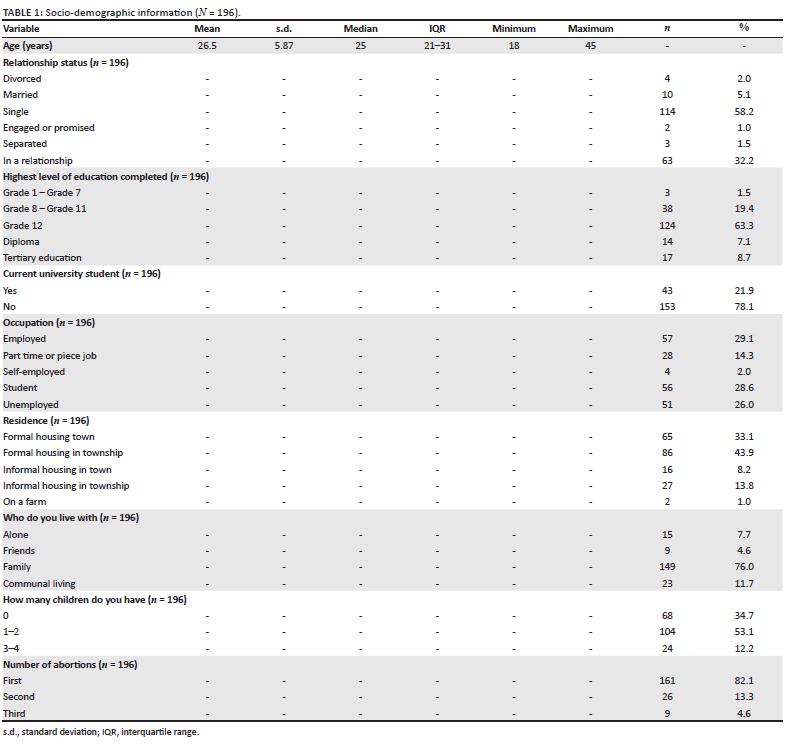
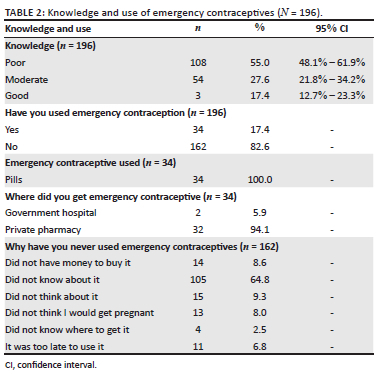
During the 9-month data collection period, 390 women were scheduled to do a TOP at the study site, and all were recruited to participate. Two hundred and five took the questionnaires to complete. Nine incomplete questionnaires were excluded as this was considered non-consent. The mean age of participants was 26.5 years (standard deviation [s.d.] = 5.87), with 114 (58.2%) participants being single women in their 20s. The socio-demographic profile of the participants is presented in Table 1. Among 162 participants who had never used emergency contraceptives, 64.8% cited a lack of knowledge as the primary barrier to use (Table 2). Only 34 (17.4%) participants have previously used emergency contraceptives, and the emergency contraceptive of choice was oral contraceptive pills (100%), and 32 (94.1%) participants obtained it from a private pharmacy. The main reason for poor uptake among the women who never used emergency contraceptives could be attributed to poor knowledge (see Table 2).
There was no observed relationship between area of residence and emergency contraceptive knowledge (p = 0.129). Furthermore, there was no statistical relation between level of education (Grade 12 and higher) and emergency contraceptive knowledge (p = 0.197). A logistic regression analysis was performed with use of emergency contraception (yes or no) as dependent variable and knowledge (good or moderate or poor) as predictor variable, modelling the probability that emergency contraception is used (Yes). Knowledge was found to be a significant predictor (p < 0.001). Calculating an odds ratio for good knowledge versus poor knowledge, it was 86 times more likely to use emergency contraception when the person had good knowledge compared to poor knowledge. Similarly, having moderate knowledge suggested 14 times more likely use of emergency contraception compared to having poor knowledge.
Using a 95% confidence interval, a range was calculated for knowledge to assess that the data were reliable (see Table 2).
Discussion
The second leading cause contributing to the global burden of disease, is unsafe sex.25
Data collection was hampered by the COVID-19 pandemic that caused a decline in TOP requests. For the period 2020 and 2021, a 29% reduction in termination of pregnancies was documented compared to 2019 and 2020.2627,28,29,30,3132527,28,29,31323334
The socio-demographic profile of this study sample was similar to that of the previous study from the KwaZulu-Natal province.1335,3637
Not only will socio-economic factors influence the family, but there can also be increased levels of stress and conflict with the sexual partner.3737,38,39,40Choice on Termination of Pregnancy Act, counselling for intimate partner violence is advised, but it is not mandatory.332
Most of the participants had a poor level of knowledge regarding emergency contraceptives (55%), and this result was in keeping with previous South African studies.9,12,14,15,16,17,19,20,2112,13,17,18,20384142,4342,43444445
The uptake of emergency contraception was low, with 17.4 % of the participants in this study reporting that they had used emergency contraceptives. It was reported that they lacked mainly knowledge of emergency contraception. Unfortunately, the poor knowledge also contributed to the poor uptake of emergency contraceptives. Of concern was the 8% who did not think that they would get pregnant, and it would have been interesting to determine whether they used other modern or cultural methods of birth control or just did not understand the biology of intercourse and pregnancy.46,47,48
Unintended pregnancies have complex and interconnected roots that need to be explored to provide comprehensive care to the woman requesting a TOP. Reasons for TOPs in South Africa are often multi-factorial and mainly socio-economical in nature.35,36
Limitations and bias
Recruiting all the women presenting for TOP, there is a limited selection bias, which is also a strength of this study. Data were collected during the COVID pandemic, and results must be interpreted within the limitations the pandemic set on patients' access to TOP facilities and contraceptives. Knowledge of emergency contraceptives was, however, independent of the pandemic. The questionnaire had only four items measuring knowledge of emergency contraception and could be considered a limitation; however, for the purpose of a dichotomous variable, it was considered sufficient for this research. It was not possible to consider language and literacy competencies before participants were recruited, as confidentiality was prioritised. This could be a limitation that some women did not feel comfortable completing the questionnaires and thus did not have the opportunity to add to this study.
Recommendations
This study alerted us that primary care facilities must advocate for more information and support to women to access emergency contraceptives at primary care level and not hospital dispensaries or private pharmacies. Increasing awareness and accessibility of a range of contraceptive options, along with proper guidance on emergency contraception for occasional use, could improve family planning outcomes. Community and primary health care interventions should aim to improve not only the knowledge and usage of emergency contraception but also provide women with a safe platform to report any injustice that led to the unintended pregnancy. It is also recommended that this study be repeated in the same setting in nonpandemic circumstances.
Conclusion
The implications of an unintended pregnancy are multifactorial and complex. If the choice is made to continue with pregnancy, it might be associated with poor antenatal care, increased maternal and child mortality and psychosocial stress, to name a few. If the choice is made to terminate, there might be short-term or long-term physical, emotional and social trauma sequelae. Emergency contraceptives can reduce the number of unintended pregnancies and its associated trauma significantly and should be utilised to its full potential. This study highlighted the importance of improving emergency contraceptive knowledge in schools, universities and primary health care.
Competing interests
The author, D.P., serves as an editorial board member of this journal. D.P. has no other competing interests to declare.
Authors' contributions
E.v.N. contributed to conceptualisation, methodology, formal analysis, investigation, writing of original draft, visualisation and project administration. D.P. contributed to conceptualisation, methodology, writing of original draft, visualisation, writing review and editing process and acted as supervisor.
Funding information
This research received no specific grant from any funding agency in the public, commercial or not-for-profit sectors.
Data availability
The authors declare that the data that support this study and findings are available in this research article and its references.
Disclaimer
The views and opinions expressed in this article are those of the authors and are the product of professional research. It does not necessarily reflect the official policy or position of any affiliated institution, funder, agency or that of the publisher. The authors are responsible for this article's results, findings and content.
Acknowledgements
Some of the work in this article stems from E.v.N.'s thesis, entitled 'Knowledge and Use of Emergency Contraceptives among Women Seeking Termination of Pregnancy in JB Marks Sub-District, North West Province', presented in partial fulfilment for the degree of Master of Medicine in Family Medicine (MMed Fam Med) in the Faculty of Health Sciences, University of the Witwatersrand in 2022.
References
-
1. Cooper D, Morroni C, Orner P, et al. Ten years of democracy in South Africa. Documenting transformation in reproductive health policy and status. Reprod Health Matters. 2004;12(24):70-85. https://doi.org/10.1016/S0968-8080(04)24143-X
» https://doi.org/10.1016/S0968-8080(04)24143-X - 2. Klugman B, Varkey S. From policy development to policy implementation: The South African Choice on Termination of Pregnancy Act. Johannesburg: Witwatersrand University Press; 2001.
-
3. Choice on Termination of Pregnancy Act 92 of 1996, Republic of South Africa Government Gazette Vol. 377 No. 17602 (22 November 1996) [homepage on the Internet]. [cited 2019 May 10]. Available from https://www.parliament.gov.za/storage/app/media/ProjectsAndEvents/womens_month_2015/docs/Act92of1996.pdf
» https://www.parliament.gov.za/storage/app/media/ProjectsAndEvents/womens_month_2015/docs/Act92of1996.pdf -
4. Choice on Termination of Pregnancy Amendment Act No. 1 of 2008. Republic of South Africa Government Gazette Vol. 512 No 30790 (18 February 2008) [homepage on the Internet]. [cited 21019 May 10]. Available from: https://www.gov.za/sites/default/files/gcis_document/201409/a1-08.pdf
» https://www.gov.za/sites/default/files/gcis_document/201409/a1-08.pdf -
5. Health Systems Trust. DHIS HST Health indicators [homepage on the Internet]. n.d. [cited 2022 Feb 22]. Available from: https://www.hst.org.za/healthindicators
» https://www.hst.org.za/healthindicators -
6. Chersich MF, Wabiri N, Risher K, et al. Contraception coverage and methods used among women in South Africa: A national household survey. S Afr Med J. 2017;107(4):307-314. https://doi.org/10.7196/SAMJ.2017.v107i4.12141
» https://doi.org/10.7196/SAMJ.2017.v107i4.12141 -
7. Chola L, McGee S, Tugendhaft A, Buchmann E, Hofman K. Scaling up family planning to reduce maternal and child mortality: The potential costs and benefits of modern contraceptive use in South Africa. PLoS One. 2015;10(6):e0130077. https://doi.org/10.1371/journal.pone.0130077
» https://doi.org/10.1371/journal.pone.0130077 -
8. Kistnasamy E, Reddy P, Jordaan J. An evaluation of the knowledge, attitude and practices of South African university students regarding the use of emergency contraception and of art as an advocacy tool. S Afr Fam Pract. 2009;51(5):423-426. https://doi.org/10.1080/20786204.2009.10873896
» https://doi.org/10.1080/20786204.2009.10873896 -
9. Hoque ME, Ghuman S. Knowledge, practices, and attitudes of emergency contraception among female university students in KwaZulu-Natal, South Africa. PLoS One. 2012;7(9):e46346. https://doi.org/10.1371/journal.pone.0046346
» https://doi.org/10.1371/journal.pone.0046346 -
10. World Health Organization. Contraception. Evidence brief [homepage on the Internet]. 2019 [updated 2019 Nov 12; cited 2022 Jan 13]. Available from: https://www.who.int/publications-detail-redirect/WHO-RHR-19.18
» https://www.who.int/publications-detail-redirect/WHO-RHR-19.18 -
11. World Health Organization. World health statistics 2020: Monitoring health for the SDGs, sustainable development goals [homepage on the Internet]. Geneva: World Health Organization; 2020. https://www.who.int/publications-detail-redirect/9789240051157
» https://www.who.int/publications-detail-redirect/9789240051157 -
12. Maharaj P, Rogan M. Emergency contraception in South Africa: A literature review. Eur J Contracept Reprod Health Care. 2008;13(4):351-361. https://doi.org/10.1080/13625180802255701
» https://doi.org/10.1080/13625180802255701 -
13. Osa-Izeko O, Govender R, Ross A. Self-reported knowledge and use of emergency contraception among women presenting for termination of pregnancy. S Afr Fam Pract. 2016;58(4):158-163. https://doi.org/10.1080/20786190.2016.1223797
» https://doi.org/10.1080/20786190.2016.1223797 -
14. Ehlers V. Adolescent mothers' utilization of contraception services in South Africa. Int Nurs Rev. 2003;50(4):229-241. https://doi.org/10.1046/j.1466-7657.2003.00187.x
» https://doi.org/10.1046/j.1466-7657.2003.00187.x -
15. Mqhayi MM, Smit JA, McFadyen ML, et al. Missed opportunities: Emergency contraception utilisation by young South African women. Afr J Reprod Health. 2004;8(2):137-144. https://doi.org/10.2307/3583187
» https://doi.org/10.2307/3583187 -
16. Roberts C, Moodley J, Esterhuizen T. Emergency contraception: Knowledge and practices of tertiary students in Durban, South Africa. J Obstet Gynaecol. 2004;24(4):441-445. https://doi.org/10.1080/01443610410001685619
» https://doi.org/10.1080/01443610410001685619 -
17. Smit J, McFadyen L, Beksinska M, et al. Emergency contraception in South Africa: Knowledge, attitudes, and use among public sector primary healthcare clients. Contraception. 2001;64(6):333-337. https://doi.org/10.1016/S0010-7824(01)00272-4
» https://doi.org/10.1016/S0010-7824(01)00272-4 -
18. Myer L, Mlobeli R, Cooper D, Smit J, Morroni C. Knowledge and use of emergency contraception among women in the Western Cape Province of South Africa: A cross-sectional study. BMC Womens Health. 2007;7(1):14. https://doi.org/10.1186/1472-6874-7-14
» https://doi.org/10.1186/1472-6874-7-14 -
19. Kwame KA, Bain LE, Manu E, et al. Use and awareness of emergency contraceptives among women of reproductive age in sub-Saharan Africa: A scoping review. Contracept Reprod Med. 2022;7:1. https://doi.org/10.1186/s40834-022-00167-y
» https://doi.org/10.1186/s40834-022-00167-y - 20. Moodley J, Morroni C. Emergency contraception-lack of awareness among women presenting for termination of pregnancy: Scientific letter. S Afr Med J. 2007;97(8):584-585.
-
21. Cooper D, Dickson K, Blanchard K, et al. Medical abortion: The possibilities for introduction in the public sector in South Africa. Reprod Health Matters. 2005;13(26):35-43. https://doi.org/10.1016/S0968-8080(05)26203-1
» https://doi.org/10.1016/S0968-8080(05)26203-1 - 22. Department of Health, South Africa. District Health Information System. Dr. Kenneth Kaunda Health District. Potchefstroom: Potchefstroom Hospital; 2019.
-
23. Statistics South Africa. Census 2011 [homepage on the Internet]. Pretoria: Statistics South Africa; 2012 [cited 2019 Apr 15]. Available from: https://www.statssa.gov.za/publications/P03014/P030142011.pdf
» https://www.statssa.gov.za/publications/P03014/P030142011.pdf -
24. Roasoft. Roasoft sample size calculator [homepage on the Internet]. No date [cited 2019 Aug 10]. Available from: http://www.raosoft.com/samplesize.html
» http://www.raosoft.com/samplesize.html -
25. Ezzati M, Lopez AD, Rodgers A, Vander Hoorn S, Murray CJ. Selected major risk factors and global and regional burden of disease. Lancet 2002;360(9343): 1347-1360. https://doi.org/10.1016/S0140-6736(02)11403-6
» https://doi.org/10.1016/S0140-6736(02)11403-6 - 26. Department of Health, South Africa. District Health Information System. Dr. Kenneth Kaunda Health District. Potchefstroom: Potchefstroom Hospital; 2021.
-
27. Fulcher IR, Onwuzurike C, Goldberg AB, et al. The impact of the COVID-19 pandemic on abortion care utilization and disparities by age. Am J Obstet Gynecol. 2022;226(6):819. https://doi.org/10.1016/j.ajog.2022.01.025
» https://doi.org/10.1016/j.ajog.2022.01.025 -
28. De Kort L, Wood J, Wouters E, et al. Abortion care in a pandemic: An analysis of the number and social profile of people requesting and receiving abortion care during the first COVID-19 lockdown (March 16 to June 14, 2020) in Flanders, Belgium. Arch Public Health. 2021;79:140. https://doi.org/10.1186/s13690-021-00665-6
» https://doi.org/10.1186/s13690-021-00665-6 -
29. Mishra SK, Rana TG, Adhikary SP, et al. Impact of COVID-19 pandemic on safe abortion and family planning services at a tertiary care women's hospital in Nepal. Int J Reprod, Contracept, Obstet Gynecol, [S.l.]. 2021;10(6):2453-2458. https://doi.org/10.18203/2320-1770.ijrcog20212192
» https://doi.org/10.18203/2320-1770.ijrcog20212192 -
30. Marquez-Padilla F, Saavedra B. The unintended effects of the COVID-19 pandemic and stay-at-home orders on abortions. J Popul Econ. 2022;35:269-305. https://doi.org/10.1007/s00148-021-00874-x
» https://doi.org/10.1007/s00148-021-00874-x -
31. Mukherjee TI, Khan AG, Dasgupta A, et al. Reproductive justice in the time of COVID-19: A systematic review of the indirect impacts of COVID-19 on sexual and reproductive health. Reprod Health. 2021;18:252. https://doi.org/10.1186/s12978-021-01286-6
» https://doi.org/10.1186/s12978-021-01286-6 -
32. Strong J. Men's involvement in women's abortion-related care: A scoping review of evidence from low- and middle-income countries. Sex Reprod Health Matters. 2022;30:1. https://doi.org/10.1080/26410397.2022.2040774
» https://doi.org/10.1080/26410397.2022.2040774 -
33. Adelekan T, Mihretu B, Mapanga W, et al. Early effects of the COVID-19 pandemic on family planning utilisation and termination of pregnancy services in Gauteng, South Africa: March-April 2020. Wits J Clin Med. 2020;2(2):43-50. https://doi.org/10.18772/26180197.2020.v2n2a7
» https://doi.org/10.18772/26180197.2020.v2n2a7 -
34. Ullah MA, Moin AT, Araf Y, Bhuiyan AR, Griffiths MD, Gozal D. Potential effects of the COVID-19 pandemic on future birth rate. Front Public Health. 2020;8:578438. https://doi.org/10.3389/fpubh.2020.578438
» https://doi.org/10.3389/fpubh.2020.578438 -
35. Steyn C, Govender I, Ndimande JV. An exploration of the reasons women give for choosing legal termination of pregnancy at Soshanguve Community Health Centre, Pretoria, South Africa. S Afr Fam Pract. 2018;60(4):126-131. https://doi.org/10.1080/20786190.2018.1432138
» https://doi.org/10.1080/20786190.2018.1432138 -
36. Ndwambi A, Govender I. Characteristics of women requesting legal termination of pregnancy in a district hospital in Hammanskraal, South Africa. S Afr J Infect Dis. 2015;30(4):22-26. https://doi.org/10.1080/23120053.2015.1107265
» https://doi.org/10.1080/23120053.2015.1107265 -
37. Lewinsohn R, Crankshaw T, Tomlinson M, et al. 'This baby came up and then he said, "I give up!": The interplay between unintended pregnancy, sexual partnership dynamics and social support and the impact on women's well-being in KwaZulu-Natal, South Africa. Midwifery. 2018;62:29-35. https://doi.org/10.1016/j.midw.2018.03.001
» https://doi.org/10.1016/j.midw.2018.03.001 -
38. Department of Basic Education, South Africa. Comprehensive sexuality education [homepage on the Internet]. No date [cited 2022 Aug 19]. Available from: https://www.education.gov.za/Home/ComprehensiveSexualityEducation.aspx
» https://www.education.gov.za/Home/ComprehensiveSexualityEducation.aspx -
39. Ngene NC, Ross A, Moodley J. Characteristics of women having first-trimester termination of pregnancy at a district hospital in Kwazulu-Natal. S Afr J Epidemiol Infect. 2013;28(2):102-105. https://doi.org/10.1080/10158782.2013.11441527
» https://doi.org/10.1080/10158782.2013.11441527 -
40. Ajayi AI, Ezegbe HC. Association between sexual violence and unintended pregnancy among adolescent girls and young women in South Africa. BMC Public Health. 2020;20:1370. https://doi.org/10.1186/s12889-020-09488-6
» https://doi.org/10.1186/s12889-020-09488-6 -
41. Department of Basic Education, South Africa. Sexuality education in Life Orientation, Scripted Lesson Plans, Grade 9 Learner book [homepage on the Internet]. No date [cited 2022 Aug 19]. Available from: https://www.education.gov.za/Portals/0/Documents/CSE%20Scripted%20lessons/Gr9%20LB%2011_11_2019A.pdf?ver=2019-11-11-143228-000
» https://www.education.gov.za/Portals/0/Documents/CSE%20Scripted%20lessons/Gr9%20LB%2011_11_2019A.pdf?ver=2019-11-11-143228-000 -
42. Eccles Dennis TC, Francis A. "No ring, no such thing": Teacher positioning on the teaching of sexuality education in Life Orientation. J Educ Stud [serial online]. 2013 [cited 2022 Aug 19];12(1). Available from: https://journals.co.za/doi/abs/10.10520/EJC157138
» https://journals.co.za/doi/abs/10.10520/EJC157138 -
43. MacPhail C, Campbell C. 'I think condoms are good but, AAI, I hate those things': Condom use among adolescents and young people in a southern African township. Soc Sci Med. 2001;52(11):1613-1627. https://doi.org/10.1016/S0277-9536(00)00272-0
» https://doi.org/10.1016/S0277-9536(00)00272-0 -
44. Mturi AJ, Bechuke AL. Challenges of including sex education in the life orientation programme offered by schools: The case of Mahikeng, North West Province, South Africa. Afr J Reprod Health [serial online]. 2019 [cited 2022 Aug 19];23(3):1340148. Available from: https://www.ajol.info/index.php/ajrh/article/view/191222
» https://www.ajol.info/index.php/ajrh/article/view/191222 -
45. Barron P, Subedar H, Letsoko M, et al. Teenage births and pregnancies in South Africa, 2017-2021 - A reflection of a troubled country: Analysis of public sector data. Afr Med J. 2022;112(4):252-258. https://doi.org/10.7196/SAMJ.2022.v112i4.16327
» https://doi.org/10.7196/SAMJ.2022.v112i4.16327 -
46. Wood K, Jewkes R. Blood blockages and scolding nurses: Barriers to adolescent contraceptive use in South Africa. Reprod Health Matters. 2006;14(27):109-118. https://doi.org/10.1016/S0968-8080(06)27231-8
» https://doi.org/10.1016/S0968-8080(06)27231-8 -
47. Williamson LM, Parkes A, Wight D, et al. Limits to modern contraceptive use among young women in developing countries: A systematic review of qualitative research. Repr Health. 2009;6:3. https://doi.org/10.1186/1742-4755-6-3
» https://doi.org/10.1186/1742-4755-6-3 -
48. Coleman JN, Milford C, Mosery N, et al. "I did not plan … that is what hurts": Pregnancy intentions and contraceptive use among pregnant young women in KwaZulu-Natal, South Africa. Afr J AIDS Res. 2021;20(2):149-157. https://doi.org/10.2989/16085906.2021.1914693
» https://doi.org/10.2989/16085906.2021.1914693

Accepted: 18 Mar. 2025
Published: 25 Oct. 2025