The prevalence of underweight in children aged 5 years and younger attending primary health care clinics in the Mangaung area, Free State
Abstract
BACKGROUND: The Constitution of South Africa stipulates that all children have the right to basic nutrition; however, a great number of South African children are underweight for age. It is important to address malnutrition as it is associated with more than 50% of all child deaths in developing countries and also increases the risk for infective diseases. AIM: To determine the prevalence of underweight in children aged 5 years and younger attending primary health care clinics in the Mangaung area, Free State, and determine the possible underlying causes thereof. SETTING: Six preselected primary health care clinics in the Mangaung area. METHODS: This was a cross-sectional study. Demographic and clinical information and anthropometric measurements were collected from the children's Road-to-Health clinic cards, obtained from the children's caregivers RESULTS: In total, 240 children were included, of which 51.7% were girls. The median age was 7.5 months. The weight-for-age graph revealed that 7.7% (95% confidence interval: 4.8%; 11.9%) of children were underweight or severely underweight for age. Length-for-age and weight-for-height graphs were mostly incomplete. Underweight children differed from normal weight children regarding birth weight (low birth weight 70.6% vs. 12.4%) and history of malnutrition (60.0% vs. 7.1%). CONCLUSION: The prevalence of underweight in children aged 0-5 years attending primary health care clinics in Mangaung is 7.7% based on information available from Road-to-Health cards. This figure could be higher if these cards were filled in more accurately. A low birth weight and history of malnutrition are associated with underweight.
Introduction
In 1948, the United Nations Children's Fund (UNICEF) declared freedom from hunger and malnutrition a basic human right.1234567
More than 50% of all child deaths are associated with malnutrition. In developing countries, infectious diseases and malnutrition are closely associated.8910
According to a study by Vorster et al.,2
Clinical evaluation and anthropometric measurements are used to assess malnutrition. Clinical signs include visible wasting and general oedema. For anthropometric measurements, the weight, height and mid-upper arm circumference (MUAC) are measured and plotted for specific ages and gender groups. The use of MUAC has been found to be a more accurate measure of nutritional status of a child than the weight-for-height graph.11
Aim and objectives
The aim of this study was to determine the prevalence of underweight in children under the age of five years attending primary health care clinics in the Mangaung area and to determine the possible underlying causes.
Methods
Study design
This was a cross-sectional study.
Setting
Public primary health care clinics in the Mangaung area, driven by professional nurses, deliver comprehensive services, including preventative, chronic and acute medicine. Based on factors such as expected number of children at the clinics and socio-economic area of the clinic, and logistics such as distance to travel to the clinic and time constraints, six primary health care clinics (out of 23 clinics in Mangaung) were purposively selected to take part in the study.
Study population and sampling strategy
The target population included children aged 5 years and younger attending public primary health care facilities in the Mangaung area. Participating clinics were contacted and preferable weekdays for data collection were set for each clinic based on the number of children usually present on these days. The sample size was set at 240 for statistical and logistical considerations. Clinics were visited once a week during the study period and consecutive patients were sampled until the target sample size for each clinic was met (ranging from 20 to 60, depending on the days of the week the clinics indicated as preferred days for data collection, and the approximate number of children visiting the clinic on these days). Children aged 5 years and younger attending the participating clinics for any reason and who had a clinic card (Road-to-Health card) were included in the study.
Malnutrition includes both overweight (z-score > 2 standard deviation [SD]) and underweight (z-score < -2 SD); however, for the purpose of this article, the researchers focused on underweight for age. The case definition for underweight for age used was a z-score of between -2 and -3 SD and severe underweight for age as a z-score of < -3 SD.
Data collection
A data collection tool was used to extract information from the Road-to-Health card. Variables included weight and head circumference at birth, vaccination status, supplements given, human immunodeficiency virus (HIV) status of mother and child, tuberculosis (TB) status of child, and anthropometric measurements and growth trends. For the pilot study, three Road-to-Health cards were obtained from each of the six selected clinics. No changes were made to the data collection sheet. The pilot study confirmed that the method of data collection, by immediately completing the data sheets once the mother or guardian gave consent, was applicable. Data from the pilot study were included in the analysis as no changes were made to the data sheet.
Data were collected between July and November 2014 by a student researcher. Mothers or guardians in the waiting room at the clinics were approached by a student researcher and asked to participate in the study. Once the study was explained to the mother or guardian, willing participants signed consent forms.
Data analysis
The student researchers coded the data. Data were analysed by the Department of Biostatistics, Faculty of Health Sciences, University of the Free State. Results were summarised by frequencies and percentages (categorical variables) or medians and percentiles (numerical variables, because of skew distribution).
Ethical considerations
The protocol was approved by the Ethics Committee of the Faculty of Health Sciences, University of the Free State (STUD NR 19/2014). Permission to conduct the study was obtained from the Free State Department of Health and the participating clinics. No identifying information was captured on the data sheets. By signing the informed consent form, the mother or guardian gave permission for the student researchers to record data from the child's Road-to-Health card.
Results
The study consisted of 240 participants of whom 51.7% (n = 124) were girls and 48.3% (n = 116) were boys. Their median age was 7.5 months (interquartile range [IQR] 3 months, 20 months). Most of the children (n = 199/236, 84.3%) had a normal birth weight of 2.5 kg or more. More than 70% of the children were born at 37 weeks or more (n = 147/201, 73.1%). The median gestational age was 39 weeks (IQR 23 weeks, 42 weeks). The median head circumference at birth was 34 cm (IQR 32 cm, 35 cm). Almost all the children were exclusively breastfed (n = 207/222, 93.2%) during their first 3 months, 5.4% (n = 12) were on formula while 1.4% (n = 3) received both breast milk and formula.
Of the 240 children, 85.8% (n = 206) were up to date with all their vaccinations as required. Thirty children missed more than one immunisation. The most frequently missed immunisations in this group were pneumococcal conjugate vaccines (PCV, 47.6%), measles (40.0%) and hepatitis B (26.7%). Of the 137 children older than 6 months, 79.6% (n = 109) had received their 6-month vitamin A supplement. Only 42.9% (n = 39) of the 91 children older than 1 year had received their 1-year deworming treatment.
The HIV status of 54 (22.5%) mothers and 72 (30.0%) children was not recorded. Of those with results, 48 (20.0%) mothers and 21 (8.7%) children tested HIV positive. Co-trimoxazole was given to 17 of the 21 HIV-positive children. Most of the 240 children tested negative for TB (n = 164, 68.3%).
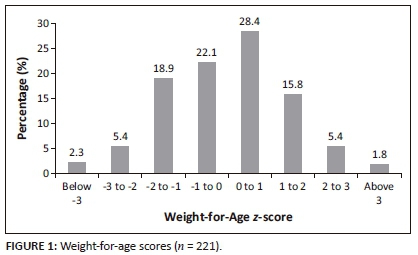
According to the most recent weight-for-age z-scores (Figure 1) of the 221 children with sufficient data, only 7.7% (95% confidence interval [CI]: 4.8%; 11.9%) (n = 17) were underweight or severely underweight for age (5.4% underweight for age and 2.3% severely underweight for age). There were insufficient recorded data for length for age (only 20.4% recorded), weight for height (only 2.9% recorded) and MUAC (only 11.7% of children aged 6 months and older recorded).
Of the 211 participants with sufficient data, 10.4% (n = 22) had a history of previous malnutrition recorded in the Road-to-Health cards, of whom only two were referred for further treatment to a doctor.
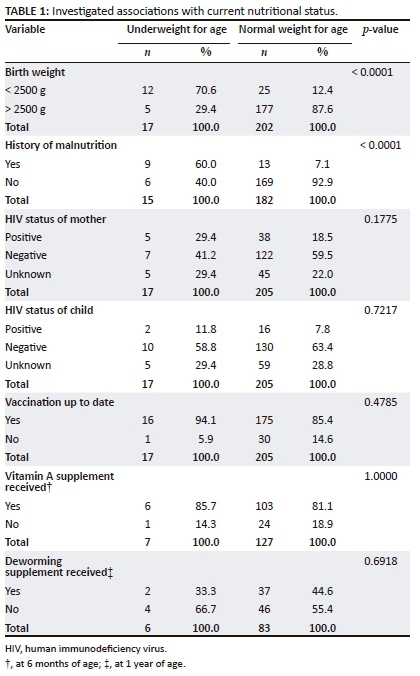
There were significant associations between birth weight and a history of previous malnutrition and the current nutritional status (Table 1). Most of the underweight-for-age children (70.6%) had a low birth weight compared to 12.4% of children who had normal weight for age. Sixty per cent of underweight children had a history of previous malnutrition compared to 7.1% of the normal weight children.
Vaccination status, HIV status of mother and child, vitamin A and deworming supplement were not significantly associated with current underweight.
Discussion
According to the weight-for-age graph, 7.7% of children aged 5 years and younger in Mangaung are currently underweight for age. A study by Sambu and Hall1314
A comparison between birth weight and underweight revealed that 70.6% of the underweight-for-age children had a low birth weight. With an average or an above-average birth weight, the likelihood of developing malnutrition and disabilities later in life may be less.14
The vast majority of children were exclusively breastfed, which is considered protective against malnutrition. In the past, formula feeding was encouraged in an attempt to reduce HIV transmission. However, it became apparent that poor sanitation and expensive formula feeds contributed to malnutrition. In 2009, the World Health Organisation (WHO) introduced the Breastfeeding Promotion Programme, which encourages breastfeeding in spite of an HIV-positive status, if antiretrovirals (ARVs) are administered to both mother and child during this time.15
Presently, 85.8% of the study population's vaccinations are up to date. This is lower than the 90.4% reported by the Department of Health in 2009 for children in the Free State under the age of 1 year.16817
For 20.4% of the children older than 6 months, there was no evidence that they received their scheduled vitamin A supplement. A study done by Mayo-Wilson et al.18
In 2010, WHO released revised guidelines on preventing mother-to-child transmission of HIV.192021
The MUAC is the international indicator of malnutrition,11
A study22
Study limitations
The student researchers were not familiar with the older Road-to-Health card; therefore, it took longer to obtain data from it. The MUAC, length and head circumference were very rarely recorded; the pilot study was too small to pick this up. An unpublished study12
Recommendations
Future studies should include both children who attend clinics and children whose parents do not bring them to clinics to have a better picture of the incidence of malnutrition in children living in the Mangaung area. Studies should also include a larger study population and more clinics in the Mangaung area to ensure that a representative study population is selected.
The HIV and TB status cannot be recorded as 'unknown' in a child's Road-to-Health card. A definite positive or negative test result should be recorded. These important conditions require a diagnosis to identify children for ARV treatment and early TB treatment to lower the risk of future complications. A rapid HIV test and four-question screening test for TB should be part of standard care.
More emphasis needs to be placed on the administration of vitamin A as well as the recording thereof in the Road-to-Health card. Weight for age, length for age and weight for height should be completed by health care workers during the child's routine check-ups to ensure all forms of malnutrition and growth deficiency are detected. Measuring and recording of the head circumference is important to ensure that proper brain development is occurring during child growth. Clinical notes need to be recorded by health care workers in the correct section of Road-to-Health card to ensure efficient routine check-ups. Timely vaccination administration, as well as catch-up immunisations should be emphasised to health care workers and parents to protect children from preventable life-threatening diseases and complications. Potential malnutrition can be addressed by preventing low birth weight through proper antenatal care.
Conclusion
The extent of underweight for age in children aged 5 years and younger who attend primary health care clinics in Mangaung is 7.7% (95% CI: 4.8%; 11.9%). Possible underlying causes may include a low birth weight and history of malnutrition. The lack of recording critical anthropometric measurements (length for age, weight for height, head circumference and MUAC) presents as an indirect cause for undiagnosed malnutrition and associated growth problems in children.
Competing interests
The authors declare that they have no financial or personal relationships that may have inappropriately influenced them in writing this article.
Authors' contributions
D.K., A.S., A.L., M.B. and C.H. developed the protocol, designed the questionnaire, performed the data collection and coding of questionnaires and wrote a draft report as part of an undergraduate research module. M.v.L. was the supervisor of this study, had the idea and assisted with the formulation of the research questions, protocol and questionnaire development, interpretation of results and writing of the manuscript. G.J. assisted with the planning of the project, performed data analysis, interpreted the data and contributed to the writing of the manuscript.
Acknowledgements
The authors acknowledge Prof. Hanneke Brits, Department of Family Medicine, for her continuous guidance during the study; Mr Cornel van Rooyen, Department of Biostatistics, for statistical assistance; and Ms Theanette Mulder, medical editor, School of Medicine, University of the Free State, for technical and editorial preparation of the manuscript.
References
-
1. UNICEF. A UNICEF policy review. Strategy for improved nutrition of children and women in developing countries [homepage on the Internet]. c1990 [cited 2014 Feb 18]. Available from: http://www.ceecis.org/iodine/01_global/01_pl/01_01_other_1992_unicef.pdf
» http://www.ceecis.org/iodine/01_global/01_pl/01_01_other_1992_unicef.pdf -
2. Vorster HH. The link between poverty and malnutrition: A South African perspective. Health SA Gesondheid. 2010;15(1):1-6. https://doi.org/10.4102/hsag.v15i1.435
» https://doi.org/10.4102/hsag.v15i1.435 -
3. United Nations. We can end poverty. The Millennium Development Goals [homepage on the Internet]. c2010 [cited 2014 Feb 18]. Available from: http://www.un.org/en/mdg/summit2010/pdf/List%20of%20MDGs%20English.pdf
» http://www.un.org/en/mdg/summit2010/pdf/List%20of%20MDGs%20English.pdf -
4. UNICEF. Levels & trends in child mortality. Report 2015. Estimates developed by the UN Inter-agency Group for Child Mortality Estimation [homepage on the Internet]. c2015 [cited 2017 Feb 22]. Available from: http://www.ceecis.org/iodine/01_global/01_pl/01_01_other_1992_unicef.pdf https://data.unicef.org/wp-content/uploads/2015/12/IGME-report-2015-child-mortality-final_236.pdf
» http://www.ceecis.org/iodine/01_global/01_pl/01_01_other_1992_unicef.pdf https://data.unicef.org/wp-content/uploads/2015/12/IGME-report-2015-child-mortality-final_236.pdf -
5. UNICEF. Malnutrition. Undernutrition contributes to nearly half of all deaths in children under 5 and is widespread in Asia and Africa [homepage on the Internet]. No date [updated 2017 Feb; cited 2017 Feb 22]. Available from: http://data.unicef.org/topic/nutrition/malnutrition/
» http://data.unicef.org/topic/nutrition/malnutrition/ - 6. Berry L, Biersteker L, Dawes A, Lake L, Smith C, editors. South African Child Gauge 2013. Part three: Children count - The numbers. Cape Town: Children's Institute, University of Cape Town; 2013; p. 84-114.
-
7. Department of Health Kwazulu-Natal. 2nd triennial report of the Committee on Morbidity and Mortality in Children under 5 years (CoMMiC): 2014 [homepage on the Internet]. c2014 [cited 2017 Feb 22]. Available from: http://www.kznhealth.gov.za/mcwh/2nd-CoMMiC-Triennial-Report-2014.pdf
» http://www.kznhealth.gov.za/mcwh/2nd-CoMMiC-Triennial-Report-2014.pdf - 8. Rice AL, Sacco L, Hyder A, Black RE. Malnutrition as an underlying cause of childhood deaths associated with infectious diseases in developing countries. Bull World Health Organ. 2000;78(10):1207-1221.
-
9. World Health Organization. UNICEF-WHO-The World Bank project. 2011 Joint child malnutrition estimates - Levels and trends [homepage on the Internet]. c2011 [cited 2014 Jan 17]. Available from: http://www.who.int/nutgrowthdb/key_facts_figures.pdf?ua=1
» http://www.who.int/nutgrowthdb/key_facts_figures.pdf?ua=1 -
10. Ruel MT, Alderman H, Maternal and Child Nutrition Study Group. Nutrition-sensitive interventions and programmes: How can they help to accelerate progress in improving maternal and child nutrition? Lancet. 2013;382(9891):536-551. https://doi.org/10.1016/S0140-6736(13)60843-0
» https://doi.org/10.1016/S0140-6736(13)60843-0 -
11. Holland D. Measuring malnutrition: Individual assessment, Part 1: Fact Sheet [homepage on the Internet]. c2011 [updated 2014 Jan 1; cited 2014 Jan 15]. Available from: http://files.ennonline.net/attachments/1052/m6-measuring-malnutrition-individual-assessment-fact-sheet.pdf
» http://files.ennonline.net/attachments/1052/m6-measuring-malnutrition-individual-assessment-fact-sheet.pdf - 12. De Beer M, Jenneke S, Parthasarady S, Swanepoel R. The prevalence of malnutrition among children (ages 6 to 59 months), in early childhood development centres in Bloemfontein. Faculty of Health Sciences, University of Free State; 2014 (Unpublished report).
-
13. Sambu W, Hall K. Nutrition - Wasting in children [homepage on the Internet]. Statistics on Children in South Africa. Children's Institute, University of Cape Town. c2014 [cited 2015 Feb 26]. Available from: http://www.childrencount.ci.org.za/indicator.php?id=4&indicator=56
» http://www.childrencount.ci.org.za/indicator.php?id=4& indicator=56 - 14. Mathews S, Jamieson L, Lake L, Smith C, editors. South African Child Gauge 2014. Cape Town: Children's Institute, University of Cape Town; 2014.
-
15. World Health Organization. Breast is always best, even for HIV-positive mothers [homepage on the Internet]. c2015 [cited 2015 Mar 2]. Available from: http://www.who.int/bulletin/volumes/88/1/10-030110/en/
» http://www.who.int/bulletin/volumes/88/1/10-030110/en/ -
16. Shung-King M. HIV and health - Immunization coverage of children [homepage on the Internet]. Statistics on Children in South Africa. Children's Institute, University of Cape Town. c2010 [cited 2015 Feb 26]. Available from: http://www.childrencount.ci.org.za/indicator.php?id=5&indicator=28
» http://www.childrencount.ci.org.za/indicator.php?id=5& indicator=28 -
17. World Health Organization. South Africa. Expanded Program on Immunization (EPI) [homepage on the Internet]. No date [cited 2017 Feb 22]. Available from: http://www.afro.who.int/en/south-africa/country-programmes/4245-expanded-program-on-immunization-epi.html
» http://www.afro.who.int/en/south-africa/country-programmes/4245-expanded-program-on-immunization-epi.html -
18. Mayo-Wilson E, Imdad A, Herzer K, Yakoob MY, Bhutta ZA. Vitamin A supplements for preventing mortality, illness, and blindness in children aged under 5: Systematic review and meta-analysis. BMJ. 2011;343:d5094. https://doi.org/10.1136/bmj.d5094
» https://doi.org/10.1136/bmj.d5094 -
19. World Health Organization. HIV/AIDS. Antiretroviral drugs for treating pregnant women and preventing HIV infections in infants - Recommendations for a public health approach [homepage on the Internet]. c2010 [cited 2017 Feb 22]. Available from: http://www.who.int/hiv/pub/mtct/antiretroviral2010/en/
» http://www.who.int/hiv/pub/mtct/antiretroviral2010/en/ -
20. Johnson L. HIV and health - HIV prevalence in children [homepage on the Internet]. Statistics on Children in South Africa. Children's Institute, University of Cape Town. c2009 [cited 2015 Feb 2]. Available from: http://www.childrencount.ci.org.za/indicator.php?id=5&indicator=29
» http://www.childrencount.ci.org.za/indicator.php?id=5& indicator=29 - 21. Shisana O, Rehle T, Simbayi LC, et al. South African national HIV prevalence, incidence and behaviour survey, 2012. Cape Town: HSRC Press; 2014.
-
22. Sambu W, Hall K. Nutrition - Stunting in children [homepage on the Internet]. Statistics on Children in South Africa. Children's Institute, University of Cape Town. c2014 [cited 2015 Feb 26]. Available from: http://www.childrencount.ci.org.za/indicator.php?id=4&indicator=53
» http://www.childrencount.ci.org.za/indicator.php?id=4& indicator=53

Accepted: 20 Jan. 2018
Published: 28 May 2018