The development of the visual screening tool for anxiety disorders and depression: Addressing barriers to screening for depression and anxiety disorders in hypertension and/or diabetes
Abstract
BACKGROUND: There is a lack of screening tools for common mental disorders that can be applied across cultures, languages and levels of education in people with diabetes and hypertension AIM: To develop a visual screening tool for depression and anxiety disorders that is applicable across cultures and levels of education SETTING: Participants were purposively recruited from two not-for-profit organisations and two public health facilities - a maternal mental health unit and a primary health care centre METHOD: This was a qualitative cross-sectional study. Thirteen drawings based on the Hospital Anxiety and Depression Scale depicting symptoms of anxiety disorders and depression were drawn. Participants described emotions and thoughts depicted in the drawings. Data were analysed through content analysis RESULTS: Thirty-one women (66%) and 16 men (34%) participated in the development of the visual screening tool. The mean age was 34 (standard deviation [SD] 12.46). There were 32 (68%) black participants, 11 (23%) mixed race participants and 4 (9%) white participants. Two participants (4%) had no schooling, 14 (31%) primary schooling, 8 (18%) senior schooling, 13 (29%) matric qualification and 8 (18%) had post-matric qualification. Participants correctly described 10 out of the 13 visual depiction of symptoms as associated with depression and anxiety disorders, with no differences between levels of education and cultural groups CONCLUSION: Ten drawings were appropriate for inclusion in the visual screening tool for anxiety disorders and depression (VISTAD). The VISTAD will be validated against the mini international neuropsychiatric interview (MINI) in a primary care population with hypertension and/or diabetes
Introduction
Diabetes and hypertension are often comorbid with depression and/or anxiety disorders.1,2,3,4,5 This comorbidity with depression and anxiety disorders has been shown to decrease adherence to treatment regimens,6789,10 In spite of this co-existence and its effects being well known, mental disorders in patients with chronic physical illness largely remain undetected and untreated at primary health care.11,12,13,14 Lecrubier15
Screening tools are often translated into other languages for use by other cultural groups. In making screening tools available for use in people across different languages, research has documented the loss of meaning in translation.21,22 Steele and Edwards232425
Educational status has been highlighted as a critical variable to be considered when developing a screening tool.1824,26,27
Researchers have developed screening tools using drawings for example, Puertas et al.2828
Contrary to Puertas et al.282927
The identification of patients with mental health problems cannot be successful without culture-fair instruments and instruments free of language bias.
Our study aimed to develop a visual screening tool that can screen both depression and anxiety disorders in people with diabetes and/or hypertension using culture-friendly drawings while avoiding some of the limitations associated with screening tools.
Methods
Development of the visual screening tool
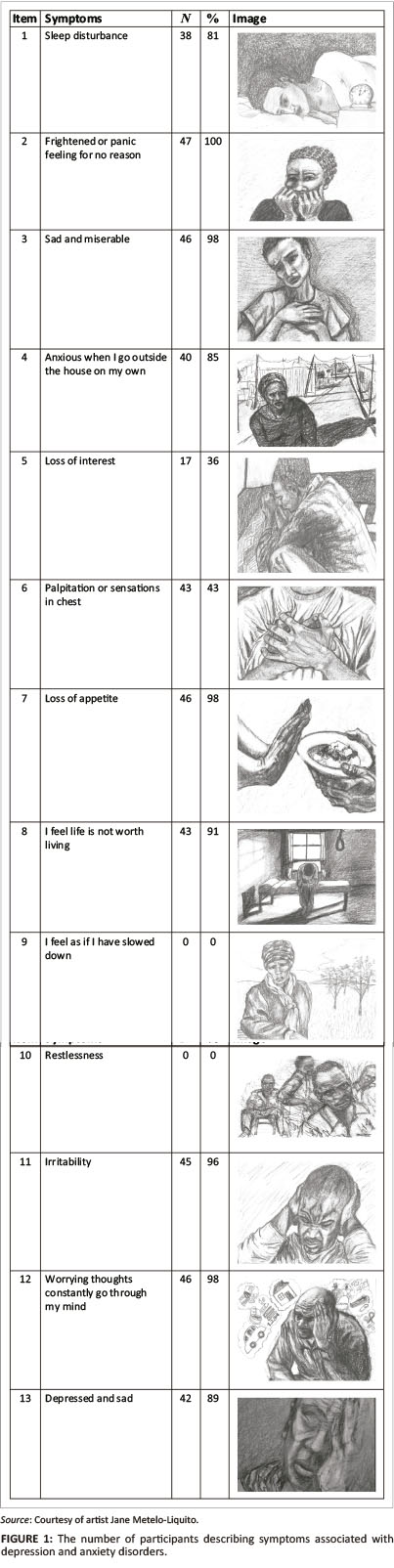
As a starting point, an artist, Mrs Jane Metelo-Liquito (Bachelor of Arts Honors, CDAT-I) was asked to make drawings depicting depression and anxiety symptoms before the recruitment for the study began. The drawings were based on the HADS3027Figure 1 shows the depression and anxiety items included in the development of the visual screening tool. Each item consisted of two drawings: one drawing depicting an abnormal state and the other depicting a normal state. Most of the drawings used in the development of the visual screening tool focused more on the face. The face, according to Betts,31
Setting
The study was conducted in two not-for-profit organisations in Cape Town and two public health facilities. The not-for-profit organisations included a church in a predominantly white community and an organisation working with business and South African youth in predominantly black and mixed-race communities. The two public health facilities included a maternal mental health clinic unit and a primary health care centre in the Eastern Cape Province of South Africa. The multiple settings included in the study serve multicultural groups from urban and rural communities and this served to minimise bias towards a specific language and/or cultural group. South Africa is a diverse country with the majority of South Africans being black people followed by mixed race people, Indian people, Asian people and white people,32
Study design
This was a qualitative cross-sectional study that utilised semi-structured interviews to develop depression and anxiety disorder items for a new visual screening tool.
Sampling strategy
Purposive sampling was utilised to recruit participants. Individuals were recruited while they were at the settings for a routine scheduled visit. The purpose of the study was explained, and individuals who expressed an interest to take part in the study were seen in a private room. The target study population excluded people with visual and hearing impairment and individuals with intellectual disability based on self-report.
Methodologists such as Morse333433
Data collection
Data were collected over a period of 3 months through semi-structured interviews conducted by the principal researcher who is a clinical psychologist. The structured interviews were conducted in English and Xhosa. English-speaking participants were interviewed in English and Xhosa-speaking participants were interviewed in Xhosa. The demographic questionnaire was administered with all the participants after the completion of written informed consent. This questionnaire was utilised to collect socio-demographic variables such as age, race, sex, marital status, level of education, employment status, family income and medical conditions. Participants were then asked to describe the emotions and thoughts depicted in the 13 drawings, with each interview lasting between 20 and 50 min. The responses provided by the participants were captured on a spreadsheet designed by a statistician.
Data analysis
The data were analysed through content analysis by coding the obtained data for words relating to symptoms of depression and anxiety disorders. Content analysis begins with predefined categories.35Figure 1) in this study were based on the HADS. Themes were identified from the descriptions provided by the participants and matched against the HADS items. The number of instances in which participants provided descriptions in response to emotions and thoughts depicted in the drawings was counted.36
Trustworthiness of the obtained data was established through respondent validation.3738
Descriptive statistics was used to describe demographic data. Demographic data was summarised as frequencies, percentages, means with standard deviation (SD). STATA version 14 was used for descriptive statistics.
Ethical considerations
Ethical approval was obtained from the Human Research Ethics Committee of the Faculty of Medicine and Health Sciences at the University of Stellenbosch (Reference number: S14/11/262) and permission was obtained from the Western Cape Department of Health and the Eastern Cape Department of Health to conduct the study. The not-for-profit organisations also granted permission to conduct the study.
Results
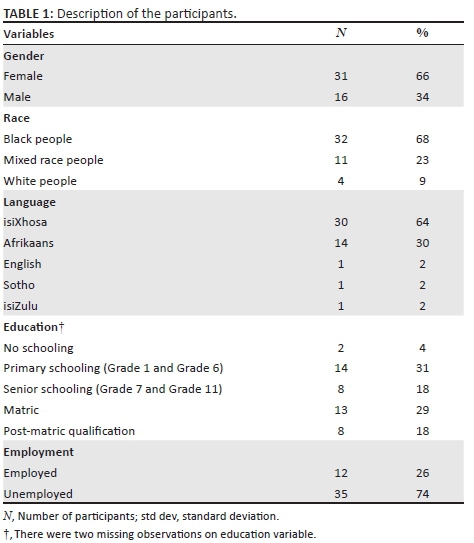
Forty-seven participants participated in the development of the new visual screening tool for anxiety disorders and depression (VISTAD). The mean age of the participants was 34 with SD 12.46 (age range 18-60 years). Thirty-five (74%) of the 47 participants were unemployed and 12 (26%) were employed. The mean income per month was US $487,70 with minimum salary less than US $357,57 and maximum US $4290,84 per month. Table 1 provides a descriptive overview of the demographics of the study participants.
Our study determined whether participants identified and described symptoms associated with depression and anxiety disorders correctly. Drawings that depicted symptoms of depression were easily identified and described by the participants. Items 1, 2, 6 and 7 recorded some of the highest frequencies in correct descriptions as symptoms of depression. The number of participants (N) who described symptoms of depression and anxiety disorders is presented in Figure 1.
As shown in Figure 1, 38 (81%) participants described item 1 as sleeping disturbance. This description was observed across race, gender and different levels of education. The other nine participants (19%) described item 1 as depicting sadness and depression. Some participants remarked that this is how they were when they were stressed, had too much on their minds and, as a result, struggled to sleep. Item 3 was described as depression, sadness and misery by 46 (98%) participants.
Similar to depression items, anxiety items were described correctly as depicting symptoms associated with anxiety disorders. For example, item 2 'frightened or panic feeling for no reason', was described as anxiety by all the 47 (100%) participants providing accurate descriptions.
The participants' personal narratives were evident in items 2 and 3. Nine participants (19%) reflected on being diagnosed with HIV and associated anxiety symptoms. The participants responded in the first person when describing the emotions and thoughts depicted in the drawings. Also, it was observed that participants became emotional and tearful during the interviews. There were 4 participants who became tearful during the interviews. In responding to item 3, sad and miserable, participants related narrative life stories which were characterised by sadness. Item 4, 'anxious when outside on my own', included 'scared, hyperalert, fear of being attacked, fearful, cannot defend herself, shadow implies fear, abused, unsafe'. Participants with varying levels of education, different races and languages were able to understand the drawings and provided descriptions of symptoms associated with anxiety and depression.
Thirty participants (64%) described item 9 as portraying sadness and loneliness in a troubled person, and descriptions such as the person was praying were also mentioned. Some of the participants described the feeling of slowing down as a story of a depressed family member (item 9). Furthermore, participants empathised with the woman on the drawing reporting she was confused, on her own and lived below the poverty line (item 9). The feeling of slowing down (item 9) and restlessness (item 10) were not identified correctly by all the participants. Seven participants (15%) narrated their life stories in relation to the feeling of slowing down (item 9) and feeling restlessness (item 10). These stories were characterised by depression and anxiety. The picture depicting restlessness (item 10) was found to be the most unclear item. This was described as a group of angry people, poverty-stricken individuals, prisoners and sad individuals.
Participants expressed sadness at the person depicted in item 13, stating that the person was stressed and had many life problems. Some of the participants personally identified with the emotional state depicted in item 13. These participants began to describe issues that concerned them in life. The descriptions provided by the participants with varying levels of education and different races and languages were associated with symptoms of depression and anxiety as predefined in the HADS, and this showed that the items could be considered for inclusion in the visual screening tool.
The items that were frequently described correctly included depression items: sleep disturbance, feeling miserable and sad, appetite, feeling life is not worth living, and anxiety items; feeling frightened or having panic feelings for no reason, feeling frightened when going out of the house on my own, getting palpitations or sensations 'butterflies' in stomach or chest, irritable than usual and worrying thoughts. Items that were least understood by the participants and did not match the predefined categories were removed, both the normal and abnormal state drawings.
Discussion
Forty-seven participants participated in the development of the VISTAD. The study confirmed that cultural and educational background had no bearing on the ability of participants to identify and describe symptoms associated with depression and anxiety disorders. Participants with low levels of education performed similarly to those with higher levels of education, and this was observed across cultures. Previous studies found visual screening tools to be valid for use as screening tools in people with low and high levels of education.293940
The participants used their life stories in describing emotions and thoughts depicted in the drawings. The use of drawings potentially offers invaluable opportunities to explore emotional status across cultural boundaries. Similar to the Rorschach technique, individuals have tremendous freedom of response.414142
The participants often responded in the first person and added statements such as 'that was me' when they identified with a specific drawing, such as sleep disturbance item. Projective drawings provide information that can enrich an individual's description of his or her own experience.4343
The new screening tool was named the VISTAD. Of the 13 drawings depicting symptoms associated with depression and anxiety disorders, we selected 10 to be used in the validation study of the VISTAD. These included the normal state drawings. Items: 'feeling as if one's mind has slowed down', 'restlessness' and 'loss of interest' were excluded from the validation study. This included both the drawings portraying a normal and an abnormal state. The VISTAD will be validated against the mini international neuropsychiatric interview (MINI) for accuracy as a screening tool in a primary health care population diagnosed with hypertension or diabetes.
Limitations
The research participants were predominantly of a low socio-economic status. However, the VISTAD is designed for primary health care, and primary health care predominantly services people of low socio-economic status. Furthermore, the study did not include all racial groups. There were no Indian participants or Asian participants. The answers provided by the participants were captured on a spreadsheet during the interview and were not recorded as the participants described emotions and thoughts.
Conclusions
The findings of this study demonstrate that the drawings are appropriate for use with people from different cultural backgrounds and varying educational levels to describe the same feelings and thoughts. As a next step, in order to establish the psychometric properties of the VISTAD, it should be validated against the MINI in a primary health care population with hypertension or diabetes.
Competing interests
The authors declare that they have no conflicts of interest to disclose. Neither personal nor financial relationship may have inappropriately influenced them in writing this article.
Authors' contributions
This article is produced from a research paper that will be submitted for a PhD in Psychiatry. Z.O. is the principal researcher and collected data and produced the first draft of the article. L.K. is the research supervisor and reviewed the article. D.J.H.N. is the co- supervisor and reviewed the article.
Acknowledgements
The authors greatly acknowledge the funding support provided by the Maternal Mental Health Fund, Rural Health Fund, National Research Foundation and the National Health Scholars Programme. They would like to thank Prof. Martin Kidd for his input on data analysis. This study was funded by the Maternal Mental Health Fund, Rural Health Fund, National Research Foundation and the National Health Scholars Programme.
References
-
1. Berge LI, Riise T, Tell GS, et al. Depression in persons with diabetes by age and antidiabetic treatment: A cross-sectional analysis with data from the Hordaland Health Study. PLoS One. 2015;10(5):e0127161. https://doi.org/10.1371/journal.pone.0127161
» https://doi.org/10.1371/journal.pone.0127161 -
2. Hasan SS, Clavarino AM, Dingle K, Mamun AA, Kairuz T. Diabetes mellitus and the risk of depressive and anxiety disorders in Australian women: A longitudinal study. J Womens Health. 2015;24(11):889-898. https://doi.org/10.1089/jwh.2015.5210
» https://doi.org/10.1089/jwh.2015.5210 -
3. Roy T, Llyod CE. Epidemiology of depression and diabetes: A systematic review. J Affect Disord. 2012;142(Suppl 1):S8-S21. https://doi.org/10.1016/S0165-0327(12)70004-6
» https://doi.org/10.1016/S0165-0327(12)70004-6 -
4. Semenkovich K, Brown ME, Svrakic DM, Lustman PJ. Depression in type 2 diabetes mellitus: Prevalence, impact, and treatment. Drugs. 2015;75:577-587. https://doi.org/10.1007/s40265-015-0347-4
» https://doi.org/10.1007/s40265-015-0347-4 -
5. Stein DJ, Aguilar-Gaxiola S, Alonso J, et al. Associations between mental disorders and subsequent onset of hypertension. Gen Hosp Psychiatry. 2014;36(2):142-149. https://doi.org/10.1016/j.genhosppsych.2013.11.002
» https://doi.org/10.1016/j.genhosppsych.2013.11.002 -
6. Gonzalez JS, Esbitt SA, Schneider HE, Osborne PJ, Kupperman EG. Psychological issues in adults with type 2 diabetes In: Pagoto S, editor. Psychological co-morbidities of physical illness: A behavioral medicine perspective. New York: Springer, 2011; p. 73-122. https://doi.org/10.1007/978-1-4419-0029-6_2
» https://doi.org/10.1007/978-1-4419-0029-6_2 -
7. Goldney R, Phillips P, Fisher L, Wilson D. Diabetes, depression and quality of life: A population study. Diabetes Care. 2004;27(5):1066-1070. https://doi.org/10.2337/diacare.27.5.1066
» https://doi.org/10.2337/diacare.27.5.1066 -
8. Egede LE, Ellis C. Diabetes and depression: Global perspectives. Diabetes Res Clin Pract. 2010;87:302-312. https://doi.org/10.1016/j.diabres.2010.01.024
» https://doi.org/10.1016/j.diabres.2010.01.024 -
9. Hutter N, Schnurr A, Baumeister H. Healthcare costs in patients with diabetes mellitus and comorbid mental disorders: A systematic review. Diabetologia. 2010;53(12):2470-2479. https://doi.org/10.1007/s00125-010-1873-y
» https://doi.org/10.1007/s00125-010-1873-y -
10. Egede LE, Bishu KG, Walker RJ, Dismuke CE. Impact of diagnosed depression on healthcare costs in adults with and without diabetes: United States, 2004-2011. J Affect Disord. 2016;195:119-126. https://doi.org/10.1016/j.jad.2016.02.011
» https://doi.org/10.1016/j.jad.2016.02.011 -
11. Chou SP, Huang B, Goldstein R, Grant BF. Temporal associations between physical illnesses and mental disorders - Results from the Wave 2 National Epidemiologic Survey on Alcohol and Related Conditions (NESARC). Compr Psychiatry. 2013;54(6):627-638. https://doi.org/10.1016/j.comppsycegchh.2012.12.020
» https://doi.org/10.1016/j.comppsycegchh.2012.12.020 -
12. Lotfi L, Flyckt L, Krakau I, Mårtensson B, Nilsson GH. Undetected depression in primary healthcare: Occurrence, severity and co-morbidity in a two-stage procedure of opportunistic screening. Nord J Psychiatry. 2010;64(6):421-427. https://doi.org/10.3109/08039481003786378
» https://doi.org/10.3109/08039481003786378 -
13. Mash B, Levitt N, Steyn K, Zwarenstein M, Rollnick S. Effectiveness of a group diabetes education programme in underserved communities in South Africa: Pragmatic cluster randomized control trial. BMC Fam Pract. 2012;13:126. https://doi.org/10.1186/1471-2296-13-126
» https://doi.org/10.1186/1471-2296-13-126 -
14. Petersen I, Lund C. Mental health service delivery in South Africa from 2000 to 2010: One step forward, one step back. S Afr Med J. 2011;101(10):751-757. https://doi,org/10.7196/samj.4841
» https://doi,org/10.7196/samj.4841 - 15. Lecrubier Y. The burden of depression and anxiety in general medicine. J Clin Psychiatry. 2001;62(8):4-9.
-
16. Jenkins R, Othieno C, Okeyo S, et al. Short structured general mental health in service training programme in Kenya improves patient health and social outcomes but not detection of mental health problems - A pragmatic cluster randomised controlled trial. Int J Ment Health Syst. 2013;7:25. https://doi.org/10.1186/1752-4458-7-25
» https://doi.org/10.1186/1752-4458-7-25 -
17. Van Oers HM, Schlebusch L. Review article: Anxiety and the patient with breast cancer: A review of current research and practice. S Afr Fam Pract [serial online]. 2013 [cited 2014 May];55(6):525-529. Available from: http://www.ajol.info/index.php/safp/article/viewFile/99010/88333
» http://www.ajol.info/index.php/safp/article/viewFile/99010/88333 -
18. Foxcroft CD. Planning a psychological test in the multicultural South African context. S Afr J Indust Psychol. 2004;30(4):8-15. https://doi.org/10.4102/sajip.v30i4.171
» https://doi.org/10.4102/sajip.v30i4.171 -
19. Andersen LS, Grimsrud A, Myer L, Williams DR, Stein DJ, Seedat S. The psychometric properties of the K10 and K6 scales in screening for mood and anxiety disorders in the South African stress and health study. Int J Methods Psychiatr Res. 2011;20(4):215-223. https://doi.org/10.1002/mpr.351
» https://doi.org/10.1002/mpr.351 -
20. Moullec G, Maïano C, Morin AJS, Monthuy-Blanc J, Rosello L, Ninot G. A very short visual analog form of the Center for Epidemiologic Studies Depression Scale (CES-D) for the idiographic measurement of depression. J Affect Disord. 2010;128:220-234. https://doi.org/10.1016/j.jad.2010.06.006
» https://doi.org/10.1016/j.jad.2010.06.006 -
21. Kerr LK, Kerr LD. Screening tools for depression in primary care: The effects of culture, gender, and somatic symptoms on the detection of depression. West J Med. 2001;175(5):349-352. https://doi.org/10.1136/ewjm.175.5.349
» https://doi.org/10.1136/ewjm.175.5.349 -
22. Smit J, Myer L, Middelkoop K, et al. Mental health and sexual risk behaviours in a South African township: A community-based cross-sectional study. Public Health. 2006;120:534-542. https://doi.org/10.1016/j.puhe.2006.01.009
» https://doi.org/10.1016/j.puhe.2006.01.009 - 23. Steele G, Edwards D. Development and validation of the Xhosa translations of the beck inventories: Challenges of the translation process. J Psychol Afr. 2007;18(1):207-216.
-
24. Hermanns N, Caputo S, Dzida G, Khunti K, Meneghini LF, Snoek F. Screening, evaluation and management of depression in people with diabetes in primary care. Primary Care Diabetes. 2013;7(1):1-10. https://doi.org/10.1016/j.pcd.2012.11.002
» https://doi.org/10.1016/j.pcd.2012.11.002 -
25. Alexander CL, Arnkoff DB, Kaburu AW, Glass CR. Detecting depression in rural primary care clinics in central Kenya: Impact of a brief training intervention. Int Perspect Psychol Res Pract Consult. 2013;2(1):14-28. https://doi.org/10.1037/a0031360
» https://doi.org/10.1037/a0031360 -
26. Hanlon C, Luitel NP, Kathree T, et al. Challenges and opportunities for implementing integrated mental health care: A district level situation analysis from five low- and middle-income countries. PLoS One. 2014;9(2):e88437. https://doi.org/10.1371/journal.pone.0088437
» https://doi.org/10.1371/journal.pone.0088437 -
27. Reddy P, Philpot B, Ford D, Dunbar JA. Identification of depression in diabetes: The efficacy of the PHQ-9 and the HADS-D. Br J Gen Pract. 2010;60(575):e239-e245. https://doi.org/10.3399/bjgp10X502128
» https://doi.org/10.3399/bjgp10X502128 -
28. Puertas G, Patel V, Marshall T. Are visual measures of mood superior to questionnaire measures in non-Western settings? Soc Psychiatry Psychiatr Epidemiol. 2004;39(8):662-666. https://doi.org/10.1007/s00127-004-0800-2
» https://doi.org/10.1007/s00127-004-0800-2 -
29. Akena D, Joska J, Musisi S, Stein DJ. Sensitivity and specificity of a visual depression screening instrument among HIV-positive individuals in Uganda, an area with low literacy. AIDS Behav. 2013;16(8):2399-2406. https://doi.org/10.1007/s10461-012-0267-1
» https://doi.org/10.1007/s10461-012-0267-1 -
30. Zigmond AS, Snaith RP. The hospital anxiety and depression scale. Acta Psychiatr Scand [serial online]. 1983;67(6):361-370. Available from: http://www.readcube.com/articles/10.1111/j.1600-0447.1983.tb09716.x?r3_referer=wol&tracking_action=preview_click&show_checkout=1&purchase_referrer=onlinelibrary.wiley.com&purchase_site_license=LICENSE_EXPIRED
» http://www.readcube.com/articles/10.1111/j.1600-0447.1983.tb09716.x?r3_referer=wol& tracking_action=preview_click& show_checkout=1& purchase_referrer=onlinelibrary.wiley.com& purchase_site_license=LICENSE_EXPIRED -
31. Betts DJ. Developing a projective drawing test: Experiences with the face stimulus assessment (FSA). Art Therapy. 2003;20(2):77-82. https://doi.org/10.1080/07421656.2003.10129393
» https://doi.org/10.1080/07421656.2003.10129393 - 32. Statistics South Africa. Community Survey 2016, Statistical release P0301. Statistics South Africa. Pretoria: Statistics; South Africa; 2016.
-
33. Morse JM. Editorial: Determining sample size. Qual Health Res. 2000;10:3-5. https://doi.org/10.1177/104973200129118183
» https://doi.org/10.1177/104973200129118183 -
34. Mason M. Sample size and saturation in PhD studies using qualitative interviews. Forum Qual Soc Res [serial online]. 2010 [cited 2015 Nov 19];11(3):8. Available from: http://www.qualitative-research.net/index.php/fqs/article/view/1428/3027
» http://www.qualitative-research.net/index.php/fqs/article/view/1428/3027 - 35. Ezzy D. Qualitative analysis: Practice and innovation. London: Routledge; 2002.
- 36. Marks DF, Yardley L. Research methods for clinical and health psychology. In: Joffe H, Yardley L, editors. Content and thematic analysis. London: Sage, 2004; p. 56-68.
- 37. Lincoln Y, Guba E. Naturalistic inquiry. Beverly Hills, CA: Sage; 1985.
-
38. Torrance H. Triangulation, respondent validation, and democratic participation in mixed methods research. J Mixed Methods Res. 2012;6(2):111-123. https://doi.org/10.1177/1558689812437185
» https://doi.org/10.1177/1558689812437185 -
39. Vick RM, Strauss BS. Assessment of affects: Comparison of ratings of prestructured images with Symptom Check List. Art Therapy. 1997;14(2):95-101. https://doi.org/10.1080/07421656.1987.10759263
» https://doi.org/10.1080/07421656.1987.10759263 - 40. Oster GD, Crone PG. Using drawings in assessment and therapy: A guide for mental health professionals. 2nd ed. New York: Brunner-Routledge; 2004.
-
41. Aronow E. The Rorschach: Projective technique or psychometric test. J Pers Assess. 1995;64(2):213-228. https://doi.org/10.1207/s15327752jpa6402_1
» https://doi.org/10.1207/s15327752jpa6402_1 - 42. Anderson JW. Henry A. Murray and the creation of the Thematic Apperception Test. In: Gieser L, Stein MI, editors. Evocative images: The thematic apperception test and the art of projection. Washington, DC: American Psychological Association, 1999; p. 23-38.
- 43. Terre Blanche S. A picture is worth a thousand words: An overview of drawing as a tool for projective assessment. New Voices Psychol. 2013;9(1&2):3-15.

Accepted: 12 Apr. 2018
Published: 19 Jun. 2018