Perceptions of women towards screening for intimate partner violence
Abstract
BACKGROUND: Intimate partner violence (IPV) is an under-diagnosed public health problem affecting women with attendant negative bio-psycho-social ramifications, and unfortunately there is no universally agreed recommendation for routine hospital IPV screening currently AIM: This study was carried out to determine the prevalence of IPV among women and their perceptions towards screening SETTING: The study was carried out in a hospital in Southwest, Nigeria METHODS: The study was a descriptive, cross-sectional study of 347 consenting women. Respondents were recruited using systematic random sampling. Data were collected using questionnaire adapted from the World Health Organization's (WHO) Multi-Country Study Questionnaire on Women's Health and Domestic Violence against women. Descriptive and inferential statistics were used and a p-value < 5% was considered significant RESULTS: The prevalence of IPV among the sample was 71.2%. The most common IPV pattern was controlling behaviour (49.6%) while sexual violence (19.6%) was the least. The majority (85.0%) of the respondents agreed that routine IPV screening should be done for women while 96.5% believed that it would enable doctors to help identify victims. The belief that it will help physicians in making a correct diagnosis, shared by 10.7% of the respondents, was statistically significant (odd ratio [OR] = 2.592, 95% confidence interval [CI] = 1.180-5.694, p-value = 0.018). A total of 37 respondents (10.7%) were about three times more likely to have experienced IPV than others CONCLUSION: There was a high prevalence of IPV and the women are open to routine hospital IPV screening, with the belief that it will help physicians to make an accurate diagnosis of IPV CONTRIBUTION: This research was done by majority of family health specialists, in Nigeria, an African country. The focus of the research was distinctly with an African perspective, in the field of family medicine which has a public health implication and effect on the community
intimate partner violence; perception; prevalence; screening; women
Introduction
Intimate partner violence (IPV) is one of the most common forms of violence against women and includes physical, emotional, sexual abuse and controlling behaviours by an intimate partner.112
In the past, IPV was considered mainly a social and minor issue affecting only relatively few women and not of importance to the health sector. However, becasue of the increasing awareness of its health consequences and its effects on the family, it has now been recognised to be of significant public health importance affecting every part of the society.1,2,3,4,56
Despite the numerous studies done revealing the magnitude of IPV worldwide, there has been no consensus among professional health bodies on the need for screening all women presenting to healthcare facilities for IPV.7891011,121213
This study, therefore, aimed to determine the perception of women towards screening for IPV, and the objectives are to determine the prevalence of IPV and the factors affecting the perception towards screening for IPV among women. The information from this study can be used in making policies that will help to reduce the burden and impact of IPV.
Methods
Study design
This was a hospital-based, descriptive, cross-sectional study.
Setting
The research was carried out in Federal Medical Centre, Owo, Ondo State. The Federal Medical Centre Owo (FMC OWO) is a 280-bedded tertiary healthcare facility, which offers general and specialised care in various fields to patients from Ondo, Ekiti, Osun, Kogi and Edo States with the General Outpatient Clinic (GOPC) and the Emergency departments (ED) serving as the major points of contact and entry for diverse patients. The departments within the hospital are Family medicine, Emergency medical services, Internal medicine, Obstetrics and Gynaecology, Paediatrics, Community Health, Dental services, Pathology, Psychiatry, Radiology, Physiotherapy, Dietetics, Laboratory Services and Surgery and its subspecialties. The hospital offers residency training for doctors in Family medicine, Internal Medicine, General Surgery, Orthopaedics, Paediatrics and Obstetrics and Gynaecology. The hospital has a main laboratory and a references laboratory where several investigations are done daily including biochemical, microbiological, pathological, as well as a functional 24-h blood transfusion services.
The Family Medicine Department oversees the GOPC where patients are attended to by both the Consultant Family Physicians and the residents in training with a patient-centred care philosophy.
Owo is one of the local governments in Ondo State, Southwestern Nigeria. Owo local government area (LGA) lies within latitude 7.1833ºN and longitude 5.5833ºE, and it is about 50 km from Akure, the capital of Ondo State and 250 km from Lagos.14215
Study population
The study participants were recruited from among registered female patients aged 18 years and above, attending the GOPC of Federal Medical Centre Owo.
Sample size determination
The sample size was calculated using the Dobson formula1617

Sampling strategy
The inclusion criteria included women aged 18 years and above who gave consent and had or have had heterosexual intimate partners in the previous one year. Eligible women who had mental or severe medical illnesses that rendered them incapable of participating in the study were excluded. A total of 347 women were recruited for the study.
Sampling technique
A systematic random sampling method was used in the selection of the study participants. An average of 100 patients attended the GOPC per day from the hospital records of which about 70 were adults. The female-to-male ratio from the records was approximately 2:1. Therefore, an average of 47 adult female patients is seen per day. The data collection was over eight weeks. All the 347 respondents were recruited in eight weeks, i.e. 347/8 = 43 respondents per week, hence nine patients per day. The sample interval was 5 (43/9 = 4.7). Each day, the first registered eligible consenting subject who fulfilled the inclusion criteria was recruited; this was followed by every fifth eligible consenting subject until the daily quota of nine was completed. For every eligible prospective respondent who declined to consent, the next eligible consenting woman was recruited in her stead. The study was conducted from 01 October 2017 until 30 November 2017.
Data collection
Before the commencement of the study, the questionnaire was pretested among 34 women attending the GOPC of the State General hospital in the same locality as the study centre. The administration took between 10 and 15 min for each subject. The study was conducted using the pre-tested semi-structured, interviewer-administered questionnaire, which was also translated into the local language (Yoruba language) for those who did not understand the English language. The questionnaires were administered directly to eligible consenting subjects after written informed consent was obtained. The interview was conducted after consultation in a separate consulting room dedicated to the study for the sake of confidentiality. Each completed questionnaire was coded and kept in a well-secured bag and the data obtained were entered into the computer secured with a password. The questionnaires were administered directly by the principal investigator because of the sensitive nature of the subject studied. The data were cross-checked within 24 h for completeness.
The questionnaire was adapted from the questionnaire developed by the World Health Organization (WHO) in a Multi-Country Study on Women's Health and Domestic Violence against Women, which is cross-culturally valid.6
The modifications made in the questionnaire for the purpose of this study included questions on the socio-demographic data, husband's or partner's attitude to IPV and subject's financial autonomy. The questionnaire had three sections - A to C.
Section A was on the socio-demographic variables such as the subjects' and their partners' age, level of education, occupation and social class. The social class was assigned using the Ogunlesi socioeconomic classification.18
Section B was on the experience of partner violence: this was categorised into four groupings - partner's controlling behaviour, emotional violence, physical violence and sexual violence. Screening for partner's controlling behaviour included asking whether a spouse or partner had ever kept her from seeing her friends, restricted her contact with her family, insisted on knowing where she is always, got angry if she speaks with other men, accused her of being unfaithful and whether he controls her access to healthcare? A 'Yes' response to one or more of these questions listed suggested the presence of the partner's controlling behaviour.
Questions on emotional abuse included whether a spouse or partner had ever insulted her or made her feel bad about herself, if the latter had ever humiliated or belittled her in front of others, intimidated or scared her on purpose or had threatened to hurt her or hurt someone she cares about. A 'Yes' response to any of this indicated emotional abuse.
For physical violence, a respondent was asked whether a spouse or partner had ever slapped, kicked, dragged or beaten her, choked her on purpose, thrown something at her that could hurt her, threatened her with or use a dangerous weapon or object against her and if any of these had occurred in the past 12 months. A 'Yes' response to one or more of these questions indicated physical violence.
For sexual violence, a respondent was asked whether a spouse or a partner had ever physically forced her to have sexual intercourse against her will, whether she had sexual intercourse with the latter because she was afraid of what her partner might do and whether she had been forced to do something sexual she found degrading or humiliating. Also, if any of these had occurred in the past 12 months. A 'Yes' response indicated sexual violence. Questions on injuries sustained and the use of healthcare facilities because of IPV were also included in this section.
Section C was on perception towards screening for IPV. Respondents were asked if they have ever been asked by a doctor or other health workers about their experience of IPV during any prior hospital visit. Respondents were asked if physicians and health workers should routinely ask adult female patients about IPV for which the Likert scale was scored 1-5; strongly agree was scored 1 point; agree had a score of 2 points; undecided had 3 points; disagree had 4 points and strongly disagree had 5 points. They were also asked to give the reason(s) for their answer.
Data analysis
The data obtained were analysed using the Statistical Package for Social Sciences (SPSS) for Windows software version 22 (SPSS 22, Chicago).19
Ethical considerations
Ethical clearance was obtained from the Ethics and Research Committee of Federal Medical Centre, Owo, Ondo State, with reference number FMC/OW/380/VOL.XLVII/122. Written informed consent was obtained from all the respondents after explaining the nature of the study to them. Confidentiality of all the divulged information was assured by maintaining anonymity on the questionnaires and ensuring that only the researcher had access to the respondents' information. Each participant was informed that she could terminate the interview and pull out of the research at any stage without any consequences.
Results
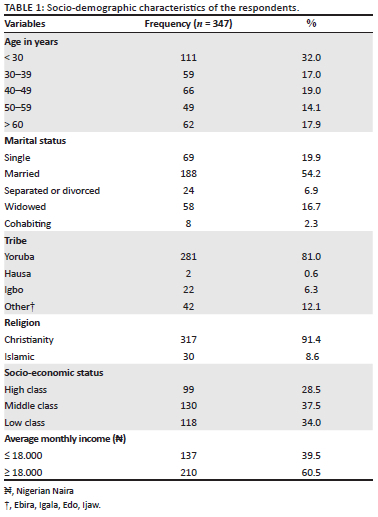
A total of 347 women were recruited for the study. The respondents' mean (± standard deviation [s.d.]) age was 41.8 (± 15.6) years, with age group < 30 years being the largest proportion, 111 (32.0%), while the age group 50-59 years had the lowest proportion 49 (14.1%). More than half (54.2%) of the respondents were married, while only 2.3% of the respondents were cohabiting. Among the ever-married participants, about two-thirds were monogamous. More than three-quarters (81.0%) of the respondents were from the Yoruba tribe, while Christianity (91.4%) was the dominant religion. The middle class constituted the highest proportion (37.5%) of the respondents. The majority (60.5%) earned above the national minimum wage (Table 1).
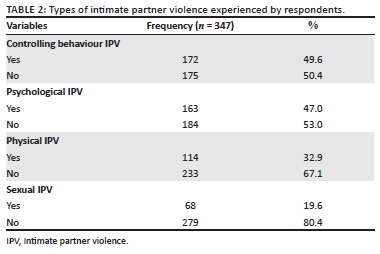
The prevalence of IPV experienced among the respondents was 71.2%, while 28.8% had never experienced any form of IPV in the previous 12 months. Table 2 showed the types of IPV experienced by the respondents. Controlling behaviour (49.6%) was the commonest type of IPV experienced, while sexual violence (19.6%) was the least.
The majority of respondents 309 (89.0%) had never been screened for IPV in the previous 12 months, while only 38 (11.0%) of the respondents had ever been asked by a doctor or other health workers about their experience of IPV during any prior hospital visit in the previous 12 months.
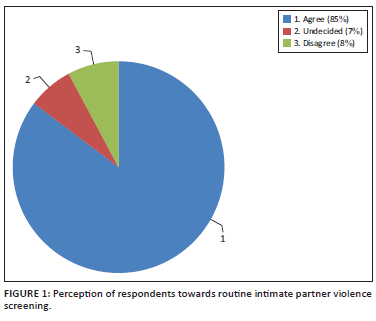
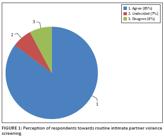
The perception of the respondents towards routine IPV screening for every adult female that presented to the GOC is shown in Figure 1. An overwhelming majority of the respondents 296 (85.0%) agreed that all women should be routinely screened for IPV, while 27 (8.0%) respondents disagreed with routine screening.
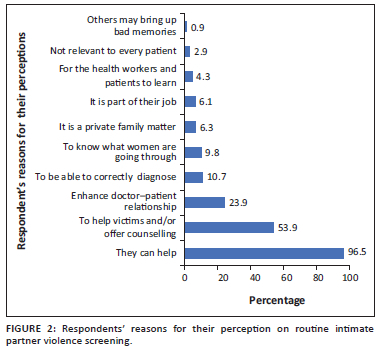
The reasons for the respondents' positive perception towards routine IPV screening are shown in Figure 2. Most of the respondents 335 (96.5%) believed that routine IPV screening would enable doctors to help the identified victims. More than half 187 (53.9%) of them felt that it would enable doctors to offer the IPV victims appropriate counselling, while 21 (6.1%) respondents felt that routine IPV screening should be part of the job or responsibilities of doctors by default, and 37 (10.7%) felt it would assist doctors in making the right diagnosis. Conversely, 22 (6.3%) respondents believed it was a private family matter while 3 (0.9%) respondents believed it could bring up bad memories in the patients' minds. It should be noted, however, that many of the respondents gave multiple responses.
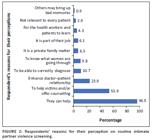
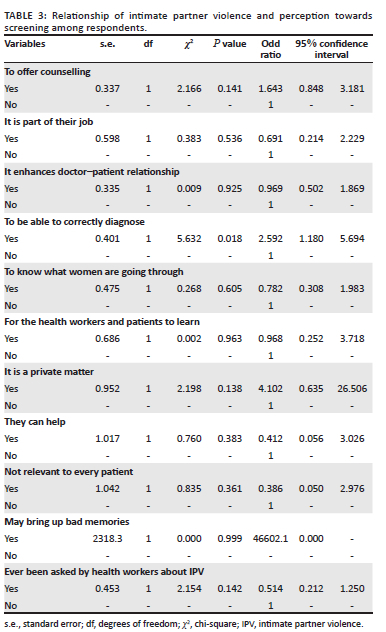
Table 3 showed the relationship between IPV and the perception towards IPV screening among the respondents. The only statistically significant finding was among respondents who thought that routine IPV screening will help doctors arrive at the right diagnosis (odds ratio [OR] = 2.592, CI = 1.180-5.694, p-value = 0.018). These respondents were about three times more likely to have IPV screening than other respondents.
Discussion
The mean (± SD) age of the respondents was 41.8 (± 15.6) years, which mirrors the Nigerian population pyramid as reported by the Nigerian Demographic and Health Survey (NDHS) carried out in 2013, which indicated that Nigeria comprises a relatively young population.1761720
The prevalence of IPV in the previous 12 months found in this study was 71.2%, which was similar to a study in South East Nigeria.212223242533
The trend of IPV pattern in this study was similar to that reported in the WHO Multi-Country study where the proportion of study participants who had experienced controlling behaviour (21% - 90%), psychological and/or emotional violence (20% - 75%), physical violence (13% - 61%) and sexual violence (6% - 59%)6626216,263,27,28,29,30
Sexual violence was the least common pattern of IPV among the respondents in this study (19.6%). This finding was similar to several other studies.6,21,25,31,32173332,34,3527ab initio.27
From this study, it was found that 309 (89.0%) respondents had never been asked by any doctor or other healthcare practitioners about IPV experience in the previous 12 months during any hospital visits. This is similar to other studies that showed that few women reported being routinely asked about IPV by the physicians in the clinics or in the emergency room; hence many cases go undetected.1,11,1236
An overwhelming majority of the respondents 296 (85.0%) agreed that all women should be routinely screened for IPV while less than one-tenth of the respondents 27 (8.0%) disagreed, and 24 (7.0%) were undecided. This finding suggested that women may not be opposed to being routinely questioned about their IPV experience. This was similar to a previous study that reported that women would welcome being screened by physicians in a confidential and supportive manner.1188,373837,38
In developing a clinical and policy guideline as a response to IPV, the WHO found that respondents identified healthcare providers as the professionals they would most trust with disclosure of IPV.399,11,40,4137
The predictor for positive perception towards screening for IPV in this study was that the screening will help physicians in making the correct diagnosis. Of these respondents, 37 (10.7%) were three times more likely to allow IPV screening than others.
The present study showed that respondents disagreed with routine IPV screening (8.0%) or were undecided about IPV screening (7.0%) because it was not relevant to every patient (6.9%), it was a private family matter and therefore beyond the purview of physicians (6.3%) and that it could evoke bad memories in affected women (0.9%), which they would rather not want to talk about. The last two reasons have been proposed to be part of the factors responsible for recall biases in studies and therefore the underestimation of IPV prevalence6,17,42
Limitations of the study
The limitation of this study is the effects of recall and reporting bias on the part of the respondents. Nevertheless, a high level of confidentiality and privacy was ensured to minimise the effect of the reporting bias while administering the study instrument. Also, the findings of this study might not be generalisable to the general populace because it is a hospital-based study. The strength of the study is the instrument used for investigating IPV, which was adapted from the Women's Health and Life Experiences Questionnaire, a validated tool developed by the WHO for IPV research.
Conclusion
In conclusion, IPV was highly prevalent among women presenting to hospital in Owo, Ondo State, and controlling behaviour was the most common form. The majority of the women would want routine IPV screening during hospital visits as it would help the physician in making the correct diagnosis. It is, therefore, recommended that routine IPV screening be incorporated into routine history taking among adult females in GOPCs. Likewise, a community-based study should be conducted to know the prevalence of IPV and perceptions of women towards IPV.
Competing interests
The authors declare that they have no financial or personal relationships that may have inappropriately influenced them in writing this article.
Authors' contribution
A.O.A. and A.A. were involved in the conceptualization of the study. A.O.K., A.J.K., M.O.A., and E.J.O. were involved in data collection. A.O.K., A.O. were involved in the statistical analysis. F.R.B., R.O.A. and O.J.O. made substantial inputs with regards to the interpretation of the findings. A.O.A., A.J.K., M.O.A., and O.J.O. contributed to drafting the first draft of the manuscript, which was reviewed by all the other authors. All authors approved the final version of the manuscript for publication.
Funding information
This research received no specific grant from any funding agency in the public, commercial or not-for-profit sectors.
Data availability
The data that support the findings of this study are available upon reasonable request from the corresponding author, A.J.K.
Disclaimer
The views and opinions expressed in this article are those of the authors and do not necessarily reflect the official policy or position of any affiliated agency of the authors and the publisher.
Acknowledgements
The authors appreciate the effort of Dr Mapayi Boladale M. of the Department of Psychiatry, Obafemi Awolowo University, for editing and proofreading this paper.
References
-
1.Claudia GM, Alessandra G, Wendy K. Understanding and addressing violence against women: Intimate partner violence [homepage on the Internet]. Geneva: World Health Organization (WHO) and Pan-American Health Organization (PAHO); 2012 [cited 2021 Jun 06]. Available from: https://apps.who.int/iris/handle/10665/77432
» https://apps.who.int/iris/handle/10665/77432 -
2.Breiding MJ, Basile KC, Smith SG, Black MC, Mahendra RR. Intimate partner violence surveillance: Uniform definitions and recommended data elements, version 2.0 [homepage on the Internet]. Atlanta, GA: National Centre for Injury Prevention and Control, Centres for Disease Control and Prevention; 2015 [cited 2021 Jun 06]. Available from: https://www.cdc.gov/violenceprevention/pdf/intimatepartnerviolence.pdf
» https://www.cdc.gov/violenceprevention/pdf/intimatepartnerviolence.pdf -
3.Ajah LO, Igoke CA, Nkwo PO, Nwakoby B, Ezeonu P. Comparison of domestic violence against women in urban versus rural areas of South-East Nigeria. Int J Women Health. 2014;6:865-872. https://doi.org/10.2147/IJWH.S70706
» https://doi.org/10.2147/IJWH.S70706 -
4.Idoko P, Ogbe E, Jallow O, Ocheke A. Burden of intimate partner violence in the Gambia - A cross sectional study of pregnant women. Reprod Health. 2015;12: 12-23. https://doi.org/10.1186/s12978-015-0023-x
» https://doi.org/10.1186/s12978-015-0023-x - 5.Onigbogi MO, Odeyemi KA, Onigbogi OO. Prevalence and factors associated with intimate partner violence among married women in an urban community in Lagos State, Nigeria. Afr J Reprod Health. 2015;19(1): 91-100.
-
6.Garcia-Moreno C. WHO multi-country study on women's health and domestic violence against women: Initial results on prevalence, health outcomes and women's responses [homepage on the Internet]. Geneva: World Health Organization; 2005 [cited 2021 Aug 05]. Available from: https://apps.who.int/iris/handle/10665/43309
» https://apps.who.int/iris/handle/10665/43309 - 7.Feinstein RE, Snavely A. Crisis intervention, trauma, and intimate partner violence. In: Rakel RE, Rakel DP, Editors. Textbook of family medicine. 8th ed. Philadelphia, PA: WB Saunders; 2011, p. 1023-1035.
-
8.US Preventive Services Task Force. Screening for family and intimate partner violence. Ann Intern Med. 2004;140(5):382-386. https://doi.org/10.7326/0003-4819-140-5-200403020-00014
» https://doi.org/10.7326/0003-4819-140-5-200403020-00014 -
9.Nelson HD, Bougatsos C, Blazina I. Screening women for intimate partner violence: A systematic review to update the U.S. Preventive Services Task Force Recommendation. Ann Intern Med. 2012;156(11):796-808. https://doi.org/10.7326/0003-4819-156-11-201206050-00447
» https://doi.org/10.7326/0003-4819-156-11-201206050-00447 -
10.O'Doherty LJ, Taft A, Hegarty K, Ramsay J, Davidson LL, Feder G. Screening women for intimate partner violence in healthcare settings: Abridged Cochrane systematic review and meta-analysis. BMJ. 2014;348:g2913. https://doi.org/10.1136/bmj.g2913
» https://doi.org/10.1136/bmj.g2913 - 11.Fogarty CT, Ambuel B, Harrison SL. Intimate partner violence - American Family Physician. Am Fam Physician. 2011;83(10):1165-1172.
-
12.Burnett LB, Adler J, Talavera F, Harwood R, Brenner BE. Domestic violence [homepage on the Internet]. [cited 2021 Jan 05]. Available from: http://emedicine.medscape.com/article/805546-overview#showall
» http://emedicine.medscape.com/article/805546-overview#showall -
13.Usta J, Taleb R. Addressing domestic violence in primary care: What the physician needs to know. Libyan J Med. 2014;9(1):23527-23535. https://doi.org/10.3402/ljm.v9.23527
» https://doi.org/10.3402/ljm.v9.23527 - 14.Aralepo AJ. A synopsis of Owo history. 1st ed. Lagos: Iadmo Press; 2013, p. 1-5A.
-
15.City population [homepage on the Internet]. [cited 2022 Apr 20]. Available from: https://citypopulation.de/php/nigeria-admin.php?adm2id=NGA029018
» https://citypopulation.de/php/nigeria-admin.php?adm2id=NGA029018 - 16.Araoye Olabisi. Sample size determination in research methodology with statistics for health and social sciences. Ilorin: Nathadex Publishers; 2004, p. 115-121.
-
17.National Population Commission. Nigeria demographic and health survey 2013 [homepage on the Internet]. Abuja: NPC and ICF International; 2014 [cited 2021 Aug 04]. Available from: https://dhsprogram.com/pubs/pdf/FR293/FR293.pdf
» https://dhsprogram.com/pubs/pdf/FR293/FR293.pdf -
18.Ogunlesi TA, Dedeke IOF, Kuponiyi OT. Socio-economic classification of children attending paediatrics centres in Ogun state, Nigeria. Nig Med Practitioner. 2008;54(1):21-25. https://doi.org/10.4314/nmp.v54i1.28943
» https://doi.org/10.4314/nmp.v54i1.28943 - 19.IBM. SPSS statistics for Windows. Version 22.0. Armonk, NY: IBM; 2013.
-
20.Mosadeghrad AM. Factors influencing healthcare service quality. Int J Health Policy Manag. 2014;3(2):77-89. https://doi.org/10.15171/ijhpm.2014.65
» https://doi.org/10.15171/ijhpm.2014.65 -
21.Okemgbo CN, Omideyi AK, Odimegwu CO. Prevalence, patterns and correlates of domestic violence in selected Igbo communities of Imo State, Nigeria. Afr J Reprod Health. 2002;6(2):101-114. https://doi.org/10.2307/3583136
» https://doi.org/10.2307/3583136 - 22.Global fact sheet violence against women prevalence estimates [homepage on the Internet]. 2018 [cited 2022 Apr 20]. Available from: file:///C:/Users/Dr%20Sola/Downloads/WHO-SRH-21.6-eng.pdf
-
23.Heise LL. What works to prevent partner violence? An evidence overview [homepage on the Internet]. 2011 [cited 2022 Apr 19]. Available from: https://www.oecd.org/derec/49872444.pdf
» https://www.oecd.org/derec/49872444.pdf -
24.Ibrahim ZM, Sayed Ahmed WA, El-Hamid SA, Hagras AM. Intimate partner violence among Egyptian pregnant women: Incidence, risk factors, and adverse maternal and fetal outcomes. Clin Exp Obstet Gynecol. 2015; 42(2):212-219. https://doi.org/10.12891/ceog1829.2015
» https://doi.org/10.12891/ceog1829.2015 -
25.Itimi K, Dienye PO, Gbeneol PK. Intimate partner violence and associated coping strategies among women in a primary care clinic in Port Harcourt, Nigeria. J Fam Med Prim Care. 2014;3(3):193-198. https://doi.org/10.4103/2249-4863.141601
» https://doi.org/10.4103/2249-4863.141601 -
26.Aizpurua E, Copp J, Ricarte JJ, Vázquez D. Controlling behaviours and intimate partner violence among women in Spain: An examination of individual, partner, and relationship risk factors for physical and psychological abuse. J Interpers Violence. 2017;36(1-2):231-254. https://doi.org/10.1177/0886260517723744
» https://doi.org/10.1177/0886260517723744 -
27.Delamou A, Samandari G, Camara BS, et al. Prevalence and correlates of intimate partner violence among family planning clients in Conakry, Guinea. BMC Res Notes. 2015;8:814. https://doi.org/10.1186/s13104-015-1811-7
» https://doi.org/10.1186/s13104-015-1811-7 -
28.Aduloju PO, Olagbuji NB, Olofinbiyi AB, Awoleke JO. Prevalence and predictors of intimate partner violence among women attending infertility clinic in South-Western Nigeria. Eur J Obstet Gynecol Reprod Biol. 2015;188:66-69. https://doi.org/10.1016/j.ejogrb.2015.02.027
» https://doi.org/10.1016/j.ejogrb.2015.02.027 -
29.Ybarra ML, Espelage DL, Langhinrichsen-Rohling J, Korchmaros JD, Boyd D. Lifetime prevalence rates and overlap of physical, psychological, and sexual dating abuse perpetration and victimization in a national sample of youth. Arch Sex Behav. 2016;45(5):1083-1099. https://doi.org/10.1007/s10508-016-0748-9
» https://doi.org/10.1007/s10508-016-0748-9 -
30.Shuman SJ, Falb KL, Cardoso LF, Cole H, Kpebo D, Gupta J. Perceptions and experiences of intimate partner violence in Abidjan, Côte d'Ivoire. PLoS One. 2016;11(6):e0157348. https://doi.org/10.1371/journal.pone.0157348
» https://doi.org/10.1371/journal.pone.0157348 -
31.Ali AA, Yassin K, Omer R. Domestic violence against women in Eastern Sudan. BMC Public Health. 2014;14:1136-1141. https://doi.org/10.1186/1471-2458-14-1136
» https://doi.org/10.1186/1471-2458-14-1136 -
32.Umana JE, Fawole OI, Adeoye IA. Prevalence and correlates of intimate partner violence towards female students of the University of Ibadan, Nigeria. BMC Womens Health. 2014;14(1):131-139. https://doi.org/10.1186/1472-6874-14-131
» https://doi.org/10.1186/1472-6874-14-131 -
33.World Health Organization. Violence against women prevalence estimates [homepage on the Internet]. 2018 [cited 2022 Apr 22]. Available from: https://www.who.int/publications/i/item/9789240022256
» https://www.who.int/publications/i/item/9789240022256 -
34.Benebo FO, Schumann B, Vaezghasemi M. Intimate partner violence against women in Nigeria: A multilevel study investigating the effect of women's status and community norms. BMC Womens Health. 2018;18:136-153. https://doi.org/10.1186/s12905-018-0628-7
» https://doi.org/10.1186/s12905-018-0628-7 -
35.Gyuse AN, Ushie AP, Etukidem A. Prevalence of domestic violence among antenatal women attending a Nigerian hospital. Niger J Med. 2009;18(4): 375-379. https://doi.org/10.4314/njm.v18i4.51246
» https://doi.org/10.4314/njm.v18i4.51246 -
36.Wu V, Huff H, Bhandari M. Pattern of physical injury associated with intimate partner violence in women presenting to the emergency department. Trauma Violence Abuse. 2010;11:71-82. https://doi.org/10.1177/1524838010367503
» https://doi.org/10.1177/1524838010367503 -
37.Sprague S, Madden K, Simunovic N, et al. Barriers to screening for intimate partner violence. Women Health. 2012;52(6):587-605. https://doi.org/10.1080/03630242.2012.690840
» https://doi.org/10.1080/03630242.2012.690840 -
38.Feltner C, Wallace I, Berkman N, et al. Screening for intimate partner violence, elder abuse, and abuse of vulnerable adults: Evidence report and systematic review for the US Preventive Services Task Force. JAMA. 2018;320(16): 1688-1701. https://doi.org/10.1001/jama.2018.13212
» https://doi.org/10.1001/jama.2018.13212 -
39.World Health Organization. Responding to intimate partner violence and sexual violence against women: WHO clinical and policy guidelines [homepage on the Internet]. World Health Organization; 2013 [cited 2020 Oct 25]. Available from: https://www.google.com/url?sa=t&rct=j&q=&esrc=s&source=web&cd=&ved=2ahUKEwiqzL3N1PX4AhWO76QKHVDIBW8QFnoECAMQAQ&url=https%3A%2F%2Fapps.who.int%2Firis%2Fbitstream%2Fhandle%2F10665%2F85240%2F9789241548595_eng.pdf&usg=AOvVaw0ajyA-2HEcBq3s652wogII
» https://www.google.com/url?sa=t&rct=j&q=&esrc=s&source=web&cd=&ved=2ahUKEwiqzL3N1PX4AhWO76QKHVDIBW8QFnoECAMQAQ&url=https%3A%2F%2Fapps.who.int%2Firis%2Fbitstream%2Fhandle%2F10665%2F85240%2F9789241548595_eng.pdf&usg=AOvVaw0ajyA-2HEcBq3s652wogII -
40.Zungu LI, Salawu AO, Ogunbanjo GA. Reported intimate partner violence amongst women attending a public hospital in Botswana. Afr J Prim Health Care Fam Med. 2010;2(1):185-191. https://doi.org/10.4102/phcfm.v2i1.185
» https://doi.org/10.4102/phcfm.v2i1.185 -
41.Rabin RF, Jennings JM, Campbell JC, Bair-Merritt MH. Intimate partner violence screening tools: A systematic review. Am J Prev Med. 2009;36(5):439-445. https://doi.org/10.1016/j.amepre.2009.01.024
» https://doi.org/10.1016/j.amepre.2009.01.024 -
42.Tanimu TS, Yohanna S, Omeiza SY. The pattern and correlates of intimate partner violence among women in Kano, Nigeria. Afr J Prim Health Care Fam Med. 2016;8(1):1-6. https://doi.org/10.4102/phcfm.v8i1.1209
» https://doi.org/10.4102/phcfm.v8i1.1209
Accepted: 09 May 2022
Published: 14 Sept. 2022