The ability of primary healthcare clinics to provide quality diabetes care: An audit
Abstract
BACKGROUND: In South Africa, much of diabetes care takes place at primary healthcare (PHC) facilities where screening for diabetic complications is often low. Clinics require access to equipment, resources and a functional health system to do effective screening, but what is unknown is whether these components are in placeAIM: The aim of this study was to assess the capacity of primary care clinics in one district to provide quality diabetes careSETTING: This study was conducted at the Tshwane district in South AfricaMETHODS: An audit was done in 12 PHC clinics. A self-developed audit tool based on national and clinical guidelines was developed and completed using observation and interviewing the clinic manager and pharmacist or pharmacy assistantRESULTS: Scales, height rods, glucometers and blood pressure machines were available. Monofilaments were unknown and calibration of equipment was rare. The Essential Drug List was the only guideline consistently available. All sites reported consistent access to medication, glucose strips and urine dipsticks. All sites made use of the chronic disease register, and only 25% used an appointment system. No diabetes-specific structured care form was in use. All facilities had registered and enrolled nurses and access to doctors. Availability of educational material was generally poorCONCLUSION: The capacity to deliver quality care is compromised by the poor availability of guidelines, educational material and the absence of monofilaments. These are modifiable risk factors that could be resolved by the clinic managers and staff development educators. However, patient records and health information systems need attention at policy level
diabetes; primary care; quality; audit; clinic
Introduction
Africa's population is predicted to reach 2.4 billion by 2050 and coupled with a predicted increase in life expectancy, the prevalence of type 2 diabetes will also rise.1233455567,8
Organisation of care in South Africa
South Africa has a population of 54 million (2014), with approximately two-thirds of the population living in urban areas.910
Diabetes care in Tshwane district
In 2013, the estimated prevalence of diabetes in SA was 9.3%.119,12 The prevalence of diabetes in Tshwane district is not known; however, high prevalence rates of poor glycaemic control, blood pressure control and diabetic complications have been reported in this district.1313,14,15 This finding suggests that there are problems with adherence to treatment guidelines in PHC clinics which, in turn, result in poor quality health outcomes.
Quality of care
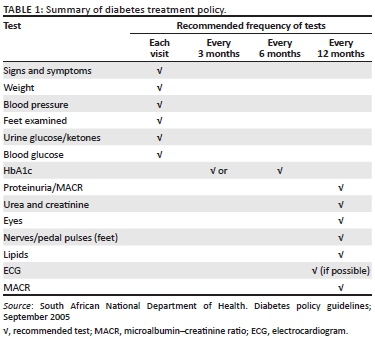
Quality of care can be defined as 'the best health outcomes that are possible, given available resources, and that are consistent with patient values, and preferences' (p. 146).1617Table 1) and the EDL.10,18 The Society for Endocrinology, Metabolism and Diabetes, South Africa (SEMDSA) issues additional guidelines for clinical care, but these are optional and are intended to inform care, enhance prevention efforts and reduce complications.19
It is essential that PHC clinics meet the national treatment guidelines and standards to ensure quality of care. Standards of care can be divided into structure, process and outcomes.202113,14,15 Achieving the standards for quality diabetes care is only possible if the correct equipment, staff, medication, clinical records and so on are available.
The aim of this study was to assess the capacity of participating clinics to provide quality diabetes care, as defined by the clinical guidelines outlined in the national diabetes policy, the EDL and SEMDSA guidelines.
Methods
Study design
A facility audit was conducted in 2013 as part of a cluster-randomised trial that was conducted among the PHC clinics of Tshwane district.
Setting
Tshwane district has a population of 2.9 million and is in the highly urbanised province of Gauteng.22
Study population and sample strategy
A list was compiled of the 64 PHC clinics and 8 CHCs in the Tshwane district from the two management levels for clinic-based healthcare within the public sector. These included clinics managed by local government as well as clinics and CHCs managed by the provincial government. Four clinics were randomly selected from each of the two levels of management and thus three clinic types, totalling 12 clinics.
Data collection
An audit tool was self-developed based on the national diabetes policy, SEMDSA and the EDL guidelines. The tool was used to assess whether the PHC clinics meet the structural standard needed to achieve the required technical competence. Data were collected by conducting face-to-face individual interviews with either the clinic manager, the professional nurse dedicated to chronic disease management and the clinic's pharmacist or pharmacy assistant. The tool focussed on eight domains: (1) equipment, (2) guidelines and health promotion material, (3) medication for diabetes and co-morbidities, (4) record-keeping, (5) staff establishment, (6) diabetes education material, (7) support structures and (8) referral network.
Data analysis
Analyses were done as proportions and counts because of the small sample size of 12 clinics. Data from the clinic audit tool were captured in Epidata (version 3.1, 2008) and analysed using STATA Corp (version 13.1, 2013).
Ethical consideration
Informed consent was obtained from healthcare providers working in the clinics where the study was conducted. The study was approved by the University of Pretoria's Faculty of Health Sciences Research Ethics Committee (Protocol # 61B/2010), by the Tshwane Metropolitan Council and by the Tshwane Metsweding Region Research Ethics Committee (Project # TMREC 2010/19).
Results
Equipment
All 12 clinics reported that they have scales and height rods. Ten of the 12 clinics (83%) had a combined machine. Almost all of the clinics (83%, n = 10) had a tape measure for waist circumference measurement and all clinics had glucometers. All clinics had blood pressure machines and obese cuffs were available in 11 clinics (92%). Seven clinics (58.3%) had electrocardiogram (ECG) machines, and body mass index (BMI) wheels were available in less than half the clinics (41.7%, n = 5). Nine clinics (75%) had an ophthalmoscope and eight (66.7%) had Snellen charts. Two-thirds of the clinics (66.7%, n = 8) had tuning forks and almost all the clinics (91.7%, n = 11) had patella hammers. No clinics had monofilaments available. Only one clinic reported that they have their ECG machine calibrated yearly.
Guidelines
The SEMDSA guidelines were not known, nor available, in any clinic, but the EDL was available in all facilities. The Department of Health guidelines on primary care for diabetes were available in seven clinics (58%). Other guidelines found in three of the clinics (25%) included 'Foot Care Guidelines for People with Diabetes' from the Provincial Department of Health, and a self-compiled dietary guidelines for diabetic patients in one clinic (8%).
Medication
All clinics reported that they had access to all the medication as prescribed by the national treatment algorithms. Two clinics (16.7%) reported a stock-out of simvastatin for a duration of 2 months in the 12 months prior to the study. All clinics reported that urine dipsticks and glucose test strips were always available, but that neither blood glucose strips nor urine glucose strips are available on the EDL for patients' use at home.
Record-keeping
All clinics had a chronic disease register in use, but no diabetes-specific structured care form. Only two clinics (17%) had a special sticker on the front of a patient's file indicating a diabetes diagnosis. In all clinics, the patient-retained card indicates a return date, but this is not captured in the clinic in an appointment register and the responsibility remains with the patient to come back for the follow-up visit. Only one quarter (25%, n = 4) of the clinics made use of an appointment system.
Staff
All clinics had both professional and enrolled nurses and all had a consulting doctor for four or more hours per week for all complicated cases (not necessarily diabetes-related) or emergencies. Seven clinics (58%) had a full-time doctor. Eight clinics (67%) had a health promotion officer, seven of whom were employed full-time at the clinic. Only one clinic (8%) had a qualified diabetes educator. Two clinics (17%) had a full-time dietician, while patients in five clinics (42%) only had intermittent access to a dietician. In four of these clinics, the dietician visited the clinic once a month, while in the fifth clinic the dietician was only available if needed. No clinics had a nutrition advisor. Seven clinics (58%) reported that their patients had access to a podiatrist, either through a monthly routine visit or else via the referral system. Two clinics (17%) had full-time podiatrists on their staff establishment.
Other staff members listed as part of the healthcare team, including pharmacy assistants, health promoters, lay counsellors and a social worker. One clinic (8%) had a trained ophthalmic nurse. Two clinics (17%) were serviced by a private optometrist with a mobile service offering visual acuity screening.
Diabetes education
All clinics reported that individual education of diabetes patients is done at every visit, with every patient by the consulting nurse or doctor. Eight clinics (67%) also run group sessions for diabetes education. The majority (50%) of these sessions are held monthly (compared to 33% weekly and 17% daily) and are facilitated by health promoters. The method of health education activities included talks (67%, n = 8), pamphlets (58%, n = 7), posters (50%, n = 6) and videos or DVDs (33%, n = 4). Five clinics (42%) had a diabetes poster somewhere in the clinic, and four clinics (33%) reported that they have books or booklets on diabetes available for patients.
Four of the 12 clinics had a diabetes support group and one planned a support group. Other support systems listed were a weekly church gathering for people with chronic diseases, a vegetable garden managed by patients and a home visit nurse.
Referral network
All clinics reported that they have a structured referral network and all respondents could name their referral hospital. Ten clinics (83%) reported that referring a patient is easy, but that there is a lack of feedback to the clinic. Two clinics (17%) listed an absence of transport as a barrier to refer patients. Only two clinics (17%) reported that they do not have access to either a telephone or a fax machine.
Discussion
This study gives an initial insight into the capacity of the PHC clinics - an often overlooked aspect of providing quality diabetes care - to provide diabetes care.
It is clear that the PHC clinics had much of the equipment needed to achieve the technical performance required. Quality screening for complications - as measured by any one element (e.g. either an ophthalmoscope or a Snellen chart) being available in the clinic to evaluate care for heart health, eyes, feet or kidneys - would have only been possible in half of the facilities in this study. These items are essential for quality diabetes care that meets the national treatment guidelines. While the BMI can be calculated in other ways, nothing can replace either the tuning forks used to test vibration sense or the monofilaments to test for neuropathy. The absence of the monofilaments is a particular concern as the NDoH standard for foot care is a yearly foot examination.
The official NDoH guidelines were absent in more than a third of the clinics. This absence is a concern as it is this document that sets the standards to ensure quality diabetes care. None of the clinics knew about the SEMDSA guidelines, which is a possible indication of the low profile of diabetes care in PHC settings. One positive finding was that all the clinics had the EDL available.
All clinics had all the medication required by the treatment guidelines with only a few reported stock-outs. Although urine dipsticks and glucose test strips were always available for staff, the EDL does not make these available for patients' home care. Patients on insulin are the patients with the worst diabetes-related outcomes in PHC settings.14
Although all clinics made use of the chronic disease register, this register does not allow for the capture of clinical information such as screening for diabetic complications or other risk factors such as smoking, diet and exercise. The content fields of the register are determined by the NDoH and its primary purpose is to collect data regarding a count across all the chronic diseases. Because of a lack of denominator data it is not possible to calculate prevalence of the different diseases. The current register does not meet the requirements of a clinical information system as outlined by the CCM because this model describes the registry as a tool to plan individual patient care and conduct population-based care.566
The delivery system design of the CCM suggests that practice teams with a clear division of labour and the inclusion of non-physician personnel are needed.6
To achieve self-management support as outlined in the CCM, patients need information to enable them to become their own primary caregiver.6
Continuity of services was ensured via the structured referral network, but the relative ease of referral was offset by the complaint of the lack of feedback after the referral. This lack of feedback to primary healthcare facilities is common.23
The findings of this study partially explain the lack of complication screening reported by Webb et al.13,14,15
Strengths and limitations
The audit provided information on PHC clinics' ability to provide quality diabetes care, an aspect that is mostly overshadowed by the higher profile conditions of HIV and TB. The small size (12 clinics) of the sample limits the generalisability of the results. We recommend studies, using methodologies such as action research, to explore the use of quality improvement strategies to address these service delivery gaps.
Conclusion
Within health systems some factors are within the scope of practice of clinic managers, and therefore modifiable, while others are not. In this study, some of the barriers to effective diabetes care such as paper-based patient records and the limitations of the chronic disease register are beyond the reach of clinic managers. From a health system perspective, the findings regarding the referral system and the good supply of essential medicines are positive. However, the referral system is flawed, as the absence of regular feedback to the PHC clinics is both a lost opportunity to learn and an obstacle to ensure continuity of care. In this study, the provision of a multi-disciplinary team was uneven and could be as a result of the different kinds of settings (PHC clinic vs. community health centre) that have different staff establishments.
On the contrary, the relatively poor availability of the treatment guidelines, posters, patient education material, support groups, tuning forks, BMI wheels and the complete absence of monofilaments is within the control of a PHC manager as these resources are available to them. Ensuring the correct material, equipment and supplies is a key competence of any PHC manager and one that directly contributes to ensuring quality of care.
Competing interests
The authors declare that they have no financial or personal relationship(s) that may have inappropriately influenced them in writing this article.
Authors' contributions
E.M.W. and P.R. conceptualised the study and developed the audit tool. Data collection and analysis were done by E.M.W. J.E.W. contributed to the development of the quality framework and the interpretation of the results. All three authors contributed towards the writing of the article. All the authors read the final article and contributed to the interpretation of the data.
Funding information
This study was funded by the Society for Endocrinology, Metabolism and Diabetes of South Africa (SEMDSA), the African Population and Health Research Centre (APHRC) and research funds from the University of Pretoria.
Data availability statement
Data sharing is not applicable to this article as no new data were created or analysed in this study.
Disclaimer
All views expressed in the article are the authors' own and do not reflect the views of any institution or funder.
Acknowledgements
The authors would like to thank the clinic managers and the pharmacy assistants for participating in the study.
References
-
1. Atun R, Gale E. The challenge of diabetes in sub-Saharan Africa. Lancet Diabetes Endocrinol. 2015;3(9):675-677. https://doi.org/10.1016/S2213-8587(15)00236-3
» https://doi.org/10.1016/S2213-8587(15)00236-3 -
2. International Diabetes Federation. IDF diabetes atlas. 6th ed. [homepage on the Internet]. Brussels: International Diabetes Federation; 2013 [cited 2019 Mar 22]. Available from: http://www.diabetesatlas.org.
» http://www.diabetesatlas.org -
3. American Diabetes Association. Fast facts: Data and statistics about diabetes [homepage on the Internet]. 2015 [cited 2019 Mar 22]. Available from: https://professional.diabetes.org/content/fast-facts-data-and-statistics-about-diabetes.
» https://professional.diabetes.org/content/fast-facts-data-and-statistics-about-diabetes -
4. American Diabetes Association. Implications of the United Kingdom prospective diabetes study. Diabetes Care. 1998;21(12):2180-2184. https://doi.org/10.2337/diacare.25.2007.S28
» https://doi.org/10.2337/diacare.25.2007.S28 -
5. Bodenheimer T, Wagner E, Grumbach K. Improving primary care for patients with chronic illness. JAMA. 2002;288(14):1775-1779. https://doi.org/10.1001/jama.288.14.1775
» https://doi.org/10.1001/jama.288.14.1775 - 6. Van Zyl D, Rheeder P. Physician education programme improves quality of diabetes care. S Afr Med J. 2004;94(6):455-459.
-
7. Gill G, Mbanya J-C, Ramaiya K, Tesfaye S. A sub-Saharan African perspective of diabetes. Diabetologia. 2009;52(1):8-16. https://doi.org/10.1007/s00125-008-1167-9
» https://doi.org/10.1007/s00125-008-1167-9 -
8. Hall V, Thomsen R, Henriksen O, Lohse N. Diabetes in sub-Saharan Africa 1999-2011: Epidemiology and public health implications: A systematic review. BMC Public Health. 2011;11:564. https://doi.org/10.1186/1471-2458-11-564
» https://doi.org/10.1186/1471-2458-11-564 - 9. Statistics South Africa. Mid-year population estimates 2014. Statistical release p0302. Pretoria: Statistics South Africa; 2014.
- 10. National Department of Health. Standard treatment guidelines and essential drugs list for South Africa primary health care level. Pretoria: National Department of Health; 2006.
-
11. International Diabetes Federation. IDF diabetes atlas. 7th ed. [homepage on the Internet]. Brussels: International Diabetes Federation; 2015 [cited 2019 Mar 22]. Available from: http://www.diabetesatlas.org.
» http://www.diabetesatlas.org -
12. Otterman B. Prevalence of diabetes in South Africa [homepage on the Internet]. 2014 [cited 2019 Mar 22]. Available from: http://www.health24.com/Medical/Diabetes/About-diabetes/Diabetes-tsunami-hits-South-Africa-20130210.
» http://www.health24.com/Medical/Diabetes/About-diabetes/Diabetes-tsunami-hits-South-Africa-20130210 -
13. Webb EM, Rheeder P, Van Zyl DG. Diabetes care and complications in primary care in the Tshwane district of South Africa. Prim Care Diabetes. 2015;9(2):147-154. https://doi.org/10.1016/j.pcd.2014.05.002
» https://doi.org/10.1016/j.pcd.2014.05.002 -
14. Webb E, Rheeder P. A cluster-randomized trial to estimate the effect of mobile screening and treatment feedback on HbA1c and diabetes-related complications in Tshwane primary health care clinics, South Africa. Prim Care Diabetes. 2017;11(6):546-554. https://doi.org/10.1016/j.pcd.2017.05.010
» https://doi.org/10.1016/j.pcd.2017.05.010 -
15. Webb EM, Rheeder P, Roux P. Screening in primary care for diabetic retinopathy, maculopathy and visual loss in South Africa. Ophthalmologica. 2016;235:141-149. https://doi.org/10.1159/000443972
» https://doi.org/10.1159/000443972 -
16. Makela M, Booth B, Roberts E. Family doctor's journey to quality. The WONCA Working Party on Quality in Family Medicine [homepage on the Internet]. Helsinki: Stakes; 2001 [cited 2018 Jul 13]. Available from: https://pdfs.semanticscholar.org.
» https://pdfs.semanticscholar.org -
17. Brown LD, Franco LM, Rafeh N, Hatzell T. Quality assurance of health care in developing countries. Quality Assurance Methodology Refinement Series [homepage on the Internet]. 1990 [cited 2017 Aug 21]. [Available from https://pdfs.semanticscholar.org/db7a/71c45f42e17bf6be7e578325ff85d20a22d1.pdf.
» https://pdfs.semanticscholar.org/db7a/71c45f42e17bf6be7e578325ff85d20a22d1.pdf - 18. National Department of Health. National guidelines for the management of diabetes type 1 and 2 in adults at hospital level. South Africa: Government Printers; 2005.
- 19. The Society for Endocrinology, Metabolism and Diabetes of South Africa Type 2 Diabetes Guidelines Expert Committee. The 2017 SEMDSA guideline for the management of type 2 diabetes mellitus. JEMDSA. 2017; 21(1)(Supplement 1):S1-S196.
-
20. Van Deventer C, Mash B. African primary care research: Quality improvement cycles. Afr J Prim Health Care Fam Med. 2014;6(1):598. http://doi.org/10.4102/phcfm.v6i1.598
» http://doi.org/10.4102/phcfm.v6i1.598 - 21. United Kingdom Prospective Diabetes Study. Recommendations for the provision of services in primary care for people with diabetes. London: United Kingdom Prospective Diabetes Study; 2005.
- 22. Statistics South Africa. Census 2011. Statistical release - p0301.4/statistics South Africa. Pretoria: Statistics South Africa; 2012.
-
23. Legodi T, Wolvaardt J. A blank page: Feedback from first referral hospitals to primary health care clinics. S Afr Fam Pract. 2015;57(4):282-285. https://doi.org/10.1080/20786190.2015.1055670
» https://doi.org/10.1080/20786190.2015.1055670

Accepted: 09 Aug. 2019
Published: 17 Oct. 2019