Factors contributing to antiretroviral drug adherence among adults living with HIV or AIDS in a Kenyan rural community
Abstract
BACKGROUND: Antiretroviral (ARV) adherence of ≥ 95% is recommended for suppressing HIV. However, studies have shown that the ≥ 95% recommended level is rarely achieved. OBJECTIVE: This cross-sectional community-based study sought to assess factors contributing to ARV drug adherence among adults living with HIV or AIDS. SETTING: The study was conducted in a rural community in Machakos County, Kenya. METHODS: The questions used for the study were adapted from the Patient Medicine Adherence Questionnaire (PMAQ), a tool grounded in the Health Belief Model. Adherence to ARV was measured using self-reports and pill counts. The perception social support was measured with a 5-point Likert scale, whereas the type and the number of side effects experienced were recorded using 'yes' and 'no' questions. We used the chi-square test to test associations and binary logistic regression to assess factors explaining dose adherence to ARV. RESULTS: The levels of adherence of 86% using self-reports were significantly higher (p < 0.001) than the pill count of 58.6%. The immediate family was rated high in providing social support (3.7 ± 0.6) followed by social support groups (3.1 ± 0.8). A binary logistic regression analysis was conducted to predict ARV adherence (adherent, non-adherent) using social support, side effects and marital status as explanatory variables. The Wald criterion demonstrated that marital status (p = 0.019) and burden of side effects (p ≤ 0.001) made a significant contribution to the prediction of ARV adherence. CONCLUSION: The burden of side effects and being a divorcee are primary predictors of ARV adherence.
Background
High levels of adherence (≥ 95%) are strongly correlated with disease suppression and reduction of morbidity and mortality rates among people infected with HIV and can suppress HIV to undetectable levels.1,234,56789101112
Evidence on the relationship between sex and adherence has been inconclusive. In a field-based study conducted in Zambia, adherence was associated with being female or having a spouse on ARVs (adjusted odds ratio [AOR] 3.3 and 5.0, respectively). These studies showed women were three times more likely to adhere to drugs than men.13109,141314,15
Social support is the help that a person receives from people in his or her social networks.716,17,181917,207191620,21
Antiretroviral drugs have been found to produce both minor and adverse side effects. Qualitative studies have shown that side effects have consistently been associated with decreased adherence.16,21,2223
Evidence from these studies shows that relationships between social demographic factors, social support and side effects with adherence have been inconclusive. The majority of the studies were qualitative, descriptive, hospital- or facility-based and used self-reports to measure adherence. There are virtually no studies using the pill count at the household level and few analytical studies on relationships between social support and side effects with ARV adherence. In our study area, data from the community care centre (CCC) show low adherence levels despite the intense HIV or AIDS interventions. The education does not particularly emphasise social demographics, social support and side effects. Better knowledge of these factors may inform the development of localised, practical and achievable interventions which will improve adherence.
Therefore, the aim of this study was to determine factors contributing to ARV adherence in order to come up with information that can be used to develop interventions to improve ARV drug adherence.
Methodology
Study area, study population and sampling
This study was carried out in Machakos County which has a population of 1 155 957 people (49% male population and 51% female population). The overall prevalence of HIV or AIDS is 5% with the prevalence among women being higher (6.8%) than that of men (2.9%). About 73% of people had never tested for HIV. About 25% of the adults are enrolled for care.242225p) of 0.64, level of confidence (Z) of 1.96 and level of precision (d) of 0.05. Because the study population was < 10 000, the sample was adjusted, and a non-response rate of 5% was added to arrive at a minimum sample size of 307. The stratified random sampling method was used to sample 102 men and 205 women from the list of 417 men and 833 women registered at the CCC. The community health workers (CHWs) were used to assist in identifying the household where the sampled respondents resided. Collection of information at the household represented real-life settings thus increasing the generalisability of the results for larger study population.
Study design and data collection
A cross-sectional study with an analytical design was adopted for this study to demonstrate relationships. The Health Belief Model, which states that both internal and external (significant endorsement of others) motivation are necessary to produce change, was used to guide this study.2627
Data analysis
Excel was used to enter and clean the data. Data were analysed by SPSS (version 19) statistical software program. The dependent variable was ARV adherence, whereas the independent variables were age, sex, marital status, education, (social demographic variables), drug side effects and social support. The number of side effects was added up for each to calculate the 'burden of side effects' or concentration of side effects. A composite variable of social support was constructed from the Likert scale; the number of side effects, age and adherence were treated as continuous variables to test for correlations. The continuous variables were categorised into dichotomous variables to test for relationships using chi-square and binary logistic regression analysis. Proportions were used to estimate the adherence rate, the percentage of the patient by demographic factors and the types of side effect experienced. The 50th percentile was used to categorise the continuous data into two categories. Chi-square tests were used to test the association between variables that were categorised and adherence levels (≥ 95 and < 95). A p < 0.05 was considered as significant. Descriptive statistics (means and standard deviation) were used to compare mean values of continuous variables among subclasses of sources and types of social support. The ANOVA test was used to test whether the difference between the means of these sub-class was significant. The analysis was conducted to demonstrate the correlation between age, social support, side effects and adherence rate using Pearson's correlation for continuous data which was normally distributed and Spearman's rank for data which was skewed or ordinal. The correlation coefficient (r) was used to describe the strength of the supposed linear association between the continuous variables. To investigate the relative importance of the independent variables which showed some association about the dependent variable, and any confounding between them, the variables were fitted together in a binary logistic regression model.
Ethical consideration
Authorisation to conduct the study was obtained from Great Lakes University of Kisumu Institutional Ethical Review Committee (GREC/152/21/2014) and Machakos County Medical Officer of Health.
Results
Social demographic characteristics of the study participants
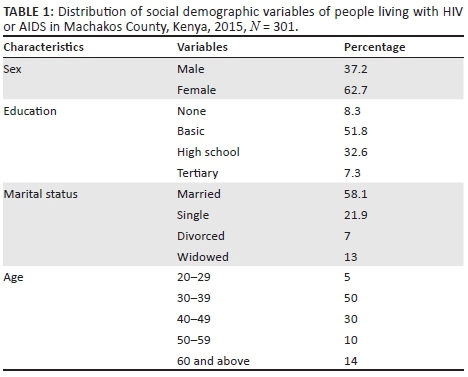
The results on social demographic characteristics are shown in Table 1. A total of 301 patients participated in the study. Their mean age was 40.4 ± 10.8 years ranging from 22 to 64 years. The majority of the participants were women (62.8%). Most (60.1%) either had no education or had only 8 years of basic education. Only 7.3% had tertiary education. About one-half (58.1%) of the study participants were married.
Knowledge of the name of antiretroviral drug used
Information from the pill container label showed that 35.8% of the participants were on a combined therapy of AZT + 3TC + NVP, 34.7% were on TDP + 3TC + NVP, 20.5% were on ABC + 3TC + EFV and 9% were on TDF + 3TC + alluvia. When asked whether they knew the name of the drug they were using and how it was supposed to be taken, 63% of the respondents did not know the name of the drug they were using. All the respondents knew the consequences of not taking the drugs as instructed. The consequences reported included drug resistance 63%, treatment failure 12% and death 25%. There was a significant relationship between education levels and knowledge of the name of the ARV drugs (χ2p = 0.004). Only 3% of the patients with no education category knew the name of the drug they were using. There was also a significant relationship between sex and knowledge of the ARV drugs (χ2p = 0.045). Women tended to be more knowledgeable of the name of drugs. Marital status and age were not related to knowledge of the drug (p ≥ 0.05). There was no significant association between the knowledge of drug and adherence (p = 0.58).
Antiretroviral adherence
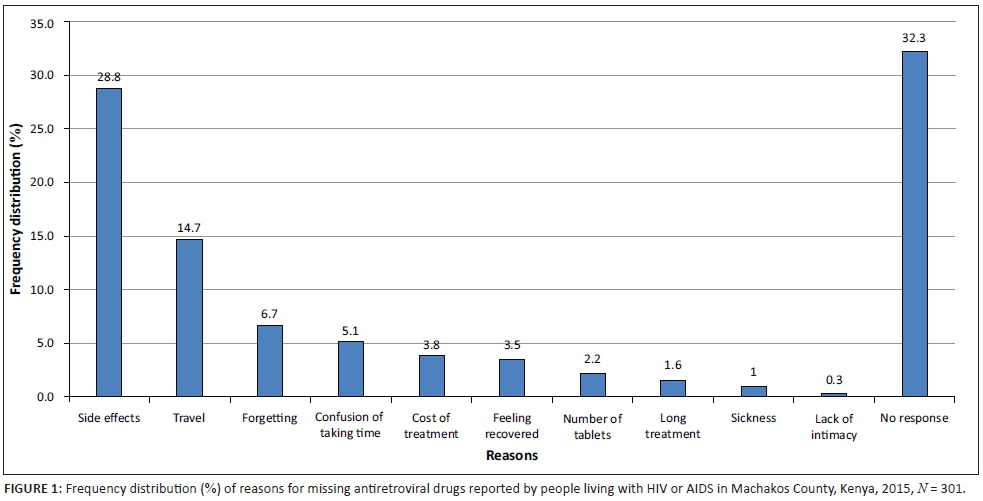
Results indicate that ARV adherence level measured using self-report was 27% higher than using the pill count. The adherence level using self-report was 85.6%. Of those who had missed the drug (14.4%), 67.7% had missed only 1 drug, whereas the rest had missed > 1 drug. Only 43.5% of the respondents were taking prescribed pills as instructed, whereas the majority (56.5%) were taking more or fewer pills per intake. Using pill count, only 58.6% of the respondents had reached the recommended level of ARV adherence of ≥ 95%. The majority (82.5%) used short message service (SMS) to remind them to take their drugs; 1% used watches; 6% were reminded by a family member, whereas 10.5% moved with their dose. About a third (33%) of the respondents had changed drugs. The main reason given by those who had changed or stopped taking the drugs was side effects (28.8%). The other reasons are shown in Figure 1. There was a significant relationship between education levels and knowledge of the ARV drugs (χ2p = 0.004).
Social support
The results indicate the immediate family was perceived most supportive, followed by the support group. The mean values from the various sources are immediate family, 3.7 ± 0.6; support group, 3.1 ± 0.8; extended family, 2.7 ± 1.1; friend, 2.7 ± 0.9; and community, 1.8 ± 1.0. Results on the type of support showed the following results: emotional support, 1.9 ± 0.3; material support, 1.8 ± 0.3; ARV support, 1.8 ± 0.4; and food support, 1.7 ± 0.3. Although the source of support was ranked quite high, the type of support was not highly ranked. About half of the respondents (51.8%) perceived the social support they received as good, whereas 48.2% perceived it as inadequate.
Side effects
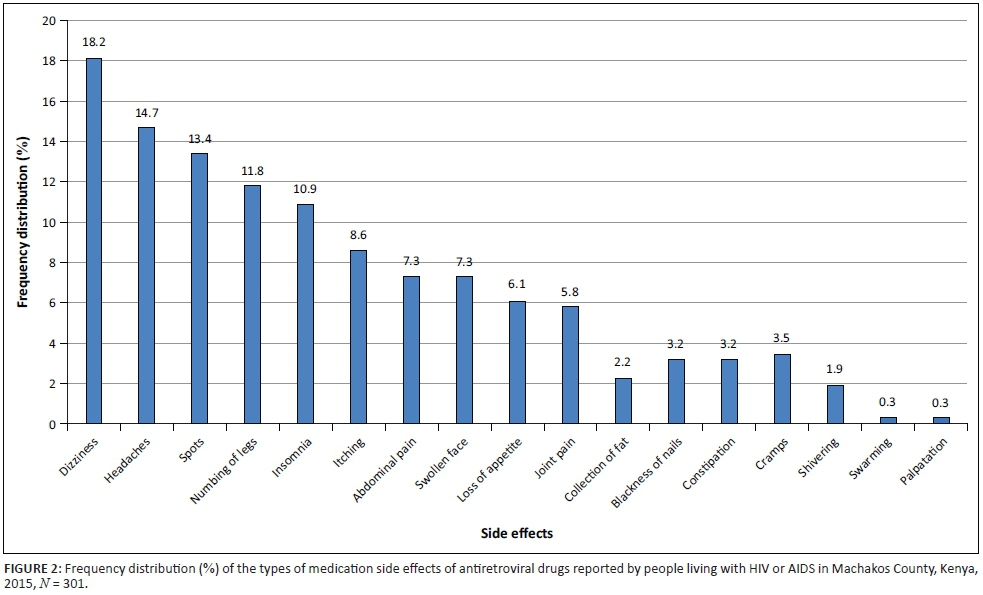
All the respondents had experienced some side effects of the ARV treatment. About 22.4% experienced 1 side effect, 47.6% had 2-3 side effects and 30% experienced ≥ 4 side effects. The main side effects reported were dizziness 18.2%, headaches 14.7%, skin rashes 13.4%. The other side effects are shown in Figure 2.
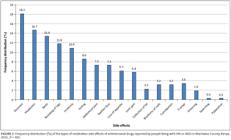
Factors associated with adherence
A Pearson's chi-square test revealed that there was a significant relationship between marital status and the level of adherence (χ2p = 0.02). Divorced people tended to be more adherent. Out of the 27 divorcees, only 1 divorcee fell into the non-adherent category (< 95%). In contrast, there was no association between age, sex, education and adherence (p ≥ 0.05). There was a significant relationship between social support and adherence (χ2p = 0.003), with an odds ratio of 2.5 (CI 1.3-3.6), showing that patients with a good perception of social support were twice more likely to adhere to ARV drugs than those with a poor perception. There was a very significant relationship between side effects and adherence (χ2p ≤ 0.001). A binary logistic regression analysis was conducted to predict ARV adherence (adherent, non-adherent) using social support, side effects and marital status - variables that showed associations - as predictors. The statistical tests of each regression coefficients (i.e. bs) were tested using the Wald chi-square statistic. The intercept test result of Y = 0.825 is greater than p > 0.05, suggesting that an alternative model without an intercept needs to be applied. Goodness-of-fit test - Hosmer-Lemeshow (H-L) - was thus used. The Wald criterion demonstrated that marital status (p = 0.019) and burden of side effects (p ≤ 0.001) made a significant contribution to prediction of ARV adherence. Thus, the likelihood of a person adhering to medication was related to their marital status. Specifically, persons who are divorced were 11 times more likely to adhere to medication. Nagelkerke R2
Discussion
Most studies carried out on social support and side effects have been qualitative, descriptive or institution-based and have used self-reports. Our study was household-based which used pill count which is a more accurate method of assessing adherence. The purpose of the study was to establish the relationships between social demographic characteristics, social support, side effects and ARV adherence. Using the pill count, we were able to demonstrate relationships between marital status, social support and side effects (independent variables) and ARV adherence. Age, sex and education level were not independently associated with adherence. We showed that patients who perceived themselves to have more social support, patients who had fewer side effects and divorcees tended to be better adherents.
Using the respondents' recall data, we found that adherence to ARV of 85.6% though slightly higher than those found in other African countries which ranged from 25% to 73.5%6,7,8,9,105119,141314,1528,29
There are inadequate studies on the relationship between social support and adherence in Africa. Most of the studies on ARV and adherence are either descriptive or qualitative. These studies usually describe the type of support such as accompanying the patient to hospital or for appointments and reminding the patients to take their drugs and to get refills.16,17,1817,19,207,1920,22
There are very few quantitative studies that show relationships between side effects and adherence. Qualitative studies have shown that side effects have consistently been associated with adherence.16,21,2223
Strengths and limitations
This study has several strengths. Most studies carried out on social support and side effects have been qualitative, descriptive or institution-based and have used self-reports. Our study was quantitative and household-based and used the pill count, a more accurate method of assessing adherence. A household-based study makes the findings more representative of the general community. We also used a theory-based approach - Health Belief Model - which we feel should be encouraged for both assessment and intervention. We found virtually no studies that have used the pill count at the household level. For a scientific study, the pill count proved more accurate for assessing the various relationships. Also, this study has demonstrated that the burden of side effects can influence ARV adherence. So far, it is the first study in Kenya to quantify 'burden of side effects' and its relationship to ARV adherence.
A major limitation of the study was that it did not include a comprehensive assessment of the multiple factors that hinder adherence. These include psychological and cognitive aspects. The study did not establish medication regimen factors that capture other dimensions of non-adherence to ARV such as schedule non-adherence which refers to not following a specific schedule for ARV medication (e.g. '3 times a day' or 'every 6 hours'). Instruction non-adherence which refers to not following special instructions for ARV medication, such as 'take with food' or 'take on an empty stomach' or dietary guideline adherence for patients reporting having special instructions for their ARV medications. Understanding medication is important because it motivates patients to overcome barriers of adherence. However, our study did not look at knowledge of ARV dosages, frequencies of the dosages and interval between those dosages. Our study did not include a qualitative research component that would have provided useful information on decision-making with regard to ARV adherence at the household level. These are some of the areas we recommend for further research.
Conclusion
Levels of ARV drug adherence of ≥ 95% were not achieved, a pattern found in developed and developing countries. The social demographic characteristics of age, sex, education and social support did not contribute to ARV adherence. However, the likelihood of a person adhering to ARV medication was related to being divorced and 'burden of side effects' or the concentration of side effects.
Competing interests
The authors declare that they have no competing interests. They do not hold any stocks or shares in any organisation that may in any way gain or lose financially from the publication of this manuscript, either now or in the future.
Authors' contributions
M.T.K. conceptualised the study and was responsible for data acquisition, analysis and interpretation of data; A.M.P. participated in study design and data analysis and facilitated in drafting the manuscript. M.T.K. and A.M.P. collaboratively wrote the paper. All authors read and approved the final manuscript.
Acknowledgements
The authors would like to extend their thanks to the Great Lakes University of Kisumu for administrative and academic support. They would also like to acknowledge Machakos County for facilitating the data collection. The authors also thank the study participants for cooperating in the study. They also appreciate the data collectors for their dedication in collecting quality data.
References
-
1. Conway B. The role of adherence to antiretroviral therapy in the management of HIV infection. J Acquir Immune Defic Syndr. 2007;45(Suppl 1):S14-S18. https://doi.org/10.1097/QAI.0b013e3180600766
» https://doi.org/10.1097/QAI.0b013e3180600766 - 2. Gulick RM. Antiretroviral treatment 2010: Progress and controversies. J Acquir Immune Defic Syndr. 2010;55(Suppl 1):S43-S48.
- 3. Beer L, Heffelfinger J, Frazier E, et al. Use of and adherence to antiretroviral therapy in a large U.S. sample of HIV-infected adults in care, 2007-2008. Open AIDS J. 2012;6(Suppl 1: M21):213-223.
-
4. Bangsberg DR. Less than 95 percent adherence to nonnucleoside reverse-transcriptase inhibitor therapy can lead to viral suppression. Clin Infect Dis. 2006;43(7):939-941. https://doi.org/10.1086/507526
» https://doi.org/10.1086/507526 -
5. Martin M, Del Cacho E, Codina C, et al. Relationship between adherence level, type of the antiretroviral regimen, and plasma HIV type 1 RNA viral load: A prospective cohort study. AIDS Res Hum Retroviruses. 2008;24(10):1263-1268. https://doi.org/10.1089/aid.2008.0141
» https://doi.org/10.1089/aid.2008.0141 -
6. Mitiku H, Abdosh T, Teklemariam Z. Factors affecting adherence to antiretroviral treatment in Harari National Regional State, Eastern Ethiopia, ISRN AIDS, 2013;2013, Article ID 960954, 7 pages, 2013. https://doi.org/10.1155/2013/960954
» https://doi.org/10.1155/2013/960954 -
7. Hardon A, Davey S, Gerrits T, et al. From access to adherence: The challenges of antiretroviral treatment [homepage on the Internet]. Geneva: WHO Press; [cited 2006 Oct 19]. Available from: http://www.who.int/medicines/publications/challenges_arvtreatment15Aug2006.pdf
» http://www.who.int/medicines/publications/challenges_arvtreatment15Aug2006.pdf -
8. Potchoo Y, Tchamdja K, Balogou A, Pitche V, Guissou IP, Kassang EK. Knowledge and adherence to antiretroviral therapy among adults people living with HIV/AIDS treated in the health care centers of the association 'Espoir Vie Togo' in Togo, West Africa. BMC Clin Pharmacol. 2010;10:11. https://doi.org/10.1186/1472-6904-10-11
» https://doi.org/10.1186/1472-6904-10-11 - 9. Talam NC, Gatongi P, Rotich J, Kimaiyo S. Factors affecting antiretroviral drug adherence among HIV/AIDS adult patients attending HIV/AIDS clinic at Moi Teaching and Referral Hospital, Eldoret, Kenya. East Afr J Public Health. 2008;5(2):74-8.
-
10. Uzochukwu B, Onwujekwe O, Onoka A, Okoli C, Uguru N, Chukwuogo O. Determinants of non-adherence to subsidized anti-retroviral treatment in southeast Nigeria. Health Policy Plan. 2009;24:189-196. https://doi.org/10.1093/heapol/czp006
» https://doi.org/10.1093/heapol/czp006 -
11. Maggiolo F, Ravasio L, Ripamonti D, et al. Similar adherence rates favor different virologic outcomes for patients treated with nonnucleoside analogues or protease inhibitors. Clin Infect Dis. 2005;40:158-163. https://doi.org/10.1086/426595
» https://doi.org/10.1086/426595 - 12. Reisner L, Matthew J, Skeer M, Perkovich B, Johnson CV, Safren SA. A review of HIV antiretroviral adherence and intervention studies among HIV-infected youth. Top HIV Med J. 2009;17(1):14-25.
-
13. Sasaki Y, Kakimoto K, Dube C, et al. Adherence to antiretroviral therapy (ART) during the early months of treatment in rural Zambia: Influence of demographic characteristics and social surroundings of patients. Ann Clin Microbiol Antimicrob. 2012;11:34. https://doi.org/10.1186/1476
» https://doi.org/10.1186/1476 - 14. Manyeki RW. The influence of psychosocial factors on HIV antiretroviral drugs adherence among young people in Nakuru central district Kenya [unpublished dissertation]. 2012.
- 15. Munthali CS. Acceptability of antiretroviral drugs among adults living in Chawama, Lusaka [Thesis]. University of Zimbabwe; 2010.
-
16. Nsimba SED, Irunde H, Comoro C. Barriers to ARV adherence among HIV/AIDS positive persons taking anti-retroviral therapy in two Tanzanian regions 8-12 months after program initiation. J AIDS Clin Res. 2010;1:111. https://doi.org/10.4172/2155-6113.1000111
» https://doi.org/10.4172/2155-6113.1000111 -
17. Knodel J, Kespichayawattana J, Saengtienchai C, Wiwatwanich S. The role of parents and family members in ART treatment adherence: Evidence from Thailand. Res Aging. 2010;32:19-39. https://doi.org/10.1177/0164027509348130
» https://doi.org/10.1177/0164027509348130 -
18. Zuurmond M. Adherence to ARVS: Challenges and successes [homepage on the Internet]. 2008. Available from: http://catalogue.safaids.net/publications/adherence-arvs-challenges-and-successes
» http://catalogue.safaids.net/publications/adherence-arvs-challenges-and-successes -
19. Li L, Lee S, Wen Y, Lin C, Wan D, Jiraphongsa C. Antiretroviral therapy adherence among patients living with HIV/AIDS in Thailand. Nurs Health Sci. 2010;12(2):212-220. https://doi.org/10.1111/j.1442-2018.2010.00521.x
» https://doi.org/10.1111/j.1442-2018.2010.00521.x -
20. Kumarasamy N, Safren SA, Raminani SR, et al. Barriers and facilitators to antiretroviral medication adherence among patients with HIV in Chennai, India: A qualitative study. AIDS Patient Care STDS. 2005;19:526-537. https://doi.org/10.1089/apc.2005.19.526
» https://doi.org/10.1089/apc.2005.19.526 -
21. Barnett W, Patten G, Kerschberger B, Conradie K, Garone DB, Van Cutsem G. Perceived adherence barriers among patients failing second-line antiretroviral therapy in Khayelitsha, South Africa. S Afr J HIV Med. 2013;14(4):170-176. https://doi.org/10.7196/SAJHIVMED.981
» https://doi.org/10.7196/SAJHIVMED.981 - 22. Sumbi VM. Assessment of factors influencing adherence to antiretroviral therapy at Nyeri Provincial Hospital in Central Kenya [unpublished MSc thesis]. 2010.
-
23. Bhengu BR, Ncama BP, McInerney PA, et al. Symptoms experienced by HIV-infected individuals on antiretroviral therapy in Kwazulu-Natal, South Africa. Appl Nurs Res. 2011;24:1-9. https://doi.org/10.1016/j.apnr.2009.01.001
» https://doi.org/10.1016/j.apnr.2009.01.001 -
24. Ministry of Health, Kenya. Kenya HIV county profiles, National Aids and STI Control Programme Statistics [homepage on the Internet]. 2014. Available from: http://www.nascop.or.ke/
» http://www.nascop.or.ke/ -
25. Jung SH. Stratified Fisher's exact test and its sample size calculation. Biom J. 2014;56(1):129-140. https://doi.org/10.1002/bimj.201300048
» https://doi.org/10.1002/bimj.201300048 - 26. Stretcher V, Rosenstock IM. The Health Belief Model. In: Glanz K, Lewis FM, Rimer BK, eds. Health Behaviour and Health Education: Theory, Research and Practice. San Francisco: Jossey-Bass; 1997.
-
27. Duong M, Piroth L, Grappin M, et al. Evaluation of the Patient Medication Adherence Questionnaire as a tool for self-reported adherence assessment in HIV-infected patients on antiretroviral regimens. HIV Clin Trials. 2001;2:128-135. https://doi.org/10.1310/M3JR-G390-LXCM-F62G
» https://doi.org/10.1310/M3JR-G390-LXCM-F62G -
28. Boateng D, Kwapong GD, Agyei-Baffour P. Knowledge, perception about antiretroviral therapy (ART) and prevention of mother-to-child-transmission (PMTCT) and adherence to ART among HIV-positive women in the Ashanti region. BMC Women's Health. 2013;13:2. https://doi.org/10.1186/1472-6874-13-2
» https://doi.org/10.1186/1472-6874-13-2 -
29. Duff P, Kipp W, Wild TC, Rubaale T, Okech-Ojony J. Barriers to accessing highly active antiretroviral therapy by HIV-positive women attending antenatal clinic in a regional hospital in western Uganda. J AIDS. 2010;13:37. https://doi.org/10.1186/1758-2652-13-37
» https://doi.org/10.1186/1758-2652-13-37

Accepted: 23 Feb. 2017
Published: 31 July 2017