Implementation of mHealth to support cancer diagnosis in Sub-Saharan Africa: A systematic review
Abstract
BACKGROUND: A reduction in communicable diseases in sub-Saharan Africa (SSA) over recent decades has led to an increased life expectancy and non-communicable diseases such as cancer. However, cancer services in SSA remain inadequate. With increasing mobile use, mobile health (mHealth) has the potential to expand healthcare access AIM: This systematic review aims to synthesise literature reporting on barriers and facilitators to the implementation and use of mHealth tools by patients or the public to support symptomatic cancer diagnosis in SSA METHOD: A comprehensive literature search was conducted following the Preferred Reporting Items for Systematic Reviews and Meta-Analyses. Two researchers independently conducted title and abstract screening, full-text review and data extraction. Extraction templates were compared and data were synthesised. Quality was assessed using the Mixed Methods Appraisal Tool RESULTS: Of 7695 records identified, three quantitative and two mixed-methods studies were included, published between 2016 and 2022. The studies focused on Kaposi's sarcoma, cervical cancer, breast cancer and any cancer. Three inter-related themes describe the barriers and facilitators: (1) user or population-related factors including access to mobile devices and connectivity, and language literacy; (2) mHealth tool-related factors such as tool accessibility and language translation; and (3) structural, societal or systemic factors such as sociocultural significance and stigma CONCLUSION: Although SSA countries experienced similar challenges to mHealth tool use as high-income nations, some barriers such as limited mobile devices and connectivity were more severely evident CONTRIBUTION: The study findings can be used to guide future mHealth tool design and implementation strategies that are relevant to SSA
digital health; cancer; early diagnosis; mobile health; primary care; sub-Saharan Africa
Introduction
With the global increase in digital technology use, digital health is rapidly expanding and has the potential to improve healthcare delivery worldwide. Electronic health or eHealth is defined by the World Health Organization as 'the use of information and communication technology in support of health and health-related fields' (Page ix).11234,567,86,910
With the reduction in communicable diseases and subsequent increase in life expectancy in SSA, over the past few decades, has led to an increase in non-communicable disease11,12131415161716
Mobile health has the potential to support more timely diagnosis of cancer in symptomatic patients through widespread communication of health information to the population of SSA, of which nearly half (43%) subscribe to mobile services.618,19202122
Methods
Study design
This systematic literature review followed the Preferred Reporting Items for Systematic Reviews and Meta-Analyses guidelines and checklist.2324
Search strategy and data sources
An initial literature search, guided by the research question and study inclusion criteria, was conducted on Google Scholar to identify key articles. Thereafter, the strategy was created with the help of a health sciences subject librarian and followed the Cochrane guidelines for searching and selecting studies for systematic reviews2524
Eligibility criteria
Study inclusion and exclusion criteria were defined based on the Population, Intervention, Comparison and Outcome(s) Framework (Box 1).2618,19

Study selection
Titles and abstracts of all identified publications were independently screened by two reviewers (G.A.B. and T.M.) to determine potential relevance. Each article identified during this first stage of screening underwent independent full-text review by K.D.A. and G.A.B. to determine selection based on the eligibility criteria. Disagreements were discussed and settled in consultation with K.D.A., G.A.B., F.M.W. and S.E.S.
Data extraction and analysis
Data extraction tools were developed following guidelines from the Cochrane Handbook,2722
Quality assessment
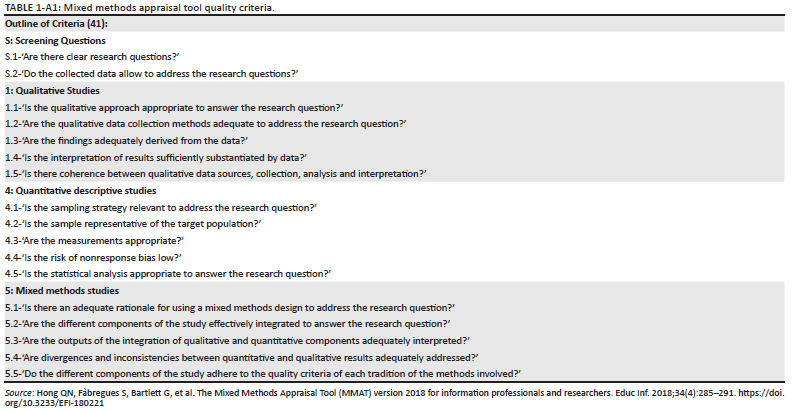
Two reviewers (K.D.A., G.A.B.) independently assessed each included study for the risk of bias using the Mixed Methods Appraisal Tool (MMAT),2829Table 1-A1), based on the study type (qualitative, quantitative, randomised- or non-randomised control trials or mixed methods). The criteria can be met ('Yes') or not met ('No' or 'Can't tell'). Each criterion is assessed individually with no overall quality score. Disagreements between scores were resolved through discussion and consensus. Studies were included irrespective of quality scores.
Review findings
Search results
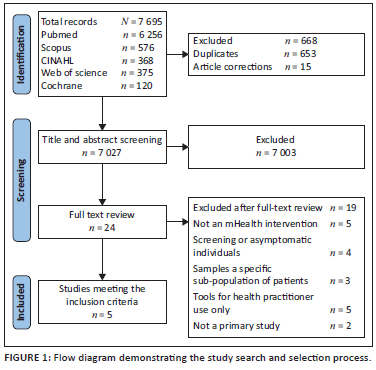
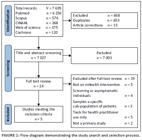
Across all databases, 7695 records were identified, of which 668 were removed (653 duplicates and 15 article corrections). Titles and abstracts were screened for the remaining 7027 unique records, of which 24 potentially relevant articles underwent full-text review. After applying the exclusion criteria (Figure 1), 5 studies were selected for inclusion.
Characteristics of included studies
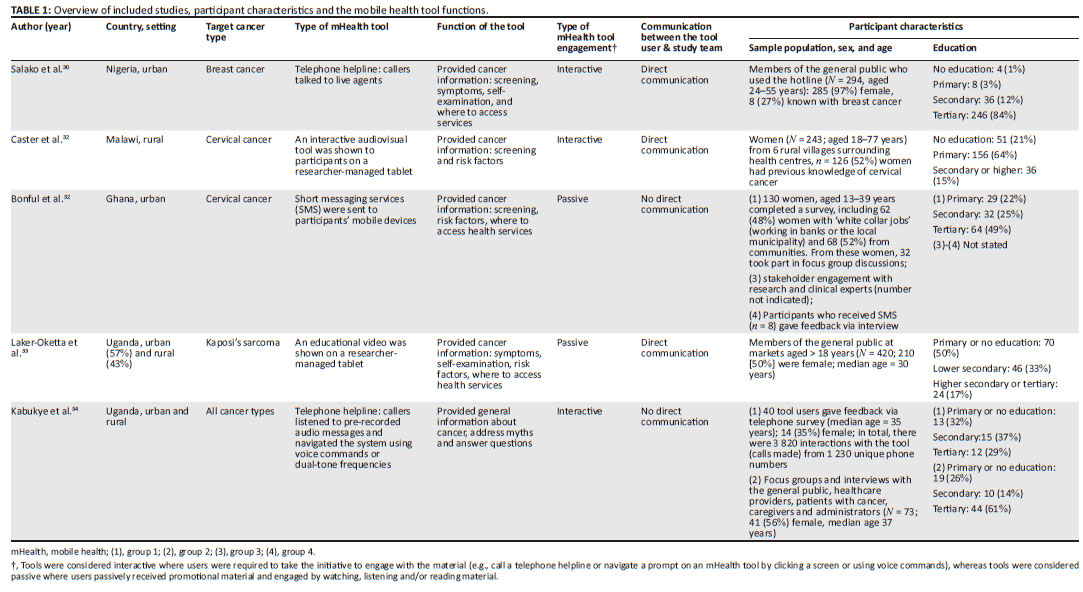
The five included studies (Table 1) were published between 2016 and 2022 across four SSA countries: Nigeria,30313233,3430,313233,3431,3233303432,333031,34
Mobile health tool types and content
Tools identified in the studies were considered as those requiring 'interactive' or 'passive' user engagement (Table 1). Tools were 'interactive' if users were required to take the initiative to engage with it or respond through a physical action (such as making a call, speaking, typing or clicking). Tools were 'passive' if users were not required to take the initiative to use it (e.g., receive an SMS), and their engagement with the tool was non-physical or purely mental (e.g., reading an SMS or watching a video). Two studies used passive tools31,3330,32,34
Two studies provided mobile telephone helplines.30,34303432,333233313130,31,33,3530,31,3230,3331,32,3330,3330,31,34
Study participant characteristics
The two telephone helplines30,3431,3231323331,32,3333Table 1). Three studies included participants with high levels of education with 49%,3134303233
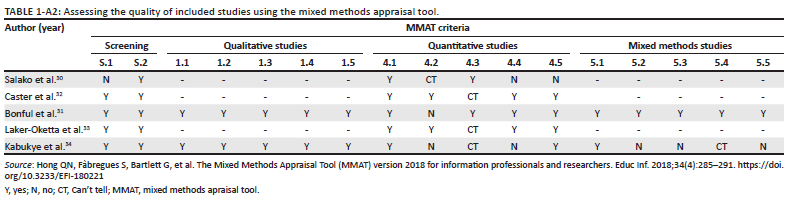
Assessing study quality
Caster et al.3233Table 1-A2). Both studies used unvalidated questionnaires, and reported change in questionnaire scores after the intervention without significance testing or an interpretation of the scoring system used. Therefore, it was unclear whether their measures were appropriate to evaluate outcomes (quality criteria 4.3).
The two telephone helplines30,34313132313031
Barriers and facilitators to tool use and implementation
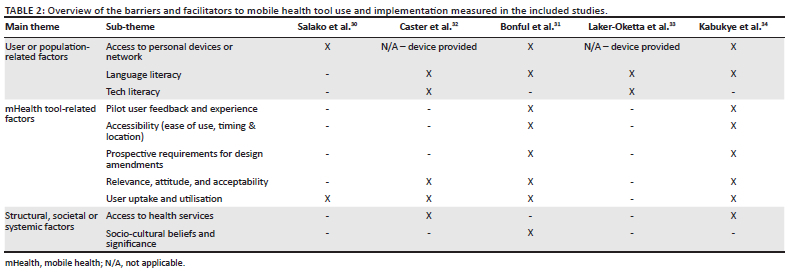
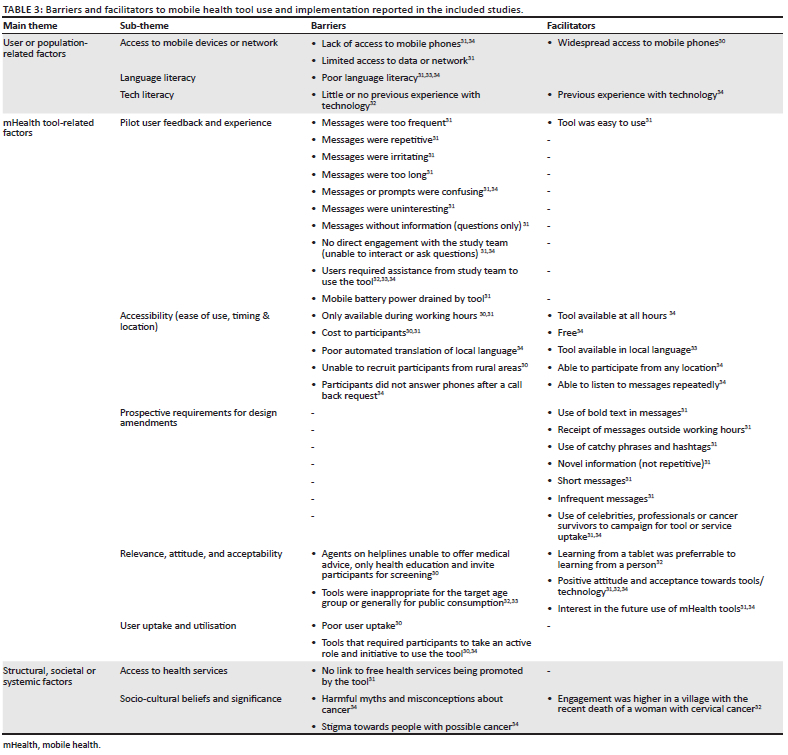
Study outcomes that directly acted as barriers or facilitators to tool use or implementation are reported in Table 2 and Table 3. Three inter-related themes were developed to describe the reported barriers and facilitators; this included: (1) user and population-related factors; (2) mHealth tool-related factors; and (3) structural, societal and systemic factors. User and population-related factors included participant or population characteristics, and individuals' access to resources that impacted their ability to use mHealth tools. mHealth tool-related factors included elements of tool design and implementation strategies that determined its usability, accessibility and reach. Structural, societal and systemic barriers and facilitators were factors that impacted the broader population and had the potential to influence health beliefs and help-seeking behaviours. Some factors may have fit into more than one theme, but were discussed under the theme in which a stronger relation was determined or where outcomes were more strongly reported in the studies. For example, some user and population factors or structural, societal and systemic factors were also considered to be mHealth tool-related if there were tool design considerations (or a lack thereof) specific to the population that used the tools, such as adaptations for population characteristics or sociocultural norms.
User and population-related factors
User and population-related barriers included low language literacy31,33,3431323431,343032,33
Mobile health tool-related factors
A barrier to engagement in two studies was the cost they incurred on users,30,313430,313431
In three studies, participants required assistance using tools from the study team32,3331323131,3431,34
Participants reported that taking the initiative to make a call in the two telephone helpline studies restricted engagement and users suggested in feedback that the researchers actively call participants.30,3431,3430
There were positive attitudes towards the tools across three studies,31,32,343231,34323330,3430
Structural, societal and systemic factors
Few structural, societal and systemic barriers and facilitators were reported in the studies, despite a significant focus in their rationales. In Bonful et al.'s3131323434
Implications and recommendations
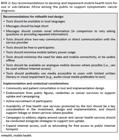
Key recommendations were developed to guide future design of mHealth tools and important considerations for implementation strategies. These recommendations were developed based on the synthesis of barriers and facilitators identified from the five studies included in this review (Box 2).
Discussion
Previous literature reviews evaluated the barriers and facilitators to digital technologies use among healthcare professionals,36,3738,3938,39,40
The positive attitudes towards mHealth tools reported in three studies31,32,3441
Similar to another review conducted predominantly in high-income countries,3831,34424344454134231
Accessibility of tools was reported in several studies, noting that availability in local languages33343430,32,33,3431
All studies in this review restricted participation to individuals with high levels of education directly, or indirectly by mobile literacy being a prerequisite for inclusion, and thus samples were not representative of the target populations. In Kabukye et al.'s3430
Previous literature has demonstrated that sociocultural norms and beliefs in SSA can delay help-seeking, such as the belief that people with cancer are cursed or being punished by ancestors,46,47,48,495048,50503031,32323331,3230
Strengths and limitations
This review used a systematic approach to thoroughly search for relevant literature using multiple databases and specifically focused on SSA to identify barriers and facilitators contextually relevant to this region. The inclusion of quantitative, qualitative and mixed methods studies broadened the scope of potential studies for inclusion. The protocol was published on PROSPERO to ensure the study processes aligned with planned procedures with transparency and to prevent duplication of work. The study offers a novel perspective to the limited body of literature on mHealth interventions to support symptomatic cancer diagnosis in SSA. The small number of eligible studies demonstrates the need for further research. With few studies included in this review and marked heterogeneity, it was difficult to make comparisons between them.
All five studies had bias, with the unmet quality criteria being most relevant to inadequately reported study outcomes. Because the barriers and facilitators in the included studies were reported through user feedback and experience, rather than as outcomes, there was still value in synthesising findings despite their limitations in quality. Restricting this review to studies in SSA limited the opportunity to explore literature in other low-resourced regions and may have provided additional insights. Despite the few studies and low quality, we were able to synthesise important lessons that can be used to guide mHealth tool development and implementation strategies to support symptomatic cancer diagnosis in SSA.
Conclusion
With the growing use of mobile devices in SSA and the lack of access to quality healthcare and information in the region, mHealth has the potential to enhance access, particularly to rural communities. This review demonstrates the lack of quality literature evaluating mHealth tools to support symptomatic cancer diagnosis in SSA, in contrast to other literature showing widespread use of digital tools among healthcare workers, integration into digital health systems, and for use among asymptomatic people to promote screening and prevention. Low-resourced settings suffer from many similar challenges to digital technology use as in high-income nations, however, these are more severely evident, most notably the lack of access to internet, mobile connectivity and electricity. Additional barriers and facilitators unique to settings in SSA were also found, including sociocultural values, beliefs, relevance and community preferences. These factors could act as significant drivers of success if adequately incorporated into mHealth tool design and implementation.
Competing interests
The authors declare that they have no financial or personal relationship(s) that may have inappropriately influenced them in writing this article.
Authors' contributions
Study conception and design were conducted by F.M.W., S.E.S. and J.M. Title, abstract and full-text screening were conducted by G.A.B., T.M., and K.D.A. Data extraction was conducted by K.D.A. and G.A.B. Data analysis and the writing of the article were led by K.D.A. with input and support from F.M.W., J.M., S.E.S., T.M. and G.A.B. All authors approved the final version of this article.
Funding information
The author reported that they received funding from the National Institute for Health Research and the study forms part of a broader study protocol (No. NIHR133231) awarded to co-principal investigators F.M.W. and J.M. which may be affected by the research reported in the enclosed publication. The author has disclosed those interests fully and has implemented an approved plan for managing any potential conflicts arising from their involvement. The terms of these funding arrangements have been reviewed and approved by the affiliated university in accordance with its policy on objectivity in research.
Data availability
The data related to the preparation of this study, including the data extraction tables, reasons for inclusion and exclusion, and previous versions of the article are available on reasonable request from the corresponding author, K.D.A.
Disclaimer
The views and opinions expressed in this article are those of the authors and are the product of professional research. The article does not necessarily reflect the official policy or position of any affiliated institution, funder, agency or that of the publisher. The authors are responsible for this article's results, findings and content.
Acknowledgements
References
-
1. The World Health Organization. Recommendations on digital interventions for health system strengthening [homepage on the Internet]. 2019 [cited 2024 Apr 16]; p. ix. Available from: https://www.who.int/publications-detail-redirect/9789241550505
» https://www.who.int/publications-detail-redirect/9789241550505 -
2. Ouma PO, Maina J, Thuranira PN, et al. Access to emergency hospital care provided by the public sector in sub-Saharan Africa in 2015: A geocoded inventory and spatial analysis. Lancet Glob Health. 2018;6(3):e342-e350. https://doi.org/10.1016/S2214-109X(17)30488-6
» https://doi.org/10.1016/S2214-109X(17)30488-6 -
3. Marcolino MS, Oliveira JAQ, D'Agostino M, Ribeiro AL, Alkmim MBM, Novillo-Ortiz D. The impact of mHealth interventions: Systematic review of systematic reviews. JMIR MHealth UHealth. 2018;6(1):e8873. https://doi.org/10.2196/mhealth.8873
» https://doi.org/10.2196/mhealth.8873 -
4. Betjeman TJ, Soghoian SE, Foran MP. mHealth in sub-Saharan Africa. Int J Telemed Appl [serial online]. 2013 [cited 2024 Apr 19];2013(1):e482324. Available from: https://www.hindawi.com/journals/ijta/2013/482324/
» https://www.hindawi.com/journals/ijta/2013/482324/ -
5. GMSA. The mobile economy sub-Saharan Africa 2023 [homepage on the Internet]. 2023 [cited 2024 Apr 19]; p. 48. Available from: https://www.gsma.com/solutions-and-impact/connectivity-for-good/mobile-economy/sub-saharan-africa/
» https://www.gsma.com/solutions-and-impact/connectivity-for-good/mobile-economy/sub-saharan-africa/ -
6. Global System for Mobile Communications Association. The mobile economy sub-Saharan Africa 2022 [homepage on the Internet]. 2022 [cited 2024 Apr 19]. Available from: https://www.gsma.com/mobileeconomy/sub-saharan-africa-2022/
» https://www.gsma.com/mobileeconomy/sub-saharan-africa-2022/ -
7. Statista. Population in Africa 2021 by age group [homepage on the Internet]. 2021 [cited 2024 Apr 19]. Available from: https://www.statista.com/statistics/1226211/population-of-africa-by-age-group/
» https://www.statista.com/statistics/1226211/population-of-africa-by-age-group/ -
8. Statista. Sub-Saharan Africa: Population by age group [homepage on the Internet]. 2022 [cited 2024 Dec 31]. Available from: https://www.statista.com/statistics/1225664/age-distribution-of-the-population-of-sub-saharan-africa/
» https://www.statista.com/statistics/1225664/age-distribution-of-the-population-of-sub-saharan-africa/ -
9. Nachega JB, Leisegang R, Kallay O, Mills EJ, Zumla A, Lester RT. Mobile health technology for enhancing the COVID-19 response in Africa: A potential game changer?. Am J Trop Med Hyg. 2020;103(1):3-5. https://doi.org/10.4269/ajtmh.20-0506
» https://doi.org/10.4269/ajtmh.20-0506 -
10. Eslami P, Niakan Kalhori SR, Taheriyan M. eHealth solutions to fight against COVID-19: A scoping review of applications. Med J Islam Repub Iran. 2021;35(1):43. https://doi.org/10.47176/mjiri.35.43
» https://doi.org/10.47176/mjiri.35.43 -
11. Levitt NS, Steyn K, Dave J, Bradshaw D. Chronic noncommunicable diseases and HIV-AIDS on a collision course: Relevance for health care delivery, particularly in low-resource settings - Insights from South Africa. Am J Clin Nutr. 2011;94(6):1690S-1696S. https://doi.org/10.3945/ajcn.111.019075
» https://doi.org/10.3945/ajcn.111.019075 -
12. Gouda HN, Charlson F, Sorsdahl K, et al. Burden of non-communicable diseases in sub-Saharan Africa, 1990-2017: Results from the global burden of disease study 2017. Lancet Glob Health. 2019;7(10):e1375-e1387. https://doi.org/10.1016/S2214-109X(19)30374-2
» https://doi.org/10.1016/S2214-109X(19)30374-2 -
13. Larkin HD. Cancer deaths may double by 2030 in sub-Saharan Africa. J Am Med Assoc. 2022;327(23):2280. https://doi.org/10.1001/jama.2022.10019
» https://doi.org/10.1001/jama.2022.10019 -
14. Omotoso O, Teibo JO, Atiba FA, et al. Addressing cancer care inequities in sub-Saharan Africa: Current challenges and proposed solutions. Int J Equity Health. 2023;22:189. https://doi.org/10.1186/s12939-023-01962-y
» https://doi.org/10.1186/s12939-023-01962-y -
15. Ferlay J, Ervik M, Lam F, et al. Global cancer observatory [homepage on the Internet]. Lyon: Cancer Today. International Agency for Research on Cancer; 2024 [cited 2024 Jun 06]. Available from: https://gco.iarc.who.int/today/
» https://gco.iarc.who.int/today/ -
16. Lombe DC, Mwamba M, Msadabwe S, et al. Delays in seeking, reaching and access to quality cancer care in sub-Saharan Africa: A systematic review. BMJ Open. 2023;13(4):e067715. https://doi.org/10.1136/bmjopen-2022-067715
» https://doi.org/10.1136/bmjopen-2022-067715 -
17. Akuoko CP, Armah E, Sarpong T, Quansah DY, Amankwaa I, Boateng D. Barriers to early presentation and diagnosis of breast cancer among African women living in sub-Saharan Africa. PLoS One. 2017;12(2):e0171024. https://doi.org/10.1371/journal.pone.0171024
» https://doi.org/10.1371/journal.pone.0171024 -
18. Walter F, Webster A, Scott S, Emery J. The Andersen model of total patient delay: A systematic review of its application in cancer diagnosis. J Health Serv Res Policy. 2012;17(2):110-118. https://doi.org/10.1258/jhsrp.2011.010113
» https://doi.org/10.1258/jhsrp.2011.010113 -
19. Scott SE, Walter FM, Webster A, Sutton S, Emery J. The model of pathways to treatment: Conceptualization and integration with existing theory: The model of pathways to treatment. Br J Health Psychol. 2013;18(1):45-65. https://doi.org/10.1111/j.2044-8287.2012.02077.x
» https://doi.org/10.1111/j.2044-8287.2012.02077.x -
20. Rossman AH, Reid HW, Pieters MM, et al. Digital health strategies for cervical cancer control in low- and middle-income countries: Systematic review of current implementations and gaps in research. J Med Internet Res. 2021;23(5):e23350. https://doi.org/10.2196/23350
» https://doi.org/10.2196/23350 -
21. Dalton M, Holzman E, Erwin E, et al. Patient navigation services for cancer care in low-and middle-income countries: A scoping review. PLoS One. 2019;14(10):e0223537. https://doi.org/10.1371/journal.pone.0223537
» https://doi.org/10.1371/journal.pone.0223537 -
22. Nnaji CA, Kuodi P, Walter FM, Moodley J. Effectiveness of interventions for improving timely diagnosis of breast and cervical cancers in low-income and middle-income countries: A systematic review. BMJ Open. 2022;12(4):e054501. https://doi.org/10.1136/bmjopen-2021-054501
» https://doi.org/10.1136/bmjopen-2021-054501 -
23. Page MJ, McKenzie JE, Bossuyt PM, et al. The PRISMA 2020 statement: An updated guideline for reporting systematic reviews. Br Med J. 2021;372:n71. https://doi.org/10.1136/bmj.n71
» https://doi.org/10.1136/bmj.n71 -
24. Tegama N, Baby G, Arendse K, et al. PROSPERO PROTOCOL: Barriers and facilitators to implementing mHealth tools for public use to support symptomatic cancer diagnosis in sub-Saharan Africa: A systematic review [homepage on the Internet]. 2024 [cited 2024 May 21]. Available from: https://www.crd.york.ac.uk/prospero/display_record.php?RecordID=503906
» https://www.crd.york.ac.uk/prospero/display_record.php?RecordID=503906 -
25. Lefebvre C, Glanville JJ, Briscoe S, et al. Cochrane handbook for systematic reviews of interventions [homepage on the Internet]. In: Chapter 4: Searching for and selecting studies. 2023 [cited 2024 Apr 22]. Available from: www.training.cochrane.org/handbook
» www.training.cochrane.org/handbook -
26. McKenzie JE, Brennan SE, Ryan RE, Thomson HJ, Johnston RV, Thomas J. Chapter 3: Defining the criteria for including studies and how they will be grouped for the synthesis [homepage on the Internet]. [cited 2024 Jun 07]. Available from: https://training.cochrane.org/handbook/current/chapter-03
» https://training.cochrane.org/handbook/current/chapter-03 -
27. Tianjing L, Higgins JP, Deeks JJ. Cochrane handbook for systematic reviews of interventions [homepage on the Internet]. In: Chapter 5: Collecting data. 2023 [cited 2024 Apr 29]. Available from: https://training.cochrane.org/handbook/current/chapter-05
» https://training.cochrane.org/handbook/current/chapter-05 -
28. Hong QN, Fàbregues S, Bartlett G, et al. The Mixed Methods Appraisal Tool (MMAT) version 2018 for information professionals and researchers. Educ Inf. 2018;34(4):285-291. https://doi.org/10.3233/EFI-180221
» https://doi.org/10.3233/EFI-180221 -
29. Emary PC, Stuber KJ, Mbuagbaw L, et al. Quality of reporting using good reporting of a mixed methods study criteria in chiropractic mixed methods research: A methodological review. J Manipulative Physiol Ther. 2023;46(3):152-161. https://doi.org/10.1016/j.jmpt.2023.11.004
» https://doi.org/10.1016/j.jmpt.2023.11.004 -
30. Salako O, Robert AA, Okunade KS, et al. Utilization of cancer information system for breast cancer control in Lagos, Nigeria. Pan Afr Med J. 2016;24:323. https://doi.org/10.11604/pamj.2016.24.323.9632
» https://doi.org/10.11604/pamj.2016.24.323.9632 -
31. Bonful HA, Addo-Lartey AA, Sefenu RS, et al. Developing a culturally tailored short message service (SMS) intervention for improving the uptake of cervical cancer screening among Ghanaian women in urban communities. BMC Womens Health. 2022;22(1):154. https://doi.org/10.1186/s12905-022-01719-9
» https://doi.org/10.1186/s12905-022-01719-9 -
32. Caster MM, Norris AH, Butao C, et al. Assessing the acceptability, feasibility, and effectiveness of a tablet-based cervical cancer educational intervention. J Cancer Educ Off J Am Assoc Cancer Educ. 2017;32(1):35-42. https://doi.org/10.1007/s13187-015-0953-6
» https://doi.org/10.1007/s13187-015-0953-6 -
33. Laker-Oketta M, Butler L, Kadama-Makanga P, et al. Using media to promote public awareness of early detection of Kaposi's sarcoma in Africa. J Oncol. 2020;2020(1):e3254820. https://doi.org/10.1155/2020/3254820
» https://doi.org/10.1155/2020/3254820 -
34. Kabukye JK, Ilozumba O, Broerse JEW, Keizer N de, Cornet R. Implementation of an interactive voice response system for cancer awareness in Uganda: Mixed methods study. JMIR MHealth UHealth. 2021;9(1):e22061. https://doi.org/10.2196/22061
» https://doi.org/10.2196/22061 -
35. Kabukye JK, Kakungulu E, Keizer N de, Cornet R. Digital health in oncology in Africa: A scoping review and cross-sectional survey. Int J Med Inf. 2022;158:104659. https://doi.org/10.1016/j.ijmedinf.2021.104659
» https://doi.org/10.1016/j.ijmedinf.2021.104659 -
36. Gagnon MP, Desmartis M, Labrecque M, et al. Systematic review of factors influencing the adoption of information and communication technologies by healthcare professionals. J Med Syst. 2012;36(1):241-277. https://doi.org/10.1007/s10916-010-9473-4
» https://doi.org/10.1007/s10916-010-9473-4 -
37. Wosny M, Strasser LM, Hastings J. Experience of health care professionals using digital tools in the hospital: Qualitative systematic review. JMIR Hum Factors. 2023;10:e50357. https://doi.org/10.2196/50357
» https://doi.org/10.2196/50357 -
38. Whitelaw S, Pellegrini DM, Mamas MA, Cowie M, Van Spall HGC. Barriers and facilitators of the uptake of digital health technology in cardiovascular care: A systematic scoping review. Eur Heart J - Digit Health. 2021;2(1):62-74. https://doi.org/10.1093/ehjdh/ztab005
» https://doi.org/10.1093/ehjdh/ztab005 -
39. Palacholla RS, Fischer N, Coleman A, et al. Provider- and patient-related barriers to and facilitators of digital health technology adoption for hypertension management: Scoping review. JMIR Cardio. 2019;3(1):e11951. https://doi.org/10.2196/11951
» https://doi.org/10.2196/11951 -
40. Aapro M, Bossi P, Dasari A, et al. Digital health for optimal supportive care in oncology: Benefits, limits, and future perspectives. Support Care Cancer. 2020;28(10):4589-4612. https://doi.org/10.1007/s00520-020-05539-1
» https://doi.org/10.1007/s00520-020-05539-1 -
41. Whitehead L, Talevski J, Fatehi F, Beauchamp A. Barriers to and facilitators of digital health among culturally and linguistically diverse populations: Qualitative systematic review. J Med Internet Res. 2023;25(1):e42719. https://doi.org/10.2196/42719
» https://doi.org/10.2196/42719 -
42. Okano JT, Ponce J, Krönke M, Blower S. Lack of ownership of mobile phones could hinder the rollout of mHealth interventions in Africa. eLife. 2022;11:e79615. https://doi.org/10.7554%2FeLife.79615
» https://doi.org/10.7554%2FeLife.79615 -
43. World Bank Open Data [homepage on the Internet]. 2023 [cited 2024 May 24]. Available from: http://data.worldbank.org/region/sub-saharan-africa.org
» http://data.worldbank.org/region/sub-saharan-africa.org -
44. Manyazewal T, Ali MK, Kebede T, et al. Mapping digital health ecosystems in Africa in the context of endemic infectious and non-communicable diseases. Npj Digit Med. 2023;6(1):1-12. https://doi.org/10.1038/s41746-023-00839-2
» https://doi.org/10.1038/s41746-023-00839-2 -
45. The World Bank. The World Bank in South Africa [homepage on the Internet]. 2024 [cited 2024 Jun 08]. Available from: https://www.worldbank.org/en/country/southafrica/overview
» https://www.worldbank.org/en/country/southafrica/overview -
46. Addae-Korankye A, Abada A, Imoro F. Assessment of breast cancer awareness in Tamale metropolis in Ghana. World Sci Res. 2016;3(1):1-5. https://doi.org/10.20448/journal.510/2016.3.1/510.1.1.5
» https://doi.org/10.20448/journal.510/2016.3.1/510.1.1.5 -
47. Agbokey F, Kudzawu E, Dzodzomenyo M, Ae-Ngibise KA, Owusu-Agyei S, Asante KP. Knowledge and health seeking behaviour of breast cancer patients in Ghana. Int J Breast Cancer. 2019;2019(1):5239840. https://doi.org/10.1155/2019/5239840
» https://doi.org/10.1155/2019/5239840 -
48. Afaya A, Anaba EA, Bam V, et al. Socio-cultural beliefs and perceptions influencing diagnosis and treatment of breast cancer among women in Ghana: A systematic review. BMC Womens Health. 2024;24:288. https://doi.org/10.1186%2Fs12905-024-03106-y
» https://doi.org/10.1186%2Fs12905-024-03106-y -
49. Asobayire A, Barley R. Women's cultural perceptions and attitudes towards breast cancer: Northern Ghana. Health Promot Int. 2015;30(3):647-657. https://doi.org/10.1093/heapro/dat087
» https://doi.org/10.1093/heapro/dat087 -
50. McCutchan G, Weiss B, Quinn-Scoggins H, et al. Psychosocial influences on help-seeking behaviour for cancer in low-income and lower middle-income countries: A mixed-methods systematic review. BMJ Glob Health. 2021;6(2):e004213. https://doi.org/10.1136/bmjgh-2020-004213
» https://doi.org/10.1136/bmjgh-2020-004213
Accepted: 30 Jan. 2025
Published: 05 Mar. 2025