Training needs of professional nurses in primary health care in the Cape Metropole, South Africa
Abstract
BACKGROUND: In the fast-changing healthcare environment, it is important to ensure that primary health care (PHC) nurses are suitably qualified and have access to appropriate and relevant ongoing education. AIM: The aim of this study was to determine the training needs of professional nurses working in PHC facilities. SETTING: The research was conducted in PHC facilities in the Cape Metropole, Western Cape, South Africa. METHODS: A quantitative descriptive survey with all-inclusive sampling was used. All professional nurses (N = 303), employed for at least a minimum of 6 months in PHC facilities were included in the study. The Hennessy-Hicks Training Needs Analysis (TNA) questionnaire was used to collect the data on professional tasks training needs and open-ended questions for specific PHC contextual training needs. Importance and performance means for each of the TNA subsections and training needs were calculated. Open-ended questions were analysed using content analysis, identifying training domains and topics in terms of frequency and ranking. RESULTS: The TNA identified 'Research' as the highest training need. Research tasks were significantly rated as the least important and the lowest rated performance compared to other domains. Child mental health was rated as the most important specific training need CONCLUSION: The results of this survey provide insight into the training needs of professional nurses employed in PHC facilities and highlight the need for child mental healthcare and research training in this setting. CONTRIBUTION: The study contributes to the understanding of the training and education needs of professional nurses working in PHC facilities.
training needs; professional nurses; primary health care; nursing; education
Introduction
South Africa is experiencing a quadruple burden of disease with high rates of human immunodeficiency virus (HIV), acquired immunodeficiency syndrome (AIDS) and tuberculosis (TB); maternal and child mortality; hypertension and cardiovascular diseases, diabetes, cancer, mental illnesses and chronic lung diseases; and injury and trauma.1234
In South Africa, PHC is predominantly nurse-led and doctor-supported and offered in community health clinics, day and community health centres (CHCs).5678910
Currently, in South Africa, in response to the need, a post-basic specialisation in Clinical Nursing Science, Health Assessment, Treatment and Care is offered by nursing education institutions and national strategies such as the National Core Standards111213141512,1616,1713,16,17
Reported challenges highlight the need for a training strategy to ensure provisioning for the training of a specialised workforce in PHC and Continuing Professional Development (CPD) opportunities for professional nurses working in PHC facilities. Such a strategy should be based on a training needs assessment and should address the professional nursing tasks and the context-specific training needs of professional nurses in this setting.18192019
The TNA tool, particularly for nurses in both developed and developing countries, has been underutilised.1018,21,22,23,24252610,27
Most published TNA studies have been conducted in high-income countries.19,21,22,24,2610,23,272810
Research methods and design
Study design
A quantitative descriptive survey was conducted to assess the training needs of professional nurses employed at PHC facilities in two of the four health substructures in the Cape Metropole, Western Cape, South Africa. The two health substructures were purposefully selected because they have the largest population of professional nurses (approximately 400) that provide healthcare to a diverse group of patients at these PHC facilities.
Setting
The Western Cape, one of the nine provinces in South Africa, was estimated to have a population of 7 million people in 2020/2021 and approximately 80% of the population made use of the public health services.292929292929
Study population and sampling strategy
The study population comprised an accessible population of 303 professional nurses working in PHC facilities in the Cape Metropole, Western Cape, South Africa. All-inclusive sampling was used, and all professional nurses employed in PHC facilities for more than six months were invited to participate in the study.
Data collection
Gate keeper permission was obtained from the PHC clinic manager. The researcher met with the PHC facility managers in November 2019 to discuss the data collection process. Data collection commenced in January 2020, but due to the coronavirus disease 2019 (COVID-19) interruptions, it was only completed in August 2021. Data were collected face-to-face in English, which is the medium of instruction in healthcare facilities in South Africa. All ethical principles were maintained through data collection. On the day of data collection, the researcher provided eligible respondents with an information sheet and verbally explained the study. The respondents signed written consent which was separated from the questionnaire to allow for anonymity. Further to ensure anonymity, each respondent was provided with an envelope to insert the completed questionnaires, which the researcher collected a week later.
Data collection instrument
The Hennessy-Hicks TNA questionnaire,30313131Table 1).
In addition, to identify the specific PHC training needs, the respondents were asked to describe five specific training needs related to their current practice and to rank these needs from '4' (most important) to '1' (least important).
Data analysis
The data were captured, cleaned and analysed using the International Business Manual (IBM) Statistical Package for Social Science (SPSS) version 27. Two categories of training needs were assessed: training needs based on the standard TNA of professional nursing tasks using a quantitative descriptive survey and specific training needs for PHC using open-ended written questions. Descriptive statistics were calculated for the demographics and means and 95% confidence intervals (CIs) for the performance and importance of training items. Training needs were calculated for each item by subtracting the performance from the importance mean score. Differences between specialist in PHC and non-specialist in PHC were measured using chi-square test (χ2U test. Significance was set at p < 0.05. The open-ended questions were analysed using content analysis with identification and frequency calculation of domains of training needs and topics. Responses were coded and similar codes were grouped into domains using current services provided in PHC facilities as the structure to generate broad training needs from the categories. The co-researchers reviewed the coding, confirmed the domains to ensure that it represented the analysed data. Once consensus was reached, two types of analysis were done by the researchers. An overall score per domain based on ranking score of most important was calculated and the frequency of rating for the overall topics listed was calculated.
Ethical considerations
Ethical clearance was obtained from the Biomedical Research Ethics Committee of the University of the Western Cape, the Provincial Government Western Cape and Department of Health and City Council Research Ethics Committee (local government). Principles highlighted in the Declaration of Helsinki were adhered to.32
Results
Demographics
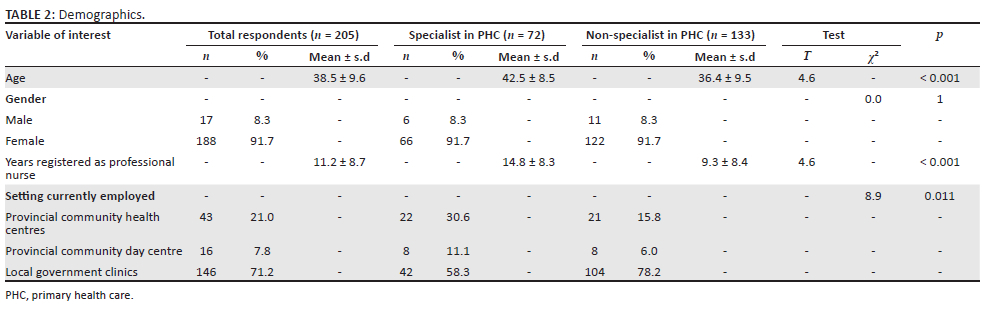
A total of 205 professional nurses employed in PHC facilities out of a total of 303 completed the questionnaires (67.7% response rate). The average age of the respondents was 38.5 years (± 9.6 years) with the age ranging from 23 to 63 years. Most of the respondents were females (188, 91.7%). More than half (n = 119, 58.0%) of the respondents reported their highest qualification as either a basic nursing diploma (n = 66, 32.2%) or degree (n = 53, 25.8%) that allowed them to register as a Nurse (General, Psychiatric and Community) and Midwife as per Regulation R425 of the South African Nursing Council. Eighty-three (40.5%) of the respondents reported that they had a post-basic qualification in nursing and only three (1.5%) had a master's degree in nursing. Although 86 (42.0%) respondents identified themselves as clinical nurse specialists, only 72 (35.1%) respondents were registered with the South African Nursing Council under Regulation R48 for Clinical Nursing Science, Health Assessment, Treatment and Care, the PHC specialist post-basic qualification. The remaining 13 clinical nurse specialist who were registered with the South African Nursing Council according to Regulation Number R212 included post-basic psychiatric nursing science (2%), occupational health nursing (1.5%), post-basic child nursing science (1%), post-basic midwifery and neonatal nursing science (1%), critical care nursing: Adult (0.5%) and child psychiatric nursing science (0.5%). Only, one respondent was registered with the South African Nursing Council according to Regulation Number R1501 as Nurse Administrator (0.5%). More than two thirds of the respondents (146, 71.2%) were employed in local government facilities with these clinic staff representing a significantly higher proportion of specialist staff with 42 (58.3%) of the staff qualified in PHC nursing compared to 30 (41.7%) in the other two provincial government settings (χ2p = 0.011) (Table 2).
Professional nursing tasks domains: Importance, performance and training needs
Using the TNA, the standard professional nursing tasks to be performed in five domains (research and audit, communication and teamwork, clinical tasks, administration and management and supervisory tasks) were rated in terms of importance and current performance. Based on these two ratings, the training needs for each item and domain were calculated.
Importance of professional tasks
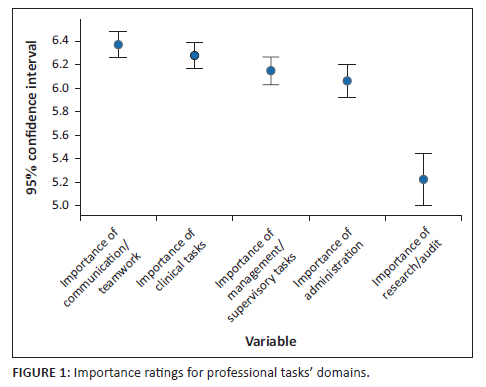
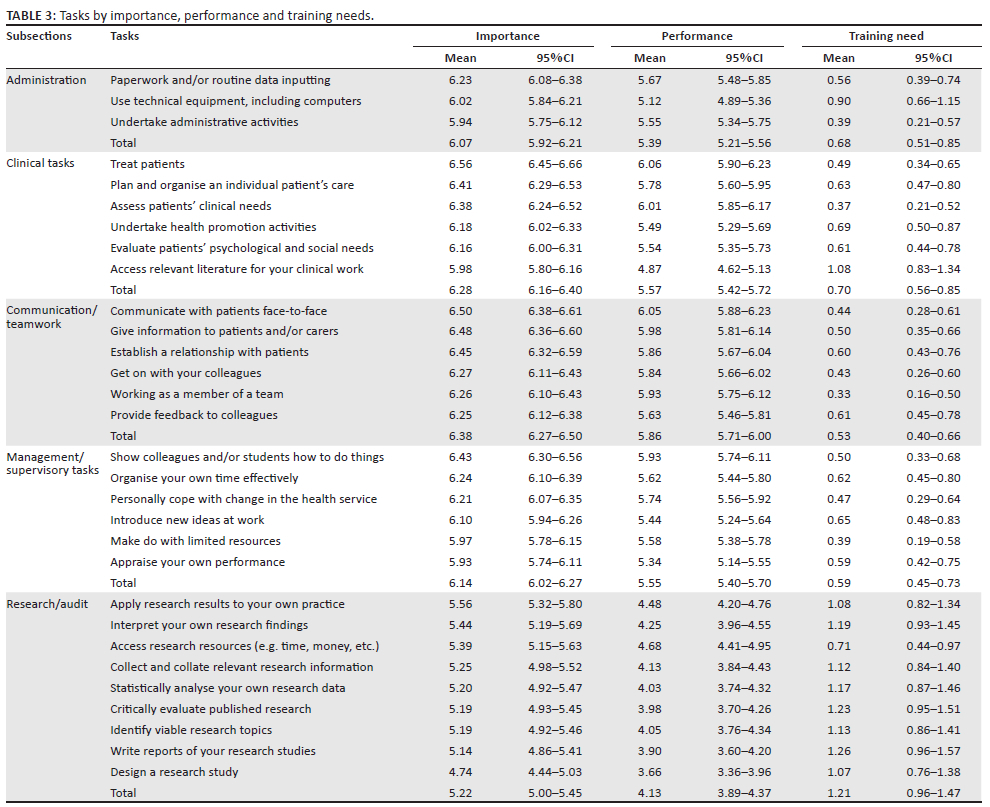
The respondents rated Communication and teamwork tasks as the most important task domain (6.38, 95% CI: 6.27-6.50]) followed by Clinical tasks (6.28, 95% CI: 6.16-6.40) (Figure 1). The most important individual task was a clinical task, Treat patients (6.56, 95% CI: 6.45-6.66), followed by two communication and teamwork tasks, Communicating with patients face-to-face (6.50 6.38-6.61) and Giving information to patients (6.48, 95% CI: 6.36-6.60) (Table 3). The research tasks as a domain were rated the least important and were rated significantly lower than the other domains (5.22, 95% CI: 5.0-5.45) (5.22, 95% CI: 5.00-5.45) (Figure 1), with the least important task identified as Designing a research study (4.74, 95% CI: 4.44-5.03) (Table 3).
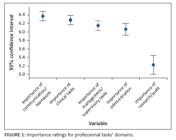
In comparing specialist in PHC respondents with non-specialist in PHC respondents, no significant differences were reported in the importance of these domains. However, differences were recorded between local and provincial government respondents with provincial government respondents rating the importance of all domains higher and with the importance of the research domain rated significantly higher (5.67 ± 1.3 vs 5.03 ± 1.7, U = 2.4, p = 0.019).
Performance of professional nursing tasks
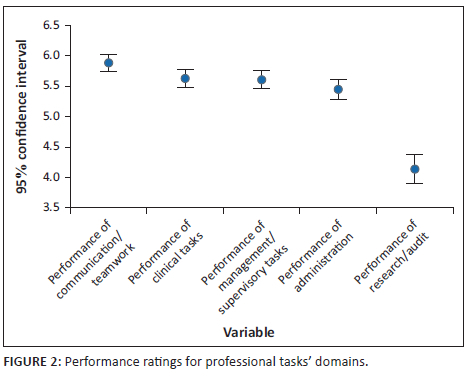
Performance was on average rated lower than importance. Communication and Teamwork Tasks had the highest performance ratings (5.86, 95 CI: 5.71-6.00), followed by Clinical Tasks (5.57, 95 CI: 5.42-5.72) (Figure 2). The task with the highest performance rating was the clinical task, Treat Patients (6.06, 95% CI: 5.90-6.23), followed by a communication and teamwork task, Communicating with Patients face-to-face (6.05 95% CI: 5.88-6.23), and then the clinical task Assess Patients' Clinical Needs (6.01, 95% CI: 5.85-6.17) (Table 3). Performance in research tasks as a domain was again rated the lowest and was rated significantly lower than the other domains (4.13, 95% CI: 3.89-4.37]) (Figure 2), with the least important task identified as Designing a Research Study (3.66, 95% CI: 3.36-3.96]) (Table 3).
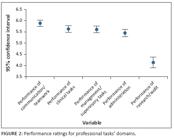
In comparing specialist in PHC respondents with non-specialist in PHC respondents, significant differences were reported in the performance of communication and teamwork (5.69 ± 1.1 vs 5.99 ± 1.0, U = 2.1, p = 0.032) and administration (5.20 ± 1.2 vs 5.58 ± 1.2, U = 2.1, p = 0.035). No significant differences in ratings of performance of the research, clinical tasks and management domains were recorded for specialist in PHC respondent's versus non-specialist in PHC respondents. Differences were recorded between local and provincial government respondents, with local government respondents rating the performance of clinical tasks domains higher than provincial government respondents (5.73 ± 1.0 vs 5.38 ± 1.1, U = 1.9, p = 0.046).
Training needs for professional nursing tasks
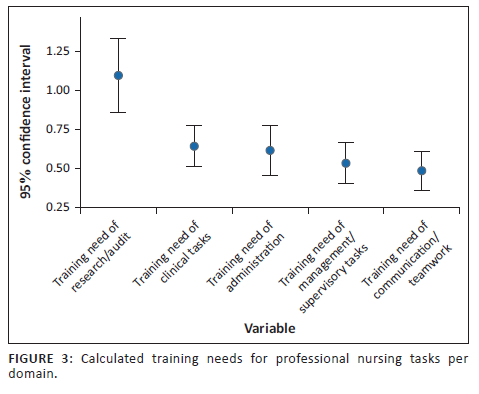
The calculated training needs for professional nursing tasks demonstrated that the highest training need was Research Tasks (1.21, 95% CI: 0.96-1.47), which was significantly higher than the other calculated training needs (Figure 3), followed by Clinical Tasks (0.70, 95% CI: 0.56-0.85), not significantly different from the other domains. The lowest calculated training need was Communication and Teamwork (0.53, 95% CI: 0.40-0.66), although this was not significant (Figure 3).
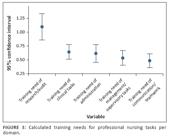
Significant higher training needs were calculated for specialist in PHC respondents compared to non-specialist in PHC respondents in the research (1.46 ± 2.0 vs 0.90 ± 1.6, U = 1.6 p = 0.10), communication and teamwork (0.67 ± 0.9 vs 0.39 ± 0.8, U = 1.6 p = 0.10), clinical (0.85 ± 1.0 vs 0.53 ± 0.9, U = 2.1 p = 0.004), administration (0.82 ± 1.2 vs 0.51 ± 1.1, U = 1.7 p = 0.09) and management domains (0.70 ± 1.0 vs 0.45 ± 0.9, U = 1.3 p = 0.18). Similarly, when comparing calculated training needs, provincial government respondents had significant higher training needs in all categories compared to local government respondents, research (1.77 ± 2.1 vs 0.80 ± 1.5, U = 3.3 p < 0.001), communication and teamwork (0.70 ± 0.9 vs 0.39 ± 0.9, U = 2.8 p = 0.005), clinical (0.93 ± 1.0 vs 0.52 ± 0.9, U = 3.4 p < 0.001), administration (0.99 ± 1.2 vs 0.45 ± 1.1, U = 3.5 p < 0.001) and management (0.84 ± 1.1 vs 0.40 ± 0.9, U = 3.5 p < 0.001).
Professional tasks by importance, performance and training need
In assessing the training needs associated with individual tasks, the top three tasks with the highest training needs were in the research domain with Writing a Research Report (1.26, 95% CI: 0.96-1.57), Critically Evaluating Published Research (1.23, 95% CI: 0.95-1.51) and Interpreting Research Findings (1.19, 95% CI: 0.93-1.45) (Table 3). Within the clinical domain, the highest rated training need was Accessing relevant literature for Clinical Work (1.08, 95% CI: 0.83-1.34), followed by Undertaking Health Promotion Activities (0.69, 95% CI: 0.50-0.87). In the management and supervisory domain, the highest rated training needs were Introducing New Ideas at Work (0.65, 95% CI: 0.48-0.83) (0.65, 95% CI: 0.48-0.83) and Organising your own time effectively (0.62, 95% CI: 0.45-0.80). In the communication and teamwork domain, Providing Feedback to Colleagues (0.61, 95% CI: 0.45-0.78) and Establishing Relationships with Patients (0.60, 95% CI: 0.43-0.76) were the highest rated training needs. Lastly, in the administrative domain, the highest rated training need was Using Technical Equipment Including Computers (0.90, 95% CI: 0.66-1.15).
Specific training needs for primary health care
Specific contextual training domains and topics for primary health care
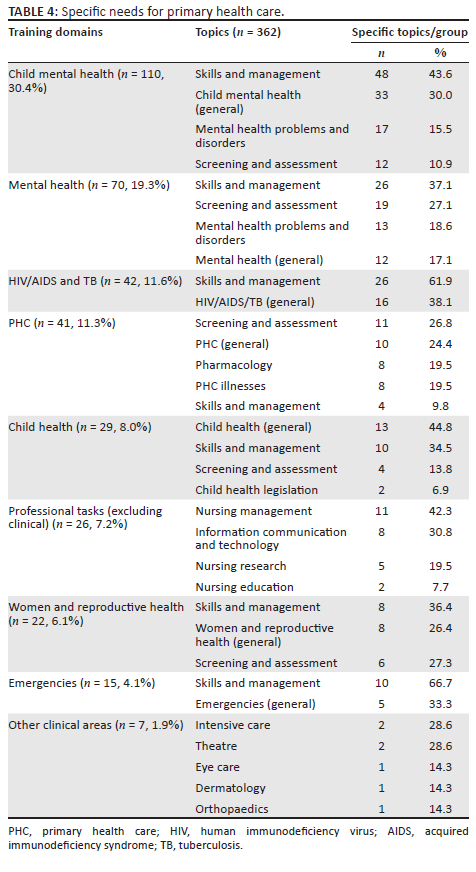
Based on all the training needs' topics, irrespective of ranking, 362 topics were listed, grouped into nine training domains (Table 4). Child mental health training topics were most frequently listed (n = 110, 30.4%) with specific topics requested in child mental health skills and management (n = 48, 43.6%), child mental health (general) (n = 33, 30.0%), child mental health problems and disorders (n = 17, 15.5%) and child mental health screening and assessment (n = 12, 10.9%) (Table 4). This was followed by mental health (n = 70, 19.3%), HIV/AIDS and TB (42, 11.6%) and PHC (n = 41, 11.3%) topics. In the top three topics in each of the domains, skills and management was the most frequently identified (Table 4).
Top ranked specific primary health care training needs
Ranked primary health care training domains and topics
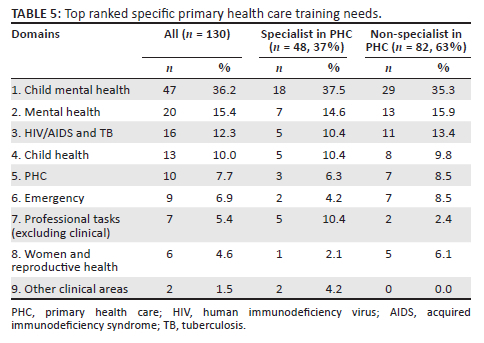
In ranking the specific training topics for PHC (n = 130), all training topics were clinical, except for professional tasks which ranked seventh. The highest ranked training domain was again for child mental health topics in the child mental health domain which was rated as most important by 47 (36.2%) respondents, followed by mental health (n = 20, 15.4%) and HIV/AIDS and TB (n = 16, 12.3%) (Table 5). The traditional PHC domains of PHC and women and reproductive health were rated higher by the non-specialist in PHC respondents than the specialist in PHC respondents (n = 5, 6.1% vs n = 1, 2.1%). However, both groups rated child mental health and mental health as the most important (Table 5).
Discussion
This is the first study to investigate the training needs of professional nurses working in PHC facilities in the Cape Metropole, Western Cape, South Africa. The first finding of note was the low level of specialisation (35.1%) in PHC Nursing, which is an additional qualification in Clinical Nursing Science, Health Assessment, Treatment and Care, in South Africa. Although professional nurses render most of the healthcare at PHC level, professional nurses qualified in Clinical Nursing Science, Health Assessment, Treatment and Care are in short supply.333433
The second finding based on the TNA was that the respondents rated the Communication and Teamwork domain as the most important and highest performance domain and the research domain significantly lower than the other domains, with the least important task identified as designing a research study. Although this study had 25.8% of respondents with a degree and 42% of respondents with a post-basic qualification in any clinical nursing specialty such as post-basic psychiatric nursing science, Occupational health nursing, post-basic child nursing science, post-basic midwifery and neonatal nursing science, Critical Care Nursing: Adult and Child psychiatric nursing science, the self-rated low importance and performance of designing research studies by the respondents is of concern. This is a concern as research methodologies are offered as an introduction to research during an undergraduate nursing degree as well as at post-basic diploma levels in South Africa. Furthermore, according to the South African Nursing Council Competency Framework for PHC nurse specialists, performance of research is a core competency.3526936
The low rating of importance and performance in the research task domain in this study, resulted in research being identified as the highest training need by PHC nurses. The results of this study are comparable with the results from an earlier study222224243729
In determining the specific training topics in PHC, most were clinical training topics specifically related to current practice in PHC, with professional topics only ranking seventh in importance. In both the most frequently listed topics and the most important ranking of training domains, child mental health was listed as the most important training need facing PHC nurses in practice. Specific topics listed were child mental health nursing skills and management, child mental health problems and disorders and child mental health screening and assessment. These findings are well supported by a recent study88383940
Strengths and limitations
The findings of the study provide baseline information on the training needs of PHC nurses in the Cape Metropole, Western Cape, South Africa, a topic that has been neglected to date. Furthermore, the study is timely as it will assist with the development of short courses for CPD and contribute to the current process of review and alignment of nursing curricular to the Higher Education Qualification Sub-Framework (HEQSF) in South Africa. The study has some limitations. Firstly, because the Hennessy-Hicks TNA questionnaire is largely a self-reported questionnaire, professional nurses in PHC rated the importance of all the tasks and their own performance of these tasks which may be subjective and not a true reflection of the PHC nurses' training needs. Secondly, the study was conducted among professional nurses employed in two of the four health substructures in the Western Cape. Therefore, the results of this study cannot be generalised to the broader nursing fraternity. Lastly, a better response rate could have been obtained; however, due to COVID-19 pandemic, some professional nurses were on sick leave or in isolation during the data collection period.
Recommendations
Firstly, the engagement of PHC nurses in collaborative research has the potential to improve nursing care and patient outcomes through evidence-based practice.414120
Conclusion
The aim of this study was to determine the training needs of professional nurses working in PHC facilities in the Cape Metropole, Western Cape, South Africa. The survey highlights the low level (35.1%) of specialisation as PHC and identified research and child mental health as the most important professional and clinical training needs.
Competing interests
The authors declare that they have no financial or personal relationships that may have inappropriately influenced them in writing this article.
Authors' contributions
All authors made substantial contribution to the conceptualisation and design of the study. A.K. contributed to the data collection. A.K. and J.C. performed the data analysis. A.K., F.D. and J.C. contributed to the revisions, read the drafts and approved the final manuscript. F.D. and J.C. are the supervisors of A.K. All authors read and approved the final version of the manuscript.
Funding information
This research received no specific grant from any funding agency in the public, commercial or not-for-profit sectors.
Data availability
Data sharing does not apply to this article as no new data were created or analysed in this study.
Disclaimer
The views and opinions expressed in this article are those of the authors and do not necessarily reflect the official policy or position of any affiliated agency of the authors.
Acknowledgements
The authors would like to thank all the study participants for their time and willingness to participate in the study. The authors would also like to thank Prof. José Frantz, (Deputy Vice-Chancellor: Research and Innovation) and Prof Nicolette Roman (South African Research Chair in the Development of Human Capabilities and Social Cohesion through the Family) at the University of the Western Cape for their continuous support.
References
-
1.World Health Organization (WHO). Global conference on primary health care: From Alma-Ata towards universal health coverage and the sustainable development goals, Astana, Kazakhstan [homepage on the Internet]. 2018 [cited 2018 Oct 25 and 26]. Available from: https://www.who.int/publications/i/item/report-of-the-global-conference-on-primary-health-care-from-alma-ata-towards-universal-health-coverage-and-the-sustainable-development-goals
» https://www.who.int/publications/i/item/report-of-the-global-conference-on-primary-health-care-from-alma-ata-towards-universal-health-coverage-and-the-sustainable-development-goals -
2.Declaration of alma-ata [homepage on the Internet]. 1978 [cited 2022 Feb 25]. Available from: https://apps.who.int/iris/handle/10665/347879
» https://apps.who.int/iris/handle/10665/347879 -
3.Binagwaho A, Ghebreyesus TA. Primary healthcare is cornerstone of universal health coverage. Br Med J. 2019;365:l2391. https://doi.org/10.1136/bmj.l2391
» https://doi.org/10.1136/bmj.l2391 -
4.Declaration of Astana: Global conference on primary health care: Astana, Kazakhstan [homepage on the Internet]. 2019 [cited 2018 Oct 25 and 26]. Available from: https://www.who.int/docs/default-source/primary-health/declaration/gcphc-declaration.pdf
» https://www.who.int/docs/default-source/primary-health/declaration/gcphc-declaration.pdf -
5.Bresick G, Von Pressentin KB, Mash R. Evaluating the performance of South African primary care: A cross-sectional descriptive survey. S Afr Fam Pract. 2019;61(3):109-116. https://doi.org/10.1080/20786190.2019.1596666
» https://doi.org/10.1080/20786190.2019.1596666 -
6.Crowley T, Kitshoff D, De Lange-Cloete F, et al. Reorganisation of primary care services during COVID-19 in the Western Cape, South Africa: Perspectives of primary care nurses. S Afr Fam Pract. 2021;63(1):e1-e10. https://doi.org/10.4102/safp.v63i1.5358
» https://doi.org/10.4102/safp.v63i1.5358 - 7.Hawkridge S, Nassen R, Vogel W. Child & adolescent mental health services in the Western Cape Province: A rapid appraisal. Cape Town: Report for the Western Cape Department of Health and Wellness; 2016 Unpublished.
-
8.Mokitimi S, Schneider M, De Vries PJ. A situational analysis of child and adolescent mental health services and systems in the Western Cape Province of South Africa. Child Adolesc Psychiatry Ment Health. 2022;16(1):1-22. https://doi.org/10.1186/s13034-022-00440-7
» https://doi.org/10.1186/s13034-022-00440-7 -
9.Mohsen MM, Safaan NA, Okby O. Facilitating factors for overcoming barriers facing nurses for research utilization in clinical settings. Am J Nurs Res. 2016;4(1) 13-24. http://doi.org/10.12691/ajnr-4-1-3
» http://doi.org/10.12691/ajnr-4-1-3 -
10.Adewole DA, Salawu MM, Bello S. Training needs assessment and preferred approach to enhancing work performance among clinical nurses in University College Hospital (UCH), Ibadan, Oyo State, South-western Nigeria. Int J Nurs Midwifery. 2020;12(4):130-138. https://doi.org/10.5897/IJNM2020.0434
» https://doi.org/10.5897/IJNM2020.0434 -
11.National Department of Health (NDoH). National core standards for health establishments in South Africa [homepage on the Internet]. 2011 [cited 2022 Mar 23]. Available from: https://static.pmg.org.za/docs/120215abridge_0.pdf
» https://static.pmg.org.za/docs/120215abridge_0.pdf -
12.Muthelo L, Moradi F, Phukubye TA, Mbombi MO, Malema RN, Mabila LN. Implementing the ideal clinic program at selected primary healthcare facilities in South Africa. Int J Environ Res Public Health. 2021;18(15):7762. https://doi.org/10.3390/ijerph18157762
» https://doi.org/10.3390/ijerph18157762 -
13.Meno FO, Makhado L, Matsipane M. Factors inhibiting implementation of integrated management of childhood illnesses (IMCI) in primary health care (PHC) facilities in Mafikeng sub-district. Int J Afr Nurs Sci. 2019;11:100161. https://doi.org/10.1016/j.ijans.2019.100161
» https://doi.org/10.1016/j.ijans.2019.100161 -
14.Cornick R, Picken S, Wattrus C, et al. The practical approach to care kit (PACK) guide: Developing a clinical decision support tool to simplify, standardise and strengthen primary healthcare delivery. BMJ Glob Health. 2018;3(Suppl 5):e000962. https://doi.org/10.1136/bmjgh-2018-000962
» https://doi.org/10.1136/bmjgh-2018-000962 -
15.Baron JC, Kaura D. Perspectives on waiting times in an antenatal clinic: A case study in the Western Cape. Health SA Gesondheid. 2021;26(1):1513. https://doi.org/10.4102/hsag.v26i0.1513
» https://doi.org/10.4102/hsag.v26i0.1513 -
16.Crowley T, Mokoka E, Geyer N. Ten years of nurse-initiated antiretroviral treatment in South Africa: A narrative review of enablers and barriers. S Afr J HIV Med. 2021;22(1):1-13. https://doi.org/10.4102/sajhivmed.v22i1.1196
» https://doi.org/10.4102/sajhivmed.v22i1.1196 -
17.Rabie T, Klopper HC, Coetzee SK. Creating positive practice environments in a primary health care setting. Int J Nurs Pract. 2017;23(4):e12555. https://doi.org/10.1111/ijn.12555
» https://doi.org/10.1111/ijn.12555 -
18.Carlisle J, Bhanugopan R, Fish A. Training needs of nurses in public hospitals in Australia: Review of current practices and future research agenda. J Eur Ind Train. 2011;35(7):687-701. https://doi.org/10.1108/03090591111160797
» https://doi.org/10.1108/03090591111160797 -
19.Holloway K, Arcus K, Orsborn G. Training needs analysis - The essential first step for continuing professional development design. Nurse Educ Pract. 2018;28:7-12. https://doi.org/10.1016/j.nepr.2017.09.001
» https://doi.org/10.1016/j.nepr.2017.09.001 -
20.South African Nursing Council (SANC). Continuing professional development framework for nurses and midwives in South Africa [homepage on the Internet]. 2022 [cited 2022 Oct 11]. Available from: https://www.sanc.co.za/cpd/
» https://www.sanc.co.za/cpd/ -
21.Burke D, Cocoman A. Training needs analysis of nurses caring for individuals an intellectual disability and or autism spectrum disorder in a forensic service. J Intellect Disabil Offending Behav. 2018;11(1):9-22. https://doi.org/10.1108/JIDOB-10-2019-0024
» https://doi.org/10.1108/JIDOB-10-2019-0024 -
22.Markaki A, Alegakis A, Antonakis N, Kalokerinou-Anagnostopoulou A, Lionis C. Exploring training needs of nursing staff in rural Cretan primary care settings. Appl Nurs Res. 2009;22(2):138-143. https://doi.org/10.1016/j.apnr.2008.12.002
» https://doi.org/10.1016/j.apnr.2008.12.002 -
23.Shongwe NG. Learning needs assessment for continuous professional development in paediatric acute care nursing: The Eswatini project [homepage on the Internet]. University of the Witwatersrand; 2019 [cited 2021 June 17]. Available from: https://hdl.handle.net/10539/27982
» https://hdl.handle.net/10539/27982 -
24.Tyler C, Hicks C. The occupational profile and associated training needs of the nurse prescriber: An empirical study of family planning nurses. J Adv Nurs. 2001;35(5):644-653. https://doi.org/10.1046/j.1365-2648.2001.01896.x
» https://doi.org/10.1046/j.1365-2648.2001.01896.x -
25.Hennessy D, Hicks C. A cross-cultural tool to identify continuing education needs. Int Nurs Rev. 1998;45(4):109-114. https://doi.org/10.1046/j.1466-7657.45.no.4issue340.4.x
» https://doi.org/10.1046/j.1466-7657.45.no.4issue340.4.x -
26.Barratt H, Fulop NJ. Building capacity to use and undertake research in health organisations: A survey of training needs and priorities among staff. BMJ Open. 2016;6(12):e012557. https://doi.org/10.1136/bmjopen-2016-012557
» https://doi.org/10.1136/bmjopen-2016-012557 -
27.Gaspard J, Yang C-M. Training needs assessment of health care professionals in a developing country: The example of Saint Lucia. BMC Med Educ. 2016;16(1):1-6. https://doi.org/10.1186/s12909-016-0638-9
» https://doi.org/10.1186/s12909-016-0638-9 -
28.Ngidi V. Training needs of medical managers in public hospitals in KwaZulu-Natal [homepage on the Internet]. 2012 [cited 2021 Apr 29]. Available from: http://hdl.handle.net/10413/10874
» http://hdl.handle.net/10413/10874 - 29.Western Cape Government. Annual report. Cape Town: Department of Health, editor. 2021.
-
30.Hicks C. Hennessy-Hicks training needs analysis questionnaire and manual [homepage on the Internet]. Vol. 3. Birmingham University Licensed to WHO for On-line use; n.d. [cited 2011 Apr]. Available from: https://www.academia.edu/7588447/HENNESSY_HICKS_TRAINING_NEEDS_ANALYSIS_QUESTIONNAIRE_AND _MANUAL_For_use_at_a_local_level_to_identify_training_and_development_needs
» https://www.academia.edu/7588447/HENNESSY_HICKS_TRAINING_NEEDS_ANALYSIS_QUESTIONNAIRE_AND _MANUAL_For_use_at_a_local_level_to_identify_training_and_development_needs -
31.Markaki A, Malhotra S, Billings R, Theus L. Training needs assessment: Tool utilization and global impact. BMC Med Educ. 2021;21(1):1-20. https://doi.org/10.1186/s12909-021-02748-y
» https://doi.org/10.1186/s12909-021-02748-y -
32.World Medical Association. Declaration of Helsinki: Ethical principles for medical research involving human subjects. JAMA. 2013;310(20):2191-2194. https://doi.org/10.1001/jama.2013.281053
» https://doi.org/10.1001/jama.2013.281053 -
33.Nesengani TV. Strategies for professional nurses to facilitate caring of patients in the primary health care clinics in Gauteng Province, South Africa [homepage on the Internet]. University of Johannesburg; 2019 [cited 2022 Nov 04]. Available from: https://ujcontent.uj.ac.za/esploro/outputs/doctoral/Strategies-for-professional-nurses-to-facilitate/9910978507691#file-0
» https://ujcontent.uj.ac.za/esploro/outputs/doctoral/Strategies-for-professional-nurses-to-facilitate/9910978507691#file-0 -
34.South African Nursing Council (SANC). Registrations and listed qualifications [homepage on the Internet]. 2021 [cited 2022 May 12]. Available from: https://www.sanc.co.za/2021-stats/
» https://www.sanc.co.za/2021-stats/ -
35.South African Nursing Council. Competencies for primary care nurse specialist [homepage on the Internet]. 2014 [cited 2021 Aug 17]. Available from: https://www.sanc.co.za/wp-content/uploads/2020/06/SANC-Competencies-Primary-Care-Nurse-Specialist.pdf
» https://www.sanc.co.za/wp-content/uploads/2020/06/SANC-Competencies-Primary-Care-Nurse-Specialist.pdf -
36.Dagne AH, Tebeje H, Demewozu M. Research utilisation in clinical practice: The experience of nurses and midwives working in public hospitals. Reprod Health. 2021;18(1):1-9. https://doi.org/10.1186/s12978-021-01095-x
» https://doi.org/10.1186/s12978-021-01095-x -
37.Duma S, Dippenaar J, Bhengu B, et al. Specialist and advanced specialist nursing and midwifery practice. Trends Nurs. 2012;1(1):102-119. https://doi.org/10.14804/1-1-28
» https://doi.org/10.14804/1-1-28 -
38.Dube FN, Uys LR. Integrating mental health care services in primary health care clinics: A survey of primary health care nurses' knowledge, attitudes and beliefs. S Afr Fam Pract. 2016;58(3):119-125. https://doi.org/10.1080/20786190.2016.1191747
» https://doi.org/10.1080/20786190.2016.1191747 -
39.Delobelle PA, Decock R, Depoorter A, Mamogobo PM, Marincowitz GJ. Introducing a primary health care nurse training course at the University of Limpopo: Experiences and views of trainees. Afr J Prim Health Care Fam Med. 2011;3(1):1-5. https://doi.org/10.4102/phcfm.v3i1.292
» https://doi.org/10.4102/phcfm.v3i1.292 -
40.Chukwu UN. The current situation of children's nursing training in South Africa [homepage on the Internet]. University of Cape Town; 2017 [cited 2022 Aug 19]. Available from: http://hdl.handle.net/11427/25017
» http://hdl.handle.net/11427/25017 - 41.Brysiewicz P, Oyegbile Y. Addressing 'research-phobia' among nurses in the clinical area. Prof Nurs Today. 2021;25(1):21-23.

Accepted: 17 Oct. 2022
Published: 16 May 2023