Measuring empathy in a group of South African undergraduate medical students using the student version of the Jefferson Scale of Empathy
Abstract
BACKGROUND: Patient-centred care is a model of care that demands healthcare providers change their focus from the disease to the patient and his or her perceived physical and psycho-social needs. This model requires healthcare workers to listen actively and to have effective communication skills and well-developed levels of empathy. AIM: The aim of this study was to determine the suitability of the Jefferson Scale for Empathy (JSE-S) as a valid test for empathy in third-year medical students at a South African university and also to determine the baseline level of empathy in this same group of students. SETTING: The study took place at a medical school in the Western Cape, South Africa. This medical degree (MB ChB) is a 6-year programme. Students are first exposed to patients within their second year of training, but it is during their third-year that they start their clinical rotations. We wanted to test whether our empathy training would give students the necessary skills and enable them to establish good empathic communication habits in order to prevent a fall in empathy during this vulnerable period. METHODS: This article explores the suitability of the student version of the JSE-S as a valid test for empathy, within the South African medical school context. We briefly discuss the psychometrics and the scores against what is already known in countries like ours, specifically, developing nations where cultural and language differences exist in the student populations. Furthermore, we explore whether the JSE-S is a valid scale for pre- and post-intervention measurement of medical student empathy within our context and discuss the limitations of self-assessment. We also report on baseline levels of empathy in third-year medical students. RESULTS: Two hundred and six third-year medical students (69% females) completed the JSE-S prior to the intervention. Females and students aged 25 years and older had significantly higher scores than males and those 22 years old or less. The mean JSE was 109.98 (SD = 12.54), which is lower than most internationally reported scores. The Cronbach's alpha coefficient was 0.81, indicating scale reliability and consistency, but graded item response testing highlighted variance in three reverse-scored questions. CONCLUSION: The JSE-S is an appropriate and valid scale for measuring levels of empathy in undergraduate medical students in South Africa. However, language may need to be clarified in the negatively phrased items.
empathy; medical education; Jefferson Scale for Empathy; validity; medical students; communication skills
Background
Patient-centred care is a model of care that is responsive to and respectful of the individual patient's physical and psycho-social preferences. There are various benefits of patient-centred care including the development of caring relationships between healthcare providers and their patients, improved adherence and health outcomes and reduced healthcare costs.1,21
Empathy is a widely used, yet complex and often misunderstood term.223,45,675,89
At the beginning of 2018 medical students were given practical, experiential training in empathic communication in the Clinical Skills Lab, and the efficacy of this new training intervention needed to be tested. The method most widely used internationally to measure empathy in medical education is the Jefferson Scale of Empathy (JSE), developed in 2002 at Thomas Jefferson Medical College (United States). The JSE was originally named the Jefferson Scale of Physician Empathy (JSPE). It was later renamed the Jefferson Scale of Empathy (JSE), as it was increasingly used within the broader context of healthcare. Slight modifications to the wording, to be more participant specific to medical students (S-version) and other healthcare providers (HP-version), resulted in further versions being made available.101112
The objectives of this paper are firstly to determine the suitability of the JSE-S scale as a valid test for empathy in South Africa, given the wide variance of cultural and home language of undergraduate medical students, and secondly to determine the baseline level of empathy in this group of students.
Methodology
Study design
The study followed a mixed-methods approach (Denscombe, 2010), including both qualitative and quantitative methodologies. This paper reports on the validity of the instrument used for the quantitative aspects of the study.
Setting
The study took place at the University of Stellenbosch Medical School in the Western Cape, South Africa. The Bachelor of Medicine and Bachelor of Surgery (MB ChB) runs over 6 years and comprises three phases. The first foundation phase; the second clinical phase, which extends from the second year to the beginning of the fifth year; and the final consolidation phase. Students are first exposed to patients within their second year of training, but it is during their third year that they start their clinical rotations. We wanted to test whether our empathy training would give students the necessary skills and enable them to establish good empathic communication habits in order to prevent a fall in empathy during this vulnerable period.
Study population and sampling strategy
The population were all the third-year undergraduate medical students (n = 287). It was our intention to include as many of the participant population as possible during a 2-week period at the beginning of the year. The reason why third-year students were selected was twofold. Firstly, within our current curriculum context this is when students enter the clinical areas and communicate with patients, as part of clinical rotations. Secondly a number of international studies have demonstrated that empathy levels begin to fall in the third year, when students first encounter patients. Ethical approval was slow, which meant data collection occurred at end of February 2018, after the orientation session and when students had already entered their clinical rotation. In the third year, students are allocated to one of five clinical rotation groups, not all of which were easily accessible during the data collection period. Students were approached to complete the JSE-S within these smaller clinical groups. The study was explained; they were informed participation was voluntary, and the students who were present and willing to take part signed an informed consent form and completed the paper-based JSE-S. Students were given the option to not participate by either indicating their refusal or simply spoiling the instrument. None of the students refused participation, and 206 students completed the JSE-S. Students were also required to provide demographic data about age and gender. Data collection and capture were performed by a researcher not actively involved in the research process teaching interventions in order to limit bias. Data was entered onto an Excel spreadsheet before a statistician assisted with the analysis.
Data collection tool: Jefferson Scale of Empathy
The JSE-S is a 20-item measure that can be completed in about 10 minutes on a Likert-type scale from 1 (strongly disagree) to 7 (strongly agree). Ten of the items are phrased positively and scored directly, while the other 10 are phrased negatively and reverse-scored for statistical analysis.5 The range of possible scores is from 20 to 140. The higher the score, the greater the participants empathic orientation towards patient care. Permission to use the JSE-S was obtained from Thomas Jefferson Medical College, and no changes were made to the original instrument.
Data analysis
A descriptive table with the gender and age breakdown was used to summarise the biographic information. A linear regression model was used to compare the mean JSE-S across age and gender categories. In terms of the reliability of the questionnaire; the Cronbach's alpha coefficient was calculated for internal consistency1213
Ethical considerations
Ethics approval (N18/01/001) from the Health Research Ethics Committee was obtained prior to commencement of data collection.
Results
Descriptive statistics
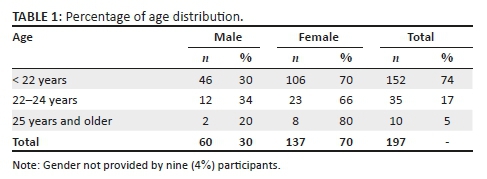
No one declined to participate, and 206 of the current 287 third-year medical students (i.e. 72%) were conveniently sampled and completed the JSE-S questionnaire. Table 1 provides details of the sample by age and gender. Some students did not indicate their gender (n = 9) or age (n = 5). The sampling was a close representation of the class demographics, because the population (i.e. third-year medical students in 2018) comprised 64% (n = 183) female students. The questionnaire was fully completed by 88% of participants.
Inferential statistics
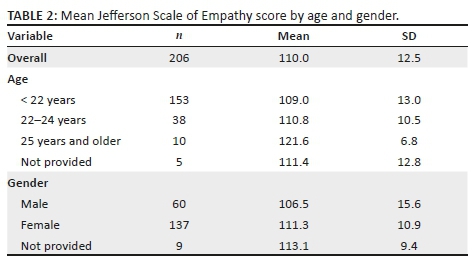
The mean total empathy score for the class was 110 (SD = 12.5). The JSE-S mean score by age and gender is given in Table 2. From the linear regression analysis both age (p = 0.006) and gender (p = 0.19) were significantly associated with the JSE-S score, although the interaction between age and gender was not significant (p = 0.055).
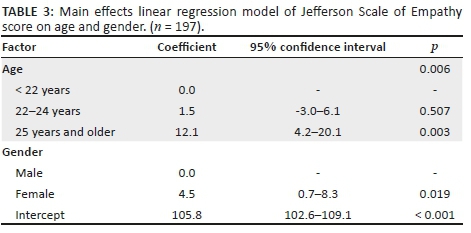
In Table 3 the estimated regression coefficients from the main effects model are presented. The students aged 25+ years had significantly higher scores than the < 22-year-olds (p = 0.003). Female students had significantly higher scores than males (p = 0.019).
Psychometrics of the student version of the Jefferson Scale of Empathy
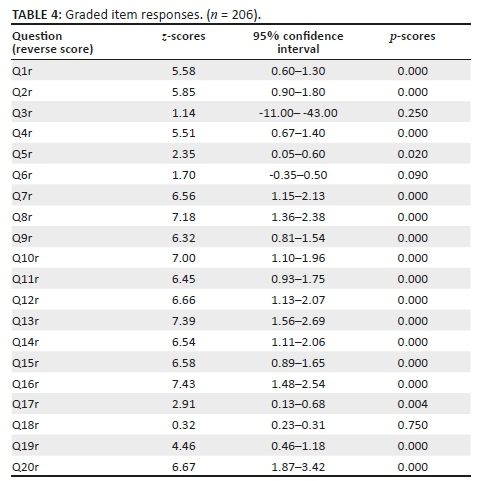
The Cronbach's alpha coefficient was 0.81, indicating adequate reliability and consistency between the items in the scale. All items in the JSE-S were evaluated for difficulty and discrimination using a graded item response model, which indicated that most items had the ability to differentiate between respondents given the underlying response model (Table 4), except for three items that had no discriminatory ability. These items were Q3R, Q6R and Q18R.
The three items, which were phrased negatively and then reverse marked, are as follows:
•Item3: 'It is difficult for a physician to view things from patients' perspective.'
•Item 6: 'Because people are different it is difficult to see things from patients' perspectives.'
•Item 18: 'Physicians should not allow themselves to be influenced by strong personal bonds between their patients and their family members.'
Discussion
This paper explores the decision to utilise the JSE-S as an instrument for measuring empathy in our mixed-methods study involving students drawn from many different cultural, religious and language groups in South Africa. In our setting, the Cronbach's alpha was reported as 0.81, which indicates good internal consistency. This correlates well with other studies, where the JSE-S was validated in groups of US medical students212
While it is not clear why three items were not discriminatory, we want to suggest it might be because the language may have been difficult to interpret when read quickly by non-first language English readers. All three of the mentioned items were negatively phrased and fall into a grouping of items labelled 'Standing in the Patient's Shoes' when describing the third trivial factor, which together with two major factors make up the JSE-S items.13
Hojat and Gonella2SD = 12.5). Our score is closer to the results of a study conducted with final (sixth) year medical students in South Africa,12SD = 10.9) is reported. This is probably a fairer comparison as both cohorts are from South African medical schools and therefore from similar social and cultural groups. By contrast data from 418 Indian medical students14SD = 14.56). Our score is slightly higher than the South African122,15,1617,1819
The finding that females have significantly higher score than males was expected. This is similar to local findings122,8,14,202
In our study, students aged +25 years had a significantly higher score than those < 22 years; this was not reported in the Indian study.14104,9
The measurement of empathy is challenging, and there are a number of possible ways to do this, including self-report questionnaires, behavioural measures and neuroscientific measures.2122
The JSE-S measures two of the primary components of empathy, namely affective and cognitive empathy. In addition, as it was developed about 15 years ago,223
Conclusion
The results suggest that the JSE-S is an appropriate and valid scale to measure levels of empathy for undergraduate medical students in our context, as our intervention focuses mainly on cognitive empathy.
To understand the impact of educational interventions on the empathy levels of medical students, it is recommended that levels of empathy be measured more than once during medical training.
Lastly, to ensure clear understanding of the scale one could consider making basic language changes to the JSE-S to ensure clarity, when dealing with multilingual student groups, because some of the negatively stated phrases were difficult to understand.
A limitation of this study is that it is a single cross-sectional design at one institution. As a follow-up study, we are planning to repeat the measurement of the students' empathy levels after 1 year of clinical placements and exposure to empathy training sessions.
Competing interests
The authors declare that they have no financial or personal relationships that may have inappropriately influenced them in writing this article.
Authors' contributions
R.T. and E.A. both contributed equally in terms of data collection, conceptualisation of the article as well as writing up of the final article.
Funding information
This study was supported by the Centre for Teaching and Learning at Stellenbosch University through a Teaching Fellowship grant to Dr Elize Archer.
Disclaimer
The views expressed in this article are those of the authors and not that of the official funder or institution.
Acknowledgements
The authors are grateful to Dr Carl J. Lombard from the Division of Epidemiology and Biostatistics, University of Stellenbosch, for his assistance with the statistical data. The authors thank Jefferson Medical College for providing them permission to use the JSE for this study.
References
-
1.Mead N, Bower P, Hann M. The impact of general practitioners' patient-centredness on patients' post-consultation satisfaction and enablement. Soc Sci Med. 2002;55:283-299. https://doi.org/10.1016/S0277-9536(01)00171-X
» https://doi.org/10.1016/S0277-9536(01)00171-X -
2.Hojat M, Gonnella JS. Eleven years of data on the Jefferson Scale of Empathy-Medical Student Version (JSE-S): Proxy norm data and tentative cutoff scores. Med Princ Pract. 2015;24(4):344-350. https://doi.org/10.1159/000381954
» https://doi.org/10.1159/000381954 -
3.Zaki J, Ochsner KN. The neuroscience of empathy: progress, pitfalls and promise. Nat Neurosci. 2012;15(5):675. https://doi.org/10.1038/nn.3085
» https://doi.org/10.1038/nn.3085 -
4.Decety J. The neurodevelopment of empathy in humans. Dev Neurosci. 2010;60637:257-267. https://doi.org/10.1159/000317771
» https://doi.org/10.1159/000317771 -
5.Hojat M, Vergare MJ, Maxwell K, et al. The devil is in the third year: A longitudinal study of erosion of empathy in medical school. Acad Med. 2009;84(9):1182-1191. https://doi.org/10.1097/ACM.0b013e3181b17e55
» https://doi.org/10.1097/ACM.0b013e3181b17e55 -
6.Riess H. The impact of clinical empathy on patients and clinicians: Understanding empathy's side effects. AJOB Neurosci. 2015;6(3):51-53. https://doi.org/10.1080/21507740.2015.1052591
» https://doi.org/10.1080/21507740.2015.1052591 -
7.Thirioux B, Birault F, Jaafari N. Empathy is a protective factor of burnout in physicians: New neuro-phenomenological hypotheses regarding empathy and sympathy in care relationship. Front Psychol. 2016;7(May):1-11. https://doi.org/10.3389/fpsyg.2016.00763
» https://doi.org/10.3389/fpsyg.2016.00763 -
8.Chen D, Lew R, Hershman W, Orlander J. A cross-sectional measurement of medical student empathy. J Gen Intern Med. 2007 Sep 21;22(10):1434-1438. https://doi.org/10.1007/s11606-007-0298-x
» https://doi.org/10.1007/s11606-007-0298-x -
9.Safran DG. Defining the future of primary care: What can we learn from patients?. Ann Intern Med. 2003;138(3):248-255. https://doi.org/10.7326/0003-4819-138-3-200302040-00033
» https://doi.org/10.7326/0003-4819-138-3-200302040-00033 - 10.Hojat M, Lanoue M. Exploration and confirmation of the latent variable structure of the Jefferson Scale of Empathy. Int J Med Educ. 2014;5:73-81.
- 11.Boynton PM, Greenhalgh T. Selecting, designing, and developing your questionnaire. 2004;328(May):1312-1315.
- 12.Vallabh K. Psychometrics of the student version of the Jefferson Scale of Physician Empathy (JSPE-S) in final-year medical students in Johannesburg in 2008. S Afr J Bioethics Law. 2011;4(2):63-68.
-
13.Alcorta-Garza A, Delgado-Bolton R, Bliss L, Wiley JF. Cross-validation of the Spanish HP-version of the Jefferson Scale of Empathy confirmed with some cross-cultural differences. Front Psychol. 2016;7(July):1-9. https://doi.org/10.3389/fpsyg.2016.01002
» https://doi.org/10.3389/fpsyg.2016.01002 -
14.Chatterjee A, Ravikumar R, Singh S, Chauhan PS, Goel M. Clinical empathy in medical students in India measured using the Jefferson Scale of Empathy - Student version. J Educ Eval Health Prof. 2017;14:33. https://doi.org/10.3352/jeehp.2017.14.33
» https://doi.org/10.3352/jeehp.2017.14.33 -
15.Neumann M, Edelhäuser F, Tauschel D, et al. Empathy decline and its reasons: A systematic review of studies with medical students and residents. Acad Med. 2011;86(8):996-1009. https://doi.org/10.1097/ACM.0b013e318221e615
» https://doi.org/10.1097/ACM.0b013e318221e615 -
16.Chen DCR, Kirshenbaum DS, Yan J, Kirshenbaum E, Aseltine RH. Characterizing changes in student empathy throughout medical school. Med Teach. 2012 Apr 28;34(4):305-311. https://doi.org/10.3109/0142159X.2012.644600
» https://doi.org/10.3109/0142159X.2012.644600 -
17.Kataoka HU, Koide N, Ochi K, Hojat M. Measurement of empathy among Japanese medical students : Psychometrics and score differences by gender and level of medical. Acad Med. 2009;84(9):1192-1197. https://doi.org/10.1097/ACM.0b013e3181b180d4
» https://doi.org/10.1097/ACM.0b013e3181b180d4 -
18.Magalhães E, Salgueira AP, Costa P, Costa MJ. Empathy in senior year and first year medical students: A cross-sectional study. BMC Med Educ. 2011;11:52. https://doi.org/10.1186/1472-6920-11-52
» https://doi.org/10.1186/1472-6920-11-52 -
19.Maselko J. Social epidemiology and global mental health: Expanding the evidence from high-income to low- and middle-income countries. Curr Epidemiol Rep. 2017;63:166-173. https://doi.org/10.1007/s40471-017-0107-y
» https://doi.org/10.1007/s40471-017-0107-y -
20.Leombruni P, Di M, Torta R. Measurement properties and confirmatory factor analysis of the Jefferson Scale of Empathy in Italian medical students. Perspect Med Educ. 2014;3:419-430. https://doi.org/10.1007/s40037-014-0137-9
» https://doi.org/10.1007/s40037-014-0137-9 -
21.Neumann DL, Chan RCK, Boyle GJ, Wang Y, Westbury HR. Measures of empathy self-report, behavioral, and neuroscientific approaches. In: Boyle GJ, Saklofske DH, Matthews G, editors. Measures of personality and social psychological constructs [homepage on the Internet]. San Diego, CA: Elsevier Inc., 2015; p. 257-289. https://doi.org/10.1016/B978-0-12-386915-9.00010-3
» https://doi.org/10.1016/B978-0-12-386915-9.00010-3 -
22.Eisenberg N, Fabes RA. Empathy: Conceptualization, measurement, and relation to prosocial behavior. Motiv Emot. 1990;14(2):131-149. https://doi.org/10.1007/BF00991640
» https://doi.org/10.1007/BF00991640 -
23.Lingard L. Joining a conversation: The problem/gap/hook heuristic. Perspect Med Educ. 2015;4(5):252-253. https://doi.org/10.1007/s40037-015-0211-y
» https://doi.org/10.1007/s40037-015-0211-y

Accepted: 15 Jan. 2019
Published: 27 May 2019