Emergency contraceptive knowledge, attitudes and practices among female students at the University of Botswana: A descriptive survey
Abstract
BACKGROUND: Unintended pregnancies are associated with unsafe abortions and maternal deaths, particularly in countries such as Botswana, where abortion is illegal. Many of these unwanted pregnancies could be avoided by using emergency contraception, which is widely available in Botswana. AIM: To assess the level of knowledge, attitudes and practices of female students with regard to emergency contraception at the University of Botswana. SETTING: Students from University of Botswana, Gaborone, Botswana. METHODS: A descriptive survey among 371 students selected from all eight faculties at the university. Data were collected using a self-administered questionnaire and analysed using the Statistical Package for Social Sciences. RESULTS: The mean age was 20.6 years (SD 1.62), 58% were sexually active, 22% had used emergency contraception and 52% of pregnancies were unintended. Of the total respondents, 95% replied that they had heard of emergency contraception; however, only 53% were considered to have good knowledge, and 55% had negative attitudes towards its use. Students from urban areas had better knowledge than their rural counterparts (p = 0.020). Better knowledge of emergency contraception was associated with more positive attitudes towards actual use (p < 0.001). Older students (p < 0.001) and those in higher years of study (p = 0.001) were more likely to have used emergency contraception. CONCLUSION: Although awareness of emergency contraception was high, level of knowledge and intention to use were low. There is a need for a targeted health education programme to provide accurate information about emergency contraception.
Introduction
Emergency contraception (EC) is a contraceptive method used to prevent pregnancy after a known or suspected failure of contraception or unprotected intercourse, including sexual assault. Emergency contraception hinders or delays ovulation, prevents fertilisation and may affect implantation, but does not disrupt an already established pregnancy.123
Every year, unplanned pregnancies lead to at least 50 million abortions worldwide and result in approximately 80 000 maternal deaths.456784
University life for many students represents a move towards independence from parental supervision, new friendships and a chance to experience romantic or sexual relationships. Many sexually active female students in Botswana engage in unprotected sexual intercourse, have multiple partners or intergenerational sexual relationships.910,11
Although EC is available in Botswana, there has been little research into how widely people are aware of it and their attitudes towards it. The aim of this study was to assess the level of knowledge, attitudes and practice of female students at the University of Botswana towards EC.
Methods
Study design
A descriptive survey was conducted using a self-administered questionnaire.
Setting
The University of Botswana is situated in Gaborone, Botswana. The presumed enrolment figure for the academic year 2015-2016 (University of Botswana, statistics office, personal communication, October and/or November 2015) was approximately 18 000, of which 10 000 were women and 8000 were men. The university offers undergraduate and postgraduate qualifications, degrees and diplomas, with academic teaching continuing during both the day and the evenings. Presumed figures for undergraduate and postgraduate studies were 16 500 and 1500, respectively. There are eight faculties: Business, Education, Engineering and Technology, Graduate Studies, Health Sciences, Humanities, Science and Social Sciences. Students can access EC via the student health services or nearby government clinics.

Study population and sampling strategy
The study population was full-time female students who attended day classes. Students who attended part-time and distance learners were excluded as they were difficult to access. A sample size of 371 was determined, using an online sample size calculator12
Data collection
Data were collected using a self-administered paper-based questionnaire (see supplementary file) between November 2015 and March 2016. The questionnaire had been used previously in Ethiopia and adapted to the local context.11,13
Data analysis
Data were entered into an Excel spreadsheet, prior to analysis in the Statistical Package for Social Sciences version 20.0. Data from incomplete questionnaires were excluded, and, therefore, there may be a slightly different denominator for each variable. For descriptive statistical analysis, results were expressed in terms of frequencies and percentages.
For each respondent, the number of correct answers to the knowledge questions was used to determine the overall percentage of correct answers. Good knowledge was classified as having 50% or more of the answers correct.
For each respondent, the mean attitudinal score was calculated using a three-point scale (0 = no opinion, 1 = disagree and 2 = agree) for each of the three attitudinal statements. A score of 1.5 or above was interpreted as having a 'positive' attitude towards EC, and from this, the frequency and percentage of all respondents with a 'positive' or 'negative' attitude could be determined.
Associations between socio-demographic or academic variables with knowledge, attitudes and practice of EC were initially analysed using the chi-square test.
Ethical Consideration
Ethical permission for the study was obtained from the Institutional Review Board of the University of Botswana (Ref No: RES/IRB/195), Ministry of Health in Botswana (Ref No: HPDME: 13/18/1 vol. X [38]) and the Health Research Ethics Committee of Stellenbosch University (HREC Reference No: S14/09/186). Ethical permission for the pilot project was obtained from the Research and Consultancy Department of Botho University.
Results
Socio-demographic and academic characteristics
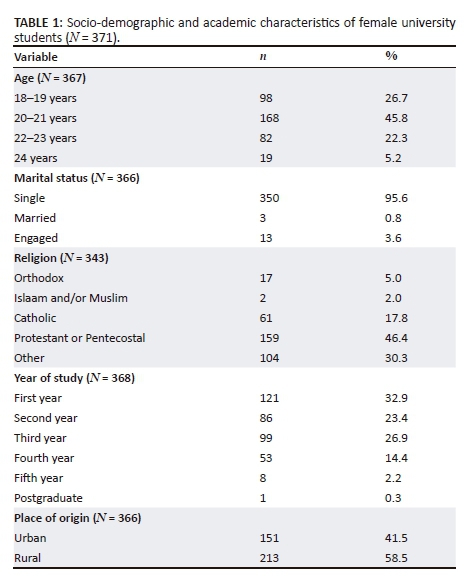
A total of 371 female students completed the questionnaire. Table 1 summarises the socio-demographic and academic characteristics of the respondents. Age was normally distributed, and the mean age was 20.6 years (SD 1.62). The majority of the students were single, from rural areas, of Christian background and studying undergraduate degrees.
Knowledge of emergency contraception
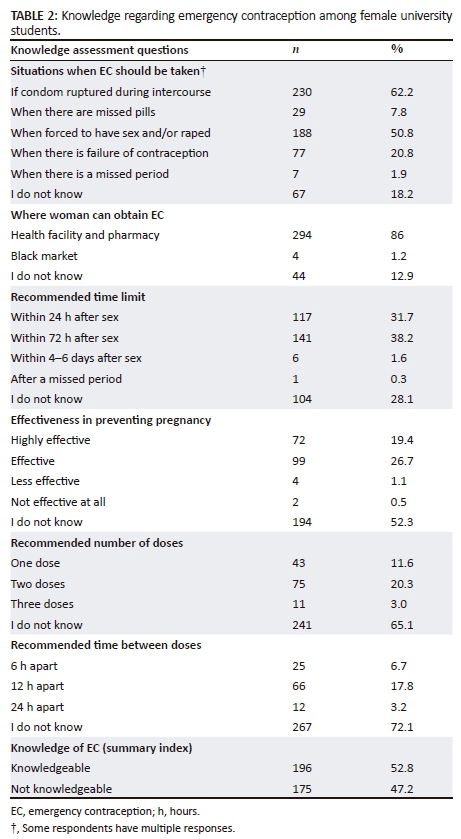
Overall, 52.8% of respondents had good knowledge of EC. Only 141 (38.2%) respondents correctly identified the recommended time limit for taking the 'morning-after pills' after sexual intercourse, 20.3% the number of doses and 17.9% the time interval between doses. Ruptured condoms during intercourse (62.2%), forced sex or rape (50.8%), missed contraceptive pills (7.8%) and failure of contraceptives (20.8%) were chosen as appropriate situations in which to use EC (Table 2). A missed period was correctly pointed out (98.1%) as an inappropriate situation in which to use the 'morning-after pill'. Only 34% understood that the use of EC was legal in Botswana.
Attitude towards and willingness to use emergency contraception
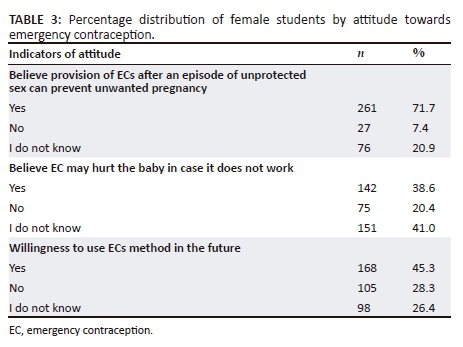
Overall, 203 (54.7%) respondents had a negative attitude towards EC, and 226 (61.4%) respondents were either worried or unsure as to whether EC might harm the baby if the pregnancy continued. Although 71.2% believed that EC could prevent unwanted pregnancies, only 45.3% were willing to consider using EC (Table 3).
Emergency contraceptive practices and pregnancy-related characteristics among sexually active female university students
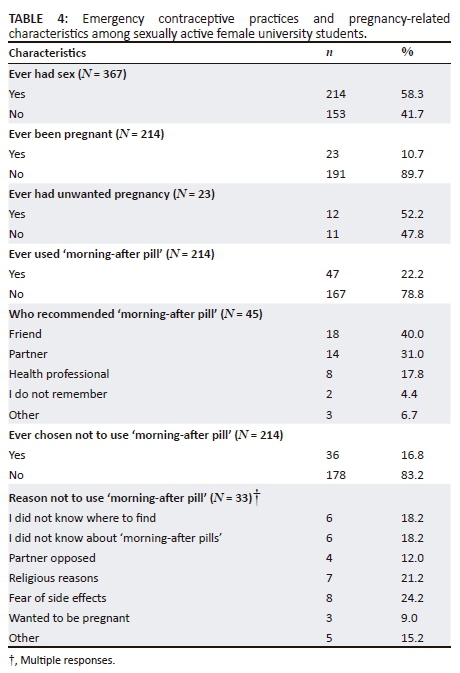
A total of 214 (58.3%) respondents reported having been sexually active, 23 (10.7%) had been pregnant and 12 (52.2%) of those pregnancies were unintended. Only 47 (22.0%) students had used EC, while another 36 (16.8%) reported choosing not to use EC when it might have been indicated. Those that used EC were encouraged by either a friend or partner, while those that choose not to use EC were worried about side effects, transgressing their religious beliefs or did not know how to obtain ECs (Table 4).
Determinant factors related to knowledge, attitudes or practice
There was no statistical association between the level of knowledge and age, marital status, religion or year of study. However, those from urban areas had better knowledge than their rural counterparts (p = 0.020).
There was no association between age, marital status, religion or year of study and attitude towards use of EC. Students from urban areas have significantly more positive attitudes towards EC (p = 0.010), and students with good knowledge were also more likely to have positive attitudes (p < 0.001).
Older students and those in higher years of study were more likely to have used EC (p < 0.001 and p = 0.001). There was no association with marital status, religion or place of origin.
Discussion
Although almost all students had heard of EC, only about half had good knowledge of how to use or access it, and less than half were willing to use it. Students were concerned about the potential side effects, particularly on the foetus; were worried about transgressing religious beliefs; or did not know how to obtain EC. Students from rural areas were likely to be less knowledgeable and to have more negative attitudes towards EC. Students with better knowledge were more likely to have positive attitudes towards EC and to use EC.
Awareness of EC was much higher among Botswana's students compared to students from Kwazulu-Natal, South Africa (50%)1014111510,16
Although awareness of EC was high in this report, accurate knowledge of EC was lacking, which is also consistent with findings from Ethiopia.11171111
Use of EC was comparable to South African studies which showed utilisation among sexually active female students between 21%101710,171819
Limitations of the study
The data were collected from only one university, and therefore, results may not be generalisable to other universities. Students who have done very well at the Botswana General Certificate for Secondary Education (BGCSE) examination prefer to enrol at the University of Botswana rather than other universities and colleges around the country. Therefore, because these students are 'smarter', they are expected to have a better knowledge about scientific issues, including emergency contraception, than those who enroll elsewhere. Furthermore, this result has limited power to be generalised to all youth in the country as only a small proportion have the chance of higher education. Because of the sensitive nature of the study, it is possible that respondents under-reported sexual activity and the use of EC. Postgraduate students are under-represented and, therefore, conclusions about the study may apply only to undergraduate students. Furthermore, because the number of students per faculty is not equal, a multistage sampling technique should have been used.
Recommendations
Initiatives are needed to improve the knowledge of university students regarding how to use and access EC, as well as to address common misconceptions and beliefs. Health services should take a stronger lead in advocating such information campaigns and contributing to them, as well as ensuring that students can easily access EC at hospitals, pharmacies and student clinics.
Future qualitative research may help to explore attitudes and beliefs and to understand in more depth the barriers to accessing and using EC. However, these recommendations are tentative because as stated above findings are not generalisable.
Conclusion
Although overall awareness of EC was very high among female students at the University of Botswana, only half had good knowledge of EC and less than half had a positive attitude towards using EC. Use of EC was low and half of those who were pregnant reported that the pregnancy was unintended. Students were worried about EC side effects, transgressing religious beliefs by using EC or did not know how to access EC. Students from urban areas were more likely to have good knowledge of EC, and those with good knowledge of EC and those from urban areas were more likely to have positive attitudes towards using EC. Older students and those from higher academic years of study were more likely to use EC. Accurate knowledge about EC should be made more widely available to students of the University of Botswana, and student health services should take the lead in enabling this and making EC more easily available.
Competing interests
The authors declare that they have no financial or personal relationships that may have inappropriately influenced them in writing this article.
Authors contributions
B.K. was the principal investigator of this M Med (Family Medicine) research assignment. J.B. was the supervisor of this M Med (Family Medicine) research assignment.
Acknowledgements
The authors wish to acknowledge the University of Botswana for supporting this study. They also thank the data collectors. The authors also wish to acknowledge Professor Bob Mash for editing the manuscript.
References
- 1. Rosenfeld JR. Handbook of women's health. 2nd ed. Cambridge: Cambridge University Press; 2009.
-
2. Croxatto HB, Brache V, Pavez M, et al. Pituitary-ovarian function following the standard levonorgestrel emergency contraceptive dose or a single 0.75 mg dose given on the days preceding ovulation. Contraception 2004;70:442-450. https://doi.org/10.1016/j.contraception.2004.05.007
» https://doi.org/10.1016/j.contraception.2004.05.007 -
3. Rodrigues I, Grou F, Joly J. Effectiveness of emergency contraception pills between 72 and 120 hours after unprotected sexual intercourse. Am J Obstet Gynecol. 2001;184:531-537. https://doi.org/10.1067/mob.2001.111102
» https://doi.org/10.1067/mob.2001.111102 -
4. Cheng L, Gulmezoglu AM, Oel CJ, et al. Interventions for emergency contraception. Cochrane Database Syst Rev. 2004;3:CD001324. https://doi.org/10.1002/14651858.CD001324.pub2
» https://doi.org/10.1002/14651858.CD001324.pub2 -
5. Ganatra B, Gerdts C, Rossier C, et al. Global, regional, and subregional classification of abortions by safety, 2010-14: Estimates from a Bayesian hierarchical model. Lancet. 2017;390(10110):2372-2381. https://doi.org/10.1016/S0140-6736(17)31794-4
» https://doi.org/10.1016/S0140-6736(17)31794-4 -
6. Ray S, Madzimbamuto FD, Ramagola-Masire D, et al. Review of causes of maternal deaths in Botswana in 2010. S Afr Med J. 2013;103(8):537-542. https://doi.org/10.7196/SAMJ.6723
» https://doi.org/10.7196/SAMJ.6723 - 7. Ministry of Health, Botswana, Division of Sexual and Reproductive Health. 5 year Maternal Mortality report 2007-2011, Stats Brief 2012. No 2012/19, Statistics Botswana.
-
8. World Bank. 2011 [Accessed 06 March 2018]. Available from: http://siteresources.worldbank.org/INTPRH/Resources/376374-1282255445143/Botswana52411web.pdf
» http://siteresources.worldbank.org/INTPRH/Resources/376374-1282255445143/Botswana52411web.pdf - 9. Hogue ME, Mokgatle M, Ntsipe T. Sexual practices amongst university students in Botswana. Gender Behav Pract. 2012;10 (2):4645-4656.
-
10. Hoque ME, Ghuman S. Knowledge, practices, and attitudes of emergency contraception among female university students in KwaZulu-Natal, South Africa. PLoS One 2012;7(9):e46346. https://doi.org/10.1371/journal.pone.0046346
» https://doi.org/10.1371/journal.pone.0046346 - 11. Gebrehiwot H, Gebrekidan B, Berhe H, Kidanu K. Assessment of knowledge, attitude, and practice towards emergency contraceptives among female college students at Mekelle Town, Tigray Region, Ethiopia: A cross sectional study. Int J Pharm Sci Res. 2013;4(3):1027-1038.
-
12. Prevalence survey - Sampsize. [Accessed March 2015]. Available from: http://sampsize.sourceforge.net/iface/
» http://sampsize.sourceforge.net/iface/ -
13. Ahmed FA, Moussa KM, Petterson KO, Asamoah BO. Assessing knowledge, attitude, and practice of emergency contraception: A cross-sectional study among Ethiopian undergraduate female students. BMC Public Health. 2012;12:110. https://doi.org/10.1186/1471-2458-12-110
» https://doi.org/10.1186/1471-2458-12-110 - 14. Byamugisha JK, Mirembe FM, Faxelid E, Gemzell-Danielsson K. Emergency contraception and fertility awareness among university students in Kampala, Uganda. East Afr Med J. 2006;6(4):194-200.
- 15. Tapia-Curiel A, Villasenor-Farias M, Nuno-Gutierrez BL. Knowledge and attitudes about using emergency contraceptives among young college students. Rev Med Inst Mex Seguro Soc. 2008;46(1):33-41.
-
16. Myer L, Mlobeli R, Cooper D, Smith J, Morroni C. Knowledge and use of emergency contraception among women in the Western Cape province of South Africa: A cross-sectional study. BMC Women's Health. 2007;7:14. https://doi.org/10.1186/1472-6874-7-14
» https://doi.org/10.1186/1472-6874-7-14 -
17. Kistnasamy EJ, Reddy P, Jordaan J. An evaluation of the knowledge, attitude and practices of South African university students regarding the use of emergency contraception and of art as an advocacy tool. SA Fam Pract. 2009;51(5):423-426. https://doi.org/10.1080/20786204.2009.10873896
» https://doi.org/10.1080/20786204.2009.10873896 - 18. Nasir T. Knowledge, attitude and practice of emergency contraception among graduating female students of Jimma University. Ethiop J Health Sci. 2010;21(2):91-97.
- 19. Abasiattai AM, Umoiyoho AJ, Bassey EA, Etuk SJ, Udoma EJ. Misconception of emergency contraception among tertiary school students in Akwa Idom State, South-south Nigeria. Niger J Clin Pract. 2007;10(1):30-40.
Accepted: 30 May 2018
Published: 06 Sept. 2018