Patient satisfaction with peri-partum care at Bertha Gxowa district hospital, South Africa
Abstract
BACKGROUND: Patient satisfaction is one of the key outcome measures of healthcare services. Aim and Setting: To explore factors that influence women's satisfaction with peri-partum care at Bertha Gxowa district hospital, South African primary care. METHODS: A cross-sectional study involving 260 women was conducted. A structured questionnaire collected information from participants on pain relief, health education provided by healthcare providers, privacy, cleanliness of the ward and their participation in decision-making about care received in the peri-partum period. RESULTS: Most respondents were co-habiting with their partners (100, 38%) and had completed only secondary school education (119, 46%). The average participant age was 27 years, with an average parity of two children. Most participants were satisfied with the privacy (218, 84%) and the general cleanliness of the wards (233, 90%). However, large proportions of women were dissatisfied with the information given to them by doctors (104, 55%) and nurses (89, 37%), and the rest were unsure. About 189 (73%) participants were dissatisfied with the extent of their participation in decision-making about their own care. The study had a caesarean rate of 53 (20%). Compared to normal vaginal delivery, participants who had caesarean section were significantly more likely to report being satisfied with pain relief during labour (p < 0.001). CONCLUSION: The study findings showed varying levels of satisfaction with different aspects of peri-partum care and suggested the need for better pain relief during vaginal delivery, information sharing by doctors and patient emancipation for decision-making about their own care.
patient satisfaction; peri-partum; care; family medicine; primary care; general practice; maternal health
Introduction
Patient satisfaction is a concept that has been in vogue for many years and has been a subject of research in different countries. Although each researcher has defined it in his or her own way, the consensus amongst most researchers is that patient satisfaction involves the correlation between what the patient expects and what the healthcare environment actually delivers.1,2,3,45,67,8
Studies on patient satisfaction and the influence of socio-demographic factors have reported varying findings. While some have found that patients from low socio-economic status with low level of education tend to have higher level of satisfaction,6,9,1096,92,11,12
Areas of dissatisfaction with labour in some African countries were poor pain control and drug prescription during labour in Ethopia5132
Communication between health workers and patients is important and is assured by information giving and sharing, and it has been shown to influence patient satisfaction.314
Peri-partum care services are priority health programmes in South Africa, and they reflect the quality of care rendered in the public healthcare system. The principal objective of maternity care was to make the entire labour process a positive experience for the women and their families, and to ensure that the birth process proceeds with minimum or no complications.8155,6
Methods
Design and study sites
This was a quantitative, cross-sectional study of women attending the third day postpartum clinic at Bertha Gxowa district hospital. This hospital situated in Germiston, south-east of the city of Johannesburg, South Africa, is the only district hospital in the Ekurhuleni health district. The catchment population is women who deliver their babies in the hospital over 2 months during the study period.1616
Women who deliver in the hospital are seen with their babies for the third day review in the hospital. Those that delivered by normal vaginal delivery are seen in the antenatal clinic (ANC), which is divided into prenatal and postnatal areas. Those who delivered by caesarean section are seen in the postnatal ward.
The study was conducted at two sites within the hospital:
•The ANC-postnatal side: for women who had a normal vaginal delivery and were returning for their third day follow-up visits. This visit caters for women who have delivered up to 10 days.
•The postnatal ward: for women who had elective or emergency caesarean. Women who had caesarean operation with no complications are discharged on the third day post-operation for follow-up at their local clinics.
Samples and procedure
The sample size was calculated to be 260 using the Raosoft software.17
Procedure
Non-randomised, convenient sampling was used for both study sites. Thirty-two women were sampled every week for 7 weeks, and 36 were sampled on the eighth week to reach a total of 260. The eligible population was women in the ward on their third day after caesarean section were all invited to participate in the study because the number of caesarean operations was small. The number of caesarean operations varied between zero and three per day. Every woman in the postnatal review clinic was eligible to participate in the study after they were seen by the nurses. As soon as the interview with one woman was completed, the next available patient was invited to participate in the study until the number for the day was reached.
Recruitment was done on every day of the week till the sample size was attained over a period of 2 months. The ratio of caesarean sections to vaginal deliveries was 53 (20%) to 207 (80%).
Data collection tool
Data collection was performed using a structured questionnaire, which was derived from two previously used questionnaires that were adapted to our South African setting. Some questions came from the Sylheti Questionnaire and some questions came from the COMFORT scale on maternal satisfaction with peri-partum services. A structured questionnaire combining the two studies was developed de novo based on the literature.18,19
Patients who accepted to participate were interviewed by the lead researcher, and their responses were recorded on the data collection tool. The questionnaire used a Likert Scale to rate responses from participants and had five sections: The first section collected information on demographic characteristics, and the second section collected information on the mode of delivery. In the third and fourth sections, participants were asked to rate their level of satisfaction with different aspects of care received on a scale of 5, ranging from 1 = strongly agree to 5 = strongly disagree, with regard to pain relief, cleanliness, privacy, delivery care, information given to them during labour and participation in their care.
Data analysis
Data were captured onto Microsoft Excel, cleaned and then imported to STATA-10 statistical software for analysis. Descriptive analysis was performed, and participants were described using frequencies and proportions for categorical data, and means with standard deviations for numeric data. Chi-square test and t-test were used to test for associations between mode of delivery and satisfaction with pain relief during childbirth. Statistical significance was set at p < 0.05. Main outcome measures included the proportions of participants satisfied with the privacy, cleanliness of the ward, the information given to them by healthcare providers, the extent of their participation in decision-making about their own care, and socio-demographic and clinical factors significantly associated with being satisfied with aspects of care.
Ethical consideration
Approval to conduct the study was obtained from the hospital chief executive officer, the Ekurhuleni District Ethical Committee and the Human Research Ethics Committee of the University of the Witwatersrand. The ethical clearance number is M111014. Written and signed informed consent was obtained from the respondents who took part in the study.
Results
Most of the participants (103, 40%) were aged between 18 and 24 years; 227 (87%) participants completed secondary school education. The mean age was 27 years with average parity of two children. Only 62 (24%) of the participants were married, while 33 (13%) participants had tertiary education. There were 53 (20%) women participants who delivered by caesarean section.
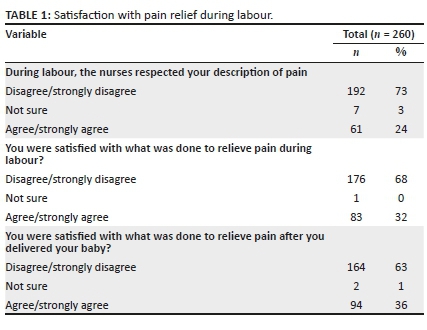
Table 1 shows satisfaction with pain relief and indicates that 83 (32%) and 94 (36%) of the participants were satisfied with what was done to relieve pain during and after, respectively.
Only 64 (24%) participants reported that nurses respected their personal description (assessment) of pain.
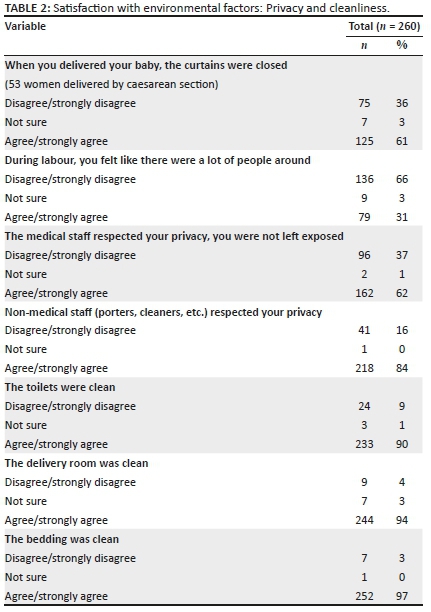
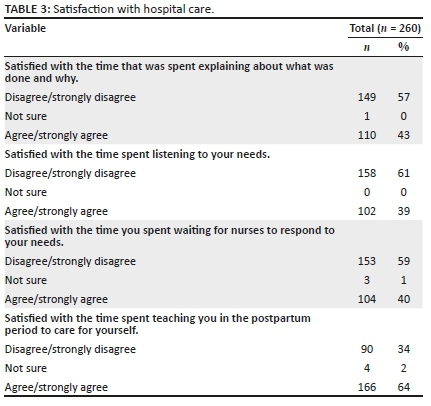
The proportion of participants who responded to the question on environmental factors, which included privacy and cleanliness, is shown in Table 2. Most participants reported that clinical and non-clinical staff respected their privacy during labour. Only 79 (30%) participants felt that there were 'a lot of people around them during labour'. Most of the participants reported that their beddings (252, 97%), rooms (244, 93%) and toilets (233, 90%) were clean. In Table 3, 166 (64%) participants expressed satisfaction with hospital care and indicated they were satisfied with the time spent on learning about self-care in the postpartum period. There were varying levels of dissatisfaction, with only 110 (43%) participants being satisfied with time spent on explaining what was done and why?, 102 (39%) participants being satisfied with listening to their needs and 104 (40%) participants being satisfied with time spent waiting for nurses to respond to a need.
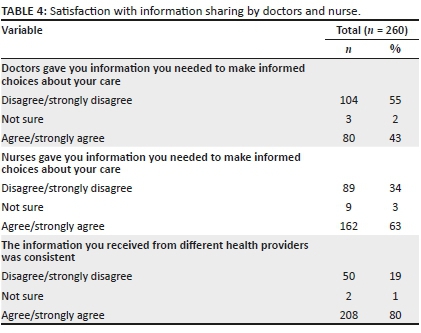
In Table 4, although most of the participants (208, 80%) were satisfied with the consistency of information received from healthcare providers, 162 (63%) versus 80 (43%) participants felt doctors were less likely than nurses to give information required for informed choices on self-care.
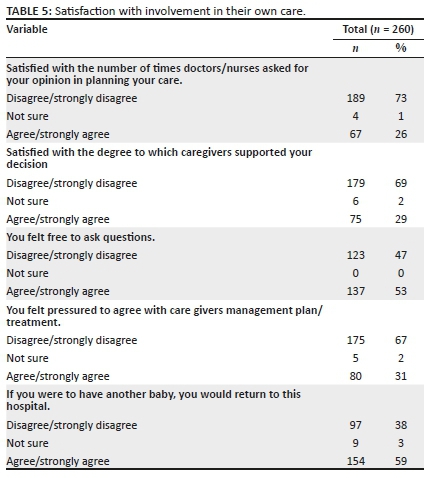
Few participants (67, 26%) were satisfied with their level of involvement in their own care, and 75 (29%) participants were satisfied with the degree to which healthcare workers supported their decisions. A total of 137 (53%) participants felt free to ask questions, 175 (67%) participants did not feel pressurised to agree with health providers' management plan and 154 (59%) participants, if they were to have another baby, would return to the hospital, as shown in Table 5.
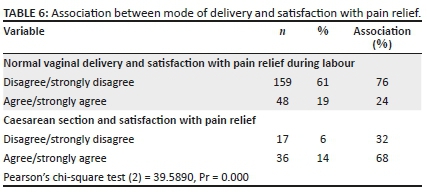
Table 6 shows the association between the mode of delivery (normal vaginal delivery or caesarean section) with satisfaction and pain relief during childbirth. There was an association between the mode of delivery with satisfaction and pain relief during childbirth. Of concern is the finding that most participants (76%) were dissatisfied with pain relief during labour, and this was more prevalent in women who delivered by normal vaginal delivery than in women who had caesarean section (76% vs. 32%). Women who delivered by caesarean section were significantly more likely to report being satisfied with pain relief during labour (p < 0.001).
Discussion
This study assessed patient satisfaction with peri-partum care and found varying levels of satisfaction with different aspects of care and indicated high levels of satisfaction with care during child birth, irrespective of age, marital status and the level of education. The participants reported higher levels of satisfaction with the environmental factors such as cleanliness of the environment (93%) and how privacy was maintained by both medical and non-medical staff (84%). These findings concur with the results of an extensive systematic review completed by Srivastava for 54 studies conducted in different developing countries where they looked at all dimensions of care during childbirth and found that cleanliness of the environment and privacy greatly influenced satisfaction.43,5,206212173,5
This may be attributed to the clinician's awareness of the importance of pain relief after caesarean section, and its importance in assisting patients in management and early mobilisation, thereby facilitating the healing process, as stated in the findings of this study, which was conducted in South Africa and involved 31 general practitioners who were involved in the care of caesarean section patients.222223
Another possible explanation for the lack of pain relief during labour is the healthcare personnel's attitude based on cultural and religious beliefs that pain is a normal process of labour, and it is something to be endured by all women in labour, as it enhances the bond between the mother and the child.24,25262627271727,282826
Lack of any pain relief during labour is unacceptable and is remembered long after childbirth, as shown in longitudinal studies conducted in Sweden and Japan, which showed that the memory of labour pain did not diminish over time in women with negative overall experience of childbirth.29,30143,311432
South Africa is a diverse country with 11 official languages.33342835South African National Health Act, the healthcare providers should inform healthcare users of their health status in a language the user understands.36337,38,39
This study indicates that participants were not satisfied with hospital care and their level of participation in their own care - in particular, the time spent explaining what was done (and why), listening to patients' needs and the waiting for clinicians to respond. These findings are consistent with a study conducted in the Eastern Cape, South Africa, by the Human Rights Commission in which women were not satisfied with the care that they received during labour because the nurses did not respond to their needs.14
This study has some limitations: the convenience sampling method could have introduced sampling bias, limiting the generalisation of the study findings. Also, the use of self-reports may result in information bias because the respondents may be reluctant to criticise the care received because of fear of reprimand and the perception that they needed to show gratitude. However, this was addressed by encouraging participants to be as honest as possible and assuring that their responses would not influence the quality of service received but will only be used for the research and quality improvement purposes. Notwithstanding these potential limitations, this study provides one of the few insights into patients' experience of maternity care in South African primary care setting and has the potential to inform interventions aimed at improving maternity care in this and similar contexts.
Conclusion
There were varying levels of satisfaction with aspects of care received by participants during the peri-partum period. Satisfaction with cleanliness, privacy and information sharing by nurses were reportedly high. In contrast, satisfaction with pain relief, time spent explaining procedures and information sharing by doctors was a matter of concern. These factors should be considered when designing quality improvement programmes to ensure respectful and patient-centred maternity care in MOUs in South Africa and in similar settings elsewhere. Considering the limitations, better designed quantitative and even qualitative studies are warranted to deepen our understanding of patient experience and satisfaction with peri-partum care.
Competing interests
The authors have declared that no competing interests exist.
Authors' contributions
All authors contributed equally to this work.
Funding information
This research received no specific grant from any funding agency in the public, commercial or not-for-profit sectors.
Data availability statement
Data sharing is not applicable to this article as no new data were created or analysed in this study.
Disclaimer
The views and opinions expressed in this article are those of the authors and do not necessarily reflect the official policy or position of any affiliated agency of the authors.
Acknowledgements
The first author (N.K.) dedicates this article to the second author, Dr E. Rwaikarara, who sadly passed away before the article could be finalised. May her soul rest in peace. The authors acknowledge the staff and management of Bertha Gxowa Hospital for their support and thank Prof. O.B. Omole for his assistance and comments on the draft manuscript.
References
-
1.Matejić B, Milićević MS, Vasić V, Djikanović B. Maternal satisfaction with organized perinatal care in Serbian public hospitals. BMC Pregnancy Childbirth [serial online]. 2014 [cited 2019 Jan 16];14:14. Available from: https://www.ncbi.nlm.nih.gov/pmc/articles/PMC3916080/pdf/1471-2393-14-14.pdf
» https://www.ncbi.nlm.nih.gov/pmc/articles/PMC3916080/pdf/1471-2393-14-14.pdf -
2.Hodnett D. Pain and women's satisfaction with the experience of childbirth: A systematic review. Am J Obstet Gynecol. 2002;186(5):160-172. https://doi.org/10.1067/mob.2002.121141
» https://doi.org/10.1067/mob.2002.121141 -
3.Kifle MM, Ghirmai FA, Berhe SA, Tesfay WS, Weldegebriel YT, Gebrehiwet ZT. Predictors of women's satisfaction with hospital-based intrapartum care in Asmara Public Hospitals, Eritrea. Obstet Gynecol Int [serial online]. 2017 [cited 2019 Feb 26];2017:3717408:1-7. Available from: https://www.hindawi.com/journals/ogi/2017/3717408/
» https://www.hindawi.com/journals/ogi/2017/3717408/ -
4.Srivastava A, Avan BI, Rajbangshi P, Bhattacharyya S. Determinants of women's satisfaction with maternal health care: A review of literature from developing countries. BMC Pregnancy Childbirth [serial online]. 2015 [cited 2018 Feb 12];15:97. Available from: https://bmcpregnancychildbirth.biomedcentral.com/articles/10.1186/s12884-015-0525-0
» https://bmcpregnancychildbirth.biomedcentral.com/articles/10.1186/s12884-015-0525-0 -
5.Melese T, Gebrehiwot Y, Bisetegne D, Habte D. Assessment of client satisfaction in labor and delivery services at a maternity referral hospital in Ethiopia. Pan Afr Med J [serial online]. 2014 [cited 2019 Sept 2019];17:76. Available from: https://www.ncbi.nlm.nih.gov/pmc/articles/PMC4085898/
» https://www.ncbi.nlm.nih.gov/pmc/articles/PMC4085898/ -
6.Kabakian-Khasholian T, Bashour H, El-Nemer A, et al. Women's satisfaction and perception of control in childbirth in three Arab countries. Reprod Health Matters [serial online]. 2017 [cited 2020 Jan 10];25(Suppl 1):S16-S26. Available from: https://www.ncbi.nlm.nih.gov/pubmed/29120285
» https://www.ncbi.nlm.nih.gov/pubmed/29120285 -
7.Batho Pele - Change management engagement programme. A guide to revitalise Batho Pele. The Department of Public Service and Administration. Republic of South Africa [homepage on the Internet]. [cited 2018 Jan 20]. Available from: http://www.dpsa.gov.za/documents/Abridged%20BP%20programme%20July2014.pdf
» http://www.dpsa.gov.za/documents/Abridged%20BP%20programme%20July2014.pdf -
8.Karlström A, Nystedt A, Hildingsson I. The meaning of a very positive birth experience: Focus groups discussions with women. BMC Pregnancy Childbirth [serial online]. 2015 [cited 2019 Jun 12];15:251. Available from: https://www.ncbi.nlm.nih.gov/pmc/articles/PMC4600272/
» https://www.ncbi.nlm.nih.gov/pmc/articles/PMC4600272/ -
9.Tocchioni V, Seghieri C, De Santis G, Nuti S. Socio-demographic determinants of women's satisfaction with prenatal and delivery care services in Italy. Int J Qual Health Care [serial online]. 2018 [2019 Dec 13];30(8):594-601. Available from: https://www.ncbi.nlm.nih.gov/pmc/articles/PMC6185688/pdf/mzy078.pdf
» https://www.ncbi.nlm.nih.gov/pmc/articles/PMC6185688/pdf/mzy078.pdf -
10.Afzal M, Rizvi F, Azad AH, Rajput AM, Khan A, Tariq N. Effect of demographic characteristics on patient's satisfaction with health care facility. J Postgrad Med Inst [serial online]. 2014 [2019 Dec 20];28(2):154-160. Available from: https://pdfs.semanticscholar.org/bb87/ce78fc7b17f3af9edfd2a17254cfc741562e.pdf
» https://pdfs.semanticscholar.org/bb87/ce78fc7b17f3af9edfd2a17254cfc741562e.pdf -
11.Bazant ES, Koenig MA. Women's satisfaction with delivery care in Nairobi's informal settlements. Int J Qual Health Care [serial online]. 2009 [cited 2018 Aug 28];21:79-86. Available from: https://academic.oup.com/intqhc/article/21/2/79/1821671
» https://academic.oup.com/intqhc/article/21/2/79/1821671 -
12.Mohammad K, Shaban I, Homer C, Creedy D. Women's satisfaction with hospital-based intrapartum care: A Jordanian study. Int J Nurs Midwifery [serial online]. 2014 [cited 2020 Jan 30];6(3):32-39. Available from: https://opus.lib.uts.edu.au/bitstream/10453/117260/1/60AC2A745962.pdf
» https://opus.lib.uts.edu.au/bitstream/10453/117260/1/60AC2A745962.pdf -
13.Lumadi TG, Buch E. Patients' satisfaction with midwifery services at a regional hospital and its referring clinics in the Limpopo province of South Africa. Afr J Nurs Midwifery [serial online]. 2011 [cited 2019 Jul 14];13(2):14-28. Available from: https://pdfs.semanticscholar.org/46f5/0c293c0bd2fcfcf919890483501f1f61ac89.pdf
» https://pdfs.semanticscholar.org/46f5/0c293c0bd2fcfcf919890483501f1f61ac89.pdf -
14.Avortri GS, Beke A, Abekah-Nkrumah G. Predictors of satisfaction with child birth services in public hospitals in Ghana. Int J Health Care Qual Assur [serial online]. 2011 [cited 2019 Nov 23];24(3):223-237. Available from: https://www.emerald.com/insight/content/doi/10.1108/09526861111116660/full/html
» https://www.emerald.com/insight/content/doi/10.1108/09526861111116660/full/html -
15.National Department of Health, South Africa. Guidelines for maternity care in South Africa. A manual for clinics, community health centres and district hospitals. 4th ed. [homepage on the Internet]. Pretoria: National Department of Health, South Africa; 2015 [cited 2019 jan 12]; p. 172. Available from: http://www.health.gov.za/index.php/2014-03-17-09-09-38/policies-and-guidelines/category/230-2015p#
» http://www.health.gov.za/index.php/2014-03-17-09-09-38/policies-and-guidelines/category/230-2015p# -
16.District Health Information System (DHIS) [homepage on the Internet]. [cited 2020 Jan 12] Available from: www.hisp.org\services
» www.hisp.org\services -
17.Raosoft Sample Calculating Software [homepage on the Internet]. [cited 2012 June 20]. Available from: http://www.raosoft.com/samplesize.html
» http://www.raosoft.com/samplesize.html -
18.Duff AL, Lamping DL, Ahmed BL. Evaluating satisfaction with maternity care in women from minority ethnic communities: Development and validation of Sylheti Questionnaire. Intern J Q Heal C [serial online]. 2001[cited 2014 Jan 23];13(3):215-230. Available from: https://pdfs.semanticscholar.org/ca8a/902e5a9ad6ef07a09151298fc270271f3640.pdf
» https://pdfs.semanticscholar.org/ca8a/902e5a9ad6ef07a09151298fc270271f3640.pdf -
19.Janssen PA, Dennis CL, Reime B. Development and psychometric testing of the care in obstetrics: Measure for testing satisfaction (COMFORTS) Scale. Res Nurs Health. 2006;29(1):51-60. https://doi.org/10.1002/nur.20112
» https://doi.org/10.1002/nur.20112 -
20.Senarath U. Factors determining client satisfaction with hospital-based perinatal care in Sri Lanka. Trop Med Int Health [serial online]. [cited 2019 Jan 20];11(9):1442-1451. Available from: https://onlinelibrary.wiley.com/doi/epdf/10.1111/j.1365-3156.2006.01698.x
» https://onlinelibrary.wiley.com/doi/epdf/10.1111/j.1365-3156.2006.01698.x -
21.Core Standards for Health Establishments in South Africa [homepage on the Internet]. Department of Health; 2011. [cited 2011 Sept 23]. Available from: http://phisa.co.za/wp-content/uploads/2019/01/National-Core-Standards.pdf
» http://phisa.co.za/wp-content/uploads/2019/01/National-Core-Standards.pdf -
22.Khan MF, Omole OB, Marincowitz GJO. Postoperative analgesia following caesarean deliveries in a rural health district of South Africa. Trop Doctor [serial online]. 2009 [cited 2020 Jan 12];39:217-221. Available from: https://www.researchgate.net/publication/26820161_Postoperative_analgesia_following_caesarean _deliveries_in_rural_health_district_of_South_Africa
» https://www.researchgate.net/publication/26820161_Postoperative_analgesia_following_caesarean _deliveries_in_rural_health_district_of_South_Africa -
23.Oosthuizen SJ, Bergh A-M, Pattinson RC, Grimbeek J. It does matter where you come from: Mothers' experiences of childbirth in midwife obstetric units, Tshwane, South Africa. Reprod Health [serial online]. 2017 [cited 2020 Jan 20];14:151. Available from: https://reproductive-health-journal.biomedcentral.com/track/pdf/10.1186/s12978-017-0411-5
» https://reproductive-health-journal.biomedcentral.com/track/pdf/10.1186/s12978-017-0411-5 -
24.South Africa 'Stop Making Excuses' Accountability for Maternal health care in South Africa [homepage on the Internet]. 2011 [cited 2019 Jan 12]. Available from: www.hrw.org/sites/default/files/reports/sawrd0811webwcover.pdf
» www.hrw.org/sites/default/files/reports/sawrd0811webwcover.pdf -
25.Nortjéa N, Alberty R. The cultural language of pain: A South African study. S Afr Fam Pract [serial online]. 2015;57(1):24-27. Available from: https://www.tandfonline.com/doi/full/10.1080/20786190.2014.977034
» https://www.tandfonline.com/doi/full/10.1080/20786190.2014.977034 -
26.Aziato L, Ohemeng HA, Omenyo CN. Experiences and perceptions of Ghanaian midwives on labour pain and religious beliefs and practices influencing their care of women in labour. Reprod Health [serial online]. 2016 [cited 2020 Jan 10];13(1):136. Available from: https://reproductive-health-journal.biomedcentral.com/track/pdf/10.1186/s12978-016-0252-7
» https://reproductive-health-journal.biomedcentral.com/track/pdf/10.1186/s12978-016-0252-7 -
27.Vivilaki V, Antoniou E. Pain relief and retaining control during childbirth. A sacrifice of the feminine identity? Health Sci J [serial online]. 2009 [cited 2020 Jan 10];3(1):3-9. Available from: http://www.hsj.gr/medicine/pain-relief-and-retaining-control-during-childbirth-a-sacrifice-of-the-feminine-identity.pdf
» http://www.hsj.gr/medicine/pain-relief-and-retaining-control-during-childbirth-a-sacrifice-of-the-feminine-identity.pdf -
28.Aziato L, Kyei AA, Deku G. Experiences of midwives on pharmacological and non-pharmacological labour pain management in Ghana. Reprod Health [serial online]. 2017 [cited 2020 Jan 11];14:128. Available from: https://www.ncbi.nlm.nih.gov/pmc/articles/PMC5644162/pdf/12978_2017_Article_398.pdf
» https://www.ncbi.nlm.nih.gov/pmc/articles/PMC5644162/pdf/12978_2017_Article_398.pdf -
29.Waldenström U, Schytt E. A longitudinal study of women's memory of labour pain - From 2 months to 5 years after the birth. BJOG [serial online]. 2009 [cited 2020 Jan 12];116:577-583. Available from: https://obgyn.onlinelibrary.wiley.com/doi/epdf/10.1111/j.1471-0528.2008.02020.x
» https://obgyn.onlinelibrary.wiley.com/doi/epdf/10.1111/j.1471-0528.2008.02020.x -
30.Takehara K, Noguchi M, Shimane T, Misago C. A longitudinal study of women's memories of their childbirth experiences at five years postpartum. BMC Pregnancy Childbirth [serial online]. 2014 [cited 2020 Jan 13];14:221. Available from: https://www.ncbi.nlm.nih.gov/pmc/articles/PMC4227007/pdf/1471-2393-14-221.pdf
» https://www.ncbi.nlm.nih.gov/pmc/articles/PMC4227007/pdf/1471-2393-14-221.pdf -
31.Mahiti GR, Mkoka AD, Kiwara AK, Mbekenga CK, Hurtig A, Goicolea I. Women's perceptions of antenatal, delivery, and postpartum services in rural Tanzania. Glob Health Action [serial online]. 2015 [cited 2020 Jan 10];8:28567. Available from: https://www.ncbi.nlm.nih.gov/pmc/articles/PMC4617868/pdf/GHA-8-28567.pdf
» https://www.ncbi.nlm.nih.gov/pmc/articles/PMC4617868/pdf/GHA-8-28567.pdf -
32.Mselle IT, Kohi T, Dol J. Humanizing birth in Tanzania: A qualitative study on the (MIS) treatment of women during childbirth from the perspective of mothers and fathers. BMC Pregnancy Childbirth [serial online]. 2019 [cited 2020 Jan 15];19:231. Available from: https://bmcpregnancychildbirth.biomedcentral.com/track/pdf/10.1186/s12884-019-2385-5
» https://bmcpregnancychildbirth.biomedcentral.com/track/pdf/10.1186/s12884-019-2385-5 -
33.South African Official languages [homepage on the Internet]. [cited 2013 Jan 12]. Available from: https://www.gov.za/about-sa/south-africas-people
» https://www.gov.za/about-sa/south-africas-people -
34.Kozhimannil KB, Attanasio LB, Yang T, Avery M, Declercq E. Midwifery care and patient-provider communication in maternity decisions. Matern Child Health J [serial online]. 2015 [ cited 2019 Jun 12];19(7):1608-1615. Available from: https://www.ncbi.nlm.nih.gov/pmc/articles/PMC4476913/pdf/nihms662677.pdf
» https://www.ncbi.nlm.nih.gov/pmc/articles/PMC4476913/pdf/nihms662677.pdf -
35.Mthombeni S, Maputle MS, Khoza LB. Perceptions of postpartum mothers towards the care provided by male student midwives at labour units in Limpopo Province, South Africa. Afr J Reprod Health [serial online]. 2018 [cited 2019 June 23];22(2):60. Available from: https://www.ajol.info/index.php/ajrh/article/view/175093/164480
» https://www.ajol.info/index.php/ajrh/article/view/175093/164480 -
36.South African National Health Act 61 of 2003 [homepage on the Internet]. [cited 2012 Sept 23]. Available from: www.section27.org.za/wp-content/uploads/2010/03/national-health-act.pdf
» www.section27.org.za/wp-content/uploads/2010/03/national-health-act.pdf - 37.Conesa Ferrer Ma B, Canteras Jordana M, Ballesteros Meseguer C, et al. Comparative study analysing women's childbirth satisfaction and obstetric outcomes across two different models of maternity care. BMJ Open [serial online]. 2016 [cited 2020 Jan 7];6. Available from: https://bmjopen.bmj.com/content/bmjopen/6/8/e011362.full.pdf
-
38.Odetola TD, Fakorede EO. Assessment of perinatal care satisfaction amongst mothers attending postnatal care in Ibadan, Nigeria. Ann Glob Health [serial online]. 2018 [cited 2020 Jan 06];84(1):36-46. Available from: https://www.ncbi.nlm.nih.gov/pmc/articles/PMC6748216/pdf/agh-84-1-10.pdf
» https://www.ncbi.nlm.nih.gov/pmc/articles/PMC6748216/pdf/agh-84-1-10.pdf -
39.Hodnett ED, Gates S, Hofmeyer GJ, Sakala C. Continuous support of women during childbirth: A systematic review [homepage on the Internet]. [cited 2013 Jan 12]. Available from: www.childbirthconnection.org/pdfs/continuous_support.pdf
» www.childbirthconnection.org/pdfs/continuous_support.pdf

Accepted: 03 June 2020
Published: 13 Aug. 2020