Accuracy of the product of symphysio-fundal height and abdominal girth in prediction of birth weight among term pregnant women at Keffi, Nigeria
Abstract
BACKGROUND: A reliable prediction of foetal birth weight aids in decision regarding time and mode of delivery. AIM: This study aimed to determine the accuracy of the product of symphysio-fundal height and abdominal girth in predicting birth weight among pregnant women in Keffi, Nigeria. SETTING: The study involved pregnant women presenting for delivery at the Federal Medical Centre, Keffi, Nigeria from July to October 2017. METHODS: One hundred and fifty-three pregnant women at term with singleton foetuses were recruited by systematic random sampling. An interviewer-administered questionnaire was used to obtain their socio-demographic data, past medical and obstetric history. Symphysio-fundal height and abdominal girth measurements were used to calculate the estimated foetal weight. This was compared with the actual birth weight. Absolute percentage error was used to determine the overall predictive error of Dare's formula. Data were analysed using SPSS version 20.0. Statistical significance was set at p < 0.05 and 95% confidence level. RESULTS: The mean age of the participants was 29.65 ± 5.15 years. The mean gestational age was 39.5 ± 1.2 weeks. There was a significant correlation (r = 0.52, p < 0.001) between the estimated foetal weight and the actual birth weight. Ninety (66.2%) of the babies within normal weight and six (85.7%) of macrosomic babies were correctly predicted. None of the low birth weight babies was correctly predicted by the formula. CONCLUSION: Dare's formula accurately predicted normal weight and macrosomic babies, but less accurately predicted low birth weight babies.
Dare's formula; birth weight prediction; symphysio-fundal height; abdominal girth; Keffi; Nigeria
Introduction
Birth weight is the first weight of the newborn obtained shortly after birth.123,4
Prenatal estimation of foetal weight is an important aspect of birth preparedness. It aids in decision-making and preparations regarding the time and mode of delivery, perinatal care required and level of care or facility required. It is also useful for assessing prognosis and perinatal counselling on likelihood of survival of preterm and small for gestational age (SGA) babies.3,4,5
Foetal weight estimation can be done by biochemical, clinical and radiological means. None of the currently available techniques of foetal weight estimation is foolproof in terms of accuracy.2,3
The two most commonly used methods for predicting birth weight are the clinical and ultrasonographic methods.2
Clinical methods of foetal weight estimation include tactile assessment of foetal size, clinical risk factor estimation, maternal self-estimated foetal weight (EFW) and birth weight prediction equations.22
Dare's formula is a simple formula in which the product of abdominal girth (AG) and SFH is used to estimate foetal weight. It has been found to correlate well with actual birth weight (ABW) in previous studies.6,7,8
Materials and methods
It was a cross-sectional analytical study conducted from 10 July to 31 October 2017 at the labour ward of the FMC, Keffi. Keffi is the Headquarters of Keffi Local Government Area of Nasarawa State, Nigeria and has an estimated population of 92 550 (2006 National census). An average of 200 new bookings and 500 return patients are seen monthly in the antenatal clinic, with an average of 120 deliveries per month.
All pregnant women who presented to the labour ward for delivery during the study period were eligible to participate in the study. The inclusion criteria were as follows:
•Booked pregnant women at term (gestational age 37 completed weeks to 41 weeks plus 6 days).
•Women whose gestational ages could be confirmed by last menstrual date or ultrasound dating at or before 20 weeks gestation.
•Patients with live singleton foetus in longitudinal lie with intact membranes.
•Patients in the first stage of spontaneous labour and those admitted for elective induction of labour or caesarean delivery.
•Patients who granted consent to participate in the study.
Comprehensive physical examination and ultrasound scan were conducted for all the women at the time of recruitment into the study. Those who had fibroid, ovarian tumour or cyst and poly or oligohydramnios were excluded from the study.
The minimum sample size was calculated using the Cochrane formula for determining the representative sample for proportions in a large population and the finite population correction for proportions recommended for adjusting the sample size for small study populations:9

where no is the minimum sample size required for a large population; Z is the 1.96 which is the standard normal deviate at 95% confidence interval level and p is the expected proportion of estimated birth weight correct to within 10% of ABW. This study used 69.5% from a similar study conducted by Njoku et al.10e is the absolute precision level of 5%.
Hence:

Because the population under study was about 240 women expected to deliver during the study period, the formula for finite population correction9

where N is the study population size and n is the adjusted minimum sample size:

Thus, the minimum sample size required for the study was 139. An additional 10% of this (14) was added to allow for possible data loss. Therefore, 153 participants were recruited for the study.
The nature and purpose of the study were explained to prospective participants during group antenatal health education sessions. The participants were recruited through a systematic random sampling technique. An estimated 120 women were expected to deliver per month over the 8 weeks of the study, giving a sampling frame of 240 and a sampling interval of 2. The first participant was selected by random sampling through a ballot. Thereafter, every second eligible and consenting participant was selected until 153 women who fulfilled the inclusion criteria were recruited. Interviewer-administered questionnaires were used to obtain socio-demographic data and medical and obstetric history. Measurements of the SFH and AG were taken by the principal researcher or trained designated senior resident doctors using a flexible tape measure calibrated in centimetres. This was used to calculate the EFW in grams using the formula (EFW) in grams = SFH × AG in cm, where 1 cm = 1 g. The babies were weighed within 1 h of delivery by the principal researcher and trained midwives using an analogue neonatal weighing scale (Waymaster® England). The scale was frequently checked and adjusted for zero error.
Data were analysed using IBM SPSS Statistics for Windows, version 20.0. (IBM Corp., Armonk, NY, USA). The EFW was compared with the ABW using paired samples t-test. Accuracy of estimated birth weight was determined using percentage error calculated as [(ABW-EBW)/ABW] × 100. This provided information on whether Dare's formula overestimated or underestimated the BW of babies. Also, absolute percentage error was used to determine the overall predictive error of Dare's formula. Frequencies and percentages were used to determine accuracy within 10% of ABW. Statistical significance was set at p < 0.05 and 95% confidence interval level.
Ethical consideration
Ethical clearance for the study was obtained from the Health Research Ethics Committee of the Federal Medical Centre Keffi (Approval no. FMC/KF/HREC/141/17). Participation in the study was voluntary and all participants provided written, informed consent at the time of recruitment.
Results
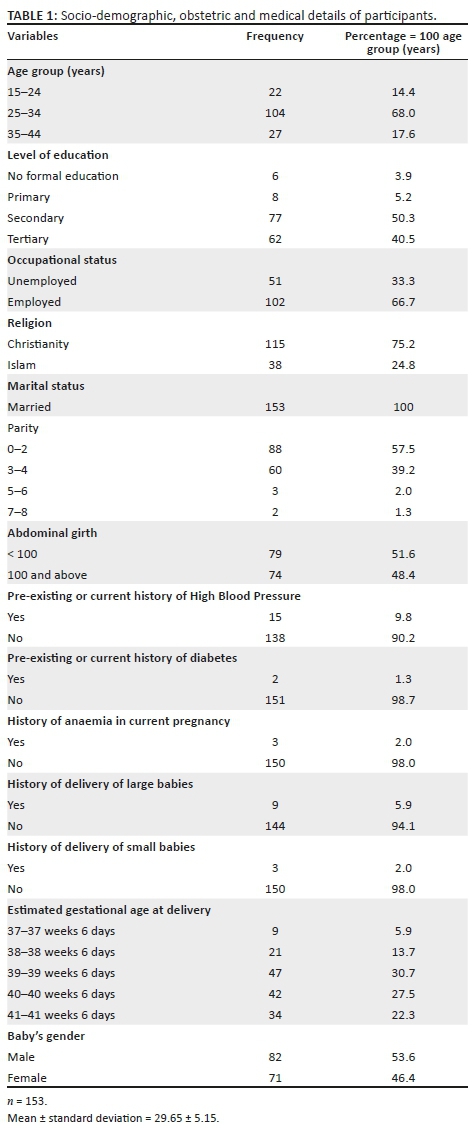
The mean age of the participants was 29.65 ± 5.15 years. All the participants were married. About half of them (77; 50.3%) had secondary education. The majority of the participants (102; 66.7%) were employed. The mean estimated gestational age of the participants at delivery was 39.5 ± 1.2 weeks. The mean parity was 1.62 ± 1.50. Only a few of the women had co-morbidities that could have impacted negatively the birth weight. Fifteen (9.8%) participants had a history of high blood pressure, two (1.3%) had diabetes mellitus, three (2%) had anaemia, whilst nine (5.9%) and three (2%) had a history of delivery of large and small babies, respectively. The socio-demographic, obstetric and medical details of the participants are presented in Table 1.
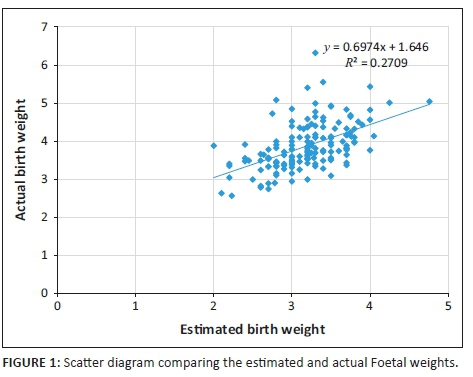
The mean EFW was 3870 g ± 620 g. Majority of the babies, 136 (88.9%), were within the normal birth weight range of 2500 g - 4000 g. The mean ABW was 3190 g ± 460 g (Figure 1).

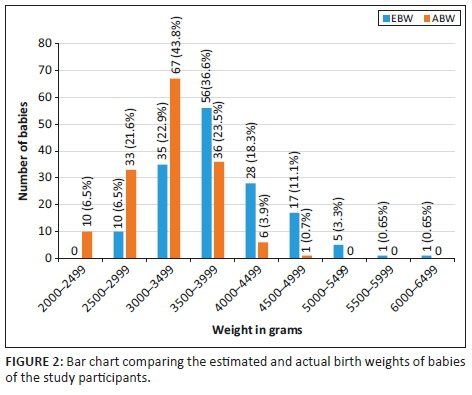
Comparison of EFW and ABW showed that Dare's formula underestimated the number of babies whose ABW was less than 3500 g, whilst it overestimated the babies whose ABW was 3500 g and above (Figure 2).

Only 37 (24.2%) of the study participants had their EFW correct to within 10% of the ABW. About 90 (66%) of the babies with birth weights within normal range and 6 (86%) of macrosomic babies were correctly predicted. None of the low birth weight babies was correctly predicted by the formula. The EFW using the Dare's formula correlated best with the ABW within the 3500 g - 3999 g range. There was a positive and significant correlation (r = 0.5, p ≤ 0.001) between the EFW and ABW. There was significant difference in the means of EFW and ABW.
Discussion
In this study, Dare's formula (product of SFH and AG) was used to predict birth weight amongst term pregnant women in FMC, Keffi, Nigeria. The mean age of the participants in this study was comparable to what was found in similar studies conducted elsewhere in Nigeria,8,1011126131415
In this study, the correlation factor between EFW and the ABW was 0.52. This was lower than what was found in the study by Sharma et al.16178
The correlation in this study was, however, comparable to what was found by Mortazavi and Akaberi77
Unlike the finding in this study, Sharma et al.16
The proportion of the participants who had EFW correct to within 10% of ABW in this study was quite low (24.2%) compared to 81% found amongst the participants of the study by Yadav et al.19
The percentage of the participants that had EFW correct to within 10% of the ABW in the study by Ugwu et al.8
Malik et al.21
Conclusion
About 24% of the study participants had their EFW correct to within 10% of the ABW in this study. The EFW correlated well with the ABW with a correlation factor of 0.52. The findings of this study showed that the Dare's formula was fairly accurate in the prediction of normal weight (66.2%) and macrosomic babies (85.7%). The formula failed to accurately predict low birth weight babies. This suggests that its use in this environment may be limited in case of suspected low birth weight. Dare's formula should be combined with other methods of foetal weight estimation to make decisions on the management of such patients.
Further research to compare the accuracy of birth weight prediction with Dare's formula in obese and non-obese mothers is recommended.
Competing interests
The authors have declared that no competing interests exist.
Authors' contributions
B. O. A. conceptualised and designed the study; performed the data collection, data analysis and interpretation; and wrote the manuscript. S.Y. conceptualised and designed the study, did the data analysis and interpretation, wrote the manuscript and approved the final version for publication. J.O.O. analysed the data.
Funding information
This research received no specific grant from any funding agency in the public, commercial or not-for-profit sectors.
Data availability statement
Data sharing is not applicable to this article as no new data were created or analysed in this study.
Disclaimer
The views and opinions expressed in this article are those of the authors and do not necessarily reflect the official policy or position of any affiliated agency of the authors.
Acknowledgements
References
-
1.United Nations Children's Fund and World Health Organization. Low birth weight: Country, regional and global estimates [homepage on the Internet]. United Nations Children's Fund; 2004 [cited 2016 Sep 27]. Available from: http://apps.who.int/iris/bitstream/10665/43184/1/9280638327.pdf
» http://apps.who.int/iris/bitstream/10665/43184/1/9280638327.pdf - 2.Sharma N, Srinivasan KJ, Sagayaraj MB, Lal DV. Foetal weight estimation methods: Clinical, sonographic and MRI imaging. Int J Sci Res Publ. 2014;4(1):1-5.
-
3.Nahum GG. Estimation of fetal weight [homepage on the Internet]. Medscape; 2014 [updated 2015 Nov 22; cited 2016 Sep 27]. Available from: http://emedicine.medscape.com/article/262865-overview#showall
» http://emedicine.medscape.com/article/262865-overview#showall -
4.Allahyar J. Macrosomia [homepage on the Internet]. Medscape; 2015 [updated 2016 Jun 14; cited 2016 Oct 7]. Available from: http://emedicine.medscape.com/article/262679-overview#showall
» http://emedicine.medscape.com/article/262679-overview#showall -
5.World Health Organization. Care of the preterm and/or low-birth-weight newborn [homepage on the Internet]. World Health Organization; 2014 [cited 2016 Oct 4]. Available from: http://www.who.int/maternal_child_adolescent/topics/newborn/care_of_preterm/
» http://www.who.int/maternal_child_adolescent/topics/newborn/care_of_preterm/ -
6.Torloni MR, Sass N, Sato JL, Renzi ACP, Fukuyama M, De Lucca PR. Clinical formulas, mother's opinion and ultrasound in predicting birth weight. Sao Paulo Med J. 2008;126(3):145-149. https://doi.org/10.1590/S1516-31802008000300002
» https://doi.org/10.1590/S1516-31802008000300002 -
7.Mortazavi F, Akaberi A. Estimation of birth weight by measurement of fundal height and abdominal girth in parturients at term. East Mediterr Health J. 2010;16(5):553-557. https://doi.org/10.26719/2010.16.5.553
» https://doi.org/10.26719/2010.16.5.553 -
8.Ugwu EO, Udealor P, Dim C, et al. Accuracy of clinical and ultrasound estimation of fetal weight in predicting actual birth weight in Enugu, Southeastern Nigeria. Niger J Clin Pract. 2014;17(3):270-275. https://doi.org/10.4103/1119-3077.130208
» https://doi.org/10.4103/1119-3077.130208 -
9.Puszczak K, Fronczyk A, Urbański M. Analysis of sample size in consumer surveys [homepage on the Internet]. Task force on quality of BCS data. 2013 [cited 2016 Oct 16]. Available from: https://www.oecd.org/
» https://www.oecd.org/ -
10.Njoku C, Emechebe C, Odusolu P, Abeshi S, Chukwu C, Ekabua J. Determination of accuracy of foetal weight using ultrasound and clinical foetal weight estimations in Calabar, South, South Nigeria. Int Sch Res Notices. 2014;2014:1-6. https://doi.org/10.1155/2014/970973
» https://doi.org/10.1155/2014/970973 -
11.Knoema. Nigeria Age of childbearing, 1950-2017 [homepage on the Internet]. World Data Atlas. [cited 2018 Feb 1]. Available from: https://knoema.com/atlas/Nigeria/topics/
» https://knoema.com/atlas/Nigeria/topics/ - 12.Malik N, Shahzad S, Malik SM, Anwar S. Comparison of two different methods for estimation of fetal weight at term. Rawal Med J. 2012;37(1):38-41.
-
13.Ugwa EA, Gaya S, Ashimi A. Estimation of fetal weight before delivery in low-resource setting of North-west Nigeria: Can we rely on our clinical skills? J Matern Neonatal Med. 2015;28(8):949-953. https://doi.org/10.3109/14767058.2014.938627
» https://doi.org/10.3109/14767058.2014.938627 -
14.Acha CK. Trend and levels of women empowerment in Nigeria. Am J Appl Math Stat. 2014;2(6):402-408. https://doi.org/10.12691/ajams-2-6-8
» https://doi.org/10.12691/ajams-2-6-8 - 15.Ejembi CL, Dahiru T, Aliyu A. Contextual factors influencing modern contraceptive use in Nigeria. DHS Work Pap. 2015;120:1-4.
- 16.Sharma R, Singh S, Bhartyia V, Gupta J, Radhakrishnan G. Product of symphysio-fundal height and abdominal circumference: A predictor of estimated fetal weight at birth. Int J Sci Stud. 2015;3(9):125-127.
- 17.Thombarapu U, Agrawal P. Comparative evaluation between two clinical methods of fetal weight estimation with actual birth weight: A prospective study. Int J Sci Res. 2015;4(6):1491-1494.
-
18.Deeluea J, Sirichotiyakul S, Weerakiet S, Arora R, Patumanond J. Fundal height growth curve for underweight and overweight and obese pregnant women in Thai population. ISRN Obstet Gynecol. 2013;2013:1-9. https://doi.org/10.1155/2013/657692
» https://doi.org/10.1155/2013/657692 -
19.Yadav R, Sharma B, Deokota R, Rahman H. Assessment of clinical methods and ultrasound in predicting fetal birth weight in term pregnant women. Int J Reprod Contraception Obstet Gynecol. 2016;5(8):2775-2779. https://doi.org/10.18203/2320-1770.ijrcog20162664
» https://doi.org/10.18203/2320-1770.ijrcog20162664 - 20.Esmaeilou H, Mohamadi E. Comparison of the accuracy of clinical methods for estimation of fetal weight. Int J Med Res Heal Sci. 2016;5(1):184-190.
-
21.Malik R, Thakur P, Agarwal G. Comparison of three clinical and three ultrasonic equations in predicting fetal birth weight. Int J Reprod Contraception Obstet Gynecol. 2016;5(1):210-216. https://doi.org/10.18203/2320-1770.ijrcog20151627
» https://doi.org/10.18203/2320-1770.ijrcog20151627
Accepted: 19 Feb. 2020
Published: 10 June 2020