Assessing laboratory specimen losses for the city of Johannesburg, South Africa
Abstract
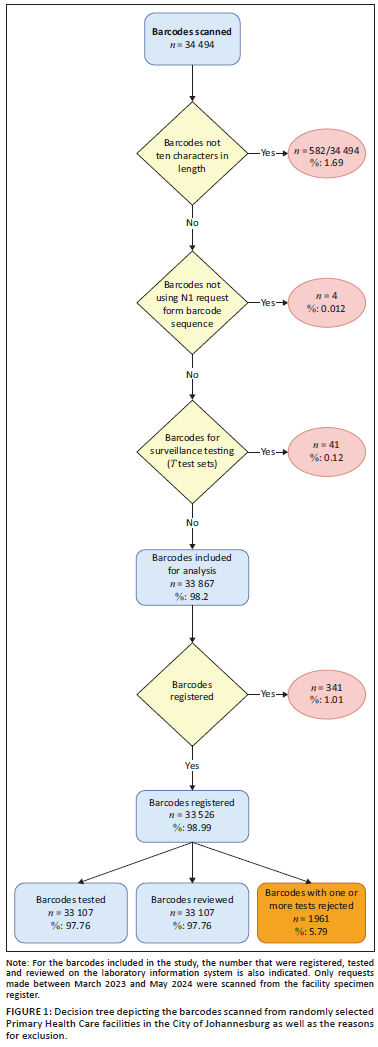
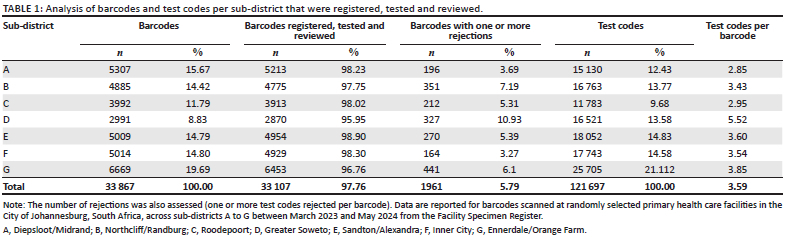
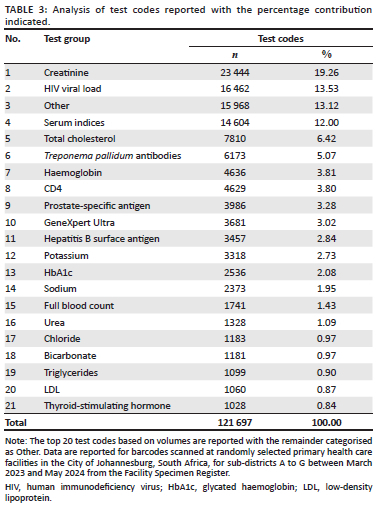
BACKGROUND: Specimen losses across the pathology value chain (PVC) result in missed diagnostic opportunities. It is difficult to fully assess these due to the current paper-based systems, with tracking of specimens only possible on the laboratory information system (LIS AIM: This study aimed to assess specimen losses using the paper-based register SETTING: Randomly selected Primary health care (PHC) facilities, City of Johannesburg, South Africa METHODS: The retrospective descriptive study design was used to scan 1,000 barcodes from facilities in sub-districts A to G. Data was limited to barcodes from the request form and excluded surveillance testing. Matching data from the laboratory repository was extracted. PVC losses were assessed by determining the percentage of scanned barcodes that had a registered, tested, reviewed and/or rejected date. The analysis was stratified according to sub-district, health facility type and test code RESULTS: The dataset analysed included 33 867 barcodes with 121 697 test codes, equating to 3.59 tests per barcode. Matching registered, tested and reviewed dates were detected for 33 107 (97.76%) barcodes. In total, a rejection for one or more test codes was detected for 1,961 barcodes (5.79%). At the sub-district level, between 95.95% (D) and 98.90% (E) of barcodes were reviewed. The rejection rate ranged from 3.27% (F) to 10.93% (D). For community health centres and clinics, 97.37% and 97.97% of the barcodes had a matching reviewed date CONCLUSION: PVC losses reported were 4.05%, excluding rejections (5.79%), with slightly higher levels noted at the sub-district level CONTRIBUTION: The continuous audit of PVC losses is recommended
pathology value chain; losses; laboratory information system; rejection; repository; primary health care
 Thumbnail