BRICS and Climate Change Law: An Opportunity to Save the Planet
Abstract
Climate change is a global problem requiring the cooperation of different states to cope with it. It has been a major concern for the international community, which has responded mainly through several United Nations treaties and other international bodies, for example the United Nations Framework Convention on Climate Change. Despite having a huge appeal to all countries, the implementation of climate change interventions has yet to produce the desired results. The BRICS+ initiative presents an opportunity for further cooperation with like-minded countries that are at the forefront of driving the global economy. BRICS+ also presents an opportunity for cooperation to address climate change. This paper analyses how countries' cooperation under the BRICS contributes to developing the international climate change regime. BRICS is a bloc of top emerging economies - Brazil, Russia, India, China, and South Africa -which has been growing since January 2024 by adding new member states such as Egypt, Ethiopia, Iran, Saudi Arabia, and the United Arab Emirates (UAE). This paper evaluates relevant provisions of the Johannesburg II Declaration of 2023 and the climate pledges of original and new BRICS members expressed in their Nationally Determined Contributions (NDCs) under the Paris Agreement. Based on this evaluation, the article concludes with a common vision for the development of climate change policy by the bloc and an assessment of how the differences and similarities of approaches of the BRICS members contribute to cooperation in addressing the climate change challenge.
BRICS; BRICS+; climate change; climate change law; nationally determined contributions; NDC; fossil fuels
1 Introduction
BRICS (an acronym for Brazil, Russia, India, China, and South Africa) is a forum of major developing economies - countries that play a significant role in the world market environment and in formulating the global agenda and response to critical issues of our time, such as sustainability.1 The bloc is expanding. In the Johannesburg Summit in the summer of 2023 BRICS invited six countries to join the bloc (Argentina, Egypt, Ethiopia, Iran, Saudi Arabia and the United Arab Emirates (UAE) (paragraph 91 of the Johannesburg II Declaration).2 Although Argentina decided not to join the bloc,3 the remaining states invited have enjoyed full BRICS membership since January 2024, thus enlarging the bloc to ten countries.4 Despite Argentina's non-membership of BRICS, we will analyse the experience of this country in addition to those of the others, because it received an invitation from BRICS and could potentially join the group in future. Since its expansion in January 2024, the bloc has been informally called BRICS+.5In this article, we will use the abbreviation BRICS, but we mean the extended version.
One of the crucial issues of our time is climate change, which is caused primarily by greenhouse gas (GHG) emissions. GHGs absorb infrared radiation that is released from the Earth's surface and turn it back to Earth, thus contributing to the greenhouse effect.6 One of the most important GHGs is carbon dioxide (CO2).7 Globally the top ten CO2 emitting countries are the following: China (11336 MtCO2), USA (5032 MtCO2), India (2674 MtCO2), Russia (1712 MtCO2), Japan (1012 MtCO2), Iran (688 MtCO2), Germany (679 MtCO2), Saudi Arabia (631 MtCO2), South Korea (616 MtCO2), and Indonesia (616 MtCOs).8 Five of these countries are BRICS countries, including new members. They account for 68,17% of the emissions from the top ten emitters. Other BRICS countries took the following positions in terms of CO2 emissions: 12th place - Brazil (497 MtCO2), 15th place - South Africa (426 MtCO2), 26th - Egypt (247 MtCO2), 27th - United Arab Emirates (237 MtCO2), 31st - Argentina (190 MtCO2), and 92nd - Ethiopia (19 MtCO2).9
Considering the significant share of GHG emissions from the BRICS countries, the bloc's role in mitigating climate change is critical. However, BRICS consists of emerging developing economies whose historical contribution to climate change was marginal or at least debatable, depending on how one calculates historical emissions. Excluding land use from the calculation, among the largest emitters historically are the United States of America (USA) and the European Union (EU), for example.10However, if land use emissions are included, the contributions of Brazil and Indonesia will increase.11 Also, if one calculates emissions per capita, the contribution of Brazil will increase while the contribution of the EU decreases.12
Different forms of GHG emissions calculations serve different purposes. Thus, calculating emissions in terms of the percentage of gross domestic product allows a comparison of similar-sized economies concerning their climate change impact.13 Presumably the purpose of the BRICS's climate policy is to contribute positively to climate change mitigation and adaptation while simultaneously addressing the needs of emerging economies and facilitating climate justice. In that case, calculating the total emissions of all nations including their historical emissions sounds like the most reasonable approach. It is expected that emissions from developing countries will increase as their economies improve.14 However, for the international climate regime to be just and not inhibit the eradication of poverty and the economic progress of the Global South, it should tolerate some degree of an increase in emissions. At the same time, BRICS cooperation should facilitate a climate-friendly mode of development and a reduction of GHG emissions in the bloc wherever possible. Hargrove, Qandeel and Sommer15claim that the participation of a nation in multiple multilateral environmental agreements has a cumulative effect and reduces emissions over time. As of now, BRICS does not have legally binding climate instruments. However, BRICS' further focus on climate change mitigation and adaptation could contribute positively towards the formation of such a cumulative effect together with the fulfilment of the other climate commitments of the BRICS nations.
Climate justice considerations require drawing attention to the following. Many of the BRICS countries suffer more from it while contributing less than non-BRICS countries to the climate problem. These include the new BRICS members from the most water-scarce region in the world - Egypt, Ethiopia, Saudi Arabia and the UAE.16 The Intergovernmental Panel on Climate Change (IPCC)17 notes that the largest adverse impact of climate change takes place in Africa, Asia, Central and Southern America, least developed countries, small islands, and the Arctic. The IPCC18 also states that the negative impacts of climate change can impede economic growth in developing and least developed states and be a constraint to successful climate change adaptation.
In this article we will identify differences and similarities in the nationally determined contributions (NDCs) of the BRICS countries committed to implementing the Paris Agreement19 - a key international treaty for coping with the climate crisis. In doing this we will articulate key elements for common climate policy and probably common legal instruments of the bloc on climate change that could enhance BRICS' integration and contribute to climate change mitigation and adaptation. The addition of the Middle Eastern countries to BRICS could be taken as an indication of the bloc's energy-centric policy.20 While modifying energy production is a critical element in coping with the climate crisis, an evaluation of the energy policy of the bloc and its development is pivotal for understanding the bloc's role from a climate perspective.
Besides the NDCs of the BRICS nations and the literature on climate law, we will assess the situation pertaining to the energy sources of the countries. In 2021 the BRICS Energy Research Cooperation Platform (ERCP) prepared the BRICS Energy Report, which, according to the Minister of Mines and Energy of the Federal Republic of Brazil Albuquerque,21 is a "valuable tool to understand the landscape in which we operate." This is not the only source for getting BRICS' views on energy issues. Others include, for example, the BRICS Energy Technology Report,22 the Annual Report of the BRICS Business Council,23 and the BRICS Plus Youth Energy Outlook.24
First this paper will provide an overview of the international climate legal regime. Then it will integrate BRICS into the climate agenda by discussing recent developments in the bloc, based on the Johannesburg II Declaration. We will evaluate the principle of common but differentiated responsibilities and respective capabilities (CBDR-RC) as one of the key elements of the international climate regime which BRICS also supports. Then the paper will assess these countries' NDC commitments and outline a comparative perspective on the climate laws and policies of the BRICS countries. The article then provides recommendations specific to the BRICS countries and concludes that BRICS cooperation can contribute positively to climate change mitigation and adaptation. However, the implementation of the NDCs of the BRICS countries and the further development of common climate law and policy are needed for this opportunity to be used productively.
2 International climate change law
In 1992 the United Nations Framework Convention on Climate Change (UNFCCC) was adopted. This was the first global treaty on the issue. The UNFCCC enshrines principles that guide parties towards achieving the stabilisation of the concentration of GHGs in the atmosphere. These principles include, among others, the precautionary principle and the CBDR-RC principle. The latter will be discussed in more detail in Section Four of this article.
Despite its significance as a milestone in forging an international legal framework for coping with the climate change challenge, the UNFCCC did not provide specific measures to address climate change. That is why the next step in developing a legal mechanism for climate change was needed.
The expectations that there would be such an instrument materialised in the Kyoto Protocol of 1997.
The success of the Kyoto Protocol was limited, on the one hand by the fact that it had binding emission reduction targets not for the whole community of states but only for developed countries, and on the other hand because even the participation of developed states was not overarching. Thus, the United States did not ratify the Protocol25 and Canada decided to withdraw from the treaty when it realised that it would not be able to fulfil its commitments under the agreement.26
Currently the legal hopes of the international community concerning climate change are focussed on the Paris Agreement of 2015. This treaty is equally binding for developed and developing nations, and all of them have made pledges under the Agreement. Article 3 of the Paris Agreement establishes one of the key elements of the international legal regime on climate change - NDCs - ambitious efforts that all parties to the Agreement are to undertake and publish.27
The formation of climate change law is complex. It concerns legal arrangements such as the transition from the idea of the top-down binding norms for developed countries of the Kyoto Protocol to the more inclusive bottom-up approach of the Paris Agreement. Complexity is visible in the uneasy relationships of this legal domain with other fields of law such as with its counterpart, environmental law.28 Also, the dynamic nature of climate change law can be observed in the role of the different actors in the formulation of its norms and principles.
At the time of the adoption of the Kyoto Protocol, the USA was the main emitter and it was critical to have them on board.29 However, its unwillingness to ratify the agreement turned attention to the attitudes of other actors such as the EU countries or Russia, whose ratification was the final act that entered the Protocol into force.30 Later, China surpassed the USA as the leading global GHG emitter, and while developing countries were still reluctant to make legally binding commitments under the international climate legal regime, it became obvious that without China and other developing countries, the evolution of international climate change law would not be satisfactory.31
Not only single states but groups of states, international organisations and non-state actors played critical roles in the development of climate change law. Among them were small island developing states, civil society activists, the IPCC, courts and tribunals, for example.32 Considering its rising influence and scope, BRICS could play a critical role in the implementation of the NDCs of its member states and the development of strategies, policies and climate-sensitive collaborations.
3 Johannesburg II Declaration
The consideration of the role of BRICS in climate change law leads to a discussion of the relevant scholarly literature.33 Despite the diversity of their approaches to climate change mitigation and adaptation among the BRICS countries and the lack of anything like a synchronisation of their behaviour in this matter,34 researchers believe that the bloc should exhibit a sense of communality in its climate change agenda and try to develop a legally obligatory climate change framework - and also try to unify domestic legislation on these matters.35 The Johannesburg II Declaration encapsulates the recent developments relating to climate change in the BRICS bloc.
The Johannesburg II Declaration illustrates, among other things, that there is currently a common vision of climate change law and policy in the bloc.36The Declaration refers to multilateral cooperation as a critical part of coping with climate change (paragraph 28), highlights the fact that addressing climate change is a crucial aspect of sustainable development for Africa (paragraph 34) and is an integral part of the effort to achieve the Sustainable Development Goals (SDGs) (paragraph 53), reemphasises the CBDR-RC principle (paragraph 56), calls on developed countries to lead the economic transition and assist developing countries with this and other aspects concerning the climate challenge (paragraphs 57-59, 61), calls for a scaling-up of climate finance and investments (paragraph 62), welcomes a study on the available technology to address climate data gaps in the financial sector (paragraph 51), opposes trade barriers as means of coping with climate change (paragraph 63), highlights the importance of all energy sources and recognises the role of fossil fuels in supporting energy security (paragraph 70), states that climate change adaptation initiatives are critical for disaster risk reduction (paragraph 72), and emphasises the role of climate change education and training (paragraph 73).
This vision is backed by the iteration of general principles shared by the BRICS countries such as the importance of inclusive multilateralism (paragraphs 1, 3, 14, 90 of the Johannesburg II Declaration), fair international governance (paragraphs 2, 6), the right to development (paragraph 6), and the need for the greater representation of emerging markets and developing countries (paragraph 90). Such ideas attract countries of the Global South to BRICS membership (paragraph 90).
Back in 2001, when O'Neill coined the term "BRIC", his approach was to integrate the emerging economies of Brazil, Russia, India and China into the G7 or other Western settings.37 However, at the heart of the BRICS cooperation is the creation of an alternative global order. BRICS tries to contribute to the formation of a multipolar world which is not ruled by the hegemony of one state and its allies.38 Thus far BRICS does not provide a comprehensive institutional and legal framework for this.39 However, there is progress in forging the BRICS instruments. Examples include the establishment of the New Development Bank40 and the adoption of the Agreement Between the Governments of the BRICS States on Cooperation in the Field of Culture in 2015. Documents such as the Johannesburg II Declaration discussed in this article could be a source of the common vision of the bloc's policy on various significant issues, including climate change. They could also be a source for developing other and probably more legally binding instruments. Despite their differences and the territorial separation of the BRICS countries, which might be seen as a disadvantage militating against closer cooperation, the same factors could contribute to the development of a unique law and policy framework accepting and synthesising such differences, which would be critical for the development of the multipolar world.41
4 The principle of common but differentiated responsibilities and respective capabilities (CBDR-RC)
Article 3(1) of the UNFCCC states that Parties to the Convention should protect the climate system in accordance with their common but differentiated responsibilities and respective capabilities (CBDR-RC). The Article then adds that the developed country Parties should take the lead in combatting climate change and the adverse effects thereof. Articles 3(2) and 4(1) mention the specific needs and special circumstances of developing country Parties and specific national and regional development priorities, objectives and circumstances.
Acknowledging the dichotomy between the developed and developing countries the UNFCCC establishes two lists of parties as Annex I and Annex II. Annex I includes developed country parties, countries that are undergoing the process of transition to a market economy and the European Economic Community (currently the EU). Annex II is a list of developed country parties and the European Economic Community that have enhanced financial commitments towards assisting developing countries. Russia is included in Annex I as a country with an economy in transition. Annexes do not include other BRICS countries. The Kyoto Protocol also clearly distinguishes between the commitments of developed and developing countries.
In the 1990s when the UNFCCC and the Kyoto Protocol were adopted such a dichotomy was quite clear and the group of developing countries was quite homogeneous.42 Later the economies of many developing countries, first of all China, surpassed the economies of some other parties included in the Annexures to the UNFCCC.43 Against this backdrop, the approach towards the CBDR-RC started to evolve.44 The Paris Agreement still retains the CBDR-RC principle but makes it more nuanced by adding the words "in the light of different national circumstances" (Preamble, Articles 2(2), 4(3), (4), (19)). Also, as discussed previously, the Paris Agreement blurs the line between the commitments of developed and developing countries by establishing that all of them are to adopt NDCs.
The Johannesburg II Declaration uses the wording of the Paris Agreement and reemphasises the CBDR-RC principle that national obligations are expected to relate to "different national circumstances" (paragraphs 56-63). The Declaration uses the CBDR-RC principle not only in relation to climate change but also relative to states' biodiversity commitments (paragraph 55). Most of the provisions of the related paragraphs concern financial and technical support by developed countries to the energy transition in developing countries and other means of implementing states' climate commitments.
However, there is a difficulty that arises from the categorisation of BRICS members such as China and India as on the one hand they are rising powers, but on the other hand they wish to express solidarity with the other countries of the Global South.45 Probably, the CBDR-RC principle needs further development and differentiation in relation to BRICS. The evolving interpretation of the principle should foster South-South cooperation and the provision of assistance by rising powers to other developing states that still need such assistance for their energy transition and adaptation to climate change.
5 The BRICS countries
In this section we will outline key features of the BRICS and we will illustrate that the problems that the BRICS countries face in setting and implementing their climate change mitigation laws and policies are diverse, which is why establishing a common response of the bloc to the climate change challenge is a complex task that requires consideration different from and sometimes contradicting the priorities of the bloc's member states.
Understanding the composition of the sources of energy in the BRICS countries is critical to setting their climate goals and implementing their NDCs. In 2019 the share of the BRICS nations in world energy consumption was 38,25%: China - 24.27%, India - 5.83%, Russia - 5.11%, Brazil - 2.12%, and South Africa - 0.92%.46 Starting from 2 000 BRICS countries reduced their CO2 emissions as follows: Russia by 41.10%, China by 35.48%, India by 20.69%, Brazil by 7.14%, and South Africa by 5.00%.47 Brazil produces the lowest CO2 emissions per unit of gross domestic product (GDP) among the BRICS nations.48
We have already mentioned that Argentina is not a BRICS country. However, Argentina's government has been invited to join the bloc, so we include Argentina in our analysis. Argentina's economy depends on natural resource extraction.49 Dorn, Hafner and Plank50 note that the commodity extractivism of the 2000s is now turning to climate extractivism. This means that extracting natural resources such as lithium to build renewable energy infrastructure is legitimised by the "saving the planet" discourse.51 In this context, opposition to a new wave of extractivism in the country is characterised as being not just against social programmes and development but also as against coping with climate change, which is inextricably linked with sustainable development transition in Argentina.52
The Brazilian energy sector is one of the least carbon-intensive in the world, with a share of renewables of almost half of the total energy supply (48.4% in 2020).53 Although this is significant, the growing population of the country requires more energy consumption.54 Also, the largest contribution to Brazil's emissions historically was not from the energy sector but was driven by deforestation and unsustainable agricultural practices.55
China is the largest developing country in the world.56 On the one hand, it is the world's largest GHG emitter, and on the other hand, it is one of the leaders in multilateral climate change cooperation.57 New Chinese international projects such as the Belt and Road Initiative draw attention in terms of their climate change impacts.58 China believes that addressing climate change is critical and, as President Xi Jinping59 notes, China does so not at others' request but on its own initiative. President Xi Jinping60highlights the link between how people address the climate change challenge and the construction of global governance. China works successfully on poverty alleviation and ensuring the provision of an electricity supply.61 It promotes the consumption of renewable energy and the construction of clean energy projects.62 It is expanding this competency globally by exporting renewable energy capacity in both goods and services.
Egypt is a developing country with a fast-growing population.63 In its NDC it notes that the historic quantity of GHG emissions of the country is marginal.64 However, it is committed to the reduction of its GHG emissions and adaptation to climate change.65 Egypt relies on international finance for the implementation of its NDC.66
Ethiopia is one of the least developed countries in the world,67 with a marginal share of emissions (0.04%).68 However, a negative climate change impact on Ethiopia and its development could be devastating and the country commits to reducing its emissions and adapting to climate change.69Ethiopia's NDC makes a clear distinction between unconditional contributions, which the country will make relying on its own finances, and conditional contributions, which are contingent on international support.70The domestically financed share of Ethiopia's contributions is 20% and the internationally/donor-financed share is 80%.71
India focusses on the rapid economic growth which is needed for poverty eradication.72 Its energy demand has increased while the country is also focussing on energy efficiency.73 The energy consumption from coal and lignite is higher than that from other energy sources (43,86%).74 India is the world's largest producer of coal after China.75 It imports crude oil and exports refined oil.76 Currently it has the fourth largest renewable energy capacity in the world after China, the United States and Brazil.77 India's specific prospect of mitigation lies in its megacities' accumulating growing population and economy, which could mobilise resources for the energy transition.78
Iran is one of the largest CO2 emitters globally.79 Energy and waste are the sectors that contribute most heavily to increasing GHG emissions in Iran.80The growing urbanisation also leads to increased emissions.81 The review of various sources on climate predictions conducted by Mansouri Daneshvar, Ebrahimi and Nejadsoleymani82 posits that the negative impacts of climate change in Iran will be the most severe among the countries of the Middle East. This is due to the significant increase in temperature and the decline in precipitation.83 On 22 April 2016 Iran signed the Paris Agreement.84 However, the country has not ratified it yet.85 Thus, Iran is the only BRICS member that has not yet ratified the Agreement, which is why it has not adopted a NDC.
Russia is a country with vast hydrocarbon resources.86 Its economy relies on them both domestically and internationally.87 Its climate mitigation law and policy are considered insufficiently ambitious, for various reasons. Among them are the unwillingness of the elites to recognise the anthropogenic causes of climate change, ignorance of climate change issues among the general population, and even the belief that climate change could benefit the country.88 It is carrying out joint projects including climate projects with the Commonwealth of Independent States (CIS) countries, BRICS, and the Association of Southeast Asian Nations (ASEAN).89 Russia is contributing to developing nuclear energy in such countries as Egypt, Jordan, Nigeria, Uzbekistan, Bangladesh, Armenia, Iran, India and China.90 Russia's share of pipeline gas exports is the largest in the world.91 It is also one of the largest producers of coal.92 Among the recent developments in its energy sector is the development of hydrogen energy.93 Russia considers it unacceptable to use climate policies as tools for creating barriers to the socio-economic development of countries.94
Saudi Arabia is a developing country with historically low GHG emissions contributions.95 In terms of climate change policy, the implementation of Saudi Arabia's NDC is not contingent on international financial support.96Moreover, the country launched the Middle East Green Initiative to facilitate climate change mitigation and adaptation in the Middle East, in North Africa (MENA), and beyond the region.97
South Africa is one of the world's most fossil fuel-dependent countries.98The share of fossil fuels in energy consumption is more than 90%.99 The share of coal is around 70%,100 which makes South Africa one of the most coal-dependent economies in the world.101 Mpumalanga province is the region in the country that produces the most coal.102 In its NDC, South Africa references as factors to consider when assessing its contributions, its slow economic growth, the negative impacts of climate change such as increasing numbers of forest fires, the COVID pandemic, and its status as a developing country.103 The climate law and policy of the country and its institutional structures for their implementation are quite fragmented.104However, there are signs that these obstacles are being overcome. Among them is the fact that in October 2023 the National Assembly passed South Africa's Climate Change Bill, which aims to establish a comprehensive legal framework and synchronise the activities of different actors towards achieving common climate goals.
The UAE hosted the 28th Conference of the Parties (COP-28) to the UNFCCC in November 2023.105 The UAE is a non-Annex I country and relies on domestic efforts to fulfil its NDCs.106 Nevertheless, it reserves the right to use the voluntary contributions of donors.107 The UAE conducts mitigation and adaptation projects not only domestically but also globally.108Examples include the hydrogen project on pioneering decarbonised air corridors between the United Kingdom (UK) and the UAE.109
6 Mitigation of climate change
In this section we will discuss the specific commitments and developments of old and new BRICS members concerning climate change mitigation. Firstly, we will observe the mitigation targets expressed in the NDCs of the BRICS countries. Secondly, we will outline the processes of energy transition in the bloc. Finally, we will briefly express the role of forests, afforestation and reforestation in climate change mitigation in the countries discussed.
6.1 Mitigation targets of the BRICS countries
This section will examine how the BRICS countries articulate in their NDCs their targets to decrease their GHG emissions. The NDC Synthesis Report observes NDCs of the various parties to the Paris Agreement and identifies common features in their approaches towards fulfilling their climate commitments.110 According to paragraph 10 of the Report, the total GHG emissions of the parties in 2019 were 45.6 GtCO2-eq. Paragraph 10 states that if the NDCs were implemented, the estimated level of GHG emissions in 2025 would be around 46.4 GtCO2-eq and in 2030 - around 45.6 GtCO2-eq. Compared with the previous NDCs, these emission levels are lower: for 2025 - about 3.8% lower, and for 2030 - about 9.5% lower.111 According to paragraph 64(a) of the Report, some parties (37%) use absolute emissions reduction targets related to the emissions of a specified year. Paragraph 64(b) states that many parties (46%) express their targets as reductions from the "business as usual" (BAU) emission model. The Synthesis Report considers that parties to the Paris Agreement express the implementation of their NDCs based on conditional or unconditional elements.112 The highest levels of emission reductions need the implementation of both groups of elements.
In December 2020 Argentina communicated its second NDC113 and in October 2021 it updated its NDC.114 The total net emission of GHGs reached 369 MtCO2-eq by 2016.115 In its second NDC Argentina committed not to exceed the net emission of 359 MtCO2-eq in 2030.116 Its updated goal is to not exceed the net emission of 349 MtCO2-eq in 2030.117 Its neighbour Brazil adopted an NDC which is considered one of the most ambitious in the world.118 According to the NDC, Brazil is committed to reducing its GHG emissions in 2025 by 37% compared to 2005; in 2030 by 50% compared to 2005.119
Among China's NDC goals are to have CO2 emissions peak before 2030 and achieve climate neutrality before 2060; before 2030 to lower CO2 emissions per unit of GDP by over 65% from the 2005 level.120 China's carbon intensity (CO2 emissions per unit of GDP) in 2019 was 51.9% of that in 2005, a decrease of about 48.1% from 2005.121 China has also improved the statistical system for GHG emissions.122 In its five-year plans, China has set different carbon intensity targets for different regions (provinces, autonomous regions, municipalities), taking into account their specific features and needs.123 Various regions in China have launched carbon emission markets.124 The Hong Kong Special Administrative Region (HKSAR) aims to reduce its carbon intensity by 65% to 70% between 2005 and 2030, the equivalent of an absolute carbon emission reduction of 26% to 36%.125 The Macao SAR target for 2030 is a 60% to 65% reduction in carbon intensity compared to 2005.126
The reference year for Egypt is 2015; the reference period is 2020 to 2030.127 Egypt uses 2030 as the BAU projection year and then articulates its mitigation commitments concerning the estimated BAU emissions for 2030.128 Egypt's commitments embed three sectors: electricity, oil and gas (associated gases), and transport.129 These sectors represented about 43% of the total GHG emissions of the country in 2015.130 Egypt's neighbour Ethiopia has a mitigation commitment to a reduction of at least 68.8% in its economy-wide emissions by 2030, as against the 2030 BAU projection.131
In its NDC, India commits to reducing the emissions intensity of its GDP by 45% by 2030 from the 2005 level.132 Its long-term goal is net-zero by 2070.133 Russia plans to reduce its GHG emissions by 2030 to 70% relative to the 1990 level.134 South Africa has two corresponding periods for its mitigation targets: (1) 2021-2025, and (2) 2026-2030.135 For the first corresponding period, the target is annual GHG emissions by 2025 in a range from 398-510 MtCO2-eq.136 For the second corresponding period, the target is annual GHG emissions by 2030 in a range from 350-420 MtCO2- eq.137
Saudi Arabia aims to reduce, avoid, and remove GHG emissions by 278 million tons of CO2-eq annually by 2030.138 The Kingdom's neighbour, the UAE, has adopted an NDC which uses a base-year and fixed-level target to ensure maximum transparency and measurability.139 The previous version of the NDC was based on the GHG emission reduction in the BAU scenario.140 Also, the current target is economy-wide.141 The UAE's NDC covers all national GHGs (CO2, CH4, N2O), except for fluoridated gases.142The UAE has resolved to reach a net-zero target by 2050.143
There is a great diversity in the measurement of GHG emissions and approaches towards climate mitigation targets among the BRICS members. However, if the bloc aims to have a common climate policy, it would be beneficial to synchronise the climate goals of the countries.144 While the diversity in measurement can be based on the level of development of each country and the priorities in their climate policies, establishing the linkages between the climate efforts of the countries would enhance equity-efficiency synergies and contribute to the overall implementation of the Paris Agreement.145
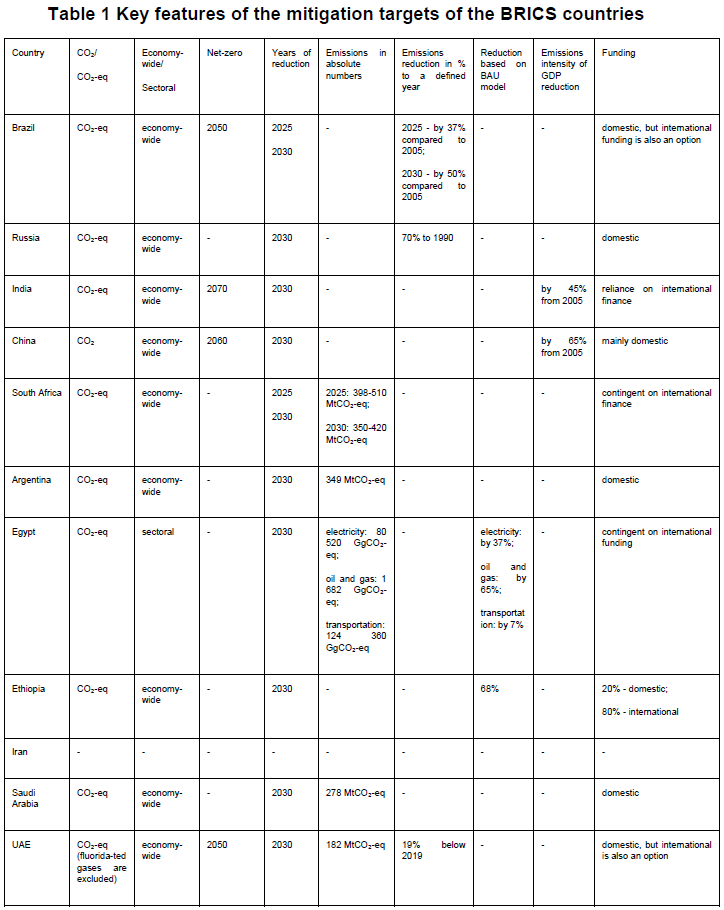
Table 1 showcases the key points of current commitments and approaches that could be starting points for such synchronisation. Iran has not adopted an NDC, thus the further analysis will concern all BRICS country members except this country. Nevertheless, Iran's admission to BRICS paves the way for the inclusion of Iran to develop an approach to climate in accordance with the general BRICS policy. By doing this, Iran joins in the existing global climate mitigation endeavours even if it is not a Paris Agreement party, which in turn could increase the significance of the bloc in the global climate regime.
Table 1 illustrates that all BRICS countries except China use CO2-eq (GHG emissions) in defining their climate targets while China expresses its commitment in carbon dioxide. The UAE also clarified that its climate target concerns CO2, CH4, N2O except for fluoridated gases. All countries except Egypt express their commitments in economy-wide terms, while Egypt defines its targets separately for electricity, oil and gas, and the transportation sectors. Some countries set their net-zero targets. Brazil and the UAE aim to achieve their climate neutrality by 2050, China by 2060, and India by 2070.
All BRICS countries define 2030 as the year by which they hope to achieve their emission reduction targets. Brazil and South Africa also set their preliminary targets for 2025, which increases their transparency and makes it easier to measure the progress of these countries. South Africa, Argentina, Egypt, Saudi Arabia and the UAE express their emissions in the reference year in absolute numbers rather than in percentages, or in addition to percentages, which also increases transparency and clarity. Brazil, Russia and the UAE express their commitments in the percentage of reduction concerning a previous year. Thus, for Brazil, the reduction by 2030 should be 50% compared to 2005; for Russia it is 70% compared to 1990, and for the UAE it is 19% below 2019. This suggests the possibility of developing synergies, but the countries use different years as base years, which makes comparison difficult.
Egypt and Ethiopia articulate their targets in relation to BAU scenarios. The UAE used this model in the past but transferred from this model to a reduction in absolute numbers using a base year emissions calculation, which is a welcome development for the sake of clarity and transparency. India and China set their targets as the reduction of the emissions intensity of their GDPs. A comparison of the goals of these two countries is possible. However, it is worth considering that China expresses its targets in CO2 emission reduction while India calculates it for all GHG emissions.
The various states also note whether they are going to consider asking for international finance for the implementation of their NDCs. Thus, for example, South Africa, Egypt and Ethiopia's programmes are contingent on receiving international finance. The approach of Ethiopia in this regard seems to be a welcome development. Ethiopia commits to achieving 20% of its climate targets based on its domestic finance (unconditional), while 80% will depend on international support (conditional). Such a distinction would help in measuring the progress of the country as well as for calculating overall progress under the Paris Agreement regime.
The New Development Bank (NDB), an institution established by the bloc, could play a critical role in the implementation of the BRICS nations' NDCs. Thus, according to the NDB General Strategy for 2022-2026, 40% of its approvals should be for projects contributing to climate change mitigation and adaptation.146 The Bank and AXA Climate,147 an entity of the French insurance company dedicated to climate challenges, draw the attention of investors to the need for integrating knowledge on climate change and its impacts into their projects. The NDB and AXA Climate148 state that in the long run such integration leads to monetary and non-monetary benefits such as job creation.
6.2 Energy transition
Paragraph 70 of the Johannesburg II Declaration highlights the importance of all energy sources and recognises the role of fossil fuels in supporting energy security. The balancing of climate change mitigation targets with this principle is one of the key features of BRICS. Nevertheless, cooperation on energy issues in the bloc, while critical for BRICS, has its obstacles. Thus, countries have different positions in the energy market. For example, Russia, South Africa and Brazil are mainly energy-exporting countries while India and China are energy-importing countries.149 They have different national development priorities and are involved in different integration processes aside from BRICS.150
The improvement of the use of energy sources in a way that reduces GHG emissions requires complex measures including developing new laws and regulations. The energy sector involves multiple interactions between energy producers, consumers and authorities at different levels. Their interests sometimes differ. Thus, investor-owned energy utilities have an interest in increasing energy consumption, while the reduction of GHG emissions requires the consumption of less energy by increasing energy efficiency.151 The shift towards using electric cars, which produce zero GHG emissions, is a climatically beneficial movement. However, the way the electricity for these cars is produced remains a critical issue. If this is electricity produced by the combustion of fossil fuels, the impact of this on climate needs additional consideration.152 The construction of buildings and the use of gas for cooking, heating and air conditioning systems are important for climate policy.153 Increasing the climate requirements for buildings could, in turn, increase the cost of buying such buildings and lead to social tensions.154 Maintaining and improving the resilience of existing and newly constructed energy utilities in the light of the increasing risks of drought, hurricanes, flooding and other climate change-related weather events is another critical aspect for the energy system.155
Although the shares of renewable energy in the energy production and consumption of the BRICS countries are increasing, hydrocarbons remain dominant in 2040.156 In future the overall energy consumption in the BRICS nations (with the possible exception of Russia) will increase.157 Finding the right balance between increasing energy consumption and achieving climate goals is a priority for BRICS.158 The transition to renewable energy, a more efficient use of traditional energy sources, and the development of new energy sectors such as hydrogen energy are critical to BRICS.159 As the previous data discussed in the text illustrate and the media observe,160except for South Africa and Russia the BRICS countries are on the way to becoming solar- and wind-powered.
The Indian Government is taking steps towards achieving a smooth energy transition.161 Among China's NDC goals are to increase the share of non-fossil fuels in primary energy consumption to around 25% and to increase wind and solar power generation.162 China has made progress in controlling GHG emissions. Examples include launching low-carbon development models,163 a new model of green poverty alleviation in a "photovoltaic village" in Sichuan,164 development of rural biogas projects in the same province,165 control over total coal consumption in Beijing-Tianjin-Hebei Region,166 the promotion of green building,167 the development of a low-carbon transportation system (Shenzhen is the first city in China to rely totally on purely electric buses),168 and the promotion of shared transportation.169 Poderati and Ou170 claim that increasing public participation in Chinese climate law and policy would benefit the climate regime in the country.
South Africa emphasises its development challenges and the need for a just transition to renewables, which means a transition which leaves no one behind.171 The implementation of the NDC requires massive investments in renewable energy sources.172 The decarbonisation of South Africa's economy will be done in the following stages: (1) in the 2020s -decarbonisation of the electricity sector, (2) in the 2030s - deeper transition in the electricity sector and transportation, (3) in the 2040s - the decarbonisation of the hard-to-mitigate sectors.173
One of the examples of international cooperation on just transition is the Political Declaration on the Just Energy Transition in South Africa adopted in 2021 by the governments of South Africa, the UK, the USA, France, Germany and the EU.174 Paragraph 18 of the Declaration states that the entities involved have resolved to mobilise the initial amount of $8.5 billion over the next three to five years to support a just transition. According to paragraph 17(2) of the document, just transition in South Africa means, among other things, the support of workers in fossil fuel industries and communities affected by such a transition. Paragraph 8 of the Declaration identifies mining, energy, manufacturing and transport as sectors that may be negatively affected by the transition. Also, the other states that adopted the Declaration recognise the unprecedented opportunity for South Africa to become a leader in the just energy transition. Similar actions in BRICS would be beneficial both for BRICS member states and for developing the climate policy and identity of the bloc as such.
Argentina articulates the principles it will follow in achieving its mitigation and adaptation goals.175 The principles include just transition, in terms of which none of its citizens will be left behind, and environmental education and energy security will be promoted, among other things.176 Argentina points out that the implementation of its NDC is not contingent on international support, but assistance from developed countries would bring benefits globally.177
Saudi Arabia is ambitious in developing its renewable energy potential, including blue and green hydrogen technologies, and energy efficiency.178One of the country's most ambitious projects in terms of urban climate sustainability is the construction of NEOM city, which is to be based entirely on renewables.179 Saudi Arabia follows the circular carbon economy approach based on the "4Rs" model (reduce, reuse, recycle, and remove to manage GHG emissions) including developing the carbon capture, utilisation and storage technologies.180
The UAE will focus on new developments such as low-carbon hydrogen (blue, green and pink), and carbon capture and storage.181 The Emirates promotes ideas of just transition, the participation of public and private entities, youth, women, and other people of determination in climate actions.182 The UAE government involved the youth in the formal proceedings of COP-28.183
The energy transition from fossil fuels to renewable energy sources is a complex issue. While it is a morally correct policy aiming to mitigate climate change and improve air quality, it is difficult to implement in countries dependent on fossil fuels.184 Against this background, it is critical that such a transition be just and consider equity issues in a global environmental context. It would be unjust to impose the burden of such a transition entirely on developing countries. While they have to reduce the use of coal, the support of the Global North is critical. The transition in the Global North from oil and gas to renewables is also pivotal for the overall success of the transition.185
In the Preamble to the Paris Agreement, the parties to the treaty take into account the imperatives of a just transition of the workforce and the creation of decent work and quality jobs in accordance with nationally defined development priorities. The legal meaning of the concept of a just transition is still emerging.186 The debate about it includes whether the concept is exclusively an internal state matter or should reflect a broader vision of cross-border equity and the CBDR-RC principle under the international climate regime.187 BRICS could contribute to the development of the concept by clarifying the meaning of the concept and implementing it in the BRICS community as an example for other countries. This process could reflect the ideas and practices of just transition in the BRICS countries, based on the transition in such coal-dependent countries as South Africa.
An energy transition requires the integration of new technologies, including those that have emerged as an outcome of the fourth industrial revolution ("Industry 4.0" or "I4.0").188 This revolution, which has to do with connecting material things with artificial intelligence, big data and other information technologies, leaves room for developing more efficient energy systems based on fossil fuels as well as the better construction and use of renewable energy sources.189 However, financial constraints, geographical limitations, and technological difficulties are obstacles to overcome in this process.190
6.3 Forests
It is not only the transition to renewables that is critical for mitigation of climate change, but also developments in other areas such as land use and agriculture or waste management.191 In their NDCs the BRICS countries explicitly mention the role of forests as carbon sinks.192 Russia considers the maximum possible absorption rate of its forests in its calculation of the mitigation of its GHG emissions.193 India is going to create additional carbon sinks through cultivating forests and further tree cover.194 Among China's NDC goals is to increase the volume of its forest stock.195 One of China's examples of increasing carbon sinks is the Saihanba Afforestation Project.196 The UAE launched the Mangrove Alliance for Climate (MAC) in partnership with Indonesia.197
The development of the common policy of the BRICS countries on forestry in climate change mitigation requires the consideration of different factors, including the different ways of using forests. They can be used, for example, primarily as carbon sinks or as a way of bioenergy production.198 In the latter option forests do not remove but instead release carbon into the atmosphere.199 In this case the development of such technologies as producing bioenergy with carbon capture and storage is critical.200 The BRICS countries are geographically diverse and their use of forests could vary significantly. Thus, the bloc has to consider different national circumstances and priorities. In doing so, learning from other jurisdictions, for example from the EU and its member states, would be beneficial.201
7 Adaptation to climate change
The impacts of climate change could be either positive or negative, depending on the region. The IPCC202 states that climate change could affect physical water availability, animal livestock health, and productivity globally not only negatively but also in a positive way. However, the impacts are mostly negative and include such things as displacement, excessive heat, malnutrition and harm from wildfire, inland flooding and the associated damage, and flood and storm-induced damage in coastal areas.203Adaptation to different impacts is critical.
The BRICS countries consider climate change adaptation in their NDCs. Besides the negative impact of climate change, Russia sees positive features for the country, such as a reduction of energy consumption during winter, the development of the Arctic including the development of sea routes, a greater potential for agriculture, and the increasing productivity of boreal forests.204
China promotes proactive adaptation to climate change, including the creation of sponge cities (urban areas with abundant trees, lakes and parks intended to absorb rain and prevent flooding),205 increasing the provision of finance, public participation and policy support,206 and promoting international cooperation on climate change, including South-South cooperation, for example with African countries.207
South Africa's NDC articulates that it is not only the mitigation endeavours of the country that are critical but also the adaptation measures, and is expecting international cooperation and financial and other facilitation from developed countries to help it achieve its climate goals.208
In its NDC, Egypt highlights the critical role of adaptation, which is especially significant for water issues.209 It includes water scarcity related to the growing population of the country and the rise in the level of the Mediterranean Sea, which could lead to the salination of fresh water and the erosion of coastal zones in the northern regions of the country.210
Saudi Arabia deals with the topic of adaptation as it is an arid country vulnerable to climate change.211 The UAE is vulnerable to climate change due to its low-lying coastal areas, and is vulnerable to drought and desertification.212 In its adaptation commitments it proposes restoring coral reefs and planting mangroves, among other things.213
For a long time, climate change adaptation was considered to be less important than mitigation. However, as actual changes in the climate occur and GHG emissions continue to rise, adaptation is becoming more important in academia and among policymakers.214 The adoption of the Paris Agreement was a milestone in international law in drawing attention to adaptation while the Kyoto Protocol focussed on mitigation.215 As one can see in the NDCs of the BRICS countries, adaptation is currently a significant part of national climate change commitments.
The development of climate change adaptation law and policy in general and in BRICS more specifically is a complex and not an easy task. While mitigation law and policy focus on specific fields of law more or less limited to energy law, forestry and agriculture regulation, climate change adaptation requires pertaining not only to energy, forestry and land use law but also to biodiversity, tourism, city planning, the regulation of marine and coastal areas, insurance, loss and damage mechanisms, the adaptation of law firms to climate litigation, and compensations from extreme weather events.216
Mitigation action can run counter to climate change adaptation. Thus, building dams for hydropower may negatively affect agriculture and lead to the need for resettlements. The same effect can arise from afforestation and reforestation as climate change mitigation measures.217 Building infrastructure for wind and solar energy can affect biodiversity negatively.218The complexity is increased by the fact that climate change impacts not only our physical environments but also our social structures. It can increase inequalities and lead to exacerbating injustice.219 Maladaptation is another issue to consider. Thus, constructing roads that are more resilient to flooding can lead to the attraction of human migration to these places, which may well be prone to natural disasters.220 Also, the situation with adaptation is even more complex, considering the uncertainties in our understanding of the impacts of climate change and our uncertainties concerning natural disasters, i.e. when and where they will happen and how severe they will be.221
What BRICS could do in this context is to become a platform that raises awareness of the challenges of adaptation and shares best practice in the bloc and with other countries, that assists in the distribution of finance, technology and capacity building to the places that are most in need of this, and that becomes an example of a successful adaptation that enhances the livelihoods of people and cares for the ecosystems in BRICS countries and beyond, and that gains political benefits for the bloc as well.
What is critical in this process is to connect local needs with the BRICS strategies.222 Climate agenda should not compete with other needs such as poverty eradication, reducing inequalities, enhancing transportation, agriculture and other sectors, but should be integrated with them.223 The involvement of local, sub-national and national public and private actors in developing and implementing the BRICS climate change mitigation and adaptation strategies would make the policy more effective.224 Also, adaptation to climate change can be spontaneous or planned.225 Being proactive and developing planned adaptation laws and policies instead of reacting spontaneously to climate events would make BRICS countries more resilient towards climate challenges.
8 Notes on further research on the BRICS countries' climate laws and policies from a comparative perspective
Because this article aims to define the features of national approaches critical to developing a common BRICS attitude to climate change at present, it focusses mainly on the NDCs' commitments rather than on domestic laws and policies. However, the necessary next step is to look beyond the NDCs. Comparative analysis of the BRICS countries' climate laws and policies would contribute to defining the differences and similarities among these countries' approaches, would lead to better mutual understanding and perhaps to deeper, long-term cooperation in climate matters. Below, we will identify possible pathways for further research on the topic.
Further research could include (1) the role of legislative and executive powers in defining climate laws and policies in the BRICS countries, (2) climate litigation, (3) the role of national and sub-national authorities, (4) specific domestic policy instruments for climate change mitigation and adaptation and their nexus, (5) the integration of doctrinal studies with socio-legal and policy research. The following are a few preliminary thoughts on these issues.
Gundlach and Gerrard226 note that Brazil is an example of a country with comprehensive climate legislation, while China and India rely primarily on regulation adopted by their executive powers, and Argentina combines both approaches. Besides these states' reliance on their legislative and executive powers, their judges play an increasing role in climate law. While the quantity of climate litigation is increasing rapidly in the Global North, it is also proliferating in the Global South.227 However, in the latter references to climate commitments, targets and policies usually constitute not the core of the cases but additional and supplementary arguments.228
As of 2023, Medici-Colombo and Berros229 identified twelve pending climate cases in Argentina. The number of cases in Argentina is higher than in most other Global South countries except for Brazil and South Africa.230 Medici-Colombo and Berros231 point out that the development of political support for climate action in Argentina is in its decline as the country relies on fossil fuel extraction and export and its leadership shows some climate denialism. At the same time, legal avenues for climate litigation in the country are more promising than political ones.232 Argentina's legal system provides multiple options for climate litigation, and procedural standing is not a problem in the country, in comparison with the situation in some other jurisdictions.233Against this backdrop, climate litigation in Argentina could increase in years to come.234
South Africa is a country where a rights-based approach in climate litigation dominates and leads to victories for the plaintiffs in court.235 China has a unique approach to climate litigation.236 In this country climate change is predominantly not a matter of rights and environmental protection but a developmental issue.237 Economic calculations, the development of new technologies and the transition towards new energy sources constitute climate policy in the country.238 The Chinese approach to the challenge of climate change in the normative context relies predominantly on policy documents, not laws.239 The role of judges in these settings is the continuation of climate policy and its sophistication through judicial means.240
The role of sub-national authorities in developing and implementing climate change laws and policies is also critical. Thus, as Gundlach and Gerrard241note, in India states such as Gujarat lead and stimulate such development while others such as Orissa avoid climate change mitigation and energy transition policies.
Additionally, further comparative analysis of specific climate policies is needed. Thus, the transition to renewables constitutes a specific challenge because solar and wind energy production, for example, depends on not always predictable natural forces and requires building specific infrastructure. In this context, the relationship between different authorities on the same governmental level or between national and sub-national authorities in the process of developing and implementing the relevant policies is critical.242
In this context, the further cooperation and sharing of best practices among the BRICS countries' legislative, executive and judicial branches is pivotal. This cooperation should occur not only on the national level but also on sub-national levels. The relevant comparative research should contribute to the stimulation of such cooperation and simultaneously provide critical observations on the advantages and disadvantages of the relevant climate laws and policies in BRICS and in a global context.
Moreover, as Mehling243 notes, legal research can reveal the expression of the collective wills of particular societies related to the climate change problem, as these wills are formally reflected in the laws of their states. The identification from a comparative perspective of legal barriers against and incentives towards achieving NDCs' targets in specific jurisdictions could contribute to our collective understanding of the role of law in the climate change context.244 A focus on the laws of the BRICS countries would be especially valuable not only due to the economic and political rise of the bloc and its cumulative share of GHG emissions but also due to the diversity of the legal systems in the bloc. Despite each BRICS country's legal system having unique features, the civil law tradition predominantly impacted such countries as Argentina,245 Brazil,246 China,247 Ethiopia248 and Russia,249while the English common law system influenced the development of India's modern law.250 The MENA countries' law is a mixture of civil law and Islamic law.251 The South African legal system is rooted in Roman-Dutch law and combines traditions of the civil law and common law systems.252
Interdisciplinarity can provide the necessary insights for further research on BRICS and climate change law. Not only doctrinal but also socio-legal study and the integration of legal knowledge with political science are needed. Thus, not only legally defined but also the factual allocation of powers among institutions at the domestic level matters are apt for research. For example, considering that the Parliament in Russia is a much weaker authority than the President, Harrison and Sundstrom253 concluded that the decision to ratify the Kyoto Protocol was the decision of the Russian President. In addition, research into the implementation of international commitments would have to take into account that the processes of the ratification of international treaties and the processes of their implementation involve different institutions and centres of power.254
Purdon255 believes that to provide correct recommendations, research should not be limited to the role of institutions but should also focus on the real, material interests of powerful actors and various entities at international, national and subnational levels. Moreover, understanding ideas and their role in environmental politics is critical.256 For the further development of the bloc's positive climate agenda, it is pivotal to ask whether the ideas and interests that forge BRICS and influence its member states and various actors at their national and subnational levels align with the climate change mitigation and adaptation targets formally expressed in the NDCs of the BRICS countries.
9 Recommendations
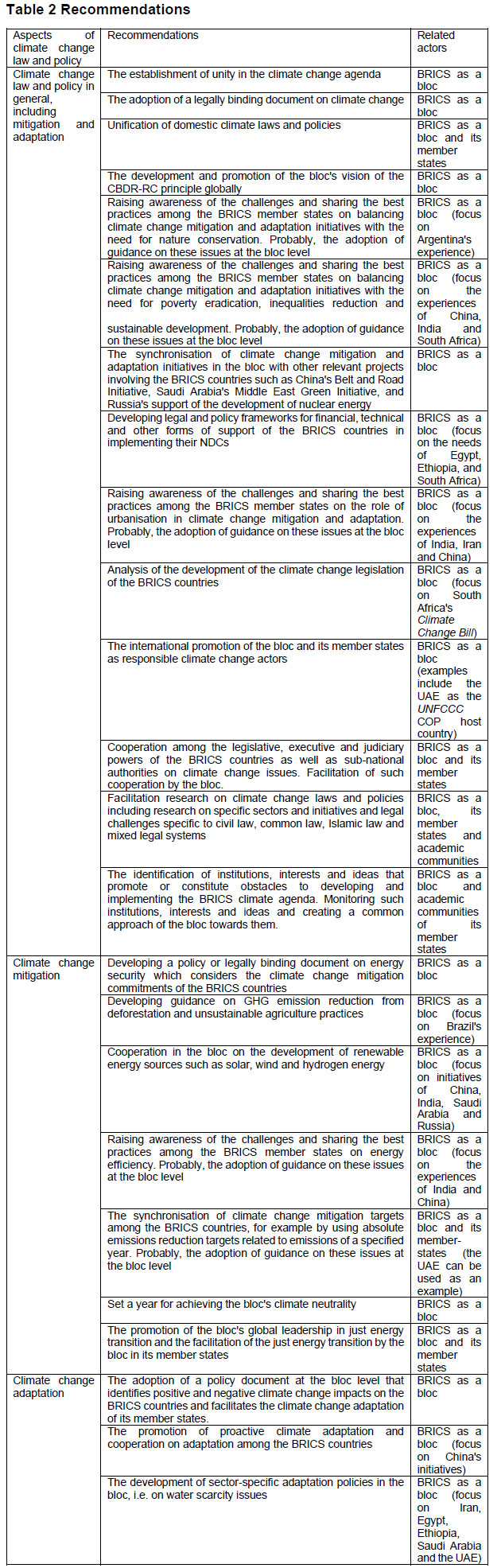
Table 2 summarises the recommendations made in this paper regarding climate change mitigation and adaptation specific to the BRICS countries.
When establishing the common normative framework at the bloc level is required, the adoption of a declaration or another form of soft law or a policy document should be prioritised because BRICS currently does not have an effective legal framework and a mechanism for its implementation. If the bloc develops in the direction of closer cooperation among its member states, the adoption of legally binding documents would be a welcome development.
The role of law in developing the legal response of BRICS to climate change is not limited by the level of the bloc. Marshall and Sterett257 note that climate change as a common problem requires the legal mobilisation of various actors at various levels. Such actors use multiple avenues, including climate litigation, to bring the climate laws and policies to bear.258 These actors are creative in formulating their claims, and they build communities for climate action.259 Such communities include academics who amplify the climate decisions and facilitate the development of the emerging climate jurisprudence.260 In the BRICS context, the enhancement of the climate agenda of the bloc requires continuous cooperation among the BRICS countries' authorities, academia, non-governmental organisations and private entities for the creation and implementation of climate laws and policies in these countries.
The diversity of the needs, priorities and resources of BRICS countries means that the creation of a unified approach towards specific mitigation and adaptation policies in the bloc is not always possible and desirable. Thus, as has already been mentioned in the article, the shift towards using electric cars as a climatically beneficial movement requires that attention be paid to the way the electricity for these cars is produced. The implications of such a shift in South Africa would be different from those in Brazil.261 In this context, what the bloc can do is facilitate cooperation and research, raise awareness of the challenges, share best practices and provide the necessary normative framework for resource mobilisation and transfer within the bloc where it is possible.
10 Conclusion
We called this article "BRICS and Climate Change Law: An Opportunity to Save the Planet". The cooperation of the ten countries in the bloc indeed constitutes an opportunity to cope with the challenges of climate change. It is critical to highlight that it is only an opportunity. There is no certainty that BRICS will take and use it to its full potential.
The main takeaways from this article are the following. First, the creation of BRICS took place without climate change mitigation and adaptation in mind. Other factors, particularly the desire to enhance the economies of the BRICS countries, were the driving force for cooperation. However, as the bloc has evolved climate change has become more visible on its policy horizon, and the Johannesburg II Declaration is one of the proofs of this development.
Second, the evolution of BRICS climate change law and policy could both support the implementation of commitments of the BRICS countries under the existing international climate regime and complement it. On the one hand, enhancing cooperation in the bloc could support actions towards the implementation of the NDCs of the individual countries through mutual support, awareness raising and the transfer of technologies, finance and capacity building. On the other hand, BRICS has visualised its approach to critical issues in the climate change regime. Thus, it holds that all energy sources are important and notes the role of fossil fuels, which is not a common position held by many actors outside the bloc.
Third, BRICS countries are diverse in terms of their status under the UNFCCC regime, their pace of development, their share of historical and current GHG emissions, their abundance of natural resources, their reliance on coal and other fossil fuels and their local needs. This diversity could be both an obstacle and an opportunity for developing the bloc's common climate change framework. We assume that if such a framework develops, this could lead to constructing a unique law and policy framework which could reconcile the different domestic agendas for achieving the same goal, and in this regard become another positive achievement not only for the climate regime but also for creating a better multipolar world where no one is left behind.
In this article we have outlined possible trajectories for the development of political cooperation and academic endeavours in such areas as the climate change mitigation targets of the BRICS countries, increasing the energy efficiency and energy transition based on just transition, and the role of forests, agriculture and land use for the climate regime and climate change adaptation. We believe that the cooperation of researchers from different BRICS countries as well as from different disciplines would enhance our understanding of climate law and policy in the bloc and in broader international settings, and would contribute to finding solutions to the existential threat of our times.
Literature
Bibliography
-
Barykina YN, Chernykh AG and Na B "Energy Production as a Basis for Sustainable Development in the BRICS Countries" 2022 IOP Conference Series: Earth and Environmental Science 012016 DOI: https://doi.org/10.1088/1755-1315/990/1/012016
» https://doi.org/10.1088/1755-1315/990/1/012016 -
Buck M, Sturzaker J and Mell I "Playing Games Around Climate Change -New Ways of Working to Develop Climate Change Resilience" 2022 Journal of Environmental Planning and Management 2538-2555 DOI: https://doi.org/10.1080/09640568.2021.1975106
» https://doi.org/10.1080/09640568.2021.1975106 -
Carlarne CP, Gray KR and Tarasofsky R "International Climate Change Law: Mapping the Field" in Gray KR, Tarasofsky R and Carlarne SP (eds) The Oxford Handbook of International Climate Change Law online ed (Oxford University Press Oxford 2016) 3-25 DOI: https://doi.org/10.1093/law/9780199684601.003.0001
» https://doi.org/10.1093/law/9780199684601.003.0001 -
Cooper AF "China, India and the Pattern of G20/BRICS Engagement: Differentiated Ambivalence Between 'Rising' Power Status and Solidarity with the Global South" 2021 TWQ 1945-1962 DOI: https://doi.org/10.1080/01436597.2020.1829464
» https://doi.org/10.1080/01436597.2020.1829464 -
Dorn FM, Hafner R and Plank C "Towards a Climate Change Consensus: How Mining and Agriculture Legitimize Green Extractivism in Argentina" 2022 The Extractive Industries and Society 101130 DOI: https://doi.org/10.1016/j.exis.2022.101130
» https://doi.org/10.1016/j.exis.2022.101130 - Elsaman RS "Middle East and North Africa" in Siems M and Yap PJ (eds) The Cambridge Handbook of Comparative Law (Cambridge University Press Cambridge 2024) 331-342
-
Gladun E and Ahsan D "BRICS Countries' Political and Legal Participation in the Global Climate Change Agenda" 2016 BRICS Law Journal 8-42 DOI: https://doi.org/10.21684/2412-2343-2016-3-3-8-42
» https://doi.org/10.21684/2412-2343-2016-3-3-8-42 - Glazewski J "South Africa" in Lees E and Viñuales JE (eds) The Oxford Handbook of Comparative Environmental Law (Oxford University Press Oxford 2019) 315-333
-
Gundlach J and Gerrard MB "Climate Change and Energy Transition Policies" in Lees E and Viñuales JE (eds) The Oxford Handbook of Comparative Environmental Law (Oxford University Press Oxford 2019) 531-577 DOI: https://doi.org/10.1093/law/9780198790952.001.0001
» https://doi.org/10.1093/law/9780198790952.001.0001 - Hailegebriel D "Ethiopia" 2009 Intl J Not-for-Profit L 9
-
Hargrove A, Qandeel M and Sommer JM "Global Governance for Climate Justice: A Cross-National Analysis of CO2 Emissions" 2019 Global Transitions 190-199 DOI: https://doi.org/10.1016/j.glt.2019.11.001
» https://doi.org/10.1016/j.glt.2019.11.001 -
Harrison K and Sundstrom LMI "The Comparative Politics of Climate Change" 2007 Global Environmental Politics 1-18 DOI: https://doi.org/10.1162/glep.2007.7.4.1
» https://doi.org/10.1162/glep.2007.7.4.1 - Hey E and Paulini S "Common but Differentiated Responsibilities" in Max Planck Encyclopedias of International Law online ed (Oxford University Press Oxford 2021)
- Hovi J, Skodvin D and Andresen S "The Persistence of the Kyoto Protocol: Why Other Annex I Countries Move On Without the United States" 2003 Global Environmental Politics 1-23
-
Intergovernmental Panel on Climate Change "Summary for Policymakers" in Core Writing Team, Lee H and Romero J (eds) Climate Change 2023: Synthesis Report. Contribution of Working Groups I, II and III to the Sixth Assessment Report of the Intergovernmental Panel on Climate Change (IPCC Geneva 2023) 1-34 DOI: https://doi.org/10.59327/IPCC/AR6-9789291691647.001
» https://doi.org/10.59327/IPCC/AR6-9789291691647.001 -
Johansson V "Just Transition as an Evolving Concept in International Climate Law" 2023 JEL 229-249 DOI: https://doi.org/10.1093/jel/eqad017
» https://doi.org/10.1093/jel/eqad017 -
Kiprizli G and Köstem S "The Onset of BRICS Cooperation on Climate Change: Material Change, Ideational Convergence and the Road to Copenhagen 2009" 2023 TWQ 1192-1210 DOI: https://doi.org/10.1080/01436597.2023.2177632
» https://doi.org/10.1080/01436597.2023.2177632 -
Leal-Arcas R et al "The BRIC and Climate Change Mitigation" in Leal-Arcas R (ed) International Trade and Sustainability (Palgrave Macmillan Cham 2022) 229-280 DOI: https://doi.org/10.1007/978-3-031-14068-6_6
» https://doi.org/10.1007/978-3-031-14068-6_6 - Leal-Arcas R et al "Climate Change Mitigation Law and Policy in the BRICS" in Reins L and Verschuuren J (eds) Research Handbook on Climate Change Mitigation Law 2nd ed (Edward Elgar Cheltenham 2021) 196-239
- Maggs PB, Schwartz O and Burnham W Law and Legal System of the Russian Federation 6th ed (Juris Huntington 2015)
-
Mansouri Daneshvar MR, Ebrahimi M and Nejadsoleymani H "An Overview of Climate Change in Iran: Facts and Statistics" 2019 Environmental Systems Research 1-10 DOI: https://doi.org/10.1186/s40068-019-0135-3
» https://doi.org/10.1186/s40068-019-0135-3 -
Marshall A-M and Sterett SM "Legal Mobilization and Climate Change: The Role of Law in Wicked Problems" 2019 Oñati Socio-Legal Series 267-274 DOI: https://doi.org/10.35295/osls.iisl/0000-0000-0000-1059
» https://doi.org/10.35295/osls.iisl/0000-0000-0000-1059 -
Medici-Colombo G and Berros MV "Climate Litigation in Argentina: A Critical and Prospective Analysis" 2023 CJEL 173-199 DOI: https://doi.org/10.1163/24686042-12340104
» https://doi.org/10.1163/24686042-12340104 -
Mehling M "The Comparative Law of Climate Change: A Research Agenda" 2015 RECIEL 341-352 DOI: https://doi.org/10.1111/reel.12141
» https://doi.org/10.1111/reel.12141 -
Merryman J and Pérez-Perdomo R The Civil Law Tradition: An Introduction to the Legal Systems of Europe and Latin America 4th ed (Stanford University Press Stanford 2018)
» 4 -
Moomaw WR, Law BE and Goetz SJ "Focus on the Role of Forests and Soils in Meeting Climate Change Mitigation Goals: Summary" 2020 Environmental Research Letters 045009 DOI: https://doi.org/10.1088/1748-9326/ab6b38
» https://doi.org/10.1088/1748-9326/ab6b38 - Naik S "Rising BRICS: A Path to Multipolar World Reality?" 2018 Comparative Politics Russia 100-108
- Nazareth A et al The Equity Dimensions of Anti-Fossil Fuels Norms (Stockholm Environment Institute Stockholm 2022)
-
Neuwirth R "'BRICS Law': An Oxymoron, or from Cooperation, via Consolidation, to Codification?" 2019 BRICS Law Journal 6-33 DOI: https://doi.org/10.21684/2412-2343-2019-6-4-6-33
» https://doi.org/10.21684/2412-2343-2019-6-4-6-33 -
Onu P, Pradhan A and Mbohwa C "The Potential of Industry 4.0 for Renewable Energy and Materials Development - The Case of Multinational Energy Companies" 2023 Heliyon e20547 DOI: https://doi.org/10.1016/j.heliyon.2023.e20547
» https://doi.org/10.1016/j.heliyon.2023.e20547 -
Pal Singh M and Kumar N The Indian Legal System: An Enquiry (Oxford University Press Oxford 2019) DOI: https://doi.org/10.1093/oso/9780199489879.001.0001
» https://doi.org/10.1093/oso/9780199489879.001.0001 - Pan XZ et al "Understanding Equity-Efficiency Interaction in the Distribution of Global Carbon Budgets" 2023 Advances in Climate Change Research 13-22
-
Petrone F "BRICS, Soft Power and Climate Change: New Challenges in Global Governance?" 2019 Ethics and Global Politics 19-30 DOI: https://doi.org/10.1080/16544951.2019.1611339
» https://doi.org/10.1080/16544951.2019.1611339 -
Poderati G and Ou Shutian "Tackling Climate Change in China: A Hybrid Approach" 2021 CJEL 141-171 DOI: https://doi.org/10.1163/24686042-12340070
» https://doi.org/10.1163/24686042-12340070 -
Purdon M "Advancing Comparative Climate Change Politics: Theory and Method" 2015 Global Environmental Politics 1-26 DOI: https://doi.org/10.1162/GLEP_e_00309
» https://doi.org/10.1162/GLEP_e_00309 - Rábago KR and Valova R "Introduction to Energy Law" in Coplan KS et al (eds) Climate Change Law: An Introduction (Edward Elgar Cheltenham 2021) 52-71
- Rinaldi AL and Martuscelli PN "The BRICS on Climate Change Global Governance" 2016 Meridiano 47. Journal of Global Studies 17:e17020.
-
Romppanen S "The LULUCF Regulation: The New Role of Land and Forests in the EU Climate and Policy Framework" 2020 Journal of Energy and Natural Resources Law 261-287 DOI: https://doi.org/10.1080/02646811.2020.1756622
» https://doi.org/10.1080/02646811.2020.1756622 - Ruppel OC and Ruppel-Schlichting K "The BRICS Partnership: Development and Climate Change Policy from an African Perspective" in Ruppel OC, Christian Roschmann C and Ruppel-Schlichting K (eds) Climate Change: International Law and Global Governance (Nomos Baden-Baden 2013) 549-570
-
Terink W, Immerzeel WW and Droogers P "Climate Change Projections of Precipitation and Reference Evapotranspiration for the Middle East and Northern Africa Until 2050" 2013 Int J Climatol 3650 DOI: https://doi.org/10.1002/joc.3650
» https://doi.org/10.1002/joc.3650 -
Tripathi M and Bhattacharya NS "Environmentally Sound Technologies for Climate Change Mitigation in BRICS Countries: A Comparative Policy and Legal Perspective" 2023 Env Pol'y & L 181-196 DOI: https://doi.org/10.3233/EPL-220067
» https://doi.org/10.3233/EPL-220067 -
Verschuuren J "Agriculture, Forestry and Other Land Use (AFOLU)" in Reins L and Verschuuren J (eds) Research Handbook on Climate Change Mitigation Law (Edward Elgar Cheltenham 2021) 433-456 DOI: https://doi.org/10.4337/9781839101595.00025.
» https://doi.org/10.4337/9781839101595.00025 - Verschuuren J "Introduction to Climate Change Adaptation" in Verschuuren J (ed) Research Handbook on Climate Change Adaptation Law 2nd ed (Edward Elgar Cheltenham 2022) 1-13
-
Wadiwala ZM "Rights-Based Climate Litigation in South Africa and the Netherlands" 2023 CJEL 227-244 DOI: https://doi.org/10.1163/24686042-12340107
» https://doi.org/10.1163/24686042-12340107 - Wang X "People's Republic of China" in Lees E and Viñuales JE (eds) The Oxford Handbook of Comparative Environmental Law (Oxford University Press Oxford 2019) 128-148
- Zahar A "Climate Law, Environmental Law, and the Schism Ahead" in Techera E et al (eds) Routledge Handbook of International Environmental Law (Routledge London 2020) 488-500
-
Zhu M "Climate Litigation in a 'Developmental State': The Case of China" 2023 CJEL 200-213 DOI: https://doi.org/10.1163/24686042-12340105
» https://doi.org/10.1163/24686042-12340105 -
Legislation
» https://unfccc.int/sites/default/files/NDC/2022-05/Actualizacio%CC%81n%20meta%20de%20emisiones%202030.pdf -
Climate Change Bill B9-2022 (As amended by the Portfolio Committee on Forestry, Fisheries and the Environment (National Assembly) of 2023)
» https://www.csis.org/analysis/six-new-brics-implications-energy-trade -
International instruments
» https://brics2023.gov.za/wp-content/uploads/2023/08/SABBC-AR-30-Aug.pdf -
Agreement Between the Governments of the BRICS States on Cooperation in the Field of Culture (2015)
» https://brics2021.gov.in/brics/public/uploads/docpdf/getdocu-41.pdf -
Conference of the Parties Serving as the Meeting of the Parties to the Paris Agreement Nationally Determined Contributions Under the Paris Agreement: Synthesis Report by the Secretariat FCCC/PA/CMA/2022/4 (4th session, Sharm el-Sheikh, 26 October 2022)
» https://yeabrics.org/wp-content/uploads/2022/02/getdocu-40.pdf -
Kyoto Protocol to the United Nations Framework Convention on Climate Change (1997)
» http://infobrics.org/page/history-of-brics/ -
Paris Agreement (2015)
» https://yeabrics.org/wp-content/uploads/2022/09/Executive-Summary_BRICS-Youth-Energy-Outlook-2022.pdf -
United Nations Framework Convention on Climate Change (1992)
» https://www.britannica.com/science/carbon-dioxide -
XV BRICS Summit Johannesburg II Declaration. BRICS and Africa: Partnership for Mutually Accelerated Growth, Sustainable Development and Inclusive Multilateralism (Sandton, 23 August 2023)
» https://unfccc.int/sites/default/files/NDC/2022-06/China%E2%80%99s%20Achievements%2C%20New%20Goals%20and%20New%20Measures%20for%20Nationally%20Determined%20Contributions.pdf -
Internet sources
» https://www.youtube.com/watch?v=AGTjKJHu99c -
Aboueleid T 2019 Legal System in Egypt https://www.academia.edu/38243878/Legal_system_in_Egypt_Taher_Aboueleid_pdf?sm=b accessed 11 September 2024
» https://www.academia.edu/38243878/Legal_system_in_Egypt_Taher_Aboueleid_pdf?sm=b -
Argentina December 2020 Segunda Contribución Determinada a Nivel Nacional de la República Argentina https://unfccc.int/sites/default/files/NDC/2022-06/Argentina_Segunda%20Contribuci%C3%B3n%20Nacional.pdf accessed 17 October 2023
» https://unfccc.int/sites/default/files/NDC/2022-06/Argentina_Segunda%20Contribuci%C3%B3n%20Nacional.pdf -
Egypt 2023 Egypt's Second Updated Nationally Determined Contributions https://unfccc.int/sites/default/files/NDC/2023-06/Egypts%20Updated%20First%20Nationally%20Determined%20Contribution%202030%20%28Second%20Update%29.pdf accessed 18 October 2023
» https://unfccc.int/sites/default/files/NDC/2023-06/Egypts%20Updated%20First%20Nationally%20Determined%20Contribution%202030%20%28Second%20Update%29.pdf -
Ekholm T and Lindroos TJ 2015 Assessing Countries' Historical Contributions to GHG Emissions https://publications.vtt.fi/julkaisut/muut/2015/VTT-R-00139-15.pdf accessed 6 September 2024
» https://publications.vtt.fi/julkaisut/muut/2015/VTT-R-00139-15.pdf -
Federal Democratic Republic of Ethiopia 2021 Updated Nationally Determined Contribution https://unfccc.int/sites/default/files/NDC/2022-06/Ethiopia%27s%20updated%20NDC%20JULY%202021%20Submission_pdf accessed 18 October 2023
» https://unfccc.int/sites/default/files/NDC/2022-06/Ethiopia%27s%20updated%20NDC%20JULY%202021%20Submission_pdf -
Federative Republic of Brazil 2022 Nationally Determined Contribution (NDC) https://unfccc.int/sites/default/files/NDC/2022-06/Updated%20-%20First%20NDC%20-%20%20FINAL%20-%20PDF.pdf accessed 02 October 2023
» https://unfccc.int/sites/default/files/NDC/2022-06/Updated%20-%20First%20NDC%20-%20%20FINAL%20-%20PDF.pdf -
Global Carbon Atlas date unknown Territorial MtCO2 https://globalcarbonatlas.org/emissions/carbon-emissions/ accessed 23 October 2023
» https://globalcarbonatlas.org/emissions/carbon-emissions/ -
Government of India 2022 India's Updated First Nationally Determined Contribution Under Paris Agreement (2021-2030) https://unfccc.int/sites/default/files/NDC/2022-08/India%20Updated%20First%20Nationally%20Determined%20Contrib.pdf accessed 04 October 2023
» https://unfccc.int/sites/default/files/NDC/2022-08/India%20Updated%20First%20Nationally%20Determined%20Contrib.pdf -
Harrisberg K 2022 What are "Sponge Cities" and How Can They Prevent Floods? https://climatechampions.unfccc.int/what-are-sponge-cities-and-how-can-they-prevent-floods/ accessed 16 October 2023
» https://climatechampions.unfccc.int/what-are-sponge-cities-and-how-can-they-prevent-floods/ -
Hedley N 2023 BRICS Moving Towards Renewable Energy, but SA and Russia are Lagging Behind https://www.capetalk.co.za/articles/473373/brics-moving-towards-renewable-energy-but-sa-and-russia-are-lagging-behind accessed 13 November 2023
» https://www.capetalk.co.za/articles/473373/brics-moving-towards-renewable-energy-but-sa-and-russia-are-lagging-behind -
Ismail S 2023 "A Wall of BRICS": The Significance of Adding Six New Members to the Bloc https://www.aljazeera.com/news/2023/8/24/analysis-wall-of-brics-the-significance-of-adding-six-new-members accessed 27 September 2023
» https://www.aljazeera.com/news/2023/8/24/analysis-wall-of-brics-the-significance-of-adding-six-new-members -
Jütten M and Falkenberg D 2024 Expansion of BRICS: A Quest for Greater Global Influence? https://www.europarl.europa.eu/thinktank/en/document/EPRS_BRI(2024)760368 accessed 29 July 2024
» https://www.europarl.europa.eu/thinktank/en/document/EPRS_BRI(2024)760368 -
Kingdom of Saudi Arabia 2021 Updated First Nationally Determined Contribution: 2021 Submission to UNFCCC https://unfccc.int/sites/default/files/resource/202203111154-KSA%20NDC%202021.pdf accessed 23 October 2023
» https://unfccc.int/sites/default/files/resource/202203111154-KSA%20NDC%202021.pdf -
Mahoozi S date unknown Iran's Climate Efforts Derided as MENA Nations Take Action https://www.aljazeera.com/news/2022/11/10/irans-climate-efforts-derided-as-mena-nations-take-action accessed 23 October 2023
» https://www.aljazeera.com/news/2022/11/10/irans-climate-efforts-derided-as-mena-nations-take-action -
Mann ME 2023 Greenhouse Gas https://www.britannica.com/science/greenhouse-gas accessed 13 November 2023
» https://www.britannica.com/science/greenhouse-gas -
McGrath M 2021 Climate Change: Iran Says Lift Sanctions and We'll Ratify Paris Agreement https://www.bbc.com/news/science-environment-59242986 accessed 23 October 2023
» https://www.bbc.com/news/science-environment-59242986 -
NEOM 2023 What is NEOM? https://www.neom.com/en-us/about accessed 23 October 2023
» https://www.neom.com/en-us/about -
New Development Bank date unknown New Development Bank General Strategy for 2022-2026: Scaling Up Development Finance for a Sustainable Future https://webapp-newwebsite-prod-hk.azurewebsites.net/about-ndb/general-strategy/ accessed 15 July 2024
» https://webapp-newwebsite-prod-hk.azurewebsites.net/about-ndb/general-strategy/ -
New Development Bank 2023 About Us https://www.ndb.int/about-ndb/ accessed 16 November 2023
» https://www.ndb.int/about-ndb/ -
New Development Bank and AXA Climate 2024 Building Climate Resilience in Infrastructure Projects: A Brief for Investors https://www.ndb.int/wp-content/uploads/2024/03/Building-Climate-Resilience-in-Infrastructure-Projects-A-Brief-for-Investors.pdf accessed 15 July 2024
» https://www.ndb.int/wp-content/uploads/2024/03/Building-Climate-Resilience-in-Infrastructure-Projects-A-Brief-for-Investors.pdf -
O'Neill J 2001 Building Better Global Economic BRICs https://www.goldmansachs.com/pdfs/insights/archive/archive-pdfs/build-better-brics.pdf accessed 7 September 2024
» https://www.goldmansachs.com/pdfs/insights/archive/archive-pdfs/build-better-brics.pdf -
Plummer R 2023 Argentina Pulls Out of Plans to Join BRICS Bloc https://www.bbc.com/news/world-latin-america-67842992 accessed 15 January 2024
» https://www.bbc.com/news/world-latin-america-67842992 -
Ruppel O 2014 The BRICS Partnership from a South African Perspective https://www.youtube.com/watch?v=YXglRcBvtoY accessed 27 September 2023
» https://www.youtube.com/watch?v=YXglRcBvtoY -
Russian Federation 2020 Nationally Determined Contribution of the Russian Federation as Part of the Implementation of the Paris Agreement of December 12, 2015 https://unfccc.int/sites/default/files/NDC/2022-06/NDC_RF_eng.pdf accessed 03 October 2023
» https://unfccc.int/sites/default/files/NDC/2022-06/NDC_RF_eng.pdf -
Saudi and Middle East Green Initiatives 2022 MGI: Powering Regional Climate Action https://www.greeninitiatives.gov.sa/about-mgi/ accessed 23 October 2023
» https://www.greeninitiatives.gov.sa/about-mgi/ -
South Africa 2021 First Nationally Determined Contribution Under the Paris Agreement: Updated September 2021 https://unfccc.int/sites/default/files/NDC/2022-06/South%20Africa%20updated%20first%20NDC%20September%202021.pdf accessed 17 October 2023
» https://unfccc.int/sites/default/files/NDC/2022-06/South%20Africa%20updated%20first%20NDC%20September%202021.pdf -
Statista 2023 Leading Countries in Installed Renewable Energy Capacity Worldwide in 2022 (in Gigawatts) https://www.statista.com/statistics/267233/renewable-energy-capacity-worldwide-by-country/ accessed 4 October 2023
» https://www.statista.com/statistics/267233/renewable-energy-capacity-worldwide-by-country/ -
Statista 2023 Leading Gas Exporting Countries in 2022, by Export Type https://www.statista.com/statistics/217856/leading-gas-exporters-worldwide/ accessed 30 October 2023
» https://www.statista.com/statistics/217856/leading-gas-exporters-worldwide/ -
The Guardian 2011 Canada Pulls Out of Kyoto Protocol https://www.theguardian.com/environment/2011/dec/13/canada-pulls-out-kyoto-protocol accessed 10 September 2024
» https://www.theguardian.com/environment/2011/dec/13/canada-pulls-out-kyoto-protocol -
United Nations Climate Change date unknown Iran (Islamic Republic of) https://unfccc.int/node/61084 accessed 23 October 2023
» https://unfccc.int/node/61084 -
United Nations Climate Change 2023 COP28 UAE https://www.cop28.com/ accessed 24 October 2023
» https://www.cop28.com/ -
United Nations Climate Change Conference UK 2021 in Partnership with Italy 2021 Political Declaration on the Just Energy Transition in South Africa https://webarchive.nationalarchives.gov.uk/ukgwa/20230106144924/https://ukcop26.org/political-declaration-on-the-just-energy-transition-in-south-africa/ accessed 21 November 2023
» https://webarchive.nationalarchives.gov.uk/ukgwa/20230106144924/https://ukcop26.org/political-declaration-on-the-just-energy-transition-in-south-africa/ -
United National Conference on Trade and Development 2022 UN List of Least Developed Countries https://unctad.org/topic/least-developed-countries/list accessed 23 October 2023
» https://unctad.org/topic/least-developed-countries/list -
United Arab Emirates Ministry of Climate Change and Environment 2023 Accelerating Action Towards a Green, Inclusive and Resilient Economy: Third Update of Second Nationally Determined Contribution for the UAE https://unfccc.int/sites/default/files/NDC/2023-07/Third%20Update%20of%20Second%20NDC%20for%20the%20UAE_v15.pdf accessed 23 October 2023
» https://unfccc.int/sites/default/files/NDC/2023-07/Third%20Update%20of%20Second%20NDC%20for%20the%20UAE_v15.pdf
List of Abbreviations
Date Revised: 16 October 2024
Date Accepted: 16 October 2024
Date Published: 14 March 2025
Journal Editor: Prof Wian Erlank
* Maksim Lavrik. Specialist in Jurisprudence (Irkutsk State University) Candidate of Law Sciences (Omsk State University) MICL (UEF) LLD (Wuhan University). Post-Doctoral Fellow, Department of Public, Constitutional and International Law, College of Law, University of South Africa, South Africa. E-mail: https://orcid.org/0000-0003-2364-4100. I am grateful to the UNISA Department of Criminal and Procedural Law, where I presented initial thoughts on the topic, and to Aleksandr Kogan for the discussions. Both authors are grateful to the reviewers for their comments, which helped us to improve the manuscript.
** Amos Saurombe. LLB LLM Med LLD. Professor, Head of the Department of Criminal and Procedural Law, College of Law, University of South Africa, South Africa. E-mail: https://orcid.org/0000-0002-9393-0789.
1 BRICS Information Portal date unknown http://infobrics.org/page/history-of-brics/; Ruppel 2014 https://www.youtube.com/watch?v=YXglRcBvtoY.
2 XV BRICS Summit Johannesburg II Declaration. BRICS and Africa: Partnership for Mutually Accelerated Growth, Sustainable Development and Inclusive Multilateralism (Sandton, 23 August 2023) (Johannesburg II Declaration). Also see Ismail 2023 https://www.aljazeera.com/news/2023/8/24/analysis-wall-of-brics-the-significance-of-adding-six-new-members.
3 See Plummer 2023 https://www.bbc.com/news/world-latin-america-67842992.
4 Johannesburg II Declaration para 91.
5 Jütten and Falkenberg 2024 https://www.europarl.europa.eu/thinktank/en/document/EPRS_BRI(2024)760368.
6 Mann 2023 https://www.britannica.com/science/greenhouse-gas.
7 Britannica 2023 https://www.britannica.com/science/carbon-dioxide.
8 Global Carbon Atlas date unknown https://globalcarbonatlas.org/emissions/carbon-emissions/.
9 Global Carbon Atlas date unknown https://globalcarbonatlas.org/emissions/carbon-emissions/.
10 Ekholm and Lindroos 2015 https://publications.vtt.fi/julkaisut/muut/2015/VTT-R-00139-15.pdf 1.
11 Ekholm and Lindroos 2015 https://publications.vtt.fi/julkaisut/muut/2015/VTT-R-00139-15.pdf 1.
12 Ekholm and Lindroos 2015 https://publications.vtt.fi/julkaisut/muut/2015/VTT-R-00139-15.pdf 1.
13 Hargrove, Qandeel and Sommer 2019 Global Transitions 194.
14 Hargrove, Qandeel and Sommer 2019 Global Transitions 191.
15 Hargrove, Qandeel and Sommer 2019 Global Transitions 193, 195.
16 Terink, Immerzeel and Droogers 2013 Int J Climatol.
17 IPCC "Summary for Policymakers" para A.2.2.
18 IPCC "Summary for Policymakers" para A.3.6.
19 Paris Agreement (2015).
20 Ismail 2023 https://www.aljazeera.com/news/2023/8/24/analysis-wall-of-brics-the-significance-of-adding-six-new-members; Baskaran and Cahill 2023 https://www.csis.org/analysis/six-new-brics-implications-energy-trade.
21 BRICS Energy Research Cooperation Platform 2021 https://brics2021.gov.in/brics/public/uploads/docpdf/getdocu-41.pdf.
22 BRICS Energy Research Cooperation Platform 2021 https://yeabrics.org/wp-content/uploads/2022/02/getdocu-40.pdf.
23 BRICS Business Council 2023 https://brics2023.gov.za/wp-content/uploads/2023/08/SABBC-AR-30-Aug.pdf.
24 BRICS YEA 2022 https://yeabrics.org/wp-content/uploads/2022/09/Executive-Summary_BRICS-Youth-Energy-Outlook-2022.pdf.
25 See Hovi, Skodvin and Andresen 2003 Global Environmental Politics 1-23.
26 See The Guardian 2011 https://www.theguardian.com/environment/2011/dec/13/canada-pulls-out-kyoto-protocol.
27 Article 3 of the Paris Agreement (2015).
28 See Zahar "Climate Law, Environmental Law, and the Schism Ahead" 488-500.
29 Carlarne, Gray and Tarasofsky "International Climate Change Law" 8.
30 Carlarne, Gray and Tarasofsky "International Climate Change Law" 8.
31 Carlarne, Gray and Tarasofsky "International Climate Change Law" 8.
32 Carlarne, Gray and Tarasofsky "International Climate Change Law" 20-23.
33 See Gladun and Ahsan 2016 BRICS Law Journal 8-42; Kiprizli and Köstem 2023 TWQ 1192-1210; Leal-Arcas et al "Climate Change Mitigation Law and Policy in the BRICS" 196-239; Leal-Arcas et al "BRIC and Climate Change Mitigation" 229-280; Petrone 2019 Ethics and Global Politics 19-30; Rinaldi and Martuscelli 2016 Meridiano 47; Ruppel and Ruppel-Schlichting "The BRICS Partnership" 549-570; Tripathi and Bhattacharya 2023 Env Pol'y & L 181-196.
34 Rinaldi and Martuscelli 2016 Meridiano 47.
35 Gladun and Ahsan 2016 BRICS Law Journal 9, 38, 41; Petrone 2019 Ethics and Global Politics 26, 27.
36 Johannesburg II Declaration.
37 O'Neill 2001 https://www.goldmansachs.com/pdfs/insights/archive/archive-pdfs/build-better-brics.pdf.
38 See Naik 2018 Comparative Politics Russia 100-108.
39 Neuwirth 2019 BRICS Law Journal 17, 18.
40 New Development Bank 2023 https://www.ndb.int/about-ndb/.
41 See Neuwirth 2019 BRICS Law Journal 6, 25.
42 Hey and Paulini "Common but Differentiated Responsibilities".
43 Hey and Paulini "Common but Differentiated Responsibilities".
44 Hey and Paulini "Common but Differentiated Responsibilities".
45 See Cooper 2021 TWQ 1945-1962.
46 BRICS Energy Research Cooperation Platform 2021 https://brics2021.gov.in/brics/public/uploads/docpdf/getdocu-41.pdf 45.
47 BRICS Energy Research Cooperation Platform 2021 https://brics2021.gov.in/brics/public/uploads/docpdf/getdocu-41.pdf 46.
48 BRICS Energy Research Cooperation Platform 2021 https://brics2021.gov.in/brics/public/uploads/docpdf/getdocu-41.pdf 46.
49 Dorn, Hafner and Plank 2022 Extractive Industries and Society.
50 Dorn, Hafner and Plank 2022 Extractive Industries and Society.
51 Dorn, Hafner and Plank 2022 Extractive Industries and Society.
52 Dorn, Hafner and Plank 2022 Extractive Industries and Society.
53 BRICS Energy Research Cooperation Platform 2021 https://brics2021.gov.in/brics/public/uploads/docpdf/getdocu-41.pdf 6.
54 Leal-Arcas et al "Climate Change Mitigation Law and Policy in the BRICS" 204.
55 Leal-Arcas et al "Climate Change Mitigation Law and Policy in the BRICS" 202, 204.
56 BRICS Energy Research Cooperation Platform 2021 https://brics2021.gov.in/brics/public/uploads/docpdf/getdocu-41.pdf 38.
57 Leal-Arcas et al "Climate Change Mitigation Law and Policy in the BRICS" 216, 219.
58 Leal-Arcas et al "Climate Change Mitigation Law and Policy in the BRICS" 224.
59 China 2021 https://unfccc.int/sites/default/files/NDC/2022-06/China%E2%80%99s%20Achievements%2C%20New%20Goals%20and%20New%20Measures%20for%20Nationally%20Determined%20Contributions.pdf 1.
60 China 2021 https://unfccc.int/sites/default/files/NDC/2022-06/China%E2%80%99s%20Achievements%2C%20New%20Goals%20and%20New%20Measures%20for%20Nationally%20Determined%20Contributions.pdf 2.
61 BRICS Energy Research Cooperation Platform 2021 https://brics2021.gov.in/brics/public/uploads/docpdf/getdocu-41.pdf 38.
62 BRICS Energy Research Cooperation Platform 2021 https://brics2021.gov.in/brics/public/uploads/docpdf/getdocu-41.pdf 38.
63 Egypt 2023 https://unfccc.int/sites/default/files/NDC/2023-06/Egypts%20Updated%20First%20Nationally%20Determined%20Contribution%202030%20%28Second%20Update%29.pdf 4.
64 Egypt 2023 https://unfccc.int/sites/default/files/NDC/2023-06/Egypts%20Updated%20First%20Nationally%20Determined%20Contribution%202030%20%28Second%20Update%29.pdf 45.
65 Egypt 2023 https://unfccc.int/sites/default/files/NDC/2023-06/Egypts%20Updated%20First%20Nationally%20Determined%20Contribution%202030%20%28Second%20Update%29.pdf 45.
66 Egypt 2023 https://unfccc.int/sites/default/files/NDC/2023-06/Egypts%20Updated%20First%20Nationally%20Determined%20Contribution%202030%20%28Second%20Update%29.pdf 8.
67 UNCTAD 2022 https://unctad.org/topic/least-developed-countries/list.
68 Federal Democratic Republic of Ethiopia 2021 https://unfccc.int/sites/default/files/NDC/2022-06/Ethiopia%27s%20updated%20NDC%20JULY%202021%20Submission_.pdf 31.
69 Federal Democratic Republic of Ethiopia 2021 https://unfccc.int/sites/default/files/NDC/2022-06/Ethiopia%27s%20updated%20NDC%20JULY%202021%20Submission_pdf 31
70 Federal Democratic Republic of Ethiopia 2021 https://unfccc.int/sites/default/files/NDC/2022-06/Ethiopia%27s%20updated%20NDC%20JULY%202021%20Submission_pdf 8.
71 Federal Democratic Republic of Ethiopia 2021 https://unfccc.int/sites/default/files/NDC/2022-06/Ethiopia%27s%20updated%20NDC%20JULY%202021%20Submission_pdf 8.
72 BRICS Energy Research Cooperation Platform 2021 https://brics2021.gov.in/brics/public/uploads/docpdf/getdocu-41.pdf 33.
73 BRICS Energy Research Cooperation Platform 2021 https://brics2021.gov.in/brics/public/uploads/docpdf/getdocu-41.pdf 21, 22-25.
74 BRICS Energy Research Cooperation Platform 2021 https://brics2021.gov.in/brics/public/uploads/docpdf/getdocu-41.pdf 23.
75 BRICS Energy Research Cooperation Platform 2021 https://brics2021.gov.in/brics/public/uploads/docpdf/getdocu-41.pdf 24.
76 BRICS Energy Research Cooperation Platform 2021 https://brics2021.gov.in/brics/public/uploads/docpdf/getdocu-41.pdf 25, 26.
77 Statista 2023 https://www.statista.com/statistics/267233/renewable-energy-capacity-worldwide-by-country/.
78 Leal-Arcas et al "Climate Change Mitigation Law and Policy in the BRICS" 216.
79 Global Carbon Atlas date unknown https://globalcarbonatlas.org/emissions/carbon-emissions/.
80 Mansouri Daneshvar, Ebrahimi and Nejadsoleymani 2019 Environmental Systems Research 7.
81 Mansouri Daneshvar, Ebrahimi and Nejadsoleymani 2019 Environmental Systems Research 1, 7.
82 Mansouri Daneshvar, Ebrahimi and Nejadsoleymani 2019 Environmental Systems Research 3.
83 Mansouri Daneshvar, Ebrahimi and Nejadsoleymani 2019 Environmental Systems Research 3.
84 UN Climate Change date unknown https://unfccc.int/node/61084.
85 On the reasons for not ratifying the Paris Agreement see for example Mahoozi date unknown https://www.aljazeera.com/news/2022/11/10/irans-climate-efforts-derided-as-mena-nations-take-action; McGrath 2021 https://www.bbc.com/news/science-environment-59242986.
86 Leal-Arcas et al "Climate Change Mitigation Law and Policy in the BRICS" 226.
87 Leal-Arcas et al "Climate Change Mitigation Law and Policy in the BRICS" 226.
88 Leal-Arcas et al "Climate Change Mitigation Law and Policy in the BRICS" 227.
89 Russian Federation 2020 https://unfccc.int/sites/default/files/NDC/2022-06/NDC_RF_eng.pdf 4.
90 Russian Federation 2020 https://unfccc.int/sites/default/files/NDC/2022-06/NDC_RF_eng.pdf 4.
91 BRICS Energy Research Cooperation Platform 2021 https://brics2021.gov.in/brics/public/uploads/docpdf/getdocu-41.pdf 15; Statista 2023 https://www.statista.com/statistics/217856/leading-gas-exporters-worldwide/.
92 BRICS Energy Research Cooperation Platform 2021 https://brics2021.gov.in/brics/public/uploads/docpdf/getdocu-41.pdf 16.
93 BRICS Energy Research Cooperation Platform 2021 https://brics2021.gov.in/brics/public/uploads/docpdf/getdocu-41.pdf 20.
94 Russian Federation 2020 https://unfccc.int/sites/default/files/NDC/2022-06/NDC_RF_eng.pdf 10.
95 Kingdom of Saudi Arabia 2021 https://unfccc.int/sites/default/files/resource/202203111154-KSA%20NDC%202021.pdf 11.
Kingdom of Saudi Arabia 2021 https://unfccc.int/sites/default/files/resource/202203111154-KSA%20NDC%202021.pdf 10.
97 Saudi and Middle East Green Initiatives 2022 https://www.greeninitiatives.gov.sa/about-mgi/.
98 Leal-Arcas et al "Climate Change Mitigation Law and Policy in the BRICS" 231.
99 BRICS Energy Research Cooperation Platform 2021 https://brics2021.gov.in/brics/public/uploads/docpdf/getdocu-41.pdf 41.
100 BRICS Energy Research Cooperation Platform 2021 https://brics2021.gov.in/brics/public/uploads/docpdf/getdocu-41.pdf 41.
101 South Africa 2021 https://unfccc.int/sites/default/files/NDC/2022-06/South%20Africa%20updated%20first%20NDC%20September%202021.pdf 4.
102 South Africa 2021 https://unfccc.int/sites/default/files/NDC/2022-06/South%20Africa%20updated%20first%20NDC%20September%202021.pdf 4.
103 South Africa 2021 https://unfccc.int/sites/default/files/NDC/2022-06/South%20Africa%20updated%20first%20NDC%20September%202021.pdf 3, 30.
104 Leal-Arcas et al "Climate Change Mitigation Law and Policy in the BRICS" 239.
105 UN Climate Change 2023 https://www.cop28.com/.
106 UAE Ministry of Climate Change and Environment 2023 https://unfccc.int/sites/default/files/NDC/2023-07/Third%20Update%20of%20Second%20NDC%20for%20the%20UAE_v15.pdf 11, 15, 68.
107 UAE Ministry of Climate Change and Environment 2023 https://unfccc.int/sites/default/files/NDC/2023-07/Third%20Update%20of%20Second%20NDC%20for%20the%20UAE_v15.pdf 68.
108 UAE Ministry of Climate Change and Environment 2023 https://unfccc.int/sites/default/files/NDC/2023-07/Third%20Update%20of%20Second%20NDC%20for%20the%20UAE_v15.pdf 12, 22.
109 UAE Ministry of Climate Change and Environment 2023 https://unfccc.int/sites/default/files/NDC/2023-07/Third%20Update%20of%20Second%20NDC%20for%20the%20UAE_v15.pdf 23.
110 Conference of the Parties Serving as the Meeting of the Parties to the Paris Agreement Nationally Determined Contributions Under the Paris Agreement: Synthesis Report by the Secretariat FCCC/PA/CMA/2022/4 (4th session, Sharm el-Sheikh, 26 October 2022).
111 Conference of the Parties Serving as the Meeting of the Parties to the Paris Agreement Nationally Determined Contributions Under the Paris Agreement: Synthesis Report by the Secretariat FCCC/PA/CMA/2022/4 (4th session, Sharm el-Sheikh, 26 October 2022) para 10.
112 See for example Conference of the Parties Serving as the Meeting of the Parties to the Paris Agreement Nationally Determined Contributions Under the Paris Agreement: Synthesis Report by the Secretariat FCCC/PA/CMA/2022/4 (4th session, Sharm el-Sheikh, 26 October 2022) paras 15, 16.
113 Argentina 2020 https://unfccc.int/sites/default/files/NDC/2022-06/Argentina_Segunda%20Contribuci%C3%B3n%20Nacional.pdf.
114 Argentina 2021 https://unfccc.int/sites/default/files/NDC/2022-05/Actualizacio%CC%81n%20meta%20de%20emisiones%202030.pdf.
115 Argentina 2020 https://unfccc.int/sites/default/files/NDC/2022-06/Argentina_Segunda%20Contribuci%C3%B3n%20Nacional.pdf 9.
116 Argentina 2020 https://unfccc.int/sites/default/files/NDC/2022-06/Argentina_Segunda%20Contribuci%C3%B3n%20Nacional.pdf 9.
117 Argentina 2021 https://unfccc.int/sites/default/files/NDC/2022-05/Actualizacio%CC%81n%20meta%20de%20emisiones%202030.pdf 2.
118 BRICS Energy Research Cooperation Platform 2021 https://brics2021.gov.in/brics/public/uploads/docpdf/getdocu-41.pdf 13.
119 Federative Republic of Brazil 2022 https://unfccc.int/sites/default/files/NDC/2022-06/Updated%20-%20First%20NDC%20-%20%20FINAL%20-%20PDF.pdf.
120 China 2021 https://unfccc.int/sites/default/files/NDC/2022-06/China%E2%80%99s%20Achievements%2C%20New%20Goals%20and%20New%20Measures%20for%20Nationally%20Determined%20Contributions.pdf 2.
121 China 2021 https://unfccc.int/sites/default/files/NDC/2022-06/China%E2%80%99s%20Achievements%2C%20New%20Goals%20and%20New%20Measures%20for%20Nationally%20Determined%20Contributions.pdf 4.
122 China 2021 https://unfccc.int/sites/default/files/NDC/2022-06/China%E2%80%99s%20Achievements%2C%20New%20Goals%20and%20New%20Measures%20for%20Nationally%20Determined%20Contributions.pdf 26.
123 China 2021 https://unfccc.int/sites/default/files/NDC/2022-06/China%E2%80%99s%20Achievements%2C%20New%20Goals%20and%20New%20Measures%20for%20Nationally%20Determined%20Contributions.pdf 6.
124 China 2021 https://unfccc.int/sites/default/files/NDC/2022-06/China%E2%80%99s%20Achievements%2C%20New%20Goals%20and%20New%20Measures%20for%20Nationally%20Determined%20Contributions.pdf 6.
125 China 2021 https://unfccc.int/sites/default/files/NDC/2022-06/China%E2%80%99s%20Achievements%2C%20New%20Goals%20and%20New%20Measures%20for%20Nationally%20Determined%20Contributions.pdf 49.
126 China 2021 https://unfccc.int/sites/default/files/NDC/2022-06/China%E2%80%99s%20Achievements%2C%20New%20Goals%20and%20New%20Measures%20for%20Nationally%20Determined%20Contributions.pdf 55.
127 Egypt 2023 https://unfccc.int/sites/default/files/NDC/2023-06/Egypts%20Updated%20First%20Nationally%20Determined%20Contribution%202030%20%28Second%20Update%29.pdf 35.
128 Egypt 2023 https://unfccc.int/sites/default/files/NDC/2023-06/Egypts%20Updated%20First%20Nationally%20Determined%20Contribution%202030%20%28Second%20Update%29.pdf 35.
129 Egypt 2023 https://unfccc.int/sites/default/files/NDC/2023-06/Egypts%20Updated%20First%20Nationally%20Determined%20Contribution%202030%20%28Second%20Update%29.pdf 35.
130 Egypt 2023 https://unfccc.int/sites/default/files/NDC/2023-06/Egypts%20Updated%20First%20Nationally%20Determined%20Contribution%202030%20%28Second%20Update%29.pdf 35.
131 Federal Democratic Republic of Ethiopia 2021 https://unfccc.int/sites/default/files/NDC/2022-06/Ethiopia%27s%20updated%20NDC%20JULY%202021%20Submission_.pdf 25.
132 Government of India 2022 https://unfccc.int/sites/default/files/NDC/2022-08/India%20Updated%20First%20Nationally%20Determined%20Contrib.pdf 2.
133 Government of India 2022 https://unfccc.int/sites/default/files/NDC/2022-08/India%20Updated%20First%20Nationally%20Determined%20Contrib.pdf 3.
134 Russian Federation 2020 https://unfccc.int/sites/default/files/NDC/2022-06/NDC_RF_eng.pdf 1.
135 South Africa 2021 https://unfccc.int/sites/default/files/NDC/2022-06/South%20Africa%20updated%20first%20NDC%20September%202021.pdf 15.
136 South Africa 2021 https://unfccc.int/sites/default/files/NDC/2022-06/South%20Africa%20updated%20first%20NDC%20September%202021.pdf 15.
137 South Africa 2021 https://unfccc.int/sites/default/files/NDC/2022-06/South%20Africa%20updated%20first%20NDC%20September%202021.pdf 15.
138 Kingdom of Saudi Arabia 2021 https://unfccc.int/sites/default/files/resource/202203111154-KSA%20NDC%202021.pdf 11.
139 UAE Ministry of Climate Change and Environment 2023 https://unfccc.int/sites/default/files/NDC/2023-07/Third%20Update%20of%20Second%20NDC%20for%20the%20UAE_v15.pdf15.
140 UAE Ministry of Climate Change and Environment 2023 https://unfccc.int/sites/default/files/NDC/2023-07/Third%20Update%20of%20Second%20NDC%20for%20the%20UAE_v15.pdf 7.
141 UAE Ministry of Climate Change and Environment 2023 https://unfccc.int/sites/default/files/NDC/2023-07/Third%20Update%20of%20Second%20NDC%20for%20the%20UAE_v15.pdf 58.
142 UAE Ministry of Climate Change and Environment 2023 https://unfccc.int/sites/default/files/NDC/2023-07/Third%20Update%20of%20Second%20NDC%20for%20the%20UAE_v15.pdf 58.
143 UAE Ministry of Climate Change and Environment 2023 https://unfccc.int/sites/default/files/NDC/2023-07/Third%20Update%20of%20Second%20NDC%20for%20the%20UAE_v15.pdf 68.
144 This article suggests that the UAE target formulation and measurement could be a synchronisation model. The country uses a base year and fixed-level target in MtCO2-eq. For synchronisation, for example, Egypt and Ethiopia should reformulate their targets from the BAU model to base year and fixed-level targets.
145 See Pan et al 2023 Advances in Climate Change Research 13-22.
146 New Development Bank date unknown https://webapp-newwebsite-prod-hk.azurewebsites.net/about-ndb/general-strategy/ 20.
147 New Development Bank and AXA Climate 2024 https://www.ndb.int/wp-content/uploads/2024/03/Building-Climate-Resilience-in-Infrastructure-Projects-A-Brief-for-Investors.pdf.
148 New Development Bank and AXA Climate 2024 https://www.ndb.int/wp-content/uploads/2024/03/Building-Climate-Resilience-in-Infrastructure-Projects-A-Brief-for-Investors.pdf.
149 Barykina, Chernykh and Na 2022 lOP Conference Series.
150 Barykina, Chernykh and Na 2022 IOP Conference Series.
151 Rábago and Valova "Introduction to Energy Law" 52-71.
152 Rábago and Valova "Introduction to Energy Law" 61.
153 Rábago and Valova "Introduction to Energy Law" 63-65.
154 Rábago and Valova "Introduction to Energy Law" 63-65.
155 Rábago and Valova "Introduction to Energy Law" 68-69.
156 Barykina, Chernykh and Na 2022 IOP Conference Series.
157 BRICS Energy Research Cooperation Platform 2021 https://brics2021.gov.in/brics/public/uploads/docpdf/getdocu-41.pdf 53.
158 BRICS Energy Research Cooperation Platform 2021 https://brics2021.gov.in/brics/public/uploads/docpdf/getdocu-41.pdf 53.
159 BRICS Energy Research Cooperation Platform 2021 https://brics2021.gov.in/brics/public/uploads/docpdf/getdocu-41.pdf 53.
160 Hedley 2023 https://www.capetalk.co.za/articles/473373/brics-moving-towards-renewable-energy-but-sa-and-russia-are-lagging-behind.
161 BRICS Energy Research Cooperation Platform 2021 https://brics2021.gov.in/brics/public/uploads/docpdf/getdocu-41.pdf 33.
162 China 2021 https://unfccc.int/sites/default/files/NDC/2022-06/China%E2%80%99s%20Achievements%2C%20New%20Goals%20and%20New%20Measures%20for%20Nationally%20Determined%20Contributions.pdf 2.
163 China 2021 https://unfccc.int/sites/default/files/NDC/2022-06/China%E2%80%99s%20Achievements%2C%20New%20Goals%20and%20New%20Measures%20for%20Nationally%20Determined%20Contributions.pdf 8.
164 China 2021 https://unfccc.int/sites/default/files/NDC/2022-06/China%E2%80%99s%20Achievements%2C%20New%20Goals%20and%20New%20Measures%20for%20Nationally%20Determined%20Contributions.pdf 9.
165 China 2021 https://unfccc.int/sites/default/files/NDC/2022-06/China%E2%80%99s%20Achievements%2C%20New%20Goals%20and%20New%20Measures%20for%20Nationally%20Determined%20Contributions.pdf 16.
166 China 2021 https://unfccc.int/sites/default/files/NDC/2022-06/China%E2%80%99s%20Achievements%2C%20New%20Goals%20and%20New%20Measures%20for%20Nationally%20Determined%20Contributions.pdf 12.
167 China 2021 https://unfccc.int/sites/default/files/NDC/2022-06/China%E2%80%99s%20Achievements%2C%20New%20Goals%20and%20New%20Measures%20for%20Nationally%20Determined%20Contributions.pdf 17.
168 China 2021 https://unfccc.int/sites/default/files/NDC/2022-06/China%E2%80%99s%20Achievements%2C%20New%20Goals%20and%20New%20Measures%20for%20Nationally%20Determined%20Contributions.pdf 19.
169 China 2021 https://unfccc.int/sites/default/files/NDC/2022-06/China%E2%80%99s%20Achievements%2C%20New%20Goals%20and%20New%20Measures%20for%20Nationally%20Determined%20Contributions.pdf 19.
170 See Poderati and Ou 2021 CJEL 141-171.
171 South Africa 2021 https://unfccc.int/sites/default/files/NDC/2022-06/South%20Africa%20updated%20first%20NDC%20September%202021.pdf 3, 5.
172 South Africa 2021 https://unfccc.int/sites/default/files/NDC/2022-06/South%20Africa%20updated%20first%20NDC%20September%202021.pdf 5.
173 South Africa 2021 https://unfccc.int/sites/default/files/NDC/2022-06/South%20Africa%20updated%20first%20NDC%20September%202021.pdf 5.
174 UN Climate Change Conference UK 2021 in Partnership with Italy 2021 https://webarchive.nationalarchives.gov.uk/ukgwa/20230106144924/https://ukcop26.org/political-declaration-on-the-just-energy-transition-in-south-africa/.
175 Argentina 2021 https://unfccc.int/sites/default/files/NDC/2022-05/Actualizacio%CC%81n%20meta%20de%20emisiones%202030.pdf 2.
176 Argentina 2021 https://unfccc.int/sites/default/files/NDC/2022-05/Actualizacio%CC%81n%20meta%20de%20emisiones%202030.pdf 10.
177 Argentina 2021 https://unfccc.int/sites/default/files/NDC/2022-05/Actualizacio%CC%81n%20meta%20de%20emisiones%202030.pdf 10.
178 Kingdom of Saudi Arabia 2021 https://unfccc.int/sites/default/files/resource/202203111154-KSA%20NDC%202021.pdf 4,5. On grey, blue and green hydrogen see DW Planet A 2022 https://www.youtube.com/watch?v=AGTjKJHu99c.
179 NEOM 2023 https://www.neom.com/en-us/about.
180 Kingdom of Saudi Arabia 2021 https://unfccc.int/sites/default/files/resource/202203111154-KSA%20NDC%202021.pdf 5,9.
181 UAE Ministry of Climate Change and Environment 2023 https://unfccc.int/sites/default/files/NDC/2023-07/Third%20Update%20of%20Second%20NDC%20for%20the%20UAE_v15.pdf 5, 22, 23.
182 UAE Ministry of Climate Change and Environment 2023 https://unfccc.int/sites/default/files/NDC/2023-07/Third%20Update%20of%20Second%20NDC%20for%20the%20UAE_v15.pdf 51, 61.
183 UAE Ministry of Climate Change and Environment 2023 https://unfccc.int/sites/default/files/NDC/2023-07/Third%20Update%20of%20Second%20NDC%20for%20the%20UAE_v15.pdf 52.
184 Nazareth et al Equity Dimensions of Anti-Fossil Fuels Norms 4.
185 Nazareth et al Equity Dimensions of Anti-Fossil Fuels Norms 11.
186 Johansson 2023 JEL 231.
187 Johansson 2023 JEL 235.
188 Onu, Pradhan and Mbohwa 2023 Heliyon.
189 Onu, Pradhan and Mbohwa 2023 Heliyon.
190 Onu, Pradhan and Mbohwa 2023 Heliyon.
191 See, for example, Verschuuren "Agriculture, Forestry and Other Land Use (AFOLU)" 433-456.
192 About the role of forests in climate change mitigation see Moomaw, Law and Goetz 2020 Environmental Research Letters.
193 Russian Federation 2020 https://unfccc.int/sites/default/files/NDC/2022-06/NDC_RF_eng.pdf 1.
194 Government of India 2022 https://unfccc.int/sites/default/files/NDC/2022-08/India%20Updated%20First%20Nationally%20Determined%20Contrib.pdf 2.
195 China 2021 https://unfccc.int/sites/default/files/NDC/2022-06/China%E2%80%99s%20Achievements%2C%20New%20Goals%20and%20New%20Measures%20for%20Nationally%20Determined%20Contributions.pdf 2.
196 China 2021 https://unfccc.int/sites/default/files/NDC/2022-06/China%E2%80%99s%20Achievements%2C%20New%20Goals%20and%20New%20Measures%20for%20Nationally%20Determined%20Contributions.pdf 20, 21.
197 UAE Ministry of Climate Change and Environment 2023 https://unfccc.int/sites/default/files/NDC/2023-07/Third%20Update%20of%20Second%20NDC%20for%20the%20UAE_v15.pdf 43.
198 See Romppanen 2020 Journal of Energy and Natural Resources Law 261-287.
199 Romppanen 2020 Journal of Energy and Natural Resources Law 284, 285.
200 On bioenergy and climate neutrality see Romppanen 2020 Journal of Energy and Natural Resources Law 261-287.
201 See Romppanen 2020 Journal of Energy and Natural Resources Law 261-287.
202 IPCC "Summary for Policymakers" 7.
203 IPCC "Summary for Policymakers" 7.
204 Russian Federation 2020 https://unfccc.int/sites/default/files/NDC/2022-06/NDC_RF_eng.pdf 18.
205 China 2021 https://unfccc.int/sites/default/files/NDC/2022-06/China%E2%80%99s%20Achievements%2C%20New%20Goals%20and%20New%20Measures%20for%20Nationally%20Determined%20Contributions.pdf 22, 25; Harrisberg 2022 https://climatechampions.unfccc.int/what-are-sponge-cities-and-how-can-they-prevent-floods/.
206 China 2021 https://unfccc.int/sites/default/files/NDC/2022-06/China%E2%80%99s%20Achievements%2C%20New%20Goals%20and%20New%20Measures%20for%20Nationally%20Determined%20Contributions.pdf 29, 30.
207 China 2021 https://unfccc.int/sites/default/files/NDC/2022-06/China%E2%80%99s%20Achievements%2C%20New%20Goals%20and%20New%20Measures%20for%20Nationally%20Determined%20Contributions.pdf 45.
208 South Africa 2021 https://unfccc.int/sites/default/files/NDC/2022-06/South%20Africa%20updated%20first%20NDC%20September%202021.pdf 28-30.
209 Egypt 2023 https://unfccc.int/sites/default/files/NDC/2023-06/Egypts%20Updated%20First%20Nationally%20Determined%20Contribution%202030%20%28Second%20Update%29.pdf 4, 22, 25, 45
210 Egypt 2023 https://unfccc.int/sites/default/files/NDC/2023-06/Egypts%20Updated%20First%20Nationally%20Determined%20Contribution%202030%20%28Second%20Update%29.pdf 22, 25.
211 Kingdom of Saudi Arabia 2021 https://unfccc.int/sites/default/files/resource/202203111154-KSA%20NDC%202021.pdf 3,6.
212 UAE Ministry of Climate Change and Environment 2023 https://unfccc.int/sites/default/files/NDC/2023-07/Third%20Update%20of%20Second%20NDC%20for%20the%20UAE_v15.pdf 11.
213 UAE Ministry of Climate Change and Environment 2023 https://unfccc.int/sites/default/files/NDC/2023-07/Third%20Update%20of%20Second%20NDC%20for%20the%20UAE_v15.pdf 35, 41, 43, 45.
214 Verschuuren "Introduction to Climate Change Adaptation" 3.
215 See Verschuuren "Introduction to Climate Change Adaptation" 3.
216 Verschuuren "Introduction to Climate Change Adaptation" 6.
217 Verschuuren "Introduction to Climate Change Adaptation" 8.
218 Verschuuren "Introduction to Climate Change Adaptation" 8.
219 Verschuuren "Introduction to Climate Change Adaptation" 2, 3, 13.
220 Verschuuren "Introduction to Climate Change Adaptation" 7.
221 Verschuuren "Introduction to Climate Change Adaptation" 9.
222 On integration of local needs in climate policy see Buck, Sturzaker and Mell 2022 Journal of Environmental Planning and ¡Management 2540.
223 See Buck, Sturzaker and Mell 2022 Journal of Environmental Planning and Management 2538-2555.
224 On modes of engagements see Buck, Sturzaker and Mell 2022 Journal of Environmental Planning and Management 2538-2555.
225 Verschuuren "Introduction to Climate Change Adaptation" 6.
226 Gundlach and Gerrard "Climate Change and Energy Transition Policies" 534.
227 See Medici-Colombo and Berros 2023 CJEL 173-199.
228 Medici-Colombo and Berros 2023 CJEL 176, 177, 188.
229 Medici-Colombo and Berros 2023 CJEL 176, 177.
230 Medici-Colombo and Berros 2023 CJEL 190.
231 Medici-Colombo and Berros 2023 CJEL 194.
232 Medici-Colombo and Berros 2023 CJEL 199.
233 Medici-Colombo and Berros 2023 CJEL 195.
234 Medici-Colombo and Berros 2023 CJEL 199.
235 See Wadiwala 2023 CJEL 227-244.
236 See Zhu 2023 CJEL 200-213.
237 Zhu 2023 CJEL 200.
238 Zhu 2023 CJEL 203.
239 Zhu 2023 CJEL 203.
240 Zhu 2023 CJEL 211.
241 Gundlach and Gerrard "Climate Change and Energy Transition Policies" 540.
242 Gundlach and Gerrard "Climate Change and Energy Transition Policies" 540-543, 554-571.
243 See Mehling 2015 RECIEL 341-352.
244 See Mehling 2015 RECIEL 341-352.
245 Merryman and Pérez-Perdomo Civil Law Tradition 1.
246 Merryman and Pérez-Perdomo Civil Law Tradition 1.
247 Wang "People's Republic of China" 128-148.
248 Hailegebriel 2009 Int'l J Not-for-Profit L 9.
249 Maggs, Schwartz and Burnham Law and Legal System of the Russian Federation 1, 7, 8, 15.
250 See Pal Singh and Kumar Indian Legal System 1-22, 79.
251 Elsaman "Middle East and North Africa" 331-342; Aboueleid 2019 https://www.academia.edu/38243878/Legal_system_in_Egypt_Taher_Aboueleid_pdf?sm=b 2.
252 Glazewski "South Africa" 315.
253 Harrison and Sundstrom 2007 Global Environmental Politics 9.
254 Harrison and Sundstrom 2007 Global Environmental Politics 12-17.
255 Purdon 2015 Global Environmental Politics 12, 13.
256 Purdon 2015 Global Environmental Politics 14.
257 Marshall and Sterett 2019 Oñati Socio-Legal Series 267.
258 Marshall and Sterett 2019 Oñati Socio-Legal Series 270, 271.
259 Marshall and Sterett 2019 Oñati Socio-Legal Series 270, 271.
260 Marshall and Sterett 2019 Oñati Socio-Legal Series 270.
261 The authors of this article are grateful to an anonymous reviewer for drawing their attention to this.