Trumpets as Odd Ending or Fitting Closure? A Study of the Relationship of Numbers 10:1-10 to the Organisation of the Camp in Numbers 1:1-10:10
Abstract
The instruction for trumpets (Num 10:1-10) is the final unit of the text viewed by the majority of scholars as the opening major section of Numbers (1:1-10:10). Assessments of the placement of this unit have ranged from appropriate, due to the role of the trumpets in coordinating the immediately ensuing march from Sinai, to an ill-fit appendix or afterthought. This essay argues Num 10:1-10 is appropriately placed as a conclusion to 1:1-10:10 based on the presence of four characteristics of closure: time bridge, optimism regarding the future, achievement of a goal and inclusio. As a result, the view that 10:10 concludes the book's opening major section is reinforced. Further, a rhetorical function for the placement of 10:1-10 is suggested in that the instruction offers a closing focus on the larger section's major theme of an ideal community organised around Yʜᴡʜ's presence at the tabernacle.
Trumpet; Law; Literary structure; Closure; Conclusion; Inclusio; Camp; Numbers 1-10
A INTRODUCTION
The organisation of the wilderness camp (Num 1:1-10:10) is viewed by most commentators as the first major section of the book of Numbers.1 In the final unit of this section, Yʜᴡʜ gives instructions for the making and blowing of trumpets (Num 10:1-10). Once finished, according to Lloyd R. Bailey, "All has been made ready. The first great episode of the book of Numbers (1:1-10:10) is complete."2 Yet little attention has been paid to how the instruction regarding trumpets actually functions as a conclusion to this larger section. Bailey cites the common explanation that the trumpets are placed immediately before Israel's departure from Sinai, beginning in 10:11-12, because of their role in coordinating the march to Canaan. As Martin Noth writes, "In the author's opinion [the trumpets] had to exist so that the signal could be given for striking the camp."3
However, other preparations essential to the march appear earlier in the text.4 Why should the trumpets not appear earlier as well? Furthermore, the actual narration of Israel's departure (10:11-28, 33-36) makes no mention of these purportedly necessary instruments.5 Others explain the unit's placement in relation to the preceding unit on the guidance of the cloud in 9:15-23. For example, it is often suggested that the blowing of trumpets constitutes the necessary human response to the divine movement of the cloud.6 According to Horst Seebass, whereas 9:15-23 is the "respectable ending to the first part of the book," 10:1-10 is a mere appendix.7 For Katherine Doob Sakenfeld, 10:1-10 "seems almost an afterthought."8
Whatever the merits of the above explanations, they are essentially silent regarding how 10:1-10 functions as a fitting conclusion to 1:1-10:10 as a whole. For many, it is hardly surprising that a major section of Numbers should be lacking signs of literary closure.9 The book has long confounded interpreters' expectations of literary sophistication. Noth writes of the "confusion and lack of order in its contents" such that "it is difficult to see any pattern in its construction."10 As Josef Forsling observes, "The incoherence of Numbers is often assumed in scholarly literature on the book."11 More broadly, studies of literary artistry in biblical texts have largely focused on narrative and poetry rather than legal material.
Nevertheless, recent Numbers scholarship has observed more evidence of literary sophistication than previously recognised. In Adriane Leveen's view, "More often than not, the sequencing of texts is driven by the strategies, rhetoric and persuasive power of the priestly editors."12 According to Mary Douglas, "This is definitely not the kind of book in which the editors have stuffed a bit in here and a bit there, as the thought occurs to them. It is constructed with fine artifice."13 Jacob Milgrom observes symmetrical patterns "in nearly every chapter of the book."14 And Nicholas Lunn, in a study of Num 1-4, argues for the pervasive presence of "artistic rhetorical structuring."15
Such studies lend legitimacy to the synchronic approach of Timothy R. Ashley, who, when confronted with interpretive difficulties, seeks "literary solutions from within the text itself … rather than simply positing a combination of sources by an editor who had little appreciation for logic, cogency, and literary style."16 Yet when it comes to the trumpets in Num 10, while Ashley notes the instruction "conclude[s] the first major section of the book," he offers only the standard explanation that the tribes "would need a device to direct their movements on the march."17 Again, there is silence regarding how the unit functions as a conclusion. The present study, while adopting a synchronic approach similar to Ashley's, aims to offer a more comprehensive explanation for the placement of 10:1-10. Rather than a mere "afterthought," it will be argued that 10:1-10 is in fact strategically placed. Specifically, the unit exhibits marks of literary closure appropriate for the final unit of the larger section of 1:1-10:10.
A side benefit of this conclusion is that it supports the majority view that sees 10:10 as ending the book's initial major section, over against those who divide the book differently, for example, by extending the ending to v. 36.18
A brief survey of the study of closure will now be offered. This will form the basis for identifying characteristics of closure in 10:1-10 that contribute to the unit's function as an appropriate ending for 1:1-10:10.
B RECENT STUDIES OF CLOSURERecent studies of closure draw upon the seminal works of Frank Kermode's The Sense of an Ending and Barbara H. Smith's Poetic Closure.19 Interest has focused especially on the means by which endings satisfy readerly expectation. According to Smith, "Closure occurs when the concluding portion of a poem creates in the reader a sense of appropriate cessation."20 Known literary conventions, based on known cultural and genre expectations, signal to a reader that a conclusion has been reached.21 It is at this point that the reader encounters the information necessary to discern a pattern of the whole.22 In Smith's words, closure "gives ultimate unity and coherence to the reader's experience of the poem by providing a point from which all the preceding elements may be viewed comprehensively and their relations grasped as part of a significant design."23
The theory of closure has been fruitfully applied in biblical studies, for example, to poetry by C. L. Seow (Job)24 and Chris Wyckoff (Psalms)25 and to narrative, by Marian Broida (Judges). Broida analyses closure both at the level of individual stories and story complexes (Judg 13-16), observing that "a well-closed narrative will not only satisfy the reader's expectations on the level of plot… but will also encourage a sense of rightness of all the elements-the harmonious interplay of content and structure."26
The most extensive analysis of biblical narrative is that of Susan Zeelander, whose book-length study looks at closure within the stories of Genesis.27 In a follow-up study, Zeelander examines characteristics of closure in the priestly narratives of Numbers with examples including "a linguistic frame, a positive twist, a look to the future… rituals, etiologies, summaries, changes in verbal or phrasal patterns, puns, and change of narrative focus."28
Although legal and cultic texts like those in the priestly material of Num 1-10 have not typically been a focus of closure studies, such texts employ marks of closure analogous to those in poetry and narrative.29 Most obvious is how individual units are clearly demarcated, typically using introductions containing variations of the divine speech introductory formula.30 Endings are marked more variously31 but examples within Num 1-10 include compliance notices,32 summaries,33 subscripts34 and inclusios.35 Gary A. Rendsburg identifies "stylistic change," also known as variation on repetition, as a technique marking closure in Num 1:20-43; 2:1-31 and 3:21-37.36
While the above examples mostly pertain to relatively small, independent units,37 Isaac Gottlieb analyses the techniques of closure at the level of biblical books with examples including the theme of death, the motif of return (שובׁ), time-shifting and breaking frame.38 As Zeelander notes, there is a lack of closure studies for larger sections within books.39 However, even within legal material many previously proposed examples of closure can be cited. The use of inclusio, for instance, is likely present in the Book of the Covenant (Exod 20:22-23:19), which both opens and closes with worship regulation (Exod 20:22-26; 23:10-19).40 The Deuteronomic Law Code may also exhibit a similar inclusio in that it opens and closes with a focus on worship at the central sanctuary (Deut 12 and 26).41 At minimum, Deut 26:16-19 serves as a conclusion to this section. Jack Lundbom argues Deut 4:44-49 functions as a summary of chs. 1-4 and forms an inclusio with 1:1-5.42 He also sees the blessing and curse in Deut 11:26-31 as offering closure to chs. 5-11.43 For Leviticus, boundary indicators of larger sections seem less frequent. Leviticus 7:35-36, however, is often identified as a conclusion for chs. 6-7 and for some, all of chs. 1-7.44 In Numbers, chs. 27-36 are frequently noted to be framed by units on the inheritance of the daughters of Zelophehad (27:1-11; 36:1-12).45 The priestly blessing in Num 6:23-27 can be seen also as a fitting conclusion to 5:1-6:27, perhaps even to the larger section of Num 1-6.46 In relation to Num 1-10, Leveen suggests a frame as part of a proposed chiasm. She does not, however, work with the more popular demarcation that sees the conclusion at 10:10.47
In light of the above precedents, it will be argued that Num 1:1-10:10 is brought to a fitting end by 10:1-10 through the use of four characteristics of closure: time bridge, optimism regarding the future, achievement of a goal and inclusio.
C CHARACTERISTICS OF CLOSURE IN NUM 10:1-10
The unit begins in Num 10:1-2 with Yʜᴡʜ's command for Moses to make two trumpets, followed by an outline of their two major purposes: 1) summoning the congregation and 2) breaking the camp.48 The remainder of the unit expands on these purposes, first in relation to the immediate task of the march (vv. 3-7) and then Israel's future life in the land (vv. 9-10).49 Verse 8 can be seen as a hinge between vv. 3-7 and 9-10 which stipulates that only the priests have the authority to blow the trumpets and describes their use as a "perpetual institution."
1 Time-bridge
Berlin considers a "time-bridge" (also known as "time-shift") to be an important device of narrative closure.50 This device is present when the writer brings "the narrative to some future time beyond the time of the plot, closer to the time of the audience."51 Etiologies are a frequent example, as when the story of Jacob wrestling with the angel ends, "Therefore, to this day the Israelites do not eat the thigh muscle that is on the hip socket…" (Gen 32:32 Nʀsᴠ). Dozeman, although not specifically commenting on closure, observes Num 10:1-10 as a whole "bridge[s] the wilderness (1-7) and life in the land (9-10)."52 While Num 10:1-7 focuses on the use of the trumpets for the wilderness march, beginning in v. 8, the temporal horizon shifts to the distant future. Here, the priestly blowing of trumpets is said to be for Israel "a perpetual institution for you throughout [your] generations," that is, they are to be used not only for the march to the land but also long after the march has concluded. Verses 9-10 proceed to develop the use of the trumpets once the march has concluded and Israel has arrived "in [the] land."53 Specifically, this involves their use in the land during war (v. 9) and worship (v. 10).54 In this way the reader's temporal frame is shifted from the immediately relevant use of the trumpets for the march to their ongoing use at a time far into the future. This glance to the distant future is one signal the larger narrative's presentation of the preparations in chs. 1-10 has drawn to an end.55
2 Optimism regarding the future
Another way texts indicate closure, observed by Zeelander, is by ending "with optimism as they look to the future."56 In Num 10:1-10, the unit clearly ends optimistically in its anticipation that, once in the land, the nation will experience both being "saved from [its] enemies" (v. 9) and feasting during "days of rejoicing" (v. 10). What is more, the sounding of the trumpets is described in each verse as a reminder (זכר) before God of his people.57 By doing so, according to Milgrom, the trumpets serve as "instruments of prayer" in that their sounding functions as a hope-filled petition that Yʜᴡʜ will act favourably on Israel's behalf.58
The optimistic tenor of these pleas for favour can be further supported by the similarity of the priestly use of the trumpets here to elicit divine favour to the priestly blessing in Num 6:22-27. The blessing is the only other priestly petition in Num 1-10 and, as mentioned above, it is also likely placed as a conclusion, at a minimum for 5:1-6:27 and arguably for the larger section of 1:1-6:27. In fact, the optimism of both texts is reinforced by their connection to Israel's times of formal worship. In Num 10:10, the trumpets are to be sounded "on your days of rejoicing, at your appointed festivals, and at the beginnings of your months… over your burnt offerings and over your sacrifices of well-being" (Nʀsᴠ). These public times of worship, themselves acts of imploring divine favour,59 are thought to provide the original setting of the priestly blessing.60 The blessing, then, is apparently a kind of parallel priestly petition for divine favour that likewise offers closure to a larger section. Most important for the present argument is that the spotlight on public worship in v. 10 is inherently optimistic in that the trumpets express hope in Yʜᴡʜ's beneficent action.
Overall, the blowing of the trumpets as petitions for Yʜᴡʜ to act, the mention of future days of salvation and rejoicing and the references to communal worship activity all sound optimistic notes about Israel's future. In so doing, they together contribute to a sense of closure in Num 10:1-10.
3 Achievement of a goal
Drawing on Gottlieb's discussion of endings in which a "chapter in history" is completed, Zeelander more narrowly identifies examples of endings in which a "goal is achieved."61 The achievement of a goal is evident in Num 10:9-10 in that the future depiction of Israel in the land places the nation at the geographical telos of the march preparations of chs. 1-10. Regarding the previously discussed characteristics of time-bridge and optimism in vv. 8-10, it is possible for closure to function merely for vv. 1-10, rather than for all of chs. 1-10. However, in the case of Israel arriving and living in the land, it is clearly better to locate it as the goal not merely of the production of the trumpets but rather the entire march preparation of 1:1-10:10.62
Furthermore, the movement from warfare (v. 9) to worship (v. 10) is itself perhaps best seen as a movement toward the achievement of a goal in its anticipation of the nation's progression from military conflict (once reaching the land) to worship (once victory and resultant peace have been achieved).
There are additional points in favour of viewing the above characteristics of closure in vv. 9-10 as relevant for the entire text of 1:1-10:10. First, optimism regarding the future is especially appropriate for concluding Num 1:1-10:10, as this larger section is itself optimistic due to its portrayal of Israel's thoroughgoing obedience in preparing for the march.63 Second, Broida speaks of a "concatenation of closural devices" that appear "at the end of [a] unit's final episode." That is, at the conclusion of larger and more significant sections, "the number and power of closural features increase significantly."64 The presence of multiple characteristics of closure in 10:1-10, then, suggests a significant ending has been reached. Such an ending might well be expected to offer closure for the entirety of 1:1-10:10. Indeed, the last characteristic of closure to which we now turn, inclusio, by definition regards 10:1-10 as the conclusion to this larger section.
4 Inclusio
Inclusio is one of the most common devices for creating a sense of closure. Known also as a frame or envelope structure, significant words or ideas at the beginning of a literary unit are repeated at its end. According to Zeelander, closure is brought about "as readers recall the opening words (or become aware of them upon re-reading), [and] they see that the writer is 'closing the loop,' or the frame is 'enclosing the story.'"65 The inclusio "helps define the beginning and end of a narrative because it contributes to the perception that the narrative has a 'distinct identity,' is 'whole,' and logically has 'internal coherence.'"66 When encountering closure brought about by an inclusio, the reader senses a "return to the original pattern after movement away in the interim."67
Despite the clear prevalence of inclusio in biblical texts, Wyckoff rightly laments a lack of methodological rigour on the part of scholars who identify its presence. The result is that "many of the so-called inclusios cited by biblicists are dubious."68 In order to remedy this problem, Wyckoff helpfully outlines criteria by which claims of inclusio can be judged.69 Accordingly, the likelihood of inclusio increases when:
There is a higher number of repeated elements (words and phrases) at each end of the inclusio.
The repeated element is precise (and not merely semantically equivalent).
The repeated element is rare in the intervening material.
The repeated element is uncommon terminology.
The repeated element is first located nearer to the beginning of the front end of the inclusio.
There is a greater presence of word-plays and puns.
Perhaps due to his focus on inclusio at the level of smaller units, Wyckoff omits other ways a text makes words and ideas more salient and thus increases the likelihood of a perceived connection between texts.70 Jeffery Leonard, in criteria developed for identifying allusion, observes two additional relevant points. First, the repetition of longer phrases is more significant than mere individual words.71 Second, "shared language in a similar context suggests a stronger connection than does shared language alone."72 This includes words and phrases that occur together in clusters or patterns of connectedness.73
Wyckoff is careful to admit that even with the use of such criteria, recognising an inclusio is more art than science.74 Nevertheless, its use adds a measure of control over what risks being an indiscriminate identification of parallels. The following survey of possible elements of an inclusio around Num 1:1-10:10 will thus be undertaken on the basis of the above criteria.
4a Lexical and Thematic Links between Num 10:1-10 and Num 1 and 2
Numbers 1 narrates the census of military personnel from Israel's twelve tribes. Verses 1-19 begin with a divine command to Moses to execute the census (vv. 1-4) and conclude with a report of its execution (vv. 17-19). In between is a list of each of the twelve tribal chiefs (with their fathers) charged to assist Moses and Aaron with the census (vv. 5-16). Verses 20-46 then report the census results for each tribe, followed by a parenthetical explanation in vv. 47-53 for the exemption of the Levites from the census.
Numbers 2 lists the twelve tribes, along with their chiefs and the census results for each tribe. In contrast to Num 1, this list is arranged according to the geographical placement of the tribal encampments in relation to the tent of meeting. Nevertheless, it is likely that Num 2 should be read together with ch. 1 as a single unit. According to Knierim and Coats, ch. 1 does not stand alone but exists only as "the direct pre-stage" of ch. 2 with its organisation of the tribes around the tent of meeting.75
The connections discussed below between 10:1-10 and ch. 1 are alone sufficient to support the case for an inclusio around 1:1-10:10. As will be seen, however, the case is reinforced considerably when chs. 1 and 2 are viewed together as the first half of the inclusio. Some readers of this essay may wish to bypass the following detailed discussion and move directly to the summary evaluation section below.
- העדה (+ כל)
The noun עדה ("congregation") appears four times in Num 1 (vv. 2, 16, 18, 53) and twice in 10:1-10 (vv. 2, 3). Its appearances in 1:16, 18 and 10:2, 3 are morphologically identical (absolute form with the definite article, העדה).76 Although occurring with high frequency elsewhere (27x in Exodus and Leviticus), the lexeme is relatively rare (4x) in the intervening text between chs. 1 and 10.77 In 1:2, 18 and 10:3 it appears as part of the expression כל העדה ("all the congregation"). Although this expression also appears three times in the intervening text (3:7; 8:9, 20), only in the proposed frame does it appear with verbs that describe the congregation's assembling (קהל in 1:18 and יעד in 10:3).
The prominence of עדה in Num 1 is indicated by its appearance almost immediately after the book's opening divine speech formula and chronological notice (1:1). In v. 2, Yʜᴡʜ instructs Moses to take a census of "all the congregation of the sons of Israel" (כל עדת בני יׂשראל) and the chapter unfolds to narrate just this. The עדה thus becomes the chapter's central focus as the census further delineates its character.
Numbers 10:1-10 similarly opens with a focus on the same עדה. The first purpose given for the trumpets is for summoning "the congregation" (העדה; 10:2). A two-fold use of the related verb יעד ("congregate, assemble"), firstly with העדה as its object (v. 3) and then the chiefs (v. 4), reinforces the prominence of the echo of עדה in ch. 1.
- אהל מועד
Numbers 1:1 begins with a description of Yʜᴡʜ speaking to Moses in the אהל מועד ("tent of meeting"). The essentially synonymous term מׁשכן ("tabernacle") appears seven times in 1:50-53, where the image of all Israel encamped in proximity to the shrine is first introduced (v. 52). This image is developed at length in ch. 2 where all the tribes are numbered and arranged in relationship to the "tent of meeting" (אהל מועד, v. 17), both in terms of camp locations and marching order. Numbers 10:2-4 echoes this as the trumpets are to signal the assembling of the congregation at the entrance of the "tent of meeting" (אהל מועד) (v. 3).78 It is true that references to the מׁשכן and אהל מועד feature prominently in the intervening text. However, it is only in the proposed frame (chs. 1 and 2, and 10:1-10) that readers encounter a view of Israel's spatial orientation relative to this structure.
- יׂשראל + אלפים + ראש / נׂשאים
Tribal representatives, called נׂשאים ("chiefs") and ראׁשי אלפי יׂשראל ("the heads of the thousands of Israel") in 1:16, are assigned to assist Moses and Aaron in carrying out the census. The description ראׁשי אלפי יׂשראל appears again in 10:4 and, reinforcing the prominence of the echo, strikingly appears nowhere else in the Pentateuch.79
The plural נׂשאים appears twice in Num 1 (vv. 16, 44) and once in ch. 10 (v. 4). The lexeme, especially in the singular, is used frequently in the intervening text.80 However, only in 1:16 and 10:4 does it appear together with ראׁשי אלפי יׂשראל.
In terms of location, the chiefs are mentioned early in Num 1 as assistants for the census (v. 4), though the terminology used is different.81 More significantly, identifying and listing these tribal leaders is the burden of the first sub-unit (1:4-17) after the introductory command to take the census. Numbers 10, then, by opening with a focus on both "the congregation" (העדה) and the "chiefs" (נׂשאים)/"the heads of the thousands of Israel" (ראׁשי אלפי יׂשראל) (vv. 2-4) directs attention to the trumpets' role with respect to the two major groups that are the focus of ch. 1.
- קרא (+ עדה)
The chiefs in 1:16 are also referred to as קריאי העדה ("summoned ones of the congregation").82 Numbers 10:2 likewise employs עדה + קרא, here, referencing the purpose of the trumpets for "summoning the congregation" (מקרא העדה). The otherwise common root קרא appears only in these two places in Num 1-10. Furthermore, the two roots appear together in the Hebrew Bible elsewhere only once (Num 26:9).
- הקהיל
The hip'il of קהל appears once in Num 1 (v. 18; הקהילו) and once in 10:1-10 (v. 7; בהקהיל) and in both cases, it refers to the action of assembling the congregation.83 In the intervening text, the verbal form of the root appears only once84 and there are no nominal occurrences. Outside Num 1-10, verbal forms of the root appear three times in Exodus-Leviticus and six times in the remainder of Numbers. Regarding location, קהל does not appear especially early in ch. 1. However, the assembling of the congregation in v. 18 immediately follows the designation of the tribal chiefs (vv. 5-16) and so begins the chapter's second major initiative, featuring its longest and most focal report, in fulfilment of Yʜᴡʜ's opening command to take the census.
- נסע + מחנה / החנים / קדמה / תימנה
The root נסע appears once in Num 1 in reference to the "setting out" of the tabernacle (v. 51) but is dominant in ch. 2 (6x), where the subject is usually those numbered as part of a מחנה ("camp"/"division"), the latter referring to a group of three tribes encamped on one side of the tabernacle (2:9, 16, 24, 31).85 Using essentially the same terminology, twice in 10:5-6, the trumpets are to signal these same groups of three tribes (here, מחנות) to "set out" (נסע).
The concept and vocabulary of the "setting out" (נסע) of the camps/divisions (מחנות/מחנה) are thus prominent both in 10:1-10 and chs. 1-2. Reference to each group of three tribes as a מחנה ("camp/division") first appears in 1:52. However, מחנה is most prominent in ch. 2 (11x) and so its significance is multiplied if chs. 1 and 2 are seen as a single unit. In 10:1-10 the lexeme is used three times (vv. 2, 5 [2x]). While it is quite common elsewhere, only in the proposed frame in 1:1-10:10 does מחנות/מחנה refer to a group of three tribes in Israel.86
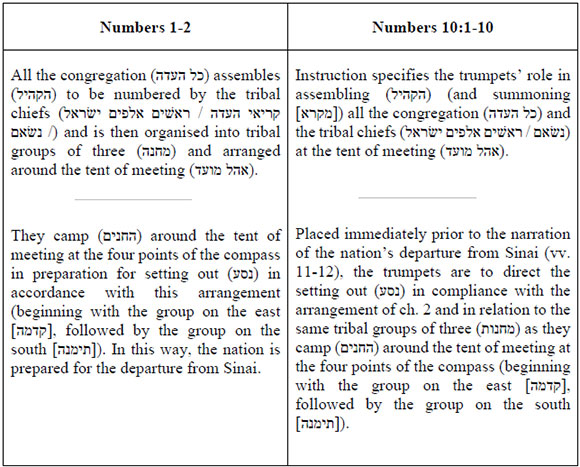
More specifically, instructions are given in Num 2 for four groups of three tribes, each referred to as a מחנה of its leading tribe, for example מחנה יהודה ("camp/division of Judah," v. 9; Reuben, v. 16; Ephraim, v. 24 and Dan, v. 31).87 The "camp"/"division" (מחנה) of Judah, the first group of three tribes, is described using the participial form of the same root, with the definite article: they are "the ones who camp" (החנים) "on the east" (קדמה; 2:3) of the tabernacle. The remaining three groups of three tribes (מחנה) are likewise assigned their locations with respect to the tabernacle, according to the points of the compass: Reuben "on the south" (תימנה; 2:10), Ephraim on the west and Dan on the north. It is in this order that those numbered from each of these groups are to "set out" (יסעו; 2:9, 16, 24, 31). Numbers 10 echoes this language through its instruction for the setting out (יסעו) of each of these same groups of three tribes (מחנות). Furthermore, ch. 10 again specifies their location according to the points of the compass, along with their setting out accordingly, in exact correspondence to the plan stipulated in ch. 2. Thus, instruction is first given for those on the east (קדמה; 10:5), that is, for Judah, and then for those on the south (תימנה; v. 6), that is, Reuben.88 Further amplifying the echo, in both vv. 5 and 6 the location of the groups is again described using the participial form with the definite article, החנים (e.g. ונסעו המחנות החנים קדמה, "and the camps/divisions camping on the east shall set out," 10:5). This form also appears in 2:5, 12, 27 and most prominently in 2:3 where we find החנים קדמה,89 language repeated precisely in 10:5. Between chs. 1-2 and 10:1-10 the form החנים occurs only once.90
In the case of נסע, the verb appears eight times in chs. 1-2. This is echoed in 10:1-10 through its twofold verbal use (v. 5[2x]) in addition to a twofold use of the nominal form מסע (vv. 2, 6). In between, it is used only twice with מחנה as subject (4:5, 15), though with reference to the camp of Israel as a whole, and nine times in 9:15-23.91 More broadly, the root is not rare. Israel as a whole, in Exodus and the remainder of Numbers, is often described as "setting out" (נסע); yet when the verb is used in conjunction with מחנה, the latter refers to either all Israel or Levitical clans and never to a group of three tribes as in the identified frame. The result is that the combined imagery of the "setting out" (נסע) of the "camps"/"divisions" (מחנה) in the frame is rendered more prominent.92
4b Summary Evaluation of Lexical and Thematic Links
We can now offer a summary evaluation of the lexical and thematic links observed above.93 The use of עדה ("congregation") at the very beginning of the book (1:2; also 1:16, 18, 53), immediately after the introductory divine speech formula and chronological notice, reflects the prominence of the congregation in ch. 1 as the object of the census. The use of the extended expression כל העדה ("all the congregation") in 1:2, 18 and 10:3, although also appearing three times between the proposed frame, is only described as being assembled in 1:18 and 10:3. A two-fold use of יעד ("congregate," "assemble") in 10:3 and 4 reinforces the link with עדה. The phrase ראׁש אלפי יׂשראל ("heads" of the thousands of Israel") is used in Num 1:16 and 10:4 and occurs nowhere else in the Pentateuch. Whereas using נׂשאים ("chiefs") in reference to these leaders is not uncommon,94 its use together with ראׁשי אלפי יׂשראל in both 1:16 and 10:4 heightens the probability of a recognisable frame. That these leaders are the dominant focus of the opening of the book increases this probability even more.
The "assembling" (יעד [10:3, 4]; הקהיל [7]) of the congregation at the "tent of meeting" (אהל מועד; 10:3) echoes both the "assembling" (הקהיל) of the congregation in 1:18 as well as the focus of chs. 1-2 on the arrangement of the tribal groups relative to the "tabernacle"/"tent of meeting" (אהל מועד/מׁשכן; 1:52; 2:17). This spatial orientation of the tribal groups comes into explicit view only in the proposed frame. In particular, the directives in both 10:5 and 6 for the "camps"/"divisions" (מחנות) to "set out" (יסעו) in accordance with their geographical arrangement-those on the "east" (קדמה) of the tabernacle first, followed by those on the "south" (תימנה)-pick up on the use of this same terminology, to portray the same procedure, established in the stipulations for "setting out" (נסע) in chs. 1-2 (see especially והחנים קדמה in 2:3 and 10:5).
The number of significant words that appear in both Num 10:1-10 and 1-2 is considerable-twelve when considering only ch. 1 and fifteen when including ch. 2 (אהל, מחנה, נסע, יׂשראל, אלפים, ראׁשים, נׂשאים, כל, העדה, קרא, הקהיל, מועד, [only in ch. 2] קדמה, [only in ch. 2] תימנה, [only in ch. 2] החנים), with the combinations נׂשאים + ראׁשי אלפי יׂשראל exclusive to the proposed frame, עדה + קרא and מחנות/מחנה + נסע absent between the frame and קדמה and תימנה each appearing in between only once. The proportion of the number of words here deemed significant for an inclusio to the total number of significant words in 10:1-10 is impressive. If all fifteen are factored in, with multiple occurrences95 as well as the related words מסע and יעד included, these number twenty-six out of a total of eighty in the unit.96 By this calculation, 33% of the total possible words in 10:1-10 have been identified as significant in forging an inclusio with chs. 1-2 (28% if ch. 2 is excluded).
Of course, the strength of the connection extends beyond mere shared vocabulary. Each repeated word in 10:1-10 carries the same or close to the same meaning as it does in chs. 1 and 2. Furthermore, the presence of clusters of words adds weight to the proposed frame. Finally, the words identified are nested within a common conceptual matrix, as illustrated by the summaries below.
Overall, the use of criteria for identifying an inclusio has supported the case that the instruction of 10:1-10 echoes the language, imagery and themes of the book's opening. The congregation and its leaders that were defined in chs. 1-2 are precisely those made subject to the trumpets' blast in ch. 10. The directing of the departure of the tribal groups in accordance with their location at the points of the compass, centred on the tabernacle, is precisely according to the specifications in chs. 1-2.
In terms of the rhetorical function of this relationship, 10:1-10 appears to be more than a concluding echo. Both its literary placement and its focus on the impending march suggest that the language and imagery of chs. 1-2 are strategically taken up in order to shine a closing spotlight on the vision set forth in the book's opening chapters. More will be said about this in the concluding comments below.
D CONCLUSION
Numbers 10:1-10 can be seen as a fitting conclusion to the march preparations of 1:1-10:10 based on its use of four characteristics of closure: time bridge, optimism regarding the future, achievement of a goal and inclusio. From a macro-structural perspective, this supports the majority view that 10:10 concludes the first major section of the book.97
Rhetorically, the inclusio especially enables the unit, prior to the beginning of the march in Num 10:11-12, to bring to prominence what is perhaps the defining image of 1:1-10:10-the congregation mobilised around the tabernacle in chs. 1 and 2. This image, according to W. H. Bellinger, "illustrate[s] well the theme of [Numbers 1-10]."98 Brevard Childs helpfully argues that "the fundamental concern" of 1:1-10:10 "lies in characterising the nature of a holy estate, which is set apart absolutely from all profane and unholy elements, and thus provides the proper dwelling within Israel for the presence of God.'99 The instruction for trumpets encapsulates this ideal vision of the holy estate as, on the eve of the departure, emphasis is placed on the manner in which the congregation is to be set in motion with reference to the tabernacle-not just procedurally but also theologically. This implicitly poses the question, just prior to the book's next major section narrating the march, as to whether the march will in fact be carried out in congruence with the vision.
In addition to the inclusio, the remaining characteristics of closure function to emphasise the end-goal of the newly organised holy estate: divine remembrance and blessing resulting in the nation's victory over its foes as well as a life of peace and joyful worship in the land. Numbers 10:1-10 thus appropriately concludes 1:1-10:10 by fixing the goal of the preparations beyond the immediate horizon of the march and onto a future where the goal of the march is realised.
BIBLIOGRAPHY
- Allen, David. "The Use of Criteria: The State of the Question." Pages 129-141 in Methodology in the Use of the Old Testament in the New. Edited by David Allen and Steve Smith. Library of New Testament Studies 579. London: T & T Clark, 2021.
- Ashley, Timothy R. The Book of Numbers. 2nd ed. New International Commentary on the Old Testament. Grand Rapids: Eerdmans, 2022.
- Awabdy, Mark A. Numbers. BCOTP. Grand Rapids: Baker Academic, 2023.
- Bailey, Lloyd R. Leviticus-Numbers. SHBC 3. Macon: Smyth & Helwys, 2005.
- Bellinger, William H. Leviticus and Numbers. New International Bible Commentary 2. Peabody: Hendrickson, 2001.
- Berlin, Adele. Poetics and Interpretation of Biblical Narrative. Sheffield: Almond, 1983.
- Blenkinsopp, Joseph. "The Structure of P." Catholic Biblical Quarterly 38 (1976): 275-292.
- Briggs, Richard S. Theological Hermeneutics and the Book of Numbers as Christian Scripture. Notre Dame: University of Notre Dame, 2018.
- Brodie, Thomas. "The Literary Unity of Numbers: Nineteen Atonement-Centered Diptychs as One Key Element." Pages 455-472 in The Books of Leviticus and Numbers. Edited by Thomas Römer. Bibliotheca Ephemeridum Theologicarum Lovaniensium 215. Leuven: Peeters, 2008.
- Broida, Marian. "Closure in Samson." Journal of Hellenic Studies 10 (2010): 2-34.
- Budd, Phillip J. Numbers. World Bible Commentary 5. Waco: Word, 1984.
- Childs, Brevard. Introduction to the Old Testament as Scripture. Philadelphia: Fortress, 1979.
- Cole, Dennis R. Numbers: An Exegetical and Theological Exposition of Holy Scripture. NAC 3B. Nashville: Broadman and Holman, 2000.
- Condren, Janson C. "Is the Account of the Organization of the Camp Devoid of Organization? A Proposal for the Literary Structure of Numbers 1.1-10.10." Journal for the Study of the Old Testament 37 (2013): 423-452.
- Davies, Eryl W. Numbers. NCBC. Grand Rapids: Eerdmans, 1995.
- Douglas, Mary. In the Wilderness: The Doctrine of Defilement in the Book of Numbers. Journal for the Study of the Old Testament Supplement Series 158. Sheffield: JSOT, 1994.
- Dozeman, Thomas B. Numbers. The New Interpreter's Bible. Vol. 2. Nashville: Abingdon, 1998.
- Fishbane, Michael A. "Accusations of Adultery: A Study of Scribal Practice in Numbers." Hebrew Union College Annual 45 (1974): 25-45.
- ______. "Biblical Colophons, Textual Criticism and Legal Analogies." Catholic Biblical Quarterly 42 (1980): 438-449.
- Forsling, Josef. "The Incoherence of the Book of Numbers in Narrative Perspective." Svensk Exegetisk Arsbok 78 (2013): 93-106.
- Fowler, Don. "First Thoughts on Closure: Problems and Prospects." Pages 239-283 in Roman Constructions: Readings in Postmodern Latin. Edited by Don Fowler. New York: Oxford University Press, 2000.
- Fretheim, Terence E. "Numbers." Pages 110-134 in The Oxford Bible Commentary. Oxford: Oxford University Press, 2001.
- Frevel, Christian. "The Book of Numbers: Some Introductory Remarks." Pages 1-38 in Torah and the Book of Numbers. Edited by Christian Frevel et al. Forschungen zum Alten Testament II 62. Tübingen: Mohr Siebeck, 2013.
- ______. Desert Transformations: Studies in the Book of Numbers. FZAT 137. Tübingen: Mohr Siebeck, 2020.
- Gane, Roy. Leviticus, Numbers. NIVAC. Grand Rapids: Zondervan, 2004.
- Gray, George Buchanan. A Critical and Exegetical Commentary on Numbers. ICC. New York: Scribner, 1903.
- Gottlieb, Isaac. "Sof Davar: Biblical Endings." Prooftexts 11 (1991): 213-224.
- ______. "From Formula to Expression in Some Hebrew and Aramaic Texts." Journal of the Ancient Near Eastern Society 31 (2008): 47-62.
- Hamon, Phillipe. "Clausules." Poetique 24 (1975): 495-526.
- Kellermann, Diether. Die Priesterschrift von Numeri 1,1 bis 10,10. Beihefte zur Zeitschrift für die alttestamentliche Wissenschaft 120. Berlin: De Gruyter, 1970.
- Kermode, Frank. The Sense of an Ending: Studies in the Theory of Fiction. Oxford: Oxford University Press, 1966.
- Knierim, Rolf and George W. Coats, Numbers. Forms of the Old Testament Literature 4. Grand Rapids: Eerdmans, 2005.
- Leder, Arie C. "From the Mountain of Yʜᴡʜ to Israel's מנוחה: The Desert Itinerary of Numbers 10:11-36." Old Testament Essays 29 (2016): 513-534.
- Lee, Won W. Punishment and Forgiveness in Israel's Migratory Campaign. Grand Rapids: Eerdmans, 2003.
- ______. "The Conceptual Coherence of Numbers 5,1-10,10." Pages 473-490 in The Books of Leviticus and Numbers. Edited by T. Romer. Leuven: Uitgeverij Peeters, 2008.
- Leonard, Jeffery. "Identifying Inner-Biblical Allusions: Psalm 78 as a Test Case." Journal of Biblical Literature127 (2008): 252-253.
- Leveen, Adriane. Memory and Tradition in the Book of Numbers. New York: Cambridge University Press, 2008.
- Levine, Baruch A. Numbers 1-20. Anchor Bible 4A. New York: Doubleday, 1993.
- Lundbom, Jack. "Scribal Colophons and Scribal Rhetoric in Deuteronomy." Pages 53-63 in Haim M.I. Gevaryahu Memorial Volume. Edited by J. Adler and B. Z. Luria. Jerusalem: Jewish Bible Center, 1990.
- ______. Biblical Rhetoric and Rhetorical Criticism. Sheffield: Sheffield Phoenix, 2015.
- Lunn, Nicholas. "Numbering Israel: A Rhetorico-Structural Analysis of Numbers 1-4." Journal for the Study of the Old Testament 35 (2010): 167-185.
- McEvenue, Scott. The Narrative Style of the Priestly Writer. Analecta Biblica 50. Rome: Pontifical Biblical Institute, 1971.
- Milgrom, Jacob. Numbers. JPS Torah Commentary. Jerusalem: Jewish Publication Society, 1990.
- Miller, Patrick D. "The Blessing of God: An Interpretation of Numbers 6:22-27." Interpretation 29 (1975): 240-250.
- Miller, William Thomas. Compact Study of Numbers. Eugene: Wipf & Stock, 2013.
- Morales, L. Michael. The Tabernacle Pre-Figured: Cosmic Mountain Ideology in Genesis and Exodus. Biblical Tools and Studies 15. Leuven: Peeters, 2012.
- ______. Numbers 1-19. AOTC 4a. London: Apollos, 2024.
- Mowinckel, Sigmund. Religion und Kultus. Göttingen: Vandenhoeck & Ruprecht, 1953.
- Nihan, Christophe. From Priestly Torah to Pentateuch: A Study in the Composition of the Book of Leviticus. Tübingen: Mohr Siebeck, 2007.
- Noth, Martin. Numbers: A Commentary. Old Testament Library. Philadelphia: Westminster, 1968.
- Ogden, Graham. "The Design of Numbers." The Bible Translator 47 (1996): 420-428.
- Olson, Dennis T. The Death of the Old and the Birth of the New: The Framework of the Book of Numbers and the Pentateuch. Brown Judaic Studies 71. Chico: Scholar's Press, 1985.
- ______. Numbers. IBC. Louisville: John Knox, 1996.
- Preminger, Alex et al, eds. The New Princeton Encyclopedia of Poetry and Poetics. Princeton: Princeton University Press, 1993.
- Rendsburg, Gary A. "Marking Closure." Vetus Testamentum 66 (2016): 280-303.
- Rofé, Alexander. Deuteronomy: Issues and Interpretation. Old Testament Studies. Edinburgh: T & T Clark, 2002.
- Ruwe, Andreas. "The Structure of the Book of Leviticus in the Narrative Outline of the Priestly Sinai Story (Exod 19,1-Num 10,10)." Pages 55-78 in The Book of Leviticus: Composition and Reception. Edited by R. Rendtorff and R. Kugler. Leiden: Brill, 2003.
- Sakenfeld, Katherine Doob. Journeying with God: A Commentary on the Book of Numbers. ITC. Grand Rapids: Eerdmans, 1995.
- Seebass, Horst. Numeri. Vol. 1. Biblischer Kommentar: Altes Testament 4. Neukirchener Verlag, 2010.
- ______. "Numeri als eigene Komposition." Pages 87-108 in Torah and the Book of Numbers. Edited by Christian Frevel et al. Forschungen zum Alten Testament II 62. Tübingen: Mohr Siebeck, 2013.
- Seow, C. L. "Poetic Closure in Job." JSOT 34 (2010): 433-446.
- Smith, Barbara H. Poetic Closure: A Study of How Poems End. Chicago: University of Chicago Press, 1968.
- Sprinkle, Joseph M. The Book of the Covenant: A Literary Approach. JSOTSup 174. Sheffield: JSOT, 1994.
- Van der Wielen, Sjoerd H. "The Passover as Inauguration of Israel's Departure from Sinai: Interpretive Potential of Analysing Narrative Technique for Discerning Literary Structure in Numbers 1-10." Journal for the Study of the Old Testament 47 (2022): 3-22.
- Watts, James W. Reading Law: The Rhetorical Shaping of the Pentateuch. Sheffield: Sheffield Academic, 1999.
- ______. Leviticus 1-10. HCOT. Leuven: Peeters, 2013.
- Weinfeld, Moshe. Deuteronomy 1-11. Anchor Bible 5. New York: Doubleday, 1991.
- Wenham, Gordon J. Numbers: An Introduction and Commentary. Tyndale Old Testament Commentary 4. Leicester: Intervarsity, 1981.
- Westermann, Claus. Blessing in the Bible and the Life of the Church. Overtures to Biblical Theology. Philadelphia: Fortress, 1978.
- Wyckoff, Chris. "Have We Come Full Circle Yet? Closure, Psycholinguistics, and Problems of Recognition with the Inclusio." Journal for the Study of the Old Testament (2006): 475-505.
- Zeelander, Susan. Closure in Biblical Narrative. BIS 111. Leiden: Brill, 2012.
- ______. "The End of Korah and Others: Closural Conventions in Priestly Narratives of Numbers." Pages 325-448 in Current Issues in Priestly and Related Literature: The Legacy of Jacob Milgrom and Beyond. Edited by Roy E. Gane and Ada Taggar-Cohen. Resources for Biblical Study 82. Atlanta: SBL, 2015.
Peer-reviewed: 09/10/2025
Accepted: 04/11/2025
1 See the surveys of over seventy commentaries from 1865 to 2002 in Dennis T. Olson, The Death of the Old and the Birth of the New: The Framework of the Book of Numbers and the Pentateuch (Chico: Scholar's Press, 1985), 32; and Won W. Lee, Punishment and Forgiveness in Israel's Migratory Campaign (Grand Rapids: Eerdmans, 2003), 3-4. For a defence, see especially idem, 73-118 and Rolf Knierim and George W. Coats, Numbers (Grand Rapids: Eerdmans, 2005), 9-17. Numbers 10:10 is also commonly viewed as the end of the entire Sinai narrative. See, e.g., Andreas Ruwe, "The Structure of the Book of Leviticus in the Narrative Outline of the Priestly Sinai Story (Exod 19,1-Num 10,10)," in The Book of Leviticus: Composition and Reception (ed. R. Rendtorff and R. Kugler; Leiden: Brill, 2003), 59. Others end the section at 10:36, thus including the departure from Sinai; e.g., Olson, Death of the Old, 118-119; Adriane Leveen, Memory and Tradition in the Book of Numbers (New York: Cambridge University Press, 2008), 77-78; L. Michael Morales, Numbers 1-19 (London: Apollos, 2024), 61-67; William H. Bellinger, Leviticus and Numbers (Peabody: Hendrickson, 2001), 215-217.
2 Leviticus-Numbers (Macon: Smyth & Helwys, 2005), 439.
3 Numbers: A Commentary (Philadelphia: Westminster, 1968), 75. Similarly, Dennis R. Cole, Numbers: An Exegetical and Theological Exposition of Holy Scripture (Nashville: Broadman and Holman, 2000, 160, describes their construction as a "required" "one final step in the preparation for the journey from Sinai" and Mark A. Awabdy, Numbers (Grand Rapids: Baker Academic, 2023), 158, sees it as "the last prerequisite for Israel's obedient departure."
4 For example, Levitical instruction for transporting the tabernacle is found in Num 3-4; the donation of carts is in ch. 7.
5 Neither does any subsequent narration of Israel's movement do so. Crafted out of silver, the instrument in view here (חצצרה) is to be distinguished from those fashioned from a ram's horn (שופרׁ [e.g. Exod 19:16] and יובל [e.g. :13]). The silver trumpet (חצצרה) appears elsewhere in Numbers only in regard to use in the battle against Midian (Num 31:6). On the distinction as well as debate over which is in view in 29:1, see Milgrom, Numbers, 246, 372-273.
6 Milgrom, Numbers, 72; Terence E. Fretheim, "Numbers," in The Oxford Bible Commentary (Oxford: Oxford University Press, 2001), 118. Gordon J. Wenham, Numbers: An Introduction and Commentary (Leicester: Intervarsity, 1981), 101-102, calls the location of the instructions "very appropriate" in that "they complete and complement" the divine guidance of the cloud. Specifically, he argues that a "more precise means of control were necessary if people were to march in the tight-knit formations envisaged in chapters 2-3." See also Phillip J. Budd, Numbers (Waco: Word, 1984), 106. Eryl W. Davies, Numbers (Grand Rapids: Eerdmans, 1995), 86, sees a "discrepancy" in that human effort is "at odds with" 9:15-23.
7 Horst Seebass, Numeri (vol. 1; Neukirchener Verlag, 2010), 242. Elsewhere Seebass, "Numeri als eigene Komposition," in Torah and the Book of Numbers (ed. Christian Frevel et al; Tübingen: Mohr Siebeck, 2013), 93, describes 10:1-10, together with 9:15-23, as a "transition" to the departure in 10:11-36. Num 9:15-23 is a proleptic narrative describing the wilderness march to come and may itself have a concluding function for 1:1-10:10. See, e.g., Janson C. Condren, "Is the Account of the Organization of the Camp Devoid of Organization? A Proposal for the Literary Structure of Numbers 1.1-10.10," JSOT 37 (2013): 442-447; Lee, "Migratory Campaign," 81-85, 89.
8 Katharine D. Sakenfeld, Journeying with God: A Commentary on the Book of Numbers (Grand Rapids: Eerdmans, 1995), 59. According to William Thomas Miller, Compact Study of Numbers (Eugene: Wipf & Stock, 2013), 205, "The odd part of this passage is not that trumpets were used in the wilderness but that the authors make such importance of them." Richard S. Briggs, Theological Hermeneutics and the Book of Numbers as Christian Scripture (Notre Dame: University of Notre Dame, 2018), 61, calls it a "strange paragraph."
9 Note, for example, the book's generic diversity which includes narrative, tribal list, liturgical poetry, census return, priestly legislation, genealogy, duty roster, ritual celebration, etc. Regarding Num 5-9, Noth, Numbers, 6, observes a variety of late additions that have "no connection with one another and in whose sequence no factual arrangement can be discerned."
10 Noth, Numbers, 4. In Noth's estimation, "the assertion of the disunity of the book" is sufficiently self-evident so as not to "require exhaustive proof…" It manifests "an unsystematic collection of innumerable pieces of tradition of very varied content, age, and character." According to Knierim and Coats, Numbers, 6, "Numbers … betrays in its individual units a variety of aspects whose relationship among one another and place in the composition of the whole are not self-evident."
11 Josef Forsling, "The Incoherence of the Book of Numbers in Narrative Perspective," Svensk Exegetisk Arsbok 78 (2013): 106.
12 Leveen, Memory and Tradition, 180. Condren, "Literary Structure of Numbers 1.1-10.10," 423-52, building on Graham Ogden, "The Design of Numbers," BT 47 (1996): 424-26, argues that 1:1-10:10 unfolds in two parallel panels, 1:1-6:27 and 7:1-10:10, of three units each and that an alternating laity-clergy-laity pattern mimics the ch. 2 arrangement of the camp.
13 Mary Douglas, In the Wilderness: The Doctrine of Defilement in the Book of Numbers (Sheffield: JSOT, 1994), 160.
14 Jacob Milgrom, Numbers (Jerusalem: Jewish Publication Society, 1990), xxii. Milgrom, Numbers, xxxi adds: "The individual pericopes of Numbers manifest design. Their main structural device is chiasm and introversion. Also in evidence are such artifices as parallel panels, inclusions, subscripts and repetitive resumptions, prolepses, and septenary enumerations."
15 Nicholas P. Lunn, "Numbering Israel: A Rhetorico-Structural Analysis of Numbers 1-4," JSOT 35 (2010): 184. Regarding the priestly writer, Scott McEvenue, The Narrative Style of the Priestly Writer (Rome: Pontifical Biblical Institute, 1971), 185, speaks of "deliberateness and careful ordering of material, conjoined with his use of echo, palistrophe, and panel, resulting inevitably in a symmetrical structure of composition." See also Joseph Blenkinsopp, "The Structure of P," CBQ 38 (1976): 275-292.
16 Timothy R. Ashley, The Book of Numbers (2nd ed.; Grand Rapids: Eerdmans, 2022), 9.
17 Ashley, The Book of Numbers, 157.
18 See fn 1 above.
19 Frank Kermode, The Sense of an Ending: Studies in the Theory of Fiction (Oxford: Oxford University Press, 1966); Barbara H. Smith, Poetic Closure: A Study of How Poems End (Chicago: University of Chicago Press, 1968).
20 Smith, Poetic Closure, 36.
21 Ibid., 13-14. This experience underlines "the feeling of finality, completion, and composure which we value in all works of art"; Ibid., 36. According to Chris Wyckoff, "Have We Come Full Circle Yet? Closure, Psycholinguistics, and Problems of Recognition with the Inclusio," JSOT (2006): 475, "an audience feels a sense of finality or closure when they perceive a poem is at its end, that it can go no further." This feeling, according to Marian Broida, "Closure in Samson," JHS 10 (2010): 4, is "generated partly by readers' recognition of literary conventions, including those specific to the work's genre, and partly by readers' broader cultural knowledge."
22 Smith, Poetic Closure, 13, calls this activity of the reader "retrospective patterning." According to Broida, "Closure in Samson," 4-5, this process "can be thought of as an internal re-reading of the work, which may make salient some features previously merely noticed in passing."
23 Smith, Poetic Closure, 36.
24 C. L. Seow, "Poetic Closure in Job," JSOT 34 (2010) 433-446.
25 Wyckoff, "Have We Come Full Circle Yet?," 475-505. Wyckoff harnesses the insights of psycholinguistics in an effort to assess more accurately the presence of inclusios.
26 Broida, "Closure in Samson," 5.
27 Susan Zeelander, Closure in Biblical Narrative (Leiden: Brill, 2012).
28 Susan Zeelander, "The End of Korah and Others: Closural Conventions in Priestly Narratives of Numbers," in Current Issues in Priestly and Related Literature: The Legacy of Jacob Milgrom and Beyond (ed. Roy E. Gane and Ada Taggar-Cohen; Atlanta: SBL, 2015), 325.
29 For comment on the overlap between literary devices in narrative and legal texts, see James W. Watts, Reading Law: The Rhetorical Shaping of the Pentateuch (Sheffield: Sheffield Academic, 1999), 84-85.
30 For example, "Yʜᴡʜ spoke to Moses, saying …" (1:1, 48; 2:1; 3:5, 11, 14, etc.).
31 Michael A. Fishbane, "Biblical Colophons, Textual Criticism and Legal Analogies," CBQ 42 (1980): 442.
32 For example, 1:54; 2:34; 3:51; 8:22b. For a study attentive to these notices, see Sjoerd H. van der Wielen, "The Passover as Inauguration of Israel's Departure from Sinai: Interpretive Potential of Analysing Narrative Technique for Discerning Literary Structure in Numbers 1-10," JSOT 47 (2022): 3-22.
33 For example, 1:16; 6:21.
34 For example, 5:29-30. See Michael A. Fishbane, "Accusations of Adultery: A Study of Scribal Practice in Numbers," HUCA 45 (1974): 25-45.
35 For example, 4:24 and 28; 5:4; 7:10, 84 and 88; see Milgrom, Numbers, xxviii-xxix.
36 Gary A. Rendsburg, "Marking Closure," VT 66 (2016): 289-291.
37 For our purposes, it is significant to note closure can occur both for more minor endings within a work and for the work as a whole-"from the level of the phrase, the line, the stanza, the chapter, the book"; so Broida, "Closure in Samson," 5, citing Don Fowler, "First Thoughts on Closure: Problems and Prospects," in Roman Constructions: Readings in Postmodern Latin (ed. Don Fowler; New York: Oxford University Press, 2000), 246 and Phillipe Hamon, "Clausules," Poetique 24 (1975): 504.
38 Isaac Gottlieb, "Sof Davar: Biblical Endings," Prooftexts 11 (1991): 213-224.
39 Zeelander, Closure in Biblical Narrative, 205.
40 Joseph M. Sprinkle, The Book of the Covenant: A Literary Approach (Sheffield: JSOT, 1994), 188. Sprinkle, The Book of the Covenant, 206-207, calls 20:22-23:19 "an artfully crafted unity" and writes of "intelligent principles of organization of the regulations vis-à-vis one another."
41 For example, Alexander Rofé, Deuteronomy: Issues and Interpretation (Edinburgh: T & T Clark, 2002), 2.
42 Jack Lundbom, Biblical Rhetoric and Rhetorical Criticism (Sheffield: Sheffield Phoenix, 2015), 108-110.
43 Ibid., 110. See also Lundbom's case for a frame around Deut 31-34 in "Scribal Colophons and Scribal Rhetoric in Deuteronomy," in Haim M.I. Gevaryahu Memorial Volume (ed. J. Adler and B. Z. Luria; Jerusalem: Jewish Bible Center, 1990), 53-63.
44 For the latter, see James W. Watts, Leviticus 1-10 (Leuven: Peeters, 2013), 425; Roy Gane, Leviticus, Numbers (Grand Rapids: Zondervan, 2004), 156.
45 Christian Frevel, "The Book of Numbers: Some Introductory Remarks," in Torah and the Book of Numbers, 24; Olson, Death of the Old, 175-77. Note also the observation by Milgrom, Numbers, 75, that 10:11-12:16 both opens and closes with mention of the desert of Paran as the geographic setting (10:12; 12:16).
46 For the latter, see Cole, Numbers, 127; Condren, "Literary Structure of Numbers 1.1-10.10," 447-449.
47 That is, she includes 10:11-36. Leveen, Memory and Tradition, 77, observes "the cloud and trumpets trigger the tribal march through the wilderness… precisely in the order laid out in the beginning," a point to be developed below.
48 Verbs in v. 2 alone are 2ms. The subsequent instruction alternates between 3mp (vv. 3-4, 6b, 8) and 2mp (5-6a, 7, 9-10). While this variation apparently reflects a process of literary growth, e.g. Diether Kellermann, Die Priesterschrift von Numeri 1,1 bis 10,10 (Berlin: De Gruyter, 1970), 140-146, and Davies, Numbers, 87, the possibility of stylistic variation should not be ruled out. See, e.g., Christophe Nihan, From Priestly Torah to Pentateuch: A Study in the Composition of the Book of Leviticus (Tübingen: Mohr Siebeck, 2007), 209; Moshe Weinfeld, Deuteronomy 1-11 (AB 5; New York: Doubleday, 1991), 15.
49 Verses 9-10, although sometimes viewed as secondary, are best viewed as "integral to the whole" and even "the climax of the section"; Budd, Numbers, 106.
50 Adele Berlin, Poetics and Interpretation of Biblical Narrative (Sheffield: Almond, 1983), 107-110.
51 Zeelander, Closure in Biblical Narrative, 47. See also Gottlieb, "Sof Davar," 216.
52 Thomas B. Dozeman, "Numbers," in The New Interpreter's Bible (vol. 2; Nashville: Abingdon, 1998), 91. Although legal in nature, this text exhibits characteristics more germane to narrative. See, e.g., Christian Frevel, Desert Transformations: Studies in the Book of Numbers (Tübingen: Mohr Siebeck, 2020), 41, who identifies strategies in the book that integrate law into the story, such that "there is therefore no law in Numbers that is not narratively integrated. The laws are woven into history and one cannot always be sure whether they are warp or weft threads" (emphasis original). Frevel, Desert Transformations, 44, further discounts a formal "dichotomy between law and narrative" on the basis that they "are closely connected through narrative techniques."
53 Zeelander, Closure in Biblical Narrative, 339, cites the daughters of Zelophehad episodes (Num 27:1-11; 36:1-12) as indicators of closure since they contain laws that "affect future generations." Regarding 10:8-10, Cole, Numbers, 162, notes that "this section has a future orientation. It describes the time when the people would be in the land, battling against their enemies for occupation and control of the territory God had granted them. There they would celebrate the bounty of God's blessing and the wonder of his salvation activities of the past."
54 Already in v. 2, the purpose of "summoning" (מקרא) the congregation appears, placed even before the purpose of signaling the departure. As noted by Frevel, Desert Transformations, 75, aside from Exod 12:16, מקרא only refers to summoning worship outlined in the festival calendars of Lev 23 (12x) and Num 28-29 (6x). The term thus "builds a bridge to the permanent cult in the annual cycle." In this way, according to Frevel, "the linear dynamic of the departure is here linked with the cyclical return in the cultic calendar. Thus the moment of departure, which is pointing beyond Sinai, is stabilized. Israel is Israel only if it is 'Sinaitic' even beyond Sinai" (ibid., italics his).
55 As mentioned in fn 7, the previous unit, 9:15-23, also bears signs of a conclusion. It too lifts the time horizon from the present phase of march preparation to the march itself. However, while both 9:15-23 and 10:1-10 utilise a time-bridge, the latter extends the time-horizon to the land, one step further than the former. Zeelander, "End of Korah," 339, cites 9:10-13 as an example of time-shifting from the time of the dilemma of those unable to celebrate Passover to "future generations" (indicated by the added dilemma of someone on a journey). It is uncertain whether Zeelander has in mind closure for the larger story of preparation in Num 1-10 or merely the second Passover, though the latter is likely in that her focus elsewhere is on smaller units.
56 She cites, for example, Num 27 and 36 where "the daughters of Zelophehad show that a logical argument before God can be successful," as well as 14:38 and 17:3-5; Zeelander, "End of Korah," 340.
57 According to Frevel, Desert Transformations, 76, this appeal to divine remembering (זכר) together with the phrase "I am Yʜᴡʜ your God" is grounded in the use of the same language at the end of Leviticus to describe God's promise to remember the covenant (Sinai and Patriarchal intertwined) (26:42, 45). As a result, "at the very end of the stay at Sinai (exactly in the last verse) the very forefront of the exodus project is invoked."
58 Milgrom, Numbers, 75.
59 According to Sigmund Mowinckel, Religion und Kultus (Göttingen: Vandenhoeck & Ruprecht, 1953), 64-65, cited by Claus Westermann, Blessing in the Bible and the Life of the Church (Philadelphia: Fortress, 1978), 20, "It was in order to receive blessing and make it secure in all its forms, that Israel… went to the sanctuary and took part in the worship offered there."
60 Knierim and Coats, Numbers, 96, hold that it was first employed at "the conclusion and culmination of communal worship." Many identify the priestly blessing as that given by Aaron at the climax of the tabernacle's inauguration in Lev 9:22; cf. Patrick D. Miller, "The Blessing of God: An Interpretation of Numbers 6:22-27," Int 29 (1975): 242; Baruch A. Levine, Numbers 1-20 (New York: Doubleday, 1993), 66, 243-244. It is often suggested this was its original location; cf. George Buchanan Gray, A Critical and Exegetical Commentary on Numbers (New York: Scribner, 1903), 71.
61 Zeelander, Closure in Biblical Narrative, 95; Isaac Gottlieb, "From Formula to Expression in Some Hebrew and Aramaic Texts," JANES 31 (2008): 47. Whereas Zeelander addresses personal goals, Gottlieb focuses on the end of major phases in Israel's history.
62 To speak of this goal as merely "geographical" is perhaps overly limiting. In the description of the trumpets' use for worship in the land readers may be encouraged to see the ultimate goal of Israel's future life in the land. Cf. L. Michael Morales, The Tabernacle Pre-Figured: Cosmic Mountain Ideology in Genesis and Exodus (Leuven: Peeters, 2012), 91-112, 286, on the "liturgical telos" that is the result of the "the so-called priestly agenda" of placing Gen 1 at the beginning of the Pentateuch.
63 The disobedience so characteristic of chs. 11-25 is notably absent from the preparations. Instead, the text is punctuated with reports of Israel's compliance to the divine command. According to Olson, Numbers (Louisville: John Knox, 1996), 53, Israel's obedience is "the central theme" of chs. 1-10.
64 Broida, "Closure in Samson," 15-16.
65 Zeelander, Closure in Biblical Narrative, 63. "When information that was reported or language that was used at the beginning of a narrative is repeated at the end, we have repetition that is closural almost by definition. It encloses the unit, bringing the reader back to the starting point" (ibid., 62).
66 Zeelander, Closure in Biblical Narrative, 63, crediting Smith, Poetic Closure, 25.
67 Zeelander, The New Princeton Encyclopedia of Poetry and Poetics (ed. Alex Preminger et al; Princeton: Princeton University Press, 1993), 361, cited in Wyckoff, "Have We Come Full Circle Yet?" 477.
68 Wyckoff, "Have We Come Full Circle Yet?" 478. Wycoff, 480, speaks of "the problem of recognition," and notes that, "Most scholarship which engages the topic plays a simple game of identification without properly considering the validity of what it describes"; Ibid., 479.
69 While Wycoff's study focuses specifically on poetry, his observations on recognising inclusios can be helpfully applied to other genres.
70 See Richard B. Hays, Echoes of Scripture in the Letters of Paul (New Haven: Yale University Press, 1989), 30 and his category "volume," used to identify intertextual references of allusion and echo, and aimed at answering, "[H]ow distinctive or prominent is the precursor text … and how much rhetorical stress does the echo receive…?"
71 Jeffery Leonard, "Identifying Inner-Biblical Allusions: Psalm 78 as a Test Case," JBL 127 (2008): 252-253.
72 Leonard, "Identifying Inner-Biblical Allusions," 255.
73 See also David Allen, "The Use of Criteria: The State of the Question," in Methodology in the Use of the Old Testament in the New (ed. David Allen and Steve Smith; London: T & T Clark, 2021), 129-141.
74 Wyckoff, "Have We Come Full Circle Yet?" 484, 500. "There is no fixed metric that allows one to judge each case definitively." Ibid., 501.
75 Knierim and Coats, Numbers, 28. Knierim and Coats, 57, cite tribal sequence, census numbers, chieftain names and 'overall style and terminology' as commonalities between the chapters, concluding that "Numbers 2 is the conceptually based continuation of the conscription report in Numbers 1." According to Won W. Lee, "The Conceptual Coherence of Numbers 5,1-10,10," in The Books of Leviticus and Numbers (ed. T. Romer. Leuven; Belgium: Uitgeverij Peeters, 2008), 475, the two chapters "should be considered as a single unit by the common denominator of the 'twelve tribes' despite being distinguished by their focus on the census and the camp respectively." See also Lunn, "Numbering Israel," 170-74; Thomas Brodie, "The Literary Unity of Numbers: Nineteen Atonement-Centered Diptychs as One Key Element," in The Books of Leviticus and Numbers (ed. Thomas Römer; Leuven: Peeters, 2008), 460-461; Dozeman, "Numbers," 31.
76 In 1:2 and 1:53, the construct form is used as part of the phrase עדת בני יׂשראל.
77 Occurring once in reference to the leaders of the congregation who help with the census (4:34), once in reference to Levite service on the congregation's behalf (3:7) and twice in reference to its involvement in the Levites' ordination (8:9, 20).
78 At the very least, the layout of the camp as outlined in ch. 2 offers the background imagery for envisioning the congregation's assembling.
79 It is attested elsewhere in the Hebrew Bible only in Josh 22:21, 30. The more limited אלפי יׂשראל occurs elsewhere only in 10:36 (as part of the expression רבבות אלפי יׂשראל, "ten thousand thousands of Israel"; Nʀsᴠ).
80 The plural appears eight times in the intervening text (6x in the focus on the chiefs' offerings in ch. 7 [vv. 2(2x), 3, 10(2x), 84], twice in relation to their role in the Levitical census [4:34, 46] and once in reference to the chiefs of the Levite clans [3:32]). The singular is even more frequent, used in reference to individual chiefs (e.g. נׂשיא לבני יהודה) in the two tribal listings of ch. 2 (12x) and ch. 7 (13x), in addition to three times in reference to chiefs of the Levite clans (3:24, 30, 35) and once in reference to Eleazar (3:32). Prior to Numbers, reference to the tribal chiefs as נׂשאים occurs in Exod 16:22; 34:31; 35:27 and Lev 4:22.
81 Here, they are described as "each man the head of his ancestral house" (Nʀsᴠ; איׁש ראׁש לבית־אבתיו הוא). Only in 1:16 are they referred to by the expression נׂשיאי מטות אבותם ראׁשי אלפי יׂשראל.
82 Reading the Kethib (Qere: קרואי). See Num 26:9 where Dathan and Abiram are קריאי העדה (reading the Qere; Kethib: קרואי).
83 That is, the עדה in 1:18 and קהל in 10:7.
84 Num 8:8, in reference to assembling the congregation for consecration of the Levites.
85 The full subject in each case is "all those numbered of the camp of x" (כל הפקדים למחנה x).
86 Mitigating against the distinctiveness of the frame created with this terminology is that in 10:11-36, מחנה is also used together with נסע in reference to these groups of three (vv. 14, 18, 22, 25) and to the whole camp (v. 34). The lexeme appears as early as Exod 14:19 to describe Israel as a whole and six times between chs. 1-2 and 10 (4:5, 15; 5:2, 3[2x], 4). In both 4:5 and 15, the camp (מחנה) is described as setting out (נסע). As noted, incongruence is evident in that in ch. 2, the singular מחנה refers to each group of three, favouring the translation "division" (e.g. "division of Judah" on the east, v. 3). In ch. 10, the plural מחנות refers to each group (e.g. "the camps" on the east, v. 5).
87 Verse 17 also refers to the מחנה of the Levites.
88 The LXX and other versions add directives for the westward and northward divisions that are absent from the MT. Although likely an expansion, Milgrom, Numbers, 74, correctly notes that, for the reader of the MT, "the blasts for the remaining divisions are to be anticipated…"
89 קדמה otherwise occurs only once between the proposed frame for the location of the priests' encampment (3:38), and תימנה only once, for the location of the Levitical clan of Korah (3:29). There is no reference between the frame, however, to the tribes camping at the points of the compass in relation to the tabernacle. Additional verbal forms of חנה ("camp") appear four times in ch. 1 and four in ch. 2. Between the frame, the imperfect is used three times for the Levite clans' location in relation to the tabernacle (3:23, 29, 35) and six times in 9:15-23. It should be noted that the participle החנים is used substantivally in ch. 2, but adjectivally in chs. 10 (to modify המחנות).
90 In reference to the encampment of the priests around the tabernacle (3:38).
91 In the latter, "sons of Israel" is the subject.
92 The combination is pronounced, however, in 10:11-36. See fn 95.
93 An additional link may be observed in the references to Aaron and priestly authority. This is evident in that Aaron is paired with Moses in 1:3, 17 and 44 (see also 2:1) as responsible for executing the census. Similarly, 10:8 invests the "the sons of Aaron, the priests" alone with the authority to sound the trumpets. However, because indications of priestly authority are very frequent in Num 1-10, the shared focus in chs. 1-2 and 10:1-10 contributes little to the proposed frame.
94 The plural form occurs three times in the proposed frame and nine between it (in addition to 12x in the sg. in the frame, 17x between it).
95 Some words appear two or three times in 10:1-10 out of a total of twenty-four times.
96 Omitted as insignificant are the introductory divine speech formula, prepositions, direct object markers, divine names (אלהים and יהוה) and the particles אם (v. 4), לא (v. 7) and כי (v. 9).
97 While Num 10:11-36 also contains significant references back to Num 1 (e.g. the tribal chiefs and camps/divisions are listed in the same order and are described as setting out according to their standards [ויסע דגל מחנה בני יהודה, v. 14; also vv. 18, 22, 25(2x)]; צבא ["army," "host"] occurs 36x in chs. 1-2 and 17x in vv. 12-36), these verses are best viewed as beginning the book's second major section. Nevertheless, the argument that 10:1-10 functions to bring closure is not negated by recognising characteristics of closure in 10:11-36. For example, John I. Lawlor, "The At-Sinai Narrative: Ex. 18-Num.10," BBR 21 (2011): 23-42, uses the language of "seam texts" for Exod 1:1-7, which can be seen as a conclusion to Genesis yet also an introduction to Exodus and Numbers 1-10, a conclusion to the Sinai narrative, yet also an introduction to Numbers. For arguments in favour of including vv. 11-36 within the opening major section, see Morales, Numbers 1-19, 61-67; Arie C. Leder, "From the Mountain of Yʜᴡʜ to Israel's מנוחה: The Desert Itinerary of Numbers 10:11-36," OTE 29 (2016): 513-534; Van der Wielen, "Passover as Inauguration," 3-22.
98 Bellinger, Leviticus, Numbers, 186.
99 Brevard Childs, Introduction to the Old Testament as Scripture (Philadelphia: Fortress, 1979), 196. Frevel, "Torah Becoming a Blessing," 24-25, describes God's presence in the middle of the camp as the "sanctifying center" of the book. See also Morales, Numbers 1-19, 12-42.