Towards a Phenomenology of Exegesis: "Structures of Feeling" and "Historical Imagination" as Concepts for Seeing Texts Differently, with Post-exilic •—”— •••• Yahwistic Piety in Job 28:28 as Example
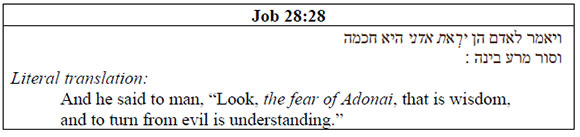
An aspect of the practice of exegesis is characterised in this contribution, namely by drawing on the concepts of "structures of feeling" and "historical imagination. " The unstated is often a key part of a communicative event, such as an ancient text, which enables understanding, but which is not openly put forward. "Structures of feeling" and "historical imagination" help to extend our understanding of the Hebrew Bible texts in order to grasp, to some extent, these underlying elements of meaning. This is concretely illustrated at the hand of the post-exilic •—”— ••• Yahwistic piety concept in Job 28:28. The key insight is that there is more meaning to be found between the proverbial lines than in the words themselves, in this illustrated instance as much as in many, perhaps all cases of written communication.
Phenomenology of exegesis; structures of feeling; historical imagination; the Fear of the Lord; Job 28:28