
 Resilience as Reliance: Brief Reflections on Intergenerational Resilience with Reference to Psalm 131
Abstract
Scholars applying principles of trauma studies on Hebrew Bible texts emphasise that successive devastating traumatic experiences did not obliterate ancient Israel, but caused it to thrive and endure in various guises in the three modern day monotheistic religions. Similarly, scholars reading Hebrew Bible texts through a critical-spatial lens emphasise that the concept of thirdspace as a counter space from which to transform all other spaces explains biblical authors' ability to retell past events in such a way that it can become a source for re-imagining Israel's future. It is a worthwhile exercise to investigate the cause of this unexpected resilience of an insignificant ancient Near Eastern people and their written documents millennia after the memory of their powerful conquerors and their achievements were all but forgotten. The present study applies trauma studies and critical spatiality as heuristic lenses to the collection of poems known as the •–––•— —•—• (Pss 120-134) in general and the brief Ps 131 in particular. These poems can be read in the context of individual and collective belief in YHWH as the only true, universal, divine king against the background of the trauma caused by colonial domination from outside and inner-Judaic marginalisation from inside during the late-Persian period.
Psalm 131; Songs of Ascents; Trauma; Resilience; Critical Spatiality; Thirdspace; Memory; Imagination; Psalter Book V; Persian Period; Greek Period
A INTRODUCTION
The aim of this study is to reflect on the theme of intergenerational resilience in the face of unbearable trauma and adverse real-life spatial experiences. The focus falls on Ps 131, a remarkable little poem set in the context of a collection of poems known as the המעלות שירי, "Songs of Ascents" (Pss 120-134). It is noteworthy that the brief poem does not expressly refer to trauma at all, only to complete contentment. Nonetheless, it appears in a context where animosity, anxiety, insecurity and turmoil - all markers of severe trauma - are often expressed.2 The primary research question to be investigated is: How could a marginalised group (cf. their self-identification as the יהוה עבדי, "servants of YHWH," in Ps 134:1 and as עבדים, "servants," in 123:2) in a marginalised community (the Persian province of Yehud) reframe the traumatic experiences of their distant and recent past in such a way that they could imagine another - or more poignantly - an other reality (Ps 131:1-2),3 thus enabling them to live life full of hope and to expect a glorious future under the protection of YHWH, their universal, divine king (Ps 131:3)?4
B BRIEF METHODOLOGICAL CONSIDERATIONSMy reading of Ps 131 in its context utilises two heuristic keys, namely trauma studies and critical spatiality, as it finds context-specific expression in ancient Near-Eastern worldview(s) and spatial orientation(s), to reflect on the theme of intergenerational resilience in the המעלות שירי in general and Ps 131 in particular.
Biblical scholars applying insights of trauma studies in various branches of the social sciences as heuristic key when reading the Hebrew Bible paid some attention to the link between trauma and resilience,5 but the theme of resilience and "how people come to identify the sources of strength that allow them to maintain their humanity in the midst of harrowing disaster or long-term oppression" deserves focused attention.6 David M. Carr defines trauma as "an overwhelming, haunting experience of disaster so explosive in its impact that it cannot be directly encountered and influences an individual/group's behavior and memory in indirect ways."7 Alphonso Groenewald emphasises the importance of language as one of the primary tools to confront, transform and transcend traumatic experiences.8 For Christopher G. Frechette and Elizabeth Boase, "(a) hermeneutics of trauma emphasises the fact that language can respond to traumatic experiences in such a way that it not only corresponds to the effects of trauma, but also creates mechanisms of survival, recovery and resilience."9 Survival of shattering traumatic experiences can elicit in the survivors hope that "looks beyond the present realities and leads to a transformation that reaches beyond the set boundaries of past experiences and perspectives."10 Traumatic experiences, properly engaged through words and actions,11 "may result in the later flourishing of individuals and greater resilience on their part."12 Resilience "may be defined as the process of coping and adapting well in the face of adversity, trauma, tragedy, threats, or significant sources of stress."13 Resilience is "an active ongoing process where not only the individual but the community as a whole have to adapt in some form or another to adverse circumstances."14
Critical spatiality claims that space is a social construct, at the same time a physical reality (firstspace), an ideological abstraction (secondspace) and a lived experience (thirdspace). In the interaction between human beings and their environment as well as the mutual interaction between human beings, spaces and counter-spaces are created through lived experience.15 Yi-Fu Tuan regards experience as "a cover-all term for the various modes through which a person knows and constructs reality."16 Reality, in turn, is a spatial concept, because every human experience transpires in a space and/or at a place of some kind. Critical spatiality, like trauma studies, emphasises the importance of language in the construction and representation of spaces and counter-spaces. We meet ancient Near Eastern spaces through texts and a text creates a "world of words,"17 a "representational world related to, but not identical to, the 'real' world."18 With reference to biblical texts, Leonard Thompson observes that "three worlds interact in the interpretation of any work: the social-historical milieu from which the work arose, the world of the reader or hearer, and the world created in the work itself."19 A text speaks about space and the very act of "speaking about space can be a way of bridging physically distant but emotionally and ethically close worlds."20 Speaking provides "an interpretative horizon where vertical and horizontal positioning of one's body in the living space has socioethical implications that, once recognised, can establish a cultural continuity that is otherwise defied by the built environment in which the interaction takes place."21 In a text, past, present and future meet, despair and hope collide and in that confrontation in lived experience (thirdspace), counterspaces are created, "spaces of resistance to the dominant order," new lived spaces "as a strategic location from which to encompass, understand, and potentially transform all spaces simultaneously."22 This process can give rise to hope, which "forms an intricate part of resilience as it is the ability to imagine a better outcome and a belief in a better future."23
I argue that Ps 131, read in the context of the המעלות שירי as a collection, displays both deeply personal and collective resilience in the face of adversity and trauma experienced by the יהוה עבדי, "servants of YHWH" (cf. Ps 134:1) at the hand of enemies from outside (i.e., the threat of the universal Persian Empire) and inside (i.e., the threat of Jewish groups assimilating to the wishes and commands of the empire). By remembering past experiences of divine intervention (cf. Ps 126:1-3), the יהוה עבדי can imagine an other reality in the face of unbearable trauma. By imagining this reality as a lived experience of quiet restfulness in the presence of YHWH, they can transcend the trauma experienced in their firstspace reality, reframe their secondspace spatial abstraction(s) and ideology(ies) as not being vulnerable victims of colonial exploitation, but servants of YHWH, the only true universal divine king, and constantly live life in YHWH's benevolent presence, both individually and collectively. For them, life in the presence of YHWH becomes a journey from desperation (Ps 107) to universal adoration (Ps 150).24
C PSALM 131: TEXT, TRANSLATION, TEXTUAL NOTES, AND CONTENT
Psalm 131 can be classified as a remarkable little poem for several reasons.25 Psalm 117 (seventeen words) is the shortest psalm and Ps 131 (thirty-one words) is the second shortest in the Psalter. It contains an extended simile (131:2abc) associating YHWH with female imagery.26 The poem repeatedly refers to and/or implies the presence and/or movement of bodies - individual, collective and divine - in and through space.27 An intensely personal perspective is apparent in the multiple occurrences of first person singular forms in vv. 1-2.28 The psalm does not conform to traditional Gattung-classifications.29 Determining its Sitz im Leben is controversial.30 As none of the traditional Gattung classifications or the proposed Sitze im Leben are ultimately convincing, it seems best to describe the poem as "a personal declaration of trust with a paranetic (sic) application."31 It has been described as a "psalm fragment,"32 at the same time, even usually reserved exegetes become lyrical when they sing the praises of this "wonderfully tender and intimate little song."33 The poem's mere three verses were deemed worthy of a monograph of more than a hundred pages!34
1 Text and Translation
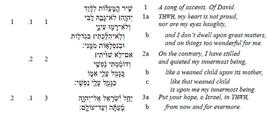
2 Textual notes
Superscript: Some Septuagint manuscripts and the Targum do not have לדוד in superscript,35 prompting commentators to argue that it belongs more naturally in the superscript of Ps 132 and should be deleted.36 The Masoretic Text has the overwhelming support of the ancient versions and should be retained. Three other poems in the collection (Pss 122, 124, 133) are also ascribed to David. The significance of these ascriptions to David cannot be discussed in the present study. For current purposes, it is relevant that the poem's "metaphoric imagery allows the reader or hearer to move past the psalm's 'royal' overtones and find a rich feminine picture of God."37 Bernard P. Robinson indicates that the theme of humility that permeates the poem "is a favourite theme of the 'Davidic' Psalms: cf 18,28… 34,27… and 101,5."38 In 2 Chr 32:25, Hezekiah is condemned for being a haughty king,39 exactly the opposite of David (2 Sam 6:21-23; 7:18-29). The ascription to David thus - at least - recalls the proverbial humility of Israel's ideal royal figure,40 an attitude displayed for instance in 2 Sam 7:18-22.41
Verse 2abc: The crux interpretum of this brief poem is determining the intention of the extended simile (כְגמֻל in v. 2b; כגמֻל in v. 2c) with no clear tertium comparationis introduced by the expected particle ןֵכ "so" as well as the concomitant interpretation of the image (translated literally) "as a weaned child (גמֻל) upon (עֲלֵי) its mother (א מֹו), as the weaned child (כ גמֻל) is upon (ע ל י) me my innermost being (נ פְ ש י)."42
Four possible solutions to the difficult interpretational issues have been proposed. The first solution is to regard the phrase נפשי עלי כגמל in v. 2c as an explanatory gloss and unnecessary repetition of v. 2b and to delete it.43 A second possibility is to over-interpret the phrase, sometimes also accompanied by textual emendation. Following the Targum's paraphrastic rendering of the phrase (באורית אתגברית אמיה תדיי על חסילא היך, "like a weaned child upon the breasts of its mother, I have grown strong in the Law"),44 some commentators read more into the Hebrew than is implied. Samuel Terrien, for example, translates v. 2 as "Far from this! My desires are moderate and quiet. Like those of an infant at his mother's breast; yes, my desires are like those of an infant." He interprets נפשי as "the seat of desire" and argues that the poet compares "himself to a well-fed infant, sated and entirely satisfied, at his mother's breast or in his mother's arms."45
A third possibility is to emend the text with reference to the ancient versions, notably the Septuagint. The Septuagint indicates that the poem's interpretation was already problematic during the Second Temple period. In most Septuagint manuscripts, the verse reads:
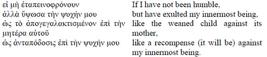
The Septuagint takes the emphatic adversative particle אם־לא "on the contrary" as a negative conditional phrase εἰ μὴ, "if not."46 The Masoretic Text's דוממתי, "I have quieted," is read as רוממתי, "I have exulted." כְגמֻל "as a weaned child" in v. 2b is taken as ὡς τὸ ἀπογεγαλακτισμένον, "as the weaned child," עלי, "upon," is rendered by ἐπὶ, "against" and כגמֻל, "as the weaned child," in v. 2c as ὡς ἀνταπόδοσις, "like a recompense," apparently relating גמל to the noun גְמּול "requital, recompense." It is not clear whether the Septuagint should be interpreted in bonam partem (i.e., because I am humble and not fretful like the weaned child to get on the mother's breast, YHWH will recompense me accordingly) or in malam partem (i.e., if I am not humble but fretful like the weaned child to get on the mother's breast, YHWH will act against me).47 Codex Sinaiticus avoids the ambiguity by translating the last phrase as ἑως ἀνταποδώσεις τὴν ψυχήν μου, "until you recompense my innermost being," thus making the positive outcome explicit. כגמֻל (v. 2c) is then apparently taken as a verbal form גמלת, "you will recompense."48
Jerome offers two translations of v. 2.49 In his Liber Psalmorum iuxta LXX translatus (the so-called Gallican Psalter) he translates:


This represents a literal translation of the Septuagint and is thus also prone to ambiguous interpretation. In his Liber Psalmorum iuxta Hebraicum translatus (cf. also the Vulgate), Jerome offers the following translation:

כגמֻל in v. 2c is apparently read as תגמל, "it is weaned" (Niphʿal Imperfect 3 fem. sing. of גמל "to wean"), an emendation accepted by numerous commentators. This translation interprets the metaphor in bonam partem. It implies that the poet's innermost being is no longer in turmoil; it has been weaned of "great things" and "things that are too wonderful" (v. 1) for a human being to comprehend.50 Taking his cue from the alternative reading of v. 2c in the Septuagint, P.A.H. de Boer removes the problematic double simile entirely from the text.51 He relates גמל to the Septuagint's ἀνταπόδοσις, "recompense," and translates v. 2cd as "thus as one makes with his mother, thus I have made myself content." According to him, it is not a "weaned" child that is involved, but a "subdued" child. He "is not rebellious but makes himself content whatever his lot may be, 'just as one makes his mother content'."52
Successive attempts at emending a difficult Hebrew text led to "solutions" without any justification in the Masoretic Text. Hence, a last possibility is to accept the Masoretic Text.53 Walter Beyerlin quite rightly argues that the interpretation of the poem then depends on the connotation(s) attached to the preposition על (cf. עֲלֵי in v. 2b; ע ל י in v. 2c).54 He departs from two presuppositions. First, על should have the same connotation in v. 2b and v. 2c.55 Second, with reference to various lexicons, he indicates that על in v. 2b and 2c should either be translated as "upon" or - especially in accordance with the widely accepted position that it is a post-exilic text - as "(in relation) to"; על is then semantically close to the preposition ל א.56
Beyerlin opts for "(in relation) to," arguing that the tertium comparationis of the extended simile is not the poet's feelings or state of mind, but the relationship of his innermost being to himself is compared to the relationship of a "weaned child" to its mother. He sees the poet reprimanding his innermost being (נפשי) in Pss 42:6, 12; 43:5 for being disturbed in him (עלי ותהמי) and encouraging it to "wait" (הוחילי) upon God as a significant parallel to vv. 2-3.57 Psalm 131:2abc implies that the poet's innermost being is not in turmoil as in Ps 42/43, but "in relation to him" (i.e. his entire being) can be compared to the inner content and safety a גמל, "weaned child," experiences in relation to its mother.58
Commentators choosing the "upon" option emphasise that גמל usually refers to a weaned child no longer suckling from its mother (Gen 21:8; 1 Sam 1:20-23). The "weaned child" no longer yearns for the mother's milk per se. It has been weaned of the urge "zur Stillung seiner Vitalbedürfnisse mit ungeduligem Ungestüm und lärmendem Klage auf seine Mutter einzudringen."59 Ancient Near Eastern depictions indeed portray toddlers being carried on their mother's shoulders60 and similar images occur in the Hebrew Bible (Isa 49:22). Frank-Lothar Hossfeld and Erich Zenger posit that the "'stilling' of the 'soul' according to Ps 131:1-2 is… the precondition for a new and deep experience of God" and they paraphrase v. 2bc as follows: "Like a nursed child with its mother, like a nursed child with me - so is my soul with you, YHWH, as my mother who nurses, protects, and consoles me."61 One controversial issue then needs to be addressed, namely the syntactical relationship between the three words in v. 2c. Beat Weber argues that v. 2c can be translated as either "as the weaned child upon me is my innermost being," or "as the weaned child is upon me my innermost being."62 Hossfeld and Zenger opt for the first possibility and deduce that the speaking I is in fact a mother (v. 2b) who refers to herself (v. 2c).63 The Masoretic accents favour the second possibility. A conjunctive accent (mūnāḥ) with י ל ע suggests a close relationship between י ש ְפ נ and י ל ע, hence I prefer the translation, "like that weaned child is upon me my innermost being." The implication is that the poet "carries" his "innermost being," which is calm (v. 2a) and content (v. 2b) and extends that image to his personal (v. 1-2) and Israel's collective (v. 3) relationship with YHWH.64 Ultimately, by stilling and quieting his innermost being, the psalmist confesses that s/he is being carried by YHWH.
Verse 3ab: Some commentators regard the verse as a liturgical addition that points to the fact that v. 3a is a repetition of Ps 130:7a and v. 3b of Pss 121:8b and 125:2b.65 Walter Beyerlin argues convincingly that both phrases can be regarded as stock liturgical expressions and that Pss 62:9-10 and 130:7-8, both of which share numerous similarities with Ps 131, also contain the shift from deeply personal prayer and/or confession to communal exhortation;66 hence, there is no reason to suspect that v. 3ab is a later addition.
3 Content
I demarcate two stanzas in the poem. Stanza 1 (vv. 1-2) is concerned with the poet's deeply personal confession, the confession of a "lyrical I,"67 that s/he is not guilty of any form of hubris and content to be quiet in YHWH's supportive and protective presence. In Stanza 2 (v. 3), the poet broadens the scope to include the Israelite community. It contains an admonition to Israel to put its trust in YHWH, both now and in the future. Personal dependence becomes a collective and intergenerational way of life. It is noteworthy that the cola becomes progressively shorter, suggesting that the poem reaches a climax in v. 3ab.68
Stanza 1 consists of two strophes (v. 1; v. 2), each containing a single verse line, the first stating the state of mind of the "lyrical I" in negative, the second in positive terms. Three characteristics of the stanza should be noted. First, the "lyrical I" employs synecdoche (לבי and עיני, v.1a; נפשי, v. 2a, 2c) to refer to her/his entire being. Second, synonymous word pairs are utilised to emphasise the poet's tranquil state of mind (רמו לא // לא־גבה, 1a; נפלאות // גדולות, v. 1b; דוממתי // שויתי, v. 2a). Third, the repetition of נפשי and גמל in v. 2abc creates a chiastic pattern emphasising the poet's contentment in the presence of and dependence upon YHWH (נפשי, 2a [a]; כגמל, 2b [b]; כגמל, 2c [b1]; נפשי, 2c [a1]).
Strophe 1.1 (v. 1ab) consists of a single bicolon. It is introduced by the vocative יהוה, emphasising the entire poem's focus on the divinity. This is also suggested by the repetition of יהוה in the last verse line (3a). The divine name creates an inclusio encompassing the entire poem.69 Colon 1a constitutes an internal syntactic and semantic parallelism (cf. // לבי לא־גבה עיני ולא־רמו, i.e., negative particle לא + perfect verb + body part with first-person singular suffix). Neither the poet's לב as centre of human intelligence, nor the עין as instrument of the longing gaze is engaged in frenetic activity.70 The parallel expressions לא־לבי גבה and עיני לא־רמו have significant parallels in wisdom literature (Prov 6:16, 17; 16:5; 18:12; 21:4; 30:13). Colon 1b is semantically parallel to colon 1a. In v. 1a references to body parts function as pars pro toto for the suppliant's body. No explicit reference is made to any body part in v. 1b. However, the feet are implied by the verbal action ולא־הלכתי, "I do not dwell upon." Colon 1b contains an internal chiasm (cf. בגדלות הלכתי ולא, i.e., first person singular verb + preposition ב + adjective feminine plural, followed by ממני ובנפלאות, i.e., preposition ב + noun feminine plural + preposition with first person singular suffix). For the interpretation of v. 1b, it is important to recognise גדולות and נפלאות as a word pair with a specific connotation of YHWH's mighty deeds in creation and history (Job 5:9; 37:5; Ps 136:4). The strophe suggests the poet's whole-body experience as lacking frantic activity,71 hence, as not attempting to penetrate the divine sphere.
Strophe 1.2 (v. 2abc) consists of a tricolon introduced by the adversative particle אם־לא, "on the contrary." The adversative particle suggests that the actions described in this strophe are the opposite of those described in the previous one. Colon 2a contains an internal syntactic and semantic parallelism (cf. נפשי ודוממתי שויתי, i.e., two synonymous first person singular perfect verbs, with נפשי doing double duty as object for both verbs). Cola 2bc contains a simile and through repetition of כגמל, "like a weaned child" (cf. 2b, 2c), likens the stilling and quieting of the poet's innermost being (cf. the repetition of נפשי in v. 2a and 2c) in YHWH's presence to the content a weaned child experiences in its mother's presence (v. 2c).72 The strophe is again permeated by wisdom terminology. It shows particular affinities to the attitude expressed by Job in Job 42:1-6. In the presence of YHWH, the "lyrical I" enjoys a whole-body experience of peace.73
Stanza 2 (vv. 3a-4c) consists of a single strophe with only one bicolon. The perspective broadens from the "lyrical I" to include the people of Israel. The strophe contains an admonition to Israel to also put their trust in YHWH (יחל ישראל אל־יהוה in v. 3a; cf. Ps 130:7). By means of the merism ועד־עולם מעתה ("both now and forever more" in v. 3b; cf. Pss 121:8; 125:2), the "lyrical I" implies that it should not be a temporary emergency measure in a time of crisis, but a constant way of life.
Psalm 131 commences with a first-person singular narration. The narration consists of six first-person singular pronominal suffixes (לבי and עיני in 1a; ממני in 1b; נפשי in 2a; עלי and נפשי in 2c) and three first-person singular verbal forms (הלכתי in 1a; שויתי and דוממתי in 2a). In v. 3, the poem's perspective broadens to a communal exhortation directed at Israel to "wait" (יחל) upon YHWH (cf. Ps 130:7) both "now and for evermore" (ועד־עולם מעתה; cf. Pss 121:8; 125:2). Significantly, the poem contains no reference to any hostile bodies, hence, no overt mention of any traumatic experiences. The body of the "lyrical I" in Ps 131 is at rest. The body, as a mobile spatial field, arrived at-centre and is at rest. The body as space is at rest in positive space. The emotion-fused thought (לבי) and longing gaze (עיני) of the "lyrical I" attained its goal. It is גבה לא, "not proud" and רמו לא, "not haughty" (v. 1a), ממני ונפלאות בגדלות ולא־הלכתי, "and I don't dwell upon great matters, things too wonderful for me." The "lyrical I" is no longer ascending, no longer involved in purposeful, even frantic activity. In v. 2a the adversative particle אם־לא suggests a strong contrastive attitude, ודוממתי שויתי נפשי, "I have stilled and quieted my innermost being." The entire human being came at rest to the core. Indeed, נפש here "does not represent any specific aspect of life, but life itself."74
The associations created by the extended simile כגמל → אמו → נפשי in vv. 2bc suggest complete tranquillity. All anxiety or excitement has passed. The royal divine body becomes the caring, nurturing body of a mother.75 Through the repetition of נפשי in Ps 131:2a, 2c the negative implications of שבע are completely reversed. The hard-to-digest food of suffering has been replaced by the nurturing presence of YHWH, the caregiver, the "mother-god" of Israel. This experience of being "at-centre" becomes the basis for the call of the "lyrical I" upon the collective human body in Ps 131:3a: אל־יהוה ישראל יחל, "put your hope in YHWH, o Israel!" (cf. Ps 130:7).76 This is a call for Israel to persevere in the face of enmity and adversity, based upon YHWH's covenant loyalty (cf. Ps 130:7-8). That hope is not intended to be a temporary emergency measure in times of crisis. The expression, ועד־עולם מעתה, "both now and forever more" (cf. Pss 121:8; 125:2), indicates that the "lyrical I" challenges Israel to make his/her experience of contentment in the presence of YHWH a constant way of life. The ability of the "lyrical I" to imagine an other reality amidst hardship and life's uncontrollable and unimaginable challenges, provides the psalmist the opportunity to enjoy a whole-body experience in the presence of the divine caregiver.77
D REFLECTIONS ON INTERGENERATIONAL RESILIENCE IN PS 131 IN THE CONTEXT OF THE SONGS OF ASCENTS
The current study is not the place to reflect on the numerous views on and interpretations of the המעלות שירי collection.78 For present purposes, it is sufficient to note that any interpretation of Pss 120-134 should consider the negative lived realities implied in the collection. References to individual and collective trauma abound.79 It includes the presence of a universal Persian Empire, a small, impoverished province of Yehud, a growing priestly aristocracy and the deep longing of marginalised groups ("servants"; "poor"; upright"; pious") to be "near" and "at-centre," i.e., to experience מעלות.80 They dared to imagine an other reality, which might consist of several מעלות experiences, such as the return from exile, pilgrimages to the rebuilt temple in Jerusalem for the pilgrimage festivals of pesaḥ, sukkôt or šābuʿôt (Exod 23:14-17; 34:18-23; Deut 16:1, 9-10, 13, 16-17) or מעלות experiences appropriated by the imagination.81 In a previous study, I proposed that Pss 120-134 can be read as a collection containing five triads of three poems each and that a careful reading of the poems in sequence reveals that they tell a spatial story of a journey that commences far, off-centre, in turmoil and distress but arrives at a destiny, at-centre, at rest and in peace.82 A negative spatial experience has a positive outcome. Trauma is reframed, a counterspace is created and it leads to resilience and hope.
In Pss 120-122, Israel (cf. ישראל; Ps 121:4) commences life's journey (Ps 120) in negative space, far, off-centre, in turmoil, amidst deadly enemies hating (שנא, v. 6) peace (שלום, v. 6, 7) and ever ready for war (מלחמה, v. 7). Israel experiences intense trauma. However, it embarks on this perilous journey (Ps 121:1) with the help (עזרי, vv. 1, 2) and under the eternal (ועד־עולם מעתה, v. 8) protection of (שמר, vv. 3, 4, 5, 7, 8) YHWH, who made heaven and earth (עשה שמים וארץ, v. 2). The people are not helpless victims of trauma, but agents of change in the midst of adversity. It is emphasised in Ps 122, when they joyfully arrive at the gates of Jerusalem (עמדות היו רגלינו בשעריך ירושלים, v. 2), the seat of YHWH's presence, to praise his name (להדות לשם יהוה, v. 5), according to the statute given to Israel (עדות לישראל, v. 5; cf. Ps 121:4). There, justice (למשפט, v. 5) is served and there the negative experience of severe trauma is reversed and peace (שלום, vv. 6, 7, 8) can be experienced. A reading of the three poems in sequence suggests a horizontal, but ascending (ששם עלו שבטימ שבטי־יה; Ps 122:4) movement from positive to negative space. Israel overcomes the traumatic experience of being alone in exile by journeying under the protection of YHWH to Jerusalem, there to enjoy the experience of being at home in the presence of YHWH and compatriots. Their negative firstspace needs not be a static, irreversible traumatic experience. Embarking on life's journey with the help and under protection of YHWH can aid them in reaching their desired destination - a life of peace in the presence of YHWH and compatriots. That experience allows them to be resilient while facing harsh realities.
Psalms 123-125 echo the movement from positive to negative space, but state it in abstract terms as a journey through secondspace. In Ps 123, the people of Israel (cf. Ps 124:1) - having arrived in Jerusalem (Ps 122) - depart on an imaginative vertical journey, their eyes fixed on YHWH enthroned in heaven (הישבי בשמים, v. 1). In complete dependence on his mercy (v. 2), they pray for mercy (חננו יהוה חננו, v. 3) because they are completely sated (שבע, v. 3, 4) by the contempt (בוז, v. 3, 4) experienced at the hands of their tormentors. This traumatic experience is also addressed in Ps 124 by means of an extended conditional sentence. Israel should confess (יאמר־נא ישראל, v. 1) that if it were not for YHWH who was with them (לולי יהוה שהיה לנו, v. 1, 2), then (אזי, v. 3, 4, 5), they would have been annihilated by their enemies, metaphorically described as being engulfed by a stream (נחלה, v. 4) and by raging waters (המים הזידונים, v. 5). However, they can praise YHWH (ברוך יהוה, v. 6) because he did not let them become prey for their enemies (v. 6-7). Their help (עזרנו, v. 8; cf. Ps 121:1, 2) is in the name of YHWH (בשם יהוה, v. 8; cf. Ps 122:4) who made heaven and earth (עשה שמים וארץ, v. 8; cf. Ps 121:2). Trauma is reframed in light of Israel's firm belief that YHWH is their saviour. This confession is confirmed in Ps 125. Those who trust in YHWH stands firm like Mount Zion (כהר חיון, v. 1). As Jerusalem (ירושלם, v. 2) is surrounded by mountains, YHWH surrounds his people, from now on and for evermore (מעתה ועד־עולם, v. 2; cf. Ps 121:8). This confession is rooted in the firm belief that the wicked (הרשע, v. 3) will not rule over the righteous (הצדיקים, v. 3, 4) indefinitely. The wicked will be dealt with, while Israel (ישראל, v. 5; cf. Pss 121:4; 122:4; 124:1) will experience peace (שלום, v. 5; cf. Pss 120:6, 7; 122:6, 7, 8). Negative abstract space becomes positive lived experience by focusing vertically on YHWH's benevolent presence surrounding his people, thus travelling to heaven (Ps 123) and avoid plunging into the depths (Ps 124).
In Pss 126-128, the focus falls entirely on the positive lived experience, the third-spatial counterspace of Israel's traumatic past experiences. Characteristic of this triad is the explicit reference to the small, mundane, everyday activities of ordinary people just getting on with their lives - to sowing and reaping (Ps 126), working and raising families (Ps 127) and expecting the fruit of their labour (Ps 128). These expectations are set in the context of the trials and tribulations of Zion (Pss 126:1-3; 128:5-6). Right at the heart of the המעלות שירי collection, harsh reality, everyday activities, real life struggles and divine presence, protection, intervention and blessing meet to create a harmonious lived experience in the face of traumatic experiences. In Ps 126, Israel remembers Zion's past experiences of unexpected reversal(s) of fortune (בשוב יהוה את־שיבת ציון; 126:1; cf. Ps 125:1), even to the astonishment of nations (vv. 2-3). It allows her to urgently call upon YHWH to completely restore Zion's fortune again (שובה יהוה את־שבותנו; 126:4; cf. Pss 125:1; 126:2). Everyday life - laborious toiling, but joyful reaping - becomes a metaphor to reframe past traumatic experiences and to create a counterspace, a space of hope, a resilience that transcends negative firstspace realities, unavoidable secondspace uncertainties, to become a hopeful and joyful third-spatial lived experience. Psalm 127 confirms this hopeful lived experience by adding a word of caution. If YHWH is not involved in the mundane everyday tasks of the small people, all efforts at reframing, at creating counterspaces, is in vain (שוא, v. 1, 2). Procreation, intergenerational survival and support are divine gifts (הנה נחלת יהוה בנים, v. 3) that should not be taken for granted, but enjoyed and utilised to secure a prosperous future (v. 4-5). Psalm 128 confirms that someone who lives in constant awareness of YHWH's awe-inspiring presence and actively walks in his ways, is truly happy (אשרי כל־ירא יהוה ההלך בדרכיו, v. 1, 4), can experience his blessing (ברך, v. 4, 5; cf. Ps 124:6) from Zion (מציון, v. 5; cf. Pss 125:1; 126:1), can enjoy the good that emanates from Jerusalem (וראה בטוב ירושלם, v. 5; cf. Pss 122:2, 3, 6; 125:2). Such a blessing has longevity (כל ימי חייך, v. 5) that spans generations (וראה־בנים לבניך, v. 6) and ensures peace (שלום, v. 6; cf. Pss 120:6, 7; 122:6, 7, 8; 125:5) for Israel (ישראל, v. 6; cf. Pss 121:4; 122:4; 124:1; 125:5). Resilience lies in living, mindful of YHWH's blessings and expectations. It ensures intergenerational survival and support and overcomes the traumatic experiences of everyday life.
Psalms 129-131 return to the abstract journey through secondspace and recall themes from Pss 123-125. On the one hand, Ps 129 focuses on the theme of Israel's (ישראל, v. 1; cf. Pss 121:4; 122:4; 124:1; 125:5; 128:6) trauma, her long history of oppression and hardship (vv. 1-3) at the hand of the wicked (רשעים, v. 4; cf. Ps 125:3) and those who hate (שנאי, v. 5; cf. Ps 120:6) Zion (ציון, v. 5; cf. Pss 125:1; 126:1; 128:5). On the other hand, it emphasises that YHWH is righteous (צדיק, v. 4; cf. Ps 125:3) and will ensure that Zion's enemies will not enjoy any longevity. The blessing of YHWH (ברכת יהוה, v. 8), indeed being blessed (ברכנו אתכם, v. 8; cf. Ps 128:4, 5) in the name of YHWH (בשם יהוה, v. 8; cf. Pss 122:4; 124:8), is not a privilege they can enjoy. Those causing trauma to YHWH's people do not have a future. In Ps 130, an individual who experienced the long history of trauma (Ps 129:1-3) calls to YHWH for salvation (vv. 1-3). The suppliant is deeply aware of his/her own sins (vv. 3-4), but also that waiting upon YHWH (קויתי, v. 5) and putting one's hope in his word (הוחלתי ולדברו, v. 5) is the only recourse for overcoming the unbearable trauma of guilt and self-induced suffering through sin (עונות, v. 3). It is worthwhile to expectantly watch out (משמרים לבקר, v. 6) for his salvation as he watches out (cf. שמר in Pss 121:3, 4, 5, 7, 8; 127:2) for his people. Ultimately waiting upon him, hoping in him, watching out for him, allows for the reframing of individual and collective trauma. Israel (ישראל, v. 7, 8; cf. Pss 121:4; 122:4; 124:1; 125:5; 128:6; 129:1) is encouraged to wait (יחל, v. 7) for YHWH, because loyalty (חסד, v. 7) and redemption (פדות, v. 7; יפדה, v. 8) come from him.
Psalm 131 closely echoes Ps 130, to such an extent that they can be regarded as poetic twins. In Ps 131, the suppliant completes the vertical second-spatial journey that commenced in Ps 123. S/he arrives at-centre, safely in the protective presence of YHWH. As in Ps 130, the poem begins with an intensely personal confession (v. 1-2). S/he avoids any form of hubris and finds complete contentment in the presence of YHWH. Again, as in Ps 130, the perspective then broadens to include the entire community. By repeating the same encouragement directed at Israel (ישראל, v. 3; cf. Pss 121:4; 122:4; 124:1; 125:5; 128:6; 129:1; 130: 7, 8) to wait upon YHWH (יחל ישראל אל־יהוה, v. 3; cf. Ps 130:7) and by putting that encouragement in a temporal-eschatological perspective (מעתה ועד־עולם, v. 3; cf. Pss 121:8; 125:2), the past traumatic experiences of Israel, on both individual and collective level, are reframed and become a source of intergenerational resilience, allowing Israel to create a counterspace, a space of resilience, in the face of trauma and exploitation.
The last triad (Pss 132-134) echoes the firstspace journey with Jerusalem as destiny described in Pss 120-122. However, in this triad, the traumatic firstspace realities alluded to in Pss 120-122 have been reframed. Negative space has been reconstructed through a world of words into a positive counterspace. Following the positive secondspace described in Ps 131, the last triad contains no explicit references to any traumatic experiences. Israel's spatial journey's ultimate goal is resilience. Psalm 132 contains a vivid description of Zion and its temple as YHWH's earthly abode, his chosen residence (כי־בחר יהוה בציון אוה למושב לו, v. 13; cf. Pss 125:3; 129:5). By harking back to Israel's mythical past when David founded Mount Zion as Israel's cultic centre (vv. 1-10), the poem also opens the door to Israel's eschatological future (vv. 11-18). From Zion (v. 11), depicted as the centre of the universe, the place where YHWH chose to be present for evermore (זאת־מנוחתי עדי־עד פה־אשב כי אותיה, v. 14), YHWH's blessings (ברך אברך, v. 15; cf. Pss 128:4, 5; 129:8) will flow to his people, explicitly designated the poor (אביוניה, v. 15) and the pious (וחסידיה, v. 16). Zion's enemies, on the other hand, will be utterly shamed (איביו אלביש בשת, v. 18). Psalm 133 expands upon the notion of YHWH's abundant blessing of his people living together in harmony (v. 1). Two similes emphasise the point. Like oil flowing from the head of Aaron to the hem of his high-priestly robe (v. 2) and dew flowing from Mount Hermon in the northern extremities of Israel's territory to have a positive influence on the mountains of Zion (הררי ציון, v. 3; cf. Pss Pss 125:3; 129:5; 132:13) in the south, YHWH will command his blessing (כי שם צוה יהוה את־ברכה, v. 3; cf. Pss 128:4, 5; 129:8; 132:15) upon his people. That blessing will be intergenerational - life for evermore (חיים עד־העולם, v. 3; cf. Pss 121:8; 125:2; 131:3). The final poem (Ps 134) contains a vivid description of being at-centre. Significantly, the root ברך occurs three times (vv. 1, 2, 3). However, different from previous occurrences of the root (cf. Pss 128:4, 5; 129:8; 132:15), it is no longer an action performed only by YHWH from the divine sphere when he blesses his people. It has also become an action performed from the human sphere when the servants of YHWH (עבדי יהוה, v. 1) praise him. Experiencing divine blessing in the face of traumatic experiences elicits a response of resilience. His people can now praise him, the deity who blesses each one of them individually (יברכך, v. 3; cf. Pss 128:4, 5; 129:8; 132:15; 133:3; 134:1, 2) from Zion (ציון, v. 3; cf. Pss 125:3; 129:5; 132:13; 133:3). He is, after all, the God who made heaven and earth (עשה שמים וארץ, v. 3; cf. Pss 121:2; 124:8).
E CONCLUSION
In this study, I have focused on the theme of intergenerational resilience in the face of unbearable trauma and adverse real-life spatial experiences as it finds expression in Ps 131 in the context of the collection of poems known as the שירי המעלות, "Songs of Ascents" (Pss 120-134). I indicate that Ps 131 is remarkable in the sense that it does not expressly refer to trauma at all, only to complete contentment and in a context where animosity, anxiety, insecurity and turmoil - all markers of severe trauma - are often expressed. Even more remarkable, the three poems following Ps 131 in the המעלות שירי collection (Pss 132-134) continue the trend. Trauma is not expressly referred to at all. I argue that Ps 131 plays a crucial role in the spatial journey described in Pss 120-134. That journey can be described as a journey from far to near, from being off-centre to being at-centre, from being victims of trauma and exploitation to being servants of YHWH who can praise him. Through the world of words created by these poems, a counterspace came into being, a lived experience where the presence of YHWH accompanies his people, individually and collectively, allowing them to exhibit intergenerational resilience as reliance.
BIBLIOGRAPHY
- Anderson, A.A. The Book of Psalms, Volume 2 Psalms 73-150. New Century Bible Commentary. Grand Rapids: Eerdmans, 1981.
- Berges, Ulrich. "Die Knechte im Psalter: Ein Beitrag zu seiner Kompositionsgeschichte." Biblica 81 (2000): 153-178.
- Botha, Phil J. "To Honour Yahweh in the Face of Adversity: A Socio-critical Analysis of Psalm 131." Skrif en Kerk 19 (1998): 525-533.
- Briggs, Charles A. and Emily G. Briggs. A Critical and Exegetical Commentary on the Book of Psalms, Volume 2. International Critical Commentary. Edinburgh: T&T Clark, 1925.
- Brueggemann, Walter and William H. Bellinger, Jr. Psalms. New Cambridge Bible Commentary. New York: Cambridge University Press, 2014.
- Burden, Jasper J. Psalms 120-150. Kaapstad: N G Kerk Uitgewers, 1991.
- Carr, David M., Holy Resilience: The Bible's Traumatic Origins. New Haven: Yale University Press, 2014.
- Crow, Loren D. The Songs of Ascents (Psalms 120-134): Their Place in Israelite History and Religion. Society of Biblical Literature Dissertation Series 148. Atlanta: SBL Press, 1996.
- Dahood, Mitchell. Psalms III: 101-150. The Anchor Bible 17A. New York: Doubleday, 1970.
- De Andrado, Paba N. "The Resilience of the Captive Girl Child in 2 Kings 5." Journal for the Study of the Old Testament 45 (2021: 461-475.
- De Boer, P.A.H. "Psalm CXXXI 2." Vetus Testamentum 16 (1966): 287-292.
- deClaissé-Walford, Nancy. Psalms Books 4-5. Wisdom Commentary 22. Collegeville: Liturgical Press, 2020.
- deClaissé-Walford, Nancy L., Rolf A. Jacobson, and Beth LaNeel Tanner, The Book of Psalms. New International Commentary on the Old Testament. Grand Rapids: Eerdmans, 2014.
- Deissler, Alfons. Die Psalmen. 2. Auflage. Düsseldorf: Patmos, 1979.
- Duranti, Allesandro. "Indexical Speech across Samoan Communities." American Anthropologist 99 (1997): 342-354.
- Esterhuizen, Elizabeth and Alphonso Groenewald, "Towards a Theology of Migration: A Survival Perspective from Isaiah 1-12," Transilvania 10 (2021): 34-41.
- Frechette, Christopher G. and Elizabeth Boase. "Defining 'Trauma' as a Useful Lens for Biblical Interpretation." Pages 1-23 in Bible through the Lens of Trauma. Edited by Elizabeth Boase and Christopher G. Frechette. Semeia Studies 86. Atlanta: SBL Press, 2016.
- Gillmayr-Bucher, Susanne. "Body Images in the Psalms." Journal for the Study of the Old Testament 28 (2004): 301-326.
-
Groenewald, Alphonso. "'For Great in Your Midst Is the Holy One of Israel' (Is 12:6b): Trauma and Resilience in the Isaianic Psalm." HTS Teologiese Studies/Theological Studies 73(4) (2017): 4 pages online, a4820. https://doi.org/10.4102/hts.v73i4.4820.
» https://doi.org/10.4102/hts.v73i4.4820 - ______. "Micah 4:1-5 and a Judean Experience of Trauma," Scriptura 116 (2017): 55-65.
- Gunkel, Hermann. Die Psalmen. 6. Aufl. Göttingen: Vandenhoeck & Ruprecht, 1986 [1929].
- Hossfeld, Frank L. and Erich Zenger. Psalms 3. Translated by Linda M. Maloney. Hermeneia. Minneapolis: Fortress, 2011.
- Keet, Cuthbert C. A Study of the Psalms of Ascents: A Critical and Exegetical Commentary upon Psalms CXX to CXXXIV. London: Mitre, 1969.
- Kissane, Edward J. The Book of Psalms, Volume 2 (Psalms 73-150). Dublin: Browne and Nolan, 1954.
- Kittel, R. Die Psalmen. Kommentar zum Alten Testament 13. Leipzig: Werner Scholl, 1922.
- Kraus, Hans-Joachim. Psalms 60-150. Translated by Hilton C. Oswald. Continental Commentaries. Minneapolis: Augsburg, 1989.
- Lefebvre, Henri. The Production of Space. Translated by Donald Nicholson-Smith. Oxford: Blackwell, 1991.
- Leupold, H.C. Exposition of the Psalms. Welwyn: Evangelical Press, 1977.
- Loretz, Oswald. Die Psalmen II: Beitrag der Ugarit-Texte zum Verständnis von Kolometrie und Textologie der Psalmen: Psalm 90-150. Alter Orient und Altes Testament 207. Neukirchen-Vluyn: Neukirchener Verlag, 1979.
- Miller, Patrick D. "Things Too Wonderful: Prayers of Women in the Old Testament." Pages 237-251 in Biblische Theologie und gesellschaftlicher Wandel: Für Norbert Lohfink. Edited by Georg Braulik, Walter Groß, and Sean McEvenue. Freiburg: Herder, 1993.
- Mowinckel, Sigmund. The Psalms in Israel's Worship, Volume 1. Translated by D. R. Ap-Thomas. Oxford: Blackwell, 1967.
- ______. Psalm Studies, Volume 1. Translated by Mark E. Biddle. History of Biblical Studies 2. Atlanta: SBL Press, 2014.
- O'Connor, Kathleen M. Jeremiah: Pain and Promise. Minneapolis: Fortress, 2012.
- Oesterley, William O.E. The Psalms. London: SPCK, 1939.
- Prinsloo, Gert T.M. "The Role of Space in the המעלות שירי) Psalms 120-134)." Biblica 86 (2005): 457-477.
- ______. "Place, Space and Identity in the Ancient Mediterranean World: Theory and Practice with Reference to the Book of Jonah." Pages 3-25 in Constructions of Space V: Place, Space and Identity in the Ancient Mediterranean World. Edited by Gert T. M. Prinsloo and Christl M. Maier. Library of Hebrew Bible/ Old Testament Studies 576. London: Bloomsbury T&T Clark, 2013.
- ______. "Suffering Bodies - Divine Absence: Towards a Spatial Reading of Ancient Near Eastern Laments with Reference to Psalm 13 and An Assyrian Elegy (K 890)." Old Testament Essays 26 (2013): 773-803.
- ______. "From Desperation to Adoration: Reading Psalm 107 as a Transforming Spatial Journey." Acta Theologica Supplements 32 (2021): 392-425.
- ______. "Raised Eyes and Humble Hearts: The Body as/in Space in Psalms 123 and 131." Old Testament Essays 36 (2023): 166-188.
- Prinsloo, Willem S. "Psalm 131: 'Nie My Wil Nie, O Here…'" Skrif en Kerk 7 (1986): 74-82.
- Quell, Gottfried. "Struktur und Sinn des Psalms 131." Pages 173-185 in Das Ferne und Nahe Wort: Festschrift Leonhard Rost zur Vollendung seines 70. Lebensjahres am 30. November 1966 gewidmet. Edited by Fritz Maass. Beihefte zur Zeitschrift für die alttestamentliche Wissenschaft 105. Berlin: Alfred Töpelmann, 1967.
- Robson, Jr., James P and Meredith Troutman-Jordan. "A Concept analysis of Cognitive Reframing." Journal of Theory Construction & Testing 18 (2014): 55-59.
- Seidel, Hans. "Wallfahrtslieder." Pages 26-40 in Das Lebendige Wort: Beiträge zur kirchlichen Verkündigung. Festgabe für Gottfried Voigt zum 65. Geburtstag. Edited by Hans Seidel and Karl-Heinrich Bieritz. Berlin: Evangelische Verlagsanstalt, 1982.
- Seybold, Klaus. Die Psalmen. Handbuch zum Alten Testament 1/15. Tübingen: Mohr Siebeck, 1996.
- Soja, Edward W. Thirdspace: Journeys to Los Angeles and Other Real-and Imagined Places. Oxford: Blackwell, 1996.
- Stec, David M. The Targum of Psalms. The Aramaic Bible 16. London: T&T Clark, 2004.
- Strawn, Brent A. "Trauma, Psalmic Disclosure, and Authentic Happiness." Pages 143-160 in Bible through the Lens of Trauma. Edited by Elizabeth Boase and Christopher G. Frechette. Semeia Studies 86. Atlanta: SBL Press, 2016.
- Terrien, Samuel. The Psalms: Strophic Structure and Theological Commentary. Eerdmans Critical Commentary. Grand Rapids: Eerdmans, 2003.
- Thompson, Leonard L. Introducing Biblical Literature: A More Fantastic Country. Englewood Cliffs: Prentice-Hall, 1978.
- Tuan, Yi-Fu. Space and Place: The Perspective of Experience. 6th printing. Minneapolis: University of Minnesota Press, 2008.
- Tucker Jr., W. Dennis. Constructing and Deconstructing Power in Psalms 107-150. Ancient Israel and Its Literature 19. Atlanta: SBL Press, 2014.
- Van der Ploeg, J.P.M. Psalmen Deel II: Psalm 76 T/M 150. Boeken van het Oude Testament 7b. Roermond: J.J. Romen, 1974.
- VanGemeren, Willem A. Psalms. Expositor's Bible Commentary 5. Grand Rapid: Zondervan, 1991.
- Weber, Beat. Werkbuch Psalmen II: Die Psalmen 73 bis 150. Stuttgart: Kohlhammer, 2003.
- Weiser, A. The Psalms. Translated by Herbert Hartwell. Old Testament Library. London: SCM, 1979.
- Zenger, Erich. Ich will die Morgenröte wecken: Psalmenauslegungen. Freiburg: Herder, 1991.
Peer-reviewed: 02/12/2025
Accepted: 05/03/2025
1 David M. Carr, Holy Resilience: The Bible's Traumatic Origins (New Haven: Yale University Press, 2014), 6.
2 Cf. Pss 120:1-7; 121:1; 123:1-4; 124:1-8; 125:5; 126:4; 127:5; 129:1-8; 130:1-8; 132:18. According to Erich Zenger, Ich will die Morgenröte wecken: Psalmenauslegungen (Freiburg: Herder, 1991), 128, "(d)er Wallfahrtspsalter ist in einer Zeit der Enttäuschung, ja innere Anfechtung und politischen Unterdrückung entstanden."
3 For the עבדים as a marginalised post-exilic group, cf. Ulrich Berges, "Die Knechte im Psalter: Ein Beitrag zu seiner Kompositionsgeschichte," Bib 81(2000): 153-178; for the Persian province of Yehud as a marginalised entity in the Persian Empire, cf. W. Dennis Tucker, Jr., Constructing and Deconstructing Power in Psalms 107-150 (AIL 19; Atlanta: SBL Press, 2014), 55-94.
4 Reframing is a concept closely associated with cognitive behaviour therapy. James P. Robson, Jr. and Meredith Troutman-Jordan, "A Concept analysis of Cognitive Reframing," Journal of Theory Construction & Testing 18 (2014): 58, define cognitive reframing as "a therapeutic technique used to alter or self-alter perceptions of a negative, distorted, or self-defeating belief with a goal of changing behaviors and/or improving well-being." In the current study, I will argue that insights from trauma and critical-spatial studies can aid modern readers in reconstructing the reframing process operative in the spatial journey of the "servants of YHWH" as expressed in the שירי המעלות collection. Singing the song had a therapeutic effect. Gert T.M. Prinsloo, "The Role of Space in the המעלות שירי) Psalms 120-134)," Bib 86 (2005): 477, indicates that the singers "find consolation in the fact that, even though they are exiles in their own country, they are safe in the protective arms of YHWH who will never forsake his true people." Zenger, Ich will die Morgenröte wecken, 129, calls the המעלות שירי, songs of "Hoffnung inmitten eines harten und verzweifelten Alltags."
5 Kathleen M. O'Connor, Jeremiah: Pain and Promise (Minneapolis: Fortress, 2012), 17, labels the book of Jeremiah as "a work of resilience, a moral act for the rebuilding of the community from the ashes of catastrophe. It is a kind of survival manual for victims of disaster and their offspring."
6 Robert J. Schreiter, "Reading Biblical Texts through the Lens of Resilience," in Bible through the Lens of Trauma (SemeiaSt 86; eds. Elizabeth Boase and Christopher G. Frechette; Atlanta: SBL Press, 2016), 194.
7 Carr, Holy Resilience, 7.
8 Alphonso Groenewald, "Micah 4:1-5 and a Judean Experience of Trauma," Scriptura 116 (2017): 55-65.
9 Christopher G. Frechette and Elizabeth Boase, "Defining 'Trauma' as a Useful Lens for Biblical Interpretation," in Bible through the Lens of Trauma (SemeiaSt 86; eds. Elizabeth Boase and Christopher G. Frechette; Atlanta: SBL Press, 2016), 13.
10 Alphonso Groenewald, "'For Great in Your Midst Is the Holy One of Israel' (Is 12:6b): Trauma and Resilience in the Isaianic Psalm," HTS Teologiese Studies/Theological Studies 73/4 (2017): 4 pages online, a4820. https://doi.org/10.4102/hts.v73i4.4820.
11 According to Schreiter, "Reading Biblical Texts," 195-203, resilience arises from confronting the paralysing effect of trauma through language and (ritual) enactment. He posits that "language has to be recovered as a vehicle for processing experience, the tyranny of past events that freezes us in an unending past and that blocks out the present and the future must be overcome, and a sense of meaning and a framework for right behavior must be restored" (196). Resilience "manifests itself… by focusing upon narratives of the group from the group's distant past that witness to its founding and having overcome adversity in those ancient times, as well as in subsequent encounters with trauma-including events" (201). Moreover, "the founding narratives are recounted in a ritual context. Ritual is important in dealing with trauma in two distinct ways. First of all, engaging in ritual is a setting off from routine or day-to-day time and space, denoting that what is being dealt with cannot be treated effectively with normal, mundane activity… Second, within the special spatiotemporal setting, ritual allows us to move through time in a different way; most notably, ritual makes possible moving backward in time to an earlier moment" (202).
12 Brent A. Strawn, "Trauma, Psalmic Disclosure, and Authentic Happiness," in Boase and Frechette, Bible through the Lens of Trauma (SemeiaSt 86; eds. Elizabeth Boase and Christopher G. Frechette; Atlanta: SBL Press, 2016), 143.
13 Paba N. De Andrado, "The Resilience of the Captive Girl Child in 2 Kings 5," JSOT 45 (2021): 461-475.
14 Elizabeth Esterhuizen and Alphonso Groenewald, "Towards a Theology of Migration: A Survival Perspective from Isaiah 1-12," Transilvania 10 (2021): 35.
15 Cf. the seminal approach to spatial analysis by the French Marxist philosopher, Henri Lefebvre, The Production of Space (trans. Donald Nicholson-Smith; Oxford: Blackwell, 1991), 38-39. Lefebvre differentiates between physical or "perceived" space, mental or "conceived" space, and social or "lived" space. Edward W. Soja, Thirdspace: Journeys to Los Angeles and Other Real-and Imagined Places (Oxford: Blackwell, 1996), 66-67, uses the terms Firstspace, Secondspace, and Thirdspace for this trialectic of spaces. I simply utilise the neologisms firstspace, secondspace and thirdspace when I refer to the three "spatial dimensions."
16 Yi-Fu Tuan, Space and Place: The Perspective of Experience (6th printing; Minneapolis: University of Minnesota Press, 2008), 8.
17 Gert T. M. Prinsloo, "Place, Space and Identity in the Ancient Mediterranean World: Theory and Practice with Reference to the Book of Jonah," in Constructions of Space V: Place, Space and Identity in the Ancient Mediterranean World (ed. Gert T. M. Prinsloo and Christl M. Maier; LHBOTS 576; London: Bloomsbury T&T Clark, 2013), 7.
18 Gert T. M. Prinsloo, "Suffering Bodies - Divine Absence: Towards a Spatial Reading of Ancient Near Eastern Laments with Reference to Psalm 13 and An Assyrian Elegy (K 890)," OTE 26 (2013): 781.
19 Leonard L. Thompson, Introducing Biblical Literature: A More Fantastic Country (Englewood Cliffs: Prentice-Hall, 1978), 4.
20 Allesandro Duranti, "Indexical Speech across Samoan Communities," American Anthropologist 99 (1997): 342. Italics added.
21 Duranti, "Indexical Speech," 342. Italics added.
22 Soja, Thirdspace, 68.
23 Esterhuizen and Groenewald, "Theology of Migration," 35.
24 Gert T.M. Prinsloo, "From Desperation to Adoration: Reading Psalm 107 as a Transforming Spatial Journey," Acta Theologica Suppl. 32 (2021): 392-425.
25 Gert T.M. Prinsloo, "Raised Eyes and Humble Hearts: The Body as/in Space in Psalms 123 and 131," OTE 36 (2023): 167.
26 Brueggemann and Bellinger, Psalms, 553 assert that v. 2 contains "the imaginative image of a weaned child snuggled into the shoulder of a mother." Jasper J. Burden, Psalms 120-150 (Kaapstad: N G Kerk Uitgewers, 1991), 81, calls Ps 131 "unusual" because it compares YHWH to a mother (cf. Isa 66:7-13). Patrick D. Miller, "Things Too Wonderful: Prayers of Women in the Old Testament," in Biblische Theologie und gesellschaftlicher Wandel: Für Norbert Lohfink (eds. Georg Braulik, Walter Groß, and Sean McEvenue; Freiburg: Herder, 1993), 245, claims that v. 2 "suggests this psalm of trust is from the lips of a woman, a mother." Gottfried Quell, "Struktur und Sinn des Psalms 131," in Das Ferne und Nahe Wort: Festschrift Leonhard Rost zur Vollendung seines 70. Lebensjahres am 30. November 1966 gewidmet (ed. Fritz Maass; BZAW 105; Berlin: Alfred Töpelmann, 1967), 177-178, contends that a mother sings the song while carrying her child on her neck. Klaus Seybold, Die Psalmen (HAT 1/15; Tübingen: Mohr Siebeck, 1996), 495, concurs that the comparison in v. 2bc indicates that a female pilgrim uttered these words, a sentiment also repeated by Frank L. Hossfeld and Erich Zenger, Psalms 3 (trans. Linda M. Maloney; Hermeneia; Minneapolis: Fortress, 2011), 448.
27 For an individual human body and its actions, cf. הּגב, לב, רום, עין in v. 1a; הלך in v. 1b; שוה, דמם, נפש in v. 2a; גמל, אם in v. 2b; גמל, נפש in v. 2c. For collective human bodies and their actions, cf. יחל, ישראל in v. 3a. For the divine body, cf. יהוה in v. 1a and 3a.
28 Cf. לבי, עיני in v. 1a; הלכתי, ממני in v. 1b; שויתי, דוממתי, נפשי in v. 2a; עלי, נפשי in v. 2c.
29 Sigmund Mowinckel, Psalm Studies, Volume 1 (trans. Mark E. Biddle; HBS 2; Atlanta: SBL Press, 2014 [originally published in six volumes as Psalmenstudien, 1921-24], 169-170, regards Ps 131 as a prayer deriving "from the genre of the individual psalm of lament" (p. 169), however, the form is transferred "to the communal psalms" (p. 169) by the "interpretative interpolation" (p. 170) of v. 3. Hermann Gunkel, Die Psalmen (6. Aufl.; Göttingen: Vandenhoeck & Ruprecht, 1986 [first published in 1929]), 563, calls the poem a "Stoßseufzer" ("a deep sigh") that represents the expression of confidence or trust usually identified as a central element in individual laments. In Ps 131 "ist aus einem Einzelmotif ein selbständiges Gedicht geworden" (p. 564). Hans-Joachim Kraus, Psalms 60-150 (trans. Hilton C. Oswald; CC; Minneapolis: Augsburg, 1989), 470, calls the poem "the prayer song of an individual… characterized by an expression of trust" comparable to Pss 16, 23 and 62. Walter Beyerlin, Wider die Hybris des Geistes: Studien zum 131. Psalm (STB 108; Stuttgart: Katholisches Bibelwerk, 1982), 87, classifies the poem as a "Vertrauenspsalm eines einzelnen." Willem A. VanGemeren, Psalms (EBC 5; Grand Rapids: Zondervan, 1991), 802, classifies the poem as "an individual psalm of confidence" (emphasis original).
30 Sigmund Mowinckel, The Psalms in Israel's Worship, Volume 1 (trans. D. R. Ap-Thomas; Oxford: Blackwell, 1967), 186 regards the poem as a communal prayer with its Sitz im Leben in the Enthronement Festival of Yahweh (i.e., the harvest and new year festival), probably uttered by the king on behalf of the people of Israel (v. 3). Walter Brueggemann and William H. Bellinger, Jr., Psalms (NCBC; New York: Cambridge University Press, 2014), 553, assert that the "traditional setting of the Song of Ascents is pilgrimage to Zion" and that the "image of mother and child… could fit that context." Quell, "Struktur und Sinn," 181, calls Ps 131 a "spiritualised confession" comparable to the confessions accompanying "entrance liturgies" such as Ps 24. Psalm 131, however, is the confession of a female "der sich bewahrt weiß und ohne Worte dafür dankt." Seybold, Die Psalmen, 495, concurs, but regards the poem literally, as the confession of a female pilgrim as she reaches her destiny - the temple in Jerusalem - carrying a child, seeking entrance into the temple precinct. Beyerlin, Wider die Hybris des Geistes, 87-90, argues that the המעלות שיר designation in the superscript does not refer to a Gattung. The individual poems in the המעלות שירי belong to a variety of Gattungen. Psalm 131 shows a particular affinity for motifs associated with Israel's "later" wisdom traditions, hence, the poet probably belonged to the learned temple personnel of the Second Temple period. Hans Seidel, "Wallfahrtslieder," in Das Lebendige Wort: Beiträge zur kirchlichen Verkündigung. Festgabe für Gottfried Voigt zum 65. Geburtstag (ed. Hans Seidel and Karl-Heinrich Bieritz; Berlin: Evangelische Verlagsanstalt, 1982), 32, argues that the poem's paraenetic character indicates that it originated in Levitical circles, according to the Chronicler the custodians of religious education.
31 Phil J. Botha, "To Honour Yahweh in the Face of Adversity: A Socio-critical Analysis of Psalm 131," Skrif en Kerk 19 (1998): 526; cf. also Willem S. Prinsloo, "Psalm 131: 'Nie My Wil Nie, O Here…'," Skrif en Kerk 7 (1986): 77.
32 Loren D. Crow, The Songs of Ascents (Psalms 120-134): Their Place in Israelite History and Religion (SBLDS 148; Atlanta: SBL Press, 1996), 94.
33 Arthur Weiser, The Psalms (trans. Herbert Hartwell; OTL; London: SCM, 1979), 776. Rudolph Kittel, Die Psalmen (KAT 13; Leipzig: Werner Scholl, 1922), 408, describes the poem as "Eine Perle im Psalter, ein rührendes kleines Gedicht, das in wenigen schlichten Worten das Größte ausspricht, das höher ist als alle Vernunft, und mehr sagt als viele Worte: den Frieden der Seele in Gott."
34 Beyerlin, Wider die Hybris des Geistes.
35 David M. Stec, The Targum of Psalms (ArBib 16; London: T&T Clark, 2004), 226.
36 Leslie C. Allen, Psalms 101-150 (WBC 21; Waco: Word Books, 1983), 198, indicates that the Davidic reference was possibly "displaced from the heading to Ps 132 where it might appear to be more relevant."
37 Nancy deClaissé-Walford, Psalms Books 4-5 (Wisdom Commentary 22; Collegeville: Liturgical Press, 2020), 217.
38 Bernard P. Robinson, "Form and Meaning in Psalm 131," Bib 79 (1998): 180-197.
39 Cf. the phrase לבו גבה כי in 2 Chr 32:25. The same accusation is directed at Uzziah (לבו גבה in 2 Chr 26:16). Of king Jehoshaphat, on the other hand, it is said לבו ויגבה בדרכי יהוה (2 Chr 17:6) and thus he received YHWH's blessing upon his reign. When Hezekiah repents (לבו בגבה 2 Chr 32:26), YHWH's wrath subsides. A similar attitude is confessed by the poet in v. 1a (לבי גבה לא).
40 J.P.M. van der Ploeg, Psalmen Deel II: Psalm 76 T/M 150 (BOT 7b; Roermond: J.J. Romen, 1974), 386.
41 Beat Weber, Werkbuch Psalmen II: Die Psalmen 73 bis 150 (Stuttgart: Kohlhammer, 2003), 313.
42 Cf. Hossfeld and Zenger, Psalms 3, 444-446, for a detailed discussion of the verse's text-critical and interpretational problems.
43 Charles A. Briggs and Emily G. Briggs, A Critical and Exegetical Commentary on the Book of Psalms, Volume 2 (ICC; Edinburgh: T&T Clark, 1925), 467; William O.E. Oesterley, The Psalms (London: SPCK, 1939), 528.
44 Stec, Targum of Psalms, 226.
45 Quotes taken from Samuel Terrien, The Psalms: Strophic Structure and Theological Commentary (ECC; Grand Rapids: Eerdmans, 2003), 842-843. Cf. also Alfons Deissler, Die Psalmen (2. Aufl.; Düsseldorf: Patmos, 1979), 514. Some commentators in addition emend כגמֻל to כן גמֻל "thus is weaned my innermost being in me"; cf. Edward J. Kissane, The Book of Psalms, Volume 2 (Psalms 73-150) (Dublin: Browne and Nolan, 1954), 269; H.C. Leupold, Exposition of the Psalms (Welwyn: Evangelical Press, 1977), 908; Oswald Loretz, Die Psalmen II: Beitrag der Ugarit-Texte zum Verständnis von Kolometrie und Textologie der Psalmen: Psalm 90-150 (AOAT 207; Neukirchen-Vluyn: Neukirchener Verlag, 1979), 282.
46 אם־לא often occurs after oath formulas in an assertive sense, i.e., "truly" (Gen 24:37-38; Isa 14:24) and can function as simple assertive particle (Isa 5:9; Job 22:20; cf. GKC §149).
47 Hossfeld and Zenger, Psalms 3, 444. Briggs and Briggs, Book of Psalms, 466, interpret the image in bonam partem, while A.A. Anderson, The Book of Psalms, Volume 2 Psalms 73-150 (NCB; Grand Rapids: Eerdmans, 1981), 878, follows the in malam partem interpretation.
48 Cuthbert C. Keet, A Study of the Psalms of Ascents: A Critical and Exegetical Commentary upon Psalms CXX to CXXXIV (London: Mitre, 1969), 83-84, accepts this emendation and interprets the image in malam partem.
49 For a detailed discussion, cf. Hossfeld and Zenger, Psalms 3, 444-445.
50 Mowinckel, Psalms Studies, 170; Gunkel, Psalmen, 564; Kraus, Psalms, 470.
51 P.A.H. de Boer, "Psalm CXXXI 2," VT 16 (1966): 291, contests that גמל refers to a "weaned child" at all. He argues that the expression על גמל means "to do something to another person." The verb גמל together with על is used in bonam partem (Pss 13:6; 116:7; 119:17; 142:8), and in 2 Chr 32:25 Hezekiah is reprimanded for not responding עליו כגמל "according to the measure of benefit" done to him.
52 De Boer, "Psalm CXXXI 2," 292.
53 For a detailed defence of this position, cf. Beyerlin, Wieder die Hybris des Geistes, 17-22.
54 Beyerlin, Wieder die Hybris des Geistes, 23-36.
55 Ibid., 24-25, criticises attempts to represent the word by two different prepositions in translation. Note the following examples: Kraus, Psalms 60-150, 469, translates על in v. 2b as "with" and in v.2c as "within." Weiser, Psalms, 776, translates it as "at" in v. 2b and as "within" in v. 2c. Mitchell Dahood, Psalms III: 101-150 (AB 17A; New York: Doubleday, 1970), 238, translates it as "with" in both cases. Van der Ploeg, Psalmen Deel II, 384, translates it as "against" in v. 2b ("tegen zijn moeder vlijt") and as "with" in v. 2c.
56 Beyerlin, Wieder die Hybis des Geistes, 25-27. Cf. also the discussion ad loci in HALOT.
57 Beyerlin, Wieder die Hybis des Geistes, 27-29.
58 Ibid., 30-35. Beyerlin translates it as "Wie ein Entwöhntes zu seiner Mutter, wie das Entwöhnte, so ist meine Seele zu Mir!," 36.
59 Ibid., 33.
60 Cf. ANEP, Plate 49.
61 Hossfeld and Zenger, Psalms 3, 451.
62 Weber, Werkbuch Psalmen II, 313.
63 Hossfeld and Zenger, Psalms 3, 446; cf. also Nancy deClaissé-Walford, Rolf A. Jacobson, and Beth LaNeel Tanner, The Book of Psalms (NICOT; Grand Rapids: Eerdmans, 2014), 565.
64 I take into account that the text contains a simile. From the poetic language as such no definitive conclusions can be made that the author of the poem is a woman; cf. Botha, "To Honour Yahweh," 532 n.23; Weber, Werkbuch Psalmen II, 313. I concur with Susanne Gillmayr-Bucher, "Body Images in the Psalms," JSOT 28 (2004): 304, that "the psalms are open for male and female reconstructions and identifications."
65 Briggs and Briggs, Book of Psalms, 467; Anderson, Book of Psalms, 878.
66 Beyerlin, Wieder die Hybris des Geistes, 37-46.
67 Gillmayr-Bucher, "Body Images," 301, refers to the psalmists as "lyrical speakers" being actively involved in a poem's world of words.
68 Traditional Biblical Hebrew scansion implies the following number of "beats" per colon: 1a: 5; 1b: 4; 2a: 4; 2b: 3; 2c: 3; 3a: 3; 3b:3.
69 VanGemeren, Psalms, 802.
70 deClaissé Walford, Jacobsen and La Neel Tanner, Book of Psalms, 565.
71 deClaissé-Walford, Psalms Books 4-5, 217-218, remarks, "(t)he reference to 'heart' (לב, mind) reflects the inner demeanor of the psalm singer, while 'eyes' and 'occupied' (הלך, walk about) reflect the outer demeanor and actions of the psalmist."
72 VanGemeren, Psalms, 803, argues that the emphasis should not be on the age of a גמול "weaned child," but on the image of utter content on the mother's lap (so also Brueggemann and Bellinger, Psalms, 553). The interpretation of the image is controversial (cf. Hossfeld and Zenger, Psalms 3, 444-445). deClaissé-Walford, Jacobsen and La Neel Tanner, Book of Psalms, 565-566, remark: "the metaphor suggests a child who no longer cries out in hunger for the mother's breast, but who seeks out the mother for her warm embrace and nurturing care. The verb, however, might also describe a suckling child who is well-fed and fully satisfied, resting peacefully in the mother's embrace. Both metaphors are a powerful image of one who finds calmness and quiet in the embrace of God."
73 Gillmayr-Bucher, "Body Images," 321, indicates that נפש here "evokes the image of an accelerated breathing that can be calmed once anxiety or excitement has passed. Simultaneously the נפש is used as a synecdoche and represents the psalmist's state of mind. Most important, however, is her/his relation to the body. From that point of view the psalmist becomes the integrating instance."
74 Gilmayr-Bucher, "Body Images,"320.
75 Hossfeld and Zenger, Psalms 3, 452 state, "psalm translates the relationship child-mother to the relationship human being-God."
76 Hossfeld and Zenger, Psalms 3, 452-453, note the close, but contrasting relationship between Pss 130 and 131. In Ps 130, YHWH is depicted as the forgiving father, in Ps 131, as the nurturing mother. Both images are a source of hope for Israel (Pss 130:7; 131:3) and pave the way for admission into the sanctuary, an encounter that is described in Pss 132-134.
77 Soja, Thirdspace, 5; Neyrey, "Wholeness," 204. Brueggemann and Bellinger, Psalms, 532-533, poignantly state, "(w)hat a way to think of prayer, as a recharacterization of social relationships with the new character, YHWH, God of mercy, as the defining reference."
78 Cf. the excursus "The Composition of the So-called Pilgrim Psalter Psalms 120-140" in Hossfeld and Zenger, Psalms 3, 286-299; deClaissé-Walford, Psalms Books 4-5, 171-176.
79 Zenger, Ich will die Morgenröte wecken, 128.
80 Tucker, Constructing and Deconstructing Power, 95-96; Berges, Die Knechte im Psalter," 153-178. Hossfeld and Zenger, Psalms 3, 346, regard tension between the post-exilic community in Yehud and a powerful empire and growing inner-Jewish tensions between an impoverished majority and a new upper class as a conceivable social-historical context for the המעלות שירי.
81 Zenger, Ich will die Morgenröte wecken, 128, remarks: "In der pilgernden oder auch meditativen Hinwendung zum Zion als dem Ort, an den JHWH seinen Segen ein für allemal gebunden hat, waren diese Lieder, gerade in ihrer Einfacheit, Lobpreis und Bitte zugleich 'in den Nächten', die Israel damals durchlebte (vgl. Ps 134)."
82 Prinsloo, "Role of Space," 457-477.
