Strategies of Stranger Inclusion in the Narrative Traditions of Joshua-Judges: The Cases of Rahab's household, the Kenites and the Gibeonites
Abstract
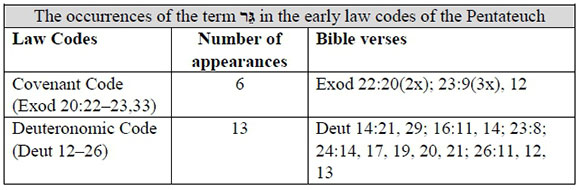
Ancient Israelite thought - represented by biblical Hebrew terminology - is aware of the difference between a non-assimilated stranger (–’•’—/ —’• ; •’— ) and that of a semi-assimilated stranger (; —’•’—“’”). The legal traditions of the OT are rather static and categorical regarding the differentiation of these types of strangers; they minimize the relationship with the —’•––’•‘‘ but provide protection and ensure provisions for the •’—’•– In addition, the law codes are almost exclusively silent about the possibility of a certain stranger's transition from one category to the other. Contrary to this, the narrative accounts of the OT are especially rich in representations of distinct strategies of stranger inclusion. Thus, it is evident that the ancient Israelite thought and everyday practice did not exclude the possibility of transitioning and transforming complete strangers into community members. In fact, the narrative representations of the treatment of strangers in the Books of Joshua and Judges encapsulate authentic ancient Israelite mentalities, cultural conventions, and social mechanisms - in a quite dynamic manner (cf. Rahab's inclusion in Josh 2 and 6; the Kenites' status in Judg 4-5; the Gibeonites' inclusion in Josh 9).
stranger; stranger inclusion; law; narrative; Rahab; Kenites; Gibeonites; Joshua-Judges