Prevalence of Giardia and Cryptosporidium in young livestock and dogs in Magude District of Maputo Province, Mozambique
Abstract
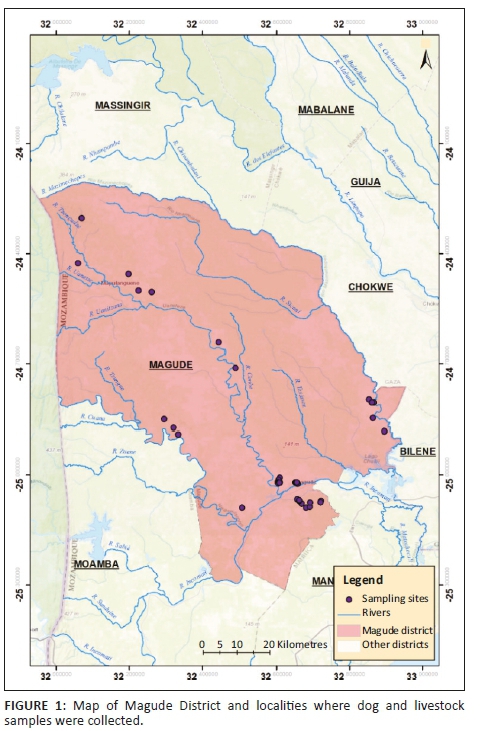
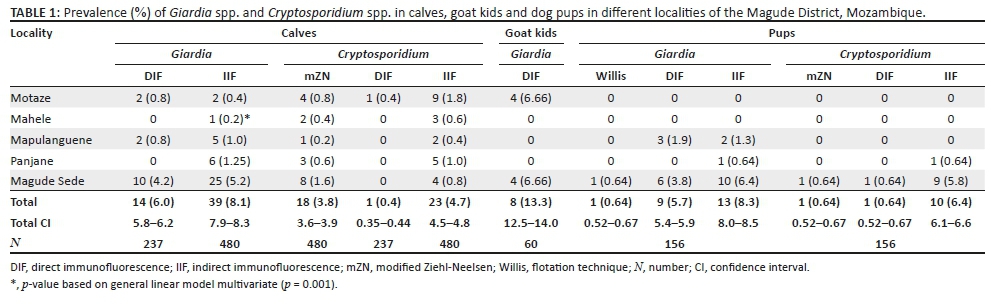
BACKGROUND: Giardia and Cryptosporidium species are significant zoonotic parasites of humans and domesticated animals. OBJECTIVES: The study aimed to determine the prevalence of Giardia and Cryptosporidium in livestock and dogs of the Magude District. METHOD: The flotation technique (Willis), modified Ziehl-Neelsen (mZN) and direct and indirect immunofluorescence (DIF and IIF) techniques were applied to determine the prevalence of Giardia and Cryptosporidium species in faecal samples of dog pups (156), goat kids (60) and calves (480) from the Magude District of Mozambique from February to September 2015. RESULTS: Using Willis, IIF and DIF, the prevalence of Giardia in calves was 0%, 8.1%, and 6.0%; in dogs 0.6%, 8.3% and 5.7% and for goats 0% and 13.3% (IIF was not performed), respectively. The prevalence of Cryptosporidium in calves using Willis, mZN, IIF and DIF was 0%, 3.8%, 4.7% and 0.4% and in dogs 0%, 0.6%, 6.4% and 0.6%, respectively. The parasite was not detected in goats. CONCLUSION: Results from the present study showed that IIF performed better diagnosis of Giardia and Cryptosporidium, and that the mZN can be used as an alternative for Cryptosporidium because of the high cost of IIF. There is a need for identification of genotypes or subtypes of these parasites through application of molecular techniques in order to determine their zoonotic potential, and we advocate a 'one health' approach in the control and prevention of these parasites.
zoonoses; Giardia; Cryptosporidium; dogs; calves; goats; Mozambique
 Thumbnail