Parasites of domestic and wild animals in South Africa. L. Ixodid ticks infesting horses and donkeys
Abstract
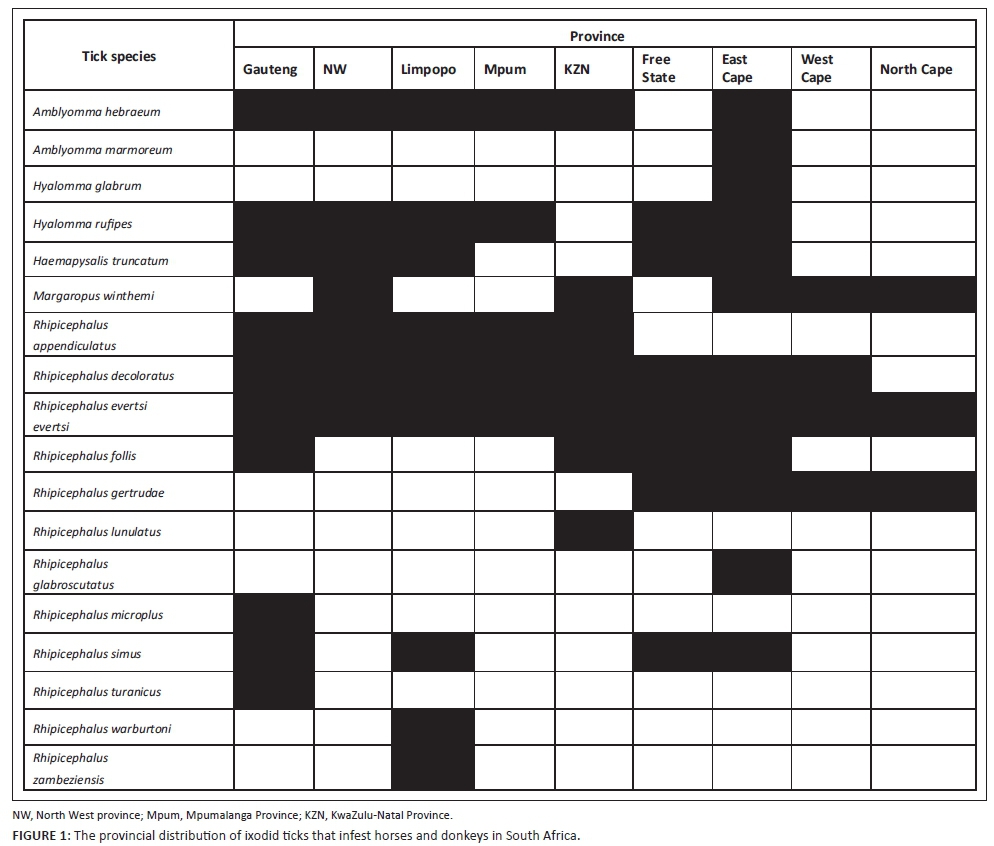
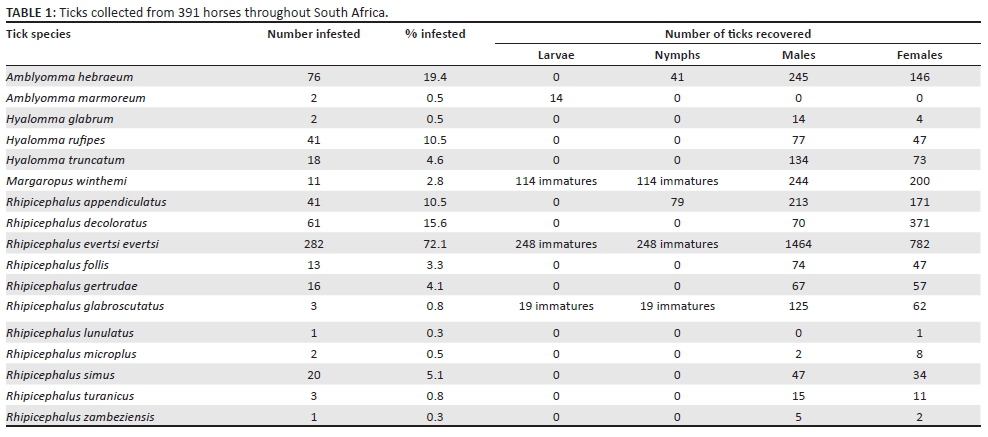
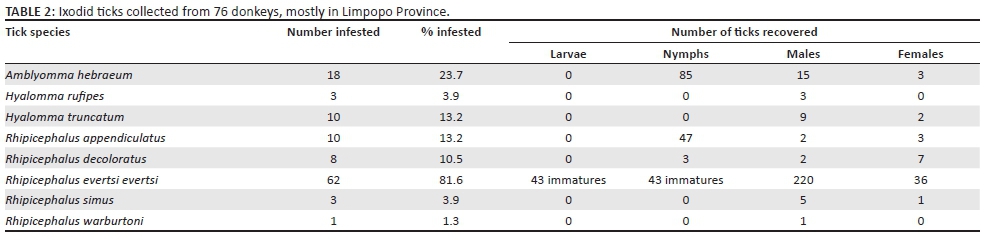
The aim of the study was to determine the species spectrum of ixodid ticks that infest horses and donkeys in South Africa and to identify those species that act as vectors of disease to domestic livestock. Ticks were collected opportunistically from 391 horses countrywide by their owners or grooms, or by veterinary students and staff at the Faculty of Veterinary Science, University of Pretoria. Ticks were also collected from 76 donkeys in Limpopo Province, 2 in Gauteng Province and 1 in North West province. All the ticks were identified by means of a stereoscopic microscope. Horses were infested with 17 tick species, 72.1% with Rhipicephalus evertsi evertsi, 19.4% with Amblyomma hebraeum and 15.6% with Rhipicephalus decoloratus. Rhipicephalus evertsi evertsi was recovered from horses in all nine provinces of South Africa and R. decoloratus in eight provinces. Donkeys were infested with eight tick species, and 81.6% were infested with R. evertsi evertsi, 23.7% with A. hebraeum and 10.5% with R. decoloratus. Several tick species collected from the horses and donkeys are the vectors of economically important diseases of livestock. Rhipicephalus evertsi evertsi is the vector of Theileria equi, the causative organism of equine piroplasmosis. It also transmits Anaplasma marginale, the causative organism of anaplasmosis in cattle. Amblyomma hebraeum is the vector of Ehrlichia ruminantium, the causative organism of heartwater in cattle, sheep and goats, whereas R. decoloratus transmits Babesia bigemina, the causative organism of babesiosis in cattle.
 Thumbnail