Bartonella spp. in human and animal populations in Gauteng, South Africa, from 2007 to 2009
Abstract
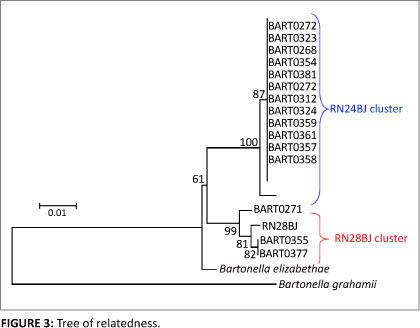
Bartonellae are highly adaptive organisms that have the ability to evade the host immune system and cause persistent bacteraemia by occupying the host's erythrocytes. Bartonella spp. is under-studied and health care professionals often misdiagnose Bartonella-related infections. The aim of this study was to investigate the carriage of Bartonella spp. circulating in human and animal populations in Gauteng using culturing and polymerase chain reaction (PCR) detection. A total of 424 human, 98 cat, 179 dog, and 124 wild rodent blood samples were plated onto specialised media and incubated for 7-21 days at 37 °C in CO2. Culture isolates morphologically similar to Bartonella control strains were confirmed by PCR and sequenced to determine species. Deoxyribonucleic acid (DNA) was extracted from all blood samples and tested by nested PCR. Bartonella could only be cultured from the cat and rodent specimens. Cat isolates were > 99% similar to Bartonella henselae URBHLIE 9, previously isolated from an endocarditis patient, and rat isolates were > 98% similar to either RN24BJ (candidus 'Bartonella thailandensis') or RN28BJ, previously isolated from rodents in China. The PCR prevalences were 22.5% in HIV-positive patients, 9.5% in clinically healthy volunteers, 23.5% in cats, 9% in dogs and 25% in rodents. Findings of this study have important implications for HIV-positive patients.
 Thumbnail