Statutory Interpretation "Laced" With a De Minimis Amount of Vanilla* Commissioner for the South African Revenue Service v Diageo SA (Pty) Ltd [2024] ZASCA 158
1 Introduction
On 15 November 2024, the Supreme Court of Appeal (SCA) handed down its judgment in Commissioner for the South African Revenue Service v Diageo SA (Pty) Ltd [2024] ZASCA 158 (SCA judgment), ruling in favour of the Commissioner of the South African Revenue Service (the Commissioner or SARS). This judgment overturns the prior full bench decision of the High Court's Gauteng Division, Pretoria (full court) in Diageo SA (Pty) Ltd v Commissioner for the South African Revenue Services [2023] ZAGPPHC 508 (full court judgment). The dispute concerns the tariff classification of a liqueur, Cape Velvet Cream Original (CVCO), locally manufactured by Diageo SA (Pty) Ltd (the taxpayer or Diageo), for the purpose of determining the excise duty payable under section 47(1) of the Customs and Excise Act (91 of 1964) (the Act). The dispute turns on the interpretation of a phrase in a schedule to the Act. In this note, it is argued that the SCA arrived at an incorrect decision for two reasons. First, the SCA failed correctly to apply the Constitutional Court's prevailing precedent as regards statutory interpretation by considering only superficially the legislation's purpose and context. Secondly, by dismissing the use of the de minimis principle in statutory interpretation, the SCA failed to apply it in interpreting the relevant provision in this case.
2 Facts of the case and the issue in dispute
2 1 The nature and characteristics of the product
The parties agree on the nature and characteristics of CVCO (SCA judgment par 49 and 50). CVCO, with an alcohol content by volume (ABV) of 16 per cent (which equates to 120ml of alcohol in a 750ml bottle of CVCO), is made from wine spirits to which syrup, flavouring, water, emulsifier, preservative and dairy products are added (Diageo's heads of argument to the SCA par 33 and 36). The flavouring consists of several ingredients, one of which is vanilla extract (vanilla). On its own, the vanilla has an ABV of 0,6 per cent (SCA judgment par 10). The flavouring that is added to the wine spirits (when all the ingredients making the flavouring, including the vanilla, are combined in their respective proportions) has an ABV of 0,002 per cent (SCA judgment par 10). Ultimately, the vanilla contributes 0,00004 per cent of the ABV to the final product (which would equate to 0.0003ml in a 750ml bottle of CVCO (750ml x 0,00004 per cent)), with the remainder of the alcohol content being contributed by the wine spirits (SCA judgment par 50).
2 2 The relevant legislative provisions
Schedule No. 1 to the Act contains the rates of duties and levies applicable to various categories of products. The parts of Schedule No. 1 relevant to this dispute are Parts 1 and 2A. Part 1 contains a comprehensive listing (97 chapters in total at the time, grouped into various sections) of product categories (based on the Harmonized Commodity Description and Coding System - generally referred to as the Harmonized System (HS) - an international product nomenclature developed by the World Customs Organization) and sets out the rates of ordinary customs duty. The purpose of the HS is to achieve uniform classification of goods (see World Customs Organization "What Is the Harmonized System (HS)?" (undated) https://www.wcoomd.org/en/topics/nomenclature/overview/what-is-the-harmonized-system.aspx (accessed 2025-05-23)). The international HS product codes consist of six digits: the first two specify the chapter number, the next two the heading number and the fifth and sixth digits the subheading number (any subsequent digits are country-specific classifications) (World Customs Organization https://www.wcoomd.org/en/topics/nomenclature/overview/what-is-the-harmonized-system.aspx). Chapter 22 (in section IV) of the HS covers beverages, spirits and vinegar. Heading 2208 is titled "Undenatured ethyl alcohol of an alcoholic strength by volume of less than 80% vol.; spirits, liqueurs and other spirituous beverages". Subheading 2208.70 ("2208.70" representing the aforementioned six digits) is titled "Liqueurs and cordials."
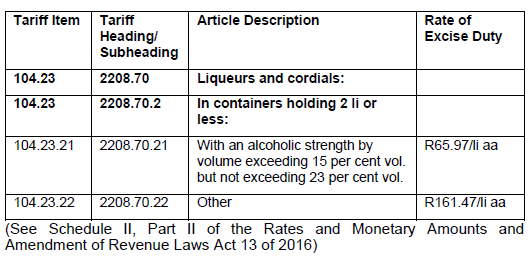
Part 2A contains the rates of excise duties on specified locally manufactured goods or on imported goods of the same class or kind. It uses the same product-classification codes as those in Part 1 to identify the excisable goods. Included in Part 2A are the products falling within the ambit of tariff item 104.23, tariff subheading 2208.70, being liqueurs and cordials. The relevant rates (at the time of the tariff determination) in Part 2A were as follows: (See Schedule II, Part II of the Rates and Monetary Amounts and Amendment of Revenue Laws Act 13 of 2016)
Included in Part 1, preceding Chapter 22's schedule of products with their corresponding rates, are Notes, Subheading Notes and Additional Notes pertaining to the chapter. Additional Note 4 to Chapter 22 (inserted by GN R172 in GG 34059 of 2011-02-28 and amended by GN R387 in GG 36515 of 2013-06-07, with retrospective effect from 1 March 2011) reads as follows:
"4. Tariff subheadings 2208.70.21, ..., shall only apply to liqueurs, cordials and other spiritous beverages containing the following:
(a) ...; or
(b) wine spirits to which other non-alcoholic ingredients have been added."
Additional Note 4 does not form part of the HS as it pertains only to the South Africa-specific classifications (specified by the seventh and eighth digits). Additional Note 4 places a limitation on the liqueurs and cordials in containers of 2L or less that would qualify for the lower rate. It is not in dispute between the parties that the National Treasury proposed the insertion of Additional Note 4(b) to Chapter 22 to support the labour intensive wine industry (full court judgment par 24; see also SARS's heads of argument to the SCA par 42). Liqueurs can be made by using either C-spirits (derived from sugar cane) or wine spirits as their alcoholic base. C-spirits are cheaper than wine spirits. The cost of liqueurs made from wine spirits would thus be higher than those made from C-spirits, rendering the use of wine spirits uncompetitive. Liqueurs made from wine spirits could, however, be made to be price competitive with those made from C-spirits if the former were subject to a lower rate of excise duty than the latter (full court judgment par 23 and 29, confirming that this is not in dispute between the parties). It is to incentivise liqueur manufacturers to use wine spirits instead of C-spirits (thereby supporting the wine industry) that Additional Note 4(b) applies to tariff subheading 2208.70.21 (which has a lower rate than tariff subheading 2208.70.22). To ensure that the final product's alcohol content is derived from wine spirits rather than from any other type of (cheaper) spirits, the qualifying phrase "to which other non-alcoholic ingredients have been added" was necessary to prevent liqueur manufacturers from adding other spirits to the wine spirits.
2 3 The issue in dispute
On 18 April 2016, the Commissioner made a tariff determination in terms of section 47(9)(a), read with section 47(11) of the Act. SARS determined CVCO to be classifiable under tariff subheading 2208.70.22 as it regarded CVCO to be a liqueur made from wine spirits to which other alcoholic ingredients had been added (thus disqualifying it from tariff subheading 2208.70.21). Diageo appealed the Commissioner's determination in terms of section 47(9)(e) of the Act as it contended that the CVCO should be classified under tariff subheading 2208.70.21 (which would attract a lower rate of excise duty) since the flavouring added to the wine spirits constitutes the addition of a "non-alcoholic ingredient" (Diageo's heads of argument to the SCA par 34(c)). It is not in dispute that CVCO should be classified under tariff subheading 2208.70 Liqueurs and cordials (SCA judgment par 14). As international harmonisation of the HS codes only extends as far as the first six digits, the parties are thus in agreement as far as the internationally harmonised classification is concerned. The dispute concerns the eighth digit (a country-specific classification) (SCA judgment par 14). The issue in dispute is thus how to interpret the phrase "wine spirits to which other non-alcoholic ingredients have been added" in Additional Note 4(b).
3 Arguments made by the parties
3 1 SARS's arguments
SARS submitted that "the non-alcoholic prescript in Additional Note 4(b) should be interpreted as an absolute - 'that is if any ingredient (bar the wine spirits) contains any alcohol, the end product is excluded from classification under tariff heading 2208.70.21'" (full court judgment par 37; see also par 71.2 of SARS's heads of argument to the SCA where it is stated that "the phrase 'non-alcoholic ingredients' is open to only one (sensible) interpretation: ingredients with a 0% ABV content"). They contend that, were this interpretation not to be accepted,
"it would lead to results that are 'inconsistent, insensible and in direct conflict with one of the purposes of tariff classification - that is to ensure that the same products are classified in the same heading or sub-heading.1' It would also make it practically impossible for the Commissioner to administer and enforce the Act." (full court judgment par 39)
SARS relied on an analogy to section 65 of the National Road Traffic Act 93 of 1996 (full court judgment par 39; see also par 68 of SARS's heads of argument to the full court), which makes it an offence for any person to drive a vehicle on a public road "while the concentration of alcohol in any specimen of blood taken from any part of his or her body is not less than 0,05 gram per 100 millilitres" (s 65(2) of the National Road Traffic Act). SARS contends:
"When the question arises whether section 65 has been breached, the test is simple. If the test result is 0.049 g/100 ml, it has not been breached. If it is 0.05 g/100ml, it has been breached." (full court judgment par 39)
3 2 Diageo's arguments
Diageo argues for a purposive approach to interpreting Additional Note 4(b) and contends that
"the probable intention of the legislature was to prevent a situation where a manufacturer used the more expensive wine spirits, but then added non-expensive C-spirits thereto and, in doing so, increased the alcohol content of the beverage with the cheaper C-spirits, but simultaneously benefitting from the lower rate of excise duty." (full court judgment par 25, which is also included in par 53 of Diageo's heads of argument to the SCA)
Diageo further contends that the ingredient added to the wine spirits is the flavouring (once all the flavouring's ingredients, including the vanilla, are combined in a separate tank) and that it is therefore the flavouring's alcohol content (being 0,002 per cent) that should be considered (Diageo's heads of argument to the SCA par 37). According to Diageo, the alcohol contained in the flavouring "is so minutely small" that it should be disregarded on the principle of de minimis non curat lex, and as such, the flavouring is a non-alcoholic ingredient (par 80 and 123 of Diageo's heads of argument to the SCA).
4 Litigation history
4 1 High Court
Diageo's appeal to SARS's tariff determination of 18 April 2016 was heard by one judge in the Gauteng High Court, Pretoria (High Court). On 18 March 2021, Strijdom AJ ruled in favour of SARS, dismissing Diageo's appeal (Diageo Proprietary Limited v the Commissioner for the South African Revenue Services, Gauteng High Court, Pretoria (unreported) 2021-03-17 Case no 93168/2019 (High Court judgment)). The High Court held that "the wording of Additional Note 4(b) is clear and unambiguous" (High Court judgment par 71) and consequently that the words "non-alcoholic ingredients" as used in Additional Note 4(b) should be ascribed their ordinary meanings. To ascertain their ordinary meanings, it considered the dictionary definitions of "ingredient", "non-alcoholic" and "alcoholic" and concluded as follows:
"In accordance with its ordinary meaning and having regard to the meaning of 'alcoholic,' it is patently clear that a 'non-alcoholic' ingredient is one that does not contain any alcohol." (High Court judgment par 40)
The High Court took the view that "[t]he enquiry as to whether an ingredient is alcoholic is not to be made with reference to the product as a whole, but with reference to the products' individual ingredients" (High Court judgment par 31). Strijdom AJ further states:
"In my view, it matters not whether the alcohol content in the vanilla flavouring is 0.6% or 1.00% ABV. What is relevant is the presence of alcohol." (High Court judgment par 61)
4 2 Full court
Diageo subsequently appealed against the High Court judgment to the full court. In the full court judgment of 5 July 2023, Van der Schyff J (with Munzhelele and Millar JJ concurring) reversed the High Court's decision, ruling in favour of Diageo's contended tariff classification. The full court undertook a purposive interpretation of Additional Note 4(b) and, in doing so, concluded that "an ingredient can only be regarded as an alcoholic ingredient if it significantly contributes to the ABV of the final product" (full court judgment par 51). Van der Schyff J, writing for the full court, held as follows:
"Having regard to this purpose [the purpose for which tariff subheading 2208.70.21 was enacted], the quantity of alcohol added to the wine spirit base is, in my view, negligible, and insufficient to invoke the application of Additional Note 4(b)." (full court judgment par 60)
Regarding SARS's analogy to section 65 of the National Road Traffic Act, the full court held:
"The Commissioner's analogy between s 65 of the Road Traffic Act and Additional Note 4(b), submitted not only for substantiating the view that the de minimis principle cannot apply but also for justifying the Commissioner's submission that 'non-alcoholic ingredient' means an ingredient with a 0% ABV, is misplaced. Insofar as s 65 of the Road Traffic Act is concerned, the legislature determined a fixed blood-alcohol level that may not be exceeded, otherwise, a crime is committed. In Additional Note 4(b), the term 'non-alcoholic ingredient' is not defined. Meaning must be attributed to the term 'non-alcoholic ingredient' through the process of interpretation in circumstances where it is evident that the term 'non-alcoholic' can be used in relation to beverages with an ABV of less than 0.5%, and having regard to the purpose for which, amongst others, tariff subheading 2208.70.21 was introduced. Contrary to the position in s 65 of the Road Traffic Act, no verifiable basis is provided for determining the meaning of 'non-alcoholic ingredient'." (full court judgment par 70, footnotes omitted)
4 3 SCA
SARS subsequently took the full court's decision on appeal to the SCA. On 15 November 2024, the SCA reversed the full court judgment, broadly agreeing with the High Court judgment, and ruling in favour of SARS.
4 4 Constitutional Court
In an order dated 12 February 2025, the Constitutional Court refused Diageo's leave to appeal the SCA's decision, stating that the leave to appeal does not engage its jurisdiction (Constitutional Court case CCT 361/24). The SCA judgment is therefore the final decision in respect of this case.
5 The SCA judgment
5 1 The three-stage product-classification approach
The SCA judgment, penned by Coppin AJA, with Mocumie, Schippers and Smith JJA and Mantame AJA concurring, devotes several paragraphs (SCA judgment par 6-9) to discussing the legal sources for tariff classification and prior judgments that have dealt with tariff classification. In paragraph 8, it cites International Business Machines SA (Pty) Ltd v Commissioner for Customs and Excise (1985 (4) SA 852 (A) 863 G-H), which describes the three stages to determining the classification of a product. Briefly, these stages are:
1. ascertaining the meaning of the words used in the headings, section and chapter notes;
2. considering the nature and characteristics of the goods requiring classification; and
3. selecting the heading most appropriate to such goods.
Paragraph 9 of the SCA judgment cites Distell Ltd v Commissioner of South African Revenue Service ([2011] 1 All SA 225 (SCA) par 22), where the court said that the first and second stages need not be regarded as being immutable. The SCA judgment then quotes from the more recent case of Commissioner for the South African Revenue Service v Toneleria Nacional RSA (Pty) Ltd ([2020] 3 All SA 299 (SCA) par 10-12), where it was held that "maintaining a clear distinction between the first and second stages of the determination process was vitally important in this case". The SCA contends that the full court "conflated the first and second stages of classification" (SCA judgment par 22, also par 31 and 32). The three-stage product-classification approach is further discussed in 6 3 below.
5 2 The approach to statutory interpretation
Essentially, the only point on which the SCA agrees with the full court judgment is that the full court correctly identified that "the issue of the correct classification of the Cape Velvet Cream Original product of Diageo, ultimately turned on the interpretation of Additional Note 4(b) (in its context)" (SCA judgment par 22). The SCA's overarching disagreement with the full court judgment pertains to the full court's approach to statutory interpretation, which it describes as an "erroneous interpretational approach" (SCA judgment par 42). The SCA concurred with SARS's contention that "while the full court mentioned the applicable legal principles, it (unfortunately) did not apply them" (SCA judgment par 28). The SCA held that the full court "decided what outcome (in its view) was reasonable, sensible and businesslike" (SCA judgment par 22), and that the full court did so in a process "which was described as purposive" (SCA judgment par 22), and that the full court "seemingly set out to purposively interpret Additional Note 4(b)" (SCA judgment par 28).
In paragraphs 23 to 26 of the judgment, the SCA provides quotations about statutory interpretation from the following four cases (in ascending order of authority): Natal Joint Municipal Pension Fund v Endumeni Municipality ([2012] 2 All SA 262 (SCA) (Endumeni case) par 34), Capitec Bank Holdings Limited v Coral Lagoon Investments 194 (Pty) Ltd ([2021] 3 All SA 647 (SCA) par 25), South African Transport and Allied Workers Union (SATAWU) v Moloto NO (2012 (6) SA 249 (CC) par 20) and Minister of Police v Fidelity Security Services (Pty) Limited (2022 (2) SACR 519 (CC) (Fidelity case) par 34).
The SCA contends that the full court erred in that "in its exercise of giving meaning to that note [Additional Note 4(b)], the full court did not give adequate attention to its actual wording" (SCA judgment par 22). The SCA states that the full court "concentrated solely on its conception of the note's secondary purpose, and background, instead of considering its text, the context and the primary purpose ... together" (SCA judgment par 28). The SCA states that the primary purpose of Additional Note 4(b) is "to explain and clarify to which liqueurs certain Subheadings, specifically mentioned in that note, would be applicable" (SCA judgment par 28, also par 46-48 where giving effect to the HS is also emphasised by the SCA as the purpose of Additional Note 4(b)). In contrast to the full court's approach, the SCA considered the High Court's approach "in giving the words in Additional Note 4, namely 'ingredient', 'non-alcoholic' and 'alcoholic' their ordinary grammatical meaning" to be "proper, unless that would have resulted in an absurdity" (SCA judgment par 27). The approach to statutory interpretation is further discussed in 6 1 below.
5 3 The de minimis principle
In paragraphs 43 to 45, the SCA dismisses Diageo's contention that the de minimis principle be applied in the interpretation of Additional Note 4(b). First, the SCA contends that "the principle has never been used as an interpretational aid in this country" (SCA judgment par 43). Secondly, the SCA raises the separation-of-powers principle as a constitutional concern, suggesting that the use of the de minimis principle by the courts could result in the judiciary encroaching on the legislature's lawmaking function (SCA judgment par 44). Finally, it concludes: "[i]n any event, the application of the principle for the purpose sought by Diageo is not of any help and is irrelevant in this matter" (SCA judgment par 45). The role of the de minimis non curat lex maxim in statutory interpretation is further discussed in 6 2 below.
5 4 The SCA's decision
Ultimately, the SCA concludes that "the word [referring to 'non-alcoholic'] must be given its ordinary, grammatical meaning" (SCA judgment par 46, footnote omitted). The SCA accordingly held that CVCO does not fall within the ambit of Additional Note 4(b) as both the vanilla itself, as well as the flavouring, are alcoholic (SCA judgment par 51). Thus, tariff heading 2208.70.21 cannot apply. As such, the Commissioner's classification of the product under tariff heading 2208.70.22 was held to be correct (SCA judgment par 51).
6 Discussion of the SCA judgment
6 1 The SCA's application of the unitary approach to statutory interpretation
In our view, the SCA misapplied the approach to statutory interpretation set out in the Constitutional Court's recent Fidelity case, which the SCA quotes in paragraph 25 of its judgment. The extract most relevant to our discussion is the following part of paragraph 34 of the Fidelity case:
"The interpretation of the Act must be guided by the following principles:
(a) Words in a statute must be given their ordinary grammatical meaning, unless to do so would result in an absurdity.
(b) This general principle is subject to three interrelated riders: a statute must be interpreted purposively; the relevant provision must be properly contextualised; and the statute must be construed consistently with the Constitution, meaning in such a way as to preserve its constitutional validity." (own emphasis)
The SCA seemingly fails to recognise that the general principle that the Constitutional Court lays out in item (a) is subject to the riders in (b). It is trite to point out that if (a) is subject to (b), then (a) is subordinate to (b). In other words, (b) takes priority over (a). To recapitulate: current Constitutional Court precedent on statutory interpretation requires that a statute must be interpreted purposively; the relevant provision must be properly contextualised; and the statute must be construed consistently with the Constitution, meaning in such a way as to preserve its constitutional validity. Only if all three of these conditions (referred to as the "riders") are met must the words in a statute be given their ordinary grammatical meaning, unless to do so would result in an absurdity.
It is thus a requirement that the purpose and context of a statute (and the provision in the statute) be considered in its interpretation. While the old approach to statutory interpretation may have been that the purpose is only considered if the text is ambiguous, this is no longer the approach, as recently reiterated by South Africa's highest court in the 2022 Fidelity case to which the SCA is bound. That purpose needs to be considered "even where the words to be construed are clear and unambiguous" (Bato Star Fishing (Pty) Ltd v Minister of Environmental Affairs 2004 (4) SA 490 (CC) par 90) was stated by the Constitutional Court on more than one occasion (see also Department of Land Affairs v Goedgelegen Tropical Fruits (Pty) Ltd 2007 (6) SA 199 (CC) par 53), as was pointed out by Van der Schyff J in the full court judgment (par 45).
The SCA judgment states that SARS and the High Court were called upon to interpret "what the word 'non-alcoholic' means within the proper context of Note 4(b)" (par 42). Strikingly absent from the SCA judgment is any consideration of the reason for which Additional Note 4(b) and the lower rate in subheading 2208.70.21 were enacted - namely, to incentivise liqueur manufacturers to use wine spirits (as opposed to cane spirits) in the manufacture of their products and so support the wine industry. While the SCA criticises the full court for mentioning the applicable legal principles but not applying them (SCA judgment par 28), it is contended that the SCA proceeds to do the same. The SCA took pains to state that the purpose and context should be considered (see e.g. SCA judgment par 22, 23, 27, 28, 30, 40 and 42) and yet, in coming to its decision, it essentially ignores the purpose for which the lower-rate category (the products of which are described in Additional Note 4(b)) was introduced. Where, however, the SCA does offer an attempt at considering the purpose and context, it does so only superficially. In paragraph 48, for example, it states that the purpose of Additional Note 4(b) is "to provide further clarity in respect of the appropriateness of certain Subheadings for certain products" (see also SCA judgment par 28). This stated purpose does not engage with the provision's raison d'être. It does not, as stated by Wallis JA in the Endumeni case at par 18, have regard to "the context provided by reading the particular provision or provisions in the light of the document as a whole and the circumstances attendant upon its coming into existence". It thus offers little (if any) insight into the purpose and context within which the words used in Additional Note 4(b) should be interpreted. Both parties, as well as both the High Court and the full court, agree that the purpose of Additional Note 4(b) "is to ensure that taxpayers use wine spirits as their alcoholic component" (High Court judgment par 45; see also full court judgment par 23-24). It is this purpose that should guide the interpretation of the words in Additional Note 4(b) (and not, for example, the purpose of giving effect to the HS, as alluded to by the SCA in paragraphs 46 and 47, since the HS product codes only deal with the first six digits and the dispute between the parties pertains to the eighth digit).
After a perfunctory consideration of the purpose of the provision (SCA judgment par 28 and 46-48), the SCA focuses its interpretative approach on the ordinary grammatical meaning of the words in Additional Note 4(b). In paragraph 48 of its judgment, it states:
"The wording of Additional Note 4, including 4(b) is plain and unambiguous.... In ordinary language, it means that the Tariff Headings specified in Additional Note 4 shall only be applicable to a liqueur consisting of a wine spirit base to which the other of its parts, components, or elements, have been added, which do not contain any alcohol." (own emphasis)
And in paragraph 46, it states:
"Since the Act (including the note) does not define 'non-alcoholic,' either within its text or with reference to other statutes or policies, the word must be given its ordinary, grammatical meaning."
In contrast, the full court had referred to a recent SCA judgment, South African Nursing Council v Khanyisa Nursing School (Pty) Ltd ([2023] ZASCA 86 (South African Nursing Council case) (par 15)) stating:
"In this case [referring to the South African Nursing Council case], the court reiterated that interpretation is a unitary exercise that takes account of text, context, and purpose. The court held that there is no straightforward attribution of a dictionary meaning of a word as the word's ordinary meaning to construe a statute. The court observed that to stare blindly at the words used in a statutory provision seldom suffices to yield their meaning." (full court judgment par 44)
By seemingly ignoring the purpose (raison d'être) for which Additional Note 4(b) was enacted (to incentivise the use of wine spirits as the alcoholic component of liqueurs), the SCA, in effect, "stared blindly" at the words used in Additional Note 4(b) in giving "non-alcoholic ingredient" its ordinary, grammatical meaning. In light of the superficiality with which the SCA considered the purpose and context of Additional Note 4(b), it is contended that the SCA's consideration of the provision's purpose and context was inadequate and that, in substance, the SCA thus essentially adopted a textual or literal interpretative approach rather than a truly unitary approach.
The ping-pong in the case's outcome as it proceeded through the various courts seems to result from differences in a) the emphasis placed on the ordinary grammatical meaning of the words or the text; and b) the depth to which the purpose and context of the statute itself and/or the provision in question (Additional Note 4(b)) was analysed. The question is thus how to consider adequately the text, purpose and context of the Act and the provision in question together in one unitary exercise.
Looking only to the ordinary meaning of the phrase "non-alcoholic ingredients" without considering the provision's purpose and context - in other words, under a purely textual or literal interpretative approach - one would indeed arrive at the meaning of "no alcohol" or "without alcohol". However, stopping at ascribing the ordinary meaning or dictionary definition to the term "non-alcoholic" (which is 'containing no alcohol') may result in the following absurdity: any ingredient containing even one molecule of alcohol would, under such an interpretation, be correctly described as "alcoholic". Alcohol is present in any foodstuff that ferments, including, for example, ripe bananas, rye bread and yoghurt. Under a purely textual interpretation of "non-alcoholic ingredient", the addition of a ripe banana to wine spirits to make a banana-flavoured liqueur would be interpreted as the addition of an "alcoholic ingredient" and thus be disqualified from tariff subheading 2208.70.21.
Without also giving due consideration to the other aspect in the unitary approach to statutory interpretation - namely, to interpret purposively and to contextualise the provision - such absurdity as illustrated above would be the result. The purpose of Additional Note 4(b), to incentivise the use of wine spirits as the alcoholic base of locally manufactured liqueurs, would be defeated if the final product's alcohol content were derived from the addition of other, cheaper spirits to the wine spirits. That is, however, not the reason for adding the flavouring to the wine spirits. Accordingly, interpreting Additional Note 4(b) purposively (to combat the mischief at which it is aimed as explained in paragraph 21 of the Endumeni case) requires a different meaning from that given to "non-alcoholic" by the SCA. The SCA's failure to properly apply the unitary approach to statutory interpretation leads, in our view, and respectfully submitted, to an incorrect interpretation of Additional Note 4(b).
6 2 The role of the de minimis principle in statutory interpretation
Since the SCA judgment does not delve into the meaning of the de minimis non curat lex (the law does not regard trifles) maxim - what it refers to as the de minimis principle - it is worth a brief mention here. Maxims are described as "broad statements of principle of which the truth and/or reasonableness appears self-evident" (see "Glossary of Legal Terms" in Humby, Kotzé, Du Plessis (eds) Introduction to Law and Legal Skills in South Africa (2012)). The Oxford English Dictionary defines "de minimis" as "too trivial or minor to merit consideration, especially in law".
Addressing the use of the de minimis principle, the SCA makes the following statement in paragraph 43:
"It is common cause that there is no case in this country where the principle [referring to the de minimis principle] has been applied by the court...as an aid or guide in the interpretation of statutes. This Court was not referred to such cases. As far as could be ascertained, the principle has never been used as an interpretational aid in this country even though it might have been used elsewhere in the world for that purpose."
There has, however, been at least one South African case in which the de minimis principle was applied to interpret a statute, namely, AA Mutual Insurance Association Ltd v Sibothobotho (1981 (4) SA 593 (A) 603) (AA Mutual Insurance). This case was considered by the full court (see fn 39 of the full court judgment). In this case, the Appellate Division applied the de minimis maxim in interpreting the phrase "being conveyed in or upon the motor vehicle" from a provision of the (now repealed) Compulsory Motor Vehicle Insurance Act (56 of 1972).
The Appellate Division concluded as follows in its judgment:
"Looking at the whole incident in broad perspective it seems to me that, whatever may be said about the driver's intentions and the passenger's intentions, this is a case in which the de minimis non curat lex rule can appropriately be applied. A man sits or stands on the front of a motor vehicle performing a simple mechanical operation. The vehicle jerks forward three or four times. He has been moved, perhaps five paces, but to say that he has been conveyed as a passenger for this distance is to strain the language of the Motor Vehicle Insurance Act." (AA Mutual Insurance case 603)
The SCA deemed it necessary to raise the constitutional concern of an infringement of the separation of powers should the de minimis principle be used as an interpretational tool by the courts (SCA judgment par 44) while steering clear of comprehensively addressing the constitutionality of using the de minimis principle in statutory interpretation. The separation of powers doctrine is, however, not absolute. Judicial lawmaking is recognised by our courts and mandated by the Constitution - for example, in the context of reading-in (see, for example, C v Department of Health and Social Development, Gauteng 2012 (2) SA 208 (CC) par 57). What the SCA failed to consider was the role that the de minimis principle can play in achieving the constitutional norms of reasonableness and proportionality (see De Lange and Malan "How Have the Courts Decided What De Minimis Is in Tax Law?" 2024 27 Potchefstroom Electronic Law Journal 1 5-6).
In contrast to the constitutional concern raised by the SCA, in Independent Community Pharmacy Association v Clicks Group Ltd [2023] ZACC 10 (Clicks case) - a case not considered in the SCA judgment - the Constitutional Court stated as an obiter dictum that "the principle that the law does not concern itself with trivialities [with reference to de minimis non curat lex] can play a role in the interpretation of statutes" (par 286). Rogers J, in Clicks, quotes as follows from Halsbury's Laws of England: "Unless the contrary intention appears, an enactment by implication imports the principle of legal policy expressed in the maxim de minimis non curat lex" (fn 230 of Clicks case). Similarly, Veech and Moon regard the maxim as a "rule of reason" that can serve as "an interpretive tool to inject reason into technical rules of law and to round-off the sharp corners of our legal structure" (see Veech and Moon "De Minimis Non Curat Lex" 1947 Michigan Law Review 537 543-544).
If one accepts that the de minimis maxim may be appropriately applied in the interpretation of Additional Note 4(b), the question that arises is: how much alcohol would be regarded as trivial or insignificant (as was raised by the SCA in paragraph 45)? Recent research on the use of the de minimis maxim by South African courts reveals that applying the maxim requires a value judgment (see De Lange and Malan 2024 Potchefstroom Electronic Law Journal 24). Further, as Ruedin points out, "it is not possible to express what a trifle is in absolute terms" (see Ruedin "De Minimis Non Curat the European Court of Human Rights: The Introduction of a New Admissibility Criterion (Article 12 of Protocol No 14)" 2008 European Human Rights Law Review 80 87). The research on how the courts have decided the applicability of the de minimis maxim finds that the courts have used several factors to guide their determination. It concludes that, in respect of statutory interpretation, the primary factor is the purpose of the provision (see De Lange and Malan 2024 Potchefstroom Electronic Law Journal 24).
6 3 Reconciling the three-stage product-classification approach with the unitary approach to statutory interpretation
The question that remains is whether, and if so, how the unitary approach to statutory interpretation fits into the established three-stage approach to the classification of products in terms of the Act (discussed in 5 1 above). Below, it is demonstrated how these two approaches can be reconciled using the facts of the present case.
6 3 1 First stage: ascertain the meaning of the words used in the headings, section and chapter notes
The words in Additional Note 4(b) (which reads "wine spirits to which other non-alcoholic ingredients have been added") require interpretation, and here the unitary approach to statutory interpretation can and must be applied. This requires due consideration of Additional Note 4(b)'s purpose and context, which was detailed in 2 2 above.
Considering the interpretation of the term "non-alcoholic", it is congruent with the overarching purpose of supporting the wine industry that the purpose of excluding the addition of alcoholic ingredients was not to exclude every possible ingredient that contains even one molecule of alcohol, but to prevent the final product's alcohol content from being derived from anything other than wine spirits. If a de minimis amount of alcohol present in the ingredients added to the wine spirits disqualifies the final product from the lower excise duty rate of tariff subheading 2208.70.21, the manufacturer would be likely to switch from using wine spirits to using the cheaper C-spirits to ensure that their product remains price competitive. Accordingly, in this context, applying the de minimis principle in interpreting Additional Note 4(b) would give greater effect to its purpose. The de minimis principle could be read into the dictionary definition of "non-alcoholic", which is "not containing alcohol", by qualifying it with a phrase to the effect of "unless the alcohol content is so trivial that it does not merit consideration". That we, in ordinary language usage, often implicitly apply the de minimis maxim to dictionary definitions is evident from the fact that we do not, for example, regard a vanilla soft serve, a vanilla cheesecake or a vanilla milkshake as "alcoholic" even though vanilla extract bought in supermarkets and used in these products contains some alcohol.
This note now turns to the interpretation of "other (...) ingredients". Considering Additional Note 4(b)'s purpose to incentivise the use of wine spirits as the alcoholic component in liqueurs, the relevant line to draw in respect of paragraph (b) is the line making the distinction between wine spirits and other ingredients. As the objective is to derive the liqueur's alcoholic component from wine spirits rather than from anything else added to the wine spirits, it would be entirely in accordance with this objective that everything else added to the wine spirits should be assessed in combination in determining its alcohol content. While the full court held that "an ingredient can only be regarded as an alcoholic ingredient if it significantly contributes to the ABV of the final product" (full court judgment par 51), it is proposed that the following statement, which more closely aligns with the de minimis principle, be used instead: everything (assessed collectively) that is added to the wine spirits should be regarded as "other non-alcoholic ingredients" for the purposes of Additional Note 4(b) if its alcohol content is so trivial that it does not merit consideration (i.e., is de minimis).
6 3 2 Second stage: consider the nature and characteristics of the goods requiring classification
After having established the proper interpretation of "wine spirits to which other non-alcoholic ingredients have been added" in the first stage, the question in the second stage is whether, considering the specific nature and characteristics of CVCO, the alcohol content of the ingredients added to the wine spirits can be regarded as de minimis. As the SCA rightly points out, "it would be difficult to determine when something becomes trifling" (par 45). This may be true, but the mere fact that something is difficult to do does not mean that it cannot be done. It merely requires a value judgment: first by SARS in exercising its administrative discretion, and then, should SARS's value judgment be disputed by the taxpayer, by the courts in the exercise of their judicial discretion. This approach is likely to give greater effect to the purpose for which the legislation was enacted than the blunter, albeit administratively easier, approach of simply regarding any other ingredients that have as much as one molecule of alcohol (such as a ripe banana) as disqualifying a product from the tariff subheadings to which Additional Note 4(b) applies. In the case of CVCO, the alcohol content of the other ingredients added to the wine spirits, assessed collectively, would be less than 0,002 per cent (as this is just the flavouring's alcohol content). As "it would be difficult to formulate a definition of a minimum that would be valid in all circumstances" (SCA judgment par 45), in determining whether this alcohol content is de minimis, the provision's purpose is paramount. Here, considering the contribution of the non-wine spirit ingredients to the final product's alcohol content may prove useful. If it is negligible, the purpose of the provision is not defeated. Taken in broad perspective, the non-wine spirit ingredients' contribution of 0,00004 per cent to the final product's alcohol content of 16 per cent is a contribution that does not merit consideration and should thus be disregarded.
6 3 3 Third stage: select the heading most appropriate to such goods
The tariff subheading most appropriate to CVCO would thus be 2208.70.21.
7 A word of caution
The complexity of tax legislation and possible ways to simplify it is a perennial topic. At the heart of this topic is the long-standing and continuing debate in the academic literature about whether tax law should be drafted as principles or detailed rules. The renowned tax scholar, John Avery Jones, identified, inter alia, "the courts" as a cause of tax-law complexity (Avery Jones "Tax Law: Rules or Principles?" 1996 17(3) Fiscal Studies 63 65).
Avery Jones made the argument that it was a lack of trust in the courts' ability to deliver the right answers that resulted in an increase in the volume of tax legislation. He laments: "[o]ne major reason for the mess that we are in is that it was caused by the habit of the courts construing tax legislation as a matter of words" (Avery Jones 1996 Fiscal Studies 70, referring to the United Kingdom's courts). Although this argument was made almost three decades ago and in the jurisdictional context of the United Kingdom, the argument that courts following a textual or literal interpretative approach may cause tax legislation to be more complicated remains valid.
The potential implications of the SCA's application of the unitary approach to statutory interpretation in this case to the future interpretation of tax legislation, if followed, could be a cause for concern, ironically, most especially for SARS. It is well known in the tax arena that a textual or literal interpretative approach to tax legislation invites avoidance (see e.g. Cassidy "Tainted Elements or Nugatory Directive? The Role of the General Anti-Avoidance Provisions ('GAAR') in Fiscal Interpretation" 2012 23(2) Stellenbosch Law Review 319). The raison d'être of general anti-avoidance rules (GAARs), such as the principal purpose test (PPT), is to thwart the tax avoidance caused when taxpayers structure their affairs to fall within the letter (strict literal wording) of the law to obtain a tax benefit while circumventing its object and purpose. While SARS contends that an interpretation of "non-alcoholic" that applies the de minimis principle would "make it 'practically impossible' to administer the Act" (SCA judgment par 37), how much truer would this be if the entire body of tax legislation were to be interpreted using a textual or literal approach? In arguing for such an interpretative approach, SARS may well have made a rod for its own back.
8 Conclusion
In this note it is argued that the decision reached by the SCA in this case was, with respect, incorrect. It is contended, first, that the SCA did not adequately consider the purpose and context aspect of the unitary approach to statutory interpretation in the interpretation of Additional Note 4(b). Secondly, it is reasoned that the SCA should have applied the de minimis maxim to the interpretation of Additional Note 4(b). Thirdly, how the proper application of the unitary approach to statutory interpretation, along with the application of the de minimis principle, could be applied in the three-stage approach to product classification is demonstrated. Finally, it is cautioned that a textual or literal interpretative approach to tax legislation may increase the complexity of tax legislation and invite avoidance.
The following anecdote is offered as a digestif. In the nineteenth century, the United States imposed a 10 per cent tariff on the importation of vegetables, while fruits were exempt from import tariffs. John Nix, a fruit importer from New York, argued that since tomatoes are in fact fruits, no such tariff was payable on their importation. The dispute reached the United States Supreme Court, and in 1893, in a unanimous ruling, the court held that for the purposes of tariffs, imports and customs, tomatoes should be classified as vegetables rather than fruits (Nix v Hedden 149 U.S. 304 (1893) 307). Related to this anecdote is the platitude "knowledge is knowing that tomato is a fruit; wisdom is not putting it in a fruit salad."
It is unfortunate that the Constitutional Court, by refusing Diageo's leave to appeal the SCA judgment, was not able to confirm the correct application of its unitary approach to statutory interpretation in this case. More regrettably, the Constitutional Court missed this opportunity to demonstrate its wisdom by exercising its judicial discretion to apply the de minimis principle in the interpretation of Additional Note 4(b) and, in doing so, firmly establish the precedent for the use of the de minimis maxim in the interpretation of statutes.
Monique T Malan
BAcc BAccHons PGDip (FinPlan) LLM PhD CA(SA) CFP®; Lecturer, University of Stellenbosch. https://orcid.org/0000-0002-4923-9595
Silke de Lange
BAccLLB (cum laude) MComm (Tax) (cum laude); Attorney and Notary Public of the High Court of South Africa, Lecturer, University of Stellenbosch. https://orcid.org/0000-0003-3939-5209
* The authors thank Dr Enelia Jansen van Rensburg for her helpful comments. All views expressed in this article are the authors'. They did not represent either of the parties and their interest in this case is solely academic.