Factors Influencing Motivation and Active Participation in a Flipped Law Module: Insights From the Extended LLB Programme at the University of the Free State
Abstract
In legal education, flipped and blended learning models offer a unique opportunity to integrate theoretical knowledge with practical skills. However, student engagement in such learning environments, particularly in law modules, remains an area that is insufficiently researched and understood. This qualitative study explores student engagement in a fully flipped and blended Legal Skills module, with a specific focus on motivation and active participation. The research is framed by Barkley's Model for Student Engagement, which defines engagement as the pedagogical result of interaction between motivation and active learning. Barkley identifies three conditions for achieving synergy in engagement: creating a sense of classroom community, helping students work at their optimal level of challenge, and teaching in a way that promotes holistic learning across cognitive, affective and psychomotor domains. Data was collected through semi-structured interviews and focus-group discussions with students enrolled in the Legal Skills module. Thematic analysis was used to identify recurring patterns in students' responses regarding their motivation and active participation in the flipped and blended learning environment. The findings reveal that while throughput rates and learner-management-system (LMS) activity suggest surface-level participation, deeper engagement is shaped by several factors. Moreover, each of Barkley's conditions was reflected in distinct aspects of the students' experiences within the module. Students reported that collaborative activities promoted a sense of community and accountability, aligning with Barkley's first condition. The use of scaffolded LMS content, released adaptively based on student progress, supported learners in working at their optimal level of challenge, aligning with Barkley's second condition for engagement. The third condition emerged through students' descriptions of personal growth, increased confidence and the development of transferable skills such as critical thinking, time management and self-directed learning. Barriers to engagement included limited Internet access and unfamiliar legal terminology, which underscore the importance of scaffolding and inclusive design. Sustainable teaching practices start with valuing student perspectives. This study shows that when flipped and blended learning environments are intentionally aligned with Barkley's conditions for engagement, they can promote sustained student motivation and active participation. Such approaches enhance the quality of learning experiences and, more importantly, foster competencies essential for lifelong learning and personal growth beyond the classroom.
extended LLB programme; blended learning; flipped learning; student engagement; active participation; student motivation
1 INTRODUCTION
In recent years, flipped and blended learning models have gained traction in higher education, particularly in response to the need for more flexible and student-centred pedagogies.1 In the context of legal education, these models offer opportunities to bridge theoretical knowledge with practical skills.2 However, questions remain about how students engage with such approaches, especially in foundational modules in an extended LLB programme.
Conventional metrics, such as assessment scores, throughput rates and LMS login frequency,3 offer limited insight into the depth and quality of student engagement. These surface-level indicators often fail to capture the nuances of motivation, cognitive effort and active participation, especially in flipped classrooms where much of the learning occurs outside the formal contact time.
Much has been written on the purpose and need for extended programmes and student engagement, respectively.4 Moreover, despite the growing adoption of flipped learning approaches in legal education, relatively little is known about the factors that contribute to sustained student engagement and motivation. Likewise, the same can be said about law students' perspectives on engagement in such blended learning environments where legal skills training requires active participation.
While performance data and LMS activity offer valuable insights, such as predicting which students are at risk of falling behind by considering the frequency of their resource views,5 they fall short of reflecting the depth and quality of student engagement. Furthermore, "engagement" is a multifaceted construct that encompasses multiple factors that cannot be understood through quantitative metrics alone. This limitation is significant in a fully flipped law module, where the LMS plays a central role in delivering content and facilitating learning. Prior research has demonstrated the value of qualitative methods in uncovering student perspectives, particularly in blended learning environments. These approaches allow students to express their perspectives in their own words, which can help uncover how cognitive processes, motivation and instructional strategies interact.
This study addresses that need by investigating engagement in a flipped first-year Legal Skills (LSKL) module in the extended LLB programme at the University of the Free State (UFS), using Barkley's Model for Student Engagement as a theoretical framework. By focusing on the interaction between motivation and active learning, the research contributes to the evolving theory of flipped learning and offers practical insights into how law students engage with digital learning environments.
Accordingly, this study aims to explore how first-year law students in an extended LLB programme engage with a flipped Legal Skills module, with particular attention to the role of motivation and active learning. The reflections presented in the following sections form part of an ongoing critical engagement with the design and delivery of the LSKL module. They illustrate both the rationale for adopting a flipped teaching approach and the outcomes thereof, as experienced by students. In doing so, the study contributes to a growing body of literature about enhancing student engagement in extended law programmes.
Permission was obtained from the University of the Free State Vice-Rector Academic to use and publish the results of the data, and the General/Human Research Ethics Committee granted ethics clearance to conduct this study.
2 KEY COMPONENTS AND CONTEXTS OF FLIPPED LEARNING AND THE LSKL MODULE
2 1 Contextualising flipped learning
To understand the dynamics of student engagement within a flipped learning environment, it is essential first to explore the foundational concepts that underpin this pedagogical approach. This study focuses on the interplay between three interrelated elements - namely, blended learning, the flipped classroom, and student engagement. Given their interconnected nature, a clear understanding of these terms is necessary to contextualise the learning environment under investigation. This section, therefore, begins by defining and discussing each of these concepts individually, before turning to a detailed overview of the LSKL module and the specific institutional and pedagogical context in which it is situated.
2 2 Blended learning
Hailed as the "new normality in higher education",6 blended learning (BL) is described as a mix of old and new best practices in education7 with the integration of face-to-face (F2F) contact and online learning experiences.8 It also comprises a systematic combination of F2F interactions and technological interactions between students and teachers.9 In the absence of a universal definition of BL, Astudillo describes the common themes of BL to include a mix of F2F and non-F2F educational modalities based on information and communication technologies (ICT) that facilitate in-person and online interaction.10 This closely resembles the definition followed by the Department of Higher Education, in which blended learning is viewed as "structured learning opportunities", whether F2F, distance, or using ICT-supported learning opportunities that suit different purposes, audiences and contexts.11
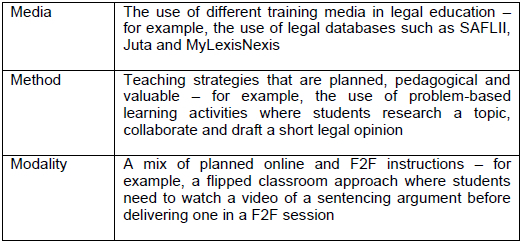
Graham and Halverson note that novice BL researchers can easily frame and design their approach by viewing BL as the integration of three components (referred to as the 3Ms) - namely, media (technological tools), method (teaching and learning strategy), and modality (instructional setting and environment).12 This relates to Balfour et al's description, which notes that BL is not restricted to F2F and online learning experiences.13 In the LSKL module, the 3Ms are represented as follows:
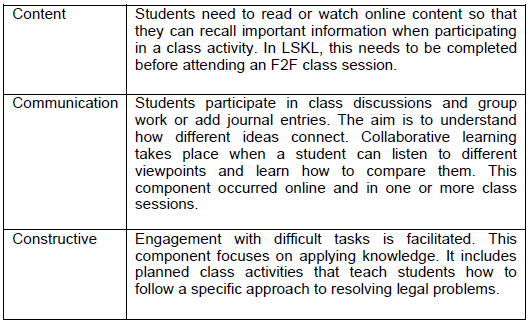
In the context of its broader e-learning application, BL also describes a combination of technologies and a combination of methodologies.14 Similarly, Kerres and De Witt propose a 3Cs model that involves three components of BL - namely, a content component (makes factual learning material available), a communication component (makes interpersonal interaction possible between learners or between learners and teachers), and a constructive component (facilitates learners' active engagement in complex learning tasks).15 In the context of the LSKL module, the 3Cs are represented as:
Kerres and De Witt furthermore go an additional step to explain that the 3Cs model is useful for arranging the components according to the difficulty of the learning tasks and the learning objectives.16 Loots et al assert that institutions of higher education bear the responsibility to become knowledgeable about who their students are and how to create the best blended environments to support learning, within and outside of the classroom.17 This requires purposeful planning and is therefore not simply a matter of blending F2F and online interactions. It becomes particularly needed when considering a discipline-specific blend design applicable to a particular "signature pedagogy" used in different disciplinary contexts,18 such as in the LSKL module.
2 3 Flipped classroom
A flipped classroom technique is acknowledged as being part of a BL approach.19 Sometimes referred to as an "inverted classroom" or "flipped learning", a flipped classroom entails that a student independently engages with new instructional material before an F2F or synchronous online session.20 Essentially, a flipped learning approach removes the traditional need for information to be transferred in the classroom only and replaces in-class instruction with practical applications, therefore focusing more on active learning experiences.21 Less time is used during class for knowledge transfer and "telling" students about the content. Instead, more time is used for activities and "doing" something where students are actively engaged.22 The F2F interaction revolves around working on active learning activities, often in groups, with the educator acting as a facilitator.23 The material viewed before the contact session usually takes the form of online videos, concept videos, audio recordings, prescribed reading, PowerPoint presentations and even podcasts.24 However, for effective engagement in contact session activities, students must actively engage with the pre-class instructional materials.25
A flipped-classroom approach brings about deeper and more active learning, especially through collaborative learning activities.26 In addition, flipped classrooms have been linked to improved learning outcomes and better levels of student engagement.27 Likewise, encouraging student participation in collaborative learning activities in contact sessions increases the opportunities for active learning experiences.28 Lee et al explain that the success of flipped learning lies in finding the right blend of online and F2F sessions, which are based on various BL approaches, and arranging each to build an integrated optimum learning experience.29 It is also recommended that the "lecturing" part of learning be kept to a minimum and that the "inquiry, discovery, and application" parts of the learning process be the main focus of the design.30
As far as the design of the online sessions and learning activities is concerned, studies identified three aspects that warrant attention: first, the physical features of the online session (length, speed and audibility); secondly, the content features of the online session (interactivity31 and clarity); and lastly, the logistical features outside of the online session, such as post-activities and formative assessments.32
2 4 Student engagement
The value that student engagement brings to a student's success in education is no longer questioned.33 Student engagement has been described as the degree to which students engage in educationally purposeful behaviour and the extent to which institutions encourage and support that involvement.34 In the early conceptualisation of student engagement, Edgerton coined the phrase "new pedagogies of engagement", referring to pedagogies that will "turn out the kinds of resourceful, engaged workers and citizens that America requires".35 "Engagement" refers to the frequency with which students participate in activities that represent effective academic practices36 and is a proven predictor of student success.37 Fisher et al state that "student engagement" is a multidimensional construct that is influenced by an array of factors.38 Fredericks et al recognise three elements of student engagement - namely, behavioural, emotional and cognitive engagement.39 In addition, Bond and Bedenlier see student engagement from the perspective of students being active participants in their learning.40 They describe the importance of agentic engagement by stating that the more students have a voice in their learning environment, the more engagement is likely to increase.41
To highlight the complexities of student engagement further, Kahu describes student engagement as a "psychosocial process, influenced by institutional and personal factors, and embedded within a wider social context, that integrates the sociocultural perspective with the psychological and behavioural views discussed".42 With this in mind, Kahu goes on to argue that no single research project could examine all facets of a complex construct such as "student engagement" and stresses the need for research on the role of emotion in student engagement.43 Emotion, as a point of departure, could form the basis for identifying the levels of student engagement in a flipped and blended approach.
Barkley views student engagement as a concept that is rooted in the motivation that students have to acquire knowledge and learn.44 In addition, the second component of student engagement entails that students must be "engaged", meaning that they are using higher-order thinking skills and actively learning in the process.45 Therefore, student engagement is a product of motivation and active learning and cannot be separated from either.46 Moreover, active learning and motivation work together in synergy, which contributes to enhanced engagement.47 In this light, Barkley defines student engagement as "a process and a product that is experienced on a continuum and results from the synergistic interaction between motivation and active learning."48
To achieve synergy in engagement, three conditions must be met. First, there must be a sense of a classroom learning community.49 To achieve this, educators must create learning environments where students feel that they are included, where they can interact with each other and where they are encouraged to learn.50 Secondly, students must be assisted to learn at an appropriate level to ensure that they remain engaged.51 This entails that students learn meaningfully, which requires them to use their prior knowledge and link it to new information.52 Lastly, in support of meaningful student learning and engagement, Barkley recommends that educators employ quality feedback and authentic assessment, develop metacognitive skills, and become active participants in the learning process.53
2 5 The purpose of the extended LLB programme and the LSKL module
The Council on Higher Education describes extended programmes with integrated foundation phases54 as a means for promoting access and success for historically disadvantaged students in South Africa.55 The primary aim of foundational courses is to address shortcomings in students' knowledge and skills; Snyman-Van Deventer and Van Niekerk note that many South African law students transition from secondary education to higher education underprepared for the challenges of university studies.56 It is therefore up to the institutions of higher education to ensure that programmes and interventions are in place to assist these students in developing the skills they need to succeed in their studies.57 Van Niekerk, in her study of the academic performance of extended-programme students who completed their LLB studies, established that extended programme students performed, on average, better than their mainstream counterparts.58 With this in mind, and in recognition of the need to provide broader access to students who face barriers to entering mainstream LLB programmes, extended curricula with integrated foundation phases emerge not only as a remedial measure but as a pathway that enables academic success.59
This research explores the teaching approach the author implemented as part of the LSKL module, offered in the second semester of the first year in the extended LLB programme at the UFS. The author has taught this foundational module since 2020, intending to develop students' legal research, writing and oral communication skills. The flipped-classroom model examined here is embedded within a broader pedagogical framework. To contextualise this approach, the following sections examine three interrelated concepts: blended learning, flipped learning and student engagement.
2 6 Overview of the flipped-classroom approach applied in LSKL
In 2020, the LSKL module underwent a comprehensive curriculum renewal as part of a broader pedagogical shift towards a flipped-classroom approach. This shift was informed by a commitment to deeper student engagement during contact time and to promoting active learning within and outside the classroom. Initially, the module followed a more traditional, lecturer-based approach, which, while structured, often limited opportunities for structured collaborative learning and active engagement. The transition was therefore both iterative and intentional.
In designing the flipped-classroom approach for the LSKL module, three key aspects were considered to support student motivation and active participation, in line with the 3Ms and 3Cs frameworks. First, the physical features of the online sessions, such as length, pacing and audibility, were structured to reduce cognitive overload and maintain attention. Secondly, the content features, including interactivity and clarity, were aligned with the module's learning outcomes to promote engagement. Lastly, logistical features beyond the sessions, such as follow-up activities and formative assessments, were structured to reinforce learning and promote self-regulation. These design choices were intentionally embedded within the flipped-classroom model to encourage student engagement both inside and outside the classroom.
Ongoing reflection on the effectiveness of the module's content and delivery informed successive revisions to the flipped learning approach, particularly regarding the integration of technology to enhance student engagement and learning outcomes in the LSKL module.
While instructional design methods can function in isolation, integrating them leads to more robust and effective courses that better meet the needs of learners. The key is to select and combine methods purposefully based on the specific context and goals of the course. Ultimately, the throughput rates in the LSKL module indicate that students are succeeding in passing the module.60 This suggests that the flipped-classroom approach has been effective in facilitating learning. However, relying solely on throughput rates is insufficient for understanding the underlying factors contributing to this success.
In the implementation of the flipped and blended teaching approach, elements of Fink's integrated course design (ICD) model were incorporated to refine and extend the application of the ADDIE model previously used. A brief overview of each important element follows.
The ADDIE model61 consists of five phases, namely:
1. analysing the learning situation: identify students' characteristics, training needs and course content;62
2. designing objectives to address the issue (didactic approach and organisation of content): identify the strategy and types of learning activities;63
3. developing resources to meet the specifications: start developing the plan, activities and materials; select the appropriate pedagogical strategies;64
4. implementing the learning resources; and
5. evaluating how the resources addressed the instructional needs - done throughout and at the end of the process.65
The process of applying ADDIE is incremental, where the teacher continuously reviews and revises content and decisions throughout the process.66 The ADDIE model is renowned for its ability to resolve problems at any stage of the design process owing to the continuous review and revision of materials.67 It is, however, not without critique. For example, the ADDIE model is hailed as being too linear and not as iterative as other models, and is not always responsive enough to the changing needs and expectations of students and stakeholders.68 While this proposal does not argue that instructional design methods cannot function in isolation, it is vital to keep in mind that integrating them can lead to more robust and effective courses that better meet the students' needs. The key is to select and combine elements of the methods thoughtfully, based on the specific context and goals of the overall redesign of the course.
Fink's ICD model was instrumental in addressing the limitations of the ADDIE model. It added an iterative, learning-centred approach that emphasised significant learning experiences, helping to create a more dynamic and engaging course structure. The ICD model is distinctive, as it allows educators to develop their courses in a suitable, interrelated way and encourages the use of active learning activities that support significant learning.69 It also provides practical steps to ensure that a module's situational factors, learning outcomes, assessments and teaching-and-learning activities all reflect and support each other in an integrated manner.70 This supports the notion that there is an overlap between a chosen teaching methodology and the other dimensions of curriculum design.71 Using Fink's 12 steps72 and the "flipped castle-top" approach73 to sequencing in- and out-of-classroom activities is useful, as it enhances the existing ADDIE instructional design approach.74 This approach supported the redesign of the LSKL module's flipped-classroom approach, resulting in more coherent and interconnected course content.
3 RESEARCH METHODOLOGY
3 1 Overview of the qualitative method
This study adopts a constructivist paradigm, which posits that individuals construct their knowledge of the world through experiences and reflection.75 An interpretive analysis methodology is used to explore how students experience and make sense of their learning within a flipped-classroom environment.76 While teaching refers to the design and delivery of instructional content, learning is a deeply personal and internal process, often complex and not directly observable. This distinction is particularly relevant in legal education, where individual perceptions and experiences shape student engagement, motivation and active participation.
Interpretive analysis is well suited to this context, as it enables the researcher to derive meaning from qualitative data and to examine how students construct understanding through their interactions with content, peers and learning technologies.77 An interpretivist approach seeks to understand how students make sense of their "life worlds",78 and therefore requires sensitivity to the socio-economic realities that shape their learning experiences. By acknowledging factors such as limited Internet access, high data costs or inadequate home infrastructure, and how these influence students' ability to engage with the flipped-classroom model, the analysis offers a more credible and comprehensive understanding of the student experience. It thus provides a foundation for theorising about student engagement from the student's perspective.
Maintaining methodological coherence is crucial for the study's integrity and is seen as the golden thread that runs through the study.79 The research methodology adopts a qualitative approach underpinned by an interpretivist approach aimed at understanding students' perceptions. This approach is intended to analyse people's "voices" and how they make sense of their "life worlds" and constructed realities.80
3 2 Data collection
To capture a comprehensive understanding of students' perceptions in a flipped classroom, this study employed two qualitative methods at two stages of the semester - namely, an interview at the start of the semester, followed by focus-group discussions after completing the LSKL module. This design was intentional, as the interviews allowed for an exploration of students' initial motivations and expectations, therefore providing a baseline insight into the students' perspectives and expectations of the LSKL module. The focus-group discussions held after the completion of the module facilitated a collective reflection among students, eliciting richer detail on the factors that influenced their motivation and active participation in the flipped module. A brief explanation of each of these stages is discussed next.
The first stage of the research involved F2F in-depth interviews, which were chosen to gather data at the beginning of the semester. To ensure the integrity and neutrality of the data-collection process, all interviews were conducted by the researcher. A semi-structured format was used to obtain subjective insights into students' expectations of the module and their perceptions of a flipped and blended classroom environment. The ability to pose follow-up questions for clarification contributed to the validity of the data. Participants were selected using a simple random sampling technique from among those who expressed willingness to take part in the study.81
The second stage of the qualitative approach entails using focus groups at the end of the semester, after the module has been completed. Focus groups offer advantages as they provide a more natural environment in which participants can influence and be influenced by others.82 Recognising the potential for bias, where participants might feel compelled to respond a certain way owing to this author's role as educator, the focus-group discussions were facilitated by a trained professional from the UFS Centre for Teaching and Learning. This approach was intended to create a more open and balanced environment where participants could share their views freely. Like individual interviews, semi-structured focus-group questioning was used, where participants had a space to share their perspectives, which in turn could lead to other discussion points.83
The participants received detailed information about the interviews and focus-group discussions. All the participants were asked to provide informed consent, signifying their voluntary agreement to take part in the study. They could withdraw from the study at any point without providing a reason. It was emphasised to all participants that their involvement in the study would neither harm nor positively affect their performance in the LSKL module. No incentives or rewards were offered to participants to ensure that their participation remained voluntary. Anonymity was ensured for all participants using pseudonyms, and any identifying information was excluded from the final write-up to protect participant confidentiality. Although the interviews and focus-group discussions were conducted, F2F measures were taken to mitigate any potential influence on academic assessment. Specifically, assessment tasks in the LSKL module were anonymised, with student names removed during marking. In addition, moderation procedures were in place to ensure fairness and objectivity in the assessments.
During the focus-group discussions, there was a risk of breach of confidentiality, as complete anonymity could not be guaranteed. Participants were made aware of this in their invitation and at the start of the focus-group discussion.
3 3 Population-and-sampling process
The participants in this study were registered students at the University of the Free State, with no involvement from other institutions. In 2024, a total of 215 students were enrolled in the LSKL module. The participants were all enrolled in the extended LLB programme, which specifically aims to broaden access to the LLB degree for historically disadvantaged students who may have been underprepared by secondary education.84 Consequently, the demographic profile inherently reflects a group that often faces socio-economic challenges, which is critical for contextualising the findings regarding digital barriers like Internet access.
Ten students were randomly selected and invited via email to participate in individual interviews; four accepted. The interviews, conducted at the beginning of the semester, lasted between 45 minutes and an hour. To protect participant confidentiality, pseudonyms were used, and all identifying information was excluded from the study write-up. The interview participants represented a range of ages and included both male and female students, all of whom were enrolled in the module for the first time.
The focus groups consisted of two smaller groups of a maximum of six students per group. Students must have been enrolled in the LSKL module for the first time. A total of 30 randomly selected students were invited by email to participate in one of two scheduled focus-group discussions. Students were free to choose which of the two dates suited them best. As a result, six students attended the first focus-group discussion, and four attended the second. Like individual interviews, semi-structured focus-group questioning was used, where participants had a space to share their perspectives, which in turn could lead to other discussion points.
4 DATA ANALYSIS
A limitation of this study was the inability to include most student voices registered for the LSKL module in 2024. Although this restricted the range of perspectives represented, the depth of the semi-structured interviews and the richer detail provided by the focus groups offered a comprehensive understanding of student motivation that quantitative metrics alone cannot capture. The themes that emerged affirm the importance students place on these factors in shaping their motivation and active learning, thereby lending credibility and weight to their contributions.
In analysing the data, Barkley's conditions for synergy in engagement were used as an initial conceptual framework. This provided a structural lens through which to interpret the students' perceptions of motivation and active participation.
Transcripts from the interview and focus-group recordings were produced, with aliases replacing participants' names for anonymity. The transcripts were coded by the researcher. Four interviews and two focus-group discussions were transcribed manually and coded by the researcher using open coding. This study relied on an inductive coding process to analyse the transcripts, allowing themes to emerge directly from the data without imposing a predefined framework or categories.85 This method ensures that the coding remains grounded in the perspectives of the students. Major themes were then generated from the identified codes. Once the themes were identified, Barkley's conditions for synergy in engagement served as a theoretical lens to interpret and organise the themes.
While the sample size is small relative to the total enrolment of 215 students, data saturation was reached as the analysis identified clear, recurring patterns that aligned with the study's theoretical framework. The consistency of themes emerging from both the initial interviews and the subsequent focus groups indicated that additional participants would have been unlikely to yield significantly new insights into student motivation and participation in this specific context.
The next section presents the findings from individual interviews conducted at the beginning of the semester and during two focus-group discussions held after the completion of the module. Thematic analysis was employed to identify recurring patterns in students' responses regarding their motivation and active participation in a flipped and blended law module. The discussion is organised into three main categories: initial expectations and perceptions; factors influencing engagement across different learning modalities; and focused themes around collaborative learning, LMS sequencing and adaptive release, assessment types and unintended outcomes.
4 1 Initial student expectations and perceptions on flipped and blended learning
The individual interviews provided a baseline understanding of students' expectations and initial perceptions of the flipped and blended learning environment.
Students generally expected the LSKL module to equip them with foundational skills relevant to their legal education. This included practical skills in legal drafting and trial advocacy, which align with the module's outcomes. Three out of the four students interviewed had limited or no prior experience with flipped and blended learning. Students indicated that they had encountered components in other modules, but not in an integrated format as applied in the LSKL module. Students identified several barriers that could limit their sustained engagement during the semester. These barriers included poor Internet connection, limited or no access to an Internet connection, and difficulties in understanding legal terminology without immediate support. This correlates with Dukhi et al's finding that technical challenges are often symptomatic of the socio-economic disparities faced by students in South Africa.86
When asked how they planned to stay motivated through the duration of the semester, responses varied. Two students connected their motivation directly to their academic performance, while the others identified class preparation and class participation as key factors to keep them motivated.
4 2 Factors influencing engagement
The focus-group discussions provided deeper insights into how the students experienced the flipped and blended learning environment. The factors that emerged from the thematic analysis are F2F learning, LMS-based learning, and assessment practices.
Students valued the F2F sessions for both their immediacy in addressing concerns or clarifying uncertainties and for their interactivity. The class sessions, and particularly the collaborative learning activities, were described by some as essential for clarifying legal concepts and fostering a sense of collaborative learning. The following responses reflect a common experience among participants:
"It is easier when things are explained by your peers than it is by the lecturer. It is easier to understand each other because we're on the same level.
We had to go over some of the work before attending class. Going through the work before class actually motivated me to engage because I already knew what was going to be talked about in class.
In class, we're engaging. Our lecturer would want us to be in groups and discuss things and share our thoughts, or share what we think."
However, some students indicated that the venue was not suitable, as poor acoustics hindered their ability to hear clearly, thus confusing the required tasks.
Collaborative learning activities emerged as a key motivator, with students expressing that class discussions and group activities improved their motivation to participate and to prepare. This sentiment was captured by students who said:
"We had a chance to talk about the preparation in class and outside of class. For example, we had cases in this last assignment. Our lecturer would group us and say we must read those cases, go through them and talk about them. I became confident enough to raise my hand and share my view and my perspective with other learners.
In class, there would be times when we would be grouped, and we had to discuss whatever it was that was being taught and give answers. That motivated me to go back home, study and come to class. It made learning the module more interesting.
We had a moot court in class, which was very interesting, instead of just sitting, listening to the lecturer and not understanding what was being said. So, at least we were engaging as a class and that alone is motivational enough to actually want to go to class and engage with other people."
In addition to the F2F learning opportunities, students were of the view that the LMS was central to the flipped and blended classroom experience. Some appreciated the flexibility that it provided when accessing the learning material. Students described this experience as follows:
"The preparations for class were very useful for me because they helped me actually understand what to expect when coming to class.
After preparing, you were able to ask the lecturer to explain the content you did not understand when you were preparing for a class."
It bears mentioning that some students expressed concerns relating to the magnitude of information that was available on the LMS during the individual interviews. However, this issue was not raised again as a concern during the focus-group discussions.
The LMS adaptive release feature received mixed feedback. On the one hand, students appreciated the structured and sequenced progression. As one student put it,
"The activities on Blackboard motivated me was basically because to move to a new study unit, you had to complete quizzes and read material. It felt like I had to earn the next part."
On the other hand, students felt constrained by the sequencing. The following comments illustrate this:
"When it came to doing those quizzes, sometimes it was a bit like, do I really have to do this to move on to the next study unit? There are other modules that I need to focus on. So now I have to do this much work for me to access the next study unit. It was a bit demotivating. I have other modules where it's easy for me to access study material. Why do I have to work so hard in this module to access them?"
How the assessments were designed influenced students' motivation. Formative assessments, such as the oral presentation and the short legal opinion, were regarded as contributing to sustained engagement in class discussions, as reflected in the following experiences:
"In the oral assessment, we had to study a case and make a video arguing that case. I feel like it helped me to grow as a learner because it made me realise that it's not actually easy arguing a case. There is also a lot of work that you have to put in terms of researching the cases and the legislation.
I couldn't raise my hand in class and answer a question whenever I had an answer. I was just keeping quiet and letting things be. After that assignment, I was able to answer the questions and felt confident enough to raise my hand and share my view and perspective with other learners in the class."
Overall, students responded positively to assessments that mirrored real-world scenarios. The following student describes this by stating that:
"In the oral, we had to convince the judge to reduce the sentence. It taught me how to act in a courtroom, the layout of a courtroom, and how to talk to a judge, like the skills that a lawyer would use in a courtroom."
Although some students initially found the LMS quizzes used as part of the adaptive release to be demotivating, their attitudes changed as they became familiar with the module's structure and expectations. The following two students shared this experience:
"The preparation work at first felt demotivating for me because I felt like I had to do homework and when I got home, I had to go and study. But then, eventually, I saw that it was helpful because when I go to class, I understand what is being taught. But at first, for me, it was demotivating, and I didn't like going home and having to do work after having classes.
I know now that active learning makes it easier to retain information. So I am also applying active learning when I study for other modules. So even though you were forced to kind of do it in the module, I see the benefit now."
Beyond the intended learning outcomes of the research, several unintended yet valuable consequences emerged from the data. Students reported that the flipped and blended approach assisted them in developing key time-management skills applicable in their other modules and real-life contexts. This was echoed in multiple responses, such as:
"We did a section about finding legislation and case laws in Legal Skills. What we were taught, I am actually applying, and it's been useful in my other modules and will be for the rest of my studies.
I wasn't the type of student who would prepare before class. I never did that before. But after starting to do this in LSKL, I started doing it for all of my other modules.
I found the module interesting, and the content was easy to grasp, learn, and memorise. Things that I learned in LSKL, I now apply in the modules that I am registered for this year. I can recall that we did this last year and can apply what I have learned.
The assessments taught us to use different sources in order to come to a decision. That is useful for the future, not just academically, but also for the future. That's going to help us, and it's going to be very helpful."
Students also described that they had increased confidence in their academic abilities as law students. This, in turn, boosted their confidence to participate in collaborative learning opportunities. Also, some students expressed that it developed their abilities on a personal level. Two students expressed how the LSKL module increased their confidence and personal development as follows:
"I feel like in real life, we have those moments where you want to show off to people that you know things. So, the things that you learned in Legal Skills - when something you read somewhere or see on TikTok - you can actually say, 'Oh, I know this. This is how it goes. This is wrong. This is how it is.'
I think this module didn't just develop us academically, even mentally as individuals. Now we can think broadly without being restricted due to activities that we did in this module … So I think this module helped us to grow as learners as well as a person."
5 DISCUSSION OF FINDINGS
Extensive research stresses the role of student motivation and active participation as key predictors of academic success.87 These factors are often applied through active and collaborative learning approaches, which foster deeper engagement and improved learning outcomes. The importance of student effort has also been emphasised, particularly in class attendance and effective time management.88 High-impact practices such as collaborative learning, peer learning, practical learning activities and online learning have been identified as particularly effective in enhancing student engagement and academic performance.89
Despite this growing body of evidence, there remains a notable gap in the literature concerning student engagement within law programmes, and more specifically, within extended law programmes. This lack of focused research limits our understanding of how these well-established engagement strategies translate into the context of legal education, where pedagogical approaches and student experiences may differ significantly from other disciplines. Current literature on the broader scope of legal education covers the limitations of the traditional model of legal education,90 authentic/alternative assessment in legal education, awareness and understanding of law's role in everyday life and society,91 developing law students' legal writing skills,92 teaching methodologies that support transformative legal education,93 and proposals for a flexible LLB curriculum.94 While some contributions provide a literature review of current teaching approaches and practices for sustained student engagement,95 few offer empirical research by legal educators focusing specifically on student engagement in a first-year extended LLB module. Given the limited research on student engagement within extended law programmes, this section aims to provide insights into what factors contribute to sustained student engagement and active participation in the LSKL module.
The interviews conducted at the start of the semester revealed that students entered the module with a desire to acquire practical legal skills, particularly in trial advocacy. This aligns with the LSKL module's objectives and suggests that students were prepared for experiential learning. However, most had limited or no exposure to flipped and blended learning, which influenced their initial perceptions and expectations.
Class discussions and group work - elements central to Barkley's framework and the "communication" and "constructive" components of the 3Cs - were consistently described as factors that fostered a sense of community and accountability, which students found motivating. This finding resonates with existing literature that supports the view that collaborative activities are effective in blended learning environments.96 The LMS was both a factor for and against engagement. It should therefore not be viewed solely as a learning tool but also as a potential point of exclusion, particularly for students who face external constraints such as high data costs or limited technological infrastructure at home. While it supported self-directed learning and flexible access to materials, adaptive release mechanisms were perceived by some as restrictive. This underscores the need for intentional and strategic planning in the design of a flipped classroom, as the alignment between in-class and out-of-class engagement is crucial to sustaining motivation and active participation.97 It is also reminiscent of Fink's "castle-top" approach that emphasises a structured progression of learning activities.98
The findings suggest two considerations. On the one hand, the role that the classroom community plays is vital since how students feel about what is occurring in class determines the degree to which they will participate and engage in the learning activities.99 On the other hand, the findings indicate that the effectiveness of a flipped-classroom approach depends, partially, on students' belief that the out-of-class activities on the LMS are purposeful and contribute to their learning.100
While the LMS enabled students to access materials at any time and supported self-directed learning, the use of adaptive-release mechanisms felt restrictive and counterproductive for some. For others, it provided a clear structure and sequence that supported both their personal learning and time-management skills. Amadi et al found that there is a strong correlation between effective time management and sustained motivation.101 This correlation reinforces the idea that self-regulated learning is not only important for law students' academic success but also for sustained engagement.
One of the most compelling findings was the development of unintended but valuable outcomes. These include the fact that students were able to develop skills in the LSKL module that were transferable to other modules and real-life contexts. These included self-directed learning, critical thinking and time management, all of which were intentionally embedded as part of the graduate attributes expected of law students.102 This suggests that a flipped-classroom approach can promote lifelong learning competencies.
Students described increased confidence in their academic abilities and personal growth. This was attributed to the structured preparation required on the LMS and the opportunity to engage meaningfully in class discussions. Some students linked this growth to improved academic performance, while others noted a broader transformation in their identity as learners. This insight again stresses the need for intentional flipped-classroom approaches that nurture confidence through scaffolded, active, sequenced, supportive and integrated learning experiences.
The discussion above affirms that motivation and active learning function in synergy as "two helices", as Barkley asserts. When educators implement flipped-classroom approaches that improve motivation and promote active participation, they are more likely to create learning environments that support sustained engagement. This synergy is most effectively achieved under Barkley's three interrelated conditions - namely, creating a sense of classroom community, supporting students to work at their optimal level of challenge, and promoting holistic learning across cognitive, affective and psychomotor domains.
The themes that emerged from the data, namely collaborative learning, LMS use, assessment types, and unintended outcomes, can be meaningfully mapped into Barkley's three conditions. For example, collaborative learning directly contributes to building a sense of community, allowing students to feel connected and supported. The strategic use of the LMS enables both independent and interdependent learning, enabling students to engage with content at their own pace while also participating in structured and collaborative activities. Furthermore, assessment types that are varied and authentic allow students to operate at their optimal level of challenge, encouraging critical thinking and problem-solving. Finally, the unintended outcomes, such as increased confidence or self-awareness, point to the holistic impact of the flipped-classroom approach, touching on different dimensions of learning. This suggests that the flipped-classroom approach has the potential to activate the synergy between motivation and active learning.
6 CONCLUSION
This study addresses gaps in the literature by contributing in two ways. It offers student-centred insights into engagement within a flipped Legal Skills module and introduces a framework that highlights the interplay between motivation and active learning. Using Barkley's Model for Student Engagement, the findings reveal that motivation and active learning are interrelated and shaped by collaborative learning opportunities, thoughtful LMS integration, and authentic assessment practices. When these elements are aligned, they not only enhance motivation but also support the development of transferable academic and professional skills.
The study further contributes to the evolving discourse on legal education by providing empirically grounded insights into student engagement in technology-enhanced legal skills modules. It offers practical guidance for educators seeking to design flipped classrooms that cultivate legal reasoning, critical thinking and self-directed learning, which are core competencies essential for law students.
These findings affirm Barkley's assertion that motivation and active learning function in synergy and that this synergy is most effectively activated when the 3Ms (media, method, modality) and 3Cs (content, communication, constructive) are intentionally embedded in the learning design. Together, these frameworks demonstrate how a flipped-classroom approach can sustain student engagement in extended legal education. Although this study was conducted within the extended LLB programme, the findings offer insights that are broadly applicable to legal education in general. The principles of motivation, active learning and intentional design, anchored in the 3Ms and 3Cs frameworks, are relevant across different programme structures and can inform pedagogical practices in both mainstream and extended law curricula.
Ultimately, this study makes a strong case for the intentional design of flipped modules in law programmes, where pedagogical strategies and assessment practices are carefully integrated to support sustained engagement. The most significant contribution of the flipped-classroom approach lies in its ability to build learner confidence and equip law students with the skills and mindset needed to succeed, advancing the dialogue around impactful pedagogies in legal education and underscoring the potential of flipped learning in extended law programmes.
References
- 1 Kiljunen, Sointu, Äikäs, Valtonen and Hirsto "Higher Education and the Flipped Classroom Approach: Efficacy for Students With a History of Learning Disabilities" 2024 88 Higher Education 1127 1129.
- 2 Ali "Bridging the Gap: Integrating Flipped Classrooms Into Legal Education in Pakistan" 2024 33(47) Journal of Legal Studies 79 79-80.
- 3 Deliwe "The Importance of a Learner Management System in Implementing Data-Driven Instruction in Higher Education Institutions" 2024 5(1) Journal of the Digital Humanities Association of Southern Africa 1 6.
- 4 Van Niekerk Investigating the Effect of the Extended Programme on the LLB Students' Success (MA mini-dissertation, University of the Free State) 2013 31; Snyman-Van Deventer "Student Engagement: More Than Bells and Whistles" 2019 40(1) Obiter 1 7.
- 6 Astudillo "The Blended Learning Pedagogical Model in Higher Education" in Martín-García (ed) Blended Learning: Convergence Between Technology and Pedagogy (2020) 142.
- 7 Crocker "Blended Learning: A New Approach to Legal Teaching in South African Law Schools" 2006 31(2) Journal for Juridical Science 1 3.
- 9 Astudillo in Martín-García (ed) Blended Learning: Convergence Between Technology and Pedagogy 142.
- 10 Astudillo in Martín-García (ed) Blended Learning: Convergence Between Technology and Pedagogy 143.
- 11 Council on Higher Education Manual and Criteria for a Themed Review: Modes of Learning and Teaching (2025) 4.
- 12 Graham and Halverson "Blended Learning Research and Practice" in Zawacki-Richter and Jung Handbook of Open, Distance and Digital Education (2022) 1161.
- 13 Balfour, Van der Walt, Spamer and Tshivhase "Blended Learning, and Open and Distance Learning: Implications for the Best Practice in Higher Education" 2015 37(1) Progressio 1 4.
14 Balfour et al 2015 Progressio 4.
15 Kerres and De Witt "A Didactical Framework for the Design of Blended Learning Arrangements" 2003 28 Journal of Educational Media 101 104.
16 Kerres and De Witt 2003 Journal of Educational Media 104.
17 Loots, Strydom and Posthumus "Learning from Students: Factors That Support Student Engagement in Blended Learning Environments Within and Beyond Classrooms" 2023 22(2) Journal of Student Affairs in Africa 73 85.
18 Graham and Halverson in Zawacki-Richter and Jung Handbook of Open, Distance and Digital Education 10.
19 Ay and Dağhan "The Effect of the Flipped Learning Approach Designed With Community of Inquiry Model to the Development of Students' Critical Thinking Strategies and Social, Teaching, and Cognitive Presences" 2023 28(11) Education and Information Technologies 1 2.
20 Matamoros "Answering the Call: Flipping the Classroom to Prepare Practice-Ready Attorneys" 2015 43 Capital University Law Review 113 118.
21 Ay and Dağhan 2023 Education and Information Technologies 569.
22 Talbert Flipped Learning: A Guide for Higher Education Faculty (2017) 74.
23 Matamoros 2015 Capital University Law Review 118.
24 Ibid.
25 Ay and Dağhan 2023 Education and Information Technologies 2.
26 Van Niekerk and Delport "Evolving Flipped Classroom Design in a Cost/Management Accounting Module in a Rural South African Context" 2022 31(4) Accounting Education 567 569-570.
27 Ay and Dağhan 2023 Education and Information Technologies 2.
28 Ay and Dağhan 2023 Education and Information Technologies 3.
29 Lee, Lim and Kim "Development of an Instructional Design Model for Flipped Learning in Higher Education" 2017 65 Education Tech Research Dev 427 430.
30 Lee et al 2017 Education Tech Research Dev 430.
31 It must be noted that Lee et al assert that interactivity is vital for the success of a flipped learning online session to keep students engaged.
32 Lee et al 2017 Education Tech Research Dev 432.
33 Nepal and Rogerson "From Theory to Practice of Promoting Student Engagement in Business and Law-Related Disciplines: The Case of Undergraduate Economics Education" 2020 10(8) Education Science 1 3.
34 Loots, Strydom and Posthumus 2023 Journal of Student Affairs in Africa 74.
35 Barkley Student Engagement Techniques: A Handbook for College Faculty (2010) 4.
36 Ibid.
37 Zepke "Student Engagement Research: Thinking Beyond the Mainstream" 2015 34(6) Higher Education Research and Development 1 3.
38 Fisher, Perényi and Birdthistle "The Positive Relationship Between Flipped and Blended Learning and Student Engagement, Performance and Satisfaction" 2021 22(2) Active Learning in Higher Education 98 100. On the contrary, what is known about student engagement is that it is related to academic success, active participation and deep learning practices, and is characterised by enthusiasm, motivation and a sense of belonging.
39 Fredricks, Blumenfeld and Paris "School Engagement: Potential of the Concept, State of the Evidence" 2004 74(1) Review of Educational Research 59 62.
40 Bond and Bedenlier "Facilitating Student Engagement Through Educational Technology: Towards a Conceptual Framework" 2019 11(1) Journal of Interactive Media in Education 1 2.
41 Bond and Bedenlier 2019 Journal of Interactive Media in Education 2.
42 Kahu "Framing Student Engagement in Higher Education" 2013 38(5) Studies in Higher Education 758 772.
43 Kahu 2013 Studies in Higher Education 773.
44 Barkley Student Engagement Techniques: A Handbook for College Faculty 5; Van Niekerk and Delport 2022 Accounting Education 570.
45 Barkley Student Engagement Techniques 5.
46 Barkley Student Engagement Techniques 6. Barkley argues that it is interconnected, and student engagement cannot be achieved if either one of the components is absent.
47 Barkley Student Engagement Techniques 7.
48 Barkley Student Engagement Techniques 8.
49 Barkley Student Engagement Techniques 25.
50 Barkley Student Engagement Techniques 26.
51 Barkley Student Engagement Techniques 27.
52 Barkley Student Engagement Techniques 28.
53 Barkley Student Engagement Techniques 28-30. In this context, quality feedback should be impactful allowing students "to know how they are doing and how to do better." Authentic assessment is described as an approach in which students are linking their knowledge and skills to real-world situations. With reference to developing metacognitive skills, Barkly suggest that students do best when they get clear feedback, learn how to reflect on their own learning process, and are treated as active participants in the classroom.
54 Also referred to as "extended curriculum programmes" or ECPs.
55 Council on Higher Education "The State of the Provision of the Bachelor of Laws (LLB) Qualification in South Africa" (11 October 2023) https://www.che.ac.za/publications/reports/state-provision-bachelor-laws-llb-qualification-south-africa (accessed 2025-07-15).
56 Snyman-Van Deventer and Van Niekerk "The University of the Free State Faculty of Law/Write Site Intervention - Supporting Broader Access With the Skills for Success" 2018 43(1) Journal for Juridical Science 39 39.
57 Snyman-Van Deventer and Van Niekerk 2018 Journal for Juridical Science 42.
58 Van Niekerk Investigating the Effect of the Extended Programme on the LLB Students' Success 57.
59 Snyman-Van Deventer and Van Niekerk 2018 Journal for Juridical Science 52. The authors assert that this is owing to rigorous admission requirements and specific numeracy and literacy proficiency requirements.
60 The throughput rates for LSKL 1524 were 94,65% in 2022, 91,54% in 2023, and 93,95% in 2024.
61 Nichols Hess and Greer "Designing for Engagement: Using the ADDIE Model to Integrate High-Impact Practices Into an Online Information Literacy Course" 2016 10(2) Communication and Information Literacy 264 267.
62 Martín-García (ed) Blended Learning: Convergence Between Technology and Pedagogy (2020) 89.
63 Martín-García (ed) Blended Learning 87.
64 Ibid.
65 Valverde-Berrocoso and Fernández-Sánchez "Instructional Design in Blended Learning: Theoretical Foundations and Guidelines for Practice" in Martín-García (ed) Blended Learning 123.
66 Nichols Hess and Greer 2016 Communication and Information Literacy 267.
67 Valverde-Berrocoso and Fernández-Sánchez in Martín-García (ed) Blended Learning 123.
68 Ibid.
69 Fink A Self-Directed Guide to Designing Courses for Significant Learning (2003) 4.
70 Fink A Self-Directed Guide to Designing Courses for Significant Learning 1.
71 Quinot and Greenbaum "The Contours of a Pedagogy of Law in South Africa" 2015 26(1) Stellenbosch Law Review 29 30.
72 Zhang, Purcell and Zang Using Fink's Integrated Course Design Model in Developing a Health IT Course Paper presented at Conference on Information Systems Education and Research, Orlando, Florida, US (2012) 3. The 12 steps are as follows: 1. identify the situational factors; 2. determine the learning outcomes for the course; 3. determine when feedback takes place and the assessment; 4. outline the teaching and learning activities in which active learning is encouraged; 5. integrate and align learning outcomes, assessment and learning activities; 6. Lay out course topics; 7. choose a teaching strategy for the course; 8. integrate course structure and instructional strategy; 9. choose a grading system and assign appropriate weights to each part of grade; 10. prepare adjustments to potential teaching difficulties; 11. write the course syllabus to communicate the information to the students; and 12. create an evaluation system for the course and teaching.
73 Fink A Self-Directed Guide to Designing Courses for Significant Learning 27. Fink describes a "castle top" approach as an instructional strategy that arranges learning activities in a particular sequence that build on one another. These activities are then grouped into in-class and out-of-class blocks.
74 Talbert Flipped Learning: A Guide for Higher Education Faculty 97.
75 Adom, Yeboah and Ankrah "Constructivism Philosophical Paradigm: Implications for Research, Teaching and Learning" 2016 4(10) Global Journal of Arts Humanities and Social Sciences 1 2.
76 Okoko, Tunison and Walker (eds) Varieties of Qualitative Research Methods: Selected Contextual Perspectives (2023) 250.
77 Ibid.
78 Ibid.
79 Bezuidenhout, Du Plooy-Cilliers and Davis (eds) Research Matters (2011) 203.
80 Bezuidenhout et al Research Matters 200.
81 Bezuidenhout et al Research Matters 161.
82 Litosseliti Using Focus Groups in Research (2003) 2.
83 Litosseliti Using Focus Groups in Research 3.
84 Council on Higher Education https://www.che.ac.za/publications/reports/state-provision-bachelor-laws-llb-qualification-south-africa.
85 Bezuidenhout et al Research Matters 270.
86 Dukhi, Sewpaul, Zungu, Mokhele and Sifunda "Learning and Institutional Support for Youth in Higher Education Institutions During the COVID-19 Pandemic in South Africa" 2024 Frontiers in Education 1 9.
87 De Villiers and Werner "The Relationship Between Student Engagement and Academic Success" 2016 14(1) Journal for New Generation Sciences 36 77.
88 Strydom, Kuh and Mentz "Enhancing Success in South Africa's Higher Education: Measuring Student Engagement" 2010 42(1) Acta Academica 259 261.
89 Strydom, Basson and Mentz Enhancing the Quality of Teaching and Learning: Using Student Engagement Data to Establish a Culture of Evidence (2012) 7.
90 Greenbaum "Current Issues in Legal Education: A Comparative Review" 2012 23 Stellenbosch Law Review 16 18.
91 Mitchell "Developing Critical Citizenship in LLB Students: The Role of a Decolonised Legal History Course" 2020 26(2) Fundamina 337 360.
92 Snyman-Van Deventer and Swanepoel "Teaching South African Law Students (Legal) Writing Skills" 2013 24(3) Stellenbosch Law Review 510 511.
93 Quinot and Greenbaum 2015 Stellenbosch Law Review 61.
94 Campbell "The Role of Law Faculties and Law Academics: Academic Education or Qualification for Practice?" 2014 25(1) Stellenbosch Law Review 15 33.
95 Crocker "Motivating Large Groups of Law Students to Think Critically and Write Like Lawyers: Part 1" 2020 41(4) Obiter 751 759.
96 Strydom, Basson and Mentz Enhancing the Quality of Teaching and Learning: Using Student Engagement Data to Establish a Culture of Evidence 7.
97 Fink A Self-Directed Guide to Designing Courses for Significant Learning 28.
98 Fink A Self-Directed Guide to Designing Courses for Significant Learning 27.
99 Barkley Student Engagement Techniques 35.
100 Fisher et al 2021 Active Learning in Higher Education 100.
101 Amadi, Du Plessis, and Solomon "Will Working Students Flourish or Give Up? Exploring the Influence of Academic Psychological Capital, Grit, and Time Management" 2022 36(6) South African Journal of Higher Education 192 193.
102 Welgemoed and Erasmus "The Importance of Graduate Attributes in Preparing Law Students for Legal Practice" 2023 44(4) Obiter 709 719-720.