Reshaping Workplace Cannabis Policies in Post-Decriminalisation South Africa. Enever v Barloworld Equipment South Africa, A Division of Barloworld South Africa (2024) 45 ILJ 1554 (LAC)
1 Introduction
The legal landscape surrounding cannabis use in South Africa has undergone significant changes in recent years, most notably with the Constitutional Court's decision (in Prince v Minister of Justice and Constitutional Development 2018 (6) SA 393 (CC) (Prince)) to decriminalise private cannabis use. This landmark ruling has profound implications for workplace policies and practices, particularly concerning drug testing and employee rights. The case of Enever v Barloworld Equipment South Africa, first heard in the Labour Court (Enever v Barloworld Equipment, A Division of Barloworld South Africa (2022) 43 ILJ 2025 (LC)) and in a later appeal to the Labour Appeal Court (Enever v Barloworld Equipment South Africa, A Division of Barloworld South Africa (2024) 45 ILJ 1554 (LAC)), brings these issues into sharp focus, highlighting the complex interplay between employee privacy rights, workplace safety concerns, and evolving societal norms.
This discussion examines the legal and practical challenges facing employers and employees in the wake of these developments. It explores several key questions. How can workplace drug policies balance the employer's duty to maintain a safe working environment with employees' constitutional rights to privacy and dignity? What are the limitations of current drug-testing methods (particularly urine tests) in accurately assessing impairment and recent cannabis use? How might alternative testing methods, such as saliva tests, offer a more rational approach to workplace drug testing? What role should observable signs of impairment play in assessing an employee's fitness for work, beyond reliance on drugtest results? How can workplace policies evolve to reflect changing legal and societal attitudes towards cannabis use while still ensuring workplace safety?
The discussion begins with an analysis of the Enever case, tracing its progression from the Labour Court to the Labour Appeal Court. It then explores the implications of the Labour Appeal Court's decision, which found the employer's zero-tolerance cannabis policy to be discriminatory and an infringement on the employee's right to privacy. The case note goes on to examine the limitations of urine testing and the potential advantages of saliva testing in workplace drug screenings. Finally, it considers the importance of assessing actual impairment through multiple indicators and the need for nuanced, job-specific approaches to cannabis-use policies in the workplace.
By critically examining these issues, this case note aims to provide insights and recommendations for crafting fair, effective, and legally compliant workplace drug policies in the context of South Africa's evolving cannabis laws. It seeks to contribute to the ongoing dialogue about balancing employee rights with workplace safety in an era of changing attitudes towards cannabis use, offering a nuanced perspective that considers both legal precedents and practical realities.
2 Facts
This case concerns the dismissal of Bernadette Enever (the employee) by Barloworld Equipment South Africa (the employer) for testing positive for cannabis during a routine medical check (Enever LAC par 2). The employee had been employed by the company since 2007, initially as an office manager and had later been promoted to category analyst (Enever LAC par 4). The employer has an "Employee Policy Handbook", the terms of which the employee accepted and signed in 2012. This handbook explicitly states that the company may require employees to undergo medical examinations during their employment (Enever LAC par 5). It also incorporates the employer's Alcohol and Substance Abuse Policy, which had a zero-tolerance approach to the possession and consumption of drugs and alcohol in the workplace (Enever LAC par 6). The policy includes requirements on random, voluntary and scheduled testing for drugs. It allowed for testing to be carried out in the following circumstances: during annual medicals; pre-employment tests; after workplace incidents; when there is reason for suspicion; when an employee returns to work after an absence exceeding 14 days; and if use or possession is disclosed (Enever LAC par 6). If an employee tests positive or non-negative, they are sent home for seven days and retested upon return. This process is repeated until the employee tests negative. During this time, employees must use any remaining annual leave or are placed on forced unpaid leave (Enever LAC par 7).
In 2019, following the Constitutional Court's decision in Prince, which decriminalised private cannabis use, the company reaffirmed that its zero-tolerance policy would still apply to cannabis (Enever LAC par 8). The employee had been using cannabis since May 2012 for medical reasons, including severe anxiety and sleep issues, as an alternative to prescription medication, which caused side effects. She smoked a cannabis cigarette every night and on weekends, in addition to daily use of cannabis-based products like cannabis oil (Enever LAC par 9-10). In 2020, the employee tested positive for cannabis during a routine medical test to regain biometric access to the workplace. She was denied access and told to return after seven days. This occurred four more times (Enever LAC par 10).
A disciplinary hearing was held, and the employee pleaded guilty. In mitigation, she explained her medical use of cannabis and its benefits (Enever LAC par 11). She was ultimately dismissed (Enever LAC par 12).
Importantly, it was accepted that, at the time of testing, the employee "was not impaired in the performance of any of her duties or suspected of being intoxicated, that she worked in an office without operating dangerous machinery nor that she was required to drive for the [employer]" (Enever LAC par 12).
3 Judgment of the Labour Court
The employee brought two challenges to the Labour Court. First, she claimed unfair discrimination in terms of section 6(1) of the Employment Equity Act (55 of 1998) (EEA). Secondly, she claimed automatic unfair dismissal in terms of section 187(1)(/) of the Labour Relations Act (66 of 1995) (LRA). Section 187(1)(/) of the LRA provides:
"A dismissal is automatically unfair _ if the reason for the dismissal is that the employer unfairly discriminated against an employee, directly or indirectly, on any arbitrary ground, including, but not limited to race, gender, sex, ethnic or social origin, colour, sexual orientation, age, disability, religion, conscience, belief, political opinion, culture, language, marital status or family responsibility."
Section 6(1) of the EEA provides:
"No person may unfairly discriminate, directly or indirectly, against an employee, in any employment policy or practice, on one or more grounds, including race, gender, sex, pregnancy, marital status, family responsibility, ethnic or social origin, colour, sexual orientation, age, disability, religion, HIV status, conscience, belief, political opinion, culture, language, birth or on any other arbitrary ground."
These two claims were consolidated into a single case before the Labour Court (Enever LC par 1). The employee's main argument was that her dismissal for testing positive for cannabis was automatically unfair and that the company's Alcohol and Substance Abuse Policy discriminated against her on arbitrary grounds (Enever LC par 2). She sought to be retrospectively reinstated if the court found in her favour (Enever LC par 2). The Labour Court dismissed her claims against the employer of unfair discrimination and automatically unfair dismissal. The key findings of the court were:
a) There was no differentiation between the employee and other employees in the application of the company's Alcohol and Substance Abuse Policy. The policy was consistently applied to all employees who tested positive for alcohol or drugs (Enever LC par 18-19).
b) The court rejected the employee's argument that her cannabis use was for medicinal purposes, finding this to be an "afterthought" raised only after she was caught. The court noted a lack of medical evidence to support her claim (Enever LC par 34-35).
c) The court found the employee's recreational use of cannabis undermined her medicinal use argument (Enever LC par 36).
d) While there was a causal link between the employee testing positive for cannabis and her dismissal, the court noted that her dismissal was also influenced by her stated unwillingness to stop using cannabis (Enever LC par 37-38).
e) The court determined that the employee's case was one of misconduct rather than discrimination. It found that she had breached a known company rule and that the company had consistently applied this rule without exception (Enever LC par 43-44).
f) The court concluded that even if there was some differentiation in applying the policy to the employee due to her claimed medical condition, this differentiation was rational and served a legitimate purpose and therefore did not amount to unfair discrimination (Enever LC par 46).
Ultimately, the court dismissed both the employee's claims of discrimination and automatically unfair dismissal, finding that she had wrongly pursued a discrimination case when no discrimination existed (Enever LC par 45-46).
The judgment was, however, subject to criticism, especially in light of the Prince judgment. For example, Van Staden ("An Update of Recent Labour Law Developments From South African Courts 2023" 2023 TSAR 696 711712) argued as follows:
"The judgment is questionable. It may be argued that the employer's policy was unconstitutional as the zero-tolerance approach infringed upon the constitutional right to consume cannabis in private spaces. The comparison to alcohol testing by the court was misleading. The court itself acknowledged that employees could test positive for cannabis use while they were no longer under the influence thereof. The same is not true of alcohol tests. The mere fact that someone tests positive for alcohol means they are intoxicated. Those who consume cannabis may be susceptible to testing positive long after the effects of the drug have vanished. It seems counterintuitive that, in light of recognising the right to consume cannabis in private, an employment policy could forbid such conduct - even in circumstances where it cannot be shown that the person was under the influence of the substance while at work. Even if it could be proved that the employee was under the influence, this would still not have meant that the policy was rational as the employee's consumption was not shown to affect her work."
So too, Sibiya suggested that courts "missed an opportunity to reconcile the employer's interests (ensuring a safe working environment) with the employee's interest (private consumption of cannabis) in order to achieve fairness in the employment relationship" ("The Legal Dilemma of Managing and Regulating Private Consumption of Cannabis in Relation to the Workplace" 2024 Obiter 107 117). The court's approach did not adequately consider the nature of the employee's role, or the actual impact of cannabis use on job performance. Sibiya criticises the courts for placing "too much emphasis ... on a positive cannabis test without a further enquiry to determine an employee's impairment" (2024 Obiter 117). This approach fails to account for the limitations of urinalysis testing, which Sibiya notes "shows past drug impairment, not accurate or current drug impairment" (2024 Obiter 116). Sibiya points out that "our courts have generally accepted urinalysis results as valid and reliable without scrutinising the unfortunate consequences of such testing" (2024 Obiter 117). This lack of critical examination of testing methods ignores the potential for unfair treatment of employees who may test positive without being impaired at work. Sibiya highlights that in the Enever case, "it was undisputed that, at the time of the urine test, the applicant was not impaired or suspected of being impaired in the performance of her duties" (2024 Obiter 117). Yet, the court still upheld the dismissal based solely on the positive test result. The author contends that "our courts have missed an opportunity to scrutinise the challenges associated with urinalysis testing" (2024 Obiter 118). This failure to examine testing methods and their implications represents a lost chance to develop a more nuanced and fair approach to managing cannabis use in the workplace. Sibiya argues that the court's approach fails to consider the constitutional right to privacy adequately, as espoused in the Prince judgment, stating that "elevating workplace safety infringes employees' right to privacy (2024 Obiter 118). By not addressing these issues, the Labour Court missed an opportunity to provide a more balanced approach that could have better reconciled the employer's need for a safe working environment with the employee's right to privacy and fair treatment, particularly in light of the Constitutional Court's Prince judgment.
4 Judgment of the Labour Appeal Court
Aggrieved by this outcome, the employee took the matter on appeal to the Labour Appeal Court, which overturned the Labour Court's decision and found in favour of the employee. The key findings of the Labour Appeal Court were as follows:
a) The employer's zero-tolerance policy on cannabis use infringed the employee's right to privacy by preventing her from engaging in conduct that had no effect on her employer (Enever LAC par 38). The court emphasised that the right to privacy includes "the right to live one's own life with a minimum of interference" (Enever LAC par 36, citing Bernstein v Bester NO 1996 (2) SA 751).
b) The Labour Appeal Court looked at the fundamental flaw of cannabis tests, that is, the prolonged detection window period. In reaching its conclusion, the court stated that "[t]here is no rational link between its zero-tolerance policy against personal cannabis use by all its employees in the privacy of their homes and maintenance of safety in its workplace" (Enever LAC par 47). This is by virtue of the fact that urine testing can only detect cannabis used in the past, as opposed to accurate impairment. Put another way, the use of cannabis in the private realm may result in an employee reporting for duty and testing positive for cannabis, even though such a person is not impaired at the time of the test. The rationale behind this finding stems from section 11 of the EEA, which requires the complainant to prove "rationality" in discrimination cases, particularly those relating to arbitrary grounds.
c) The use of a blood test alone, without proof of impairment at work, violated the employee's dignity and privacy (Enever LAC par 38). The court noted that dignity is a cornerstone of the Constitution and is closely linked to the right to privacy (Enever LAC par 37, citing AmaBhungane Centre for Investigative Journalism NPC v Minister of Justice and Correctional Services 2021 (3) SA 246 (CC)).
d) The Labour Appeal Court rejected the notion that a zero-tolerance approach is always appropriate. It cited previous cases to establish that intoxication is a matter of degree, and that the nature of the employee's job is crucial in determining the appropriate response (Enever LAC par 42, citing Shoprite Checkers (Pty) Ltd v Tokiso Dispute Settlement (2015) 36 ILJ 2273 (LAC)).
e) The court distinguished between employees in safety-critical roles and those, like the employee, who work in office environments. It found that the company had not shown that abstaining from cannabis use was an inherent requirement of the employee's job (Enever LAC par 46).
f) The Labour Appeal Court found that the policy discriminated against cannabis users when compared to alcohol users, as cannabis remains detectable in the body for longer periods without necessarily indicating impairment (Enever LAC par 47).
g) The court rejected the employer's argument that a uniform policy was necessary for operational reasons, stating that the application of labour laws cannot yield to an employer's operational convenience (Enever LAC par 51, citing Mbana v Shepstone & Wylie (2015) 36 ILJ 1805 (CC)).
The Labour Appeal Court concluded that the employer's policy was overbroad and constituted unfair discrimination under section 6(1) of the EEA. Consequently, the employer's dismissal was deemed automatically unfair under section 187(1)(f) of the LRA (Enever LAC par 52, 54). As a remedy, the court awarded the employee 24 months' compensation, the maximum allowed for automatically unfair dismissals under the LRA (Enever LAC par 61, referring to s 194(3) of the LRA). The Labour Appeal Court's decision emphasises the need for workplace policies to balance safety concerns with employees' constitutional rights, particularly in light of the decriminalisation of private cannabis use in South Africa.
5 Effect of the judgment of the Labour Appeal Court
It is important to note that the Labour Appeal Court did not find that there would be no circumstances under which an employee may be dismissed for the use of cannabis. This nuanced approach is evident in several aspects of the judgment. Importantly, the Labour Appeal Court emphasised that the appropriateness of dismissal depends significantly on the nature of the employee's job. The court stated that "[t]his matter could well have been different for an employee who was found to be 'stoned', intoxicated or impaired during work hours on the premises or if it was an employee who operates or works with heavy and dangerous machinery" (Enever LAC par 43). In particular, the court considered the nature of safety-critical roles and referenced cases where dismissals for cannabis use were upheld. For example, in Marasi v Petroleum, Oil and Gas Corporation of South Africa (SOC) Ltd ((2023) 44 ILJ 2261 (LC)), a rock drill operator at a petro-chemical plant tested positive for cannabis; and in SGB Cape Octorex (Pty) Ltd v Metal and Engineering Industries Bargaining Council ((2023) 44 ILJ 179 (LAC)), an employee was dismissed for smoking cannabis while on duty ((Enever LAC par 43). The court referred to the Occupational Health and Safety Act (85 of 1993). Specifically, the court mentioned that "[p]olicies against drug and alcohol use are standard and are aimed at complying with section 8(1) of the Occupational Health and Safety Act" (par 34). Section 8(1) provides that "[e]very employer shall provide and maintain, as far as is reasonably practicable, a working environment that is safe and without risk to the health of his employees". The court also referenced regulation 2A, which states that "[s]ubject to the provisions of subregulation (3), an employer or a user, as the case may be, shall not permit any person who is or who appears to be under the influence of intoxicating liquor or drugs, to enter or remain at a workplace" (Enever LAC fn 28). The court, therefore, acknowledged the legal basis for employers to implement policies aimed at maintaining a safe working environment. However, the court's overall decision suggests that such policies must be balanced against employees' constitutional rights and applied in a manner appropriate to the specific nature of each employee's role and the actual safety risks involved. Given the employee's office-based role, the court found no rational link between the zero-tolerance policy and workplace safety in her case (Enever LAC par 47). However, this implies that where such a rational link can be established, a stricter policy might be justified.
Furthermore, and perhaps most importantly, the judgment does not preclude dismissal for being under the influence of cannabis at work. The court noted that the principle of intoxication being a matter of degree, as established in alcohol-related cases, could be applied to cannabis cases (Enever LAC par 42). The court acknowledged that "workplaces have different configurations" and that its conclusion was "merely a fact-specific one based on this case and the nature of the Appellant's job" (Enever LAC par 49). This suggests that in workplaces with different safety requirements, the approach to cannabis use might differ. In essence, the Labour Appeal Court ruled against the blanket zero-tolerance policy in this specific case, leaving room for employers to take action against cannabis use where it genuinely impacts workplace safety or an employee's ability to perform their job. The judgment calls for a more nuanced, job-specific approach to cannabis-use policies, rather than a one-size-fits-all prohibition. The Labour Appeal Court suggested that, as in cases where "alcohol intoxication has been suspected, a breathalyser is not always conclusive on its own to justify dismissal. Instead, it can be coupled with other evidence such as the employee having slurred speech; impaired coordination; loudness; and all the other known symptoms of alcohol intoxication" and that similarly employers could consider developing "a similar jurisprudence on the known symptoms of cannabis and their effect compared to the duties associated with the nature of the job" (Enever LAC par 48). This implies that where there is evidence of impairment affecting job performance, dismissal might be justified.
6 Detecting cannabis use that impacts work performance or workplace safety
The Labour Appeal Court has highlighted the need for a more nuanced approach to cannabis use in the workplace. While the court rejected a blanket zero-tolerance policy, it acknowledged that employers still have a duty to maintain a safe working environment. This raises an important question. How can employers effectively identify when employees are under the influence of cannabis in a way that impacts their work performance or workplace safety? Unlike with alcohol, where breathalyser tests can provide immediate results, cannabis intoxication presents unique challenges for detection and assessment. To address this, employers may need to develop new strategies and protocols that balance employee rights with workplace safety concerns. The following section explores some key considerations and potential approaches that employers might adopt in this evolving landscape.
6 1 Urine tests
The limitations of urine testing for cannabis in the workplace present significant concerns regarding the fairness and accuracy of such testing. Two key issues stand out: a prolonged detection window and a lack of correlation with actual impairment. First, urine tests can detect cannabis metabolites long after use, potentially weeks after consumption (Rosen "The Fourth Amendment Implications of Urine Testing for Evidence of Drug Use in Probation" 1990 Brooklyn Law Review 1159 1170). This extended detection period means that an employee could test positive even if they had used cannabis legally and responsibly outside of work hours, and with no impact on their job performance. As noted by the Labour Appeal Court in Enever, there is "no rational link between its zero-tolerance policy against personal cannabis use by all its employees in the privacy of their homes and maintenance of safety in its workplace" (Enever LAC par 47). This highlights how urine testing can infringe on employees' privacy rights and autonomy in their personal lives. Secondly, and crucially, a positive urine test does not necessarily indicate current impairment or intoxication (Craig "Entrop v. Imperial Oil Ltd - Employment Drug and Alcohol Testing Is Put to the Test" 2002 Labour and Employment Law Journal 147 148). The presence of metabolites does not correlate with cognitive or psychomotor impairment that would affect work performance or safety. As Craig points out, urine testing detects inactive metabolites, rather than the presence of active drug compounds (2002 Labour and Employment Law Journal 148). This means that an employee could be penalised for past use that has no bearing on their current fitness for work.
The disconnect between urine-test results and actual impairment was recognised by the Labour Appeal Court, which labelled the employer's urine-testing policy as "irrational" (Enever LAC par 63). Similarly, in the Canadian case of Entrop v Imperial Oil ((2000), 3I CHRR D/481 (Ont CA)), the court concluded that urine testing is not consistent with the goal of identifying employees who cannot work safely, as it cannot reasonably detect current impairment. Importantly, the court adopted the so-called Meiorin test (British Columbia (Public Service Employee Relations Commission) v BCGSEU (Meiorin) [1999] 3 SCR 3, 176 DLR (4th) 1), which invokes "rationality" in a three-step enquiry, as a mechanism to declare urine testing to be prima facie discriminatory. Meiorin enumerated the following three-step enquiry to determine whether a discriminatory workplace rule or standard was justified (Entrop par 75):
"(a) That the employer adopted the standard for a purpose rationally connected to the performance of the job;
(b) that the employer adopted the particular standard in an honest and good faith belief that it was necessary to the fulfilment of that legitimate work-related purpose; and
(c) that the standard is reasonably necessary to the accomplishment of that legitimate work-related purpose. To show that the standard is reasonably necessary, it must be demonstrated that it is impossible to accommodate individual employees sharing the characteristics of the claimant without imposing undue hardship upon the employer."
Relying solely on urine tests may therefore unfairly penalise employees for legal private use that does not impact work performance. This approach fails to strike a proper balance between workplace safety concerns and employees' rights to privacy and fair treatment. As noted by the Labour Appeal Court, it can lead to employees being found to have breached workplace policies "even though their actions were taken in their own time and in no way affect their capacity to do their job safely" (Enever LAC par 41). The limitations of urine testing highlight the need for more nuanced and accurate methods of assessing cannabis use and impairment in the workplace context. Alternative approaches, such as saliva testing, may offer a more rational connection between testing and the legitimate goal of ensuring workplace safety.
6 2 Saliva tests
With South African drug-testing jurisprudence still in its infancy, a foreign position on the limitations of drug testing may provide an interpretive aid through the prism of section 39(1)(b) of the Constitution. Alternative approaches, such as saliva testing, do indeed offer a more rational connection between testing and the legitimate goal of ensuring workplace safety. This assertion is supported by several key arguments and foreign legal precedents. First, saliva testing provides a more accurate indication of recent cannabis use and potential impairment. As noted in the Australian case of Endeavour Energy v Communications, Electrical, Electronic, Energy, Information, Postal, Plumbing and Allied Services Union of Australia (Endeavour Energy) ([2016] FCAFC 82; 244 FCR 178; 338 ALR 574; 260 IR 231), "oral fluid testing is a better indicator of likely impairment as a result of smoking cannabis than a urine test" (Endeavour Energy par 40). This is because saliva tests detect the presence of active THC compounds, rather than inactive metabolites, which more closely correlate with recent use and potential cognitive effects. The Australian Fair Work Commission in Endeavour Energy recognised this advantage, stating that "a method which tests for recent consumption is more likely to identify someone who is impaired" (Endeavour Energy par 40). This aligns more closely with the legitimate aim of workplace drug policies, which is to ensure safety by identifying current impairment rather than past use. Moreover, saliva testing has a shorter detection window compared to urine testing. While urine tests can detect cannabis use in days or even weeks prior, saliva tests typically only show positive results for more recent use, usually within the past 24 hours. This shorter timeframe makes saliva testing more relevant to assessing an employee's current state and fitness for work, in comparison to penalising them for past, off-duty use.
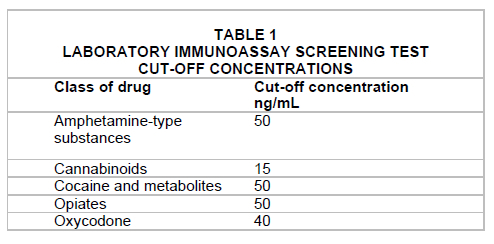
The rationality of saliva testing is further supported by its adoption in various jurisdictions. For instance, the Joint Australian/New Zealand Standard for oral fluid testing provides clear guidelines for interpreting results based on specific cut-off concentrations (Australian/New Zealand Joint Standard "Procedure for Specimen Collection and the Detection and Quantification of Drugs in Oral Fluid" AS/NZS 4760:2019). This standardised approach enhances the reliability and fairness of the testing process. With regard to saliva testing, section 1.3.17 of the Joint Standard defines a "confirmed positive test" as the drug-testing outcome at or above the cut-off concentration. On the other hand, "cut-off concentration" is defined under section 1.3.19 as "[a] value at or above which the drug and/or metabolite is deemed to be a confirmed positive and below which the drug and/or metabolite is deemed to be a negative". Expressed differently, the Joint Standard provides that a drug test is deemed harmful where such a result is above the relevant cut-off concentration or limit of reporting. This is stipulated in section 4, which explains the "interpretation of result". Table 1 below provides a cut-off concentration limit of 15 ng/mL for cannabis tests through a "laboratory". If the specimen contains THC below 15 ng/mL, the employee is deemed to have tested negative. According to scientific experts, levels below 15 ng/mL of cannabis metabolites do not impair the employee's capacity to undertake a job. On the other end of the spectrum, an oral drug test above the 15 ng/mL threshold is deemed positive.
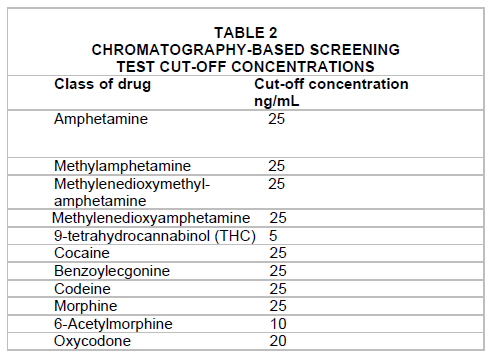
The cut-off concentration of cannabis is 5 ng/mL when using a chromatography test, as shown in Table 2.
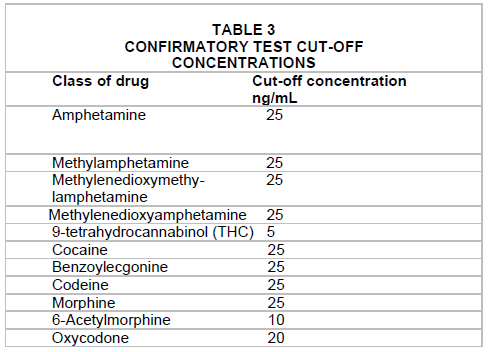
The cut-off concentration of cannabis is 5 ng/mL when using the confirmatory test, as shown in Table 3.
Establishing science-based cut-off levels for determining a positive drug test, particularly for oral fluid testing, is crucial for ensuring both accuracy and fairness in workplace drug policies. The Australian/New Zealand Joint Standard recommends a tiered approach to cannabis testing, with different cut-off levels for initial screening and confirmatory tests. Specifically, it suggests a threshold of 15 ng/mL for the initial screening of cannabis in oral fluid samples. This initial screening serves as a preliminary filter to identify potential positive cases. For confirmatory tests, which are typically more precise and used to verify initial positive results, the Joint Standard recommends a lower cut-off level of 5 ng/mL. This two-tiered approach helps to minimise false positives while maintaining sensitivity to recent cannabis use. The rationale behind these specific cut-off levels is rooted in a scientific understanding of how cannabis is metabolised and detected in oral fluid. As noted in the Endeavour Energy case, oral fluid testing is particularly effective at identifying recent cannabis use, which is more likely to correlate with potential impairment. The 15 ng/mL threshold for initial screening strikes a balance between detecting recent use and avoiding false positives from trace amounts that may not indicate significant impairment. Importantly, the Joint Standard defines a "confirmed positive test" as a result at or above the specified cut-off concentration. This clear definition helps to standardise the interpretation of test results across different workplaces and testing facilities, promoting consistency and fairness in the application of drug policies. Furthermore, saliva testing is less invasive than urine testing, which can help balance the employer's need for safety with the employee's right to privacy. This consideration was significant in the Enever Labour Appeal Court case, where the court emphasised the importance of respecting employees' privacy rights in relation to their off-duty conduct (Enever LAC par 47).
However, it is important to note that while saliva testing offers improvements over urine testing, it is not without limitations. As highlighted in the Endeavour Energy case, saliva testing can still be susceptible to cheating if not properly administered. In addition, the interpretation of results still requires careful consideration of cut-off levels to assess impairment accurately (Endeavour Energy par 38-39). Nevertheless, saliva testing presents a more rational approach to workplace drug testing, particularly for cannabis. It offers a closer connection to the goal of identifying current impairment and potential safety risks while better respecting employees' privacy and off-duty conduct. As workplaces continue to grapple with the implications of cannabis legalisation, adopting more precise and fair testing methods like saliva testing may help strike a better balance between safety concerns and employee rights.
The New Zealand legislature has verified the CT Oral Scan (Box of 25) as the reliable saliva testing equipment according to the Australian/New Zealand Joint Standard (AS/NZS 2019). Chiefly, the CT Oral Scan features a quick collection of saliva samples and offers consistent results. It is therefore no surprise that the New Zealand corporate environment has adopted the CT Oral Scan to interpret the cut-off concentrations and establish what constitutes a positive test of cannabis in saliva samples. As discussed later, the discourse of this study recommends that South African employers use this product.
6 3 Other circumstantial factors
The notion that a positive drug test should automatically indicate impairment in the workplace is increasingly being challenged, particularly in the context of cannabis use. This approach oversimplifies a complex issue and may lead to unfair treatment of employees. Instead, employers should focus on whether the employee's capacity to perform duties is actually inhibited and should consider multiple indicators beyond just a positive test result. First, it is crucial to recognise that a positive drug test, especially for cannabis, does not necessarily correlate with current impairment. As highlighted by the Labour Appeal Court in the Enever case, there is "no rational link between its zero-tolerance policy against personal cannabis use by all its employees in the privacy of their homes and maintenance of safety in its workplace" (Enever LAC par 47). This underscores the disconnect between detecting the presence of cannabis metabolites and actual impairment that could affect job performance. The limitations of relying solely on drug tests are further emphasised by Craig, who notes that urine testing detects inactive metabolites, rather than the presence of active drug compounds (2002 Labour and Employment Law Journal 148). This means that an employee could test positive owing to past use, even if they are not currently under the influence or impaired in any way that affects their work. Instead of automatically equating a positive test with impairment, employers should focus on assessing whether the employee's capacity to perform duties is actually inhibited. This approach aligns with the principle established in Tanker Services v Magudulela, where the Labour Court stated that "intoxication is a matter of degree" ([1997] 12 BLLR 1552 (LAC)). This suggests that the mere presence of a substance in an employee's system does not necessarily equate to a level of impairment that would justify disciplinary action.
To achieve a more nuanced and fair assessment, employers should consider using multiple indicators beyond just a positive test. Observable signs of impairment, such as coordination, speech and behaviour, can provide a more accurate picture of an employee's current state and ability to perform their duties safely. This multi-faceted approach was implicitly endorsed in the Rankeng case, where the commissioner noted that drug-testing methods do not indicate whether the employee is impaired to the extent that their capacity to perform duties is inhibited (Rankeng/Signature Cosmetics and Fragrance (Pty) Ltd Mbileni [2020] 10 BALR 1128 (CCMA) 4C-5D). The importance of considering observable signs of impairment is further supported by the approach taken in the Moodley case, where the employer relied on "circumstantial evidence" such as bloodshot eyes, changed demeanour, and unusual behaviour to corroborate a positive drug test (Moodley and Clover SA (Pty) Ltd (2019) 40 ILJ 2857 (CCMA) par 73.1A-73.9e). While this approach has its own limitations and potential for bias, it demonstrates the value of looking beyond test results alone.
Sibiya recommends considering physical impairment testing as an alternative to urinalysis for detecting cannabis use in the workplace, suggesting the adoption of methods similar to the standard field sobriety test (SFST) used in the United States (2024 Obiter 119). This recommendation is based on the limitations of urinalysis testing, which cannot accurately determine current impairment or recent use of cannabis. The SFST, as described by Sibiya, consists of three components: the horizontal gaze nystagmus (HGN) test, which "measures an involuntary jerking of the eyeball to tracking an object using peripheral vision"; and the walk-and-turn and one-leg-stand tests, which are divided attention tests requiring subjects to perform simple physical movements while following instructions (2024 Obiter 119). Sibiya notes that "impaired persons have difficulty with tasks requiring them to divide their attention between simple mental and physical exercises" (2024 Obiter 119). While this approach offers a potential solution to the limitations of urinalysis, it also raises new challenges. These include ensuring objectivity and consistent application, addressing legal considerations, evaluating practicality in various workplace settings, considering the test's specificity to cannabis impairment, and assessing potential cultural and social impacts on workplace dynamics. The implementation of such tests in a South African workplace context would require careful consideration of these factors, as well as further research and legal analysis to determine their viability and effectiveness.
However, implementing a more nuanced approach to assessing impairment does present challenges. Employers need to ensure that their methods for observing and documenting signs of impairment are objective, consistent, and respectful of employee privacy. Training for supervisors and clear, fair policies are essential to avoid potential discrimination or misapplication of these principles. The evolving landscape of cannabis use and workplace safety requires a more sophisticated approach to assessing impairment than simply relying on positive drug tests. By focusing on an employee's actual capacity to perform their duties and considering multiple indicators of impairment, employers can strike a better balance between maintaining workplace safety and respecting employee rights. This approach aligns with the principles of fairness and rationality emphasised in recent legal decisions and standards and reflects a more nuanced understanding of the complex relationship between substance use and workplace performance.
Workplace drug policies, particularly in the context of cannabis use, must also strike a delicate balance between employees' rights to privacy and legal off-duty conduct, and employers' duty to maintain a safe workplace. This balance has become increasingly complex in the wake of changing cannabis laws and evolving societal attitudes towards its use. The decriminalisation of the private use of cannabis has significant implications for workplace drug policies. The Prince ruling underscored the importance of respecting employees' privacy and autonomy in their personal lives. As noted by the Labour Appeal Court in Enever, there is "no rational link between its zero-tolerance policy against personal cannabis use by all its employees in the privacy of their homes and maintenance of safety in its workplace" (par 47). This highlights the need for policies that differentiate between private, off-duty use and on-the-job impairment. However, employers have a legitimate and legally mandated duty to ensure workplace safety. Section 8(1) of the Occupational Health and Safety Act in South Africa requires employers to provide and maintain a safe working environment. This obligation must be balanced against employees' constitutional rights, including the right to privacy and fair labour practices.
The challenge lies in crafting policies that respect these competing interests. Urine testing, which has been a common practice, is increasingly seen as problematic owing to its inability to distinguish between recent use and past consumption. This can lead to unfair penalisation of employees for legal, off-duty conduct that does not affect their work performance. It is crucial to recognise that even with more accurate testing methods, policies must still respect employees' privacy and dignity. The Constitutional Court of South Africa has emphasised the importance of these rights, with Justice Ackermann describing privacy as "the right to be let alone" (Bernstein v Bester 1996 (4) BCLR 449 (CC) par 76). Workplace drug policies should be designed and implemented with this principle in mind.
Furthermore, policies should take into account the nature of the employee's role and the specific safety requirements of the workplace. As highlighted in the Marasi case (par 1.6), the interpretation of drug test results should consider individual circumstances and job requirements. This nuanced approach helps to ensure that policies are not overly broad or intrusive. In crafting balanced policies, employers should also consider the potential for discrimination. In Enever, the Labour Appeal Court found that treating alcohol and cannabis users differently could constitute unfair discrimination. Policies should be consistently applied and based on rational, safety-related criteria rather than on outdated stigmas or assumptions.
The evolving legal landscape also necessitates regular review and updating of workplace drug policies. As noted in Nhlabathi v PFG Building Glass, while the Prince judgment decriminalised private cannabis use, it did not override employers' rights to maintain workplace safety (NUMSA obo Nhlabathi v PFG Building Glass (Pty)) Ltd (2023) 44 ILJ 231 (LC) par 42). However, policies must evolve to reflect changing legal and societal norms. Balancing employees' rights to privacy and legal off-duty conduct with employers' duty to maintain a safe workplace requires careful consideration and nuanced policies. By adopting more accurate testing methods, considering multiple factors in assessing impairment, respecting privacy rights, and regularly updating policies to reflect legal changes, employers can create fair and effective drug policies. These policies should aim to maintain workplace safety without unduly infringing on employees' personal lives and legal choices outside of work hours.
7 Conclusions and recommendations
The legal landscape surrounding cannabis use has evolved significantly, necessitating a reassessment of traditional zero-tolerance workplace drug policies. The Prince judgment, which decriminalised private cannabis use, has profound implications for employee rights and employer responsibilities. The Enever case further underscores the need for nuanced, job-specific approaches to cannabis-use policies that balance workplace-safety concerns with employees' constitutional rights to privacy and dignity.
A critical conclusion is that urine testing for cannabis, while widely used, has significant limitations in the workplace context. Its extended detection window and inability to correlate with actual impairment make it an unreliable indicator of an employee's fitness for work. This can lead to unfair penalisation of employees for legal, off-duty conduct that does not impact their job performance. As such, alternative testing methods, particularly saliva testing, offer a more rational approach to workplace drug screening. Saliva tests provide a better indication of recent use and potential impairment, aligning more closely with the legitimate aim of ensuring workplace safety. However, it is crucial to recognise that no single testing method can provide a complete picture of an employee's impairment or fitness for work. A more holistic approach is necessary, one that considers multiple indicators beyond just a positive test result. Observable signs of impairment, the nature of the employee's role, and the specific safety requirements of the workplace should all factor into assessments of an employee's capacity to perform their duties safely.
Based on these conclusions, employers seeking to develop fair and effective workplace drug policies in light of evolving cannabis laws should consider several key recommendations. First, existing drug policies should be reviewed and updated to ensure they align with current legal standards and societal norms. Zero-tolerance policies should be critically examined and potentially replaced with more nuanced approaches that differentiate between private, off-duty use and on-the-job impairment. Employers should consider transitioning from urine testing to saliva testing for cannabis screening, as this change can provide a more accurate indication of recent use and potential impairment, striking a better balance between safety concerns and employee rights.
Furthermore, clear guidelines for assessing impairment that go beyond reliance on drug test results alone should be developed. These should include assessing observable signs of impairment and job-specific performance indicators. Supervisors and managers should receive training on how to identify and document signs of impairment objectively and consistently. It is also crucial to implement job-specific drug policies that take into account the nature of each role and its associated safety risks. Policies for employees in safety-critical positions may justifiably be more stringent than those for office-based staff. Employers must ensure that drug policies and their implementation do not unfairly discriminate between different substances or employee groups. Policies should be based on rational, safety-related criteria rather than on outdated stigmas or assumptions. Regular reviews and updates of drug policies are essential to reflect ongoing legal developments and emerging best practices. This should include staying informed about advancements in testing technologies and impairment assessment methods.
Consideration should be given to adopting a tiered approach to cannabis testing, with different cut-off levels for initial screening and confirmatory tests, similar to the Australian/New Zealand Joint Standard. Furthermore, the use of CT Oral Scan is widely accepted in New Zealand as a product to detect accurate impairment of cannabis according to the cut-off levels set by the Joint Standard. The South African environment may find solutions emanating from a foreign position to minimise false positives while maintaining sensitivity to recent use. Employers may also want to explore the potential implementation of physical-impairment testing methods, such as those similar to the SFST, as complementary tools for assessing fitness for work. However, careful consideration must be given to ensuring objectivity, consistent application, and cultural appropriateness in the South African context.
Finally, it is crucial to prioritise education and communication with employees about drug policies, testing procedures, and the rationale behind them. This can help foster understanding and compliance while respecting employee rights. By implementing these recommendations, employers can work towards creating drug policies that effectively maintain workplace safety while respecting employee rights and adapting to the changing legal and social landscape surrounding cannabis use. These balanced policies will not only help navigate the complex legal terrain but also contribute to fostering a fair and productive work environment.
Thato Lentsoe
LLB PGDipLL LLM; Lecturer, IIE's Varsity College. https://orcid.org/0009-0000-2295-7880
Marthinus van Staden
LLB LLM LLD PGDipHE; Associate Professor, Wits School of Law. https://orcid.org/0000-0002-7515-1423