The Basic Education Laws Amendment Act of 2024: Fortifying the Legal Framework Prohibiting Corporal Punishment
Abstract
Over the last three decades, South Africa has steadily eliminated the lawful use of corporal punishment in various settings: corporal punishment has been removed as a punishment for a crime, and as a disciplinary measure in penal institutions, independent schools (formerly private schools), state schools, alternative-care settings, and by parents and those in loco parentis. However, while corporal punishment is prohibited in all these settings, some technical issues remained to be rectified. One of those issues was the lacuna in section 10 of the Schools Act, which prohibited corporal punishment under the threat of criminal sanction without providing a clear definition of what corporal punishment entails. The South African Constitution requires a statute to be clear and unambiguous. In order to adhere to the principle of legality as set in section 35(3) of the Constitution, this defect needed to be addressed by including a comprehensive definition of the concept of corporal punishment in the Schools Act. In one of the most significant reforms to the basic education legal framework since 1994, the Basic Education Laws Amendment Act 32 of 2024 rectified this issue. It amended the Schools Act by including a clear and very wide definition of corporal punishment that is similar to the definition adopted by the Committee on the Rights of the Child in General Comment No. 8. The last issue for the South African legislature to address is the need for a statutory prohibition on corporal punishment in the home - to follow up on the Constitutional Court's decision in Freedom of Religion South Africa v Minister of Justice and Constitutional Development - which would further strengthen the legal framework that prohibits corporal punishment across all settings. Adding a positive statement to the Children's Act will achieve this goal.
BELA Act 2024; section 10 of the Schools Act; principle of legality; corporal punishment; Children's Act
1 INTRODUCTION
Over the last three decades, South Africa has been steadily eliminating the lawful use of corporal punishment1 from various settings by judiciously using the powers of the Constitutional Court and the legislature. Corporal punishment or physical force has been removed as a punishment for crime and also as a disciplinary measure in penal institutions, independent or private schools, state schools, and alternative-care settings. The 2019 prohibition of corporal punishment in the home (private setting) by the Constitutional Court in Freedom of Religion South Africa (FORSA) v Minister of Justice and Constitutional Development2 was a significant milestone. It was the final nail in the coffin of the common-law defence of reasonable and moderate chastisement used by parents and those in loco parentis charged with common assault when physically punishing their children. However, while corporal punishment was prohibited in all settings at that time, some technical issues remained (and still do) and needed rectifying before South Africa could claim to prohibit corporal punishment in statute across all settings. One of those issues was correcting the defect found in section 10 of the South African Schools Act (Schools Act).3 Section 10 sets out an explicit prohibition of corporal punishment. However, it did not adhere to the principle of legality, which requires that if the State prohibits a particular activity in statute, that statute should clearly define the elements of the offence. Section 10 did not clearly define corporal punishment, leaving the statute vague and ambiguous. To fill this lacuna and to make other significant amendments to the Schools Act, the Department of Basic Education drafted the Basic Education Laws Amendment Act4 (BELA Act), which is one of the most significant reforms to the basic education legal framework since 1994.5
The BELA Act brings the Schools Act, as well as the Employment of Educators Act,6 up to date with recent developments in the education landscape, specifically with the inclusion of a comprehensive definition of corporal punishment. It therefore strengthens the legal framework of statutes and case law that prohibit corporal punishment in South Africa in all settings. This contribution focuses on the inserted definition of corporal punishment, which aligns the Schools Act with the United Nations (UN) Convention on the Rights of the Child (CRC).7 Defining corporal punishment is a positive legislative step to bring South Africa closer to a complete legislative ban on corporal punishment in all settings. Finally, the Schools Act now adheres to the principle of legality by providing certainty to educators and learners regarding appropriate school discipline.
This article is primarily a doctrinal study with a limited focus on law reform. It starts with an analysis of one of the amendments in the BELA Act, namely the inclusion of a comprehensive definition of corporal punishment in the Schools Act. It then provides a brief overview of the philosophical changes regarding punitive physical punishment that took place in the legislature and judiciary after 1994. This section highlights case law and statutes that have gradually prohibited corporal punishment in specific settings. Although this part may be considered primarily descriptive, it is necessary as background information to plot the course taken by the courts and the legislature to eliminate punitive violence in South Africa. Following this section is an analysis of corporal punishment in international law - referring primarily to the CRC, General Comments No. 8 and 13 of the Committee on the Rights of the Child (CRC Committee),8 and the African Charter on the Rights and Welfare of the Child (ACRWC).9 Furthermore, this article looks towards the (possible) inclusion of a prohibition clause (or positive statement) in the South African Children's Act.10 This article argues that inserting a positive statement in civil law is preferable to a prohibition clause in criminal law if society is to change from favouring punitive physical punishment to non-violent, positive disciplinary measures. This article ends with a submission that, given that corporal punishment is still rampant in schools and the home, a change in the law can change attitudes and behaviour, although not in isolation from other child-protection and parental-support policies.11
2 CORPORAL PUNISHMENT IN THE SOUTH AFRICAN SCHOOLS ACT
2 1 The principle of legality
It is argued that "the law can only play a positive part in effectively eradicating corporal punishment in schools if the legal provisions are clear, accessible and constitutional".12 This is the basis of the principle of legality, which is a common-law principle of statutory interpretation that forms part of South African law and is found in the Constitution of the Republic of South Africa, 1996 (the Constitution).13 The principle of legality is underpinned by the maxim nullum crimen sine lege, which consists of the following vital elements:
"An accused may not be found guilty of a crime and sentenced unless the type of conduct with which he is charged:
(a) has been recognised by the law as a crime [known as the ius acceptum principle which is recognised in both common law and statutory crimes];
(b) in clear terms [the ius certum principle];
(c) before the conduct takes place [the ius praevium principle];
(d) without the court having to stretch the meaning of the words and concepts in the definition to bring the particular conduct of the accused within the compass of the definition [the ius strictum principle], and
(e) after conviction the imposition of punishment also complies with the four [preceding] principles" [the nulla poena sine lege principle].14
Prior to the amendments in the BELA Act, corporal punishment was not defined in the Schools Act. The Act did not explicitly define the elements of corporal punishment. Section 10 of the Act merely stated:
"(1) No person may administer corporal punishment at a school to a learner.
(2) Any person who contravenes subsection (1) is guilty of an offence and liable on conviction to a sentence which could be imposed for assault."
Therefore, the Schools Act did not adhere to the ius certum principle in that the offence was vague and imprecise.15 As a result, educators could only be charged with assault,16 which has a much narrower definition than does corporal punishment. Assault is defined as:
"any unlawful and intentional act or omission
(a) [w]hich results in another person's bodily integrity being directly or indirectly impaired, or
(b) [w]hich inspires a belief in another person that such impairment of her bodily integrity is immediately to take place."17
In 2000, the former National Department of Education (NDE) published a booklet, that contained a definition of corporal punishment, and disseminated it among educators. Corporal punishment is defined in the booklet as follows:
"any deliberate act against a child that inflicts pain or physical discomfort to punish or contain him/her. This includes, but is not limited to, spanking, slapping, pinching, paddling or hitting a child with a hand or with an object; denying or restricting a child's use of the toilet; denying meals, drink, heat and shelter; pushing or pulling a child with force; forcing a child to do exercise."18
In 2014, the Gauteng Department of Education (GDE) issued circular 4 of 2014, in which corporal punishment was defined as:
"any deliberate act against a child that inflicts pain or physical discomfort to punish or contain him/her. This includes, but is not limited to, spanking, slapping, pinching, padding or hitting a child with a hand, any other object, denying or restricting a child's use of the toilet, denying meals, drink, heat and shelter, pushing or pulling a child with force, forcing the child to do exercise. It is, therefore, not just about caning but also refers to an assault on a person in any manner whatsoever."19
The Western Cape Education Department (WCED) issued circular 24 of 2016, in which it defined corporal punishment as:
"any deliberate act against a child that inflicts pain or physical discomfort to punish or contain him/her. This includes, but is not limited to, spanking, slapping, pinching, paddling or hitting a child with a hand or any other object; denying or restricting a child's use of the toilet; denying meals, drink, heat and shelter; pushing or pulling a child with force; forcing the child to do exercise. It is, therefore, not just about caning but also refers to an assault on a person (learner) in any manner whatsoever."20
This definition is very similar to the NDE and the GDE definition. The KwaZulu-Natal Department of Education (KZNDE) issued circular 10 of 2016, in which corporal punishment is defined as:
"any deliberate act against a child that inflicts pain or physical discomfort to punish him/her. This includes, but is not limited to, slapping, pinching, hitting or kicking a child with a hand or a leg or any other object, pushing or pulling a child with force."21
The KZNDE definition is not as broad as the NDE, GDE and WCED definitions and does not include forms of punishment such as restricting the child's use of the toilet, denying meals and drinks and forcing a child to exercise. None of these provincial departmental definitions includes verbal and psychological harm. Although not as comprehensive, the NDE, GDE and WCED definitions are similar to the definition passed into law under the BELA Act.
2 2 Corporal punishment in the BELA Act
The CRC Committee has stated unequivocally that corporal punishment is in breach of the provisions of the CRC and that children "do not lose their human rights by virtue of passing through the school gates".22 With the passing of the BELA Act in 2024, corporal punishment in schools is now an offence defined in section 1(1) of the South African Schools Act as follows:
"any deliberate act against a child that inflicts pain or physical discomfort, however light, to punish or contain the child, which includes, but is not limited to -
(a) hitting, smacking, slapping, pinching or scratching with the hand or any object;
(b) kicking, shaking, throwing, throwing objects at, burning, scalding, biting, pulling hair, boxing ears, pulling or pushing children;
(c) forcing children to stay in uncomfortable positions, forced ingestion, washing children's mouths out with soap, denying meals, heat and shelter, forcing a child to do exercises which are not in accordance with the curriculum applicable to the learner or denying or restricting a child's use of the toilet; and
(d) any acts which seek to belittle, humiliate, threaten, induce fear or ridicule the dignity and person of a learner."
It is argued here that paragraph (a) ought to be read disjunctively so as to emphasise that the use of any object or implement is absolutely not permitted. Therefore, paragraph (a) ought to be read to mean "hitting with the hand or any object, smacking with the hand or any object, slapping with the hand or any object, pinching or scratching with the hand or any object..." .
The BELA Act contains an expansive definition of corporal punishment, both as physical force and psychological harm. School educators can now be charged with common assault for administering corporal punishment, however light, to discipline a child. Furthermore, the comprehensive definition of corporal punishment in the BELA Act also categorises as an offence psychological harm, such as restricting a learner's use of the toilet or denying meals, and verbal abuse, such as acts that belittle, humiliate and induce fear and ridicule.
The BELA Act does not include the words "denigrates" and "scapegoats", but it is presumed that these words are supposed to have been included in the other descriptions of unacceptable punishment, such as "humiliates" and "belittles". Nevertheless, as with the definitions from the GDE and WCED circulars, these definitions are very close to being identical. It therefore seems that the legislator purposefully adopted definitions from other trusted sources, such as provincial education departments and the CRC Committee, and incorporated them into the now-amended Schools Act. This is further evidence that, as regards children's rights, South Africa is a monist state where international law is incorporated into domestic legislation. This means that the provisions contained in the CRC and, by extension, General Comment No. 8 can now be applied by the courts under this new and comprehensive definition in matters where corporal punishment in schools is an issue. The BELA Act, therefore, now prohibits a wide variety of violent acts previously perpetrated by educators on children in their care.
This is a positive step in that it acknowledges that the offence of assault does not adequately cover the myriad acts of violence that are perpetrated against children in schools to this day, and that violence can be both physical and psychological.23 Assault includes humiliating and belittling treatment from educators, such as verbal and psychological abuse. Violence against children, in whatever form or degree, is never acceptable, and, as a civilised society, we need to evolve to recognise that children are autonomous holders of rights, that they have agency and are entitled to the protection of their bodily integrity and dignity as much as any adult to whom the Bill of Rights applies. Furthermore, corporal punishment, in whatever setting, is not in the child's best interests. Moreover, there is no evidence that corporal punishment has any discernible benefits for children.24
3 A PHILOSOPHICAL CHANGE OF ATTITUDE TO PUNITIVE AND RETRIBUTIVE PUNISHMENT
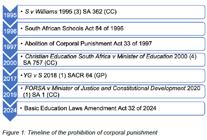
Over the last 30 years, South Africa has steadily removed the punitive and retributive aspects of punishment from the penal system, the justice system, the youth-justice system, the school system and the child-protection system. Figure 1 depicts the key points in this progression.
3 1 Corporal punishment in the public sphere
It is crucial to contextualise the significant constitutional changes that South Africa experienced during the 1990s and 2000s and how they have affected the lives of children - first, by acknowledging that children have rights and, secondly, by elevating children's rights to the constitutional level. Under the apartheid system, children, and Black children in particular, lived under extremely harsh conditions.25 In 1947, the Penal and Prison Reform Commission (commonly known as the Lansdown Commission) found that, given a lack of viable alternative forms of punishment for juvenile offenders26 - for example, probation and institutional (juvenile justice) facilities - the retention of corporal punishment seemed to be the only option. As a result of this finding, the Commission regarded the use of corporal punishment (whipping) as a legitimate tool of punishment in penal institutions.27 South Africa embraced the use of whipping as a powerful tool in penal institutions.28 The epochal shift came first in March 1995 when the Constitutional Court handed down its decision in S v Williams29 (Williams), prohibiting judicial whipping as a sentence for juveniles, and secondly, in June 1995, when South Africa ratified the CRC.
The court's decision in the Williams case was in line with the philosophical approach adopted in S v Makwanyane,30 in which the death penalty was abolished. Chaskalson P proclaimed that retributive punishment no longer had the same impact under the Constitution (as before) and that there was no evidence that the death penalty would be a more effective deterrent to preventing murders from occurring than a sentence of life imprisonment.31 In the Williams case, the court acknowledged a move away from the pre-constitutional attitude of retribution and vengeance towards a more humane approach of prevention and correction.32 This more humane approach to sentencing was carried forward by Sachs J in S v M,33 where he stated:
"Thus, our courts have observed that one of its strengths is that it rehabilitates the offender within the community, without the negative impact of prison and destruction of the family. It is geared to punish and rehabilitate the offender within the community (by means of correctional supervision) leaving his or her work and domestic routines intact, and without the negative influences of prison."34
Following the decision in the Williams case, Parliament enacted the Abolition of Corporal Punishment Act,35 which amended or repealed legislation containing provisions on judicial corporal punishment.36 Furthermore, in 1996, Parliament passed the South African Schools Act,37 which prohibited corporal punishment in both public and independent (private) schools. Section 10 of the Schools Act, which forms the focus of this contribution, sets out the prohibition, which provides that no person may use corporal punishment on a school learner and that any person convicted of doing so is liable to be sentenced for assault. Four years later, section 10 of the Schools Act took centre stage in Christian Education South Africa v Minister of Education (Christian Education).38
Christian Education, an umbrella body representing some 200 independent Christian schools, submitted, during the parliamentary debate of the Schools Act, that the prohibition of corporal punishment infringes on its rights guaranteed under the Constitution of the Republic of South Africa (the interim Constitution),39 specifically to its right to freedom of religion40 and cultural life.41 However, when Christian Education failed to secure an exemption from the limitation on parents' right to delegate powers of reasonable chastisement to educators, a legal challenge to the section ensued.42 This matter went through the High Court to the Constitutional Court, which concluded that, save for this one aspect (corporal punishment), the appellant's schools were not prevented from maintaining their Christian ethos. The Constitutional Court dismissed the appeal and held that the applicants could not be granted an exemption from the limitation on the right to delegate the power to administer reasonable chastisement from parents to educators in independent schools because corporal punishment is unconstitutional. Therefore, section 10 of the Schools Act, as a general law, ought to be upheld.43
3 2 Corporal punishment in the private sphere
In 2017, the focus shifted to corporal punishment administered in the home when the South Gauteng Division of the High Court heard the matter of YG v S44 (YG). The father, YG, had found his 13-year-old son, M, allegedly watching pornography on an iPad while sitting on his parents' bed. YG punched M on the thighs with his fists because he argued that pornography is strictly forbidden for Muslims, and he needed to discipline his son "out of concern to show him in the future what is right and what is wrong".45 YG was initially charged with assault with intent to do grievous bodily harm, but was convicted in the Johannesburg Regional Court on the lesser charge of common assault of M.46 He appealed to the High Court, claiming reasonable and moderate chastisement, and that as part of a Muslim family, M knew that pornography is strictly forbidden.47 The defence of reasonable and moderate chastisement in the South African context can be traced back to the early twentieth century in R v Janke and Janke.48 Here, Mason J stated:
"The general rule adopted both by the Roman, the Roman-Dutch law and the English law is that a parent may inflict moderate and reasonable chastisement on a child for misconduct provided that this be not done in a manner offensive to good morals or for other objects than correction and admonition ... The presumption is that such punishment has not been dictated by improper motives and the court will not lightly interfere with the discretion of parents of those empowered with a similar authority."49
Fortunately, the High Court realised that this presumption could safely be set aside in this instance since the Constitution mandates the State and the courts to step in when children's best interests are not given paramount importance. Keightley J affirmed that courts are obliged to develop the common law to align it with the values in the Constitution.50 Section 28(1)(d) of the Constitution states that every child has the right to be protected against maltreatment, neglect, abuse or degradation. Furthermore, section 28(2) of the Constitution has the added requirement that the child's best interests should be of paramount importance in every matter concerning the child.51 On 19 October 2017, the High Court found the common-law defence of reasonable chastisement to be unconstitutional, and no longer available in South African courts. However, the abolition of the defence was held to apply only prospectively from the date of the judgment.52
Legal scholars and child-rights advocates welcomed the court's decision. However, it has come in for some criticism for suffering from a "justificatory shortfall" in that the court "fails to furnish sufficiently compelling arguments to show that the reasons it supplies are good reasons".53 One example is the court's lack of reasons for asserting that corporal punishment is inherently violent. The court makes this statement without providing any support for this proposition. As Lenta explains, the court ought to have started, at the very least, with a definition of violence from an authoritative dictionary.54 Perhaps an alternative argument could be made here that the court could also have consulted General Comment No. 13 for the CRC Committee's definition of violence, and, having dissected this definition, the court could have consulted General Comment No. 8 for its definition of corporal punishment (see discussion below). Given that General Comments "act as authoritative statements on the implementation, interpretation and meaning of provisions under the CRC",55 the CRC Committee publishes them in order to help parties to the CRC (and domestic courts indirectly) to interpret its provisions, such as article 19(1), and to help with implementation in the protection of children from all forms of mental and physical violence.56 General Comments form part of the CRC and should be read as such. International scholars argue that treaty bodies use General Comments informally as human-rights lawmakers to shape international law.57 However, there has also been some criticism levelled at treaty bodies for treating General Comments as "advocacy documents" and not attempting to expand on their legal aspects, instead expecting the international legal fraternity to take on this responsibility.58 What is surprising is that the court in YG does not engage with the relevant definitions found in the General Comments to the CRC to any significant degree. Keightley J makes two references to General Comment No. 8 but does not once refer to the definition of corporal punishment in paragraph 11. This definition is also repeated in General Comment No. 13 in paragraph 24, which directly relates to article 19 in that it provides substantive content to the child's right to live free from all forms of violence. This is an unfortunate misstep by the High Court since it is argued that the Constitutional Court has shown enthusiastic engagement with the Convention and, in some instances, also with General Comments.59
Freedom of Religion South Africa, a Christian organisation and the fourth amicus curiae in the YG case, applied for and was granted direct access to the Constitutional Court to appeal the YG decision. In the FORSA case,60 the Constitutional Court decided on the constitutionality of moderate and reasonable chastisement based essentially on the provisions of section 12(1)(c) of the Constitution.61 The court analysed the meaning of "assault" and "violence" before determining that, by its very nature, chastisement involves violence.62 It queried why one would resort to chastisement if not to cause actual or potential pain and discomfort in the belief that this would have a more significant effect than any other form of discipline.63 In a unanimous decision, the Constitutional Court found the defence of "reasonable and moderate chastisement" to be inconsistent with the provisions of the Constitution and, therefore, no longer valid against a charge of common assault.64 The court dismissed the appeal.65
Although children's-rights advocates and legal scholars were relieved by the court's decision, they were critical of the reasons given for it. Legal scholars wrote extensively about the shortcomings of the court's reasons, including its failure to provide a "comprehensively reasoned judgment" given the significance of the issue and the public interest it generated.66 This criticism stems from the fact that, for a crucial judgment that significantly developed the common law, it was surprisingly short. Lenta laments this fact, stating:
"[A] more fully reasoned judgment need not be annoying or irksome to read, or imprecisely or loosely reasoned; longer judgments, especially if carefully crafted and strongly argued, can afford just as much, if not more, satisfaction than shorter ones."67
Sloth-Nielsen expressed her disappointment that the court failed to address the child's right to protection from abuse, neglect, degradation and ill-treatment, which, in her view, undermines the value of the judgment.68 Sloth-Nielsen further criticises the court's failure to refer to General Comment No. 8 (or the CRC Committee's definition of corporal punishment, for that matter).69 Undoubtedly, by not referencing the definition in General Comment No. 8, the court missed an opportunity to assist the legislature in adopting a comprehensive definition of corporal punishment in domestic legislation. These are only some of the criticisms levelled at the court's judgment. Further analysis of these criticisms is beyond the scope of this article.
The FORSA case, therefore, concluded the long road to prohibiting corporal punishment formally in all settings in South Africa.
4 CORPORAL PUNISHMENT AND INTERNATIONAL LAW
The CRC does not explicitly mention corporal punishment. However, according to article 28(2) of the CRC, states are obliged to take all appropriate measures to ensure that school discipline is administered in conformity with the child's human dignity and is in accordance with the provisions of the CRC. Furthermore, the Convention provides children with the right to protection against all forms of violence. Article 19(1) states:
"States Parties shall take all appropriate legislative, administrative, social and educational measures to protect the child from all forms of physical or mental violence, injury or abuse, neglect or negligent treatment, maltreatment or exploitation, including sexual abuse, while in the care of parent(s), legal guardians(s) or any other person who has the care of the child."
The CRC Committee has adopted the view that article 19 forms the "core provision" when addressing violence prevention and elimination in relation to children.70 The Committee also stated that "[c]lear operational legal definitions are required of the different forms of violence outlined in article 19 in order to ban all forms of violence in all settings". It is also crucial that these definitions be sufficiently explicit, direct and appropriate for different societies and cultures. States are, therefore, tasked with developing rights-based definitions of violence.71
Appropriately, the CRC Committee adopted a view that violence need not only be physical but can also be psychological. Interpreting article 19(1), the CRC Committee lists a wide range of behaviours that are considered "mental violence", which is often described as psychological maltreatment, mental abuse, verbal abuse and emotional abuse. This can include harmful interactions conveying to a child that they are worthless, unloved and unwanted; terrorising or threatening a child; neglecting educational or medical needs; insulting a child or name-calling, belittling, ridiculing or hurting a child's feelings; exposure to domestic violence and bullying or hazing (including cyberbullying).72 The Committee, furthermore, highlighted that physical violence can include bullying and hazing; being forced to get sterilised; violence in the guise of treatment such as aversion treatment; and corporal punishment.73 The Committee in General Comment No. 8 defines "corporal" or "physical" punishment as
"any punishment in which physical force is used and intended to cause some degree of pain or discomfort, however light. Most involves hitting ('smacking', 'slapping', 'spanking') children, with the hand or with an implement - a whip, stick, belt, shoe, wooden spoon, etc. But it can also involve, for example, kicking, shaking, or throwing children, scratching, pinching, biting, pulling hair or boxing ears, forcing children to stay in uncomfortable positions, burning, scalding, or forced ingestion (for example, washing children's mouths out with soap or forcing them to swallow hot spices). In the view of the Committee, corporal punishment is invariably degrading. In addition, there are other non-physical forms of punishment that are also cruel and degrading and thus incompatible with the Convention. These include, for example, punishment which belittles, humiliates, denigrates, scapegoats, threatens, scares or ridicules the child."74
It is clear from this definition of corporal punishment that both physical and non-physical violence are included.75 The United Nations Convention Against Torture and Other Cruel, Inhuman or Degrading Treatment or Punishment76 (CAT) defined "torture" in article (1)1 as:
"For the purposes of this Convention, the term 'torture' means any act by which severe pain or suffering, whether physical or mental, is intentionally inflicted on a person for such purposes as obtaining from him or a third person information or a confession, punishing him for an act he or a third person has committed or is suspected of having committed, or intimidating or coercing him or a third person, or for any reason based on discrimination of any kind, when such pain or suffering is inflicted by or at the instigation of or with the consent or acquiescence of a public official or other person acting in an official capacity. It does not include pain or suffering arising only from, inherent in or incidental to lawful sanctions."
South Africa ratified CAT on 10 December 1998 and is therefore under an obligation to "take effective legislative, administrative, judicial or other measures to prevent acts of torture in any territory under its jurisdiction", as required by article 2(1).
Furthermore, the United Nations has targeted eliminating all forms of violence against children, including physical punishment, in its Agenda for Sustainable Development, which sets out 17 sustainable development goals (SDGs) for 2030. SDG target 16.2 aims to end the abuse, exploitation, trafficking, and all forms of violence against and torture of children.77
At the regional level, the ACRWC, like the CRC, does not expressly prohibit corporal punishment. However, as Mezmur points out, just like the CRC, the move towards finding a right against corporal punishment is through interpretation.78 Article 11(5) of the ACRWC reads as follows:
"States parties to the present Charter shall take all appropriate measures to ensure that a child who is subjected to school or parental discipline shall be treated with humanity and with respect for the inherent dignity of the child and in conformity with the present Charter."
Article 16(1) of the ACRWC reads:
"States Parties to the present Charter shall take specific legislative, administrative, social and educational measures to protect the child from all forms of torture, inhuman or degrading treatment and especially physical or mental injury or abuse, neglect or maltreatment including sexual abuse, while in the care of a parent, legal guardian or school authority or any other person who has the care of the child."
Similar to article 19(1) of the CRC, the provision in article 16(1) of the ACRWC is unambiguous: the child should be protected from all forms of torture, inhuman or degrading treatment, physical or mental injury or abuse, neglect or maltreatment and sexual abuse; therefore, there is no room for any violence. Moreover, the African Committee of Experts on the Rights and Welfare of the Child (African Committee of Experts), the body that monitors the implementation of the ACRWC, explicitly denounced the use of corporal punishment by stating that states parties must adopt legislation that outlaws corporal punishment as a judicial punishment, in alternative-care settings, in schools, and in the home.79 Furthermore, the African Committee of Experts adopted Africa's Agenda for Children 2040, comprising 10 aspirations. The aim is to "restore the dignity of the African child" through the implementation of the ACRWC. Aspiration 7 aims to ensure that by 2040, every child is protected against violence, exploitation, neglect and abuse.80
It is undeniable that international human-rights law does not tolerate any violence dressed up as reasonable corporal punishment, reasonable physical force, reasonable and moderate chastisement or any other form of physical or mental abuse targeting children. Encouragingly, South Africa is in lockstep with international law in its efforts to eradicate corporal punishment within its legal framework. The recent inclusion of a clear definition of corporal punishment in the Schools Act is but one example.
5 THE SOUTH AFRICAN CHILDREN'S ACT 38 OF 2005
A final step in consolidating the elimination of corporal punishment, according to the CRC, will be follow-up legislation banning the use of corporal punishment. In General Comment No. 8, the CRC Committee noted that, given the widespread use of corporal punishment, simply repealing extant legislation that permits the use of corporal punishment and any existing defences will not suffice. States parties must expressly prohibit corporal punishment or any other cruel, degrading or inhuman punishment in civil and criminal legislation, and also in sectoral legislation such as family law, education law, law relating to alternative-care and justice systems, and employment law.81
The South African Children's Act (Children's Act)82 is the primary legislative instrument addressing parental responsibilities and rights.83 The Children's Act does not mention corporal punishment in the home; it merely aims to protect children from "maltreatment, neglect, abuse or degradation"84 and to "protect children from discrimination, exploitation and any other physical, emotional or moral harm or hazards."85
Given that the Schools Act now has a clear definition of corporal punishment and the elements of the offence are explicitly set out, it may well be that a prohibition in the Children's Act will be dealt with in the same way - that is, an explicit follow-up prohibition to the Constitutional Court's ruling in the FORSA case in civil law, but with a criminal-law penalty. It is suggested here that the prohibition of corporal punishment should form part of civil law exclusively; in other words, there should be no criminal-law provision prohibiting corporal punishment in the home save for offences of a more serious nature, such as assault with intent to cause grievous bodily harm. Parental corporal punishment is best addressed in legislation such as the Children's Act so as not to criminalise parents and those in loco parentis, but instead require them to pay a fine and attend education (parenting) programmes focusing on positive parenting and the use of non-violent discipline.86 Furthermore, inserting a positive statement in the Children's Act will go a long way to changing attitudes towards the use of corporal punishment as a disciplinary measure.87 Nevertheless, such new legislation might still be seen as the State interfering with private family matters. An example of such a positive statement is found in section 27(4) of Botswana's Children's Act,88 which relates to parental duties and rights and reads as follows:
"[E]very parent shall have the duties, in respect to his or her child to -
(h) respect the child's dignity and refrain from administering discipline which violates such dignity or adversely affects the physical, emotional or psychological well-being of the child or any other child living in the household."
However, this statement rings especially hollow since the very next section, section 27(5), provides that the previous section "shall not be construed as prohibiting the corporal punishment of a child in such circumstances or manner as may be set out in this Act, the Penal Code or any other law."
Sloth-Nielsen makes the startling observation that the Constitutional Court did not, in fact, prohibit corporal punishment in the FORSA case; it merely removed the defence of reasonable and moderate chastisement.89 Therefore, inserting a positive statement in the Children's Act could potentially prohibit corporal punishment and quell parliamentarians' anxieties.90 This approach dispels the perception that banning corporal punishment necessarily creates a new criminal offence, allowing the legislature to support the reform without the anxiety associated with the criminalisation of well-meaning parents.
Inserting a prohibition on corporal punishment in the Children's Act would also solve the problem of the counter-majoritarian dilemma. If the judiciary embarks on law-making contrary to the will of the majority, the electorate cannot hold them to account - hence the counter-majoritarian dilemma.91 In the Constitutional Court's decision in the FORSA case, the common law was developed in such a manner as to outlaw the defence of reasonable and moderate chastisement for being incompatible with the Constitution, thereby determining that corporal punishment is unconstitutional. In jurisdictions such as South Africa, which have a supreme constitution, the executive, the legislature, and the judiciary are bound by it. The Constitution is the supreme law of the land. As members of the judiciary are not elected, unlike members of the executive and the legislature, this creates a dilemma when unelected officials turn their hand to law-making. The public prefers their parliamentarians to make the laws of the land, as they are elected to enact laws that will benefit their constituents, who, in a democracy, are the majority.92 However, this argument is not intended to undermine the Constitutional Court or diminish the significant benefits that the court brings to social justice in South Africa.
Time will tell how this final hurdle to legislate corporal punishment out of existence is negotiated. Rosenberg, a legal realist, argues that it is a revolutionary idea to believe that litigation can effect social change or that rights can overcome politics.93 Until the mid-twentieth century, reform proponents believed that significant cultural change would only come through the establishment of social movements and follow-up legislative triumphs.94 South Africa has progressively eliminated corporal punishment from the legal landscape through the legislature and the courts. It is hoped that the adoption of a statutory prohibition of corporal punishment in the home will happen soon. That would, at long last, draw a line under corporal punishment in all settings in South Africa. The challenge is for all South Africans to eliminate corporal punishment at a substantive level, which will require cooperation and the will to change and overcome politics to progress to a society free from punitive and retributive violence towards children.
6 CONCLUSION
South Africa has been steadily eliminating the lawful use of corporal punishment from various settings over the last three decades. The 2019 prohibition of corporal punishment in the home in the FORSA case is a significant milestone on the road to eliminating corporal punishment in the home. It was the final nail in the coffin of the common-law defence of reasonable chastisement, which allowed parents and those in loco parentis to use physical force for correction. However, while corporal punishment was prohibited in all settings after the FORSA decision was handed down, some technical issues remained that needed to be rectified. One of those issues was correcting the lacuna found in section 10 of the Schools Act by including a comprehensive definition of corporal punishment.
The BELA Act rectified this issue. It brought the Schools Act in line with the CRC in that it now contains a clear definition of corporal punishment, similar to the one found in General Comment No. 8. Educators and learners now have certainty about what corporal punishment is, and therefore, the Schools Act now adheres to the principle of legality and, more specifically, the ius certum principle. Educators can now be charged with the offence of administering corporal punishment. In contrast, previously, they could only be charged with assault, the definition of which is vastly inadequate to cover all the instances and types of violence that make up corporal punishment.
From a philosophical point of view, the BELA Act strengthens the legal framework that prohibits physical force as a disciplinary measure in schools. It also adds to the overall philosophy that all forms of violence are wrong and ought to be banned and ultimately eliminated from disciplinary measures directed at children. All that remains now is for corporal punishment in the home to be prohibited by statute. However, it is argued here that this might be a bridge too far for South African legislators, given the ongoing attempts to introduce an explicit prohibition of corporal punishment in the Children's Act.95 This contribution has shown that commentators are convinced that a change in the law can change attitudes and behaviour, although not in isolation from other child-protection and parental-support policies. However, to change societal and cultural attitudes, there must first be a change in the law. The South African government's ongoing failure to adopt legislation banning corporal punishment in private settings shows unacceptable deference to parental unease and concerns about their rights being curtailed and insufficient concern for children and their rights under the Constitution. Prohibiting corporal punishment in legislation will, over time, help to bring lasting societal and cultural change at a substantive level where physical, verbal and psychological abuse towards children, under the guise of chastisement or correction, is forever eradicated.
1 The term "corporal punishment" in this article is synonymous with the terms "physical punishment" and "physical force" and the words "whipping" and "smacking".
2 2020 (1) SA 1 (CC).
3 84 of 1996.
4 32 of 2024.
References
- 5 Veriava "The Basic Education Laws Amendment Bill: A Case Study in Transformative Constitutionalism Beyond the Courts" 2024 24(1) African Human Rights Law Journal 153 154 http://dx.doi.org/10.17159/1996-2096/2024/v24n1a8.
- 6 76 of 1998.
- 7 1577 UNTS 3 (1989). Adopted: 20/11/1989; EIF: 02/09/1990. South Africa ratified the CRC on 16/06/1995.
- 8 UN Committee on the Rights of the Child (CRC Committee) General Comment No 8 (2006): The Right of the Child to Protection From Corporal Punishment and Other Cruel or Degrading Forms of Punishment (Arts. 19; 28, Para. 2; and 37, inter alia) (2 March 2007) CRC/C/GC/8; UN Committee on the Rights of the Child (CRC Committee) General Comment No 13 (2011): The Right of the Child to Freedom From All Forms of Violence (18 April 2011) CRC/C/GC/13.
- 9 Organisation of African Unity (OAU) African Charter on the Rights and Welfare of the Child CAB/LEG/24.9/49 (1990). Adopted: 11/07/1990; EIF: 29/11/1999. South Africa ratified the ACRWC on 07/01/2000.
- 10 38 of 1995.
- 13 S 35(3)(a) and (l) of the Constitution.
- 14 Hoctor and Snyman Snyman's Criminal Law 7ed (2020) 31.
- 15 Reyneke 2018 Journal of Juridical Science 122.
- 16 Reyneke 2018 Journal of Juridical Science 120.
- 17 Hoctor and Snyman Snyman's Criminal Law 395.
- 18 Quoted in Reyneke 2018 Journal of Juridical Science 127.
21 Quoted in Reyneke 2018 Journal of Juridical Science 129.
22 CRC Committee General Comment No.1: The Aims of Education (Article 29) (17 April 2001) CRC/GC/2001/1 par 8.
23 See, e.g., Centre for Child Law v South African Council of Educators 2024 (4) SA 473 (SCA), where two primary school educators were charged with assaulting learners in their care. One of the educators went as far as to threaten one of the victims if they spoke out about the assault. This highlights the fact that violence and abuse can be physical and psychological.
24 Heilmann, Mehay, Watt, Kelly, Durrant, Van Turnhout and Gershoff "Physical Punishment and Child Outcomes: A Narrative Review of Prospective Studies" 2021 398(10297) The Lancet 355 356 https://doi.org/10.1016/S0140-6736(21)00582-1.
25 Sloth-Nielsen "Chicken Soup or Chainsaws: Some Implications of the Constitutionalisation of Children's Rights in South Africa" 1996 Acta Juridica 6 10.
26 Juveniles were classified as all persons younger than 21 years of age.
27 Midgley "Corporal Punishment and Penal Policy: Notes on the Continued Use of Corporal Punishment With Reference to South Africa" (1982) 73(1) Journal of Criminal Law & Criminology 388 395.
28 Skelton "S v Williams: A Springboard for Further Debate About Corporal Punishment" 2015(1) Acta Juridica 336 336 https://hdl.handle.net/10520/EJC-60c2c6f9a.
29 1995 (3) SA 632 (CC).
30 1995 (3) SA 391 (CC).
31 S v Makwanyane supra par 146.
32 S v Williams supra par 64.
33 2008 (3) SA 232 (CC).
34 S v M supra par 62.
35 33 of 1997.
36 S 1 reads: "Abolition of corporal punishment: Any law which authorises corporal punishment by a court of law, including a court of traditional leaders, is hereby repealed to the extent that it authorises such punishment."
37 84 of 1996.
38 2000 (4) SA 757 (CC).
39 200 of 1993.
40 S 14(1) of the interim Constitution stated: "Every person shall have the right to freedom of conscience, religion, thought, belief and opinion, which shall include academic freedom in institutions of higher learning."
41 S 31 of the interim Constitution stated: "Every person shall have the right to use the language and to participate in the cultural life of his or her choice."
42 Christian Education South Africa v Minister of Education supra par 3.
43 Christian Education South Africa v Minister of Education supra par 51-52.
44 2018 (1) SACR 64 (GJ).
45 YG v S supra par 6.
46 YG v S supra par 2.
47 YG v S supra par 4.
48 1913 TPD 382.
49 R v Janke and Janke supra 385.
50 YG v S supra par 27.
51 Ibid.
52 YG v S supra par 107.
53 Lenta "The 'Reasonable Corporal Punishment' Defence Struck Down: YG v S" 2018 135(2) The South African Law Journal 205 205; Lenta "Corporal Punishment and the Cost of Judicial Minimalism" 2020 137(2) The South African Law Journal 185 186.
54 Lenta 2018 SALJ 210.
55 Varadan "The Principle of Evolving Capacities Under the UN Convention on the Rights of the Child" 2019 27 International Journal of Children's Rights 306 308.
56 CRC Committee General Comment No. 8 par 1.
57 Lesch and Reiners "Informal Human Rights Law-making: How Treaty Bodies use 'General Comments' to Develop International Law" 2023 12(2) Global Constitutionalism 378 379 https://doi.org/10.1017/S2045381723000023.
58 Couzens "CRC Dialogues: Does the Committee on the Rights of the Child 'Speak' to the National Courts?" in The United Nations Convention on the Rights of the Child (2017) 119 https://doi.org/10.1163/9789004295056_008.
59 Skelton 2015 Acta Juridica 353.
60 FORSA v Minister of Justice and Constitutional Development supra.
61 FORSA v Minister of Justice and Constitutional Development supra par 36.
62 FORSA v Minister of Justice and Constitutional Development supra par 39.
63 Ibid.
64 FORSA v Minister of Justice and Constitutional Development supra par 71 and 73.
65 FORSA v Minister of Justice and Constitutional Development supra par 76.
66 Lenta "Criminalisation and Persuasion: FORSA and Parental Corporal Punishment" 2022 12(1) Constitutional Court Review 87 91 https://doi.org/10.2989/CCR.2022.0003; Sloth-Nielsen "Sideswipes and Backhanders: Abolition of the Reasonable Chastisement Defence in South Africa" 2020 34(2) International Journal of Law, Policy and the Family 191 196 https://doi.org/10.1093/lawfam/ebaa005.
67 Lenta 2022 Constitutional Court Review 91.
68 Sloth-Nielsen 2020 International Journal of Law, Policy and the Family 198.
69 Sloth-Nielsen 2020 International Journal of Law, Policy and the Family 199.
70 CRC Committee General Comment No. 13 par 7.
71 CRC Committee General Comment No. 13 par 18.
72 CRC Committee General Comment No. 13 par 21.
73 CRC Committee General Comment No. 13 par 22 and 23.
74 CRC Committee General Comment No. 13 par 11.
75 Cf Tobin and Cashmore "Article 19 The Right to Protection Against all Forms of Violence" in Tobin (ed) The UN Convention on the Rights of the Child: A Commentary (2019) 691, where they argue against this broad definition of "violence" in favour of a more traditional definition as accepted in the literature and argue that the CRC Committee has not considered accidental injuries such as falls from play equipment.
76 UN General Assembly 1465 UNTS 85 (1984). Adopted: 10/12/1984; EIF: 26/06/1987.
77 UN Department of Economic and Social Affairs "Violence Against Children: Related SDGs" (undated) https://sdgs.un.org/topics/violence-against-children (accessed 2024-12-05).
78 Mezmur "The African Charter on the Rights and Welfare of the Child: Spare the Rod, Spare the Child: Regional Instruments" 2006 2(3) Dullah Omar Institute 8 10 https://journals.co.za/doi/pdf/10.10520/AJA0000002_106.
79 African Committee of Experts General Comment No 5 on State Party Obligations Under the African Charter on the Rights and Welfare of the Child (Article 1) and Systems Strengthening for Child Protection (2018) par 5.3.1.
80 African Committee of Experts "Agenda 2040" (undated) https://www.acerwc.africa/en/page/agenda-2040 (accessed 2024-12-06).
81 CRC Committee General Comment No. 8 par 34-35.
82 38 of 2005.
83 Heaton "Parental Responsibilities and Rights" in Boezaart (ed) Child Law in South Africa (2017) 77.
84 S 2(b)(iii) of the Children's Act.
85 S 2(f) of the Children's Act.
86 This will also be a more proactive way to reduce the burden on the criminal-justice system in dealing with parents who contravene the relevant provisions of the Children's Act.
87 See, e.g., the Swedish Children and Parent Code, ch 6 s 1, which reads: "Children are entitled to care, security and a good upbringing. They shall be treated with respect for their person and their distinctive character and may not be subjected to corporal punishment or any other humiliating treatment."
88 8 of 2009.
89 Sloth-Nielsen 2020 International Journal of Law, Policy and the Family 199.
90 Sloth-Nielsen "Southern African Perspectives on Banning Corporal Punishment - A Comparison of Namibia, Botswana, South Africa and Zimbabwe" in Saunders, Leviner and Naylor (eds) Corporal Punishment of Children: Comparative Legal and Social Developments Towards Prohibition and Beyond (2019) 257; Skelton 2015 Acta Juridica 346.
91 Dent and Kroeze "Minority Rights in the South-African Context: An Exploration of the Counter-Majoritarian Dilemma" (2015) 26 Stellenbosch Law Review 518 518 https://hdl.handle.net/10520/EJC-619f97a54.
92 Ibid.
93 Rosenberg The Hollow Hope: Can Courts Bring About Social Change? (2008) 445.
94 Ibid.
95 Sloth-Nielsen in Saunders et al Corporal Punishment of Children 257.