Reimagining Decolonial Praxis in South-South Cooperation: A Phenomenological Inquiry into the Lived Experiences of Korean Christian Development Practitioners
Abstract
While decoloniality has become a prominent discourse in Global South Christianities, practical methodologies for transformational mission remain underdeveloped. This phenomenological study explores the lived experiences of Korean Christian practitioners working in faith-based development organisations. The findings reveal the duality of Korea as a liminal actor: colonial history generates solidarity with Global South partners, yet compressed growth reproduces internalised coloniality and developmentalism within South-South cooperation. To address these structural frictions, this study proposes the South-South Dialogical Approach. By shifting the paradigm from delivery to dialogue, this approach offers a concrete methodology for authentic decolonial collaboration among Global South Christianities pursuing transformational mission.
Faith-Based Development Organisations; decoloniality; transformational mission; South-South cooperation; Korean Christianity; liminal actor; phenomenology
1. Introduction
1.1 Decoloniality and Transformational Mission in Global South Christianities
In recent years, decoloniality has emerged as a critical discourse within Global South Christianities (GSCs). Decoloniality, as a conceptual framework, refers to the ongoing process of dismantling colonial legacies-including Western-centric epistemologies, power structures, and mission paradigms-that continue to shape theological thinking and ecclesial practices even after political independence. This emphasis on decoloniality is crucial because many churches across the Global South, despite their numerical growth and missional vitality, often remain trapped in colonial patterns of dependency, whether theological, economic, or organisational. Therefore, there is a pressing need for sustained research into contextually rooted theologies and locally grounded missional practices to enable these churches to exercise authentic agency in the Missio Dei.
However, research on how to actualise these concepts in concrete contexts remains considerably limited, despite numerous scholarly works articulating the theoretical importance of decoloniality. No matter how theoretically sound these academic discussions may be, if they are not accompanied by methodologies that can translate them into the daily lives of believers, pastoral contexts, and mission fields, such research risks remaining mere theological rhetoric. Transformational mission, for instance, explicitly addresses decoloniality in its political and economic dimensions, yet specific methodologies or approaches regarding 'what should actually be done and how' remain largely underdeveloped in practice. This reality underscores the urgent need for research that provides practical pathways for GSCs to move towards decoloniality in the lived realities of believers and church communities.
1.2 Purpose of the Study
Given this context, this study explores the lived experiences of Korean Christian development practitioners with long-term service in Korean Christian Faith-Based Development Organisations (KC-FBDOs) operating in the Global South. The selection of these participants is guided by two considerations. First, Christian FBDOs-understood here as religiously grounded actors engaged in international development-function as key actors in a transformational mission, bridging theological convictions with development practice. Second, Korea represents a liminal case: having transitioned from a recipient to a donor country, it occupies an interstitial position between the Global South and the Global North, thereby offering a unique vantage point from which to engage with both perspectives.
Among their varied experiences, this study focuses on two interrelated research questions: the conflicts encountered by Korean practitioners in Global South field settings, and the characteristics of Korea and Korean Christianity as they emerge through those conflicts. These research questions are motivated by empirical grounds: the conflicts experienced by Korean practitioners may foreshadow structural tensions that other emerging Global South donors are likely to reproduce. At the theoretical level, conflict can function as critical counterevidence against the assumption that South-South cooperation inherently guarantees decoloniality. Therefore, analysing these dynamics matters not merely for understanding the Korean case, but also for identifying concrete alternatives for fostering genuinely decolonial South-South collaboration.
Building on this research design, this study aims to identify specific potential forms of conflict in South-South cooperation among GSCs pursuing decoloniality in their transformational mission activities. It then builds on this analysis to propose a concrete alternative to mitigate these conflicts. By grounding these considerations in actual field experiences rather than abstract theorisation, this study seeks to contribute to the actualisation of decoloniality and transformational mission in tangible, operational terms.
2.1 Global South Christianities and Decoloniality
The discourse on decolonisation in the Global South has evolved into discussions of decoloniality. While decolonisation typically refers to the historical process of gaining political independence from colonial powers, decoloniality addresses the persistent colonial patterns embedded in knowledge production, power relations, and socio-cultural structures that outlast formal colonialism (Quijano 2000; Maldonado-Torres 2007; Mignolo 2011). This conceptual shift marks a move from juridical sovereignty to epistemic liberation.
This theoretical development has significantly shaped decoloniality research within GSCs. Theologians such as Kwok Pui-lan (2005) have called for postcolonial theological reconstruction that recovers suppressed indigenous voices and challenges the universalising claims of Western theology. African scholars like Jesse Mugambi (1995) and Mercy Amba Oduyoye (1986) have examined how Western theological frameworks continue to dominate ministerial training and church governance structures across the continent. In Latin American contexts, liberation theologians have long advocated for decolonial epistemologies emerging from below that centre the experiences of the marginalised (Boff & Boff 1987; Gutiérrez 1988).
These researchers propose various methods to achieve decoloniality, including reclaiming indigenous hermeneutics, developing contextual theologies rooted in local cultures, and restructuring theological institutions to reflect non-Western epistemologies. However, these proposals largely remain at the cognitive and theoretical level-focused on what should be thought differently rather than on what should be done differently. Research on how to achieve decoloniality in the concrete realities of believers' daily lives, pastoral practices, and mission fieldwork remains considerably underdeveloped. This gap strongly calls for studies that offer practical methodologies for actualising decoloniality among GSCs in their everyday contexts.
2.2 Transformational Mission and Faith-Based Development Organisations
Transformational mission is the theological concept that comes closest to contributing to the realisation of Global South decoloniality in real-world contexts. This is closely connected to the holistic and integral mission discourses that emerged within ecumenical and evangelical traditions. It can also be regarded as a theological development that broadens the scope of mission beyond individual conversion to encompass social and structural transformation (Padilla 1985; Samuel & Sugden 1999). As further articulated by development practitioner and missiologist Bryant Myers (2011), this paradigm advocates not only for individual conversion but also for the systemic transformation of unjust economic, political, and social structures.
However, the ambitious goals of a transformational mission, namely structural change, economic justice, political empowerment, and long-term community development, pose significant challenges for local churches. While local churches possess spiritual authority and community rootedness, they often struggle with the technical expertise, sustained programme capacity, financial management systems, and organisational flexibility required for complex development interventions. This is not a deficiency; rather, it reflects the reality that the local church, as a religious organisation, historically emerged primarily to serve religious purposes. Therefore, critical attention should be given to FBDOs as a distinct organisational form better suited to sustaining a transformational mission in practice. This is because FBDOs conceive development practice as a missional vocation and thus represent a specialised organisational form possessing structures typical of development agencies and professional competencies that differ from those of local churches.
Yet, both Christian and secular societies predominantly view FBDOs instrumentally, as tools for evangelism or for delivering development services. Given the decolonial aspirations of transformational mission, this instrumental understanding itself reflects colonial patterns that separate the religious from the secular and subordinate local faith actors to external development agendas. Therefore, FBDOs should be understood not simply as instruments but as theological actors-organisations of believers who confess development work as participation in transformational mission. This reconceptualisation repositions FBDOs as legitimate expressions of ecclesial life engaged in the comprehensive restoration envisioned by transformational mission.
2.3 Global South and the Republic of Korea
The Global South is a relatively recent concept that has replaced earlier terms such as Third World, underdeveloped countries, and developing countries (Prashad 2012). While these older designations emphasised economic deficiency and implicitly positioned the West as the developmental norm, the Global South functions as a geopolitical and postcolonial category that foregrounds shared histories, experiences of colonisation, economic exploitation, and resistance to Northern-dominated global orders (Levander & Mignolo 2011). Scholars such as Nour Dados and Raewyn Connell (2012) define the Global South not merely geographically but as a transnational political subjectivity positioned against hegemonic structures.
The question then arises: Does Korea belong to the Global South or the Global North? This is not an easy question to answer, as Korea occupies a distinctively liminal position in the international community. Having become a Japanese colony in the early twentieth century, Korea emerged as a newly independent nation after World War II. However, the outbreak of the Korean War transformed Korea into a recipient of substantial international aid. Beginning as a post-conflict fragile state, Korea transitioned to developing country status and, by the early twenty-first century, achieved recognition as a donor country by the Development Assistance Committee of the Organisation for Economic Co-operation and Development (OECD DAC). Korea's colonial experience and recent history as an aid recipient continue to shape living memories that inform national consciousness and constitute development discourse. Given this trajectory, if the Global South category is centred on historical experiences of colonisation and geographical location in the non-West, Korea clearly belongs. Conversely, if the category is defined by current economic status or aid dependency, contemporary Korea stands outside the Global South. In this sense, Korea embodies a transitional trajectory from the Global South towards the Global North, while simultaneously occupying a liminal position between the two.
This particularity is mirrored in Korean Christianity. On the Korean Peninsula, the Catholic Church emerged indigenously in the late eighteenth century without foreign missionaries-a rare instance of self-evangelisation. Methodist and Presbyterian missionaries arrived in the late nineteenth century, establishing churches, schools, and hospitals. From the late twentieth century onward, Korean churches began sending missionaries abroad in large numbers, becoming the world's second-largest missionary-sending force by the early 2000s. This transition from a receiving church to a sending church occurred within approximately one century, an extraordinarily compressed timeline compared with the gradual growth of Western Christianity. However, this interpretation overlooks the underside of such compressed growth. The intense drive for rapid growth has fostered a theological orientation deeply intertwined with developmentalism-a belief system in which numerical growth, visible results, and institutional expansion are often equated with divine blessing.
The dominant scholarly perspective on Korea and Korean Christianity following this period of rapid growth has been, as missiologists such as Kirsteen Kim and Sebastian Kim (2015) point out, to interpret Korea as a successful case that followed Western developmental and missiological trajectories, essentially viewing it as an extension of the Western model. However, this interpretation reflects an analytical bias that mirrors the persistent colonial tendency to view all histories through Northern frameworks. Korea and Korean Christianity can offer distinctive insights for South-South cooperation-insights that present both opportunities and challenges. Korea's dual experience provides the capacity to understand both Global South and Global North perspectives simultaneously, to translate between different worlds, and to mediate partnerships. Of course, the reverse is also true: this liminal position can generate confusion and internal tensions, as Korea sometimes struggles to reconcile competing identities. Therefore, it is more appropriate to view Korea and Korean Christianity not as an extension of the Western model but as a liminal case with its own unique dynamics and complexities.
3. Research Methodology
3.1 Moustakas' Phenomenological Research
Unlike traditional theological studies that rely primarily on literature reviews, this study employs a qualitative research method to capture practitioners' lived realities. Among various qualitative research methods, I selected Clark Moustakas' (1994) phenomenological research method. This choice is justified by two primary considerations. First, given the relatively short history of KC-FBDOs, theoretical frameworks remain underdeveloped, necessitating an inductive empirical inquiry. Second, Moustakas' phenomenological research method is uniquely suited to illuminate both the 'texture' (what was experienced) and 'structure' (how it was experienced) of the phenomenon. Moustakas' method for moving from individual textural descriptions to composite structural descriptions aligns precisely with this study's aim: discovering the meaning and essence of the research participants' experiences of conflict, as well as the emerging characteristics of Korea and Korean Christianity.
3.2 Researcher's Positionality
In qualitative research, the researcher is the primary instrument of data collection and analysis. Therefore, validity is secured not by feigning objectivity, but by practising epoché, the conscious suspension of judgement, and by transparently disclosing one's positionality. To strengthen the methodological rigour of this study, I explicitly articulate my positionality as follows.
My background aligns directly with the three domains of this study: Christian mission, international development, and KC-FBDOs. First, as an ordained pastor and former military chaplain, I possess an insider's understanding of the ecclesiastical context of Christian mission. Second, I engaged academically with international development discourse while obtaining a master's degree in development studies in the UK. Third, I have lived experience as a development practitioner, having served as a Country Director for a KC-FBDO in Niger, West Africa.
This insider status facilitated rapid rapport-building and enabled a deep understanding of context-specific jargon. However, it also carried the risk of projecting my own experiences onto the research participants. To mitigate this, I practised bracketing rigorously to ensure the findings were grounded in participants' experiences rather than my professional biases. Specifically, before and during the research, I consciously set aside my memories of conflict in fieldwork and my theological pre-understandings. I constantly asked myself, 'Is this the participant's voice, or my interpretation?' This reflexive stance enabled me to leverage my insider status to navigate the field while maintaining the analytical distance needed to interpret the data faithfully.
3.3 Participant Selection
In phenomenological research, the validity of the sample is determined not by its size but by the depth and richness of participants' experiences. To ensure the rigour and depth of the study, I established strict inclusion criteria for participant recruitment. The criteria were as follows: (1) Religious Identity: Participants must clearly self-identify as Christian to understand how their faith commitments intersect with professional development work. (2) Professional Longevity: They must possess at least ten years of experience in international development to ensure professional maturity and a historical perspective on the changes within the field. (3) Organisational Context: They must have worked for KC-FBDOs for at least five years. This criterion ensures sufficient exposure to the specific organisational culture and Korean dynamics central to this study. (4) Communicative Competence: They must be willing and able to articulate their inner experiences through in-depth interviews. (5) Commitment: They must agree to participate in the entire research process, including follow-up interviews and member-checking. To protect anonymity, no further identifying details were disclosed.
Through the snowball sampling method, the final five participants were recruited and provided informed consent. While a sample size of five might appear limited from a quantitative perspective, scholars such as Sandelowski (1995) and Creswell (2013) argue that in phenomenology, a small, homogeneous sample allows for a deeper examination of the essence of the experience. Following Moustakas' guidelines, this research focused on obtaining thick descriptions from participants who had lived the phenomenon deeply, thereby achieving data saturation with a limited number of participants.
3.4 Ethical Considerations
Ethical integrity was paramount throughout the research process. To safeguard the participants' welfare, I implemented three key measures. First, informed consent was obtained not merely as a formality, but through a transparent dialogue that ensured participants fully understood the research aims. Second, to accommodate the participants' demanding schedules, which involved frequent overseas travel, interviews were conducted at their convenience to respect their time and privacy. Third, member-checking was employed: participants were provided with the research findings and given the authority to request modifications or deletions. This iterative process ensured that the findings were not only accurate but also ethically respectful of the individuals' stories.
3.5 Data Collection and Analysis
Data collection was conducted from November 2022 to October 2023. This longitudinal approach enabled the development of strong rapport with the participants. I gathered data through two formal in-depth interviews and multiple informal conversational interviews with each participant. All sessions were one-on-one to foster a safe environment for open sharing.
The process unfolded in three stages. First, I briefed prospective participants on the purpose of the research, its procedures, and their ethical rights, and obtained signed informed consent forms. Second, formal interviews were scheduled, and an interview guide (rather than a rigid questionnaire) was provided in advance to allow participants to reflect on their experiences. Third, the interviews followed an unstructured, open-ended format and lasted approximately 60 to 90 minutes each. Supplementary informal conversations were also documented to clarify ambiguities during the analysis phase.
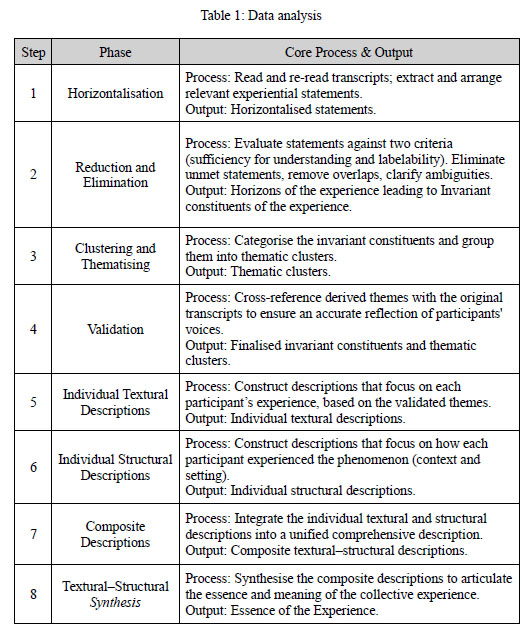
Data analysis followed Moustakas' modification of the Van Kaam method. The procedure involved (see Table 1):
4. Findings
This section presents the research findings from five Korean Christian development practitioners (Participants 1-5, hereafter P1, P2, etc.) who possess over ten years of experience in both KC-FBDOs and secular development organisations.
The findings focus on the conflicts they encountered in Global South field settings and on the characteristics of Korea and Korean Christianity that emerged from these conflicts. Their experiential accounts reflect the systemic tensions occurring in Christian FBDOs working towards transformational mission, as well as the characteristics of Korea and Korean Christianity embedded within KC-FBDOs.
Following Moustakas' method, I conducted individual textural and structural descriptions, composite descriptions, and a textural-structural synthesis. This section primarily presents the textural-structural synthesis derived from data analysis.
4.1 Encountering Conflict in Field Settings Within the Global South
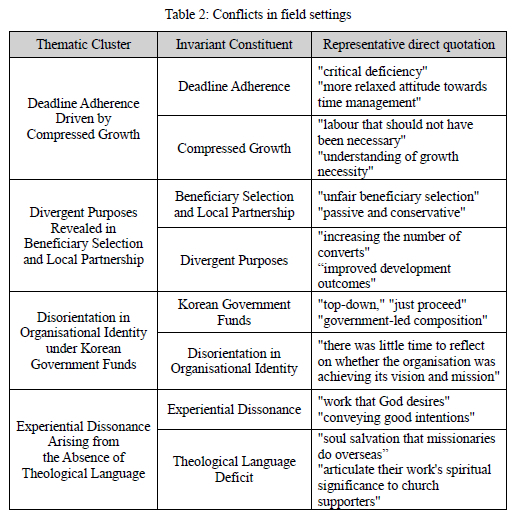
In this section, I present the essence of the conflicts that research participants experienced while working in the Global South, responding to the call to love their neighbours yet facing challenging realities (see Table 2). Given this study's purpose, the various conflicts they encountered are significant. These conflicts may represent potential tension points when GSCs engage in South-South cooperation towards transformational mission activities oriented towards decoloniality.
4.1.1 Deadline Adherence Driven by Compressed Growth
This experience for participants working in Global South field settings is characterised by profound tension arising from divergent perceptions of time management. Participants who placed a significantly high importance on 'meeting deadlines' felt extreme frustration and discomfort when time commitments with local partners were not kept. They considered failing to adhere to agreed-upon schedules a "critical deficiency." When demanding that local staff meet deadlines, P5 experienced "sceptical glances that seemed to question, 'Why is he behaving this way?'" in the field.
In addition, participants experienced an internal burden, feeling that the need to explain the self-evident necessity of growth was exhausting "labour that should not have been necessary." P5 stated, "Koreans, having been shaped by highly competitive and stimulating environments, tend to possess a relatively high level of responsiveness and understanding within such contexts. By contrast, in more fragile field settings where such forms of stimulation and exposure are less prevalent, it is often difficult for individuals to recognise the need to set goals or actively pursue them."
This experience is situated within contrasting cultural contexts. P5's rigid "understanding of growth necessity" and sense of urgency are deeply internalised assumptions shaped by Korea's "highly competitive and stimulating environments" and its underlying historical narrative of the ideology of 'compressed growth.' Conversely, local partners operate within a "more relaxed attitude towards time management" in fragile settings where such forms of stimulation and exposure are less prevalent.
In synthesis, these textural and structural descriptions suggest that the conflict transcends mere time management; it reflects fundamentally different understandings of what constitutes a problem and what should be prioritised. Despite a shared Christian identity with locals, the participants' naturalised imperative for rapid growth conflicts with local rhythms, highlighting the need for explicit negotiation of these cultural logics rather than assuming a shared operational framework.
4.1.2 Divergent Purposes Revealed in Beneficiary Selection and Local Partnership
In KC-FBDOs, overseas branches are typically led by locally recruited missionaries, yet participants experienced conflicts when collaborating with them due to ' divergent purposes.' During the 'beneficiary selection' stage of projects, participants faced significant difficulties in applying the "professional principle of non-discrimination." As international development experts, participants strove to select individuals suffering from the problems they sought to solve based on "accurate indicators," but local missionary branch leaders prioritised "church members or those likely to attend church." P2 stated that, while they perceived this choice as "unfair beneficiary selection" and an "error in the selection process," they felt frustrated by their low rank and authority.
Similar conflicts also emerged in the collaboration process with 'local governments,' which are widely regarded as a core element of development practice. According to P2, who believes that "cooperation with local authorities is essential for development projects," a local missionary branch leader often displayed a "passive and conservative" attitude in relationships with government agencies when "the local government was not favourable towards Christian evangelism." P2 noted instances in which the branch leader "avoided communication despite receiving requests for participation from local authorities." P2 stated that this passive attitude "ultimately hinders the ability of Christian FBDOs to operate effectively in the field."
These textural descriptions demonstrate that while professional development practitioners strategically pursue "improved development outcomes," some local missionary branch leaders aim to "increase the number of converts." Participants' experiences of collaborating with local missionary branch leaders reveal that collaborators can hold different underlying purposes even when participating in the same project.
In synthesis, these textural and structural descriptions suggest that beyond operational differences, deeper structural tensions can arise within transformational mission projects, namely, a clash between evangelism and development priorities. This highlights the importance of establishing genuine consensus on project purposes; without such alignment, South-South cooperation among GSCs risks producing conflicts driven by divergent purposes rather than fostering a truly context-appropriate approach.
4.1.3 Disorientation in Organisational Identity under Korean Government Funds
Participants experienced additional conflicts in their relationships with government agencies serving as funders, as compliance with these agencies' requirements often made it difficult for participants to maintain and fulfil their organisational mission statements. Regarding the experience of implementing projects with 'Korean government funds,' P4 stated that "there was little time to reflect on whether the organisation was achieving its vision and mission" as the "Korean government frequently required detailed performance reports designed to verify whether projects were being implemented in strict alignment with government plans." P4 reflected that "when we focus too much on satisfying donor requirements, we lose sight of why we started this work in the first place." Specifically, P3 experienced that these agencies made "top-down" requests to "just proceed" with "projects that were deemed unfeasible given the realities of the field or the local context" to produce "quantitative results in a short period of time" or conducted "performance-oriented projects." P3 stated that "when the Korean government proceeds with projects, it becomes a government-led initiative."
This experiential conflict arises from the misalignment at the intersection of diverse accountability structures among donors, beneficiaries, and FBDOs. Government funding imposes a strict, results-oriented structure, leading to a "government-led composition." Conversely, participants who worked at FBDOs considered the experience of realising values derived from a transformational mission throughout the entire course of operations just as important as development outcomes. Consequently, the conflict arising from externally funded operations was sometimes experienced as "sceptical reflection on whether the organisation was truly preserving its identity."
In synthesis, these textural and structural descriptions demonstrate that meeting the demands of secular government donor agencies extends beyond a simple tension between government and civil society organisations; rather, it often constitutes a form of 'disorientation in organisational identity.' The essence of this experience indicates that navigating the relationship with a secular government is a critical challenge for a genuine transformational mission, as FBDOs must uphold their organisational mission statements while engaging with externally imposed funding requirements.
4.1.4 Experiential Dissonance Arising from the Absence of Theological Language
Participants experienced another conflict rooted in the lack of adequate theological language for their work. Participants reported a "reflexive realisation of faith" in their daily operations. For P2, development felt viscerally as "work that revives people" and "work done through faith"; similarly, P5 confessed that it was "work that God desires." For P3, international development work meant "conveying good intentions" to improve local people's lives.
Yet, they did not regard their work as a Christian mission, reserving that term strictly for "soul salvation that missionaries do overseas." Consequently, they struggled to "articulate their work's spiritual significance to church supporters," facing "acute frustration" when forced to defend their vocational choices against accusations of insufficient evangelistic zeal.
This 'experiential dissonance' is structurally situated within an inadequate conceptual framework that perpetuates colonial-era dichotomies between spiritual and material mission, between saving souls and transforming society. In their local Korean churches, participants did not experience their development activities as recognised recognised forms of explicit and formal Christian mission. This indicates an emerging demand among transformational mission practitioners working in the Global South for theological language and methodological models to bridge the gap between theological conviction and actual development practice.
In synthesis, these textural and structural descriptions reveal a 'deficit of theological language' with which to name and frame their work. The essence of these experiences indicates the necessity for a theology of development practice and a field-grounded professional model that supports development work as theological praxis grounded in lived experience.
4.2 Discovering the Characteristics of Korea and Korean Christianity
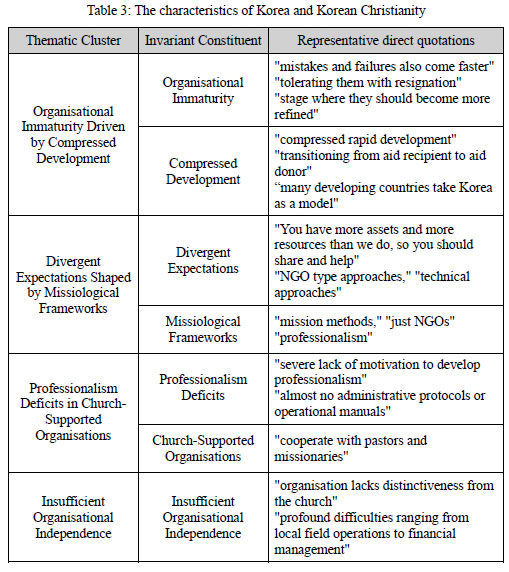
In this section, I present the characteristics of Korea and Korean Christianity that participants experienced in KC-FBDOs (see Table 3). Given this study's purpose, the characteristics identified in their experiential accounts are significant; they may suggest structural causes of conflicts that could arise when GSCs engage in South-South cooperation for transformational mission activities oriented towards decoloniality.
4.2.1 Organisational Immaturity Driven by Compressed Development
Participants experienced a profound duality of pride and frustration regarding Korea's "compressed rapid development." P3 reported that in the international development field, "Korea is widely promoted as the only country" to have experienced "transitioning from aid recipient to aid donor," emphasising that "in this field, we absolutely must not miss this keyword." Not only globally, but also within Korean society, the international development field has been perceived as "extremely attractive." P3 and P5, reflecting on their long tenure working in KC-FBDOs, noted that "really excellent people in terms of human resources" had "continuously entered" the sector.
However, this initial pride is quickly overshadowed as participants begin to experience shame within their organisations. For P3, driven by Korea's characteristic "rapid speed" and the "explosive growth" of KC-FBDOs, "mistakes and failures also come faster." The problem is that rather than utilising these "mistakes and failures as lessons," most leaders in the organisation endure a disempowering environment of "tolerating them with resignation." Acutely conscious that "many developing countries take Korea as a model," P3 felt pressing urgency as KC-FBDOs have reached a "stage where they should become more refined."
These lived experiences reveal a fundamental characteristic of the temporality of 'compressed development.' The very developmental success story of Korea, which provides organisational "legitimacy and attractiveness in Global South contexts," structurally enforces an unsustainable pace.
In synthesis, these textural and structural descriptions suggest a critical tension: the compressed development that made Korea's transformation remarkable has concurrently compressed organisational learning cycles, limiting opportunities for reflection and adaptation. The essence of these experiences is that the historical growth defining their identity may hinder the organisational maturation necessary for sustainable, ethical development practice.
4.2.2 Divergent Expectations Shaped by Missiological Frameworks
Participants experienced conflicting expectations stemming from the different ways their organisations were perceived by Korean missionaries serving in the field. On one hand, P1 faced demanding attitudes from some missionaries who viewed Christian FBDOs merely as "mission methods." These missionaries asserted, "You have more assets and more resources than we do, so you should share and help." Similarly, P3 encountered dismissive attitudes from those who labelled them as "just NGOs," claiming it was "impossible" to facilitate "inner transformation" through their activities.
Conversely, P3 felt encouraged when other missionaries embraced collaboration and actively interacted with what they viewed as a "newer generation doing a recent mission." These welcoming missionaries valued "NGO-type approaches" and "technical approaches," appreciating the "professionalism" demonstrated through tools such as IT.
These experiential realities are deeply shaped by the various missiological and theological legacies within Korean Christianity. The divergent attitudes of these missionaries are not merely personal prejudices; rather, they are structurally bound to different theological assumptions about mission-specifically concerning whether the focus prioritises evangelism, social transformation, or holistic engagement. While these 'diverse expectations' are broadly influenced by a missionary's position on the theological spectrum, for "those who have previously interacted with NGOs," they are also pragmatically determined by whether those past experiences were positive or negative.
In synthesis, these textural and structural descriptions show that such 'divergent missiological frameworks' are not merely theoretical disagreements; rather, they create tangible, practical obstacles to partnership. The essence of these experiences indicates that a transformational mission cannot assume theological consensus, even among those committed to similar goals.
4.2.3 Professionalism Deficits in Church-Supported Organisations
Participants reported that working for FBDOs established and supported by Korean churches was often more challenging than working in secular development organisations. P2 experienced a "severe lack of motivation to develop professionalism" within these 'church-supported organisations,' resulting in profound "frustration." Staff employed by these organisations, who were often recruited from church congregations regardless of their technical expertise, held a complacent attitude that "since the church has a strong will to run this organisation, we just need to do what we are told, and the church will take care of funding." This stood in stark contrast to secular practitioners, who understood that they "must compete through professionalism."
The difficulties participants experienced stem from the structural dynamics of KC-FBDOs, which are established and heavily supported by Korean churches. Participants identified the failure to maintain a clear "separation of church and FBDO" as the primary factor hindering organisational development. P5 recounted intense friction when required to "cooperate with pastors and missionaries" who notably lacked "accounting transparency" and "professional expertise," a reality stemming from their church origins, and from environments typically characterised by "almost no administrative protocols or operational manuals."
In synthesis, these textural and structural descriptions reveal a critical organisational paradox faced by KC-FBDOs operating under significant church influence. While connections to supporting churches provide financial stability, they can also reduce the institutional pressure to develop professional capacity and organisational systems. The essence of this experience suggests that unreflective dependence on church support cultivates complacency, thereby fundamentally weakening organisational professionalism.
4.2.4 Insufficient Organisational Independence
Participants working for church-supported KC-FBDOs expressed profound frustration that their "organisation lacks distinctiveness from the church." They worked in environments where "non-professionals, such as pastors or elders" made executive decisions and managed daily operations without providing an adequate rationale. P5 reflected on the systemic practice of appointing Koreans as local branch leaders solely to avoid English-language communication barriers. Consequently, P5 experienced "profound difficulties ranging from local field operations to financial management" when working with these branch leaders.
These experiential realities are fundamentally rooted in the KC-FBDOs' deep structural dependence on their founding churches. Critical decisions are dictated "primarily by the Korean headquarters and leaders of the supporting church, rather than by the voices of the local community, beneficiaries, or field staff." This dynamic structurally reverses the core power relations essential to development work. A prime manifestation of these structural constraints is the selection of local branch leaders based on linguistic and cultural familiarity-specifically, ease of communication and pre-existing trust with church leadership-rather than on objective professional competence.
In synthesis, these textural and structural descriptions demonstrate that KC-FBDOs, shaped by strong church influence, face significant constraints on 'organisational independence.' Participants' experiences suggest that, without sufficient autonomy, these organisations may function more as extensions of their supporting churches than as independent development actors. The essence of these experiences points to the importance of securing organisational independence to sustain their distinct role and identity in development practice.
5. Discussion
Based on the findings, this section discusses the theoretical and practical implications of the conflicts and the characteristics of Korea and Korean Christianity experienced by the participants. It first interprets these conflicts and characteristics through the lens of a liminal actor and then proposes the South-South Dialogical Approach as a practical alternative to foster authentic decolonial collaboration.
5.1 The Duality of the Liminal Actor
The findings presented in section 4 reveal that Korea and Korean Christianity, operating as a liminal actor between the Global South and the Global North, exhibit a profound duality in the context of transformational mission and international development. On the one hand, Korea's historical trajectory as a colonised nation, a post-conflict society, and a recipient country facilitates a unique emotional solidarity with Global South partners, creating an initial bond of shared suffering. On the other hand, the specific conflicts related to Compressed Growth (4.1.1) and Korean Government Funds (4.1.3) often reproduce top-down, outcome-oriented, and donor-driven approaches characteristic of Western donors.
This paradoxical duality can be interpreted as the manifestation of internalised coloniality (Mignolo 2011). The intense drive for visible results and strict adherence to deadlines observed in the findings transcend mere organisational habitus; they are a theological reflection of developmentalism-a syncretic belief system in which quantitative expansion and institutional speed are equated with the primary signs of divine blessing. Having internalised the Western developmental model as the only valid path to survival and prosperity during their own period of Compressed Development (4.2.1), Korea and Korean Christianity may now unconsciously project these values onto their partners. This suggests that without critical self-reflection, South-South cooperation may risk becoming a site where sub-empires reproduce colonial dynamics of domination and dependency under the guise of partnership.
However, these conflicts should not be seen merely as failures to be avoided. When viewed through the lens of Anna Tsing's (2005) concept offriction, these tensions serve as necessary and revelatory moments. They expose the awkward, unequal, unstable, and creative qualities of interconnection where the global meets the local. The discomfort experienced by the participants is, in fact, a signal that the prevailing developmentalist missiology is clashing with the lived realities of the Global South, thereby opening a space for alternative possibilities. It is within these very frictions that the necessity for a new collaborative methodology-one that transcends the logic of efficiency-becomes undeniable.
Theologically, recognising this duality of the liminal actor compels us to reimagine dialogue not as a negotiation technique but as praxis for decoloniality. The conflicts highlight that simply transferring resources or even theological concepts from Korea, a successful Global South country, to others does not constitute decolonisation. Instead, an authentic transformational mission requires constructing theology through dialogue processes rooted in the actual, often conflictual, contexts of the field.
This approach fundamentally refuses the colonial assumption that legitimate theological knowledge flows only from the North to the South, or from the developed South to the developing South. Instead, it posits all Global South practitioners-regardless of their economic power-as legitimate theological subjects capable of generating knowledge. Therefore, the South-South Dialogical Approach proposed in the following section is not merely a manual for conflict resolution but a decolonial theological methodology in itself-a creative process in which collaborating parties theologise their shared experiences and frictions, ensuring that partnership, mutual learning, and contextual knowledge generation become inseparable dimensions of the Missio Dei. Thus, the resolution of the liminal actor's friction lies in shifting from a mission of delivery to one of dialogue.
5.2 The South-South Dialogical Approach
To transcend the duality of the liminal actor discussed above, this study proposes the South-South Dialogical Approach. This approach aims to manage conflicts that may arise in South-South cooperation projects and to help the cooperative relationship ultimately become a process of acquiring decoloniality. This approach consists of five dialogue categories that can be applied throughout a project. The five dialogical categories were constructed based on the empirical findings presented in section 4. Each category comprises three detailed dialogue topics that can be applied in practice. This concrete alternative may help transform the abstract concept of decoloniality into tangible conversational topics.
5.2.1 At the Beginning: Dialogue for Epistemological Consensus
Epistemological consensus addresses the following question: What problems do we want to solve? 1 Divergent problem recognition within cultural contexts: Discrepancies over what constitutes a problem can generate unnecessary friction. In the nascent stages of collaboration, intentional time must be allocated to articulate perceived problems and their underlying rationales. The objective is not to impose one party's perspective but to engage in epistemic dialogue that honours diverse value systems. 2 Consensus on the direction of change: A transformational mission pursues sustainable change beyond material deficiencies. However, the nature of the pursued change-whether spiritual, material, or holistic-must be clarified. The absence of this consensus ultimately leads to disagreements in project implementation and evaluation. 3 Consensus on the question of for whom we are solving problems: This involves an ethical commitment to ensuring that beneficiaries receive the greatest possible benefit. Listening and dialogue are needed to determine what assistance is actually required and what state constitutes a resolution.
5.2.2 At the Beginning: Dialogue for Role Distribution
Dialogue on role distribution determines the answer to the question: Given limited time and resources, what will each party be responsible for? 1 The expertise and resources each party contributes: Conflicts arise when roles are assigned based on resource scale rather than expertise. Decision-making authority should be distributed according to expertise rather than financial primacy. 2 Formalisation of decision-making structures: Prior agreement is required on final authority, consensus-building mechanisms, and emergency protocols. Delimiting the boundaries between operational execution and ultimate accountability is essential to mitigate friction. 3 Specific agreements on resource inputs: The scale and timing of contributions such as funding and personnel must be specified. Clarity is required regarding the extent to which financial providers can intervene in execution, to ensure partnership equality.
5.2.3 In the Process: Dialogue for Positioning Strategies
Dialogue on positioning strategies addresses the strategic challenge: How can we maintain equal partnerships with stakeholders such as churches and governments? 1 Strategies for relational boundaries with supporting churches: Governance structures should enable professionals to oversee operational implementation while pastors focus on spiritual support. Diversifying donor bases is essential to reposition churches as partners rather than controllers. 2 Strategies for government funds: While government funding offers scale, it carries the risk of political co-option. Principles are required to support only projects that align with organisational missions and to impose caps on government funding ratios, positioning the organisation as an independent expert partner rather than a mere service provider. 3 Strategies with local governments and communities: Effective positioning must centre on local ownership. Christian FBDOs should view local governments as agents of change, not just regulatory bodies, and build balanced relationships with community leadership.
5.2.4 In the Process: Dialogue for Autonomy Strategies
Dialogue on autonomy strategies addresses the existential challenge: How do we mobilise resources to achieve our specific mission? 1 Diversification for financial independence: Relying on emotional storytelling for fundraising can compromise project effectiveness. Establishing a balanced resource mix-encompassing individual donors, foundations, and social enterprise models, alongside long-term endowments-is crucial for institutional stability. 2 Strengthening governance structures: Boards should set policy while delegating operations to experts. They should include diverse expertise (law, finance, development) rather than just church leaders, and local directors should be recruited based on professional competence. 3 Securing legitimacy through effectiveness: Institutional trust is earned through the empirical validation of project efficacy. Christian FBDOs must objectively measure outcomes and learn from failures, thereby fulfilling their primary accountability to the beneficiaries.
5.2.5 Throughout the Whole Process: Dialogue for Theological Articulation
Dialogue for theological articulation is the ongoing process of finding answers to the foundational questions: Who is the God we discover in collaboration? and How do we translate development into theology? 1 Experiential testimonies: Intentional reflection on practice is essential to capture the nuances of faith discourse-what God is like in the field, and how faith wavers and recovers-and to translate them into theological language. 2 Theological articulation of activities: Global South Christian FBDOs must collectively examine how education, health, and poverty alleviation constitute participation in the Missio Dei. This process affirms development as a faithful commitment to God's kingdom, not merely humanitarian aid. 3 Collaborative model development: Many transformational mission actors express a need for problem-solving models. Christian FBDOs must create concrete praxis models by systematising case studies, thereby establishing their identity as theological actors.
6. Conclusion
This study began with the urgent task of translating the abstract discourse of decoloniality into the concrete praxis of transformational mission. While the necessity of decoloniality has been articulated within GSCs, practical methodologies for its realisation in field settings have remained underdeveloped. By exploring the lived experiences of Korean Christian development practitioners, this study found that South-South cooperation does not automatically guarantee decoloniality. Instead, without critical reflection, it may risk reproducing internalised coloniality and developmentalism.
However, this study went beyond identifying these structural risks. By reinterpreting these conflicts as generative frictions, the study proposed the South-South Dialogical Approach, encompassing five dimensions: epistemological consensus, role distribution, positioning, autonomy, and theological articulation. This framework fulfils the study's purpose by providing tangible, operational safeguards that enable GSCs to move beyond colonial patterns of dependency and domination towards authentic partnership.
Despite these contributions, this study has limitations. First, the phenomenological focus was restricted to the experiences of five research participants. While this illuminated the internal struggles of Christian development practitioners in the donor country, it did not directly capture the voices of their local partners in the recipient country. Second, the findings derived from the Korean case as a liminal actor may not be universally applicable to all Global South contexts, though they are particularly meaningful for emerging donors in the Global South. However, this study does not disregard the voices of recipient-country actors. Rather, it deliberately narrows its analytical focus, as an act of phenomenological reduction, to the internal tensions experienced by Korean practitioners situated within this liminal positionality.
Therefore, I suggest three directions for future research. First, research focusing on local communities is essential to balance the narrative. Second, comparative studies of other emerging Global South donors, such as Brazil, China, or Nigeria, are needed to examine whether the internalised coloniality and developmentalism tendencies observed in Korea are unique to Korea or common to emerging Global South powers. Third, as highlighted in the findings, rigorous theological work is required to further develop Christian Global Development Studies, providing a solid theological foundation for practitioners struggling with the dualism of transformational mission and international development.
In conclusion, decoloniality in the Global South can be realised not merely by cooperating South-South for a transformational mission, but by shifting missiological paradigms from a mission of delivery to a mission of dialogue. It is my hope that the South-South Dialogical Approach proposed as the concrete alternative in this study will help empower GSCs to dismantle the remaining colonial legacies, participating in the Missio Dei not as sub-empires, but as equal, distinct, and interdependent agents of comprehensive restoration.
References
Acknowledgements
This article draws on data collected during doctoral research; however, it constitutes an independent study with a distinct thematic focus, theoretical framework, and scholarly argument. An earlier version of this paper was presented at the Conference on Mission Studies and Decoloniality, convened by the International Association for Mission Studies (IAMS) in 2026. The author thanks the Protestant University of Lubumbashi for funding the article processing charges (APC) for this publication. Its institutional support contributes to advancing the emerging field of Christian Global Development Studies.
2. Literature Review
- Boff, L. and Boff, C. 1987. Introducing liberation theology. Maryknoll: Orbis Books.
- Creswell, J.W. 2013. Qualitative inquiry and research design: choosing among five approaches. 3rd edition. Thousand Oaks: SAGE.
- Dados, N. and Connell, R. 2012. The Global South. Contexts 11(1):12-13.
- Gutiérrez, G. 1988. A theology of liberation: history, politics, and salvation. Revised edition. Maryknoll: Orbis Books.
- Kim, S.C.H. and Kim, K. 2015. A history of Korean Christianity. Cambridge: Cambridge University Press.
- Kwok, P.-l. 2005. Postcolonial imagination and feminist theology. Louisville: Westminster John Knox Press.
- Levander, C. and Mignolo, W. 2011. Introduction: the Global South and world dis/order. The Global South 5(1):1-11.
- Maldonado-Torres, N. 2007. On the coloniality of being: contributions to the development of a concept. Cultural Studies 21(2-3):240-270.
- Mignolo, W.D. 2011. The darker side of Western modernity: global futures, decolonial options. Durham: Duke University Press.
- Moustakas, C.E. 1994. Phenomenological research methods. Thousand Oaks: SAGE.
- Mugambi, J.N.K. 1995. From liberation to reconstruction: African Christian theology after the Cold War. Nairobi: East African Educational Publishers.
- Myers, B.L. 2011. Walking with the poor: principles and practices of transformational development. Revised edition. Maryknoll: Orbis Books.
- Oduyoye, M.A. 1986. Hearing and knowing: theological reflections on Christianity in Africa. Maryknoll: Orbis Books.
- Padilla, C.R. 1985. Mission between the times: essays on the kingdom. Grand Rapids: Eerdmans.
- Prashad, V. 2012. The poorer nations: a possible history of the Global South. London: Verso.
- Quijano, A. 2000. Coloniality of power, Eurocentrism, and Latin America. Nepantla: Views from South 1(3):533-580.
- Samuel, V. and Sugden, C. 1999. Mission as transformation: a theology of the whole gospel. Oxford: Regnum Books International.
- Sandelowski, M. 1995. Sample size in qualitative research. Research in Nursing & Health 18(2):179-183.
- Tsing, A.L. 2005. Friction: an ethnography of global connection. Princeton: Princeton University Press.