Transforming urban vulnerability: A theological and political priority
Abstract
South African cities are often marked by deep urban vulnerabilities. This article explores vulnerability and resilience, distinguishing between adaptive and transformative resilience. Proposing an approach that fuses three overlapping cycles - hermeneutic, pragmatic and institutional - it then unpacks key elements of such an approach. The proposed approach presupposes a theological - and political - commitment to, and solidarity with, vulnerable people, places and systems, played out in concrete actions towards transforming urban vulnerability. It proposes the use or crafting of vulnerability indices by faith-based communities, to measure the degree to which urban vulnerabilities are being transformed.
South Africa; urban; vulnerability; political priority
1. Introduction
The challenge to engage urban vulnerability, heal urban fractures1, and build transformative urban alternatives, is not only a theological challenge, but goes to the core of urban well-being - of people, places, systems and environment -requiring holistic, collaborative and trans-disciplinary approaches.
In the context of deep urban vulnerabilities, caused by psycho-socio-spatial fractures, this article explores and agitates for transforming urban vulnerability as a theological and political imperative, that should be engaged holistically, collaboratively and in thoroughly trans-disciplinary ways. It explores what transforming urban vulnerability might look like, going beyond resilience as adaptation, but bringing about more fundamental and systemic change.
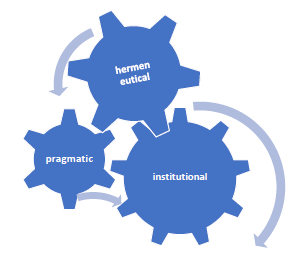
It proposes an approach that fuses three overlapping cycles - hermeneutic, pragmatic and institutional - each characterized by specific elements. The hermeneutic cycle includes immersion, analysis, (theological) reflection / imagination, and co-construction, grounded in a spirituality of life; the pragmatic cycle includes elements of imagination, incubation, and innovation; and the institutional cycle speaks to the elements that will drive and sustain processes of transformational change, including data generation, communication, collaboration, and mobilizing technologies.
In 2020, our Urban Studio in the City of Tshwane published a research report, titled Inside the pandemia Vulnerability, imagination, innovation (Centre for Faith and Community 2020), in which we reflected on some of the concerns described in this article. In a 2021 article titled 'Change agency and urban vulnerability' (De Beer 2021), I again explored this theme. And in 2022, Amira Osman, the South African Research Chair for Spatial Transformation, requested me to present on this same topic, at an event on divided cities, mostly attended by architects and others in disciplines related to the built environment (cf. De Beer 2022). Here, I will seek to develop my own understanding and contribution to the topic further, conceptually.
2. Defining urban vulnerability
There is no single definition that captures the concept of urban vulnerability well. Urban vulnerability is both a condition and a process, characterized by varying levels of dependency or agency, with related (in)capacity or (in)ability to deal effectively with urban challenges, changes or crises.
Cities are home to vulnerable populations, places, building and systems. They are part of a larger eco-system, that is threatened by unfolding patterns of climate change. Increasing occurrences of environmentally-determined displacement is recorded, with floods sporadically wiping out entire urban settlements built below flood lines. Even cities in the global north struggle to keep up with the provision of good health care, quality education, and affordable public transport to all their inhabitants.
In 2023, Lilian Ngoyi Street in Johannesburg's inner city collapsed without warning, causing deaths and severe damage. This was caused by either a gas line explosion or illegal mining, but whatever caused this accident underscored the severe frailty of urban infrastructure (Panchia 2023). This, besides what some suggest to be around 200 inner city buildings in Johannesburg that are probably unfit for human habitation, yet house thousands of vulnerable inner-city residents. These buildings lack secure tenure and good maintenance; often being fire traps and in many cases the result of slumlords extorting money from the residents without any services or maintenance in return. (Maggs 2024).
Srinivas (2021) describes cities and their associated vulnerabilities as affecting the entire planet. Many definitions of urban vulnerability focus on the exposure of urban residents to climate hazards and their ability to adapt or mitigate risks in order to reduce negative impacts (cf. Lankao & Quinn 2011; Rubin 2011; Srivinas 2021).
Although climate factors are one critical lens through which to explore urban vulnerabilities, I propose understanding and defining urban vulnerability more holistically (cf. Birkmann, et al 2013:199-201), considering human-social, physical-spatial, cultural, economic, health, environmental and institutional factors. To address, reduce or overcome urban vulnerability, all these factors - the totality of the urban household / eco-system - need to be considered simultaneously.
Urban vulnerability is simultaneously multidimensional (different types of vulnerability), dynamic (changing over time), site-specific (each location differs) and at different scales (from individual to household, neighbourhood, city, country) (cf. Van Westen 2014). Retrieving tools to measure the extent of urban vulnerability - known as a vulnerability index - in a particular city or neighbourhood, or among a particular population, is a helpful way of assessing possible policy or pragmatic interventions that could prevent threat proactively, foster resilience, or transform conditions that deepen vulnerabilities to start with. Local communities, community organisations or faith communities would do well to assess the well-being, resilience or agency of a local community through the use of a vulnerability index, adopted to be appropriate for their local context or conditions.
Levels of urban vulnerability are mostly not accidental but determined by human agency or neglect. If urban vulnerability is the result of systemic socioeconomic-spatial exclusions, over shorter or longer periods of time, then such conditions - and exclusions - were mediated by policies, planning and priorities that failed to foster radical inclusivity or opt for the most vulnerable urban places and populations, beyond political forms of rhetoric (cf. Bhanjee 2019). Vulnerability then is an expression of people's lack of access to essential sources of livelihood, well-being or freedom, and the lack of resistance to those forces that render people or neighbourhoods vulnerable.
Specific groups or populations are characterised by absolute forms ofvulnerability, due to the multidimensional nature of their situations: homeless communities; people living with chronic mental illness; waste pickers; impoverished, isolated older persons; young unemployed people; girl children in informal settlements; commercial sex workers operating from the streets or forced into sex work. All these groups are present in our city, but often restricted behind the walls of our dividedness, and, therefore, rendered even more acutely vulnerable because of their lack of being connected to interdependent communities.
Undocumented urban children are unable to access health clinics or schools. Older persons, whose only financial support is the monthly SASSA grant, face vulnerability in terms of their housing, food security and general support. Many abandoned inner city buildings and informal settlements are perpetually vulnerable, exposed to fire hazards, toxic waste, lack of running water and sanitation, and hazardous environmental conditions.
During hard lockdown in Kampala, Human Rights Watch (2020) reported multiple incidents where vulnerable populations were seriously violated:
On March 29 (2020), community residents and police raided a shelter for homeless lesbian, gay, bisexual and transgender youth in Wakiso, outside of Kampala, and beat and arrested 23 people, including shelter residents.
This was done, not because anyone was in breach of Covid-protocols, but merely because of people's sexual orientations. Urban vulnerability is often a matter of life and death - for people, places and systems.
3. Resilience: adaptive or transformative
Resilience is often indicated as the antidote to vulnerability; or, vulnerability and resilience being two extremes on a spectrum of urban well-being (cf. Birkmann 2006; Birkmann et al. 2013; Bohle 2001; Pelling 2003).
Absolute vulnerability is marked by multiple forms of exclusion, a lack of access to resources that mediate well-being or freedom, and a lack of capacity to resist multiple forces rendering people or places vulnerable or at-risk. Vulnerability is not restricted to low-income or poor individuals or households. During recent floods in urban Kwazulu-Natal, poorer and richer families and neighbourhoods were made vulnerable, with some having the resilience to bounce back and recover quicker, whilst others had almost no ability to bounce back, without any form of external support or internal capacity.
Resilience is 'the capacity of individuals or communities to withstand the impact' (Pelling 2003) of external or internal forces or risks, and the ability to overcome such forces or risks creatively. Resilient people, places or cities, are able 'to manage, or maintain certain basic functions and structures, during disastrous events...' or 'to recover or "bounce back" after an event' (Twigg 2007:6).
Many acutely vulnerable places exhibit strong elements of resilience, having had to building mechanisms to cope and bounce back in the face of many adversities. In some vulnerable spaces, creative resistance and insurgent citizenship have evolved, reclaiming the city from below, and birthing social movements that present daring alternatives to the status quo. Building resilience includes actions that foster adaptive capacity such as information sharing, building strong local organisations, establishing participatory management and governance structures, or ensuring grey or green infrastructure to mitigate climate-related risks (cf. Patel, et al 2020).
Resilience assists communities in reducing exposure to risk of frailty through the mobilisation of institutional, socio-economic, political, psychological, cultural or spiritual assets or capacities, existing both within and outside the community. Yet, romanticizing resilience is to place a huge additional burden on resource-poor communities, that are often systematically excluded from resources they should have access to. It is failure to address the causes of vulnerability, which should be centred in theological and political engagement.
A distinction needs to be made between adaptive resilience (Maunder, et al 2023) and transformative resilience (Asadzadeh, et a; 2022). Adaptive resilience includes 'the ability to adapt to traumatic or adverse experiences' (Luthar & Cicchetti 2000:857-885); the 'ability to anticipate, prepare for and adapt to changing conditions' (Baskin & Bartlett 2021: 2329-2342), or, 'the capacity to adapt and respond to challenges and changes at different system levels' (Wiig & O'Hara 2021).
Asadzadeh and others (2022) distinguishes between 'conservative coping adaptation', 'reformative incremental adaptation', and 'fundamental transformative adaptation'. Whereas the first categories consider resilience as adaptation to crises or change, and sometimes deeper forms of incremental change, the last category - 'fundamental transformative adaptation', calls for a more significant shift in resilience paradigms and theories. Transformative resilience refers to 'the capacity of individuals and organisations to be able to both transform themselves and their societies in a deliberate, conscious way' (Ziervogel, et al 2016: 95). It is aimed at changing the very urban systems that render communities vulnerable in the first place, and build the transformative capacity to do so (cf. Wolfram 2016:121-130).
In spaces and with people characterized by vulnerability, faith-based solidarity should not only support people to foster local resilience, as that could perpetuate the status quo; instead, I argue for resilience as the substance upon which communities could build, fostering the agency required for imagining and making deeper change, that is personal, communal, paradigmatic, and systemic.
4. Transforming urban vulnerability: a theological and political priority
I argue for an approach that will not engage urban vulnerability only through tailor-made services, however generous they might be; nor through an approach that focuses singularly on fostering greater resilience. Theologically, practices are required that will engage with the conditions that create and perpetuate vulnerability to start with, with a view of transforming such. Transformative resilience, or transforming vulnerability, should not merely be a paradigmatic or semantic shift, but should be measured in terms of tangible change - in the vulnerability index, stewardship of resources, and reintegration of people and places into the city's fiber.
What I argue for here, is a prioritization of vulnerable urban populations and spaces by those who are concerned about the divided or segregated city and committed to healthy and liveable cities for all. God's preferential option for the poor should expand its scope to include urban vulnerability - of people, places, systems and the environment - equally on its agenda. Equally, urban vulnerabilities that are not engaged with politically - in ways that are proactive, caring, courageous and wise - will over time breed conditions that contribute to urban violence of both human and non-human actors alike, in resistance to their perpetual exploitation. Urban vulnerability should be made a deliberate theological and political priority, centred by those tasked with urban planning, policy, design or management; and all those who understand as their vocation to contribute to psycho-social, spatial, economic, or other forms of urban healing.
This is not merely semantic discourse about vulnerability, resilience or transformation, but an assertion for embodied solidarities, pragmatic politics and praxis-oriented theologies that will accompany processes, people and communities from vulnerability to resilience and transformation.
4.1 What prioritizing urban vulnerability might look like
If a core premise of liberation theology is a preferential option for the poor (Gutierrez 1988:xxv), translated it would mean (i) locating itself in deep solidarity with the city's most vulnerable, oppressed and marginalized people and places; (ii) working actively for the city's most vulnerable through solidarity, action, reflection, dialogue, research and activism; and (iii) assessing the well-being of the city through the lenses of those who are systemically excluded from the city and its resources. Such assessment will include assessing our own professions and disciplines, and our personal commitments, through the lens of how faithful we are in our solidarity with the urban poor, marginalized and stranger.
Such prioritisation of vulnerable places, people and systems might have to include the following very deliberately:
1. Assessing urban vulnerability through the use of a vulnerability index -considering social, physical, health, economic, political, environmental and institutional risk factors
2. Mapping urban vulnerability and risk factors across the city - in order for actual data to inform policies, strategies, interventions and resource distribution
3. Ensuring the reduction of vulnerability being explicitly integrated on the agenda of the city, civil society, research community and the church, with clearly articulated measurable outcomes, including a systematic transformation of conditions that create and sustain vulnerability
a. Identifying and prioritizing actions for reducing vulnerability
b. Identifying institutional mechanisms for implementing such actions
c. Creating creative sources of finance to invest in reducing vulnerability
d. Implementing and assessing the impact of our collective actions
This should not be a desktop exercise, but should be informed by careful and attentive contextual listening. Patel, et al (2020) emphasize 'the context-specific characteristics' of vulnerable people, and the need to better understand how such vulnerability came about, and how it can be transformed.
4.2 Measuring liberation-transformation of urban vulnerability
Assessing impact, theologically, would be to ask in how far we accompany - and mediate, where possible - freedom, in the fullest sense of the word - spiritually/ psychologically, socio-economically, spatially, environmentally and politically.
Transforming urban vulnerability would be to assist communities to develop the spiritual, psychological and mental capacities to re-imagine themselves, their institutions, and their neighbourhoods; to create conditions for socio-economic, spatial, environmental and political freedom; and to midwife the alternatives that are birthed from such new imaginaries and altered conditions.
This cannot be a rational discourse only. Unless the vulnerability index does not shift markedly for a particular population, neighbourhood or city, our work has not yet ended, and the transformative agenda remains.
Let me refer to one local example to try make my point. There is only one shelter for homeless men in the Centurion area of the City of Tshwane, created during Covid-19. People residing here have often connected to local resources for temporary employment, and found ways to foster relative personal well-being. Since it was a temporary shelter only, in a community hall designed for other purposes, the City has tried to evict people from here for a couple of years now. The city was blocked legally, since they failed to offer alternatives in the same vicinity, even though there are identified city-owned properties standing empty and abandoned within walking distance from the current shelter.
Connecting to the vulnerabilities of the shelter residents in the Lyttleton area is only the first step. Acknowledging the resilience that they have fostered among themselves, and building on it, is a second step. The way to honour this resilience is not to prolong shelter living, but to support them into sustainable vocational opportunities and accessible affordable housing options. Only then would vulnerability be transformed, not only into resilience but into self-reliance - psychologically, socio-economically, and otherwise.
Simultaneously, the creation of a permanent shelter facility in the Centurion area for street-based populations, and affordable housing options for low-income people, would contribute to a more resilient neighbourhood with the potential to contribute to personal and societal transformation.
4.3 Transformative agency: whence?
To ensure the ongoing and full liberation - and therefore integration and participation - of the city's most vulnerable populations, deep transformation is required. Can any deep change occur without the primacy of deep, embodied solidarity with the city's greatest vulnerabilities?
Agency to effect such change has to be deliberately fostered, among vulnerable populations themselves, who often resist exclusion and dehumanisation as a way of survival; among local faith communities that have the potential to be centres of capacity building and resilience; through research and educational pursuits that opt to be in intentional solidarity with vulnerable people and places in the city; through planning and design that refuse perpetuation of urban segregation and the concentration of urban capital away from where the majority of urban inhabitants find themselves; and, perhaps, through progressive city officials and non-partisan politicians, hell-bent on serving the city's people and not their own interests.
5. A value-based ethos of city-making: Practicing three overlapping cycles
I seek to locate this reflection - on transforming urban vulnerability - in a value-based ethos (a spirituality) of city-making, to be worked out through practicing three overlapping cycles - hermeneutical, pragmatic and institutional. These proposed overlapping cycles should work like cogs in a wheel, making the city through transforming urban vulnerability and building local agency.
The hermeneutical cycle (I) includes immersion, analysis, (theological) reflection and planning for action, grounded in a spirituality of life; the pragmatic cycle (II) includes imagination, incubation, and innovation; and the institutional cycle (III) includes data generation, communication, collaboration, and mobilizing technologies.
Any one of these cycles by themselves will be insufficient to make deep and lasting change. The first cycle might enable paradigmatic shifts and some transformative actions, but without deliberating fostering new forms of agency, would fall short. The second cycle will be able, but without deep solidarity and critical analysis, might end up with frustrated dreams and unsustainable innovations. The third cycle will organize resources well, based on good data, but without depth of analysis and agency, this might become a well-oiled bureaucratic machine, of whom the brand is more potent than the substance. The cycles, practiced simultaneously, have potential to transform urban vulnerability and make cities that reflect something of God's common household. I speak of a value-based ethos, because it departs from a deep assertion that all people are equal in the eyes of God and members of God's common household, and any vulnerability that deplete such an assertion needs to be engaged in redemptive ways, to mediate a fuller sense of life and well-being.
5.1 Cycle I: Hermeneutical
The hermeneutical cycle is about sense-making - faith communities or faith-based leaders immersing themselves in places of vulnerability; analysing and discerning the nature of vulnerabilities and possible socio-ecclesiá responses; reflecting on vulnerability theologicály with the view of imagining alternatives; and discerning posoble plans on action that will arrest, address and overcome vulnerabiltty (cf. Holland & Henrfot 1980).
5.1.1 Immersion:
Transforming urban vulnerability presupposes immersion in places and among people where deep vulnerability is experienced. Theologically speaking, it requires incarnational commitment shown in deep forms of solidarity with particular areas of urban vulnerabilitv
The 'task' ot immersion - and I speak of it as a 'tasV es it needs to be on inteetional, disciplined and tommitted act, or process - is to enter into spaces through proximity, deep listening, and openness to learn, discerning the voices, cries, assets and needs of local communities.
Foefaith communities to contribute to transfoiming vtrbaV vulnerability there nœdsto tie intentionality - in a discij^ine0 and committed process - to proximity, deep karningje^ning, unlearning ane re-learning, and collective disœrnment.
5.1.2 Socio-ecclesial analysis:
Disciplined immersion should include disciplined, and systematic, socio-ecclesial analysis, deconstructing social, economic, political or environmental vulnerability - understanding the what, why and how - as well as the institutional responses to urban vulnerability. Such analysis should include ecclesial analysis, asking questions about how the church respond to urban vulnerability, whether our responses are appropriate, effective and impactful, and, in how far we ourselves are vulnerable, and how to offer our vulnerability as a gift, but also how to overcome our vulnerability through deliberately fostering agency for change-making.
5.1.3 Theological reflection (imagination):
The collective of what we discern through immersion and analysis, needs to be reflected upon theologically. As faith-based people committed to transformative city-making, our immersion and analysis are not only sociological or anthropological exercises - we have to discern theologically how urban vulnerability challenges notions of human dignity, social and other forms of justice, and the integrity of creation. Our theological reflection should include fostering agency for imagining alternatives, and fostering alternative imaginaries for overcoming particular forms of urban vulnerability.
5.1.4 Planning for action (co-constructing urban innovations):
Theological reflection fostering alternative imaginaries needs to be translated very deliberately into plans for action - the kinds of interventions and infrastructures required to facilitate transformation of urban vulnerability. These plans are not individualized but ideally should be plans to co-construct urban innovations, addressing urban vulnerability creatively.
5.2 Cycle II: Pragmatic
5.2.1 Imagination:
The dominant urban imagination often insulates itself from vulnerability, marginalizing it in policy-making, budgetary commitments, and professional practices. Instead of it being centered, vulnerable people and places often have to be content with the crumbs from excessive tables.
We have come to accept as 'normal' the abnormalities of exclusion, marginalization and segregation that still mark South African cities at-large. We are told that the resources that were available during Covid-19 to shelter unhoused people effectively, are no longer available, because the 'disaster' of Covid is over. But, for the individual homeless woman, with her children, being on the streets of the city is a daily disaster.
The dominant imaginary insists that students and older persons cannot reside in the same facility; or that certain neighbourhoods are not conducive for affordable housing. Even despite evidence of successful mixed-typology housing, in which the intergenerational character of students and older persons sharing space, becomes its distinctive gift, naysayers remain stuck in their limited imaginations.
Arbitrary land value discourse became gods, that cannot be tampered with, in spite of the fact that an informal settlement in the east of our city, within 300 metres of an expensive golf estate, hardly influenced the property price in the estate at all, challenging the myth that social or other forms of low-income or precarious housing will necessarily impact on land costs detrimentally.
Dunn (2018) laments the 'imaginative lock-in' that hinders cities from imaginative alternatives, being socialized into dominant narratives that we are unable or unwilling to be freed from. He speaks of a sparseness of ideas that keep us beholden to dominant ideas, often in a rather uncritical way.
Yet, it is often in vulnerable places themselves, that alternative urban imaginaries are born. In some instances, unless people give expression to visions of alternative futures, the despair that might overcome them is too hard to bear. As strategies and tactics for outwitting death, forms of resilience and innovation evolve from such places, necessitated by the sheer odds. It is from the 'underside of history', Gutierrez (1988:169) writes, that new and liberative narratives will emerge.
The depth of multiple and intersectional vulnerabilities in our cities are unsustainable - like ticking time-bombs that result in violence, decay, displacement, disease and death. Isabel Sanchez (2014) calls for 'a new possible urban imagination' that will articulate and map different possible urban futures. She draws from the work ofJames Holston (2008) who argued for 'a different social imagination in planning and architecture in order to construct the future of our cities' (Holston, 2008). I draw on the wisdom of theologian Walter Brueggemann (1978) who speaks of a prophetic or hopeful imagination, which will include (i) to name death where it is at work in the city; (ii) to evoke imaginaries of life; and (iii) to animate movements of change to realize such imaginaries.
Holston (2008) cautions that our urban imaginaries should not be far-fetched or unattainable, speaking of "(T)he necessity of having to use what exists to achieve what is imagined" (Holston, 2008). Building on the assets, actions and dreams of local places and people, however vulnerable or insignificant it might look, should form the foundation of bold - yet attainable - new imaginaries.
In the face of multiple urban vulnerabilities - of places, people and systems - we have to interrogate and re-imagine our own pedagogies, research agendas and spaces, as institutions of higher learning. Where do we teach, do research or engage? With whom, why, and to what end? Our faith communities need to reimagine their properties and land as possible 24/7 centres of life that help arrest decay, organizing strong local movements, and engaging collaboratively with policy makers to make urban change.
imagining the future city - as inclusive and whole - should be our vocation. Imagining different and resilient urban futures, against the backdrop of deep urban divides and vulnerabilities, require of us not just to imagine spaces and populations differently, but also our urban practices, institutional mechanisms, participatory processes, financial models, institutions, and, ourselves.
5.2.2 Incubation:
We desperately need communities and spaces to animate and practice an alternative imagination together - bringing those who experience particular vulnerabilities, with officials, planners, urban practitioners, and researchers, who all also experience vulnerability maybe in other ways - to dream up doable alternatives together. In these communities of practice, or citizens academies, or urban studios, we need to allow our insulation to be disrupted: for the wound and anger of the city and its people to disrupt us sufficiently, to dare to imagine afresh.
What is required are deliberate spaces where such alternative imaginaries can be evoked, nurtured and protected. Holston (2008) speaks of 'spaces of insurgent citizenship' where 'entrenched stories' of the dominant imagination are interrupted by 'introducing new identities and practices'. Wood (2007) thought of this as 'micro-utopias' in which citizens participated to construct alternative local futures. Instead of urban master plans, Edgar Pieterse (2022:1-17) insists on community-based plans, in which local communities and stakeholders take ownership of local processes and futures.
I would suggest such spaces as incubators that connect imagination and innovation. Imagination, by itself, cannot make change. Imagination - evoked, nurtured and protected in urban incubators - can translate into urban innovations that make change.
Incubation is a term used to describe the process or conditions of support that are provided to ensure frail life - e.g. a premature baby or an egg before hatching - can be protected. It is well-described here:
To incubate means to keep something safe and warm so that it can grow. The word can be used metaphorically to mean to keep something safe in order for it to have time to grow. You incubate a plan or an idea before bringing it into the world, or, metaphorically speaking, hatching it (Vocabulary.com 2025)
Urban incubators in contexts of urban vulnerability are spaces created to foster conditions for frail life, processes and systems, to grow strong, in order to contribute to change and well-being. Practically speaking, such incubators should include possible resources such as access to information and technology, co-working spaces, advice and mentoring, access to networks, and, even, seed capital (cf. Atal Innovation Mission 2024).
Sanchez (2014:13) holds that there is 'a great range of new actors willing to participate in the construction of the urban futures'. Instead of peddling that which does not work, urban incubators should discern where vibrant citizenship, social mobilizations and artistic flair are already working to transform urban vulnerabilities, in the interest of a more just, inclusive city. Urban incubators should be deliberate about inviting fresh imaginarles from unconventional places, to help disrupt and subvert some of our own dusty practices, to birth new possibilities.
They should birth imaginations / rationalities that are not cognitively sterile, but enacted, embodied, practiced. It is the anger of fourth generation residents of Woodstock in Cape Town, forced from their housing through gentrification, and left to their own devices, that birthed a movement known as Reclaim the City (2023), occupying unused buildings for unhoused people. Theirs is not simply an act of urban defiance, nor criminality as local politicians would have one believe. Instead, theirs is a bold alternative imagination of a city that houses all its people, with a certain bias towards those who are especially vulnerable and having low incomes.
It imagines a spatially transformed city where those of lowest income do not always have to live the furthest from economic and other opportunity, thereby using the largest percentage of their incomes for public transport. Theirs is a reimagined city, which, through their actions, they reclaim themselves. Their disciplined communal living in Woodstock is at once a city, re-imagined; a new community, incubated; a possible model of bottom-up urban innovation.
5.2.3 Innovation:
Dunn (2018) suggests three concrete questions to be answered, when considering innovations:
1. How to craft our visions in ways that can capture the public imagination and disrupt dominant imaginaries?
2. What are the potential institutional mechanisms able to translate such visions sustainably and well into action?
3. What are the innovative resourcing mechanisms to support implementation of alternative visions, when incubated and piloted, but, once they work, to invest in their replication and scaling?
These are important questions to be considered as part of urban incubation processes, dealing with dissemination and popularization of alternative imaginaries; institutional mechanisms that could viably implement, foster and sustain innovations; and resourcing mechanisms for sustainability, replication and scaling. Already at incubation stage, these three questions need to be answered, to be able to accompany innovations that are imaginative, broadly owned and sustainably viable.
Yet, many grassroot innovations, incubated by people and communities themselves, already exist, yet they seldom contribute to make larger-scale urban change, either because they remain invalidated by policy-makers, marginalized in urban discourses, and seldom at the table in crafting local urban plans.
The millions of rands saved to cities by waste pickers in South Africa annually (Council for Scientific and Industrial Research 2016), even though they remain criminalized and disregarded, offer an alternative urban system to be built upon and refined. In the case of waste-pickers, not only do they address the challenge of urban waste management, but they also create livelihoods for themselves. Jaime Lerner (2014) - architect, urban designer, and former Mayor of Curitiba - spoke of 'pinpricks' of urban change - those small but strategic interventions that can actually contribute to heal an entire street or neighbourhood; and applying such 'pinpricks' across the city might even contribute to transformation at scale. These 'pinpricks', or his approach of 'urban acupuncture', are urban innovations that over time will get validation, and contribute to new urban, helping to overcome specific urban vulnerabilities.
For three decades I was involved in local interventions that sought to address urban vulnerabilities. Although these interventions continue at a local level, breaking cycles of exclusion for 100s of people annually, they were never replicated across the city, or taken to scale. Supportive housing for vulnerable populations - people with chronic psycho-social challenges, victims of gender-based violence, or frail older persons - was piloted and proved to be innovative models of community-based housing. Failure to replicate these represents a great loss in terms of transformative possibilities at a larger scale. Some reasons were our specific focus on the inner city and not necessarily on the entire metropolitan municipality; the fact that practices that address and helped overcome urban vulnerabilities were not well-documented; the inability to appreciate these as innovative models worthy of replication; and the resources for replication and scaling.
Most importantly though, mechanisms seldom exist in which the donor (government or other), implementor / intermediary and beneficiary community, could share lessons learnt in a collaborative way, in order to assess and validate the impact, interrogate the necessity and possibility for replication, and consider how policy and funding mechanisms can be informed and geared towards scaling of what works.
Innovation, if not well-held (in safe incubators), communicated and shared, might remain small and isolated, however much change it mediates at local levels for those it was initially designed for. At early stages, such innovations when still extremely frail, might even fail to come to life.
It is also the case that urban organisations doing groundbreaking work to address urban vulnerability, themselves are often unable to appreciate and articulate just how potentially transformative their work could be for the city at-large, or, as disruptors to dominant urban narratives. They often work intuitively to make change, without always reflecting critically on what they do, and how it might contribute, in relation to larger urban processes. Often, they work tirelessly with limited resources, and not time to look beyond the daily challenge of keeping what works alive. This might be the role of researchers - to assist such grass-root or community-based initiatives with self-appreciation and critical interrogation of their own practices, with the view of allowing the imaginaries / innovations they pioneered to disarm the dominant narrative and shape the city from below; in a more transformative way.
In contexts where governments are more willing to invest generously in so-called smart cities, than in addressing urban vulnerabilities innovatively and decisively, we might need to heed the assertion of the Aspen Institute (2020), as they focus on urban innovation:
We deserve cities that promote human flourishing and digital infrastructure that enhances the experiences and opportunities that city life affords for all residents, particularly those in underserved neighbourhoods.
They agree with the mobilization of digital and other such infrastructures for ensuring good cities, but focus their innovations on all urban residents, but 'particularly those in underserved neighbourhoods'. Their work includes catalysing value-based movements aimed at disrupting the status quo, whilst reinventing innovative solutions to some of the city's greatest problems.
5.3 Cycle III: Institutional
The institutional cycle includes data generation, communication, collaboration, and mobilizing technologies. Without such critical competencies, the imaginaries and innovations that are held into life, through strategic incubation, might not be optimized. As part and parcel of the incubation and innovation process, simple yet robust institutional elements need to be fostered.
In a 2020 report, titled Inside the pandemic (De Beer & Hugo 2020), we wrote:
Once a city resolved to place their most vulnerable populations centre stage -imagining their complete integration into a city that will be truly and deeply inclusive, innovative strategies are required to enable such imagination into reality. In reflecting upon the urgent demands made upon health care strategies during Covid-19, Begun and Jiang drew from the insights of complexity science. They suggest that effective health services that responded at high speed during Covid-19 were characterized by three complementary processes, namely communication, collaboration and innovation...
...innovation without ongoing collaboration and communication between stakeholders that make up the city, will never be optimal.
Local governments should spend much more time in carefully cultivating broad based collaborative partnerships as vehicles for long-term and locally owned urban change.
Drawing from the work of Begun and Jiang (2020), we proposed data generation, communication, collaboration and mobilizing technologies, as four elements that can assist in translating new imaginaries, through incubation, into transformative innovations.
During the pandemic, we experienced an eruption of kindness, collaboration and communication, but this could sadly not be sustained beyond the period of hard lockdown. Instead of the disruptions of 'the new normal' becoming enduring new patterns of how to address vulnerability transformatively, many yearned for a return to what was, with dire effects.
We have documented the story of homelessness during Covid-19 in various platforms. I cannot resist evoking that narrative again, here. After all, it was during this period that I encountered the work of Begun and Jiang (2020:1-12), which helped us make sense of what we experienced.
During hard lockdown in Tshwane, we were able to create 27 temporary homeless shelters in only 10 days, accommodating 2000 people, complemented by psycho-social and health care services, and re-integrated into communities, jobs or families. This demonstrated loudly that ending homelessness for large numbers of people were possible and sustainable, if there was the will. Most of the temporary facilities run by non-profits or congregations during hard lockdown, remained, and, as a result, bed spaces for unhoused individuals in our city increased by at least 800 after lockdown.
Moral and political will alone is not sufficient however. It was political and moral will that activated a process of innovatively addressing urban homelessness. The innovation was enabled though by the four elements of data generation, communication, collaboration, and mobilized technologies.
5.3.1 Data generation:
On a daily basis, in-time data was generated from the 27 shelters across the city, but also from the seven regions in the City of Tshwane. The data was shared widely among service providers, but also used for the distribution of food and other resources; and for allocating the right number of health care workers to shelters and spaces where homeless persons resided.
Appropriate urban interventions require accurate, and in the case above, in-time, data generation and analysis. Unfortunately, much of our theological and even policy work, remains conceptual and philosophical, and neglect to generate evidence-based data that could support interventions, or proposals for interventions.
As we seek to transform urban vulnerability, as theologians and faith-based communities, various methods need to be employed and brought into conversation with each other, if our approaches want to bring deep change, that also resembles and finds grounds in our own traditions. Therefore, combing textual work that draws from Biblical reflections on vulnerability and agency, with qualitative research that contributes to 'thick descriptions' and deep understandings of particular vulnerabilities, now need to be further complemented with quantitative work that helps establish baselines and indicators for measuring impact.
In doing so, transdisciplinary engagement is critical, as diverse disciplines contribute different lenses and competencies with which to retrieve, engage, analyse and utilize good data.
5.3.2 Mobilizing technologies:
The data generated and disseminated during Covid-19, was supported by simple and appropriate technologies that did not require intensive training of field workers, shelter managers or city officials.
During Covid-19, simple technologies were used to equip shelter managers in 27 temporary facilities across the city, and to connect shelter managers to a central operational centre and the possible reception of resources.
Appreciating the possibilities that digital technologies open up for doing theology, has not yet been fully explored. In recent times, through collaborating with colleagues from the University of Pretoria's Geography/GIS Department, we started to value mapping, for example, in showing digitally and visually where concentrations of unhoused people live, but also where shelters and services are concentrated, surfacing gaps that need to be addressed. Story maps document the landscape of community-based organisations in Mamelodi East, offering social infrastructure in contexts where municipal and other services often fall short.
Connecting data generation with the tools to immediately indicate where such data was retrieved, through geo-location, further enhances the possibility to discern and design appropriate responses to particular urban challenges. It pinpoints, namely, where particular vulnerabilities concentrate, in visual ways.
5.3.3 Communication:
The collaborative Covid-19 response to homelessness in the City of Tshwane, was engine by day-to-day strategic communication. A task team was established that included service providers, people with lived experience of homelessness, officials from local and provincial governments, as well as people from the research communities. Daily communication in the task team, helped identify what was done, what gaps were, and how these could be addressed. Building a responsive vehicle 'on the run', frequent decisions had to be made. Communication enabled proactive decision-making that was also strategic. Communication occurred not only within the task team, but also included churches, non-profits and the community at-large, which enabled a collaborative response - individual non-profits, faith communities, citizens or others, offering assistance or opening shelters.
I do not need to add to the above, as it describes the intensity with which communication channels was opened up and nurtured during hard lockdown. Without such, the whole Covid-19 response to homelessness in the City of Tshwane, would not have happened as it did. Sadly, this was not continued beyond hard lockdown, which hampered continued effective interventions substantially.
In addressing and transforming urban vulnerability, good and continuous communication is required - to clarify challenges related to specific vulnerabilities; to articulate possible imaginaries; and to popularize possible approaches to address and overcome vulnerability. But, it is further important, to ensure collaborative responses, particularly during crisis moments where quick and bold interventions are required. Having established such communication systems already, would enhance the possibility for rapid responses when required.
5.3.4 Collaboration:
Local government, civil society, people with lived experience of homelessness, religious communities and researchers all contributed as part of the broad team making this possible. Some offered shelter; or provided access to primary health care; or mobilized food and material resources; or designed training material for service providers; or provided psycho-social or reintegration services to residents of temporary shelters.
Of course, without collaborative networks being established and in place, communication will also be in vain, because who do we communicate with? And, is there sufficient trust already in place? It is impossible to facilitate transformative urban work, without broad-based collaboration between various stakeholders, having learnt to trust each other in spite of possible different mandates and even different philosophies. Faith communities need to learn to collaborate with each other, with people from different religious communities and broader civil society; with local and provincial government partners; with social movements; and with the broader research community. Faith communities should refrain from always wanting to be the lead player, as we are primarily called to serve: sometimes it might be required of us to take the lead; but, often, we are required to accompany and support collaborative processes that might be led by others, through serving with people, spaces and resources.
5.3.5 Institutional infrastructure:
The importance of continuous and appropriate institutional infrastructure needs to be recognized. The Covid-19 response to homelessness in the City of Tshwane was able to coordinate data generation, mobilizing technologies, communication and collaboration, because there was a centralized Task Team consisting of practitioners, city and provincial government officials, researchers, and people with lived experience. The day-to-day monitoring and assessment of implementation, as well as on-the-run adaptation of plans to refine our collaborative response, made all the difference.
Towards the end of the process, the City recognized the value of what occurred, and requested the University of Pretoria to create an on-going institutional mechanism, to ensure that the work of the Task Team, including its collaborative methodology, will continue. Yet, the mechanism that was then created for this purpose, on the request of the City, never received the same support from government or civil society, as was provided during hard lockdown. The urgencies of hard lockdown, but also the promise of resource allocation, enabled deeper forms of collaboration, that could not be achieved since.
6. Vulnerability and solidarity
Transforming urban vulnerability requires deep solidarity, which presupposes a posture of vulnerability - relinquishing power; embracing a not-knowing approach; journeying humbly with - from theologians and faith communities that opt to engage in vulnerable urban spaces. The harshness of urban vulnerability, and the many ways in which vulnerable places and people are rendered invisible, requires of us not aloof forms of theological reflection, but action (whether research, collaboration, investment or interventions) in close solidarity with vulnerable people and places.
Without becoming vulnerable in partnership with the city's most vulnerable places and people, our theological praxes run the risk of remaining rhetoric without transformative substance. Theological and political solidarity will make urban vulnerability visible, central and disruptive.
Proximity to vulnerability might evoke within us a sense of pain and anger. Middle-class and intellectual decencies often prohibit pain and anger from their corridors, regarding expressions of pain and anger as improper, instead of hosting such expressions hospitably and safely in their spaces. And yet, pain or anger, unchecked, can become sources of toxicity, vengeance or illness. On the other hand, pain and anger, when held well, can become potent sources of brave new imaginaries, if enabled. Solidarity with vulnerable spaces presuppose not only postures of vulnerability, but inevitably invites into deep forms of personal, spiritual and institutional transformation.
Elsewhere I stated,
Connected to places of urban vulnerability (is) the political process of making vulnerability visible, centring vulnerable places and people as priority, and organising and connecting such centres of action, into movements of urban change, from below (De Beer 2021)
Proximity to vulnerability is not only a theological act, but also deeply political -centering vulnerability as a priority to be regarded by the city.
Harvey Cox (1965:116) asserts the church as the servant of the city, 'who bends herself to struggle for its wholeness and health'. This seems to me to be the vocation of those committed to transform urban vulnerability: to bend ourselves to struggle for the city's wholeness and health - in and with places of deep vulnerability.
Transforming urban vulnerabilities asks of us to be fully immersed in spaces where people are being dehumanized and places devalorized - to discover afresh in such spaces what it meant to be human together, as designers, planners and healers in divided cities.
7. From vulnerability to resilience to liberation-transformation
The three overlapping cycles - hermeneutic, pragmatic and institutional - are aimed at transforming urban vulnerability over time. It is not necessarily a linear process as working in the space of urban vulnerability is perpetually messy and complex. But certain indicators or milestones can provide evidence of reduced vulnerability, increased resilience, and, indeed, tangible expressions of liberation-transformation.
Liberation will be to remove the obstacles that prevent people and communities from accessing resources that they have a right to, whilst also fostering a consciousness among local communities that they indeed have the agency, ability and right, to take ownership for their own destinies. It is at the same time mental, psychological, spiritual, physical and systemic freedom from whatever conditions created harsh vulnerabilities to start with.
It is also the process of then transforming into something new: a new consciousness, new agency, new institutional or organizational capacities, and new infrastructure, that can provide optimal access to transform vulnerability for as many people as possible.
I propose an index or barometer that can help assess the degrees to which vulnerability is being transformed, or not; including the degree to which obstacles are removed or conditions changed that perpetuate vulnerability.
Whereas many indices focus rather exclusively on climate and environmental disaster, there are also more comprehensive indiced, such as the one developed by the Caribbean Disaster Emergency Management Agency (Van Westen 20Ý4), who differentiates between human-social, physical, economic, environmental and cultural vulnerabilities, and how these should be navigated. During Covid-19, Statistics South Africa developed a social vulnerability index with which to measure cities, and possible responses to address and overcome vulnerabilities. The MOVE Project, although departing from a concern with managing climate-related disasters in Europe, realized the need to develop a more holistic vulnerability index for assessing urban resilience in the face of crisis.
8. Some assertions
I conclude with 10 assertions, drawing from the above reflections:
1. Urban vulnerability is often a matter of life and death - for people, places and systems
2. Centering urban vulnerability should be a theological, political, research and moral priority, informed by a hermeneutics of immersion, analysis, reflection and action
3. Building resilience, as the adaptive capacity to manage extreme forms of vulnerability, is a necessity; but resilience cannot be the final objective
4. Vulnerability and resilience often exist simultaneously, but vulnerability needs to be transformed by addressing its causes
5. In the context of divided, exclusivist cities, new forms of solidarity are required
6. Solidarity with the city's most vulnerable requires making ourselves vulnerable
7. Prioritising urban vulnerability through deep solidarity should help animate alternative imaginations
8. Alternative imaginations are often fueled by insurgent forms of citizenship or the resistance of the vulnerable (sourced by pain or anger)
9. Alternative imaginations are required for incubating urban innovations that are human- and earth-centred, ethical and liberative, instead of technocratic, bureaucratic or partisan
10. Urban innovations - to be sustained and optimized - need to fuse collaboration, communication, accurate data generation and technological support, being grounded in a value-based ethos of inclusive city-making (our common household).
Finally, faith-based organisations, social movements and political formations need to center urban vulnerability on their agendas, through deliberately reducing the degrees of vulnerability in terms of a measurable vulnerability index. In doing so, the assertions above need to guide and ground them, if their commitments are to contribute to transform urban vulnerability, of all kinds, sustainably.
References
-
Asadzadeh, A., Khavarian-Garmsir, A. R., Sharifi, A., Salehi, P., & Kötter, T. (2022) Transformative Resilience: An Overview of Its Structure, Evolution, and Trends. Sustainability, 14(22), 15267. https://doi.org/10.3390/su142215267
» https://doi.org/10.3390/su142215267 -
Aspen Institute, (2020) 'Governments must fail (forward) to succeed', 4 August 2020, https://www.aspeninstitute.org/news/governments-fail-forward/
» https://www.aspeninstitute.org/news/governments-fail-forward/ -
Atal Innovation Mission (2024), 'What is an incubator?', https://aim.gov.in/what-is-an-incubator.php#:~:text=Incubation%20is%20usually%20done%20by,facilities%2C%20mentoring%20and%20advisory%20support
» https://aim.gov.in/what-is-an-incubator.php#:~:text=Incubation%20is%20usually%20done%20by,facilities%2C%20mentoring%20and%20advisory%20support -
Baskin, R.G. & Bartlett, R. (2020) 'Healthcare worker resilience during the COVID-19 pandemic: An integrative review',/ NursManag. 29(8):2329-2342, https://doi.org/10.1111/jonm.13395
» https://doi.org/10.1111/jonm.13395 - Begun, J.W & Jiang H.J. (2020) 'Health care management during COVID-19: Insights from complexity science', NE/MCatalInnov CareDeliv 1(5):1-12.
-
Bhanjee, S. (2019) Urban (un)planning and social vulnerability in the context of rapid urbanization and data constraints: A quantitative study of Dar es Salaam, Tanzania, Unpublished PhD in Urban and Public Affairs, University of Louisville, Louisville, KY, viewed 08 February 2021, from https://doi.org.10.18297/etd/3254
» https://doi.org.10.18297/etd/3254 - Birkmann, J. (2006) 'Measuring vulnerability to promote disaster-resilient societies: Conceptual frameworks and definitions', in J. Birkmann (ed.), Measuring vulnerability to natural hazards: Towards disaster resilient societies, pp. 9-54, United Nations University Press, Tokyo
-
Birkmann, J., Cardona, O.D., Tibaduiza, M.L.C. & Barbat, A.H. (2013) 'Framing vulnerability, risk and societal responses: The MOVE framework', Natural Hazards 67(2), 193-211, https://doi.org/10.1007/s11069-013-0558-5
» https://doi.org/10.1007/s11069-013-0558-5 - Bohle, H.G. (2001) 'Vulnerability and criticality: Perspectives from social geography', IHDP update 2/2001, Newsletter of the International Human Dimensions Programme on Global Environmental Change: 1/6-6/6.
- Brueggemann, W (1978) The prophetic imagination, Minneapolis, MO: Fortress Press
- Centre for Faith and Community (2020) Inside the pandemic: Vulnerability, imagination, innovation. Research report, Pretoria: University of Pretoria
- Council for Scientific and Industrial Research (CSIR) (2016) Integrating Informal Waste Pickers into the Economy, Pretoria: CSIR
- Cox, H. (1965) The Secular City, New York City: The MacMillan Company
- De Beer, S. & Hugo, J. (2020) Homelessness and Covid-19 in the City of Tshwane. Research Report, Pretoria: University of Pretoria
-
De Beer, S. (2021) 'Change agency and urban vulnerability: Theological-ecclesial paralysis or deep solidarity', HTS Theological Studies, vol.77, no.3, 1-10, https://doi.org/10.4102/hts.v77i3.6548.
» https://doi.org/10.4102/hts.v77i3.6548 - De Beer, S. (2022) 'Vulnerability, imagination, innovation: healing urban fractures', a paper presented at The City is [Not] a Tree: The Urban Ecologies of Divided Cities, hosted by the SARCHI Chair for Spatial Transformation, 5 July 2022, Pretoria
-
Dunn, N. (2018) 'Urban imaginaries and the palimpsest of the future, 373-386, in Lindner, C. & Meissner, M. (eds), The Routledge Companion to Urban Imaginaries, London & New York: Routledge. https://doi.org/10.4324/9781315163956-28
» https://doi.org/10.4324/9781315163956-28 - Gutierrez, G. (1988) A theology of liberation, Maryknoll, NY: Orbis Books
- Holland, J. & Henriot, P.J. (1980) Social analysis: Linking faith and justice, Maryknoll, NY: Orbis Books
-
Holston, J. (2008) Insurgent Citizenship: Disjunctions of Democracy and Modernity in Brazil, Princeton: Princeton University Press. https://doi.org/10.1515/9781400832781
» https://doi.org/10.1515/9781400832781 -
Human Rights Watch, 2020, 'Uganda: Respect rights in COVID-19 response', 01 April, viewed 15 January 2021, https://www.hrw.org/news/2020/04/02/uganda-respect-rights-covid-19-response#
» https://www.hrw.org/news/2020/04/02/uganda-respect-rights-covid-19-response# -
Lankao, PR. & Qin, H. (2011) 'Conceptualizing urban vulnerability to global climate and environmental change', Current Opinion in Environmental Sustainability 3(3), 142-149, https://doi.org/10.1016/j.cosust.2010.12.016
» https://doi.org/10.1016/j.cosust.2010.12.016 - Lerner, J. (2014) Urban Acupuncture: Celebrating Pinpricks of Change That Enrich City Life, Washington DC: Island Press
-
Luthar, S.S & Cicchetti, D. (2000) 'The construct of resilience: Implications for interventions and social policies', Dev Psychopathol 12(4):857-885. https://doi.org/10.1017/S0954579400004156
» https://doi.org/10.1017/S0954579400004156 -
Maggs, J. (2024) 'Hope for hijacked buildings in Joburg CBD', Moneyweb, 2 September 2024, https://www.moneyweb.co.za/moneyweb-podcasts/moneyweb-midday/hope-for-hijacked-buildings-in-joburg-cbd/
» https://www.moneyweb.co.za/moneyweb-podcasts/moneyweb-midday/hope-for-hijacked-buildings-in-joburg-cbd/ -
Maunder, R.G., Rosen, B., Heeney, N.D., et al (2023) 'Relationship between three aspects of resilience-adaptive characteristics, withstanding stress, and bouncing back-in hospital workers exposed to prolonged occupational stress during the COVID-19 pandemic: a longitudinal study'. BMC Health Serv Res, June 28; 23(1):703l, https://doi.org/10.1186/s12913-023-09731-x https://www.move-fp7.eu/building-resilient-cities-how-urban-planning-can-reduce-vulnerability/
» https://doi.org/10.1186/s12913-023-09731-x https://www.move-fp7.eu/building-resilient-cities-how-urban-planning-can-reduce-vulnerability/ -
Panchia, Y (2023) 'Joburg CBD street collapses after explosion, residents instructed to leave area', Daily Maverick, 19 July 2023, https://www.dailymaverick.co.za/article/2023-07-19-joburg-cbd-street-collapses-after-explosion-residents-instructed-to-leave-area/
» https://www.dailymaverick.co.za/article/2023-07-19-joburg-cbd-street-collapses-after-explosion-residents-instructed-to-leave-area/ -
Patel, R., Sanderson, D., Sitko, P., & De Boer, J. (2020) 'Investigating urban vulnerability and resilience: a call for applied integrated research to reshape the political economy of decision-making', Environment & Urbanization, 32(2), 589-598, https://doi.org/10.1177/0956247820909275
» https://doi.org/10.1177/0956247820909275 - Pelling, M. (2003) The vulnerability of cities. Natural disasters and social resilience, London: Earthscan Publications
- Pieterse, E. (2022) 'Participatory local governance in the making', in Parnell, S., Pieterse, E., Swilling, M. & Wooldridge, D. Democratising Local Government. The South African Experiment, 1-17, Cape Town: UCT Press
-
Reclaim the City (2023) 'Land for people, not for profit', https://reclaimthecity.org.za/
» https://reclaimthecity.org.za/ - Rubin, M. (2011) Reducing the vulnerability or urban slum dwellers in the Southern African region to the impact of climate change and disasters, Concept paper, Prepared for Urban Landmark, s.l.
- Sanchez, I. (2014) A new possible urban imagination, Unpublished MSc (City Design & Social Science) Essay, London School of Economics, December 2014
-
Srinivas, H. (2021) 'Cities and urban vulnerability in the context of urban environmental management', GDRC Research Output - Concept Note Series E-125, Kobe, Japan: Global Development Research Center, viewed 17 August 2021, http://www.gdrc.org/uem/disasters/cities-vulnerability.html
» http://www.gdrc.org/uem/disasters/cities-vulnerability.html - Twigg, J. (2007) Characteristics of a Disaster-Resilient Community. A Guidance Note, August 2007, prepared for the DFID Disaster Risk Reduction Interagency Coordination Group
-
Van Westen, C.J., 2014, 'Vulnerability', in Caribbean handbook on risk information management, Chapter 5.3, viewed 08 February 2021, http://www.charim.net/methodology/53Vocabulary.com (2025) 'incubation', https://www.vocabulary.com/dictionary/incubation
» http://www.charim.net/methodology/53Vocabulary.com -
Wiig, S. & O'Hara, J.K. (2021) 'Resilient and responsive healthcare services and systems: challenges and opportunities in a changing world', BMC Health Serv Res. 21:1037. https://doi.org/10.1186/s12913-021-07087-8
» https://doi.org/10.1186/s12913-021-07087-8 -
Wolfram, M. (2016) 'Conceptualizing Urban Transformative Capacity: A Framework for Research and Policy', Cities 51, 121-130. https://doi.org/10.1016/j.cities.2015.11.011
» https://doi.org/10.1016/j.cities.2015.11.011 - Wood, J. (2007) Designfor micro-utopias: Making the unthinkable possible, London: Routledge
-
Ziervogel, G., Cowen, A. & Ziniades, J. (2016) 'Moving from Adaptive to Transformative Capacity: Building Foundations for Inclusive, Thriving, and Regenerative Urban Settlements', Sustainability 8, 95. https://doi.org/10.3390/su8090955
» https://doi.org/10.3390/su8090955