One name, two genres: The curious case of polish encyclopaedias of law
Abstract
This study examines Polish legal reference works through systematic analysis of publications labelled as encyclopaedias of law, addressing a gap in legal metalexicography. It sheds some light on the typology and characteristics of such volumes. The library survey revealed two types of Polish encyclopaedias of law: lexicographic works with alphabetically ordered entries presenting fragmented knowledge and monographic works structured in chapters that resemble academic textbooks. In fact, in the majority of cases, only opening a given work lets the user learn what type of publication it is. The study describes 78 works published between 1842 and 2023 in terms of the publication year, the fields of law covered, size, scope and target users. The analysis demonstrates that lexicographic encyclopaedias of law predominantly specialise in specific legal fields and employ various systematisation techniques including cross-referencing and thematic indices, while monographic encyclopaedias of law primarily address general Polish law for educational purposes. An important observation emerging from this study is that monographic publications, despite their textbook-like structure, share fundamental characteristics with lexicographic ones and serve complementary knowledge-organizing functions that demonstrate lexicographic adaptability to diverse user needs within specialized domains. The findings challenge traditional lexicographic classification systems by suggesting that functional criteria may be more significant than formal structural features in understanding specialised lexicographic practice.
encyclopaedia of law; lexicography; polish lexicography; legal language; lsp; special-purpose dictionary
Abstract
Hierdie artikel ondersoek Poolse regsnaslaanwerke deur 'n sistematiese analise van publikasies wat as regsensiklopedieë geëtiketteer is, uit te voer, en wys 'n gaping in die regsmetaleksikografie uit. Dit belig die tipologie en eienskappe van hierdie bronne. Die biblioteekopname het twee tipes Poolse regsensiklopedieë geïdentifiseer: leksikografiese werke met alfabeties geordende inskrywings wat gefragmenteerde kennis aanbied en monografiese werke wat in hoofstukke verdeel is wat soos akademiese handboeke lyk. In die meeste gevalle besef die gebruiker in werklikheid eers watter tipe publikasie dit is wanneer die gegewe werk oopgeslaan word. Die studie beskryf 78 werke wat tussen 1842 en 2023 gepubliseer is volgens die publikasiejaar, regsvelde wat gedek word, grootte, omvang en teikengebruikers. Die analise toon dat leksikografiese regsensiklopedieë hoofsaaklik in spesifieke regsvelde spesialiseer en verskeie sistematiseringstegnieke, insluitend kruisverwysing en tematiese indeksering, aanwend, terwyl monografiese regsensiklopedieë hoofsaaklik die algemene Poolse reg vir opvoedkundige doeleindes aanspreek. 'n Belangrike waarneming wat uit hierdie studie voortspruit, is dat monografiese publikasies, ongeag hul handboekagtige struktuur, fundamentele eienskappe met leksikografiese publikasies deel en aanvullende kennisorganiserende funksies verrig wat leksikografiese aanpasbaarheid by diverse gebruikersbehoeftes binne gepesialiseerde velde vertoon. Die bevindings daag tradisionele leksikografiese klassifikasiestelsels uit deur te suggereer dat funksionele kriteria dalk belangriker as formele strukturele kenmerke in die begrip van die gespesialiseerde leksikografiese praktyk kan wees.
regsensiklopedie; leksikografie; poolse leksikografie; regstaal; tsd; spesiale doel woordeboek
1. Introduction
Legal language has attracted considerable attention from lexicographers and terminographers, resulting in a wide array of lexicographic works, from glossaries and dictionaries to lexicons and encyclopaedias. While the various names these works are given suggest genre differences, in practice it is often impossible to predict the content, functions and structure of such works without consulting them directly. This study looks at publications labelled as encyclopaedia of law in order to identify their genre characteristics.
This study arose from the observation that, in Poland, publications labelled as encyclopaedias of law frequently diverge in nature. Some volumes follow traditional lexicographic models with alphabetically organised entries presenting fragmented knowledge (hereinafter "lexicographic encyclopaedias of law"). Others resemble monographs with chapter-based structures offering systematic surveys of legal topics (hereinafter "monographic encyclopaedias of law"). Many of these monographic works function as academic textbooks for non-law students and are aligned with an academic course traditionally known as Encyclopaedia of Law1. This duality raises a scholarly question: do these monographic works, despite not being conceived as lexicographic encyclopaedias, share features with thematic legal encyclopaedias? Unlike legal encyclopaedic traditions in most other countries where terminological distinctions clearly separate reference works from academic textbooks, the Polish practice of using identical nomenclature for functionally distinct publications appears to be distinctive.
This paper reviews Polish library holdings for works titled "encyclopaedia of law" (hereinafter "encyclopaedias of law"), analyses their typological features and examines how monographic volumes align with encyclopaedic and lexicographic concepts. In doing so, the study seeks to contribute to the relatively underexplored area of descriptive monolingual legal metalexicography in Poland, offering insights into the lexicographic and monographic forms of encyclopaedias of law.
Research on legal lexicography and terminography is extensive but predominantly focuses on legal dictionaries rather than encyclopaedias. While bibliographies of law dictionaries and encyclopaedias exist (e.g., De Groot and Van Laer's bibliography of bilingual and multilingual legal dictionaries (2005)), they often form part of larger general lexicographic projects (e.g., Wojan's bibliography of translation dictionaries and popular encyclopaedias (2013)). Beyond bibliographic work, research in this field has focused on areas such as term presentation (Bajčić 2017), the quality of legal dictionaries (De Groot and Van Laer 2006; 2008), challenges in compiling legal dictionaries (Greenberg 2014), the lexicographic presentation of legal collocations (Michta and Mroczyńska 2022) and translation applicability (Šarčević 1989; Chromá 2004; Szemińska 2011, 2014; Nielsen 2010). However, monolingual legal terminography has received limited attention, with researchers focusing primarily on bilingual and multilingual studies (e.g., Šarčević 1988; Nielsen 1994; De Groot and Van Laer 2005). One exception is a study into English and Russian monolingual terminological dictionaries by Bezuglova and Kuznetsova (2016). This review of encyclopaedias of law aims to fill this gap by providing insights into the Polish contemporary and past publishing practices and the distinctive conceptualisation of encyclopaedias of law in Poland.
2. Encyclopaedia as a lexicographic work of reference
Encyclopaedias are among the works of reference that lexicography deals with. Until the end of the 18th century, they were regarded as varieties of dictionaries. Now, encyclopaedias are sometimes classified next to dictionaries and all other works of reference, or alternatively as types of dictionaries, with entries typically in alphabetical order (McArthur 1986: 103). Contemporary works often blur the boundaries, with some encyclopaedic works being called dictionaries, such as The Oxford Dictionary of Natural History (Allaby 1985) (McArthur 1996: 323, Bergenholtz 2012: 22). Encyclopaedias range from single volumes (e.g., The Cambridge Encyclopaedia of Language (Crystal 2010)) to multi-volume undertakings (e.g., 32 volumes of Encyclopaedia Britannica) (McArthur 1996: 323).
The scholarly debate around distinguishing encyclopaedias from dictionaries centres on several key criteria, particularly the type of knowledge presented: linguistic in dictionaries and encyclopaedic in encyclopaedias (Bergenholtz and Tarp 1995, Bajčić 2017: 55-56). Geeraerts suggests that the distinction lies in macrostructural and microstructural differences:
Macrostructurally, the encyclopedia focuses on proper names, nouns, and maybe a number of other elements from open word classes, whereas the dictionary includes all word classes (typically excluding all or most proper names). Microstructurally, the encyclopedia focuses on expert information as provided by scientific, technical, or professional experts, whereas that information is only one of the types of semantic description that the dictionary may include, together with the more everyday uses of the words. (Geeraerts 2007: 1164)
However, this distinction remains contentious. Allan treats encyclopaedias as structured databases containing comprehensive information across multiple areas of human activity, with dictionaries serving as access points to encyclopaedic entries (Allan 2006: 573). Haiman controversially argues that dictionaries are encyclopaedias, seeing only the frequency of proper names as distinguishing them (Haiman 1980: 331). The subsequent debate between Haiman (1982) and Frawley (1981) identifies typical encyclopaedic traits: emphasis on cultural rather than linguistic knowledge, objective rather than subjective facts, pragmatics over semantics, synthetic over analytic knowledge and proper names over common names (Haiman 1980: 331-354; Frawley 1981: 53).
Hartmann and James define an encyclopaedia as
a type of reference work which presents factual information in a wide range of subject disciplines. This information is collected from expert consultants and arranged in a combination of systematic and alphabetical order for the benefit of the general educated reader. Encyclopedic definitions are more detailed and less vague than the meaning explanations offered in general dictionaries (Hartmann and James 2002: 48).
They emphasise that encyclopaedic definitions reflect encyclopaedic rather than linguistic knowledge, though these categories often overlap in practice. Encyclopaedic information "is more concerned with the description of objective realities than the words or phrases that refer to them" (Hartmann and James 2002: 49).
Both dictionaries and encyclopaedias share systematic structures enabling quick information retrieval, typically through alphabetical arrangement - a method nearly 1,000 years old for encyclopaedias. Before printing came to Europe, encyclopaedias had been arranged systematically by subject. In Roman times the approach taken was practical, depending on what was seen as the most urgent everyday topic, this is what the encyclopaedia started with. Some modern works maintain this ancient arrangement (Collison and Preece 2024), such as the latest edition of Encyclopaedia Britannica (32 volumes), which combines three approaches: two alphabetical (macropaedia and micropaedia) and one thematic (propaedia) (Peters 2015: 73-74).
Lexicographic works are to serve two main functions: communication-oriented and cognition-oriented. Dictionaries primarily address text understanding and production in specific communicative situations, while encyclopaedias and encyclopaedic dictionaries provide knowledge without communicative context to help solve problems (Bergenholtz and Nielsen 2006: 286; Ptaszynski 2010: 412). From a lexicographical viewpoint, understanding a work's function and purpose is essential for selecting appropriate contents and presentation methods, since user utility is paramount (Louw 1999: 286; Tarp 2000: 204; Nielsen 2008: 187-188). This functional understanding necessitates specialised dictionaries and encyclopaedias for particular knowledge fields. As Allan puts it, "[m]ultiple dictionaries and encyclopaedias would model individual human capacities and divide data and processing into manageable chunks" (Allan 2006: 574).
2.1 Encyclopaedia of law
Elaborating on the classification of specialised lexicographic works, Bergenholtz and Tarp suggest their division into dictionaries (with information about words), encyclopaedias (with information about facts) and encyclopaedic dictionaries (with information about words and facts). However, they emphasise that the information included depends on field, purpose and target group, ultimately affecting dictionary structure (Bergenholtz and Tarp 1995: 28-30). Between dictionaries and encyclopaedias lies the category of lexicons, which combines features of both reference types (Hartmann and James 2002: 86, Lukszyn 1998: 286, 2005: 63). Lexicons typically present alphabetically arranged entries with both linguistic and encyclopaedic information, making them particularly relevant to specialised domains where terminological precision and factual context are equally important. This intermediate category is especially pertinent to legal reference works, where the boundary between linguistic and encyclopaedic knowledge often becomes blurred, as evidenced in the Polish publications examined in this study.
Encyclopaedias of law are examples of lexicographic works dealing with a specific area of human activity which is highly culturally bound (Bergenholtz and Nielsen 2002: 15).
[A]n encyclopaedia of law with pretensions to completeness is a huge and complex undertaking. In its encyclopaedic mode, the 'legal' could include both a doctrinal analysis of the questions behind every legal term and an account of every object, process or phenomenon to which law at one time or other has directed its gaze. (Hutton 2014: 180)
Legal lexicography typically follows the Roman definitions, a definition type that is not purely lexical, as it never aims at presenting the terminological meaning of terms only, but attempts to adopt a descriptive and synthetic approach (Barenot 2014: 14). Similarly to what has been said about encyclopaedias and dictionaries in general, Hayaert notices that in the legal context there is no "waterproof division" (Hayaert 2011: 316, as cited in Barenot 2014: 14) between a dictionary of language and encyclopaedia either. There are even fewer differences between an LSP2 dictionary and an encyclopaedia, as the former rarely focuses on linguistic aspects of headwords but more on technical, professional and scientific expert knowledge. Both lexicographic works may be large-scale publications with thousands of entries or small-scale with an emphasis on the most frequent and most central senses (Geeraerts 2007: 1164-1165), both may cover a legal system as a whole, a narrow area of law or a single legal theme, and both may be alphabetical, systematic or a bit of each (Mattila 2016: 37; Nielsen 2023: 434). The traditional metalexicographic divisions have become less clear owing to the requirements of the legal matter and the practicality expected from lexicographic works. But as an encyclopaedia tends to be seen as a means of serving "broader cultural needs" (Louw 1999: 285), no wonder that it has found a place in describing legal issues.
3. Encyclopaedia of law as a monographic publication
Monographic encyclopaedias of law seem to have much in common with ancient encyclopaedias arranged by subject and importance. In the introduction to his monographic encyclopaedia of law, Ahrens (1862: 1) references the definition of encyclopaedia as a systematic review of a field or fields of knowledge in its entirety. Other scholars agree with that when explaining why they call their academic books encyclopaedias of law: first of all, Encyclopaedia of Law3 is the name of an academic course encompassing a few fields of law taught at non-legal studies and, secondly, the information presented at such courses is encyclopaedic in nature, that is, it often skips details and focuses on presenting a general image of a given institution of law (e.g. Encyklopedia prawa … 1917: 7; Łopatka 1995a: 7; Siuda 2010: 11). Therefore, Encyclopaedia of Law, as the name of an academic course, is a review of individual fields of law which, when put next to each other, depict the essence of what is most important in law. Additionally, such texts should concentrate on basic concepts and define them in the simplest possible way. At the same time any comments and clarifications need to be limited to minimum, which will let the lecturer decide on the number of details included in the course (Izdebski and Murzyn 1968: 11). Encyclopaedia of Law is also seen as an introductory course preparing students for other, more detailed lectures on law, such as civil law or commercial law (Lewandowski 2003: 7).
Academic books for Encyclopaedia of Law courses have evolved during their presence at Polish universities. Initially, they were for part-time students and were supposed to be the main source of information. As their readers had very few opportunities to consult lecturers, the academic books had to be written in simple language understandable for the novice. After the 1990 Higher Education Act enabled private universities, these books shifted to supplementing lectures and helping lecturers deliver systematic instruction. Authors wrote monographic encyclopaedias of law with an assumption that any unclear issues would be discussed with lecturers (Izdebski and Murzyn 1968: 10).
4. The study
4.1 The method
The study aims to examine Polish publications titled "encyclopaedia of law" with a view to identifying their characteristics and investigating the relationship between the two genres discovered: lexicographic and monographic encyclopaedias of law.
The sources for this study include the collections of the National Library of Poland, the University of Warsaw Library, the Library of Cardinal Stefan Wyszyński University in Warsaw and the Main Library of the University of Siedlce. The National Library of Poland, the primary source of data, is one of the libraries that receive two copies of books, serials and other publications under the Act of November 7, 1996 on Legal Deposit Copies (Cornell 2016: 26). Consequently, it holds nearly all items published in Poland since 1996 and maintains extensive pre-1996 collections. The other three libraries supplemented the sample with volumes that had failed to be deposited with the National Library of Poland, including the 23 volumes of Wielka encyklopedia prawa. The completeness of the sample was verified using the meta-catalogue available on the website of the National Library of Poland. This meta-catalogue provides access to catalogues from 651 Polish libraries and their branches (university, public, scientific and specialist)4.
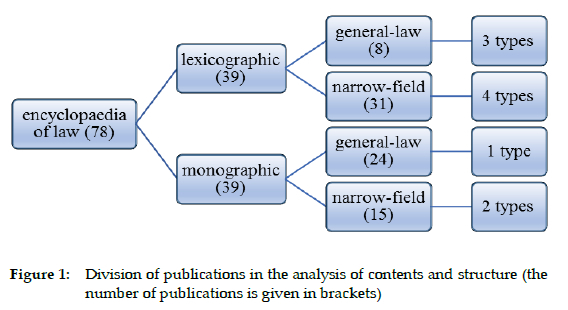
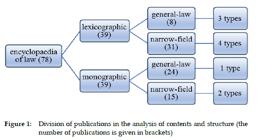
Publications were identified using the keywords: "encyklopedia prawa" (encyclopaedia of law), "encyklopedia" (encyclopaedia) and "prawo" (law), or "encyklopedia" and "prawa" (the genitive case of "prawo")5. Consequently, the study comprises 78 publications, including 39 lexicographic and 39 monographic encyclopaedias of law. For publications with multiple editions, the analysis includes only one - preferably the most recent volume.
The study is organised into two parts. The first provides general characteristics of the sample: timeframe, size of publications (number of pages), their scope (number of entries), thematic coverage and target audience. The second focuses on analysing the contents and structure of individual publications. This analysis follows the division into lexicographic and monographic volumes, and general-law (discussing the legal system as a whole) and narrow-field ones (discussing specific areas of law). These categories were subdivided into types sharing common features, pointing at characteristics recurring within each genre (Figure 1).
For lexicographic publications, the analysis includes:
- the target group as stated by the authors or implied by the contents,
- the macrostructure, including the arrangement of entries, components of front matter and back matter, and
- the microstructure, including definition type and components of individual entries.
For monographic publications, the analysis focuses on structuring of contents, wording of chapter titles and methods of presenting information. The analysis begins with features common to all monographic works before examining specific categories and types.
4.2 Types of publications and their characteristics
Two types of encyclopaedias of law were identified. One group comprises lexicographic works (39 publications) containing definitions of headwords accompanied by encyclopaedic information in separate alphabetically or thematically arranged entries. A clear separation technique is evident, as each entry is an independent, self-contained unit. However, cross-reference systems in the majority of lexicographic publications highlight strong relations between concepts. The other group - monographic volumes (39 publications) - comprises works structured in chapters and subchapters, covering topics from Encyclopaedia of Law taught primarily in non-legal disciplines.
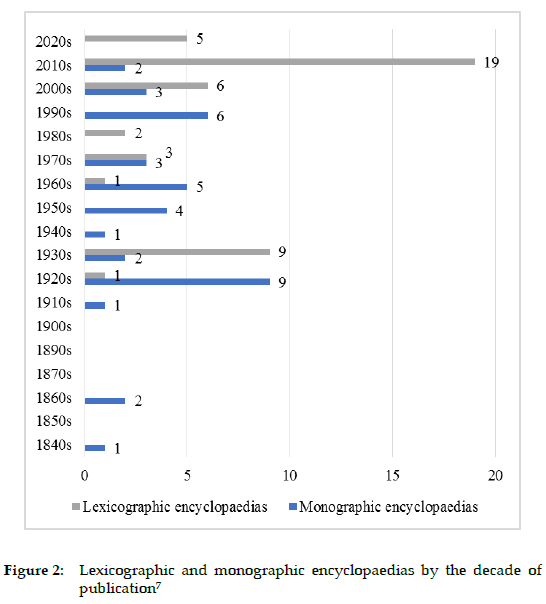
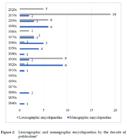
The sample encompasses works published from 1842 to 2023 (Figure 2). Lexicographic encyclopaedias started appearing in the 1930s (the interwar period) as Polish law systematization after the Partitions of Poland6. Many such publications were published in the 21st century: in the 2000s this may be connected with the terminographic boom in Poland (see Łukasik (2015: 88) and Rzepkowska (2018: 66-67)), and in the 2010s and 2020s this results from printing the 23 volumes of Wielka encyklopedia prawa. Monographic encyclopaedias of law in Poland date back to the first half of the 19th century (Kłodziński 1842), including early translations from German. In the interwar period, such works appeared in considerable numbers as academic books (9 publications in the 1920s and 2 in the 1930s). Such monographs continued after WWII for non-law students. These students used Encyclopaedia of Law courses to familiarise themselves with the Polish legal system for business and administrative purposes.
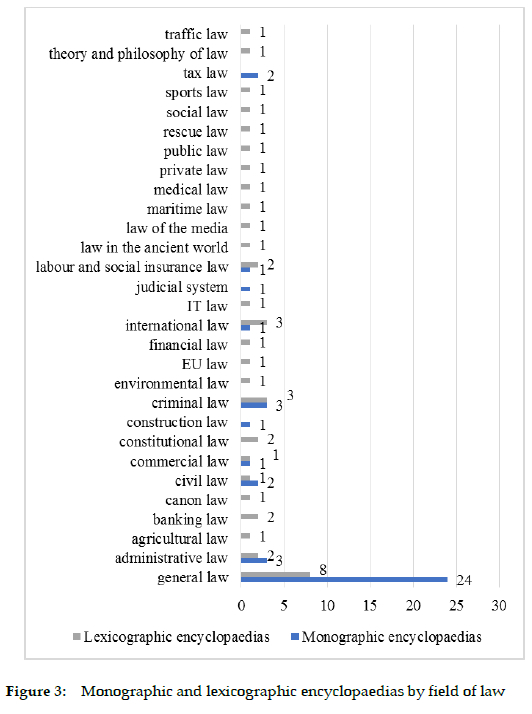
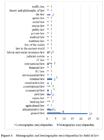
The majority of monographic encyclopaedias concentrate on Polish law in general (61%). The rest discuss seven fields of law, including administrative and criminal law. The proportions are reversed for lexicographic encyclopaedias: 21% concentrate on general law and 79% on specific fields of law (28 fields in total) (Figure 3). Given the marked differences between general and narrow-field publications in the two groups under analysis, the remaining figures in the paper follow this division.
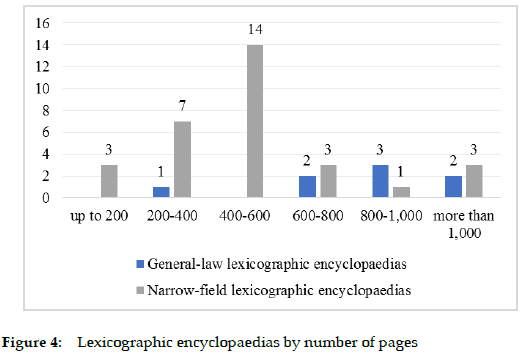
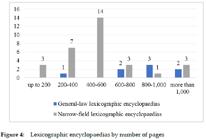
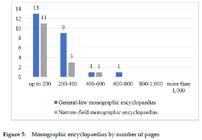
Monographic and lexicographic encyclopaedias differ in the number of pages (Figures 4 and 5). Monographic encyclopaedias are generally thinner, while lexicographic encyclopaedias are thicker. Narrow-field and general-law lexicographic encyclopaedias are of relatively similar size (from 600 to over 1,000 pages). The largest publications are the multi-volume narrow-field encyclopaedias from the 1920s and 1930s, for example a 4-volume encyclopaedia with 2,500 pages (Konic 1931, Zoll and Wasilkowski 1936, 1938, 1939). Monographs are much smaller: 54% have under 200 pages and 92% under 400 pages.
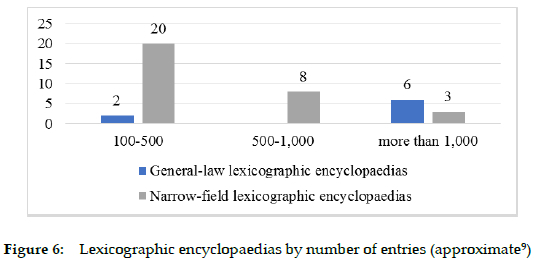
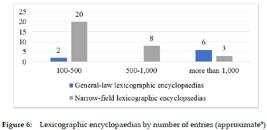
The analysis of publications by number of entries applies to lexicographic encyclopaedias only (Figure 6). The largest number of entries is found in general-law encyclopaedias. Over 60% of the narrow-field sample contains between 100 and 500 entries. Page-to-entry ratios imply that entries in narrow-field publications are extensive8 and those in general-law books short, which corresponds to their respective purposes: meeting the needs of professionals and semi-professionals in the former case, and the needs of non-professionals in the latter, respectively.
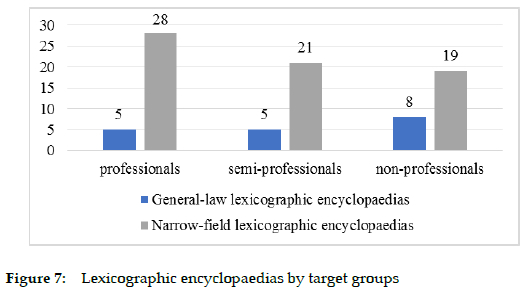
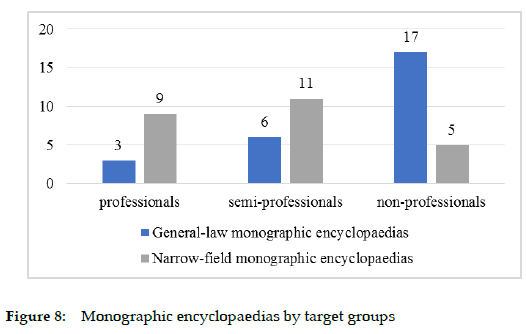
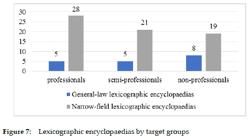
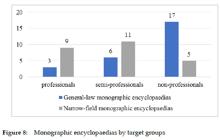
All general-law lexicographic encyclopaedias are addressed to non-professionals (the general public), but professionals (lawyers) and semi-professionals (law students) may benefit from them as well, as the authors note10. Narrow-field lexicographic publications are often designed as multi-purpose volumes, attempting to meet various users' needs (Figure 7). The majority of general-law monographic volumes are targeted at non-professionals (mainly students of non-legal studies), while the narrow-field ones are mostly addressed to professionals and semi-professionals (Figure 8).
4.3 Lexicographic encyclopaedias of law: Structure and contents
4.3.1 General-law lexicographic encyclopaedias
Type 1
The first group comprises encyclopaedias featuring a relatively simple macrostructure with an alphabetical order of entries and additional components in the front matter - such as a preface, a list of abbreviations, a list of illustrations, Latin phrases, basic literature and a list of authors with initials (e.g., in Hołyst 2005 and Kalina-Prasznic 2004, 2005) - and in the back matter - such as an index of persons (Kurowski 1960), an afterword (Rybicki 1980) and a list of tables (Kalina-Prasznic 2004). The microstructure comprises short classical definitions by genus and difference ("A is B, that is C"), usually supplemented with encyclopaedic information, typically yielding several entries per page. The 20th-century publications include authors' initials at the end of each entry. Encyclopaedias in this group include volumes by Kurowski (1960), Rybicki (1980), Hołyst (2005) and Kalina-Prasznic (2004, 2005). The typical target group is non-lawyers (engineers, doctors, economists, etc.), law students and lawyers who wish to learn about topics from beyond their specialty in law. The short classical definitions make them appear more like dictionaries than encyclopaedias, but the fact that the volumes present such content as the history of law, names of places as entries, and a list of authors of political and legal doctrines moves them towards the encyclopaedic type. These lexicographic encyclopaedias use cross-referencing to provide broader context for the headwords and save space in individual entries, revealing the systemic nature of law.
Type 2
This type contains two publications selected based on their target group - both are addressed to non-experts in law: Garlicki (1974) and Kerplik et al. (2009). By avoiding discussions about controversial issues that, due to their specificity, would be addressed to lawyers, they present information in a simplified manner that can be easily understood by those without a legal background. The authors of individual entries are identified in both cases: authors' initials appear at the end of each entry in the former and a list of headwords is provided alongside the authors' names in the front matter in the latter. In Garlicki (1974), the entries are alphabetically arranged within eight thematic sections, each devoted to one field of law, creating the impression of several narrow-field encyclopaedias within a single volume. The headwords are listed in the contents found in the front matter. There is also an index of entries in the back matter with page references. In Kerplik et al. (2009), the headwords are in alphabetical order. They are also listed at the beginning of each alphabetical section. The microstructure of entries in this volume is presented with varied visual formatting, with content in different font sizes and styles, sometimes italicised or bold to attract the reader's attention, and includes illustrations where applicable. Each entry is divided into sections - for example, in the case of "abortion": "remember" with practical information about the concept discussed, "legal liability" and "legal basis". The back matter comprises an index of legal terms and the titles of sections in which they can be found.
Type 3
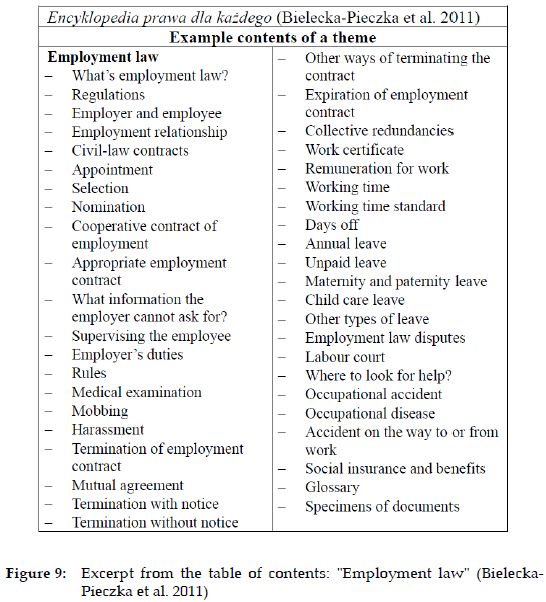
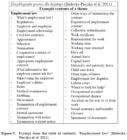
This group comprises only one publication that is notable in terms of its structure: the work by Bielecka-Pieczka et al. (2011). It is a thematic encyclopaedia organising the essence of general law into 16 themes (Figure 9). The title literally means that it is an encyclopaedia of law for everyone, which suggests that the content is designed to meet the needs of the general public. Each theme is developed through several topics (see the theme "employment law" in Figure 9). Neither themes nor content within each theme are alphabetically arranged. The only alphabetical arrangement is used in glossaries that conclude each theme. The glossary entries comprise classical definitions of the headwords, only sometimes supplemented with encyclopaedic information such as the applicability of a given legal concept. Additional context is provided in the sections preceding each glossary. There are elements that are repeated in each theme, such as subchapter titles posed as questions at the beginning and the glossary at the end. The themes are several pages long (over 40 pages in the case of the "employment law" theme).
4.3.2 Narrow-field lexicographic encyclopaedias
Type 1
The review of narrow-field encyclopaedias starts with publications from the interwar period, which are extraordinary works considering their size and their function as a means of unifying law in the Polish territories after the partitions. The time of their publication coincided with the formation of a new legal regime in Poland out of five different civil legal systems in force in its territory before Poland regained independence in 1918 (Konic 1931: "Przedmowa"). All three encyclopaedias in this group - by Cybichowski (1926, 1930), Makowski (1931-1934, 1934-1936, 1936-1937, 1938-1939) and Konic (1931), Zoll and Wasilkowski (1936, 1938, 1939) - are multi-volume publications. In terms of their macrostructure, entries are arranged alphabetically (the first volumes start with the letter A and the last volumes end with Z). The front matter includes a foreword and a list of authors with their initials (in Makowski's encyclopaedia and in Konic, Zoll and Wasilkowski's publications). Thematically, each covers an area of the contemporary legal system: Cybichowki's covers public law, Makowski's covers criminal law and Konic, Zoll and Wasilkowski's covers private law. As for the microstructure, the structure of the entries in the encyclopaedias varies depending on the subject and the author of a particular article. Rather than providing concise definitions, they contain descriptive essays providing broad background on the relevant legal concept. Each entry is a self-contained, usually lengthy, dictionary article, often divided into separate sections (numbered or unnumbered chapters and subchapters), ending with source literature and the name or initials of the author. In one of the encyclopaedias, some entries start with a table of contents depicting the structure of the articles (e.g., "Księgi wieczyste" (Zoll and Wasilkowski 1936: 615) and "Osobistość prawna" (Zoll and Wasilkowski 1938: 1245)). Although the authors do not specify it, the magnitude and degree of detail of these publications made them suitable for lawyers and law students (in Konic, Zoll and Wasilkowski's publications, approximately 250 entries across 2,500 pages, and in Cybichowski's, 416 entries across nearly 1,200 pages).
Type 2
The next group of narrow-field encyclopaedias concentrates on publications addressed to non-legal professionals - namely, experts in the professions that law focuses on. This group includes volumes by Brojewski et al. (1975), Łopuski and Kowalewski (1982), and Klafkowski (1976). What they have in common is a relatively complex macrostructure (including detailed explanations of the microstructure and macrostructure (Łopuski and Kowalewski 1982; Klafkowski 1976) and an index grouping entries thematically in the back matter), alphabetical arrangement of entries and, microstructurally, cross-references to other entries and intensive use of abbreviations. The first volume (Brojewski et al. 1975) is a concise encyclopaedia of employment and social insurance law. Entries (about 110 in total) do not contain classical definitions of headwords but only encyclopaedic information in the context of employment and social insurance. The information is relatively detailed but without legal jargon, making it accessible to non-lawyers. In Łopuski and Kowalewski's volume (1982), the back matter is extensive with a thematic index of headwords (with 18 themes under which the headwords are listed) and a thematically arranged reference list and indices of foreign language equivalents (English, French, German and Russian). This is the only publication in the sample that includes foreign language equivalents. Each entry starts with a classical definition followed by encyclopaedic information supported by illustrations. It ends with a list of equivalents in four languages. Klafkowski's encyclopaedia (1976) is distinctive for its developed front matter, which comprises a preamble, initial remarks, general abbreviations and acronyms of institutions with their full names, an explanation of the system of references, a list of Latin phrases used in the encyclopaedia and their explanations. In terms of microstructure, there are entries with classical definitions supplemented with encyclopaedic information on the topic and entries containing only encyclopaedic information. Each entry ends with references to legal sources and literature, and the full name of the entry author.
Type 3
This group of encyclopaedias has been grouped together because they were published in an easily updatable paper form using a ring-binder, which accommodates the changing nature of law (these are Pyzioł 2001 and Florek 2003). Both alphabetically arranged publications are large (nearly 1,000 and over 600 pages, respectively) and addressed to lawyers, law students, students of related disciplines and those interested in legal issues related to banking (Pyzioł 2001) and labour law and social insurance (Florek 2003). The front matter in Pyzioł (2001) comprises a list of authors, a page for recording updates, a list of abbreviations, a foreword and a list of entries with page numbers. The entries are relatively long (from 2-3 to even 20 pages; a little over 200 entries across about 1,000 pages), providing substantial encyclopaedic and specialist information in addition to defining headwords, yet without presenting definitions that summarise the concept in question. They do not follow any strict structure. In the encyclopaedia by Florek (2003), the front matter comprises an alphabetical index of entries and a thematic index with page numbers. In addition, there are a user guide and a list of abbreviations. Each entry follows a predefined structure: a concise definition of the headword, its legal basis, a detailed description of the institution and references.
Type 4
Wielka encyklopedia prawa11, published between 2014 and 2023, is a collection of 23 volumes with 11,921 entries across 11,000 pages12. The volumes discuss different areas of law individually, which is why in this paper they are treated as separate publications, not as a single encyclopaedia. The fields discussed in individual volumes include: the laws of antiquity, canon law, EU law, public international law, environmental law, constitutional law, theory and philosophy of law, agricultural and food law, law of the media, medical law, financial law, social law, criminal law, commercial law, rescue law, banking law, public commercial law, substantive law, traffic law, administrative law, law of criminal procedure, IT law and sports law. Each volume has its own editors and follows roughly the same structure. As for the macrostructure, the front matter is well-developed. It comprises an introduction, a list of authors of entries, information about abbreviations used, a list of sources (usually divided into different categories of sources depending on the field of law and applicability) and references to literature. When examining the microstructure, one can notice that each entry starts with a classical definition and is supplemented with information of an encyclopaedic character. It ends with the author's initials, followed by a reference to recommended literature. What can be found within individual entries is a system of cross-referencing. The entries are of varying length: the shortest only refer readers to other entries, whilst the longest can be a few pages long. The volumes are of varying sizes: from 192 pages (Skoczylas 2018) to 668 pages (Pyć et al. 2021) and from approximately 160 entries (Bagińska 2016) to about 1,000 entries (Bator et al. 2016; Szpor and Grochowski 2021).
4.4 Monographic encyclopaedias of law: Structure and contents
Monographic encyclopaedias of law follow the structure outlined in the tables of contents typically found in the front matter. The information is divided into chapters representing themes which are either general in scope (resulting in fewer chapters) or highly specific (resulting in more numerous chapters). These themes are then divided into related topics which are further subdivided into subtopics (subchapters). The hierarchical structure created in this way serves to reconstruct the system of relations within the relevant domain, resembling that of thematic encyclopaedias.
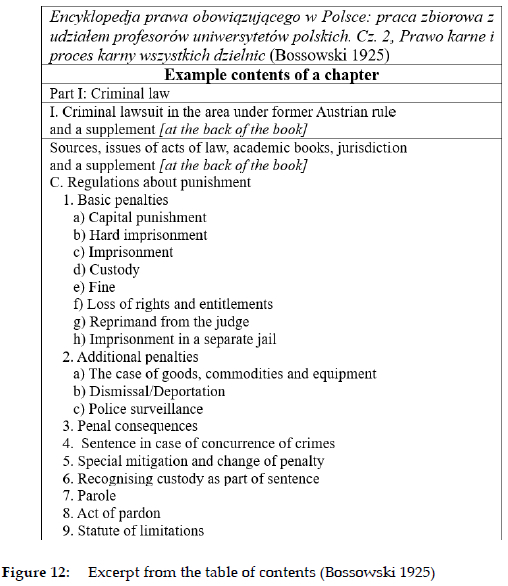
The back matter typically contains thematic or alphabetical indices, but having these components is not a standard for these publications. Generally, chapters and subchapters take the form of articles of varying length describing the concepts discussed. The titles of chapters are sometimes very descriptive (e.g., Kowalczyk 2002), but in some cases they are limited to the legal term on which the chapter focuses when the chapters are very detailed (e.g., Siuda 1975; Łopatka 1995a, 1995b; Bossowski 1925; Guzy 1967). When this is the case, they may be comparable to the headwords in lexicographic publications on law.
4.4.1 General-law monographic encyclopaedias
Type 1
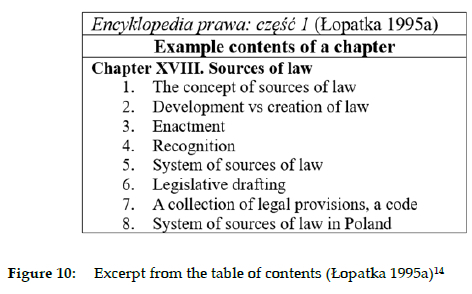
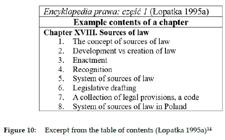
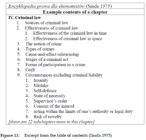
Monographic general-law encyclopaedias comprise publications intended to define Encyclopaedia of Law as an academic discipline and academic subject13. They were frequently written in connection with the course in Encyclopaedia of Law directly for university students (as a source of information) and indirectly for lecturers (as a way to unify the contents of lectures delivered by different scholars). The majority of publications of this type are addressed to non-law students and often take the form of publications for internal university or higher education institutions' needs. They are written with the special needs of those studying particular subjects in mind, providing them with general information about the Polish legal system, for example, in economics (Siuda 1975), management and marketing (Muszyński 2001) or tourism (Kowalczyk 2002). Figures 10 and 11 present excerpts from the tables of contents of selected monographs.
4.4.2 Narrow-field monographic encyclopaedias
Type 1
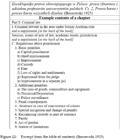
Nine of the 15 narrow-field publications date from the interwar period15. Like lexicographic publications from that time, their purpose was to systematise and ultimately unify law in the new territory of Poland. Their focus on specific areas of law in various aspects, such as criminal, commercial and tax law, makes them publications for lawyers and law students, rather than for non-lawyers (which is often confirmed by the authors in the prefaces). The content of each subchapter is typically in the form of academic essays providing very detailed information on the topic compared to the general-law publications (see Figure 12).
Type 2
The publications published after WWII include four volumes from the 1960s (Guzy 1967, 1968; Muszyński 1969; Saulewicz 1967), one from the 1970s (Bejtka 1977) and one from the 21st century (Domagała et al. 2010). The publications from the 1960s provide basic information about selected areas of law for military personnel, the one from the 1970s for site managers and the one from 2010 for public administration.
In this group, the volume by Guzy (1967) is notable in the context of this paper as it can be placed on the boundary between a lexicographic and monographic work. The table of contents suggests that it is another monograph titled "encyclopaedia of law". However, the titles of chapters are all relatively short, terminology-based noun phrases referring to legal concepts and the contents of chapters resemble those of a lexicographic work, in many cases starting with a classical definition that is further completed with encyclopaedic information. All of this leads to the volume being very similar to a thematic encyclopaedia.
5. Findings and conclusions
The analysis of 78 Polish publications titled "encyklopedia prawa" (1842-2023) revealed the existence of two distinct types of works under this title: lexicographic and monographic encyclopaedias. Each constitutes roughly half of the sample. The lexicographic encyclopaedias are characterized by entries arranged alphabetically (e.g., Kurowski 1960, Hołyst 2005) or thematically, the latter quite infrequently (e.g., Bielecka-Pieczka et al. 2011), presenting fragmented, encyclopaedic information. In contrast, the monographs adopt a systematic chapter-based structure, resembling textbooks or academic introductions to law.
The review of library holdings revealed the following general and detailed characteristics of the two genres:
- Timeframe - Lexicographic encyclopaedias emerged primarily in the 20th and 21st centuries, while the monographic encyclopaedias appeared earlier, in the 19th century. Interestingly, interwar narrow-field monographic publications (eight volumes in 1923-1929) preceded the lexicographic encyclopaedias (eight volumes in 1931-1939), as if preparing the ground for the latter.
- Size - Lexicographic encyclopaedias were generally larger than monographs. Some entries spanned several pages, particularly in narrow-field publications, and resembled chapters divided into sections, like monographic volumes.
- Coverage and target group - Lexicographic encyclopaedias typically specialised in specific fields, while monographs covered general Polish law. General-law lexicographic encyclopaedias target non-professionals (non-law students), while narrow-field encyclopaedias serve: lawyers, law students and non-legal professionals interested in specific law. Monographic purposes vary by scope: general-law volumes focus on non-professionals and are rarely considered suitable for professionals, while narrow-field volumes target legal professionals.
- Macrostructure (lexicographic volumes) - Encyclopaedias are typically alphabetical, with one thematically arranged exception. They are usually single-volume, except for large interwar narrow-field encyclopaedias. They sometimes feature extensive front and back matter, alphabetical and thematic indices, lists of abbreviations and illustrations, and reference lists. The twenty-three narrow-field volumes in Wielka encyklopedia prawa (2014-2023) maintain consistent structural patterns across multiple volumes while addressing different legal domains. Notable are systematisation techniques, including cross-referencing and thematic indices, demonstrating the need to place legal concepts in wider context, particularly in narrow-field works. This illustrates that restricting law descriptions to discrete entries is difficult considering the systemic and culturally bound nature of law.
- Microstructure (lexicographic volumes) - Entries in general-law works are either short, containing classical definitions with little additional information (type 1), or longer entries containing simplified information for non-professionals (types 2 and 3). Entries in narrow-field publications vary in length and detail. On the one hand, there is extensive and often chapter-based organisation of lexicographic entries in narrow-field encyclopaedias, which address specialist information using expert terminology. Others designed for non-legal professionals (e.g., in the marine industry (Łopuski and Kowalewski 1982)) include entries with classical definitions and profession-focused information, sometimes in illustrated form, or contain only encyclopaedic information.
- Structure (monographic volumes) - Monographic volumes are organised into chapters and subchapters as outlined in tables of contents found in the front or back matter. Chapters group related concepts under thematic categories, with their titles being either concise and terminology-based (1 to 3 words) or descriptive. Chapters comprise articles, following the formula of an academic textbook, particularly in general-law volumes. Notably, Guzy (1967), with its definitional content and terminology-based chapter titles, represents a work on the boundary between lexicographic and monographic publications.
These findings suggest that functional criteria may be more significant than formal structural criteria in understanding lexicographic practice, particularly in specialized domains where traditional boundaries between reference genres become blurred. This perspective could inform future research on specialised lexicographic traditions and help develop frameworks for analysing contemporary reference publishing.
An important observation emerging from this study is the correlation between the structure of monographic and lexicographic works. The former, while structured as academic textbooks with chapters and subchapters rather than discrete entries, display several characteristics that align them with thematic encyclopaedic principles. Their hierarchical organization mirrors the systematic arrangement found in ancient encyclopaedias, presenting legal knowledge in a structured manner that reflects the conceptual relationships within the legal domain. The chapter titles in narrow-field monographic volumes often function analogously to headwords in lexicographic works, while the content provides definitional and explanatory information comparable to encyclopaedia entries. However, both genres serve distinct but complementary lexicographic functions. Traditional encyclopaedias primarily fulfil cognition-oriented functions, providing quick access to factual information and definitions for immediate reference needs. Monographic encyclopaedias, while ostensibly designed for systematic learning, also serve knowledge-organizing functions characteristic of thematic encyclopaedias, presenting comprehensive conceptual frameworks that enable users to understand the systematic relationships within legal knowledge.
For legal lexicography specifically, the study reveals the importance of recognizing multiple approaches to organizing and presenting legal knowledge. The coexistence of different arrangements, entry lengths and target audiences within one titular category demonstrates lexicographic adaptability to specialised user needs.
6. Methodological limitations
Whilst this study employs systematic criteria for analysing Polish encyclopaedias of law, the classification of publications into categories necessarily involved interpretative decisions that may contain elements of subjectivity. The determination of target audiences and primary functions relied on authorial statements where available but required inference from content and structure when explicit guidance was absent. To mitigate potential bias, classification decisions were based on multiple criteria including structural features, content presentation and stated purposes. The large sample size (78 publications) helps ensure that individual classification decisions do not significantly affect the overall analysis of trends in Polish legal encyclopaedic publishing.
7. Endnotes
1 For the purpose of this paper, Encyclopaedia of Law when capitalised should be understood as the name of an academic course.
2 Languages for Special Purposes.
3 Encyclopaedia of Law as a subject taught at universities originates from Germany, from where it spread to other countries, including Russia, France, Belgium and Poland (Encyklopedia prawa … 1917: 7). The origins of Encyclopaedia of Law go back to the 16th century and the heyday of the discipline was observed in the 18th and 19th centuries. It was not merely an academic course but a science and an academic discipline (for a review of famous German lawyers-encyclopaedists see Slobozhaninov 2022).
4 See https://katalogi.bn.org.pl.
5 Polish legal reference works include numerous lexicons ("leksykon prawa", particularly the C.H. Beck series, e.g., Bagińska 2011; Barczewski and Kowalska 2019; Bartnik 2013). Other publications use the adjective "encyclopaedic" ("encyklopedyczny") in their titles, identifying them as encyclopaedic dictionaries (Wołodkiewicz 1986; Litewski 1998). These works comprehensively describe legal concepts and could merit separate analysis, but were excluded from this study as the focus is specifically on publications titled "encyclopaedia of law."
6 There were three partitions of Poland between 1772 and 1795 by Austria-Hungary, the German and the Russian Empires resulting in the loss of sovereignty by Poland for 123 years. Poland regained independence on 11 November 1918. The interwar period that followed (1918-1939) was the time of rebuilding the country, shaping its borderlines and economy, unifying the legal system and developing national identity.
7 Each volume of the multi-volume encyclopaedias from the interwar period (for the list of works, see 4.3.2, Type 1) is treated here separately owing to the long gaps between publishing individual volumes. Subsequently in the analysis, only the volumes of Wielka encyklopedia prawa are treated as separate publications, as each constitutes a self-contained work on a specific area of law.
8 For instance, there are approximately 250 entries in the four volumes of Encyklopedja podręczna prawa prywatnego (Konic 1931; Zoll and Wasilkowski 1936, 1938, 1939), which is the largest publication in the sample. As a result, entries there are, on average, 10 pages long.
9 The number of entries is rarely provided by authors, so the data in the chart is an estimation of the number of terms by the author of this paper.
10 The purpose of publications was determined based on information from the authors in the introductions or preambles. Where there was no such information given, the assessment of the purpose was based on the contents and other details from the authors.
11 The editor-in-chief of all volumes is Hołyst, but individual volumes have their own editors, specialists in the relevant areas of law.
12 Based on information about the encyclopaedia on the publisher's website: (https://www.tamprawo.org/wielka-encyklopedia-prawa/).
13 The publications in this group include, alphabetically: Ahrens 1862; Arndts von Arnesberg 1866; Encyklopedja (…) 1917; Glaser 1931; Gnela 1998; Izdebski 1948; Izdebski and Murzyn 1968; Kłodziński 1842; Kowalczyk 2002; Krzymuski 1921; Lewandowski 1993, 2003; Łopatka 1993, 1995a, 1995b, 1998; Murzyn 1974; Muszyński 2001; Siuda 1975, 2010; Wiszniewski 1952, 1956, 1958; Żabczyński 1957.
14 The contents of publications translated by the author.
15 The publications in this group include, alphabetically: Bossowski 1925; Głąbiński 1926; Makowski 1925; Peretiatkowicz 1923a, 1923b, 1925, 1926; Szczygielski 1938; Wasiutyński 1929.
References
- Allaby, M. 1985. The Oxford Dictionary of Natural History. Oxford: Oxford University Press.
- Allan, K. 2006. Dictionaries and Encyclopedias: Relationship. Brown, E.K. (Ed.). 2006. Encyclopedia of Languages and Linguistics. Second edition: 573-577. Oxford: Elsevier.
- Bagińska, E. (Ed.). 2011. Leksykon prawa cywilnego - część ogólna: 100 podstawowych haseł. Warszawa: C.H. Beck.
- Bajčić, M. 2017. New Insights into the Semantics of Legal Concepts and the Legal Dictionary. Amsterdam/ Philadelphia: John Benjamins.
- Barczewski, M. and E. Kowalska (Eds.). 2019. Leksykon prawa własności intelektualnej: 100 podstawowych pojęć. Warszawa: C.H. Beck.
- Barenot, P.-N. 2014. A View of French Legal Lexicography - Tradition and Change from a Doctrinal Genre to the Modern Era. Mac Aodha, M. (Ed.). 2014. Legal Lexicography: A Comparative Perspective: 11-30. London: Routledge. https://doi.org/10.4324/9781315592053 [6 April 2025].
- Bartnik, M. (Ed.). 2013. Leksykon polskiej procedury karnej: 100 podstawowych pojęć. Warszawa: C.H. Beck.
- Bergenholtz, H. 2012. What Is a Dictionary? Lexikos 22: 20-30.
- Bergenholtz, H. and S. Nielsen. 2002. Terms in the Language of Culture-Dependent LSP Dictionaries. Lexicographica 18: 5-18. https://doi.org/10.1515/9783484604476.5 [6 April 2025]
- Bergenholtz, H. and S. Nielsen. 2006. Subject-field Components as Integrated Parts of LSP Dictionaries. Terminology 12(2): 281-303.
- Bergenholtz, H. and S. Tarp. 1995. Manual of Specialised Lexicography. Amsterdam/Philadelphia: John Benjamins.
- Bezuglova, O. and A. Kuznetsova. 2016. Tendencies of Legal Terms Representation in English and Russian Monolingual Terminological Dictionaries. Journal of Language and Literature 7(3): 137-140.
- Chromá, M. 2004. Legal Translation and the Dictionary. Tübingen: Max Niemeyer.
- Collison, R.L. and W.E. Preece. 2024. Encyclopaedia. Encyclopedia Britannica. https://www.britannica.com/topic/encyclopaedia [6 April 2025]
- Cornell, M. 2016. Libraries in Poland. Warsaw: Biblioteka Narodowa. https://ksiegarnia.bn.org.pl/pdf/Libraries%20in%20Poland.pdf [6 April 2025]
- Crystal, D. 2010. The Cambridge Encyclopedia of Language. Cambridge: Cambridge University Press.
- De Groot, G.-R. and C.J.P. van Laer. 2005. Bilingual and Multilingual Legal Dictionaries in the European Union: An Updated Bibliography. Legal Reference Services Quarterly 30(3): 149-209. https://doi.org/10.1080/0270319X.2011.601715 [6 April 2025]
- De Groot, G.-R. and C.J.P. van Laer. 2006. The Dubious Quality of Legal Dictionaries. International Journal of Legal Information 34(1): 65-86.
- De Groot, G.-R. and C.J.P. van Laer. 2008. The Quality of Legal Dictionaries: An Assessment. Maastricht Faculty of Law Working Paper 2008(6). Maastricht: University of Maastricht.
- Frawley, W. 1981. In Defense of the Dictionary: A Response to Haiman. Lingua 55: 53-61.
- Greenberg, D. 2014. The Challenges of Compiling a Legal Dictionary. Mac Aodha, M. (Ed.). 2014. Legal Lexicography: A Comparative Perspective: 59-74. London: Routledge. https://doi.org/10.4324/9781315592053 [6 April 2025]
- Haiman, J. 1980. Dictionaries and Encyclopedias. Lingua 50(4): 329-357.
- Haiman, J. 1982. Dictionaries and Encyclopedias Again. Lingua 56(3-4): 353-355.
- Hartmann, R.R.K. and G. James. 2002. Dictionary of Lexicography. London/New York: Routledge.
- Hayaert, V. 2011. Les lexiques juridiques: une ambition encyclopédique? Groult, M. (Ed.). 2011. Les Encyclopédies: construction et circulation du savoir de l'Antiquité à Wikipédia: 313-328. Paris: L'Harmattan.
- Hutton, C. 2014. Defining Ordinary Words for Mundane Objects: Legal Lexicography, Ordinary Language and the Word Vehicle. Mac Aodha, M. (Ed.). 2014. Legal Lexicography: A Comparative Perspective: 177-200. London: Routledge. https://doi.org/10.4324/9781315592053 [6 April 2025]
- Litewski, W. 1998. Słownik encyklopedyczny prawa rzymskiego. Kraków: Towarzystwo Autorów i Wydawców Prac Naukowych "Universitas".
- Louw, P.A. 1999. Portals to Knowledge: CD-ROM Encyclopaedias, with Specific Reference to Microsoft Encarta 99 Encyclopedia. Lexikos 9: 283-293.
- Lukszyn, J. (Ed.). 2005. Języki specjalistyczne. Słownik terminologii przedmiotowej. Warszawa: UW.
- Łukasik, M. 2015. Quality of Multilingual Specialised Lexicography in Poland. Cognitive Studies/ Études Cognitives 15: 79-95.
- Mattila, H.E.S. 2016. Legal Vocabulary. Tiersma, P.M. and L.M. Solan (Eds.). 2016. The Oxford Handbook of Language and Law: 27-38. Oxford/New York: Oxford University Press.
- McArthur, T. 1986. Worlds of Reference. Lexicography, Learning and Language from the Clay Tablet to the Computer. Cambridge: Cambridge University Press.
- McArthur, T. 1996. The Oxford Companion to the English Language. Oxford/New York: Oxford University Press.
- Michta, T. and K. Mroczyńska. 2022. Towards a Dictionary of Legal English Collocations. Siedlce: Wydawnictwo Naukowe UPH.
- Nielsen, S. 2008. The Effect of Lexicographical Information Costs on Dictionary Making and Use. Lexikos 18: 170-189. https://doi.org/10.5788/18-0-483 [6 April 2025]
- Nielsen, S. 2010. Legal Translation Dictionaries for Learners. Karpova, O. and F. Kartashkova (Eds.). 2010. New Trends in Lexicography: Ways of Registrating and Describing Lexis: 221-232. Newcastle upon Tyne: Cambridge Scholars.
- Nielsen, S. 2023. Legal Lexicography and Legal Information Tools. Biel, Ł. and H.J. Kockaert (Eds.). 2023. Handbook of Terminology: Volume 3. Legal Terminology: 432-457. Amsterdam/New York: John Benjamins.
- Peters, P. 2015. Transcending Their Formats: Dictionaries, Encyclopedias and Atlases. Humanities Australia 6: 68-81.
- Ptaszynski, M.O. 2010. Checking Knowledge in Online Encyclopaedias: Towards a Behavioural Approach to Data Accessibility. Lexikos 20: 410-424.
- Rzepkowska, A. 2018. Interdyscyplinarny słownik terminologiczny. Siedlce: Wydawnictwo Naukowe Uniwersytetu Przyrodniczo-Humanistycznego w Siedlcach.
- Šarčević, S. 1988. Bilingual and Multilingual Legal Dictionaries: New Standards for the Future. Revue générale de droit 19(4): 961-978. https://doi.org/10.7202/1058506ar [6 April 2025]
- Šarčević, S. 1989. Conceptual Dictionaries for Translation in the Field of Law. International Journal of Lexicography 2(4): 277-293. https://doi.org/10.1093/ijl/2.4.277 [6 April 2025]
- Slobozhaninov, O.K. 2022. Development of the Academic Discipline "Encyclopaedia of Law" in Germany in XVIII-XIX Centuries. Juridical Journal of Samara University 8(2): 88-94.
- Szemińska, W. 2011. Translating Law into a Dictionary. A Terminographic Model. Research in Language 9(1): 177-186. https://doi.org/10.2478/v10015-011-0012-2 [6 April 2025]
- Szemińska, W. 2014. Translating Law into Dictionaries, or Why One Dictionary Is Not Enough. Budin, G. and V. Lušicky (Eds.). 2014. Languages for Special Purposes in a Multilingual Transcultural World. Proceedings of the 19th European Symposium on Languages for Special Purposes, 8-10 July 2013: 118-125. Viena, Austria: University of Viena, Centre for Translation Studies.
- Tarp, S. 2000. Theoretical Challenges to Practical Specialised Lexicography. Lexikos 10: 189-208.
- Wołodkiewicz, W. (Ed.). 1986. Prawo rzymskie: słownik encyklopedyczny. Warszawa: Wiedza Powszechna.
- Lexicographic encyclopaedias of law
- Bagińska, E. (Ed.). 2016. Wielka Encyklopedia Prawa. Vol. 10. Prawo medyczne. Warszawa: Fundacja "Ubi societas, ibi ius".
- Bałandynowicz, A., S. Pikulski and J. Warylewski (Eds.). 2018. Wielka Encyklopedia Prawa. Vol.13. Prawo karne. Warszawa: Fundacja "Ubi societas, ibi ius".
- Bator, A., J. Zajadło and M. Zirk-Sadowski (Eds.). 2016. Wielka Encyklopedia Prawa. Vol. 7. Teoria i filozofia prawa. Warszawa: Fundacja "Ubi societas, ibi ius".
- Belka, M. and A. Glapiński (Eds.). 2019. Wielka Encyklopedia Prawa. Vol. 16. Prawo bankowe. Warszawa: Fundacja "Ubi societas, ibi ius".
- Bielecka-Pieczka, A. et al. 2011. Encyklopedia prawa dla każdego. Poznań: Publicat Wydawnictwo.
- Brodecki, Z. (Ed.). 2014. Wielka Encyklopedia Prawa. Vol. 3. Prawo Unii Europejskiej. Warszawa: Fundacja "Ubi societas, ibi ius".
- Brojewski, M. et al. 1975. Prawo na co dzień: encyklopedia podręczna: prawo pracy i ubezpieczeń społecznych. Warszawa: Wiedza Powszechna.
- Brzeziński, B., H. Litwińczuk and Z. Ofiarski (Eds.). 2017. Wielka Encyklopedia Prawa. Vol. 11. Prawo finansowe. Warszawa: Fundacja "Ubi societas, ibi ius".
- Cybichowski, Z. 1926. Encyklopedja podręczna prawa publicznego (konstytucyjnego, administracyjnego, i międzynarodowego) [...]. Vol. 1, Abolicja - Państwo. Warszawa: Bibljoteka Polska.
- Cybichowski, Z. 1930. Encyklopedja podręczna prawa publicznego (konstytucyjnego, administracyjnego, i międzynarodowego) [...]. Vol. 2, Państwo związkowe - Źródła lecznicze. Warszawa: Bibljoteka Polska.
- Florek, L. (Ed.). 2003. Encyklopedia prawa pracy i ubezpieczeń społecznych: komentarz do instytucji prawnych. Warszawa: "ABC".
- Garlicki, S. (Ed.). 1974. Prawo na co dzień: encyklopedia podręczna. Warszawa: Wiedza Powszechna.
- Górski, M. and J. Stelmasiak (Eds.). 2014. Wielka Encyklopedia Prawa. Vol. 5. Prawo ochrony środowiska. Warszawa: Fundacja "Ubi societas, ibi ius".
- Hauser, R., Z. Niewiadomski and A. Wróbel (Eds.). 2020. Wielka Encyklopedia Prawa. Vol. 20. Prawo administracyjne. Warszawa: Fundacja "Ubi societas, ibi ius".
- Hofmański, P., P. Kruszyński and B. Sygit (Eds.). 2021. Wielka Encyklopedia Prawa. Vol. 21. Prawo karne procesowe. Warszawa: Fundacja "Ubi societas, ibi ius".
- Hołyst, B. (Ed.). 2005. Wielka encyklopedia prawa. Warszawa: Wydawnictwo Prawo i Praktyka Gospodarcza.
- Kalina-Prasznic, U. (Ed.). 2004. Encyklopedia prawa. Warszawa: C.H. Beck.
- Kalina-Prasznic, U. (Ed.). 2005. Mała encyklopedia prawa. Warszawa: C.H. Beck.
- Katner, W.J. (Ed.). 2018 Wielka Encyklopedia Prawa. Vol. 14. Prawo handlowe. Warszawa: Fundacja "Ubi societas, ibi ius".
- Kerplik, J. et al. 2009. Prawo: encyklopedia. Warszawa, Bielsko-Biała: Wydawnictwo Szkolne PWN.
- Klafkowski, A. (Ed.). 1976. Encyklopedia prawa międzynarodowego i stosunków międzynarodowych. Warszawa: Wiedza Powszechna.
- Konic, H. (Ed.). 1931. Encyklopedja podręczna prawa prywatnego. T. 1, Agent handlowy - księgi handlowe. Warszawa: Instytut Wydawniczy "Bibljoteka Polska".
- Krześniak, E.J. and A.J. Szwarc (Eds.). 2023. Wielka Encyklopedia Prawa. Vol. 24. Prawo sportowe. Warszawa: Fundacja "Ubi societas, ibi ius".
- Kuniewicz, Z., K. Piasecki and B. Ziemianin (Eds.). 2019. Wielka Encyklopedia Prawa. Vol. 18. Prawo cywilne materialne. Warszawa: Fundacja "Ubi societas, ibi ius".
- Kurowski, L. (Ed.). 1960. Mała encyklopedia prawa. Warszawa: Państwowe Wydawnictwo Naukowe.
- Łabno, A. (Ed.). 2016. Wielka Encyklopedia Prawa. Vol. 6. Prawo konstytucyjne. Warszawa: Fundacja "Ubi societas, ibi ius".
- Leszczyński, G. (Ed.). 2014. Wielka Encyklopedia Prawa. Vol. 2. Prawo Kanoniczne. Warszawa: Fundacja "Ubi societas, ibi ius".
- Łopuski, J. and E. Kowalewski. 1982. Encyklopedia podręczna prawa morskiego. Gdańsk: Wydawnictwo Morskie.
- Makowski, W. (Ed.). 1931-1934. Encyklopedja podręczna prawa karnego: (prawo karne materjalne i formalne, karne skarbowe i administracyjne; socjologja i psychologja kryminalna; medycyna i psychjatrja sądowa; kryminalistyka i więziennictwo). Vol. 1, Aberratio ictus-Ecuador. Warszawa: Bibljoteka Polska.
- Makowski, W. (Ed.). 1934-1936. Encyklopedja podręczna prawa karnego: (prawo karne materjalne i formalne, karne skarbowe i administracyjne; socjologja i psychologja kryminalna; medycyna i psychjatrja sądowa; kryminalistyka i więziennictwo). Vol. 2, Egipt-Międzynarodowe prawo karne. Warszawa: Bibljoteka Polska.
- Makowski, W. (Ed.). 1936-1937. Encyklopedja podręczna prawa karnego: (prawo karne materjalne i formalne, karne skarbowe i administracyjne; socjologja i psychologja kryminalna; medycyna i psychjatrja sądowa; kryminalistyka i więziennictwo). Vol. 3, Międzynarodowe prawo karne-Polska. Warszawa: Bibljoteka Polska.
- Makowski, W. (Ed.). 1938-1939. Encyklopedja podręczna prawa karnego: (prawo karne materjalne i formalne, karne skarbowe i administracyjne; socjologja i psychologja kryminalna; medycyna i psychjatrja sądowa; kryminalistyka i więziennictwo). Vol. 4, Polska. Warszawa: Bibljoteka Polska.
- Prutis, S. (Ed.). 2015. Wielka Encyklopedia Prawa. Vol. 8. Prawo rolne i żywnościowe. Warszawa: Fundacja "Ubi societas, ibi ius".
- Pyć, D., R. Stefański and M. Żylicz (Eds.). 2021. Wielka Encyklopedia Prawa. Vol. 19. Prawo komunikacyjne. Warszawa: Fundacja "Ubi societas, ibi ius".
- Pyzioł, W. (Ed.). 2001. Encyklopedia prawa bankowego. Warszawa : Wydawnictwa Prawnicze PWN.
- Rybicki, Z. (Ed.). 1980. Mała encyklopedia prawa. Warszawa: Państwowe Wydawnictwo Naukowe.
- Sieńczyło-Chlabicz, J. (Ed.). 2016. Wielka Encyklopedia Prawa. Vol. 9. Prawo mediów. Warszawa: Fundacja "Ubi societas, ibi ius".
- Sitek, B. and W. Wołodkiewicz (Eds.). 2014. Wielka Encyklopedia Prawa. Vol. 1. Prawa świata antycznego. Warszawa: Fundacja "Ubi societas, ibi ius".
- Skoczylas, J.J. (Ed.). 2018 Wielka Encyklopedia Prawa. Vol. 15. Prawo ratownicze. Warszawa: Fundacja "Ubi societas, ibi ius".
- Symonides, J. and D. Pyć (Eds.). 2014. Wielka Encyklopedia Prawa. Vol. 4. Prawo międzynarodowe publiczne. Warszawa: Fundacja "Ubi societas, ibi ius".
- Szpor, G. and L. Grochowski (Eds.). 2021. Wielka Encyklopedia Prawa. Vol. 22. Prawo informatyczne. Warszawa: Fundacja "Ubi societas, ibi ius".
- Walaszek-Pyzioł, A. (Ed.). 2019. Wielka Encyklopedia Prawa. Vol. 17. Prawo publiczne gospodarcze. Warszawa: Fundacja "Ubi societas, ibi ius".
- Zoll, F. and J. Wasilkowski (Eds.). 1936. Encyklopedja podręczna prawa prywatnego. Vol. 2, F-K. Warszawa: Bibljoteka Polska.
- Zoll, F. and J. Wasilkowski (Eds.). 1938. Encyklopedja podręczna prawa prywatnego. Vol. 3, L-P. Warszawa: Bibljoteka Polska.
- Zoll, F. and J. Wasilkowski (Eds.). 1939. Encyklopedja podręczna prawa prywatnego. Vol. 4, P-Ż. Warszawa: Bibljoteka Polska.
- Monographic encyclopaedias of law
- Ahrens, H. 1862. Encyklopedja prawa czyli Rys organiczny nauk prawnych i politycznych na podstawie filozofji prawa osnuty. [Translated by Julian Głowacki et al.]. Petersburg: s.n.
- Arndts von Arnesberg, K.L. 1866. Encyklopedya i methodologia prawa. [Translated by F.M.]. Kijów: s.n.
- Bejtka, M. 1977. Encyklopedia prawa dla kierownika budowy. Bydgoszcz: Towarzystwo Naukowe Organizacji i Kierownictwa.
- Bossowski, J.J. 1925. Encyklopedja prawa obowiązującego w Polsce: praca zbiorowa z udziałem profesorów uniwersytetów polskich. Cz. 2, Prawo karne i proces karny wszystkich dzielnic. Poznań: Fiszer i Majewski.
- Domagała, M., A. Haładyj and S. Wrzosek (Eds.). 2010. Encyklopedia prawa administracyjnego. Warszawa: C.H. Beck.
- Encyklopedja prawa: wykład z roku 1917 i 1918. 1917. Warszawa: s.n.
- Głąbiński, S. 1926. Encyklopedja prawa obowiązującego w Polsce: praca zbiorowa z udziałem profesorów uniwersytetów polskich. Cz. 1 z. 4, Ustrój skarbowy Rzeczypospolitej Polskiej. Poznań: Fiszer i Majewski Księgarnia Uniwersytecka.
- Glaser, S. 1931. Encyklopedja prawa. Wilno: s.n.
- Gnela, B. 1998. Encyklopedia prawa dla ekonomistów. [Ed. by Cz. Żuławska]. Kraków: Wydawnictwo Akademii Ekonomicznej.
- Guzy, S. 1967. Encyklopedia prawa. Cz. 2, Wybrane zagadnienia prawa cywilnego. Warszawa: Wojskowa Akademia Polityczna.
- Guzy, S. 1968. Encyklopedia prawa. Cz. 3, Podstawowe wiadomości z prawa pracy. Warszawa: Wojskowa Akademia Polityczna.
- Izdebski, Z. 1948. Encyklopedia prawa w zarysie. Katowice: Bratnia Pomoc Studentów Wyższego Studium Nauk Społeczno-Gospodarczych.
- Izdebski, Z. and R. Murzyn. 1968. Encyklopedia prawa. Katowice: Wyższa Szkoła Ekonomiczna.
- Kłodziński, J. 1842. Encyklopedya i methodologia obejmująca ogólny rys nauk i wiadomości prawnych. Warszawa: w Drukarni przy ul. Długiej no 591.
- Kowalczyk, J. 2002. Encyklopedia prawa: zarys wykładu w Wyższej Szkole Turystyki i Rekreacji w Warszawie. Warszawa: Wyższa Szkoła Turystyki i Rekreacji: Estrella.
- Krzymuski, E. 1921. Encyklopedja prawa: (teorja prawa): według wykładów. Kraków: s.n.
- Lewandowski, J. 1993. Encyklopedia prawa w zarysie A ... & ... Z. Warszawa: Szkoła Główna Handlowa.
- Lewandowski, J. 2003. Encyklopedia prawa w zarysie. Warszawa: Szkoła Główna Handlowa. Oficyna Wydawnicza.
- Łopatka, A. 1993. Encyklopedia prawa: [skrypt]. [Cz. 1]. Warszawa: Wydawnictwa PWSBiA.
- Łopatka, A. 1995a. Encyklopedia prawa. Cz. 1. Warszawa: Wydawnictwa Prywatnej Wyższej Szkoły Businessu i Administracji.
- Łopatka, A. 1995b. Encyklopedia prawa. Cz. 2. Warszawa: Wydawnictwa Prywatnej Wyższej Szkoły Businessu i Administracji.
- Łopatka, A. 1998. Encyklopedia prawa. Warszawa: Wyższa Szkoła Handlu i Prawa.
- Makowski, J. 1925. Encyklopedja prawa obowiązującego w Polsce: praca zbiorowa z udziałem profesorów uniwersytetów polskich. Cz. 1, z. 3, Zobowiązania międzynarodowe Polski. Poznań: Fiszer i Majewski.
- Murzyn, R. 1974. Encyklopedia prawa w zarysie. Cz. 1. Katowice: Wyższa Szkoła Ekonomiczna.
- Muszyński, J. 1969. Encyklopedia prawa. Cz. 5, Wojskowe prawo karne materialne. Warszawa: Wojskowa Akademia Polityczna: Wojskowy Instytut Prawniczy.
- Muszyński, J. 2001. Encyklopedia prawa. Warszawa: Wyższa Szkoła Zarządzania i Marketingu.
- Peretiatkowicz, A. (Ed.). 1923a. Encyklopedja prawa obowiązującego w Polsce: praca zbiorowa z udziałem profesorów uniwersytetów polskich. Cz. 1. Poznań: Fiszer i Majewski.
- Peretiatkowicz, A. (Ed.). 1923b. Encyklopedja prawa obowiązującego w Polsce: praca zbiorowa z udziałem profesorów uniwersytetów polskich. Cz. 2. Poznań: Fiszer i Majewski.
- Peretiatkowicz, A. (Ed.). 1925. Encyklopedja prawa obowiązującego w Polsce: praca zbiorowa z udziałem profesorów uniwersytetów polskich. Cz. 3, Prawo cywilne. Poznań: Fiszer i Majewski.
- Peretiatkowicz, A. (Ed.). 1926. Encyklopedja prawa obowiązującego w Polsce: praca zbiorowa z udziałem profesorów uniwersytetów polskich. Cz. 5. Poznań: Fiszer i Majewski.
- Saulewicz, A. 1967. Encyklopedia prawa. Cz. 1, Zagadnienia wojskowego prawa administracyjnego. Warszawa: Wojskowa Akademia Polityczna im. F. Dzierżyńskiego.
- Siuda, W. 1975. Encyklopedia prawa dla ekonomistów. Warszawa: Państwowe Wydawnictwo Naukowe.
- Siuda, W. 2010. Encyklopedia prawa. Poznań : Wydawnictwo Naukowe Contact.
- Szczygielski, A.D. (Ed.). 1938. Encyklopedia praktyki prawniczej. Część 1, Prawo handlowe. Warszawa: Wydawnictwo "Prasa Prawnicza".
- Wasiutyński, B. 1929. Encyklopedja prawa obowiązującego w Polsce: praca zbiorowa z udziałem profesorów uniwersytetów polskich. Cz. 1 z. 2, Ustrój władz administracyjnych, państwowych i samorządowych. Poznań: Fiszer i Majewski Księgarnia Uniwersytecka.
- Wiszniewski, J. 1952. Encyklopedia prawa: wykład. Z. 1. Warszawa: Szkoła Główna Planowania i Statystyki.
- Wiszniewski, J. 1956. Encyklopedia prawa. Cz. 1. Warszawa: Oddział Wydawniczy Zaocznych Studiów Ekonomicznych.
- Wiszniewski, J. 1958. Encyklopedia prawa. Warszawa: Oddział Wydawniczy Zaocznych Studiów Ekonomicznych.
- Żabczyński, A. 1957. Encyklopedia prawa: przewodnik metodyczny. Warszawa: Oddział Wydawniczy ZSE.