The Reception of the Dictionaries Compiled by the ALLEX Project and ALRI
Abstract
This article examines the reception of the African Languages Lexical (ALLEX) Project and the African Languages Research Institute's (ALRI) dictionaries by the target users. It assesses the target users' ownership, awareness, knowledge, and use of the dictionaries. Thus, the study seeks to gauge the dictionary culture of the primary target users of the dictionaries under study. The findings of the study demonstrate that since the publication of the dictionaries, the dictionary culture of the target users has not changed much. Most of the target users do not own the dictionaries and do not use them. The dictionaries are also not prescribed as key reference materials or tools in the basic education sector or as tools of the trade for language mediators in courts, parliament, or media. There is also no curriculum for the teaching of dictionary skills and imparting dictionary culture in the Zimbabwean basic education system. The findings of this study further highlight the prevailing misconception that in African speech communities, dictionary assistance is not required in one's mother tongue.
Reception; ALLEX; ALRI; Dictionary; University of Zimbabwe; Sales Records; Dictionary Culture; Dictionary Pedagogy; Educational Policy On Dictionaries; Ownership
Abstract
In hierdie artikel word die teikengebruikers se resepsie van die woordeboeke van die African Languages Lexical (ALLEX) Project en die African Languages Research Institute (ALRI) ondersoek. Hul eienaarskap, bewustheid, kennis en gebruik van die woordeboeke word beoordeel. Die studie poog dus om die woordeboekkultuur van die primêre teikengebruikers van die woordeboeke wat bestudeer word, te peil. Die bevindings van hierdie studie toon dat die woordeboekkultuur van die teikengebruikers sedert die publikasie van die woordeboeke nie veel verander het nie. Die meeste van die teikengebruikers besit nie die woordeboeke nie en gebruik dit nie. Die woordeboeke word ook nie voorgeskryf as sleutelbronne of hulpmiddels in die basiese onderwyssektor of as hulpmiddels vir taalbemiddelaars in howe, die parlement of media nie. Daar bestaan ook geen kurrikulum vir die onderrig van woordeboekvaardighede en die oordra van woordeboekkultuur in die Zimbabwiese basiese onderwysstelsel nie. Die bevindings van hierdie studie beklemtoon verder die heersende wanopvatting dat woordeboekhulp in spraakgemeenskappe in Afrika nie benodig word in 'n moedertaal nie.
Resepsie; ALLEX; ALRI; Woordeboek; Universiteit Van Zimbabwe; Verkooprekords; Woordeboekkultuur; Woordeboekpedagogie; Onderwysbeleid Rakende Woordeboeke; Eienaarskap
Introduction
Since their inception in 1996 and 2000, respectively, the University of Zimbabwe's ALLEX Project and ALRI have produced two Ndebele dictionaries and five Shona dictionaries. The first Ndebele general-purpose dictionary, Isichazamazwi SesiNdebele (Hadebe, Dube, Ndlovu, Mhlabi, Khumalo, Maphosa, Ndlovu, Masuku and Dube 2001) turned 24 in 2025. The only Ndebele specialised dictionary, Isichazamazwi SezoMculo (Nkomo and Moyo 2006) turned 19 in 2025. The first Shona general-purpose dictionary, Duramazwi reChiShona (Chimhundu, Mberi, Batidzirai, Chitauro, Mangoya, Masasire and Matambirofa 1996) turned 29 in 2025. The Advanced Shona dictionary, Duramazwi Guru reChiShona (Chimhundu, Mangoya, Chitauro-Maweme, Chabata, Mpofu and Mavhu 2001) turned 24 in 2025. The first Shona specialised medical terms dictionary; Duramazwi reUrapi neUtano (Mpofu, Chimhundu, Mangoya and Chabata (2004) turned 21 in 2025 and the specialised Shona music terms dictionary, Duramazwi reMimhanzi (Mheta, Chinouriri, Mavhu and Zivenge 2005) turned 20 in 2025 year. Given the many years since these dictionaries were published, this study presents the results of a lexicographic survey conducted amongst target users of the dictionaries compiled by the ALLEX Project and ALRI, to gauge their dictionary use and culture. It studies the reception, ownership, usage, knowledge, and awareness of these dictionaries.
Methodology
This study employs a multi-method approach to data collection, combining a survey questionnaire, semi-structured interviews, document analysis, disclosed and undisclosed non-participant and participant observations to enhance the triangulation of results. Introspection was also employed since the researcher is in the category of the target users being studied and a trainer of language practitioners.
Sales Records
The primary source of data was sales records from the publishers of the dictionaries. The records provided data on the number of copies sold. This information provides insights on the reception of the dictionaries, dictionary ownership, dictionary use and dictionary culture.
Observations
The researcher also used disclosed and undisclosed participant and non-participant observations. Strategic institutions which offer language mediation services and training, as well as teach Ndebele and Shona were selected to see whether they have and use the dictionaries that are being investigated. The researcher concentrated on dictionary ownership, use, in classroom activities during Ndebele, Shona, translation, interpreting, editing practicums lectures. Students in the following programmes were observed in class to get a fair representation of the students' dictionary habits and use in lecture room practice, HTIS 4.2, HMCTI 2.2, HMCTI 2.1, BA Dual Hons Shona and History 3.2 and BA Dual Hons Ndebele and History 3.2.
Introspection
The study also employed introspection mainly because the researcher is a user of the dictionaries under study and trainer of dictionary users and compilers. Thus, he collected data from his personal dictionary use experiences and lecture room practice.
Document analysis
Data for this study was also gathered through document analysis of primary, secondary and higher tertiary education curriculum policy documents to examine the policy position as regards dictionary pedagogy in Zimbabwe. The analysed documents include the Heritage Based Curriculum, Competence Based Curriculum, and Teacher's Guide for Zimbabwean Indigenous Languages and Literature syllabus for Primary and Secondary Education, the Indigenous Languages Junior Syllabus (Grade 3-7), the Zimbabwean Indigenous Languages and Literature Syllabus (Form 1-4), the Zimbabwean Indigenous Languages and Literature Advanced Level Syllabus (Form 5-6), and the University of Zimbabwe's undergraduate and postgraduate translation, interpreting, editing, lexicography, Ndebele and Shona course outlines, including the language acquisition and intercultural communication modules. The music and heritage studies syllabus and course outlines were also analysed to determine whether the music terms dictionaries were prescribed as key reference materials. Course outlines for medical and health sciences were also analysed to determine whether the medical terms dictionary is prescribed as a key reference material. An analysis of the afore-mentioned documents for primary and secondary education was conducted to determine if university students had been exposed to dictionary education in the lower levels of education, and whether the dictionaries that are the focus of this study were prescribed as reference texts.
Questionnaire
Questionnaires were distributed to 16 BA Honours in Translation and Interpretation Studies, 30 Honours in Multilingual Communication, Translation and Interpretation and 11 Bachelor of Arts Honours in Ndebele and Shona students, 23 language mediators, 5 librarians as well as 12 lecturers. The questionnaires sought to gather information about the users' dictionary habits, culture, awareness, knowledge, and ownership.
Semi-structured interviews
Semi-structured interviews with purposively sampled language mediators, teachers, publishers, librarians, lecturers and majors in Ndebele and Shona at university were used to complement data from the other sources.
Theoretical framework
This study employs linguistic imperialism as its theoretical framework. Linguistic imperialism focuses on language dominance, which culminates in the use of the languages of the dominant powers as media of communication, especially in high function domains (Phillipson 1992; 1996; 1999; 2007; 2009; Skutnabb-Kangas and Phillipson 1994; Ndhlovu 2009; Ndlovu 2022). Linguistic imperialism is a situation where certain languages dominate others internationally, regionally or nationally. The hegemonic languages are given a prominent functional role with a bias towards high function domains. This consequently disenfranchises other languages in the same linguistic ecology which play an insignificant role in public life. This contributes to negative attitudes towards the excluded languages and their underdevelopment. Linguistic imperialism involves inequality and a hierarchy that privileges the dominant languages. Its impact entails exclusion and unequal development of languages (Phillipson 1992; 1996; 1999; 2007; 2009; Skutnabb-Kangas and Phillipson 1994; Ndhlovu 2009; Ndlovu 2022). It is against this background that this study uses the theory of linguistic imperialism as the theoretical framework for data analysis. Linguistic hegemony is useful in understanding the impact of English on the reception of African languages dictionaries. Given the historical dominance of English in Zimbabwe, linguistic imperialism becomes an appropriate theory for providing the tools of analysis for this research. It is important to understand the impact of this hegemony on the reception, use and ownership of the dictionaries under study.
Dictionary culture
According to Hartmann and James (1998: 41), dictionary culture can be defined as the critical awareness of the importance and limits of dictionaries and other reference works. Research in lexicography has shown that reference skills and dictionary culture do not develop naturally but must be learnt through the formal teaching of reference strategies. These scholars note dictionary culture should be inculcated through formal education. They argue that dictionary education should be in school syllabi that place the attainment of dictionary skills as a learning outcome (Béjoint 1989; Carstens 1995; Hartmann and James 1998; Landau 2001; Hadebe 2004; Nkomo 2014; 2015).
Hadebe (2004) argues that teachers should be educated in the reference skills to empower them to effectively use the dictionary and subsequently pass on the knowledge to the learners. Carstens (1995: 105) argues that dictionary culture and reference skills can be developed by integrating dictionary exercises and tasks with other language learning activities. According to Carstens (1995: 105), dictionary pedagogy should ideally be introduced in the first language class during primary education. If this is missed, learners can still benefit if such pedagogy is introduced in the intermediary stages of second language learning. Carstens further argues that learners who already appreciate the problem-solving value of dictionaries through personal experiences become more independent users who will have a strong dictionary culture even after the years of formal education.
Hartmann and James (1998: 41) submit that dictionary culture varies depending on the prestige of the language, the accessibility of dictionaries, and the levels of dictionary use. A well-developed and prestigious language is thus expected to have a more pronounced dictionary culture when compared to a less developed and less prestigious one. Where lexicography and language mediation are well-established, it is expected that dictionary culture will be well-established. Lexicography and language mediation are not common professions and disciplines in most African countries, and this has effects on the dictionary culture of African languages speakers (Ndlovu 2020; Ndlovu and Moyo 2021; Nkomo 2010). Nkomo (2010) notes that people in most African communities believe that they do not require lexicographic backing for their native languages. This results in dictionaries in local languages being underutilised.
Dictionaries and language mediation
Dictionaries are utility tools in professional language practices such as translation, interpreting, and editing. There is an intricate relationship between lexicography and all language mediation professions and disciplines. Translators, interpreters and editors need dictionaries to conduct their work effectively. Translators, interpreters and editors have frequently been the authors of dictionaries themselves. Lexicographers have also shown great interest in translation, editing and interpreting, at least as sources and processes for dictionary making (Zgusta 1971; 1984; Pinchuck 1977; Swanepoel 1989; Manning 1990; Svensén 1993; 2009; Piotrowski 1994; Newmark 1998; Landau 2001; Harouni 2004; Hartmann 2001; Gauton 2008; Veisbergs 2010; Rigual and Calvi 2014; Humbley 2017; Ndlovu and Moyo 2021).
The central role played by dictionaries in language mediation is explicitly expressed by many scholars who assert that dictionaries are the translators' significant support, and translators who do not consult one when uncertain are arrogant or ignorant or both (Manning 1990; Newmark 1998; Rigual and Calvi 2014; Humbley 2017; Ndlovu and Moyo 2021). According to Hartmann and James (1998), translating from the source language (SL) to the target language (TL) is one of the most common reasons for consulting a dictionary, and this explains the production of a large quantity of bilingual, monolingual, specialised and multilingual dictionaries of all types and sizes, over the past centuries.
Dictionaries and language teaching and learning
Dictionaries are language learning tools. Tomaszczyk (1983) notes that monolingual L1 and L2 dictionaries are indispensable for interpreting texts about the target language culture and for producing texts set in the cultural context of the target language. Dictionaries are therefore useful tools for improving communication and are aids for L1 and L2 learning (Lew 2011; Ghabanchi and Ayoubi 2012; Jin and Deifell 2013; Wolfer, Weber, Bartz, Abel, Meyer, Müller-Spitzer and Storrer 2016; Müller-Spitzer, Koplenig and Wolfer 2018; Ndlovu and Moyo 2021; Ptasznik, Wolfer and Lew 2024). Tomaszczyk (1983) further notes that the education sector needs lexicographic aids to improve native language proficiency and support the learning of foreign languages.
A dictionary can also be utilised productively, for text generation and vocabulary acquisition. It provides word meaning, pronunciation and use among other functions. Tomaszczyk (1983) argues that dictionaries serve a purpose which can hardly be met by any other type of reference material in facilitating aural and reading comprehension and L1/L2 and L2/L1 translation, reception and productive skills as in writing and speaking.
Nation (2001) argues that a dictionary facilitates comprehension or reception and production skills. Nation calls for the combined use of the monolingual and bilingual dictionaries to complement each other for production purposes. The study conducted by Hartmann (2001) showed that dictionaries are used in reading activities more than verbal tasks. Learners use dictionaries while engaging in listening activities and are expected to use a dictionary in writing more than in speaking.
According to Hadebe (2004) and Béjoint (1981) cited in Scholfield (1982), the monolingual dictionary encourages articulacy among learners by providing definitions of words in context. It provides multiple meanings associated with a single word. The monolingual dictionary avails in-depth information about the words than the bilingual one. It can assist students to acquire a culture of thinking in the target language and encourage learners to work independently and think in the language of the dictionary. As argued by Nation (2001) and Hadebe (2004), monolingual dictionaries in overall, contain far more information about each headword than bilingual dictionaries do. Consequently, educators recommend their use in combination with bilingual dictionaries for speaking and writing. Carstens (1995: 105) submits that dictionaries are useful aids in language teaching for both the learner and teacher, especially in improving reading, writing, speaking and listening.
Data presentation and discussion
Questionnaires: Dictionary ownership and use
HTIS 4.2: Shona
A total of 13 students completed the questionnaire. Of this number, nine students do not own any Shona dictionary. Only one student has Duramazwi reChiShona and Duramazwi Guru reChiShona and two students have Duramazwi reChiShona. Only one student has both Duramazwi reMimhanzi and Duramazwi reUrapi neUtano. None owns all the Shona dictionaries compiled by the ALLEX Project and ALRI.
HMCTI 2.1: Shona
A total of 17 students completed the questionnaire. Of this number, six do not have any Shona dictionary. Four students have Duramazwi reChiShona. One student has Duramazwi reChiShona and Duramazwi Guru reChiShona. Five students have Duramazwi reChiShona, Duramazwi Guru reChiShona and Duramazwi reDudziramutauro noUvaranomwe while one student has Duramazwi reChiShona, Duramazwi Guru reChiShona and Duramazwi reDudziramutauro noUvaranomwe and Duramazwi reMimhanzi. None owns all the Shona dictionaries.
HMCTI 2.2: Shona
Ten students completed the questionnaire. Of this number, eight do not have any Shona dictionary. One student has Duramazwi reChiShona and Duramazwi Guru reChiShona and one student has Duramazwi reChiShona.
BA Dual Honours Shona and History
Eight students completed the questionnaire. Seven students do not have any of the dictionaries in question. One student has Duramazwi reChiShona and Duramazwi Guru reChiShona.
HTIS 4.2: Ndebele
A total of nine students completed the questionnaire. Seven students do not have any of the Ndebele dictionaries. Only two students have both Ndebele dictionaries.
HMCTI 2.2: Ndebele
A total of three students completed the questionnaire. One student has both Ndebele dictionaries. One student has none of the Ndebele dictionaries. One student only has Isichazamazwi SesiNdebele.
BA Dual Honours in Ndebele and History 3.2
A total of three students completed the questionnaire. All the students in this class do not have both Ndebele dictionaries.
These results show that most of the target users do not own any dictionary. These results are concerning, especially given that the participants are language mediation students who understand the value of dictionaries in their profession. This reflects a lack of dictionary awareness since the learning activities of the students require dictionary assistance as they translate and interpret, edit and attempt language exercises. These results show that the dictionaries are not used where dictionary use is a prerequisite.
The results of the survey suggest that the students are not aware of the value of the dictionaries in course activities which require dictionary assistance. Some students pointed out that local languages dictionaries do not provide the answers to their challenges when they interpret, translate or edit. They expressed that the dictionaries do not contain discipline-specific language and content relevant to their translation, interpreting and editing tasks. This makes clear the need to develop more specialised dictionaries that will meet the target user's needs and perspectives.
Dictionary use in organisations offering language mediation
Courts
A total of 16 HTIS 4.2 were attached in the courts. 15 students indicated that the courts they were attached to did not have all the dictionaries produced by the ALLEX Project and ALRI. One student indicated that the court where they were attached had a copy of Isichazamazwi SesiNdebele.
Translation agencies
Three HTIS 4.2 students attached in translation agencies indicated that the following dictionaries were available: Isichazamazwi SesiNdebele, Duramazwi reChiShona and Duramazwi Guru reChiShona.
Bible Society of Zimbabwe
One HTIS 4.2 student who was attached at the Bible Society of Zimbabwe indicated that the following dictionaries were available: Isichazamazwi SesiNdebele, Duramazwi reChiShona and Duramazwi Guru reChiShona.
These results show that Ndebele and Shona dictionaries are not given the status of utility tools in professions where dictionary use is a prerequisite. This was corroborated by data from interviews with court, parliament and media interpreters, and translators who expressed that in their organisations, the dictionaries are neither available nor used. The findings indicate that the dictionaries are seldom used by language practitioners. These results indicate that the place of these dictionaries in the studied language practice fields is almost none-existent in Zimbabwe. The low status of language mediation explains the poor dictionary culture and use in the country. Regardless of the importance of dictionaries in the language mediation industry, interpreters, translators and editors in Zimbabwe continue to function without lexicographic backing in their native languages.
Given that dictionary culture and use vary depending on the prestige of the language used, it was observed that the low status of Ndebele and Shona compared to English explains the poor dictionary use among local languages speakers. Since English is considered a prestigious language in Zimbabwe, its dictionaries are widely used as attested by publishers who noted that English dictionaries have very high sales records. The poor to low level of dictionary training among language practitioners in Zimbabwe also explains their poor dictionary culture and lack of understanding of the value of dictionaries in their profession. Moreover, these results confirm Carstens' (1995) observation that people who already appreciate the problem-solving value of dictionaries through personal experiences become more independent users who will have a strong dictionary culture even after the years of formal education. The lack of dictionary training in basic education explains why the target users' under study reflects lack of dictionary culture. This also confirms the misconception that in African speech communities, dictionary assistance is not required in one's mother tongue.
Lecturers' perspectives
Lecturers: Shona
A total of five lecturers completed the questionnaire. One lecturer has all the Shona dictionaries produced during the tenure of the ALLEX Project and ALRI. One lecturer has Duramazwi reChiShona and Duramazwi Guru reChiShona. One lecturer has Duramazwi reChiShona, Duramazwi Guru reChiShona and Duramazwi reUrapi neUtano. One lecturer has Duramazwi reChiShona and Duramazwi reUrapi neUtano. One lecturer does not have any of the available dictionaries. None owns all the Shona dictionaries.
Lecturers: Ndebele
A total of seven lecturers completed the questionnaire. One has both Ndebele dictionaries. Six have none of the Ndebele dictionaries, and they indicated that they used borrowed dictionaries. Those teaching Ndebele and Shona as second languages indicated that they need bilingual dictionaries, namely English-Ndebele-Ndebele-English, English-Shona-Shona-English and trilingual dictionaries such as the English-Shona-Ndebele and English-Ndebele-Shona dictionaries to facilitate language teaching and intercultural communication. It was however, noted that none of the Ndebele and Shona dictionaries are prescribed as reference materials in the language acquisition modules as valuable resources for L2 teaching and learning alongside bilingual dictionaries.
The lecturers indicated that they were trained on dictionary use in the lexicography course. Some indicated that they self-taught while others noted that they were trained at primary school on how to use English dictionaries. All the interviewed lecturers emphasized the need for training in dictionary use from kindergarten. Lecturers echoed that dictionary use, culture and skills must be learnt and improved by the teaching of reference strategies. They underscored that dictionary pedagogy should ideally be introduced in the early education of learners.
They noted that dictionary culture is very poor among the students and practising language mediators. In line with Nkomo's (2020) observations, they attributed the poor lexicographic traditions in Shona and Ndebele to existing pedagogical practices in the Zimbabwean public schooling system. They noted that the curriculum policy works contrary to the creation of a thriving dictionary culture. This was confirmed through the analysis of curriculum policies which showed that dictionary culture and skills were not introduced in the early language grades for African language learners in Zimbabwe. It was observed that the dictionaries under study are not prescribed as reference materials at primary and secondary education except for English. It was also observed that there is no curriculum for the teaching of dictionary skills in the Zimbabwean education system, except in English. This confirms Nkomo's (2010) conclusion that a lot of African people are of the opinion that the use of dictionaries is not necessary in their mother tongue.
Hadebe (2004) recommends means of cultivating dictionary expertise among the Ndebele and contends that this can be achieved by integrating dictionary education into teacher training curricula as teachers can transfer their acquired skills to learners. This can become a cycle which leads to the birth of a dictionary culture that can support the compilation of future dictionaries. This also aligns with Carstens' (1995) observation that learners who already appreciate the problem-solving value of dictionaries through personal experiences become more independent users who will have a strong dictionary culture even after the years of formal education.
Some lecturers suggested that the reluctance to use dictionaries may be due to the communicative approach that favours general comprehension and guessing the meaning from context rather than consulting a dictionary, as well as to the prevailing teacher-centred approach. The lecturers also noted that due to lack of dictionary pedagogy, students do not exhibit an affinity to dictionaries even if they are prescribed as primary texts for their courses. Lecturers also confirmed that there is no dictionary pedagogy in primary and secondary education involving indigenous languages.
Interviewed lecturers also indicated that their students lack a culture of using dictionaries. They also noted that the unavailability of dictionaries in language classrooms, workspaces, and libraries accounts for the poor reception of the dictionaries under study. They argued that the unavailability of dictionaries in schools, workspaces and universities undermines the value of dictionaries as utility tools. The lecturers further submitted that the students and language mediators' reluctance to use the dictionaries stems from the unavailability of the dictionaries that can aid them in editing, translating and interpreting specialised texts.
Interviewed lecturers also noted that some speakers do not know that such dictionaries exist and very few target users think they need dictionaries in indigenous languages. However, both lecturers and students acknowledged that these dictionaries are useful. All the participants acknowledged the need for training in dictionary use. Both lecturers and students noted that dictionaries are prescribed for applicable modules. Lecturers indicated that modules for languages acquisition, lexicography, linguistic structure, translation, interpreting and editing offer exercises and strategies for integrating dictionary use. This reflects that dictionary use is central to language learning and the language teaching programmes as well as teaching of language practice and language acquisition modules, although their use is very low due to lack of dictionary culture.
Interviewed lecturers indicated that even though their translation, interpreting, editing and lexicography modules prescribe local languages dictionaries, students still appear reluctant to use dictionaries regardless of being provided the list of all the available dictionaries and making arrangements with the library to allow these to be loaned out. The dictionaries are kept in the collection which is not loaned out of the library.
Accounting for the students' aversion to dictionary use, some lecturers noted that this is probably due to poor dictionary culture, perception that they do not require lexicographic backing as regards their native languages, unavailability of relevant dictionaries, especially given that there are very few specialised dictionaries in African languages. These observations confirm earlier scholars' observations about most African language speakers' dictionary culture (Newmark 1998; Rigual and Calvi 2014; Nkomo 2010; 2014; 2015; 2020; Hadebe 2004; Carstens 1995).
Most interviewed lecturers acknowledged and emphasized the need for training. They noted that direct teaching of dictionary skills should start as early as in primary school with the curriculum explicitly integrating dictionary exercises and incorporating direct teaching of dictionary skills, especially in African languages. The interviewed lecturers expressed that they are attempting to develop dictionary culture and impart reference skills through translation, interpreting, language acquisition and editing tasks of dictionary use. They, however, expressed that despite their instructions and encouragements to students to use dictionaries, they note that their students still do not appreciate the value of the dictionaries in executing tasks.
This was corroborated through an analysis of the course/module outlines for the students under study where it was observed that the translation, interpreting and editing curriculum and lecturers integrate dictionary pedagogy in everyday teaching and learning activities. Some of the lecturers expressed that integrating dictionary pedagogy and use in the continuous and summative assessment activities is invaluable, especially among their students with a poor to non-existent dictionary culture.
However, despite the observations by lecturers regarding their students' poor dictionary culture, the lecturers' lack of ownership of the dictionaries reflects their own poor dictionary culture.
The results of this survey reflect that the target users lack an appreciation of the educational, professional and utility value of dictionaries. They also reflect a poor individual and societal dictionary culture which is traced back to the inability of the educational curricula to integrate dictionary pedagogy. The data also reflects that the would-be professionals and practitioners lack the critical awareness of the value of dictionaries as practical tools. These users lack a basic awareness of the value of dictionaries under study in their work.
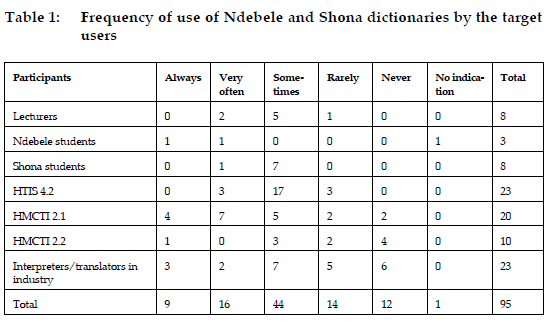
The table below shows the frequency of use of the dictionaries under study by the target users.
Document analysis - Primary and secondary school syllabus and textbooks and university course/module outlines
A search of the words, dictionary, dictionaries, duramazwi, isichazamazwi, izichazamazwi and the names of the Ndebele and Shona dictionaries under study in primary and secondary school syllabuses show that Shona and Ndebele dictionaries are not prescribed as resource materials. There is no explicit dictionary pedagogy in the primary and secondary school indigenous languages syllabus across grades and forms. The Ndebele and Shona textbooks across all levels of primary education do not prescribe dictionaries as reference materials.
An analysis of the Ndebele and Shona syllabi, Heritage Based Curriculum (HBC), Competence Based Curriculum (CBC) shows that they do not include explicit dictionary pedagogy. The syllabi, HBC and the CBC do not include dictionary or reference skills as learning outcomes that primary and secondary school learners should possess by the end of each study. There are no policy statements and directives in the educational policies and curriculum documents on the educational value of dictionaries. Thus, the primary and secondary education system does not have what Nkomo (2015: 75) calls the educational policy on dictionaries.
The analysed documents do not have any statement detailing activities that are related to dictionary pedagogy in African languages. The syllabi, HBC and CBC do not have any policy statements on the importance of dictionaries as educational tools, their use and dictionary skills. Effectively, the Zimbabwean educational policy and curriculum policy do not refer to dictionary use in African languages. This is a clear indication that dictionaries are not considered as language learning tools for African languages and other subjects where these dictionaries can be used. This confirms the truthfulness of the assertion that African people are of the opinion that lexicographic assistance is not necessary in their mother tongue.
Commenting on the value of Isichazamazwi SesiNdebele, Hadebe (2004: 96) notes that it is useful for teaching Ndebele to non-mother tongue speakers. Making clear the value of Isichazamazwi SesiNdebele across all levels of the education sector, Nkala (2001: vii) notes that
... umfundi obesenwaya ubuchopho edinga ingcazelo thile yamabala olimini lwesiNdebele, uzathapha atshiye ...
(A learner who was stuck searching for the meaning of a particular word in isiNdebele will benefit immensely ...)
Commenting on Duramazwi Guri reChiShona, Mutswairo (2001: vii) notes that;
Kumapeto kwebhuku racho kune zvirongwa nezvionwa zvinotsigira nokupamhidzira ruzivo rwese rwaasiyana rwungadiwa pamatanho akasiyana oupenyu needzidzo ... Panguva imwe chete, mazwi nezvirevo zvose zvinodiwa nevadzidzi nevadzidzisi vezvemaumbiro omutauro nezvinyorwa zvouranomwe zvemarudzi ose vanozviwana zvose netsanangudzo dzazvo muduramazwi irori.
(At the end of the dictionary, there is a section with a variety of additional information which can be needed for different uses in life and education ... At the same time, entries and all the other words needed by the students and teachers/lecturers on the morphology of word categories of different dialects and their meanings are found in this dictionary.)
Despite these remarks, primary and secondary education policy and curriculum do not prescribe the use of these dictionaries within the education system. The education sector has not prescribed the dictionaries under study as part of the learners' and teachers' prerequisite teaching and learning tools for Shona and Ndebele and other related subjects. As rightly observed by Hadebe (2004: 95), Isichazamazwi SesiNdebele is useful for teaching and learning Ndebele grammar, especially given that there is no comprehensive grammar book.
However, English dictionaries are prescribed, and textbooks offer information and activities on dictionary use and strategies for integrating dictionary use with English language learning activities. This confirms Hartmann and James' (1998: 41) observation that dictionary culture varies according to the status of the language used. The high sale records of English dictionaries confirmed by publishers further confirm this observation. Publishers reported that schools only prescribe English dictionaries as mandatory for all form 1 learners. Publishers also reported that when schools buy dictionaries, they tend to be biased towards English dictionaries at the expense of African languages dictionaries, hence the low sales records for the latter. The privileged status of English as the de facto official language, language of instruction throughout the education system and as a core subject explains why English dictionaries are considered important compared to local languages dictionaries. Thus, the unfavourable educational policy on African languages dictionaries negatively impacts the reception, use and ownership of African languages dictionaries. Dictionaries such as the Isichazamazwi SezoMculo and Duramazwi reMimhanzi are not considered and prescribed for Music, Social Studies, and Heritage Studies. The same is true for Duramazwi reUrapi neUtano in subjects such as Social Studies.
The researcher observed that the university curriculum for translation, interpreting and editing majors integrate dictionary pedagogy and use in the everyday teaching and learning activities. Reference to dictionaries in translation, interpreting, lexicography and editing curriculum show that at this level, dictionaries are regarded as key reference materials. It emerged that in these courses/modules, students are mandated to own and use the dictionaries under study. The assessment activities include a range of activities that require students to own and use the dictionaries. These modules train students to use dictionaries through dictionary activities that cover metalexicography, translation, interpreting and editing activities as well as compiling a dictionary. The modules purposefully link the dictionaries under study to the students' learning and continuous and summative assessment activities.
Lecturers noted that they integrate dictionary use and pedagogy to help students appreciate the professional and educational value of dictionaries in the programmes and professions. Interviewed lecturers indicated that their integration of dictionary pedagogy and use seeks to aid effective and best possible use of dictionaries. These findings reflect that the university curriculum for translation, lexicography, interpreting and editing majors provide space for dictionary use as part of everyday training for language mediators. Such initiatives develop a dictionary culture in students.
It was noted that the course/module lexicography also provides dictionary pedagogy that seeks to improve the users' dictionary culture. The dictionaries are used in the editing, lexicography, translation and interpreting practicum modules/courses across all levels. An analysis of the ethnomusicology, dance, organology and music modules/courses showed that both music terms dictionaries are prescribed as references.
However, this comes somewhat late since research shows that learners who already from an early stage appreciate the problem-solving value of dictionaries through personal experiences become more independent users who will have a strong dictionary culture even after the years of formal education (Carstens 1995; Hadebe 2004; Nkomo 2015). This delay in exposure to dictionary pedagogy, possibly explains the students' aversion to dictionary use and ownership in African languages.
Sales records
College Press dictionary sales records
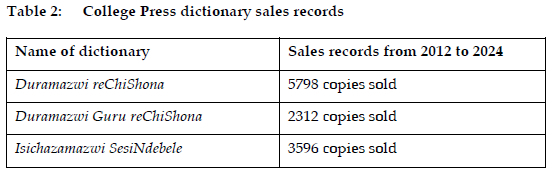
Table 2 presents sales records for dictionaries published by College Press. The publisher only managed to provide sales records from 2012 to 2024 citing that records for previous years had been discarded.
Efforts to get sales records from the publisher of Duramazwi reUrapi neUtano, Duramazwi reMimhanzi and Isichazamazwi SezoMculo proved fruitless. The publisher indicated that they could not retrieve the sales records for the three dictionaries. They however, indicated that the sales have been very low. Comparing these dictionaries with English dictionaries, the publishers expressed that these dictionaries fare badly on the market. These sales records reflect the dearth of the cultural practice of dictionary use that should ensue once a dictionary has been published. They further confirm the misconception that in African speech communities, dictionary assistance is not required in one's mother tongue. The lack of particular attention and focus by the publishers on how well these dictionaries are faring in the market could be a reflection that they are not worth monitoring in terms of their reception and performance in the market. They are not as valued as their English counterparts. Based on these results, one is tempted to conclude that the publishers are not aggressively marketing these dictionaries and pushing sales as well tracking how they are faring in the market. The hegemonic status of English possibly explains this 'neglect' of African languages dictionaries since they are deemed commercially not viable in terms of sales records.
Interviews: Publishers
Publishers noted that the poor sales records for Ndebele and Shona dictionaries are because the school curriculum is silent on dictionary use. Interviewed publishers argued that the incorporation of dictionary use in the school curricula will create a demand for dictionaries in local languages. Publishers argued that the lack of an educational policy on African languages dictionaries negatively affects the reception, sales and ownership of these dictionaries.
Publishers indicated that English dictionaries sell much better than those in local languages. They noted that English dictionaries are prescribed when learners start form 1 in most schools, especially boarding schools. The enabling educational policy on English dictionaries in primary and secondary schools, thus explains their high sales records. This confirms Nkomo's (2010) observations that dictionaries in indigenous languages are not considered as utility tools. This further confirms Hartmann and James' (1998: 41) observation that dictionary culture varies according to the status of the language used. The hegemonic status of English partly explains why African languages dictionaries fare badly in terms of sales, reception, use and ownership.
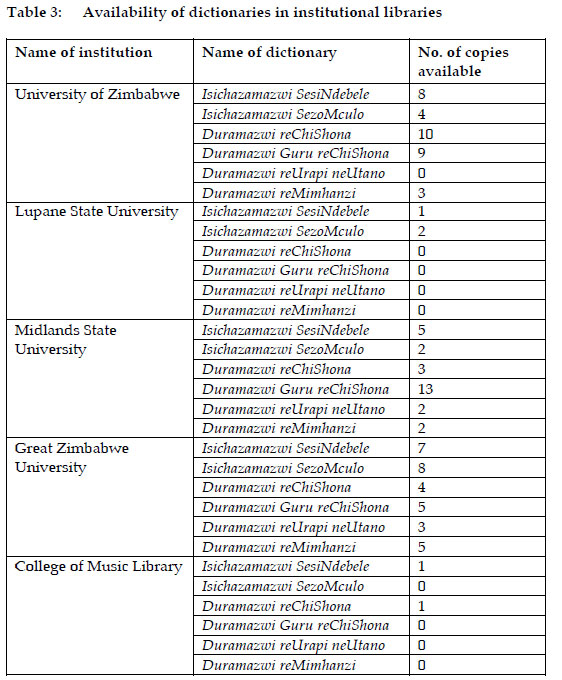
Table 3 indicates the dictionaries and number of copies available in the different institutions of higher and tertiary education.
According to Nkomo (2020: 15), at country level, individual dictionary ownership or availability at public and institutional libraries and educational institutions can be indicators of the level of dictionary culture. Nkomo argues that where the society lacks dictionary culture, it is difficult for its members to acquire it. Based on Nkomo's observations, low individual dictionary ownership and the low number of copies of the dictionaries under study in the selected institutional libraries and educational institutions reflect the Zimbabwean society's poor dictionary culture. A questionnaire survey completed by students, librarians, lecturers, interpreters and translators in selected institutions showed insignificant dictionary ownership which corresponds with institutional ownership.
It was observed that even when some of these dictionaries are available in the institutional and educational libraries, they are safely kept and cannot be loaned out; they are only used within the libraries. The low number of specialised dictionaries such as Duramazwi reMimhanzi, Isichazamazwi SezoMculo and Duramazwi reUrapi neUtano in the educational institutions libraries reflects that dictionaries are not acknowledged as pedagogical tools beyond language subjects. One would have expected the College of Music to have many copies of Duramazwi reMimhanzi and Isichazamazwi SezoMculo, especially given that its focus is music, musicology and ethnomusicology education. Similarly, given that all the studied universities have departments of Music and Faculties of Anatomy, Medicine and Health Sciences, the music terms dictionary and medical terms dictionary respectively, should be available in large numbers, given that these are mainly targeting students and lecturers in the disciplines.
Commenting on the value of Duramazwi reMimhanzi, Chipangura (2005: v) notes that;
Zvakare neduramazwi rino ndinotarisira kuti vadzidzisi nevadzidzi vemuzvikoro, mumakoreji uyewo nevekumayinivhesiti vachabatsirikana zvikuru muzvidzidzo nemubasa avo akasiyana-siyana.
(Moreover, with this dictionary, I hope that teachers/lecturers and students in schools, colleges and universities will immensely benefit in their education and in their different work-related activities.)
Similar sentiments are echoed about Isichamazwi SezoMculo by Nkala (2006: ix) who notes that;
Banengi abadala, ngingasabali abatsha, abangawaziyo amabizo alawo machacho laleyo migido ... Amabizo akho konke okuphathelane lemiculo asesiya esobela labadala ababewazi ... Ngumbono omuhle kakhulukazi-ke ukuthi kuhlelwe phansi ngoba okulotshiweyo kusesiphaleni solwazi lapha izizukulu lezizukulwana zizathapha khona zitshiyele ezilandelayo. Umbono lo uzasiza kakhulu laba abenza izifundo zomculo ezikolo, kumakolitshi lakumayunivesithi ... Ugwalo lolu ngolokuqala ngqa kuzifundo zomculo esiNdebeleni ...
(There are many elderly people, not to mention young people who do not know the names of these musical instruments and dances ... All the names related to music are getting extinct together with the elders who knew them ... It is a great idea to document this knowledge because what is written down in this knowledge reservoir will be used by grandchildren and great grandchildren. This dictionary will help those studying musicology in schools, colleges and universities ... This is the first ever dictionary in the field of Ndebele musicology.)
The introduction of the university-wide language acquisition modules for the Faculty of Medicine and Health Sciences should have seen the University of Zimbabwe increasing the number of copies of the Duramazwi reUrapi neUtano to facilitate the teaching of Shona for students from the Faculty. The introduction of heritage-based education should have seen the mainstreaming of resources in African languages such as the Duramazwi reUrapi neUtano to facilitate the teaching of modules in the Departments of the Faculty of Medicine and Health Sciences.
Mpofu et.al (2004: ix) note that;
Duramazwi rino rakanangana nokurerutsa kunzwisisana pakubatsirana kunoita varwere, vanachiremba, varapiri, vachiri kudzidzira uchiremba nourapi, noruzhinji rwavhanu. Zvakaonekwa kuti, nekuda kwekuti vanachiremba vanodzidziswa nerurimi rweChiRungu asi vachizotarisirwa kubatsira vanhu vanotaura ChiShona, zviri nane kuti pave nebhuku rerudzi urwu ...
(This dictionary seeks to address the challenges experienced by patients, doctors, nurses, medical students and many people in general. It was observed that since medical students learn in English, yet they will offer services to people who speak Shona, it will be better to have a dictionary in this language ...)
However, both language acquisition and content module lecturers in this Faculty are unfamiliar with the resources offered by Duramazwi reUrapi neUtano. They are unaware of the support this reference book provides for the development of discipline specific terminology in local languages. The outright majority of interviewed lecturers expressed that they did not know that such a dictionary exists.
Duramazwi reMimhanzi, Isichazamazwi SezoMculo and Duramazwi reUrapi neUtano are useful for content subjects such as music and human health sciences. As Nkomo (2020: 20) observes, there is a strong misconception that dictionaries are merely linguistic tools instead of pedagogical resources in the broader sense. Engagements with students from the Faculty of Medicine and Health Sciences and music, musicology and ethnomusicology institution showed that these dictionaries are not established as core informational texts in teaching modules and courses in the faculties and institutions. It was observed that the universities which offer medicine have each less than 5 copies of the dictionary in their libraries, and some do not have a single copy of the dictionary; this is a serious cause for concern.
Conclusion
Research findings of this study paint a somewhat bleak picture which shows that since the publication of the dictionaries under study, the dictionary culture of the target users has not changed that much. It emerged that the majority of the target users do not own these dictionaries, are not aware of them and do not use them frequently and they are not prescribed as reference materials. It is unfortunate that the tremendous growth in the number of dictionaries in local languages is not matched by the development of a dictionary culture. There is no dedicated curriculum for the teaching of dictionary skills in primary and secondary education. The findings of this study demonstrate that there is need for Zimbabwe to invest in a curriculum that will cultivate, ingrain and enhance the culture of using dictionaries in local languages right from basic education.
The findings of the study also make clear that the closure of ALRI was a gross mistake since there is still a lot of work that needs to be done to cultivate, ingrain and enhance the culture of using dictionaries in local languages and to compile dictionaries in the other officially recognised languages and domains. There is a need for a re-branded ALRI which will assume a coordinating role at national level in the teaching of dictionary use to improve dictionary culture, especially in view of dictionaries in local languages. The findings of this study make clear the need for the country to prioritise dictionary pedagogy across all levels of the education systems in order to improve the reception of African languages dictionaries.
References
Literature review
- Béjoint, H. 1989. The Teaching of Dictionary Use: Present State and Future Tasks. Hausmann, F.J., O. Reichmann, H.E. Wiegand and L. Zgusta (Eds.). 1989. Wörterbücher. Ein internationales Handbuch zur Lexikographie / Dictionaries. An International Encyclopedia of Lexicography / Dictionnaires. Encyclopédie internationale de lexicographie. Vol. 1: 208-215. Berlin: De Gruyter.
- Carstens, A. 1995. Language Teaching and Dictionary Use: An Overview. Lexikos 5: 105-116.
- Chimhundu, H. and E. Chabata (Eds.). 2007. Duramazwi reDudziramutauro noUvaranomwe. Gweru: Mambo Press.
- Chimhundu, H., E. Mangoya, M.B. Chitauro-Maweme, E. Chabata, N. Mpofu and W. Mavhu (Eds.). 2001. Duramazwi Guru reChiShona. Harare: College Press.
- Chimhundu, H., N.E. Mberi, R.B. Batidzirai, M.B. Chitauro, E. Mangoya, A. Masasire and F. Matambirofa (Eds.). 1996. Duramazwi reChiShona. Harare: College Press.
- Chipangura, T. 2005. Nhuriro. Mheta, G., B. Chinouriri, W. Mavhu and W. Zivenge (Eds.). 2005. Duramazwi reMimhanzi: v. Gweru: Mambo Press.
- Gauton, R. 2008. Bilingual Dictionaries, the Lexicographer and the Translator. Lexikos 18: 106-118.
- Ghabanchi, Z. and E.S. Ayoubi. 2012. Incidental Vocabulary Learning and Recall by Intermediate Foreign Language Students: The Influence of Marginal Glosses, Dictionary Use, and Summary Writing. Journal of International Education Research 8(2): 85-96.
- Hadebe, S. 2004. Improving Dictionary Skills in Ndebele. Lexikos 14: 89-104.
- Hadebe, S., K. Dube, T.M. Ndlovu, S.J. Mhlabi, L. Khumalo, M. Maphosa, V. Ndlovu, J. Masuku and T. Dube (Eds.). 2001. Isichazamazwi SesiNdebele. Harare: College Press.
- Harouni, Z. 2004. Contrastive Lexicology, Bilingual Lexicography and Translation. Revue des Sciences Humaine 15(2): 73-80.
- Hartmann, R.R.K. 2001. Teaching and Researching Lexicography. Harlow: Pearson Education.
- Hartmann, R.R.K. and G. James. 1998. Dictionary of Lexicography. London: Routledge.
- Humbley, J. 2017. Is Terminology Specialized Lexicography? The Experience of French-Speaking Countries. HERMES - Journal of Language and Communication in Business 10(18): 13-31.
- Jin, L. and E. Deifell. 2013. Foreign Language Learners' Use and Perception of Online Dictionaries: A Survey Study. MERLOT Journal of Online Learning and Teaching 9(4): 515-533.
- Landau, S. 2001. Dictionaries: The Art and Craft of Lexicography. Second edition. Cambridge: Cambridge University Press.
- Lew, R. 2011. Studies in Dictionary Use: Recent Developments. International Journal of Lexicography 24(1): 1-4.
- Manning, A. 1990. The Role of Dictionaries and Context in the Translation Process: The Canadian Connection. Thelen, M. and B. Lewandowska-Tomaszczyk (Eds.). 1990. Translation and Meaning. Part 1: 56-166. Maastricht: Euroterm.
- Mheta, G., B. Chinouriri, W. Mavhu and W. Zivenge (Eds.). 2005. Duramazwi reMimhanzi. Gweru: Mambo Press.
- Mpofu, N., H. Chimhundu, E. Mangoya and E. Chabata (Eds.). 2004. Duramazwi reUrapi neUtano. Gweru: Mambo Press.
- Müller-Spitzer, C., A. Koplenig and S. Wolfer. 2018. Dictionary Usage Research in the Internet Era. Fuertes-Olivera, Pedro Antonio (Ed.). 2018. The Routledge Handbook of Lexicography: 715-734. London: Routledge.
- Mutswairo, S.M. 2001. Nhuriro. Chimhundu, H., E. Mangoya, M.B. Chitauro-Maweme, E. Chabata, N. Mpofu and W. Mavhu (Eds.). 2001. Duramazwi Guru reChiShona: Rinezvirungamutauro: vii-viii. Harare: College Press.
- Nation, I.S.P. 2001. Learning Vocabulary in Another Language. Cambridge: Cambridge University Press.
- Ndhlovu, F. 2009. The Politics of Language and Nation Building in Zimbabwe. Bern/New York: Peter Lang.
- Ndlovu, E. 2020. Interpretation and Translation as Disciplines and Professions in Zimbabwe: A Critical Appraisal. Language Matters 51(2): 129-147.
- Ndlovu, E. 2022. Language and Inclusive Sustainable Human Development in Zimbabwe: A Case Study of the Agricultural Sector. Journal of African Languages and Literary Studies 3(2): 119-142.
- Ndlovu, E. and W. Moyo. 2021. The Nexus between Language Policy and Lexicography in Zimbabwe. South African Journal of African Languages 41(3): 294-303.
- Newmark, P. 1998. A Textbook of Translation. London/New York: Prentice Hall.
- Nkala, B.C. 2001. Isethulo. Hadebe, S., K. Dube, T.M. Ndlovu, S.J. Mhlabi, L. Khumalo, M. Maphosa, V. Ndlovu, J. Masuku and T. Dube (Eds.). 2001. Isichazamazwi SesiNdebele: vii. Harare: College Press.
- Nkala, B.C. 2006. Isethulo. Nkomo, D. and N. Moyo (Eds.). 2006. Isichazamazwi SezoMculo: vii. Gweru: Mambo Press.
- Nkomo, D. 2010. Affirming a Role for Specialised Dictionaries in Indigenous African Languages. Lexikos 20: 371-389.
- Nkomo, D. 2014. Teaching Lexicography at a South African University. Per Linguam 30(1): 55-70.
- Nkomo, D. 2015. Developing a Dictionary Culture through Integrated Dictionary Pedagogy in the Outer texts of South African School Dictionaries: The Case of Oxford Bilingual School Dictionary: IsiXhosa and English. Lexicography ASIALEX 2: 71-99.
- Nkomo, D. 2020. Dictionary Culture in African Language Communities: Research, Development, Challenges and Prospects. Lexicographica - International Annual for Lexicography / Internationales Jahrbuch für Lexikographie 36(1): 11-37.
- Nkomo, D. and N. Moyo (Eds.). 2006. Isichazamazwi SezoMculo. Gweru: Mambo Press.
- Phillipson, R. 1992. Linguistic Imperialism. Oxford: Oxford University Press.
- Phillipson, R. 1996. Linguistic Imperialism. African Perspectives. ETL Journal 50(2): 160-167.
- Phillipson, R. 1999. Political Science. Fishman, J.A. (Ed.). 1999. Handbook of Language and Ethnic Identity: 94-108. Oxford: Oxford University Press.
- Phillipson, R. 2007. Linguistic Imperialism: A Conspiracy or a Conspiracy of Silence? Language Policy 6: 377-383.
- Phillipson, R. 2009. Linguistic Imperialism. Mey, J.L. (Ed.). 2009. Concise Encyclopedia of Pragmatics. Second edition: 780-782. Amsterdam: Elsevier.
- Pinchuck, I. 1977. Scientific and Technical Translation. London: André Deutsch.
- Piotrowski, T. 1994. Problems in Bilingual Lexicography. Wrocław: Wydawnictwo Uniwersytetu Wrocławskiego.
- Ptasznik, B., S. Wolfer and R. Lew. 2024. A Learners' Dictionary Versus ChatGPT in Receptive and Productive Lexical Tasks. International Journal of Lexicography 37(3): 322-336.
- Rigual, C.C. and M.V. Calvi. 2014. Translation and Lexicography: A Necessary Dialogue. Monografías de Traducción e Interpretación 6(1): 37-62.
- Scholfield, P. 1982. Using the English Dictionary for Comprehension. Tesol Quarterly 16(2): 185-194.
- Skutnabb-Kangas, T. and R. Phillipson. 1994. Linguistic Imperialism. Asher, R.E. and J.M.Y. Simpson (Eds.). 1994. The Encyclopedia of Language and Linguistics. Volume 2: 2223-2226. London: Pergamon Press and Aberdeen University Press.
- Svensén, B. 1993. Practical Lexicography: Principles and Methods of Dictionary Making. Oxford/New York: Oxford University Press.
- Svensén, B. 2009. A Handbook of Lexicography. The Theory and Practice of Dictionary-Making. Cambridge: Cambridge University Press.
- Swanepoel, P.H. 1989. Only Study Guide for LEKPER-Q. Pretoria: University of South Africa.
- Tomaszczyk, J. 1983. On Bilingual Dictionaries: The Case for Bilingual Dictionaries for Foreign Language Learners. Hartmann, R.R.K. (Ed.). 1983. Lexicography: Principles and Practice: 41-51. London: Academic Press.
- Veisbergs, A. 2010. Translators' Tools: Latvian and Lithuanian Bilingual Lexicographical Tradition Compared. Vertimo Studijos 3: 131-149.
- Wolfer, S., T. Weber, T. Bartz, A. Abel, C.M. Meyer, C. Müller-Spitzer and A. Storrer. 2016. The Effectiveness of Lexicographic Tools for Optimising Written L1-Texts. International Journal of Lexicography 31(1): 1-28.
- Zgusta, L. 1971. Manual of Lexicography. The Hague: Mouton.
- Zgusta, L. 1984. Translational Equivalence in the Bilingual Dictionary. Hartmann, R.R.K. (Ed.). 1984. LEXeter '83 Proceedings. Papers from the International Conference on Lexicography at Exeter, 9-12 September 1983: 147-154. Tübingen: Max. Niemeyer.