The Serbian-Russian and Russian-Serbian Idiomatic Dictionary for Expressing Emotions: Theoretical and Practical Aspects
Abstract
This article presents the development of the Serbian-Russian and Russian-Serbian Dictionary of Emotion-Expressing Idioms (SRIDE). The project aims to systematise idioms that convey emotional expression in Serbian and Russian, taking into account their cultural, linguistic, and cognitive aspects. The author designs a specialised dictionary based on data from the Serbian web corpus (srWaC) and the Russian National Corpus (RNC), compiled at the Department of Russian Language and Literature at the University of Montenegro. Material collection has been ongoing since 2020, with the phraseological database continuously expanding. The methodological foundation of the study is a comprehensive analysis of existing monolingual and bilingual dictionaries, which has identified key challenges, such as idiom polysemy and equivalence issues. The project employs a thematic classification of material based on twelve basic emotions defined by Izard's model. Each dictionary entry is meticulously structured, including a thematic heading, adaptive index, transcription, grammatical information, definition, usage examples, etymological notes, equivalents, and antonyms. The implementation of the OnLex electronic platform enhances functionality, offering multimedia storage and automated search capabilities. The findings demonstrate that integrating traditional lexicographic methods with modern technologies enables the creation of a reliable tool for cross-cultural analysis, language teaching, and translation, catering to the needs of linguists, translators, educators, and students.
equivalence; emotions; bilingual dictionaries; serbian-russian idioms; corpus analysis; comparative lexicography; multi-aspect classification
Abstract
In hierdie artikel word die ontwikkeling van die Serbian-Russian and Russian-Serbian Idiomatic Dictionary for Expressing Emotions bespreek. Die projek het die sistematisering van idiome wat emosionele uitdrukking in Serwies en Russies weergee, met inagneming van hul kulturele, linguistiese en kognitiewe eienskappe, ten doel. Die outeur ontwerp 'n gespesialiseerde woordeboek gebaseer op data van die Serwiese webkorpus (srWaC) en die Russiese Nasionale Korpus (RNC) wat by die Departement Russiese Taal en Letterkunde aan die Universiteit van Montenegro saamgestel word. Materiaal word sedert 2020 versamel en die fraseologiese databasis word voortdurend uitgebrei. Die metodologiese grondslag van die studie is 'n omvattende ontleding van bestaande eentalige en tweetalige woordeboeke, wat sleuteluitda-gings soos idioompolisemie en ekwivalensiekwessies geïdentifiseer het. 'n Tematiese klassifikasie van materiaal gebaseer op twaalf basiese emosies wat deur Izard se model gedefinieer word, word vir die projek gebruik. Elke woordeboekinskrywing is noukeurig gestruktureer en sluit 'n tematiese opskrif, aanpasbare indeks, transkripsie, grammatikale inligting, definisie, gebruiksvoorbeelde, etimologiese aantekeninge, ekwivalente en antonieme in. Die implementering van die elektroniese platform OnLex verbeter funksionaliteit en bied multimediabergings- en outomatiese soekmoontlik-hede. Die bevindings toon dat die integrasie van tradisionele leksikografiese metodes en moderne tegnologie die skep van 'n betroubare hulpmiddel vir kruiskulturele analise, taalonderrig en vertaling, wat voorsiening maak vir die behoeftes van taalkundiges, vertalers, opvoeders en studente, moont-lik maak.
ekwivalensie; emosies; tweetalige woordeboeke; serwies-russiese idiome; korpusanalise; vergelykende leksikografie; multi-eienskap-klassifikasie
1. Introduction
In the context of global cultural integration and the continuous evolution of idiomatic expressions, the lexicographic task of creating a specialised bilingual dictionary gains particular significance. The present project - Serbian-Russian and Russian-Serbian Idiomatic Dictionary for Expressing Emotions (hereinafter SRIDE) - aims to systematise idioms in both languages to capture their emotional and cultural connotations. Lexicography, as the science of dictionary-making, not only documents fixed linguistic expressions but also reflects the mentality, cultural traditions, and historical dynamics of nations. In society, dictionaries serve as authoritative guides for users, functioning as a kind of social institution that regulates word usage and, more broadly, the life of a language within a certain normative framework. This perspective is particularly pertinent to the SRIDE lexicographic project, the relevance of which is determined by several key factors:
1. Growing communication between Montenegro and Russia. The increasing interaction between Montenegro and Russia has heightened the need for exchanging expressive phrases and idioms that convey nuances of emotional perception in both cultures. In today's information-driven society, emotional speech plays a crucial role in interpersonal communication, affecting both its effectiveness and intercultural understanding. Idioms expressing feelings and emotions not only serve as a means of expressiveness but also reflect deep-rooted cultural and historical features of a nation's linguistic consciousness. Such a dictionary will be a valuable resource for linguists, translators, educators, students, and anyone interested in the richness of Serbian and Russian phraseology. There is a pressing need for a new dictionary, as no specialised collections of emotion-expressing idioms currently exist. Moreover, both Serbian and Russian are undergoing constant renewal of their idiomatic inventories: some expressions lose relevance, others acquire new emotional connotations, and entirely new phraseological units emerge due to shifts in culture and social life. The dynamic nature of modern culture necessitates an updated lexical resource capable of documenting both established and emerging expressions.
2. Declining proficiency in phraseological resources. Over the past two decades, command of phraseological units in Serbian and Russian has significantly declined. Annual testing of first- and second-year philology students at the University of Montenegro - assessing their knowledge of Serbian and Russian (as a foreign language) idiomatic expressions - reveals a stark contrast with previous generations. Tasks requiring the reconstruction of idioms based on their initial or final fragments, which students easily completed two decades ago, now prove challenging for most. Notably, when these same students conduct similar tests with their older relatives, they find that the older generation faces no difficulties in restoring the original form of fixed expressions. This trend underscores the importance of explanatory phraseological dictionaries in contemporary lexicography. Such dictionaries not only record stable expressions but also provide commentary on their usage, ensuring their preservation and accurate transmission to future generations. The SRIDE project thus responds to both linguistic and socio-cultural demands, offering a comprehensive tool for cross-linguistic and cross-cultural analysis while addressing the challenges posed by the evolving nature of idiomatic language.
3. Practical experience and target audience. Experience from seminars on Serbian-Russian phraseology has shown that students exhibit strong interest in tasks involving the identification of idioms in their native language that are seman-tically close to Russian equivalents. Such exercises allow learners to compare the imagery and situational contexts underlying idiomatic expressions across languages. For example: Ljut kao pas (Serbian) - Злой как собака (Russian) - angry as a bear (English) - meaning extremely angry and easily irritated. A specialised bilingual dictionary of idiomatic expressions will thus serve as an effective tool for both students and educators.
This report presents the SRIDE - a specialised bilingual project under development at the Department of Russian Language and Literature, the University of Montenegro. Work on its database, initiated in 2020, has so far compiled over 500 idioms. The creation of the SRIDE represents a significant scholarly and practical endeavour, contributing to the in-depth study of idiomatic inventories in both languages, as well as the advancement of intercultural communication and lexicography as a whole. The project is designed to serve as a reliable resource for linguists, translators, and educators, while laying a solid foundation for future research in phraseology and cross-linguistic analysis.
2. Theoretical and practical background
The development of the SRIDE builds upon prior research, existing lexicographic traditions, and established methods of lexical description. Lexicographic works form a cohesive academic framework in which new projects expand upon and refine earlier data, ensuring continuity and comprehensiveness. As noted by Dubichinskiy (2009: 50): "It is not uncommon for a dictionary that initially fails to meet its creators' expectations to later prove valuable as a source for compiling other dictionaries". This project draws on: (1) corpus data - Serbian media texts, the Serbian web corpus (srWaC 2025), and the Russian National Corpus (RNC 2025); and (2) phraseological lexicographic sources - existing monolingual and bilingual dictionaries.
A key terminological clarification is required here. The operational unit of this study is the idiom. In line with English linguistic tradition, the terms phraseological unit (PU) and idiom are treated as synonymous: "PU as an opaque, invariable unit related to the word and its syntactic function in the Russian school, often referred to as 'idiom' in Anglo-Saxon linguistics" (Veisbergs 2013: 110).
The monolingual and bilingual lexicographic works which were considered and analysed when compiling the SRIDE card index include four Serbian and five Russian publications. The Serbian works examined are as follows:
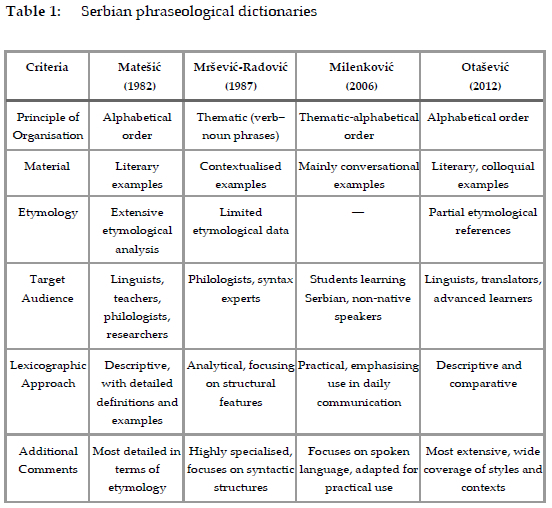
1. Phraseological Dictionary of the Croatian or Serbian Language (Matešić 1982), which is intended for linguists, educators, translators, and anyone interested in the phraseology of these languages. The dictionary employs an alphabetical classification of idioms, with partial thematic grouping, for example, expressions related to emotions are structured but not always systematically. The material includes expressions from literary works, oral speech, and journalism, such as: Srce u petama - to be terrified, experience intense fear; and Pući od muke - to feel extreme irritation or anger. Some examples are supported by classical literary sources: Skočiti od radosti - to experience sudden, intense joy; and Biti na sedmom nebu - to be overjoyed (lit. to be on the seventh heaven). A notable strength of this dictionary is its regional differentiation between Serbian and Croatian. However, it lacks clear label-ling of emotionally charged idioms, and some usage examples are presented without context.
2. Phraseological Verb-Nominal Syntagms in Contemporary Serbo-Croatian Language (Mršević-Radović 1987), which focuses on stable idiomatic constructions where the primary element is a verb-noun combination. The classification is based on: (1) syntactic structure - identifying fixed verb-noun syntagms; (2) semantic load - thematic grouping, with significant attention to emotionally expressive phrases; and (3) stylistic and pragmatic features - distinguishing between colloquial, literary, and archaic forms. The material was collected through corpus analysis and native speaker interviews, reflecting real usage patterns in Serbian: Izbečiti (iskolačiti) oči - to goggle one's eyes (i.e., to be astonished); Bojati se vlastite sjene - to be afraid of one's own shadow (i.e., to be extremely fearful); and Plakati kao kiša - to cry like rain (i.e., to be deeply upset). The dictionary includes etymological notes, though they serve only as a general overview - a common feature in specialised phraseological works.
3. Idioms in the Serbian Language (Milenković 2006), a reference guide focused on Serbian idioms. Unlike traditional academic works, this is a practical manual for Serbian learners and those seeking to enrich their speech. It emphasises colloquial usage, featuring numerous informal expressions: Zračiti srećom - to radiate happiness (i.e., to be very joyful); Slediti se od straha - to freeze in fear; and Grč u stomaku - to have a knot in one's stomach (i.e., to feel intense anxiety). The material is drawn from literature and media. Idioms are categorised by syntactic, morphological, semantic, expressive, and usage-based criteria. However, the dictionary's limited scope precludes in-depth semantic analysis or extensive examples for each category, with no more than two pages devoted to any classification. Consequently, despite its varied systematisation principles, the content remains largely introductory and lacks systematic rigor - a deliberate choice, as the dictionary prioritises practical spoken-language application over specialised emotional idiom categorisation.
4. Phraseological Dictionary of the Serbian Language (Otašević 2012) comprises 25 000 entries, covering both common and specialised idiomatic units. Each entry provides a concise definition, emphasising stylistic nuances and contextual usage. Though academically oriented, the dictionary remains accessible to a broad audience due to its detailed explanations - a distinguishing feature compared to more specialised publications.
This analysis underscores the methodological foundations of the SRIDE, which synthesises these works' strengths while addressing their limitations through systematic emotional categorisation and corpus-based validation. The compiled data are presented in Table 1.
As for the relevant Russian monolingual dictionaries, the following were investigated:
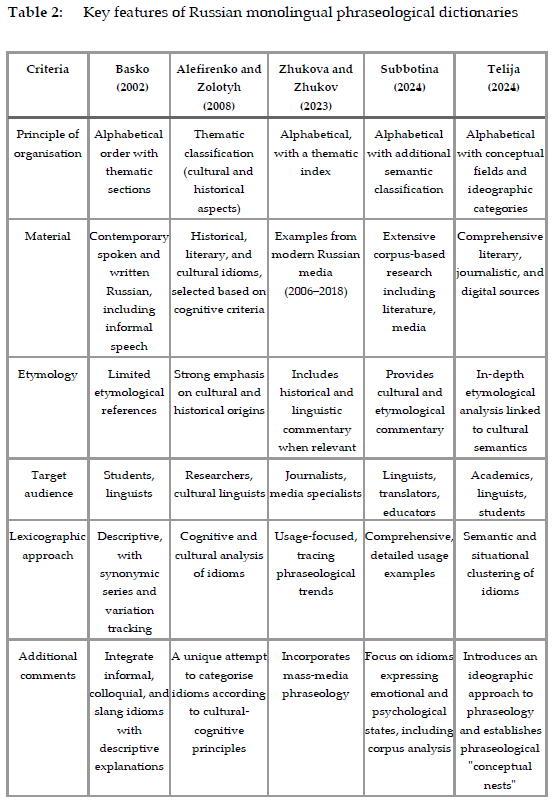
1. Phraseological Units in Russian Speech. Dictionary-Reference Book (Basko 2002), which focuses on contemporary usage while also incorporating expressions with historical background. The dictionary covers colloquial, literary, professional, vernacular, and archaic idioms. It also documents new phraseological units that have gained prominence in modern media language. The author employs a descriptive method for presenting idiom meanings, supplemented with explanatory notes. Synonymous series are frequently used, and possible expression variations are indicated. Unlike academic dictionaries, this work contains more authentic examples from spoken language.
2. Phraseological Dictionary: Cultural and Cognitive Space of Russian Idiomatic Expressions (Alefirenko and Zolotyh 2008) represents a systematic attempt to describe Russian phraseology with emphasis on reflecting cultural-cognitive space. The dictionary selects culturally marked phraseological units including: (a) idioms reflecting elements of classical culture (e.g., Аркадская идилия - Arcadian Idyll - a blissful life; and Медеевская ярость - Medea's fury - an intense feeling of anger and vindictiveness, associated with the legendary Medea); and (b) idioms containing references to specifically Russian cultural-historical realities (e.g., Вот так клюква - What a cranberry! - an expression of surprise at an unpleasant unexpected situation; and Сесть в калошу - to be in a tight spot - to experience a feeling of shame and embarrassment); (c) idioms borrowed from other languages (e.g., Иметь зуб - to hold a grudge - a feeling of hostility, or a desire for revenge against someone); and (d) idioms of biblical origin (e.g., Испытывать благодать - to experience grace - to feel a sense of spiritual inspiration, bliss, or divine favour, often in a religious context). The dictionary also includes phraseological units based on Russian fairy tales (e.g., Как за каменной стеной - like behind a stone wall - to feel safe, confidence in protection) and anecdotes (e.g., Как слону дробина - like a grain of sand to an elephant - feeling of calmness or indifference, regardless of the circumstances). Dictionary entries follow established Russian phraseographic principles while incorporating distinctive features, providing comprehensive information about phraseological synonyms and antonyms, grammatical characteristics, syntactic functions, cognitive-cultural information, etymological sources and conceptual frameworks.
3. Dictionary of Contemporary Russian Phraseology (Zhukova and Zhukov 2023), which is based entirely on modern newspaper material. It presents not only semantic, stylistic and grammatical characteristics of phraseological units, but also includes historical-linguistic, cultural and etymological commentary when necessary. A significant aspect is the information about paradigmatic, syntagmatic and derivational features of phraseological units. The dictionary's uniqueness lies in its use of illustrative material from prominent Russian newspapers (2006-2018). Notably, it includes phraseological units absent from other dictionaries, incorporating youth slang and colloquialisms (e.g., Вогнать в краску - make someone blush - to embarrass or cause someone to turn red from shame or shyness; and Крыша поехала - lost one's marbles - to lose one's mind, behave in an irrational or erratic manner, or show signs of insanity). This linguistic snapshot demonstrates just one facet of phraseology reflected in modern newspaper discourse.
4. Dictionary of Russian Idioms (Subbotina 2024) stands out for its exceptional level of detail and the relevance of its material. This work combines alphabetical organisation with a thematic index, facilitating efficient search and analysis of idioms - particularly those expressing emotional states. The dictionary's value for linguists, educators, translators, and general users is enhanced by the following: abundant usage examples, comprehensive cultural and etymological commentary, and detailed stylistic markers. The dictionary draws on an extensive corpus of contemporary texts including literary works, journalism, media documents, and colloquial speech examples (e.g., Дрожать как осиновый лист - to tremble like a poplar leaf - denoting intense agitation or fear).
5. The Large Phraseological Dictionary of the Russian Language (Telija 2024) presents an exhaustive collection of citations from all written genres, including internet idioms. Developed in collaboration with the Institute of Linguistics (Russian Academy of Sciences), its selection criteria include: (a) 16 thematic or ideographic fields; (b) archetypal cultural layers; and (c) diversity of cultural codes in phraseological units. The macrostructure comprises three dialogically complementary sections: "meaning", "usage" and "cultural commentary" (Bayramova 2010: 28-29). Telija identifies four groundbreaking features in the preface: (1) first implementation of a "compressed" situa-tional interpretation zone; (2) aspectual "nests" or idiom paradigms (containing up to eleven components); (3) first Russian phraseographic work to incorporate cultural commentary; and (4) systematic revelation of cultural meanings through analysis of idioms as elements of cultural semiotics.
Thus, these idiom dictionaries represent a new generation of lexicographic works that supplement traditional information with culturological data tied to cultural codes and cognitive characteristics. These dictionaries document emerging idioms with current media illustrations - the primary contemporary sources (see Table 2).
The next logical stage of the study is the examination of bilingual dictionaries. The study of Serbian-Russian and Russian-Serbian lexicography shows that the tradition of compiling bilingual idiomatic dictionaries has a relatively recent history. Unlike general lexical dictionaries, the development of which can be traced back to the 19th century, phraseographic work in this direction began only in the second half of the 20th century. The formation of dictionaries of this type comprises two editions, each of which made its own contribution to the development of lexicography:
1. Russian-Croatian or Serbian Phraseological Dictionary, a systematic collection of fixed expressions emphasising their semantic load and context of use (Menac et al. 1979). This edition focuses primarily on idioms used in the Serbo-Croatian linguistic space, with parallel presentation of equivalents in Russian. Some dictionary entries could have been more detailed: in certain cases, a literal translation of Russian idioms is provided without literary illustrations or stylistic characteristics. The authors adopted a broad approach to phraseology, including only fixed expressions as well as terms and collocations in the process of phraseologisation. At the same time, expressivity is not considered as a key feature of idioms, so the dictionary presents both traditional proverbs and sayings (e.g., Daleko od očiju, daleko od srca - out of sight, out of mind) and word combinations that do not have a pronounced imagery, such as Razrovani put - Разбитая дорога - rough road.
2. Serbo-Croatian-Russian Phraseological Dictionary, which is characterised by updated methodology and current data, allowing for a better reflection of the modern linguistic landscape (Trofimkina 2005). It features Serbian phraseological units (in the narrow sense of the term), accompanied by Russian-language semantic descriptions, syntactic characteristics, and phraseological equivalents in Russian. A particularly valuable aspect of the work is the commentary on culture-specific words, elucidating their cultural and linguocultural context. For example, the expression Tražiti / Htjeti preko hljeba pogače (to be dissatisfied with what is available; to demand more than necessary) is accompanied by an explanation of the word pogače - a traditional wheat bread in Serbian cuisine. The dictionary includes an extensive corpus of quotations from literary, popular science, memoir, and journalistic texts, significantly expanding its utility in research and translation practice.
Despite the modest lexicographic practice in the field of Serbian-Russian idiomatics, it can be noted that this direction is developing promisingly. A number of works continue to emerge: Serbian-Russian idioms of different thematic groups are compared (Dzonic 2016), theoretical aspects are developed (Štrbac 2018), work is underway on compiling a new large bilingual dictionary (Dragičević et al. 2024), and problems in the selection of clauses for the Serbian-Russian dictionary are analysed (Dragičević 2024). The analysis of these works indicates a growing interest in the study of Serbian-Russian idiomatic connections. It is, however, noteworthy that works dedicated to describing idioms expressing emotions are absent in contemporary lexicography. This category of phraseology presents significant challenges for learners of Russian as a foreign language, as it involves complex metaphors, cultural-historical realities, and lexico-grammatical structures that differ from Serbian.
3. Principles and methodology
The development of the SRIDE database employed comprehensive methodological approaches combining lexicographic analysis, corpus linguistics, cultural linguistics commentary, and cognitive research (Knežević et al. 2021). According to Fraser (2008: 2), the organisational principles of bilingual dictionaries depend fundamentally on three kinds of information: "form, meaning and context. Form includes spelling, accentuation and quantities, and inflections. Meaning includes translations: single-word equivalents of the lemma in the exit language. Context covers both the real-world and the linguistic environments." The core principles governing material selection and dictionary organisation include:
-Frequency and stability. Phraseological units were selected based on their regular occurrence in literature, media, and spoken discourse. National corpus data (the srWaC for Serbian, and the RNC for Russian) helped identify stable expressions with high representativeness in both languages. Selection criteria prioritised quantitative analysis of phraseological frequency across genres and functional significance in daily communication. The primary criterion was current usage by native Serbian speakers and/or presence in the srWaC, complemented by verification in the RNC.
-Normative compliance. Only expressions conforming to contemporary literary standards were included. This principle ensures reliability and practical applicability by excluding taboo or non-normative expressions and regional or dialectal phraseologisms. Exceptions were made for widely adopted non-standard expressions, which were marked with appropriate stylistic labels (e.g., Izbečiti, iskolačiti oči - Шары на лоб полезли - eyes popped out of one's head - marked as colloquial). As a descriptive dictionary, the SRIDE documents actual usage while maintaining language cultivation standards - particularly crucial for learners mastering literary norms.
-Linguocultural relevance. Units must reflect culture-specific emotional realities. Selected idioms embody characteristic imagery, symbolism, and stereotypes embedded in Serbian and Russian linguistic cultures. This principle facilitates not only accurate translation but also deeper intercultural understanding of emotional expression.
-Contextual grounding. Each unit is evaluated through authentic textual examples to ensure accurate representation of usage patterns. Contextual analysis determines the following: register (formal or informal), domain (literature, conversation), and emotional-expressive load. This approach helps users grasp appropriate situational usage.
-Equivalence principle. For each Serbian unit, the dictionary provides: (1) direct Russian equivalents where available; (2) descriptive translations for non-equivalent items; and (3) culturally analogous constructions with explanatory notes. This systematic comparison reveals both convergences and divergences in emotional expression across cultures.
-Standardised presentation. All entries follow a uniform structural template ensuring consistency in orthography, grammatical annotation, definition formatting, and example presentation.
-Functional-pragmatic relevance. The dictionary covers idioms expressing emotions fundamental to modern communication: (a) basic emotions (joy, surprise, fear, anger, sadness); (b) complex affective states (nostalgia, ambivalence); and (c) social emotions (shame, pride). The selection prioritises units with high communicative utility in contemporary contexts.
These methodological principles collectively ensure the SRIDE's scholarly rigor, cultural precision, and practical utility for language learners, translators, cross-cultural researchers and bilingual speakers. The approach bridges theoretical lexicography with applied language pedagogy, addressing a critical gap in Slavic phraseological resources while establishing replicable standards for emotion-focused dictionary compilation. Subsequent sections will demonstrate how these principles manifest in the dictionary's macrostructure and individual entry design.
4. The dictionary
4.1 Macrostructure
The dictionary's macrostructure is currently being developed in Microsoft Word as a manuscript intended for subsequent print publication. Simultaneously, completed materials are being transferred to the OnLex electronic lexicographic platform (Makarov et al. 2022), which significantly enhances the SRIDE's functionality through several key advantages:
-Space optimisation: Unlike print editions, the digital format eliminates spatial constraints, allowing for more extensive illustrative examples, richer contextual information, and comprehensive usage explanations.
-Advanced search capabilities. The platform's modern design supports full paradigm representations (enabling searches by any word form), multimedia integration (particularly audio recordings for stress patterns), and multi-criteria searching (including tags, equivalents, and usage examples).
-Editorial efficiency. The platform provides online article creation tools, automated format conversion, unified presentation standards, collaborative work environment, etc.
The dictionary features a dual-component structure with complementary sections. The first part - the Serbian-Russian Dictionary - comprises a selection of Serbian idioms, grouped by emotional categories, with detailed descriptions, culturological commentaries, and translations into Russian.
The second part contains a corresponding collection of Russian idioms presented according to the same emotional categories, with comprehensive analyses and translations into Serbian. The bilingual dictionary, constructed on the principle of two equal parts, offers several advantages over a monolingual version:
-Symmetry of information and ease of search makes it easy to find similar expressions in both languages, since each section is organised according to one thematic scheme (emotions).
-Dual lexicographic referentiality enables contrastive analysis of emotional expression, reveals cultural-linguistic parallels and divergences, and supports bidirectional translation workflows. The inclusion of both sections allows users to see the translation from one language to another and to compare how different idioms convey emotional connotations in both language cultures.
-Contrastive analysis documents equivalence types (full, partial, or lacunary), highlights culture-specific emotional conceptualisation, and provides research data for cultural linguistics.
-Pedagogical utility serves both Serbian and Russian native speakers, reduces reference source switching, and enhances learning efficiency through systematic presentation.
While the design principle maintains structural parity, practical implementation reveals quantitative asymmetries across languages, particularly in emotion domains with differential phraseological development. According to the plan, both parts of the dictionary should be structured equally in terms of the volume and quality of the presented material, which ensures a symmetrical reflection of the phraseological system of both languages. However, in practice there are cases when the number of idioms in one part exceeds their number in the other. This circumstance is determined by the peculiarities of the linguistic space and the degree of development of the corresponding phraseology in one of the languages. For example, Serbian idioms reflecting joy or emotional intensity are characterised by great diversity, whereas Russian contains more idioms for melancholy or sadness (reflecting cultural-historical factors). To address such imbalances, the project employs descriptive translation strategies, functional equivalents, explicit lacuna marking, and culturally contextualised commentary. In this regard, the dictionary places higher demands on the classification of polysemous expressions and the selection of precise equivalents, which remains its main challenge. Current development focuses on maintaining methodological consistency while accommodating natural language asymmetries, ensuring the dictionary remains both a reliable reference tool and a valid research instrument for comparative phraseology.
4.2 Material organisation
We employ a combined approach integrating alphabetic-thematic classification principles. This dual methodology incorporates: (1) formal-alphabetic organisation based on graphic sign systems, that follows standard lexicographic ordering, enables quick reference lookup, and maintains traditional dictionary accessibility; and (2) semantic-thematic organisation grounded in conceptual relationships between lexical units, which utilises categorisation and grouping techniques, and follows Faber et al.'s (2014) principle of organising lexical units through systematic conceptual frameworks.
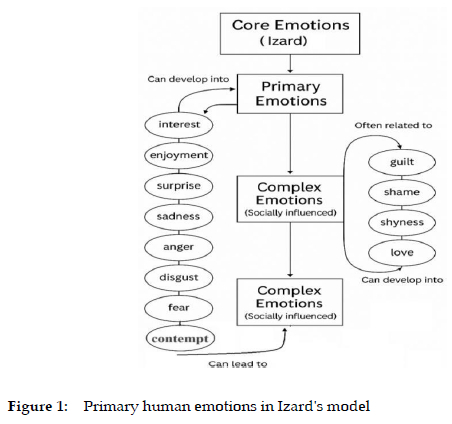
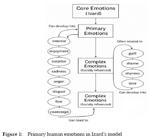
The organisational structure is fundamentally based on Izard's (2009) differential emotions theory, which identifies twelve primary human emotions. These are arranged in alphabetical order for ease of search and comparison: bijes (anger), gadenje (disgust), interes (interest), iznenadenje (surprise), krivica (guilt), ljubav (love), prezir (contempt), sramota (shame), stidljivost (shyness), strah (fear), tuga (sadness), and uživanje (enjoyment). Idioms are systematically linked to these lexical hubs, and within each emotion category, idioms are arranged alphabetically. The model of primary emotions is illustrated in Figure 1.
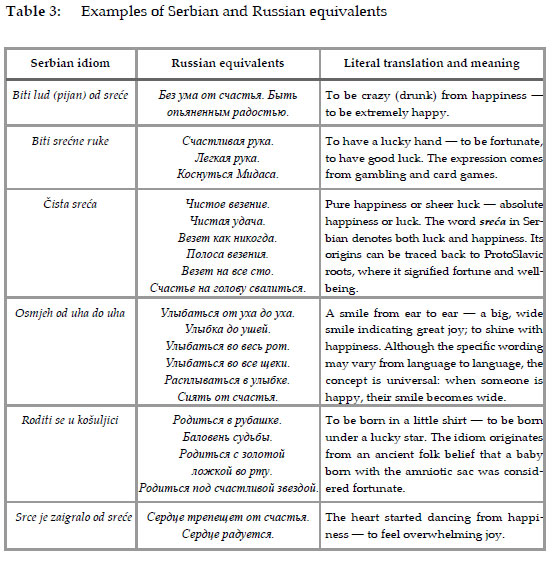
In other words, all idioms are grouped alphabetically by the main emotions, each of which represents a separate dictionary entry or section (e.g., Enjoyment, Surprise, Sadness, and Contempt). A sample of phraseological grouping based on the central emotion Enjoyment is presented in Table 3.
This study critically evaluates the interpretation of polysemantic linguistic units, where the same idiom can have multiple meanings depending on the context, and Figure 1 confirms the cluster model of emotions. The polysemy of emotion-expressing idioms poses a challenge for their unambiguous classification, as many fixed expressions can simultaneously convey a complex range of feelings. For example, the expression Srce je sišlo u pete - Сердце ушло в пятки - one's heart dropped to one's stomach - may denote fear, anxiety, or surprise. It should also be noted that within the "Anger" cluster, emotions such as dissatisfaction, irritation, indignation, resentment, anger, and rage manifest simultaneously. This complicates the selection of the primary emotional category for inclusion in an alphabetically and thematically organised dictionary. To address the issue of idiom polysemy, the following solutions are proposed:
-Determining the dominant emotion. By analysing the frequency and intensity of emotional nuances in a text corpus, it is possible to identify the dominant emotion for a given idiom. This allows for the selection of a primary category, while secondary ones can be retained as supplementary information.
-Using a multifaceted classification. A single idiom may be included in multiple thematic entries, with all its emotional nuances indicated. The primary (dominant) nuance is marked with a special label, while secondary ones are reflected through synonyms or additional notes.
-Cross-referencing. Each dictionary entry may include cross-references to other categories. For instance, if an expression conveys both joy and sadness, it can be listed under the entry "Enjoyment" with a note "see also Sadness," and vice versa. If similar expressions exist in both sections, cross-references should also be created, enabling users to quickly navigate between related idioms and consider comparative analysis.
-Employing an adaptive index. Incorporating a general index section for both parts of the dictionary allows for keyword-based searches. An adaptive index, serving as a consolidated reference, compiles keywords, themes, or categories, enabling users to locate relevant expressions regardless of their placement in the dictionary. This navigational tool offers the following advantages: (a) coverage of the entire dictionary rather than individual entries; (b) inclusion of both idioms and key elements (e.g., searching for the word "fear" in the index displays all related expressions); (c) grouping of idioms with similar meanings, even if they lack direct equivalents.
-Aiding contextual analysis. When compiling the dictionary, it is essential to provide usage examples that help users understand the contexts in which a particular emotion predominates.
Thus, the issue of idiom polysemy is mitigated through multifaceted classification with the identification of a dominant emotional nuance, the use of cross-references, and the provision of contextual examples. Even if an idiom conveys a complex range of emotions, users will be able to discern the context and emotional emphasis of its usage. An example of an idiom expressing multiple emotions: Steže mi se srce - Сердце сжимается - one's heart sinks - a feeling of disappointment, anxiety, or despondency. Here the dominant emotion is sadness, and a possible secondary emotion is fear. This leads to a classification of the entry in the dictionary article "Sadness/Fear", with a cross-reference to "Fear". Each meaning is illustrated with specific contexts demonstrating the idiom's usage in that particular sense. As a result of this approach, the dictionary becomes more flexible and informative.
4.3 Microstructure
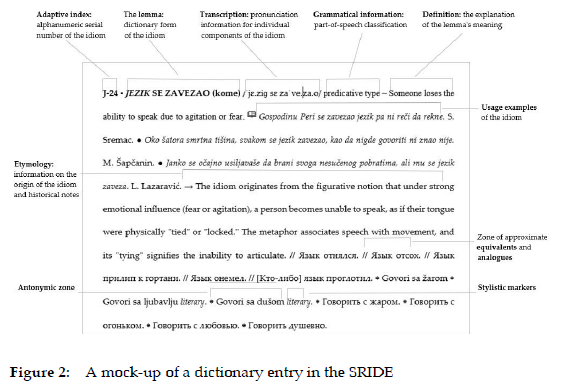
The basic unit of the dictionary is the dictionary entry, which includes mandatory and optional lexicographic elements. The microstructure design, with authorial additions and adjustments, is based on the Academic Dictionary of Russian Phraseology's dictionary entry (Baranov et al. 2020), which serves as the foundation for the wordlist. The SRIDE dictionary entry consists of the following zones (Figure 2):
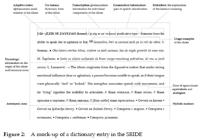
Moreover, if an idiom is polysemous, the sense number is indicated before the definition using Arabic numerals. The zones for stylistic labels, definitions, and usage examples are repeated for each sense. If the stylistic characteristic remains the same for all senses, it is indicated in the lexical entry of the idiom, before the senses section. The structural elements of the dictionary entry include the following:
-An adaptive index, which is the serial number of the idiom facilitating its retrieval within the dictionary corpus. It consists of a letter (the initial letter of the core component) and a number indicating its position within that letter. For example, the idiom Nevolja je natjerala nekoga - strong dissatisfaction - has the serial number A-14.
-The lemma typed in bold uppercase letters, with the symbol "■" preceding the phraseological unit. The core component is italicised. Features of the morphological realisation of the idiom's valencies are indicated in bold within parentheses: ■ IZBEČITI (od nečega) OČI (nečije / kod nekog) - to pop one's eyes out. Variants of expressions are separated by the symbol e.g. IZBEČITI / ISKOLAČITI. For an idiom with a verb in the infinitive, the morphological realisation of the subject is not provided. However, since most verbal idioms frequently occur in a specific conjugated form or exclusively in one non-infinitive form, the lexical entry selects the conjugated
verb form and specifies the subject's morphological realisation, e.g. PADA MRAK NA OČI (kod nekoga) - blinded by rage. Words and phrases that are optional components of the idiom are enclosed in square brackets, e.g. NEK BUDE [TRI PUTA] NESREĆAN - strong dissatisfaction, indignation, or irritation. Some idioms may include a negative particle or be used in an affirmative form. If the non-negated form is more common, only that variant is provided. If the expression is used exclusively with negation or the nonnegated form is perceived as less common, the dictionary entry strictly provides the negated form: NE MOŽE SE POKRENUTI - paralysed with fear.
-A transcription providing pronunciation information for individual components of the idiom. A simplified phonetic transcription is used to describe the phonetics of idioms, represented by lowercase symbols in italics enclosed within slash symbols "/". The transcription details the pronunciation features of each component, which are crucial for correct oral usage and comprehension of the idiom, e.g.: ■ NA KRV I NOŽ - /na krv i no3/ - cruelly and mercilessly.
-Grammatical information, specifically the part-of-speech classification, which provides details on the grammatical category of the idiom, helping to determine its syntactic role in a sentence. Information on the part of speech aids in understanding the morphological characteristics and functional usage of the expression. Examples of phraseological units include: KRSTITI SE LIJEVOM RUKOM - to cross oneself with the left hand - predicative type; LJUT KAO PAS - furious as a dog - adjectival type; and HLADNO JE OKO SRCA NEKOME - it feels cold around the heart - adverbial type.
-Stylistic markers reflecting the tone, register, and contextual nuances of the idiom. Expressions are accompanied by stylistic markers such as bookish, neutral, colloquial, and vernacular. Each variant of an idiom in the lexical entry may be assigned a label, set in a smaller font and italics. The bookish register indicates that the idiom is typical of formal written speech, often found in scientific or journalistic texts: OSTATI BEZ DAHA literary - take one's breath away - surprise or admiration. The neutral register means the idiom is stylistically neutral and used across various spoken and written styles: OD SVEG SRCA standard - with all one's heart - sincerely, with deep devotion and full emotional commitment. A vernacular expression indicates that the idiom has a lowered stylistic tone and is typically used in everyday speech: PUKNUTI OD BIJESA informal - outburst of anger or fury. It is worth noting that the stylistic labels do not include colloquial, because most idioms inherently belong to the colloquial register. Thus, labelling them as colloquial would apply to the majority of entries. To avoid redundancy, colloquial idioms in the dictionary remain unmarked.
-The definition, constituting a semantic explanation of an idiom's meaning, revealing its substantive content. It describes nuances of meaning, variability of interpretations, and specific connotations inherent to the given idiomatic unit, which is a key element for comprehensive lexicographic analysis. In cases of polysemy, the meanings are numbered, with each interpretation presented under the corresponding number and preceded by the symbol For example: ■ KAO MUVA BEZ GLAVE HODATI [TUMARATI] ~ 1. To be confused, agitated, or disoriented. 2. To not know what to do. 3. To wander aimlessly; to act chaotically and without purpose.
-Cross-references, which are optional elements and are indicated when an idiom appears in multiple sections. They direct the user to related entries where each meaning is examined in detail. The reference is marked with "see", facilitating a comprehensive approach to polysemy and preventing information overload in the main entry by avoiding excessive duplication.
-Usage examples, marked with the symbol "". Illustrative material is drawn from corpora of modern Serbian and Russian texts, as well as lexicographic sources. Idioms in examples are italicised and differentiated by the symbol •. The number of examples typically does not exceed five. Their arrangement follows two principles: (1) from literary examples to media materials (prose first, then poetic); and (2) from primary forms of the idiom to secondary non-basic forms. Exceptions are permitted if an example more vividly illustrates the idiom's meaning.

-Etymology and historical information, providing data on the idiom's origin and historical development. It concisely describes roots, possible metaphorical transformations, and the evolution of the idiom's meaning, allowing for tracing the cultural-historical aspects of its formation. This zone is introduced by the symbol "..." and is obligatory.
-A zone of approximate equivalents and analogues, listing words, phraseological units, or expressions that are semantically or emotionally close to the given idiom. Equivalents are introduced by the symbol "//". For example, the expression Eto ti ga na! - Well, there you go! - depending on context, may convey surprise or disgust, such as in the following case:
■
ETO TI GA NA! /'ɛ.tɔ ti ɡa na/ interjectional type ~ 1. An expression of surprise, bewilderment, or irritation in response to an unexpected, undesirable, or inexplicable situation. // Вот тебе и на! // Вот так сюрприз! // Вот так номер! // Ну и дела! 2. An expression of irritation and disappointment. // Ну и ну! // Hy bot, Ну вот, пожалуйста!-The equivalent selection zone, which is optional as languages often contain non-equivalent examples. However, when linguistic correspondences exist, they are recorded in the dictionary without fail.
-The antonymic zone highlights opposing meanings of the given idiom. This element facilitates a deeper understanding of the language's semantic structure by demonstrating how contrasting emotional states are expressed. Antonyms are marked with Serbian antonyms are listed first, followed by Russian. Examples of antonyms for the idiom with the meaning to faint from fear:
■ PASTI U NESVIJEST * Biti smiren kao stijena * Быть спокойным как удав * Олимпийское спокойствие * В ус не дует * Не подавать виду * Хоть трава не расти! * Все трын-трава! * Все параллельно! informal. * По барабану informal. * До фонаря informal.
It is important to note that the project deliberately omits a separate synonym zone, as thematic organisation renders it redundant: phraseological units are grouped by shared emotion, automatically placing synonymous expressions in the same section.
Thus, the microstructure of the SRIDE constitutes a system integrating obligatory and optional elements to provide a comprehensive representation of idiomatic units. Each dictionary entry is structured according to the functional and semantic features of expressions: from the thematic heading, which determines emotional colouring, to the adaptive index for organisation and quick retrieval. The entry includes components such as lexical input, transcription, grammatical information, and stylistic labels, capturing not only the base form of the idiom but also its phonetic, morphological, and stylistic characteristics.
Special attention is given to semantic diversity: in cases of polysemy, meanings are numbered, and corresponding zones of interpretation, usage examples, and stylistic labels are repeated for each, ensuring detailed semantic and pragmatic perspective. Additional elements such as cross-references, etymological data, and zones of equivalents and antonyms contribute to a comprehensive lexicographic analysis, helping users grasp the full spectrum of semantic and emotional nuances.
5. Conclusion
The SRIDE project is based on the integration of traditional lexicographic approaches with modern methods of corpus and cognitive analysis, which ensures not only the description of set expressions but also a deep understanding of their semantic, stylistic, and cultural characteristics. The methodology is grounded in the principle of thematic grouping of idioms into twelve key emotions, enabling contextual and emotional differentiation of the material. Problematic areas, such as the polysemy of idioms, are addressed through multifaceted classification with the identification of dominant emotional nuances, the use of cross-references, and adaptive indexing, facilitating precise matching of expressions in both language systems.
The microstructure of dictionary entries has been developed with consideration of mandatory and optional components, including lexical entry, transcription, grammatical information, stylistic labels, definitions, usage examples, etymological data, and equivalent and antonym zones. Particular attention is paid to maintaining the integrity and functional homogeneity of each entry: a uniform structure ensures quick search, comparison, and matching of idiomatic units, which holds significant practical value for translators, linguists, teachers, and students.
The use of extensive linguocultural sources, such as national language corpora, as well as materials from media and literary texts, allows for the documentation of both established and emerging idioms. This is particularly relevant in the context of the dynamic evolution of idiomatic inventory and continuous cultural interaction, where emotional speech coloring plays a key role in intercultural communication.
The SRIDE project represents a lexicographic work in which methodological principles - based on frequency analysis, normativity, contextualisation, and equivalence - are integrated with modern electronic platforms (OnLex). The systematic approach to designing the microstructure and the well-considered solutions to problematic areas of polysemy contribute to the creation of a reliable tool for cross-linguistic analysis of emotional expression, meeting the needs of both specialists and a broader audience. The SRIDE serves as a specialised resource that contributes to a deeper understanding of emotional expression in language and supports the development of contemporary lexicographic theory and practice.
The first edition of the SRIDE dictionary is scheduled for release in 2026, with final compilation and digital integration expected to be completed by late 2025. Future stages of the project include multilingual expansion, enhanced corpus-based updates, and the refinement of lexicographic annotation techniques based on digital corpora.
A. Dictionaries
References
- Alefirenko, N.F. and L.G. Zolotyh (Eds.). 2008. Frazeologiceskij slovar': Kul'turno-poznavatel'noe prostranstvo russkoj idiomatiki. Moscow: ELPIS.
- Baranov, A.N., M. Voznesenskaja, D.O. Dobrovol'skij, K. Kiseleva and A. Kozerenko (Eds.). 2020. Akademicheskij slovar' russkoj frazeologii. Moscow: LEXRUS.
- Basko, N. (Ed.). 2002. Frazeologizmy v russkoj reci. Slovar'-spravocnik. Moscow: Flint, Nauka.
- Matesic, J. (Ed.). 1982. Frazeoloski rjecnik hrvatskoga ili srpskog jezika. Zagreb: Školska knjiga.
- Menac, A., R. Venturin, T. Korac and M. Popovic (Eds.). 1979. Rusko hrvatski ili srpski frazeoloski rjecnik. Zagreb: Školska knjiga.
- Milenkovic, T. (Ed.). 2006. Idiomi u srpskom jeziku. Beograd: Narodna biblioteka Srbije.
- Mrsevic-Radovic, D. 1987. Frazeoloske glagolsko-imenicke sintagme u savremenom srpskohrvatskom jeziku. Beograd: Filoloski fakultet Beogradskog univerziteta.
- '
- Otasevic, D. (Ed.). 2012. Frazeoloski recnik srpskog jezika. Novi Sad: Prometej.
- Subbotina, L. (Ed.). 2024. Slovar' frazeologizmov russkogo jazyka. Moscow: AST.
- Telija, V. (Ed.). 2024. Bol'soj frazeologiceskij slovar' russkogo jazyka. Moscow: AST-Press Shkola, Gramota.
- Trofimkina, O. (Ed.). 2005. Serbokhorvatsko-russkij frazeologicheskij slovar'. Moscow: Vostok-Zapad.
- Zhukova, M. and A. Zhukov (Eds.). 2023. Slovar' sovremennoj russkoj frazeologii. Moscow: AST-Press Shkola, Gramota.
- B. Other literature
- Bayramova, L. 2010. Phraseological Dictionaries of the New Generation. Vestnik Chelyabinskogo Gosudarst-vennogo Universiteta 29(210): 27-32.
- Dragicevic, R., M.D. Korolkova, D.A. Ryzhova, Y.L. Shapich and E.I. Yakushkina. 2024. A New Large Serbian-Russian Dictionary (A General Conception and Problems of Lexicographic Description). Voprosy leksikografii 32: 43-60.
- Dubichinskiy, V. 2009. Leksikografiya russkogo yazyka. Moscow: Flint, Nauka.
- Dzonic, V. 2016. Russian and Serbian Phraseological Units: Experience of Comparative Analysis. Vestnik Kemerovskogo gosudarstvennogo universiteta. Philology 2: 166-170.
- Faber, P., P. León-Araúz and A. Reimerink. 2014. Representing Environmental Knowledge in EcoLexicon. Bárcena, E., T. Read and J. Arús (Eds.). 2014. Languages for Specific Purposes in the Digital Era: 267-301. Cham: Springer.
- Fraser, B.L. 2008. Beyond Definition: Organising Semantic Information in Bilingual Dictionaries. International Journal of Lexicography 21(1): 69-93.
- Izard, C.E. 2009. The Psychology of Emotions. Second edition. Saint-Petersburg: Piter.
- Knezevic, L., S. Halupka-Resetar, I. Miskeljin and M. Milic. 2021. Millennials as Dictionary Users: A Study of Dictionary Use Habits of Serbian EFL Students. Sage Open 11(2): 1-11.
- Makarov, Y., M. Melenchenko and D. Novokshanov. 2022. Digital Resources for the Shughni Language. Ojha, A.K., S. Ahmadi, C.-H. Liu and J.P. McCrae (Eds.). 2022. Proceedings of the Workshop on Resources and Technologies for Indigenous, Endangered and Lesser-resourced Languages in Eurasia within the 13th Language Resources and Evaluation Conference 2022, Marseille, France, 3-20 June 2022: 61-64. European Language Resources Association.
- Russian National Corpus (RNC). https://ruscorpora.ru/ [6 April 2025]
- Serbian Web Corpus (srWaC).https://www.clarin.si/ske/#open [6 April 2025]
- Štrbac, G. 2018. Frazeologija o coveku i covek u frazeologiji. Novi Sad: Filozofski fakultet.
- Veisbergs, A. 2013. Phraseological Units and Idioms, East and West and Where Do We Stand. Baltic Journal of English Language, Literature and Culture 3(1): 109-121.