Thematic Classification in Polish Electronic Dictionaries - From Tradition to New Tools and Opportunities
Abstract
The main topic of this article is the thematic classification of vocabulary in two Polish dictionaries that were compiled at the beginning of the 21st century. The first is the Wielki słownik języka polskiego PAN (WSJP PAN) [The Polish Academy of Sciences Great Dictionary of Polish], which describes contemporary vocabulary and can function as a thematic dictionary. The second is the Słownik pojęciowy języka staropolskiego (SPJS) [Conceptual Dictionary of Old Polish], which collects vocabulary up to the end of the 15th century and arranges it in conceptual fields. The primarily electronic format of these dictionaries has created completely new possibilities for classification according to meaning, which is worth briefly describing in the context of the thematic lexicography used in Polish paper dictionaries to date. Therefore, the most important Polish thematic dictionaries over the centuries are listed first (Section 2), followed by a more detailed description of the SPJS and WSJP PAN (Section 3). In Section 4, the following is described based on these two Polish electronic dictionaries: the ease of switching between onomasiological and semasiological orders, the significantly greater possibilities for classifying lexical units, and the ability to search fields using advanced search functions. These considerations are important given the growing number of electronic dictionaries increasingly adopting onomasiological orders.
onomasiological lexicography; thematic lexicography; thematic dictionaries; concept dictionaries; primarily electronic dictionaries; search tools in electronic dictionaries; onomasiological and semasiological order; thematic classification of vocabulary
Abstract
Der vorliegende Artikel befasst sich mit der thematischen Klassifizierung des Wortschatzes in zwei zu Beginn des 21. Jahrhunderts erarbeiteten Wörterbüchern der polnischen Sprache. Das erste ist Wielki słownika języka polskiego PAN (WSJP PAN) [Großes Wörterbuch der polnischen Sprache der Polnischen Akademie der Wissenschaften], das den zeitgenössischen Wortschatz ab dem Jahr 1945 erfasst und zugleich als thematisches Wörterbuch genutzt werden kann. Das zweite, Słownik pojęciowy języka staropolskiego (SPJS) [Begriffswörterbuch des Altpolnischen], dokumentiert den bis zum Ende des 15. Jahrhunderts verwendeten Wortschatz, geordnet nach Begriffsfeldern. Die primär elektronische Form beider Wörterbücher eröffnet völlig neue Möglichkeiten für die Klassifikation nach Bedeutungen. Diese Entwicklungen verdienen eine kurze Darstellung im Kontext der thematischen Lexikografie, wie sie bislang in gedruckten polnischen Wörterbüchern praktiziert wurde. Daher werden zunächst im zweiten Abschnitt die wichtigsten thematischen Wörterbücher des Polnischen im Verlauf der Jahrhunderte vorgestellt. Im dritten Abschnitt folgt eine detaillierte Charakterisierung des SPJS und des WSJP von PAN. Der zentrale vierte Abschnitt des Artikels widmet sich den verschiedenen Zugriffsformen auf das Wörterbuchmaterial in diesen beiden polnischen elektronischen Wörterbüchern. Besonders hervorgehoben wird dabei die Möglichkeit des einfachen Wechsels zwischen onomasiologischer und semasiologischer Ordnung. Beschrieben werden zudem deutlich erweiterte Optionen für die Klassifizierung des sprachlichen Materials sowie für die feldspezifische Suche mithilfe erweiterter Suchfunktionen. Diese Überlegungen gewinnen an Relevanz angesichts der wachsenden Zahl elektronischer Wörterbücher, die zunehmend auf einer onomasiologischen Ordnung basieren.
onomasiologische lexikografie; thematische lexikografie; thematische wörterbücher; begriffswörterbücher; primär elektronische wörterbücher; suchfunktionen in elektronischen wörterbüchern; onomasiologische und semasiologische ordnung; thematische klassifikation des wortschatzes
1. Introduction
The aim of this article is to present the thematic classification of vocabulary used in two Polish dictionaries that were compiled at the beginning of the 21st century (and are only available online), as well as new possibilities for its use as offered by their electronic versions. The first of these is the Wielki słownik języka polskiego PAN (WSJP PAN) [The Polish Academy of Sciences Great Dictionary of Polish], which describes contemporary vocabulary from 1945 onward. The second is the Słownik pojęciowy języka staropolskiego (SPJS) [Conceptual Dictionary of Old Polish], which collects vocabulary up to the end of the 15th century. These dictionaries were created independently of each other, as they were developed by two different teams of lexicographers, and they differ in the types and amounts of linguistic material covered. However, they also have much in common, in that they are primarily electronic dictionaries that use both semasiological and onomasiological orders. Dictionary entries are also available thematically, as both dictionaries employ semantic classification of large, collected vocabulary groups. Due to the pioneering nature of these solutions, the authors responsible for this kind of classification in each dictionary have presented both the methodological framework and practical aspects of applying these classifications, situating them within the broader context of Polish and European thematic or onomasiological lexicography (Batko-Tokarz 2019; Sieradzka-Baziur 2020).
Dictionaries that do not follow alphabetical but semantic order constitute a subtype of onomasiological lexicons (Hartmann and James 2002: 101-102). In European lexicography (including Slavic), the following terms are used to describe such works: analogical, conceptual, ideographical, ideological, thematic, topical, systematic, semantic (dictionary), nomenclator, and thesaurus (e.g., Jedlička 1977: 222-223; Sierra 2000: 224; Nikolić-Hoyt 2004: 7-8, 21; Hüllen 2006: 13; França 2010: 1291-1292; Obstová, Tichý and Klégr 2022: 77).1 There are also differences in the terminology used in both dictionaries, as the WSJP PAN uses the terms thematic classification or thematic qualification, thematic dictionary, thematic zones, fields, and subfields, while the SPJS uses the term conceptual in its title, conceptual categories in its classification scheme, semantic unit (Sieradzka-Baziur 2020: 46) and semantics in entries.
In this article, terms containing the adjective thematic - such as thematic classification, thematic dictionary, and thematic lexicography - are used as overarching in relation to other types of dictionaries and classifications that arrange vocabulary according to its semantic properties. This is firstly related to the tradition of such terminology in Polish and Slavic lexicography (although other terms are also used in this tradition).2 Additionally, this decision is compliant with new lexicographic trends because, as analyses of the interest in onomasiological dictionaries at the turn of the 20th and 21st centuries indicate, the adjective thematic is becoming increasingly more popular due to its general meaning (Kawalya and De Schryver 2013: 178). These terms will be understood broadly (McArthur 1998; Hartmann and James 2002: 142; Burkhanov 2010: 242-243 - the first meaning);3 that is, they refer both to dictionaries with a simple structure (such as those arranging words according to specific topics important in teaching, or presenting a certain type of vocabulary) and to general language dictionaries with precisely built hierarchical structure (such as thesauruses or conceptual lexicons, as their subtypes).
SPJS and WSJP PAN are available only in electronic format, which firstly means that it is easy to switch from the order typical of semasiological dictionaries to that used in onomasiological dictionaries, and secondly, advanced search options are available. It is worth showing, using the example of these two Polish dictionaries, how the use of electronic tools makes the thematic classification used in dictionaries much more effective and functional. The electronic form of dictionaries enables a completely new way of functioning for Polish thematic lexicography, which until now has only existed in printed form. Furthermore, it eliminates many of its previous limitations and difficulties, which is why more attention to the connections between lexicography and new disciplines, especially information technology, is necessary (Hartmann 2005: 15-16).
However, it would be difficult to demonstrate this without a brief background overview. This overview includes a short description of the tradition of Polish thematic lexicography over the centuries, with particular emphasis on Polish printed dictionaries of the 20th and 21st centuries, arranged in whole or in part thematically in line with the words: "Yet, it seems high time that non-alphabetical dictionaries should at least regain their history" (Hüllen 2006: 21). Although the tradition of lexicographic works arranged in such a way may differ depending on language, the cross-sectional approach to a specific type of dictionaries in a given country is justified. Such an approach makes it possible to identify what is universal, not only in terms of historical practices, but also in relation to future applications. Therefore, the most important Polish printed thematic dictionaries in history will be briefly presented below (Section 2), followed by a description of contemporary electronic (online) dictionaries using a thematic layout, namely the SPJS and WSJP PAN (Section 3). In the penultimate and particularly important part of this article using these two dictionaries as examples, new possibilities and tools for the thematic classification of vocabulary offered by electronic lexicography will be presented (Section 4).
2. Brief history of Polish thematic lexicography4
2.1 From the 16th century to the first half of the 20th century
The tradition of arranging vocabulary in dictionaries according to meaning is older than the European culture of writing - dictionaries arranged thematically rather than alphabetically constitute the foundations of European lexicography (cf. Nikolić-Hoyt 2004: 39-62; Hüllen 2006: 32-54). The beginnings of Polish lexicography are also associated with the thematic arrangement of vocabulary, which can be seen in the first printed dictionaries (with Polish materials modeled on foreign works). This tradition began with the Polish adaptation of the dictionary by Dutch philologist Johannes Murmellius (Hüllen 2006: 324-326), namely the German-Latin-Polish dictionary titled Dictionarius Ioannis Murmelli variarum rerum (Murmeliusz 1526), which was frequently reprinted back then. It is now believed that the Polish part was prepared by Hieronim of Wieluń (Spiczyński), but in the Polish tradition this work is referred to as the "Murmellius Dictionary". In 1528, Francis Mymer's Dictionarium trium linguarum was published with the same language combination (Mymer 1528). The author modeled it on a Czech dictionary from 1513 and, in part, on Murmellius' dictionary (Gruszczyński and Saloni 2013: 207-208). This type of vocabulary arrangement was also used in the so-called Słowarz (1532), an adaptation of the quadrilingual dictionary (Gruszczyński and Saloni 2013: 208). The last thematically organised dictionary of the 16th century was the Latin-German-Polish Nomenclator selectissimas rerum appellationes [...] by Petrus Artomius (Artomiusz 1591), which was published as a reworking of the Latin-German version. This became the most frequently reprinted Polish dictionary in the 17th century, though most of the editions were erroneously signed with the name of Murmellius (Gruszczyński and Saloni 2013: 209).
From the 17th century onward, the alphabetical arrangement began to dominate European lexicography, including that of Poland (Gruszczyński and Saloni 2013: 209 ff.). Thematically arranged dictionaries from the 17th to the mid-20th centuries were rare and considered anachronistic by the lexicographic standards of the time - most often, these were glottodidactic dictionaries. However, it was then that a work of great importance for Polish thematic lexicography was created, namely, the Dobór wyrazów. Słownik wyrazów bliskoznacznych i jednoznacznych. Do praktycznego użytku [Selection of Words. Dictionary of Synonymous and Monosemantic Words. For Practical Use] (Zawiliński 1926). The author based his work on the 1912 edition of Roget's Thesaurus. However, this dictionary was underestimated by its first users and researchers, who were unprepared for its reception and identified it merely as a dictionary of synonyms, despite its much higher quality.
2.2 From the second half of the 20th century to modern times (printed dictionaries)
Since the middle of the 20th century, there has been a revival of the tradition of classifying vocabulary based on meaning, alongside its increasing popularity in linguistic research and lexicography. Furthermore, the influence of foreign achievements in this field on Polish lexicography is evident, as is the development within the country itself. The paper dictionaries created at that time using thematic arrangements can be divided into three types.
First, they were local dialect dictionaries. In the 1960s, the Porównawczy słownik trzech wsi małopolskich [Comparative Dictionary of Three Lesser Poland Villages] was published (Kucała 1957). The researcher followed the scheme of R. Hallig and W. von Wartburg (1952) but adapted it to the collected vocabulary. This dictionary gained recognition in Polish and Slavic dialectology. Although the lexicography of dialects departed from thematic arrangements in later years, there has recently been a return to this method of ordering the dictionary macrostructure. In this respect, at least two large dictionary projects are worth mentioning, with the first being the ongoing ethnolinguistic Słownik stereotypów i symboli ludowych [Dictionary of Folk Stereotypes and Symbols] (Bartmiński and Niebrzegowska-Bartmińska 1996-2024). According to the plan, the work was to consist of seven overarching subject areas, starting with nature and ending with man, culture, and categories that organise the world. Another dictionary of this type is the recently completed 12-volume Słownik gwar Lubelszczyzny [Dictionary of Lublin Dialects] (Pelcowa 2012-2024). The overarching thematic arrangement of the individual volumes was intended to reflect the image of the world and man as preserved in the consciousness of the rural population. At present, increased attention is being devoted to electronic versions of dictionaries in Polish dialect lexicography (cf. Rembiszewska 2016: 49, 80-81), as well as to the challenges and advantages associated with employing thematic organisations within these resources (cf. Rembiszewska 2016: 42, 223-225, 273). However, to date, no dictionary has yet combined thematic classification with an electronic format.
Second, thematic arrangements were used in the dictionaries of the different language varieties in Polish lexicography in the second half of the 20th century, for example the Słownik gwary studenckiej [Lexicon of Students' Dialect] (Kaczmarek, Skubalanka and Grabias 1994),5and the Słownik polszczyzny potocznej [Colloquial Polish Dictionary] (Anusiewicz and Skawiński 1996). Because the entry orders in these dictionaries were based on hierarchical classification schemes created from the bottom up, they showed the image of non-linguistic reality and the value systems that were encoded in these language varieties. At the beginning of the 21st century, the use of thematic organisation in Polish lexicography in phraseological dictionaries and dictionaries of proverbs became prominent, which made it easier to show the valuations that were encoded in these language varieties, for example the Wielki słownik frazeologiczny [Great Phraseological Dictionary] (Lebda 2009).
Third, pedagogical dictionaries are an important branch of thematic lexicography in Poland (as is the case in world lexicography) (Burkhanov 1999; Hartmann and James 2002: 107), even though many of them are arranged alphabetically. Bilingual thematic dictionaries that include Polish have been very popular in Poland since the early 1990s. However, these types of dictionaries are not as popular in other Slavic countries, such as Serbia and Croatia, as they are in Poland, since thematic arrangements are more commonly found in the form of picture dictionaries in these countries (cf. Daković 2011: 40-45). In Polish lexicography, however, these dictionaries are rare, although an original and highly rated glottodidactic publication of this type does exist, titled A co to takiego? Obrazkowy słownik języka polskiego [What's This? A Picture Dictionary of Polish] (Seretny 2008), which was first published in 1993. It is also worth mentioning monolingual pedagogical dictionaries that contain basic vocabulary for learners of Polish, which are organised thematically, for example the Ilustrowany słownik podstawowy języka polskiego [Illustrated Elementary Dictionary of Polish] (Kurzowa 2020),6 first published in 1999. Monolingual pedagogical dictionaries intended primarily for native speakers interested in improving their language skills should also be mentioned, such as the Słownik tematyczny języka polskiego [Thematic Dictionary of Polish] (Kita and Polański 2002).
There remains a need for electronic thematic dictionaries (monolingual, bilingual, or multilingual) of a glottodidactic nature, despite the existence of online thematic dictionaries that are added to language portals or multilingual thematic portals that are created by users (Daković 2011: 44-45). However, printed formats still dominate among dictionaries published by established publishing houses, and their electronic versions are rarely made available.7 Linguists working in Polish scientific centres have been developing various ideas and projects related to bilingual (Daković 2011: 45-47) and multilingual corpora-assisted thematic dictionaries (Koutny 2005). Researchers are also paying more attention to both the theoretical and practical potentials of pedagogical thematic dictionaries regarding the enhancement of the linguistic or cultural skills of their users (Koutny 2012; Kononenko and Mytnik 2017; Sękowska 2020; Greń 2023).
3. Newest electronic dictionaries in which thematic classification of vocabulary is applied
In a survey on onomasiological lexicons in 20th-century Europe, Hartmann (2005: 11) indicated the potential of two particular Slavic languages in relation to onomasiological lexicography: Russian and Polish, which achieved the best results among the Slavic languages. As far as Russian is concerned, this lexicography is particularly related to its very large user base, but it is also related to the academic tradition of creating such dictionaries (Hartmann 2005: 11). In the case of Polish (which has a significantly smaller number of users), Hartmann (2005: 13) clearly emphasised the potential of Polish lexicographers. He wrote the following in the paragraph that was dedicated to Polish onomasiological lexicons: "Compilers and theoreticians have been open to ideas and innovations from both East and West, a development that is likely to continue into the future" (Hartmann 2005: 13). These predictions turned out to be correct, because work began on two Polish electronic dictionaries soon after the publication of this article, and they employed the thematic classification of vocabulary that is described in this article.
3.1 The Słownik pojęciowy języka staropolskiego (SPJS) [Conceptual Dictionary of Old Polish]
In 2015, a project was completed at the Institute of Polish Language of the Polish Academy of Sciences in Krakow (which began in 2011). Its outcome was the creation of the SPJS. It is an electronic dictionary that includes the lexis of the earliest period of Polish language development up until the end of the 15th century. Based on the printed dictionary of old Polish language in alphabetical order, the first comprehensive and systematic lexicographic presentation of old Polish semantics was created (Sieradzka-Baziur 2020: 9). As emphasised by the dictionary's editor-in-chief, Bożena Sieradzka-Baziur (2020: 41), the SPJS is a "digitally born dictionary" because "it retains its distinctiveness from the Old Polish Dictionary - it has a different structure, and the material taken from that work has undergone extensive modifications, which include both the macrostructure of this dictionary and the microstructure of the entries".
In the SPJS, more than 23 000 medieval words and several thousand expressions were classified, but the classifications (sometimes even to several categories) were made on the level of meanings, which often resulted in several distinct classification within a single dictionary entry (Sieradzka-Baziur 2020: 49, 72). For practical reasons, the lexicographers decided to present the old Polish linguistic universe within the field of contemporary concepts. Again in Polish thematic lexicography (Kucała 1957), the scheme that was applied in the dictionary by R. Hallig and W. von Wartburg (1952) became the starting point for creating a classification structure in the SPJS. However, the original scheme was modified and adjusted to old Polish vocabulary, so the differences between them were clear (Sieradzka-Baziur 2020: 69-75). The classification structure consisted of more than 200 conceptual categories within the hierarchised classification scheme. Similarly to the original dictionary, this comprised of three general areas: Wszechświat i świat [Universe and the World]; Człowiek [Human], and Człowiek a wszechświat i świat [Man, the Universe and the World]. Although the work on the SPJS is finished, the lexicographers are open to its possible modifications (Sieradzka-Baziur 2020: 83).
In the bookmark named Słownik [Dictionary], users can search for words by using the conceptual classification scheme (which is the essence of the project). However, this can also be done according to an alphabetical arrangement or grammar characteristics. A general search window is also available in the dictionary. The dictionary's website has recently made the English version of the classification scheme available, including information on the number of semantic units assigned to each category (https://spjs.ijppan.pl/spjs/strona/classificationScheme).
3.2 The Wielki słownik języka polskiego Polskiej Akademii Nauk (WSJP PAN) [Polish Academy of Sciences Great Dictionary of Polish]
The WSJP PAN was created in 2007 as the first primarily electronic general dictionary of contemporary Polish. This lexicographical project is still under development. Its history and principles of preparation are also described in English (Żmigrodzki 2018).
In the description, modern solutions implemented in the project are outlined, including the thematic classification introduced into newly created dictionary entries. In July 2024, the total number of all the entries in the dictionary was more than 90 000. Meanwhile, work has also been completed on a dictionary application for mobile devices, which can be downloaded and used on a tablet or mobile phone (cf. https://wsjp.pl/page/historia). The vast majority of the autosemantic entries (i.e., those in which semantic classification was possible), received thematic categorisation, although sometimes they could be assigned to the athematic category. Thematic classification was also carried out on the level of particular meanings that were separated within the dictionary entries, and it was possible to classify them into several thematic categories (Batko-Tokarz 2008: 34-39; 2018: 34-36).
For the purpose of the thematic classification of the entries that are being created in the WSJP PAN, an original classification scheme was created that is hierarchical and consists of three degrees. This comprises seven general thematic groups: (1) Man as a Physical Being; (2) Man as a Psychological Being; (3) Everyday Life of a Man; (4) Man in Society; (5) Man and Technology; (6) Man and Nature; and (7) Physical Categories. Within these groups, 45 fields are separated, followed by 205 subfields, which are the basic place of the lexical units classification (although some units may be classified on higher levels). The thematic classification was intended to cover newly created dictionary entries, therefore the classification scheme had to be designed a priori. To improve the functionality of such a classification, the names of certain categories were revised, and their scope was made clearer and more understandable for users in 2013. The rules of the classification and the classification scheme have also been described in detail (Batko-Tokarz 2008; 2019: 135-293).
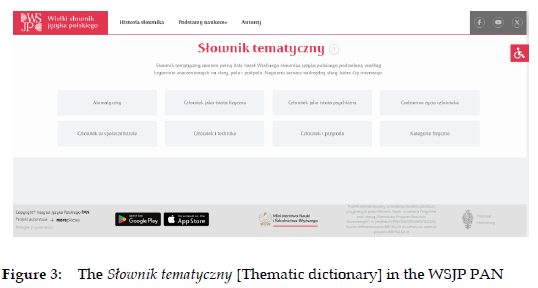
The dictionary makes it possible to access the lexicographic material in different ways. One can check words according to an alphabetical arrangement, but there are also various advanced search options, with the possibility of marking various categories (including thematic ones). Thanks to this solution, it was possible to find dictionary entries that were classified into particular groups and related fields as well as thematic subfields for many years (Żmigrodzki 2018: 215-216; Żmigrodzki 2022: 157-160). At the end of 2022, the bookmark Słownik tematyczny [Thematic dictionary] was added to the top right corner of the home page, which shows how important such access to the vocabulary was for the lexicographers. The rules for using the dictionary are clearly presented on the website in the Jak korzystać [How to use] section, which also includes instructional videos demonstrating how to use the various tools available to users. They were created as part of a modern online guide to this dictionary. One of them focuses to the thematic dictionary (https://www.youtube.com/watch?v=0tySvF1ZKBA)
4. Polish thematic lexicography in the electronic form - New tools and opportunities
The advantages and disadvantages of primarily electronic dictionaries are increasingly more interesting to various researchers (cf. Granger and Paquot 2012; Ferrett and Dollinger 2021) - including those that deal with Slavic languages (cf. Żmigrodzki 2008: 98-123; Balalaieva 2021). The electronic format results in there being no limits to volume as well as the linear arrangement of dictionaries no longer being necessary. Instead, lexicographers are dealing with multimedia data-bases and open, flexible, and interactive systems with various search tools. User may adjust systems' structures to their needs by opening the desired modules. Moreover, electronic dictionaries (especially those that are included on the internet) are available to everyone, and their forms make it possible for lexicographers to implement the necessary modifications and enhancements. Thematic classification therefore seems to be much more effective in an electronic dictionary than in a paper one. Considering this, the advantages and new opportunities of this combination are presented below on the base of the WSJP PAN and SPJS.
4.1 Combining a semasiological dictionary with an onomasiological dictionary
In an electronic dictionary, there are no longer differences among various dictionaries that used to function according to the principle of opposition. In modern printed dictionaries, the divisions into semasiological, onomasiological, and picture dictionaries have also become increasingly more blurred (Kawalya and De Schryver 2013: 180, 182). In electronic lexicography this is much simpler, which is why Kawalya and De Schryver (2013: 185-186) suggest a new useful model of a multilingual dictionary. This model is called the "alphaconceptual+ dictionary", which combines the advantages of these three types of dictionaries and eliminates the faults of each of them separately (cf. Kawalya and De Schryver 2013: 185-186).
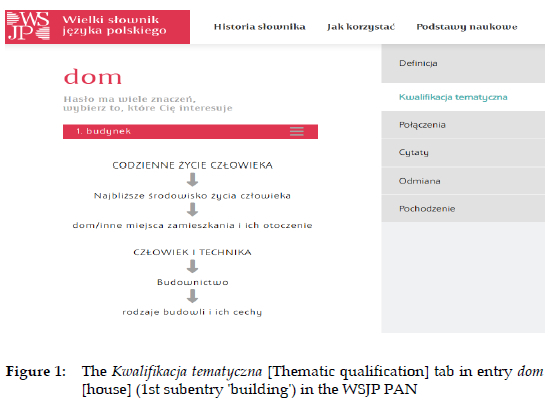
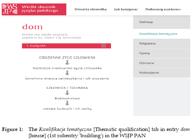
In both of the aforementioned Polish electronic dictionaries, the lexicographers managed to combine the arrangement that is typical of thematic dictionaries with information that can be found in a semasiological dictionary,8and moving from a single entry to a thematic category (and the other way around) is very easy. In both of these dictionaries, the structure of an entry makes it possible to check into which fields of the classification scheme a given unit was classified. In the WSJP PAN the arrangement within an entry, or within its individual meaning (subentry), is structurally organised in the form of expandable tabs. The Kwalifikacja tematyczna [Thematic qualification] tab appears below the Definicja [Definition] tab (cf. Żmigrodzki 2018: 216; Żmigrodzki 2022: 157-158). When opened, it displays information about the thematic classification (Figure 1).
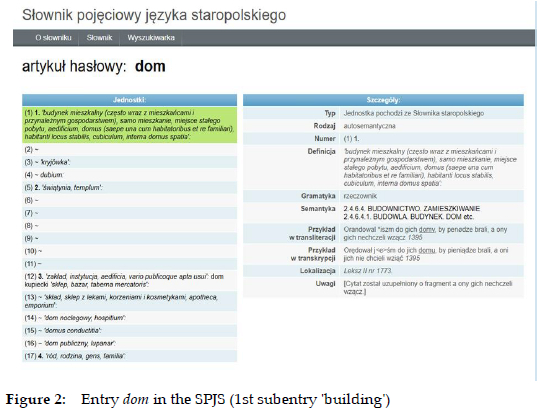
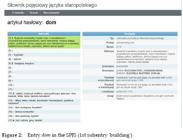
In the SPJS, all relevant information within an entry (subentry) is displayed on the right-hand side, including classification into a conceptual category in the Semantyka [Semantics] tab (Figure 2).
From the side of single entries, such a classification scheme facilitates the semantic characteristics of a given word, and it may emphasise its polysemousness when particular meanings obtain different classifications (partially or fully), which is often the case. Such information is valuable for people who are learning a new language, but it is also good for other users (Batko-Tokarz 2018: 82-83).9 This was especially important in the SPJS due to the nature of the vocabulary that was collected in the dictionary - and assignments to particular fields is a valuable supplementation of a definition. The dictionary user also has access to definitions and other elements of the microstructure, for example in the WSJP PAN an entry includes large collections of various semantic, grammatical, and etymological information, as well as collocations and full sentence quotations (Kozioł-Chrzanowska 2017: 204; Żmigrodzki 2018: 211). In the SPJS, grammatical characteristics as well as examples of word use in medieval texts are provided (Sieradzka-Baziur 2020: 59-63).
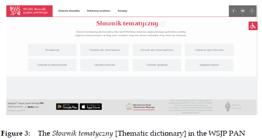
If dictionary users are interested in a given meaning, they can move to the field into which it was classified to see the units that are thematically related to this topic. In both dictionaries, users can search for entries according to a hierarchical thematic index that gives users access to the linguistic material in the fields, even though it looks slightly different in terms of the graphics in each dictionary. In the SPJS, the whole long and complex structure becomes visible in the bookmark Schemat klasyfikacyjny SPJS [SPJS Classification scheme]. Within the Słownik tematyczny [Thematic dictionary] section of the WSJP PAN, users are presented with an expandable hierarchical structure of thematic scheme (Figure 3). Clicking the question mark icon on this page provides instructions on how to use the search engine and the thematic classification principles used in this dictionary.
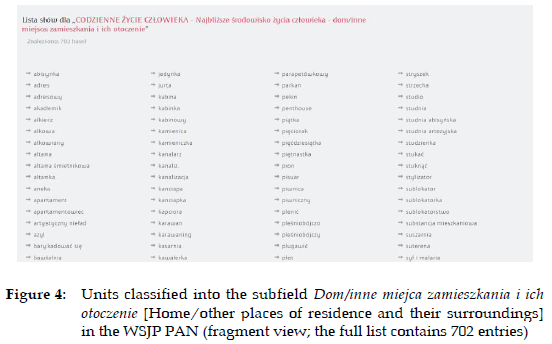
If users search for words using the classification scheme, they can see lexical units assigned to various thematic areas, fields and especially subfields (in alphabetical arrangement). After choosing the unit, they can quickly move to a description that is typical of a semasiological dictionary (Figures 4 and 5).
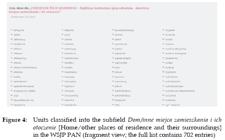
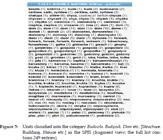
The electronic form of a dictionary helps lexicographers overcome the faults of the thematic order that are visible in the aforementioned printed Polish thematic dictionaries, and this seems to be the solution to problems of metaideography (Burkhanov 1999: 144-147). Such faults may include a frequent lack of definitions of thematically classified units, which results in certain doubts that are related to the reasons for their classification. When classification in printed dictionaries was carried out at the level of individual meanings, the various senses of a single word were distributed across different sections of the scheme. Problems also include the arbitrariness and non-intuitiveness of a given classification or its assignments - especially when there are no definitions - as well as related difficulties when searching for particular units by the thematic scheme. Researchers have mentioned that those units that are thematically non-classifiable or hard to classify have been omitted in such dictionaries (cf. Batko-Tokarz 2019: 114-122). Until now, the lexicographers have combined various kinds of access to the dictionary material through thematic or alphabetical indices in order to remove the faults, and they have used the advantages of both arrangements of a dictionary macrostructure (Burkhanov 2010: 108-109). This was dealt with in the above-mentioned Polish dictionaries (including the historical ones), but they have not solved all of the problems (Batko-Tokarz 2019: 122-124).
4.2 Abundant and rich linguistic material in thematic fields and various opportunities for its characteristics
Both of the above-mentioned Polish dictionaries follow the assumptions that thematic classification should be made on the level of meanings separated within an entry, and that there can be several possible classifications. Due to these assumptions, thematic classification was able to include a considerable number of lexical units. First, in the dictionaries of general Polish, entry articles often have several or even more than a dozen meanings. Second, many of them have been classified several times. According to the recent official statistics of the WSJP PAN10 of as many as 38 215 units were simultaneously classified into two fields, and 4 001 units were classified into three or more fields (Żmigrodzki 2022: 156).
The electronic form of a dictionary definitely facilitates broadly understood thematic classification, as there are no limitations to the volume of such a lexicon. Because of this, the WSJP PAN is the largest thematic dictionary of contemporary Polish at the moment and outrivals the other Polish thematic dictionaries mentioned above. According to the status as of August 2021, it included 141 561 meanings that were classified in a thematic manner. If multiple classifications are, however, taken into account, it turns out that the total number of classifications to thematic categories is as many as 188 037 (Żmigrodzki 2022: 155, 160). Although it refers to the early stage of the development of Polish, the SPJS also includes 80 594 thematic classifications, while 44 177 units were classified thematically into at least one (and often more) categories (Sieradzka-Baziur 2020: 90). A similar number of units are included in the largest translation dictionaries that are arranged thematically and include Polish, while the above-mentioned contemporary Polish glottodidactical thematic dictionaries (Kita and Polański 2002; Kurzowa 2020) or phraseological dictionaries (Lebda 2009) count from several to more than ten thousand entries (Żmigrodzki 2022: 155).
All of this influences the richness of the material in particular thematic categories and the completion of them with new units (Batko-Tokarz 2018: 87-88), because the WSJP PAN (as the dictionary of general language) collects lexical units with various features (e.g., scientific, colloquial, expressive, and official features) that will all be included in a given category if they are connected by the same topic. In both dictionaries, not only single words but also discontinuous units (phrasemes and proverbs) are subject to classification. Due to this, the user obtains simultaneous access to both of those groups in the fields. Thematic fields that are created in this way may be useful for specialised users of a language, such as translators, journalists, or authors of various texts who want to extend their vocabulary on a given topic. Additionally, such fields may be useful for both native and non-native language users. Each of them may adjust the access to the dictionary to their needs, and each user may select the linguistic material in a variety of ways. This is enabled by the advanced search options.
Such a dictionary and its material selection options may be very useful for the researchers of a language (Sieradzka-Baziur 2020: 90-96). With the use of electronic devices, it is easy to carry out varied characteristics of particular categories and their contents and structure as well as quantitative analyses. For example, the field Życie społeczne [Social life] dominates in the most developed group in SPJS (Człowiek [Human]), which counts as many as 166 categories. The next two places are occupied by those aspects that are related to psychological and spiritual life (Sieradzka-Baziur 2020: 85-86). In the WSJP PAN, the two groups with the largest number of thematically classified units were Człowiek jako istota psychiczna [Man as a psychological being] (23,6%) and Człowiek w społeczeństwie [Man in society] (22,18% of the units) (Żmigrodzki 2022: 160). Based on such quantitative analyses, interesting conclusions can be drawn on the thematic structure of the vocabulary and comparative analyses can be carried out. It is possible to see which thematic fields or subfields are the most or least numerous (Sieradzka-Baziur 2020: 86-87; Żmigrodzki 2022: 160-164).
4.3 Advanced search
Electronic dictionaries offer various kinds of searching in which modern researchers are increasingly more interested, including various forms of thematic searching (Pastor and Alcina 2010; Camacho-Niño 2021).
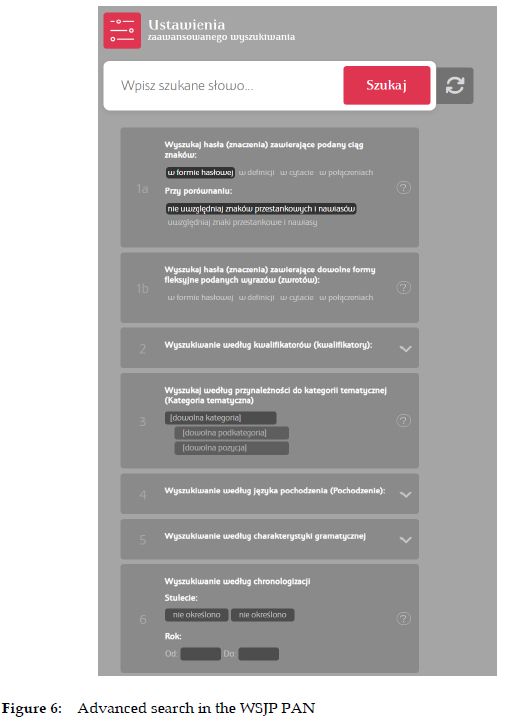
A bookmark Wyszukiwanie zaawansowane [Advanced search] in the WSJP PAN merits special attention for its exceptional appeal (Figure 6). This is because various search filters may be combined with searching by thematic categories, which gives users an almost unlimited opportunity to arrange thematic fields and search for the material that interests them. The option of searching by thematic criteria in an advanced search looks similar to that on the main page of this dictionary (Option 3: Wyszukaj według przynależności do kategorii tematycznej [Search by Thematic Category] (Żmigrodzki 2022: 158-159).
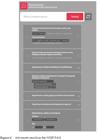
Searching by a specific thematic category can be combined with other options, such as with the option to search by the dictionary's rich set of chronological, expressive, normative, and specialist qualifiers, as well as qualifiers that characterise the vocabulary in terms of the geographical, stylistic, and environmental ranges. Such a searching method can further be combined with searching by the language of origin of a given unit, which enables the semantic analysis of borrowings. Another method of searching is possible by grammar characteristics (i.e., by the types of entries, such as phraseological expressions) or by specified parts of speech. In this way, users may gain access to only the colloquial and expressive vocabulary that is typical of a given specialisation, for example, or to nouns or phraseological expressions that belong to a given thematic category (Batko-Tokarz 2018, 89-91; Żmigrodzki 2022: 158-159). This is a valuable supplementation of the above-described thematic dictionaries of various kinds.
The WSJP PAN has recently added another search option based on the date of the appearance of a given form in Polish (based on the chronologising of dictionary entries in the WSJP PAN). This makes it possible to see, for example, how the vocabulary of a specific stage (such as the beginning of the 21st century) is classified thematically and, thus, in which fields the greatest changes have taken place in this respect. The advanced search, which allows one to search thematic fields and classify the vocabulary that is collected in them according to various criteria, seems to be an invaluable tool that allows one to tailor the thematic dictionary to the diverse needs of its users and, in fact, transform it into the various types of thematic dictionaries that were described above.
5. Summary
Researchers often indicate the centuries-long domination of the alphabetical arrangement in lexicography (McArthur 1998: 150; Kawalya and De Schryver 2013: 174-177; Kay 2015: 54). Although the same is true from Polish lexicography, the results that were collected in this article show that, in previous centuries as well as in recent decades, many thematic dictionaries have emerged in Polish. Polish scientific research is increasingly focusing on onomasiological and thematic lexicography, which is related to the growing interest in these types of dictionaries in world linguistics as well (Kawalya and De Schryver 2013: 178-180). This phenomenon is reflected in Polish electronic dictionaries that enable the new and definitely more effective functioning of this method and overcoming its limitations. Such dictionaries seem to be the lexicons of the future - especially because they are very useful and their functioning in the electronic form is very promising. In Slavic lexicography, a revival of the research on thematic dictionaries can also be observed in the electronic format; this is clearly related to new lexicographic projects in this area. This is evident from a thesaurus of the Czech language that was published at the beginning of the 21st century, which maintained the format of Roget's thesaurus (Klégr 2007). In the following years, a Czech online onomasiological dictionary and database (https://beta.najdislovo.cz/) was developed (Obstová et al. 2022) on the basis of this thesaurus and another Czech thematic dictionary (Haller 1969-1986). Also in Croatian lexicography, the Croatian thesaurus project was described (cf. Nikolić-Hoyt 2004), and now it is a project of the somatic thesaurus for this language (Nikolić-Hoyt 2020). Furthermore, one can find descriptions of projects focused on the compilation of thematic dictionaries for various types of vocabulary (cf. Bihday 2018; Nenasheva 2024).
Endnotes
1. See Batko-Tokarz (2015; 2019: 21-32) for a detailed description of the perception of these terms in European and Polish lexicography.
2. In a dictionary of Slavic linguistic terminology (Jedlička 1977: 222-223), the term thematic dominates, but other terms (sometimes several of them) also appear for a given language. The word ideographical is popular - especially in the Russian tradition (Burkhanov 1999). In older works, the following names were used: subject dictionary - słownik rzeczowy (Polish), and věcný slovnik (Czech). In newer ones terms such as conceptual: pojęciowy (Pol.) and pojmový (Cz.) are also found.
3. In a narrow understanding, a thematic dictionary is identified only with pedagogical dictionaries that are to support language learning (Burkhanov 2010: 242-243).
4. All of those dictionaries have been characterised in detail against the broader background of the Polish linguistic thought (Batko-Tokarz 2019: 39-127).
5. This was prepared in the late 1960s, but communist censorship prevented its publication because the topics reflected a student perspective that differed from the official state propaganda. The dictionary was only published after the fall of communism in Poland.
6. The one part of the dictionary, arranged in alphabetical order, has been provided with subject indexes modeled on McArthur's (1981) dictionary.
7. In the middle of 2022, however, one of the publishing houses made it possible for users to download the electronic version of the Słownik tematyczny polsko-ukraiński [Polish-Ukrainian Thematic Dictionary] (Kononenko, Mytnik and Wasiak 2015). The dictionary was dedicated to Ukrainian refugees who were forced to leave their country and move to Poland because of the war.
8. So far, they do not include image or sound elements. This is one of the challenges that Polish electronic lexicography face, and Polish researchers are thinking about ways of implementing them. For example, Biesaga (2017) analysed which thematic fields were illustrated most often and least often in selected dictionaries by using the thematic scheme applied in the WSJP PAN. Furthermore, she pointed out that it was justified to introduce images that were connected with the thematic division of the vocabulary.
9. This was described in the example of the entry zdechnąć [die]. In the WSJP PAN, seven meanings are separated (https://wsjp.pl/haslo/podglad/35274/zdechnac) with references to (1) the deaths of animals, and (2) the deaths of human beings, (3) to the functioning of man in the physical aspect (tiredness), and (4) in the psychological aspect (boredom), but also, respectively, with reference (5) to plants, when they wither, (6) to machines and devices when they stop working, and (7) to non-material phenomena that which disappear. Thematic classification emphasises this polysemy as each meaning has been classified in a different way. This is helpful especially to less proficient users of Polish, especially because meanings 3 through 7 are colloquial. In the SPJS, two meanings are distinguished in the entry zdechnąć, which receive different thematic classifications (death of people, and death of animals) (https://spjs.ijppan.pl/haslo/index/21523/9978).
10. Work on the WSJP PAN is still ongoing, and these numbers should be higher now.
Printed dictionaries
References
- Anusiewicz, J. and J. Skawiński. 1996. Słownik polszczyzny potocznej. Warszawa: Wydawnictwo PWN.
- Artomiusz, P. 1591. Nomenclator selectissimas rerum appelationes tribus linguis, Latina, Germanica, Polonica explicatas indicans. Kraków.
- Bartmiński, J. and S. Niebrzegowska-Bartmińska (Eds.). 1996-2024. Słownik stereotypów i symboli ludowych. Lublin: Wydawnictwo Uniwersytetu Marii Curie-Skłodowskiej.
- Hallig, R. and W. von Wartburg. 1952. Begriffssystem als Grundlage fűr die Lexikographie. Berlin: Akademie Verlag.
- Kaczmarek, L., T. Skubalanka and S. Grabias. 1994. Słownik gwary studenckiej. Lublin: Wydawnictwo UMCS.
- Kita, M. and E. Polański. 2002. Słownik tematyczny języka polskiego, Łódź: Wydawnictwo Literatura.
- Kononenko, I., I. Mytnik and E. Wasiak. 2015. Słownik tematyczny polsko-ukraiński. Warszawa: Wydawnictwo PWN.
- Kucała, M. 1957. Porównawczy słownik trzech wsi małopolskich. Wrocław: Zakład Narodowy im. Ossolińskich.
- Kurzowa, Z. 2020. Ilustrowany słownik podstawowy języka polskiego wraz z indeksem pojęciowym wyrazów i ich znaczeń. Kraków: Universitas.
- Lebda, R. 2009. Wielki słownik frazeologiczny. Kraków: Krakowskie Wydawnictwo Naukowe.
- McArthur, T. 1981. Longman Lexicon of Contemporary English. Essex: Longman.
- Murmeliusz, J. 1526. Dictionarius Ioannis Murmellii variarum rerum. Kraków.
- Mymer, F. 1528. Dictionarium trium lingvarum: Latinae: Teutonicae et Polonicae …. Kraków.
- Pelcowa, H. 2012-2024. Słownik gwar Lubelszczyzny. Lublin: Wydawnictwo UMCS.
- Seretny, A. 2008. A co to takiego? Obrazkowy słownik języka polskiego. Kraków: Universitas.
- Słowarz (so-called). Anonymous author. 1532. Dictionarius seu nomenclatura quatuor linguarum. Kraków.
- Zawiliński, R. 1926. Dobór wyrazów. Słownik wyrazów bliskoznacznych i jednoznacznych. Do praktycznego użytku ułożył Roman Zawiliński. Kraków: "Poradnik Językowy". Accessed at:https://rcin.org.pl/dlibra/show-content/publication/edition/36954?id=36954 (23 April 2005)
- Online dictionaries
- SPJS - Sieradzka-Baziur, B. (Ed.). Słownik pojęciowy języka staropolskiego. Accessed at:https://spjs.ijp.pan.pl/spjs/strona/kartaTytulowa (16 November 2025)
- WSJP PAN - Żmigrodzki, P. (Ed.). 2006-. Wielki słownik języka polskiego PAN. Accessed at: https://wsjp.pl/ (16 November 2025)
- Other literature
- Balalaieva, O. 2021. Класифікації Електронних Словників [Classifications of Electronic Dictionaries], Міжнародний Філологічний Часопис [International Philological Journal] 12(2): 60-63. https://doi.org/10.31548/philolog2021.02.060
- Batko-Tokarz, B. 2008. Tematyczny podział słownictwa w Wielkim słowniku języka polskiego. Żmigrodzki, P. and R. Przybylska (Eds.). 2008. Nowe studia leksykograficzne 2: 31-48. Kraków: Lexis. Accessed at:http://ijp.pan.pl/publikacje-elektroniczne/nowe-studia-leksykograficzne-t-2 (1 April 2025)
- Batko-Tokarz, B. 2015. Słowniki o układzie hierarchicznym - próba uporządkowania pojęć. Język Polski 95(5): 406-417. https://doi.org/10.31286/JP.95.5.2
- Batko-Tokarz, B. 2018. Klasyfikacja tematyczna w WSJP PAN. Żmigrodzki, P., M. Bańko, B. Batko-Tokarz, J. Bobrowski, A. Czelakowska, M. Grochowski, R. Przybylska, J. Waniakowa and K. Węgrzynek (Eds.). 2018. Wielki słownik języka polskiego PAN. Geneza, koncepcja, zasady opracowania: 79-92. Kraków: Libron. Accessed at:https://rcin.org.pl/dlibra/publication/edition/68631?id=68631&from=publication (10 April 2025)
- Batko-Tokarz, B. 2019. Tematyczny podział słownictwa współczesnego języka polskiego - teoria, praktyka, leksykografia. Kraków: Wydawnictwo Uniwersytetu Jagiellońskiego. Accessed at:https://ruj.uj.edu.pl/entities/publication/f52bfbba-4e31-4246-bd1b-f222891e8d06 (12 April 2025)
- Biesaga, M. 2017. Dictionary Tradition vs. Pictorial Corpora: Which Vocabulary Thematic Fields Should Be Illustrated? Lexikos 27: 132-151. https://doi.org/10.5788/27-1-1397
- Bihday, M. 2018. Representation of Lexical-Semantic Classification of the Ukrainian Verbs in the Form of Ideographic Dictionary. Linguistic Studies 36: 44-49. https://doi.org/10.31558/1815-3070.2018.36.6
- Burkhanov, I. 1999. Linguistic Foundations of Ideography: Semantic Analysis and Ideographic Dictionaries. Rzeszów: Wydawnictwo Wyższej Szkoły Pedagogicznej.
- Burkhanov, I. 2010. Lexicography: A Dictionary of Basic Terminology. Rzeszów: Wydawnictwo Uniwersytetu Rzeszowskiego.
- Camacho-Niño, J. 2021. Estructuras de acceso y remisión en los diccionarios del siglo XXI. Moreno Moreno, M.A. and M. Torres Martinez (Eds.). 2021. Estudios del léxico en el ámbito universitario del siglo XXI: 125-148. Barcelona: Editorial Octaedro S.L. Accessed at: https://www.researchgate.net/publication/352996840_Estructuras_de_acceso_y_remision_en_los_diccionarios_del_siglo_XXI (1 April 2025)
- Daković, S. 2011. Słowniki tematyczne w Polsce, Serbii i Chorwacji. Südslavistik online - zeitschrift für südslavische Sprachen und Literaturen und Kulturen 3. Dvojezična leksikografija bosanskog/hrvatskog/ srpskog jezika: 33-52. Accessed at:http://www.suedslavistik-online.de/03/03.pdf (1 April 2025).
- Ferrett, E. and S. Dollinger. 2021. Is Digital Always Better? Comparing Two English Print Dictionaries with Their Digital Counterparts. International Journal of Lexicography 34(1): 66-91. https://doi.org/10.1093/ijl/ecaa016
- França, P.C. 2010. Onomasiological Dictionaries and Ontologies. Dykstra, A. and T. Schoonheim (Eds.). 2010. Proceedings of the XIV Euralex International Congress, Leeuwarden, 6-10 July 2010: 1291-1298. Ljouwert: Fryske Akademy. Accessed at:http://www.euralex.org/elx_proceedings/Euralex2010/121_Euralex_2010_9_FRANCA_Onomasiological%20dictionaries%20and%20ontologies.pdf (8 April 2025)
- Granger, S. and M. Paquot (Eds.). 2012. Electronic Lexicography. Oxford: Oxford University Press.
- Greń, Z. 2023. Klasyfikacja tematyczna słownictwa w leksykografii czeskiej jako źródło do badania zmian w językowym obrazie świata. Falski, M. and E. Kaczmarska-Zglejszewska (Eds.). 2023. Czechy przez naukę języka do rozumienia kultury. Księga dedykowana Teresie Piotrowskiej-Małek: 15-43. Kraków: Libron.
- Hartmann, R.R.K. and G. James. 2002. Dictionary of Lexicography. London/New York: Routledge.
- Hüllen, W. 2006. English Dictionaries, 800-1700. The Topical Tradition. Oxford: Oxford University Press.
- Jedlička, A. (Ed.). 1977. Slovník slovanské lingvistické terminologie = Словарь cлавянской лингвистической терминологии = Dictionary of Slavonic Linguistic Terminology. Praha: Academia nakladatelství Československé akademie věd Praha.
- Kawalya, D. and G.-M. de Schryver. 2013. Introducing a New Lexicographical Model: AlphaConceptual+ (and How it Could Be Applied to Dictionaries for Luganda). Lexikos 23: 172-200. https://doi.org/10.5788/23-1-1210
- Kononenko, I. and I. Mytnik. 2017. Potencjał teoretyczny i praktyczny dwujęzycznego słownika tematycznego. Borys, O., M. Jeż, A. Samadowa and M. Saniewska (Eds.). 2017. Szkice językowe i literacko-kulturowe: 40-57. Warszawa: Katedra Ukrainistyki, Uniwersytet Warszawski. Accessed at: https://open.icm.edu.pl/handle/123456789/19237 (10 April 2025)
- Koutny, I. 2005. A Corpora Assisted Multilingual Thematic Dictionary. Archives of Control Sciences 15(4): 573-582.
- Koutny, I. 2012. From Semantic Networks to Dictionary Structure. Język. Komunikacja. Informacja. Language. Communication. Information 7: 115-128. Accessed at:https://repozytorium.amu.edu.pl/server/api/core/bitstreams/61eb6b33-8db3-4f17-8023-25e811b2968d/content
- Kozioł-Chrzanowska, E. 2017. What Do Users of General Electronic Monolingual Dictionaries Search For? The Most Popular Entries in the Polish Academy of Sciences Great Dictionary of Polish. Kosem, I., C. Tiberius, M. Jakubíček, J. Kallas, S. Krek and V. Baisa (Eds.). 2017. Electronic Lexicography in the 21st Century. Proceedings of eLex 2017 Conference, Leiden, the Netherlands, 19-21 September 2017: 202-220. Brno: Publisher: Lexical Computing CZ s.r.o., Brno, Czech Republic. Accessed at:https://elex.link/elex2017/wp-content/uploads/2017/09/paper12.pdf
- Nikolić-Hoyt, A. 2004. Konceptualna leksikografija: prema tezaurusu hrvatskoga jezika. Zagreb: Hrvatska sveučilišna naklada.
- Nikolić-Hoyt, A. 2020. Iz riznice Benešićeva rječnika i Somatskoga tezaurusa hrvatskoga jezika. Filologija 75: 47-65. https://dx.doi.org/10.21857/y54jofkgqm
- Obstová, Z., O. Tichý and A. Klégr. 2022. Projekt Lexikálně-sémantické databáze češtiny (LSD-Czech): uživatelský pojmový slovník a online databáze. Studie z Aplikované Lingvistiky 13: 86-98. Accessed at: https://studiezaplikovanelingvistiky.ff.cuni.cz/wp-content/uploads/sites/19/2023/01/Zora_Obstova_-_Ondrej_Tichy_-_Ales_Klegr_86-98.pdf (28 April 2025)