The Effectiveness of the "Real-Life-Based School Dictionary" as an Electronic Dictionary
Abstract
The Real-Life-Based School Dictionary (GYTOS) is designed to include the general vocabulary, terms, collocations, idioms, proverbs, synonyms and antonyms of Turkish for primary and secondary school students who are the target audience with monolingual, virtual and code generation and decoding functions. The corpus linguistics method was used in the creation phase of the dictionary and all lemmas were identified and structured on a real-life basis through the created corpus (https://okulsozlugum.com/). The aim of the study was to determine the effect of GYTOS on the vocabulary development of primary and secondary school students. For this purpose, the students' level of experience in using the dictionary was first determined. Then, an achievement test was administered to students who used the dictionary and students who did not use the dictionary to statistically determine the effect of GYTOS on students' vocabulary development. In the study, a 13-question questionnaire was used to determine students' experience of using GYTOS and it was found that they found GYTOS to be highly adequate. Furthermore, students stated that GYTOS was an easy-to-use and accessible resource. As a result of the achievement test, it was found that the scores of two different groups of students at the same level and with the same number of users of GYTOS from the same achievement test showed a statistically significant difference.
Real-life-based School Dictionary; Effectiveness; School Dictionary; Language Skills
Abstract
Die Real-Life-Based School Dictionary (GYTOS) is ontwerp om die algemene woordeskat van Turks in te sluit, asook terminologie, kollokasies, idiome, spreekwoorde, sinonieme en antonieme met eentalige, virtuele en kodegenererings- en dekoderingsfunksies vir laer- en hoërskoolleerders, wat die doeltaalgehoor vorm. Die korpuslinguistiekmetode is in die samestellingsfase van die woordeboek gebruik en alle lemmas is aan die hand van die werklike lewe geïdentifiseer en gestruktureer deur die korpus wat saamgestel is (https://okulsozlugum.com/). Die doel van die studie was om die effek van GYTOS op die woordeskatontwikkeling van laer- en hoërskoolleerders vas te stel. Daarom is die leerders se ervaringsvlak in die gebruik van die woordeboek eers vasgestel. Daarna is leerders wat die woordeboek gebruik het en dié wat dit nie gebruik het nie, aan 'n prestasietoets onderwerp om die effek van GYTOS op die leerders se woordeskatontwikkeling statisties vas te stel. In die studie is 'n vraelys met 13 vrae gebruik om leerders se ervaring in die gebruik van GYTOS vas te stel. Daar is bevind dat hulle GYTOS hoogs toereikend vind. Daarbenewens het leerders verklaar dat GYTOS 'n bron is wat maklik is om te gebruik en toeganklik is. Uit die prestasietoets is afgelei dat die punte van die twee verskillende groepe leerders op dieselfde vlak en met dieselfde aantal gebruikers van GYTOS van dieselfde prestasietoets 'n statisties beduidende verskil toon.
Real-life-based School Dictionary; Effektiwiteit; Skoolwoordeboek; Taalvaardighede
1. Introduction
Dictionaries have always been used as important reference works in language teaching. In this sense, they are indispensable for both native speakers and learners of a language as a foreign language. Today, it is possible to find dictionaries displaying a variety of features, depending on the expectations of the users and the purpose of the dictionary. In this context, researchers have classified dictionaries according to their features. Considering these features, it is clear that dictionaries are classified according to the number of languages they contain, the medium in which they are published, their size, function, ordering of the articles, scope and user group (Bekdaş 2017). One of the types of dictionaries that have been proposed in terms of dictionary typology is school dictionaries. For these dictionaries prepared for school-age students, terms such as school dictionary, children's dictionary, high school dictionary and college dictionary are used in the literature (Hartmann and James 1998). The concept in question corresponds to "a dictionary designed for school-age children". Dictionaries corresponding to this concept generally contain a controlled vocabulary, are supported by visuals and have a simple design (Özkan 2022).
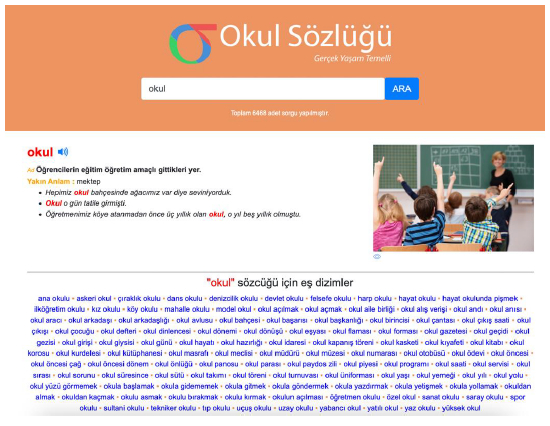
It can be said that the Real-Life-Based School Dictionary (GYTOS), whose effect on vocabulary teaching is emphasised in the study, is a monolingual electronic dictionary that includes the general vocabulary of Turkish, terms, collocations, idioms, proverbs, synonyms and antonyms for the target audience with its code generation and decoding function.
The literature emphasises the need for school dictionaries. It is stated that the need to use dictionaries increases with age and grade level, especially in secondary schools, and that the intensification of course content as grade level increases, and thus the expansion of the vocabulary of the texts used in class, leads to this need. In this sense, students stated that they use dictionaries more frequently each year in order to understand the words in the texts whose meanings they do not know (Melanlıoğlu 2013).
Researchers also stated that there are some shortcomings in the existing school dictionaries. It was stated that a school dictionary should not only be a source that contains the meaning of words but also a source that shows the pronunciation, form and usage characteristics of words (Akcan 2012). On the other hand, Melanlıoğlu (2013) emphasised that the problems students see in dictionaries should be given in bold letters, examples of the connotative and figurative meanings of words should be given, and visual elements should be included. It was also stated that school dictionaries are not created on the axis of a criterion (Çotuksöken 1999).
In general, it can be said that school dictionaries, just like general-purpose dictionaries, have deficiencies in terms of preparation and presentation criteria. In this sense, an original and real-life-based school dictionary can be created as an educational/teaching material by using a special purpose corpus that includes texts from natural language environments such as textbooks, children's literature products, periodical children's publications, etc. that children may encounter from primary school to high school. In this sense, it can be said that the Real-Life-Based School Dictionary, which is based on information technologies, is easily accessible, and has qualities that are different and fully meet the needs when other school dictionaries are considered (Özkan 2022).
1.1 GYTOS as a school dictionary
A special domain corpus was used to construct the Real-Life-Based School Vocabulary. The special field corpus includes two main layers. The first layer of the corpus is the Turkish Children's Literature Corpus, which is a special domain corpus in which Turkish Children's Literature is the subject of qualitative and quantitative research. The "Turkish Children's Literature Special Area Corpus", which contains 8,639,522 million lexemes, has been built using the principles and methods of corpus linguistics. Textbooks approved by the Ministry of Education were included in the second layer of the corpus. In this sense, the second layer of the corpus includes textbooks and periodicals containing 2,047,135 lexemes.
GYTOS contains a total of 49,279 items, which were sourced from the afore-mentioned corpus of these lemmas. 13,801 are enriched with visuals/graphics. 13,801 of these items were enriched with visuals/graphics and the pronunciation of each item was added with a voice button in the word search interface of the dictionary.
In addition, this GYTOS contains 4,712 idioms and their explanations, 2,847 proverbs and their explanations, 1,090 abbreviations, 9,698 personal names and their meanings, 18,422 tagged synonyms, 3.919 tagged antonyms, 760 misspelled words, the most frequently encountered spelling rules and 6 different games such as meaning puzzles, idiom puzzles, proverb puzzles, close meaning puzzles, antonym puzzles and correct spelling puzzles (see https:// okulsozlugum.com/).
In this context, in order to determine the effect of GYTOS on vocabulary development, the level of students' experience was first determined and secondly, its effect on students' vocabulary development was attempted to be determined with an achievement test.
2. Aim of study
The aim of this study is to determine the extent to which GYTOS meets the expectations of the target group and whether GYTOS contributes to the development of the language skills of the target group, primary and secondary school students.
3. Method
The research used a 13-question evaluation questionnaire which was applied to determine the extent to which GYTOS met the expectations of the target audience. Two groups were formed from students studying in a public secondary school. There are equal numbers of students in both groups and both groups have students from the same grade level (5th and 7th grades). The students in the first group were allowed to use and analyse GYTOS, while the students in the second group were not given a dictionary. Through this 13-question questionnaire, GYTOS was asked to be evaluated by the students using it. In the first stage, the results of this questionnaire are given.
In the second stage of the study, an achievement test was administered to determine the effect of GYTOS on language skills and the results were evaluated using descriptive statistics. The achievement test was administered to 5th graders (40 students with a dictionary and 40 students without a dictionary) and 7th graders (43 students with a dictionary and 43 students without a dictionary). T-test was applied on the achievement scores obtained from this test and the differences were tried to be evaluated statistically.
4. Findings and interpretation
4.1 GYTOS in terms of user (student) experiences
Another concept that appears in lexicographic studies is "user research". User research is carried out to find out what kind of users have what kind of expectations of the dictionary to be presented to the user, what the user finds useful in a dictionary and what the user does not find useful in a dictionary. Jackson (2002: 163) emphasises that the target group that will use the dictionary should be identified before the planning stage. This stage can be carried out in a number of ways, such as field research, surveys, observation or obtaining expert opinion (Atkins and Rundell 2008: 30). Who will be the target users of the dictionary, the age range, the level of education and the purpose of use will reveal a plane that will influence the basic structure of the dictionary. (Factors such as the target user group of the dictionary, age range, education level, and purpose of use reveal a ground that will affect the basic structure of the dictionary.) According to Bowern (2008), the readership, the format of the dictionary, the content of the dictionary, the way in which lexical items are conveyed (indicating the type of word, whether construction and derivation suffixes are shown, whether dependent morphemes are included, etc.), the stages of dictionary preparation and publication are among the most important elements that should be taken into account when creating a dictionary.
In relation to the evaluation of dictionaries by users, user research is also concerned with the attitudes of users towards the dictionary and whether the dictionary has an impact on vocabulary. In this sense, it was ensured that GYTOS was used and experienced by the students. Then, students were asked to evaluate GYTOS.
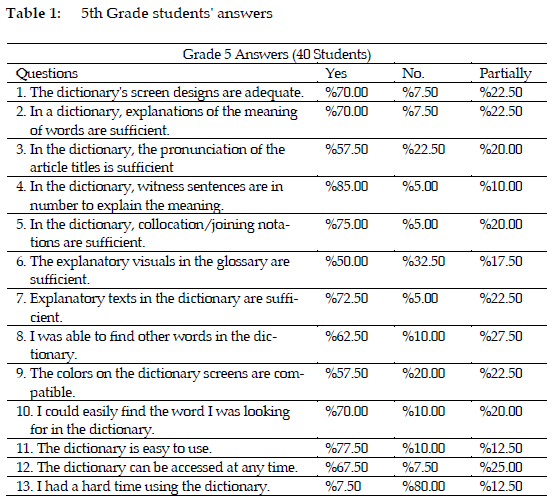
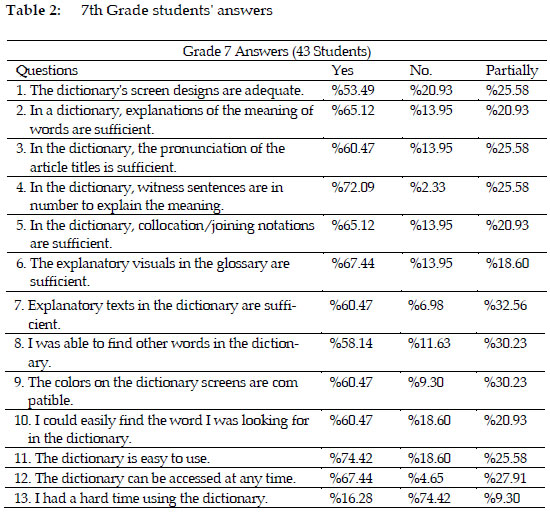
The survey questions and responses regarding the dictionary experiences of students who are stakeholders in GYTOS are presented below (see Table 1 and Table 2). A total of 83 students participated in the survey, 40 of whom were 5th grade students and 43 of whom were 7th grade students.
An analysis of the responses to the 13-question questionnaire designed to determine the students' experience of using the dictionary shows that a high percentage of students (when the sum of yes and partial responses is taken into account) found the screen designs, meaning explanations, pronunciation feature, witness sentences, collocation/joining feature, explanatory text and explanatory images to be sufficient. Again, students found GYTOS easy to use and stated that they had no difficulty using it. They also stated that they could access the dictionary at any time and that they could easily find the words they were looking for in the dictionary. On the other hand, the students also stated that the colours of the dictionary screens were in harmony with each other.
4.2 The effectiveness of GYTOS and its impact on vocabulary teaching
Another dimension of user research is the effectiveness of the dictionary. The extent to which a dictionary is effective in educational settings and whether it contributes to students' vocabulary can also be revealed through user research. In this framework, the effectiveness of a new, original and real-life-based school dictionary as a teaching/learning aid was attempted to be shown, based on corpus linguistic and lexicographic practices. This research on effectiveness was carried out on the basis of the difference between the scores of the two groups in the language proficiency test (see Appendix 1) given to students who used GYTOS and those who did not.
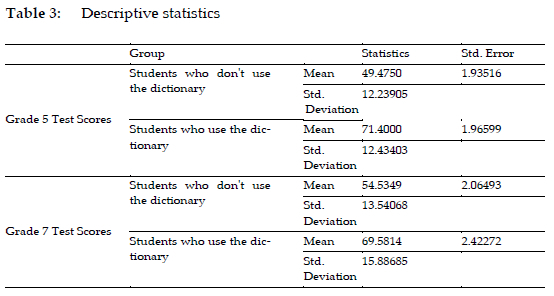
The achievement test was administered to 5th graders (40 students with and 40 students without the dictionary) and 7th graders (43 students with and 43 students without the dictionary). The mean, standard deviation and standard error values of the descriptive statistical calculations revealing the basic statistical properties of the data obtained in the study are given in the table below (Table 3).
According to the table above, the mean score of the fifth-grade students who answered the common test without using a dictionary was 49, the mean score of those who used a dictionary was 71, and the standard deviation of both groups was 12. The difference between the mean scores is quite large, 22 points. However, the standard deviation of both groups is almost the same. This shows that the deviation values of the scores of both groups from the mean are equal.
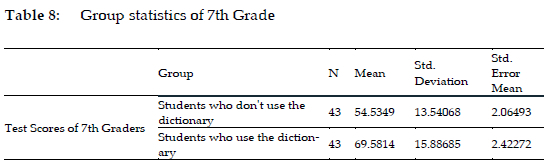
When we look at the descriptive statistics of seventh-grade students, the mean score of those who did not use a dictionary while answering the common test was 54, while the mean score of those who used a dictionary was approximately 70. There is a difference of 16 points between the two groups in the expected direction. In addition, the standard deviations of the two groups are also different. It is noteworthy that especially the seventh-grade students who used a dictionary had a higher deviation from the group mean than the others. This situation can be evaluated separately.
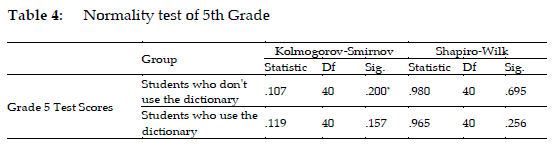
In order to decide whether the analyzed data are suitable for independent sample T-test, it is necessary to check the assumption of normal distribution of difference scores. The results of the normality tests and T-tests for the fifth and seventh-grade levels, respectively, are presented below (see Table 4).
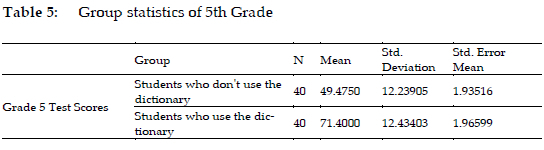
The results of the Shapiro-Wilk test (.695 and .256, p>.05) and the Kolmogorov-Smirnov test (.200 and .157, p>.05) on the difference in the scores of the exam results of two groups of fifth grade students who used GYTOS and those who did not use GYTOS were both greater than the reliability level of .05. Therefore, it can be assumed that the research data are normally distributed. Therefore, the data are suitable for a T-test. As the aim was to show the difference between two independent groups on a single variable, it was decided to conduct an independent sample T-test (see Table 5).
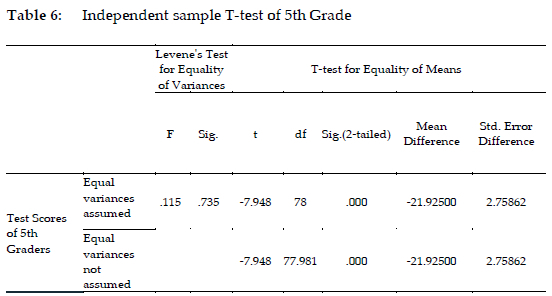
It can be seen that the mean scores of the fifth-grade students who use a dictionary are significantly higher than the mean scores of those who do not use a dictionary. However, in order to make this difference statistically clearer, it is necessary to look at the T-test results (see Table 6).
When the above findings are analyzed, it is seen that there is a significant difference between the test scores of fifth grade students who use dictionaries and those who do not use dictionaries [t(78)=.000, p<.05]. Based on this result, it can be argued that the number of correct answers given by the two different groups of students at the same level and with the same number of correct answers to the same test questions showed a statistically significant difference (see Table 7).
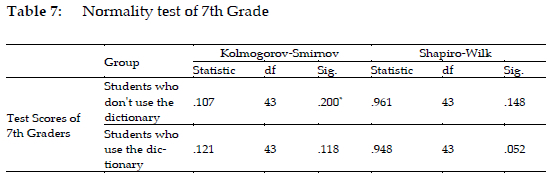
Both the results of the Shapiro-Wilk test (.148 and .052, p>.05) and the results of the Kolmogorov-Smirnov test (.200 and .118, p>.05) on the difference in the test scores of the two groups of seventh-grade students who used GYTOS and those who did not were greater than the .05 level of reliability. Since the research data showed normal distribution and met the normality assumption, it was accepted that the data were suitable for the application of T-test. As the aim was to show the difference between two independent groups on a single variable, it was decided to conduct an independent sample T-test (see Table 8).
It is seen that the mean scores of the seventh-grade students who use a dictionary are higher than the mean scores of those who do not use a dictionary (see Table 9).
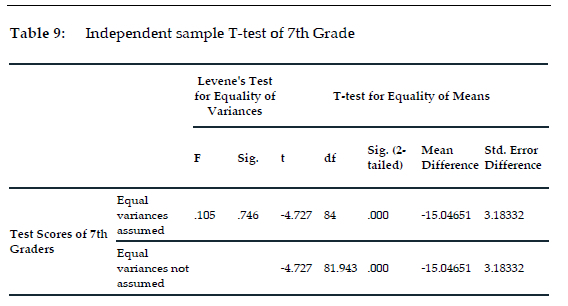
When the results of the independent sample T-test are analyzed, it is clear that there is a significant difference between the exam scores of seventh-grade students who use dictionaries and those who do not use dictionaries [t(84)=.000, p<.05]. Therefore, it can be said that the use of dictionary created a statistically significant difference in the number of correct answers given by two different groups with the same level and equal number of students to the same exam questions.
The dictionary was also tested in classroom settings and it was concluded that it has the potential to meet user needs to a high degree. This result was obtained by recruiting students. In the study conducted with 5th and 7th grade students, it was statistically determined that there were significant differences in the achievement tests administered between those who used GYTOS and those who did not.
The study found that there was a significant difference between the test scores of fifth grade students who used a dictionary and those who did not [t(78)=.000, p<.05].
Again, it was observed that the exam scores of seventh-grade students who used a dictionary and those who did not use a dictionary showed a significant difference [t(84)=.000, p<.05]. Based on this result, it can be said that the use of GYTOS shows a statistically significant difference in the scores of two different groups of students at the same level and with the same number of students on the same achievement test.
5. Conclusion
Scientific methods should be used at every stage of a dictionary, from its creation to its delivery to the end user. It would not be wrong to say that the dictionaries created so far contain word lists and configurations at an intuitive level. In this sense, it can be said that GYTOS is a dictionary created with modern lexicographic methods. On the other hand, whether the dictionary is effective in educational environments and whether it can contribute to the users' vocabulary is a situation that needs to be determined separately.
It can be said that GYTOS, which was tested in course environments, has the potential to meet user needs to a high degree. It was found that there was a significant difference between the exam scores of the fifth grade students who used GYTOS and those who did not use a dictionary [t(78)=.000, p<.05]. Again, a significant difference was found between the test scores of seventh grade students who used a dictionary and those who did not [t(84)=.000, p<.05]. Based on this result, it can be said that the use of GYTOS shows a statistically significant difference in the scores of two different groups of students at the same level and with the same number of students on the same achievement test.
References
- Akcan, İ.P. 2012. Türkçe Öğretiminde Sözlük Kullanımı: Türkçe Çalışma Kitaplarında Sözlüğe Gönderen Alıştırmalar. Aksan, M. and Y. Aksan (Eds.). 2012. Türkçe Öğretiminde Güncel Çalışmalar: 93-102. Ankar: Şafak Yayınları
- Bekdaş, M. 2017. Sözlük Türlerinin Tasnifi (Classification of Dictionary Types). Route Educational and Social Science Journal 4(4): 52-59.
- Bowern, C. 2008. Linguistic Fieldwork: A Practical Guide. New York: Palgrave Macmillan.
- Çotuksöken, Y. 1999. Okul Sözlükleri Üzerine. Kebikeç 7-8: 61-65.
- Hartmann, R.R.K. and G. James. 1998. Dictionary of Lexicography. London/New York: Routledge. http://okulsozlugum.com/. Date of access: 2-4-2024.
- Jackson, H. 2002. Lexicography: An Introduction. London/New York: Routledge.
- Melanlıoğlu, D. 2013. Ortaokul Öğrencilerinin Sözlük Kullanma Alışkanlıkları: Nitel Bir Araştırma. Uluslararası Türkçe Edebiyat Kültür Eğitim Dergisi 2(2): 266-284.