Lexicography in action: The traversal from coinage and iconicity to iconisation
Abstract
This paper seeks to connect Lexicography and Critical Discourse Analysis (CDA) by highlighting that the critical potential of Lexicography lies in the coinage of dictionary entries, which can function as semiotic acts that aim to rally the readers around the sign-maker's world view. To illustrate this, Got Israeled, a new entry in the crowdsourced Urban Dictionary added on 21 October 2023, is taken as an example. This entry is defined as the act of allowing someone to share something with you but this person claims the thing as his/her own and expels you. The entry has gone viral on social media and induced divergent attitudes. Its wide reach is due to its iconic nature and coinage during the war on Gaza. The entry has also been heavily resemiotised inside Urban Dictionary and its critical potential has gradually increased clearly recontextualizing the colonization of Palestine and the issue of Jewish settlements. 36 entries added between 21 October 2023 and 10 July 2024 are analyzed at three levels: coinage, iconicity and iconisation. The analysis draws upon Semiotic and Social Semiotic frameworks, which include DeSaussure's (1916) sign system, the Social Semiotic principle of motivated sign (Kress 1993), and Peirce's (1931) principles of hypo-iconicity. An SFL-based analysis exploiting subsystems within the ideational and interpersonal metafunctions is employed to explain the sign's 'iconisation' (Halliday and Matthiessen 2014, Kress and Van Leeuwen 1996/2021, Martin and White 2005). The investigation simultaneously highlights the critical potential of the sign and describes its transformation into a bonding icon rallying people around the writers' world view (Stenglin 2008, 2012).
lexicography in action; coinage; iconicity; iconisation; urban dictionary; motivated sign
Abstract
In hierdie artikel word gepoog om die Leksikografie en Kritiese Diskoersanalise (KDA) met mekaar te verbind. Dit word gedoen deur te beklemtoon dat die kritiese potensiaal van die Leksikografie geleë is in die vaslegging van woordeboekinskrywings wat as semiotiese handelinge kan funksioneer. Laasgenoemde is daarop gemik is om die lesers te laat saamstem met die sender van die teken se wêreldbeskouing. Ter illustrasie hiervan word "Got Israeled", wat op 21 Oktober 2023 as nuwe inskrywing in die skarebenutte Urban Dictionary bygevoeg is, as voorbeeld gebruik. Hierdie inskrywing word gedefinieer as die handeling om iemand toe te laat om iets met jou te deel, maar hierdie persoon eis dan die item as sy/haar eie op en verdryf jou. Die inskrywing het vinnig op sosiale media versprei en uiteenlopende standpunte ontlok. Die breë reikwydte daarvan is toe te skryf aan die ikoniese aard en vaslegging daarvan tydens die oorlog teen Gaza. Die inskrywing is ook in die Urban Dictionary grootliks gehersemiotiseer en die kritiese potensiaal daarvan het geleidelik toegeneem om sodoende die kolonisasie van Palestina en die kwessie van Joodse nedersettings duidelik te herkontekstualiseer. 36 inskrywings wat tussen 21 Oktober 2023 en 10 Julie 2024 bygevoeg is, word op drie vlakke geanaliseer: nuutskepping, ikonisiteit en ikonisering. Die analise steun op Semiotiese en Sosiaal-Semiotiese raamwerke, wat DeSaussure (1916) se tekensisteem, die Sosiaal-Semiotiese beginsel van gemotiveerde teken (Kress 1993), en Peirce (1931) se beginsels van hipo-ikonisiteit insluit. 'n SFL-gebaseerde analise wat substelsels binne die ideasionele en interpersoonlike metafunksies benut, word gebruik om die 'ikonisering' van die teken te verduidelik (Halliday en Matthiessen 2014, Kress en Van Leeuwen 1996/2021, Martin en White 2005). Die ondersoek beklemtoon tegelykertyd die kritiese potensiaal van die teken en beskryf die transformasie daarvan in 'n saambindende ikoon wat mense rondom die skrywers se beskouings van die wêreld verenig (Stenglin 2008, 2012).
die leksikografie in aksie; nuutskepping; ikonisiteit; ikonisering; urban dictionary; gemotiveerde teken
1. Introduction
Lexicography is commonly known as the scholarly field involving compiling dictionaries and editing them (Bergenholtz and Gouws 2012). Mainstream Lexicography prioritizes the objective linguistic descriptions of dictionaries as "objective value-free representations of languages" (Chen 2015: 311) and attributes little attention to the contextualization of dictionary-making. Critical Lexicography, a recent research direction, addresses this gap and showcases that dictionaries are influential ideological texts. Critical Lexicography meshes with CDA, and views language use as a form of social practice conditioned by the context of use and the dominant ideologies (Fairclough 1995). Dictionaries are, therefore, ideological sites that can be understood in terms of the context of use and power dynamics (Bertulessi 2023, Chen 2015, 2019, Fuertes-Olivera and Tarp 2022, Hornscheidt 2008, Pettini 2023). Chen (2015: 362) concentrates on the link between dictionary structures and entries and the external factors of language use stating that "lexicography and its products, dictionaries, are never value-free, apolitical or asocial. Instead, they are subject to ideology, power and politics".
Dictionary writing as "a literate writing activity" is situated within a process of social recontextualization and meaning relocation and "is inevitably bound up with subjectivity, re-representation, objectivity and ideology" (Chen 2015: 312). This entails that dictionary-making is a floating domain that shifts from context to context, practice to another and from sign-maker to sign-maker. According to Linell (1998), recontextualization in Lexicography is concretely realized across three dimensions: intra-textual recontextualization which happens within the same dictionary, intertextual recontextualization which concerns the shifts in meaning-making of the same types of texts situated within different contexts (for example two dictionaries defining the same entry) and interdiscursive recontextualization which occurs across different media and genres (for instance, a dictionary entry and an argumentative text dealing with a dictionary entry). Intra-textual recontextualization is the focus of this paper, a recontextualization afforded by the participatory nature of online crowdsourced dictionaries.
The current literature on Critical Lexicography is centered upon deciphering the ideology related to gender, ethnicity and politics. By means of examining ideology-loaded entries, research studies point out that dictionaries recontextualize ethnic and gender bias in societies (Chen 2015, Fuertes-Olivera and Tarp 2022). These studies have emphasized that ideology is articulated through the selective techniques of the dictionary-maker, which include deleting, replacing, re-signifying … etc. (Chen 2015). With regards to political ideology, studies have demonstrated that projects of dictionary compilation expose the political views of the dominant political groups (Bertulessi 2023) and perpetuate ideologies of racism and colonialism (Hornscheidt 2008).
The study at hand aligns with Critical Lexicography through showing that ideology stands as a mediating force for the coinage of new signs or the mutability of existing ones. The existing literature on Critical Lexicography has adopted a critical stance towards the work of ideology in dictionary-making and has argued that the role of scholars engaging with (Critical) Lexicography research is to uncover the opaque techniques of power dynamics (Chen 2019, Kachru 1995). Though this study acknowledges that Lexicography is a site of ideology encoding, it maintains that dictionaries can also be sites for semiotic acts, giving voice to the marginalized and oppressed groups. Chen (2019) articulates the dual work of dictionaries as domains of power and resistance. Within the latter, regional dictionaries, and dictionaries for minority groups can disrupt the hegemony of dominant dictionaries. Resistance Lexicography can be a promising direction of research within Critical Lexicography. To the best of my knowledge, there is a scarcity of substantive research on uncovering the dynamics of meaning-making in lexicography in action. This paper aims to address this gap. To do so, it offers to analyze 36 new entries of the lexical item Got Israeled, a new coinage in the online Urban Dictionary that first appeared on 21 October 2023 and was widely resemiotised within the dictionary and in different generic and mediated forms outside it. This paper argues that these entries are semiotic acts introducing, in an escalating way, the agency and the subjective views of the compilers, who aim to turn the new entry into a semiotic force that recontextualizes what they consider as an unrightful colonization of Palestine. Within a period of two weeks, the entry had proliferated and shifted, in an incremental way, from an almost apolitical sign to a politicized one overtly recontextualizing the Palestinian cause through pointing to hot political issues, like the Jewish settlements and the religious grounding of the colonization of Palestine. The critical potential of these entries derives from the iconic nature of the sign. Studying the critical force of iconic signs based on the resemblance between form and meaning remains underexamined in the literature.
Methodologically speaking, the current studies on Critical Lexicography have pointed out that power manifestations in lexicography are mediated through the selective techniques of censoring, altering, replacing and redesigning (Chen 2019). This study, however, contends that lexicography, as a semiotic act, exploits techniques of attitude construction and expansion. The compiler's role is to use the discourse resources to rally the reader around his/her world view. In the sign under examination, I propose to delve into how the writers of the different dictionary entries exploit the semiotic principles of motivated sign, iconicity and iconisation to produce an effect upon the reader.
To decipher the dynamics of attitude amassing in the dictionary entries under examination, three levels of analysis are adopted:
- The coinage of the sign
- Its iconicity
- Its iconisation
The first level draws upon De Saussure's (1916) principles of the sign system to highlight the innovative relation between signifier and signified and it explains, through the principle of the im/mutability of the sign system, the social forces triggering its mutability. Along with this, the analysis adopts a Social Semiotic perspective to underscore the motivated relation between signifier and signified in the coinage of the present sign (Kress 1993).
The second level exploits Peirce's (1931) typology of signs to explore the semiotic relation foregrounded in this iconic sign. By using Peirce's principles of hypo-iconicity, this analysis underscores how the principles of direct resemblance and metaphoric distortion in hypo-iconicity build up direct connection with reality and foreground the critical potential of the sign.
The third level shows how the entry has evolved from iconicity to a bonding icon (Stenglin 2022: 314). To highlight this, the analysis draws upon the principles of iconisation, an evolving research direction in Social Semiotics (Stenglin 2008; 2012; Martin 2010). The main tenets of iconisation are that signs turn into bonding icons when they rally people around a set of values (Stenglin 2022). This paper posits that the entry under examination has evolved into a bonding icon through amassing attitudes uniting internet users, though in divergent ways, around the sign. This is translated in its wide resemiotisation inside the dictionary and outside it in different mediated forms, its viral status, as well as the substantial positive and negative reactions the sign has triggered. In the process of its shift into a bonding icon, the entry realizes simultaneously an ideational role and an interpersonal one: it represents the world from the standpoint of the entry writer and rallies people around this world view. To highlight the interface between ideational and interpersonal meanings in the production of this sign, I adopt an analysis drawing upon the ideational and interpersonal metafunctions in SFL (Systemic Functional Linguistics) (Halliday and Matthiessen 2014, Martin and White 2005). A Systemic Linguistic analysis is undertaken building upon subsystems within the ideational and interpersonal metafunctions, which include the systems of represented participants, process types, participant roles and metaphoric distortion, on the one hand and the systems of interactive participants and graduation, on the other. The different systems will be explained in details in section 6.
This introduction has argued that a critical reading of lexicography should be combined with the linguistic one to grasp the meaning potential of dictionary entries. Such a critical reading is especially relevant in lexical entries with an action force. Based on these premises, the paper is structured as follows: section 2 grounds the study within the research direction of language as a semiotic act, section 3 introduces the discoursal and sociopolitical context of the study. It presents the sociopolitical context of the sign coinage, introduces the dictionary under examination and narrows down the focus to the entries and their generic structure. Sections 4, 5 and 6 analyze the entries at the three levels mentioned above: coinage, iconicity and iconisation using tools from semiotics and SFL. Finally, in section 7, a framework for analyzing signs with an action force is introduced.
2. Semiosis in action
This study draws upon the principle of semiosis as action developed by Peirce (1907). By semiosis, Pierce (1907: 411), means "an action, or influence, which is, or involves a cooperation of three subjects, such as a sign, its object, and its interpretant". In this triadic relation, the interpretant's role is central and is understood as the thing that the sign triggers for the interpreter, which can be a feeling, an effect or a thought (Strand 2013). Peirce's semiosis constitutes a paradigm shift from DeSaussure's structure of sign, according to which a sign is inherently communicative as it is a pre-defined and fixed connection between a signifier and a signified (DeSaussure 1916). Peirce's semiotics foregrounds the signs as mediators to action. The meaning of signs is not fixed as the interpreter assigns meanings to them through processes of construction, reconstruction and validation (Strand 2013). The principle of interpreter's role in assigning meaning to signs is congruent with the principle of reader agency in Social Semiotics, which advocates that reading is a meaning-making action rather than a reception phenomenon (Kress 2010). The principle of reader agency is more evident in this media age, which affords a more participatory role to the reader (Moalla 2023).
The semiotic effect advocated by Peirce cannot be understood without reference to authorial agency. Social Semiotics describes the role of the designer as semiosis in action or semiosis at work, highlighting the agentive power of the designer in meaning-making and his/her interest in the process of design. Kress and Van Leeuwen (2001) equate semiosis in action with changes in representation, which are done through the action of individuals. This action cannot be dissociated from the macro-level changes in the social context. Kress and Van Leeuwen (2001: 36) describe the role of social forces in semiotic action as "all semiotic action is social: that social action changes the actor, the acted on or acted with".
To sum up, this paper suggests semiosis in action as a framework for understanding the dynamics of meaning-making in the coinage and interpretation of dictionary entries. This framework is aligned with Peirce's semiosis as action along with the principles of CDA and Social Semiotics. It is understood at two levels. First, in line with CDA, signs are mediated forms that simultaneously recontextualize the world and reflect the authorial voices. Therefore, signs "shape how we think and act in the world" (Ledin and Machin 2018: 15). Second, signs are not fixed entities. They induce action that can be translated into a thought, a feeling or an effect. Of special interest here, is how signs trigger feelings and attitudes. This kind of action is aligned with the principle of iconisation in Social Semiotics, according to which signs align and unite people around a set of values, which are induced by the authorial discoursal strategies.
3. Context of the study
Chen (2019) maintains that modern lexicography should be more critical through going beyond the text to the context of text production and its power dynamics. He proposes three phases of lexicographic analysis that include social analysis, discourse analysis and text analysis. This paper aligns with this methodology. This section proposes simultaneously to anchor the sign under examination within the sociopolitical context of its coinage and to ground it within the generic tradition of online dictionaries before undertaking a text analysis in the following sections.
The entry under examination was added to Urban Dictionary, an online crowdsourced dictionary about new lexis and slang words (Ro 2019). Internet users can add their lexical entries. After approval, the entry appears with the name of the writer and the date of entry. Internet users can upvote or downvote it and share it on social media platforms. From its creation by the computer science student Aaron Peckham as a humorous parody to scholarly dictionaries, Urban Dictionary has become very notorious with 65 million visitors every month. It is also widely used by linguists to keep record of slang words entering into the language (Ro 2019).
Urban Dictionary aligns with online dictionaries, which are increasingly appearing as alternative forms of dictionaries along with the traditional printed ones. Meta-lexicography research on online dictionaries has yielded divided views relative to their textual features and content. Advocates of this emerging genre argue that it allows selected searches of entries and rapid access to them (Kirkness 2004). At the content level, e-dictionaries, especially those treating slang words, can give voice to minority groups to counterbalance the dominance of standard language-based dictionaries (Coleman 2004). Pettini (2023) expands on this, suggesting that printed dictionaries, being produced by multinational publishing industries, reflect the interest of the dominant groups. Online dictionaries give voice to the oppressed and marginalized groups. Critical voices about slang online dictionaries emphasize the poor quality, and the inaccuracies of many of them (Liu 2015) and the lack of a conventionalized structure (Gouws 2014). Critics also contend that online dictionaries proliferate discourses of offensiveness and hate (Pettini 2023).
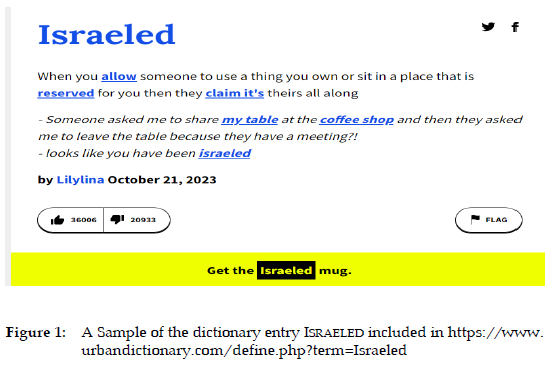
As to its generic structure, the homepage in Urban Dictionary includes four components: (1) the heading of the homepage, (2) a horizontal bar for the menu, (3) a search bar and (4) a right-hand side section for the coinage of new words including also small icons for social media sharing. The dictionary exploits the interactive affordance of the internet allowing users to exert different actions like clicking on the search bar, adding an entry, and sending a question (Urban Dictionary 2024). With reference to the expression under consideration, the search bar includes two entries, the verb and noun (Israel and Israeled) along with other compound nouns. The noun 'Israel' includes many entries, mostly coined in the years 2000s and more recent versions were added in November 2023. The definitions have clear political orientations and echo divergent views about the state/ entity of Israel. On 21 October 2023, for the first time, a new entry in the verbal form, Got Israeled, was added. This entry is defined as the act of allowing someone to share something with you but this person claims the thing as his/her own and expels you. The sign-maker takes the example of sharing a table in a restaurant with a stranger, who ends up expelling you pretending s/he has a meeting. Five entries were coined on the same day (21 October) by different writers with different pseudonyms. Thus, it is difficult to decide which of them is the original entry, especially that the interdiscursive recontextualization of the entry in other media and genres (online magazines and blogs) refer to one entry appearing on the 22nd as the original. For this reason, I will consider all the entries appearing on 21st as the original entries.
Starting from 22 October and during 9 months, the sign has gone viral on social media and has been widely resemiotised inside Urban Dictionary. The resemiotisations have shown, in an escalating way, more politicized definitions of the sign. The link of the sign with the colonization of Palestine becomes more direct. The wide reach of this entry and its viral status are mainly due to its iconic nature and its coinage against the backdrop of the Israeli war on Gaza, which may explain the increasing political orientation. The sign is also resemiotised outside Urban Dictionary in different mediated forms (blogs, videos, billboards, online journals) by advocates of the Palestinian cause as well as by defenders of Israel.
Grammatically speaking the verbal form of the entry is used in the passive voice 'be Israeled' in the simple, progressive and perfective aspects (11 entries), in the passive voice with the mutative 'get' as in Got Israeled (16 entries) as well as in the active To Israel (11 entries). Got Israeled is used generically to refer to the verbal realizations of this entry. Starting from May 30th, six different definitions of the verb had been coined, very probably by pro-Israeli writers, to counter the iconisation of the verb but the definition did not achieve the viral status. Since these entries have a different meaning, they are not within the scope of this study.
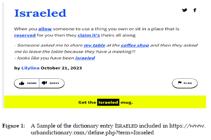
The generic structure of each entry aligns with the typical structure of dictionary entries outlined by Fuertes-Olivera and Tarp (2022). It includes a headword highlighting the verbal form of the entry although such grammatical information is not explicitly mentioned as in standardized printed and online dictionaries. The head word is followed by a co-text, which is divided into a definition followed by a usage example in a concrete situation and ends with a sentence example. The generic structure exhibits a few specificities, which are congruent with the communicative function of crowdsourced dictionaries. As illustrated in the sample entry in Figure 1, the top right corner includes social media links to help the user share the entry. Below the sentence example, the pseudo name of the writer and the date of addition are included. At the bottom of the entry, two icons are provided allowing the user to react by upvoting, or downvoting.
4. Coinage: Mutability and motivation
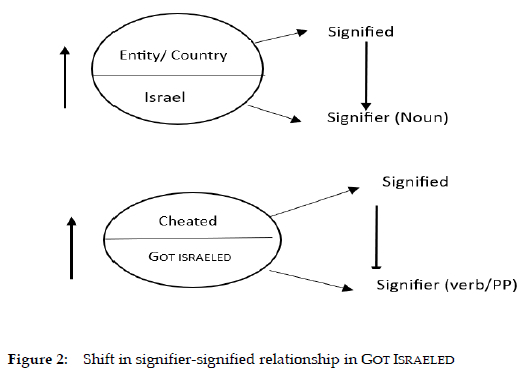
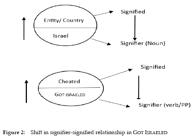
The entry is considered as a sign that partly subscribes to the structure of the sign in DeSaussure's sign system (1916). A sign, in this framework, is an intrinsic, conventionalized, inherently communicative connection between a cluster of sounds, a signifier and a concept, a signified. The sign under examination is a combination of a signifier in the passive voice with a mutative 'got' (cf. Halliday and Matthiessen 2014: 349) and a signified, 'to be cheated' by someone or a group of people, who take something that used to belong to the victim.
Got Israeled is directly associated with a previous sign in the nominal form (Israel), which is also a controversial sign within Urban Dictionary. DeSaussure refers to this shift as the mutability of signs that may affect the signifier, and/or signified and/or the relationship between them (DeSaussure 1916). Despite the phonological resemblance between this sign and the previous nominal form, the mutability occurs at the three levels as shown in Figure 2.
In DeSaussure's framework, language is an inherited immutable system with a fixed relationship between signifier and signified. The individual and linguistic community have little freedom to control or change it. He justifies this fixedness by the fact that "a particular language state is always the product of historical forces and these forces explain why the sign is unchangeable, i.e. why it resists any arbitrary substitution" (DeSaussure 1916: 72 emphases added). Despite the immutability of signs, DeSaussure argues that language is unable to resist changes at a certain point in time. He posits two factors for sign mutability, which are time and social force. Time allows social force to exert sign mutability but the shift is only possible by the agreement of the community of speakers. His theory provides manifestations of language change (signifier, signified and relationship between them) but its description of time and social force as contributors to sign mutability remains vague and not thoroughly described (Holdcroft 1991).
Many critics attribute DeSaussure's failure to account for language mutability to the fact that he describes the relationship between signifier and signified as arbitrary and unmotivated. On the contrary, Holdcroft (1991: 53) maintains that, beyond onomatopoeia, many signifiers are "appropriate for the signifieds", at different levels of appropriateness, which are divided into categorical and structural ones. Categorical appropriateness refers to the correspondence between grammatical categories and conceptual ones. For instance, nouns denote entities and verbs denote action. Structural appropriateness refers to the link between sentence structure and the structure of thought.
In the Social Semiotic Theory, this appropriateness is conceptualized within the notion of motivated sign (Hodge and Kress 1988, Kress 1993). In this theory, the motivated sign is the result of an interplay between the social context, the material features of signifiers and the individual's contribution to the production of signs (Björkvall and Karlsson 2011). The social/cultural dimension is the superordinate force in meaning-making that dictates social practices and forms of discourse. The making of meaning resides in the intersection between the agreed upon social meaning attributed to signs and the material features of signifiers (for instance, the grammatical category). In this interplay between the social and the structural, a motivated sign is generated. Grammatical and lexical categories and other semiotic modes are culturally established and materially appropriate to express certain meanings. Kress (1993) illustrates this with the example of the circles (signifier) being apt for car wheels (signified). Social practices execute a force in transforming the material features of signifiers into meaning. The individual sign-maker is aware of the fact that signs have a meaning potential dictated by culture/society and the material features of the sign, and exploits this connection to express the desired meanings. The signs produced are "motivated by the producer's interest and the characteristics of the objects" (Kress 1993: 173).
To illustrate this triadic relationship between the social, material and individual in the sign under examination, the sign makers' choice of the root 'Israel' is motivated by the socio-political context of the colonization of Palestine and its appropriateness is accentuated against the backdrop of the war on Gaza. The use of the signifier in the past participle is also materially appropriate to express the signified, the act of being cheated. This sign aligns with Kress's description of motivated sign as transparent in which the reader can easily see why the signifier Got Israeled is used to express the signified. Accordingly, the writers of the entries have drawn upon the choices available in grammar and dictated by context to produce signs. Kress (1993: 174) describes this as a selection process of what to be presented and how to be presented through the use of apt signifiers, which should have "criterial characteristics in respect to the object to be presented, that is, it becomes, the signified". The selection process also reflects the sign maker's relation to an object or event at a very particular context of the situation to reflect his/her intentions, purposes, world views and political positions. The sign makers, who are obviously positioned in favor of the Palestinian cause, have exploited the criterial characteristics manifested in Jewish settlement and the genocidal acts against the people of Gaza to transform the name 'Israel' into a verb in the past participle form as an apt signifier for the signified 'be cheated'. In the selection of the apt signifier, a metaphorical relation is selected by the sign-maker, who believes that the metaphor has the appropriate characteristics for the signified (Kress 1993). Taub (2004: 9) illustrates this criterial aptitude in connection with the coinage of new signs deriving from existing signs. She argues that the use of the new signs reflects the users' beliefs about the original sign. She exemplifies that 'dogged persistence' reflects our attitude towards 'dogs' as patent and persistent.
The concept of motivated sign, which underscores the interplay between the social anchoring of signs, the individual contribution in their production and the signs' material appropriateness explained above, can account for sign mutability. According to Kress and Van Leeuwen (2001), changes in the linguistic system like the mutability of signs are motivated by the larger scale social, economic and political practices and are situated within the domain of ideology. Sign mutability explains the ideological positioning of the sign-maker. The ideological embedding of sign mutability can be a concretization of DeSaussure's notion of social force. This force is, however, not necessarily extended over a long period of time. Kress and Van Leeuwen (2001: 36) correlate the force of change in society with the intensity of change in modes of representation saying that "the intensity of the dynamic for change in practices increases the intensity of the dynamic of change in the various articulatory modes, and in the discourses which they articulate". Seen from this perspective, we can say that changes of attitudes and growing empathy towards the Palestinian cause have induced this coinage.
This section draws upon the Social Semiotic principle of motivated sign according to which signs are motivated by social forces and the sign-maker's interest. The latter chooses the materially and socially appropriate signifiers to express the intended meaning (Van Leeuwen 2005). In this process, ideology stands as a mediating element that can explain the choice of signs and their mutability. From this perspective, there is no neutral arbitrary sign and all signs are subject to criticism. Therefore, CDA rests on the principle of motivated sign to undertake a critical reading of signs. (Kress 1993). The following section will highlight how the iconic nature of Got Israeled facilitates its ideological work adopting Peirce's principle of 'hypo-iconicity in iconic signs (Farias and Queiroz 2006).
5. Iconicity: Resemblance and metaphoric distortion
In the essay entitled 'on a new list of categories' in Syllabus, Peirce divides signs into icons, symbols and indexes (Peirce 1931). Indexes relate signs with the ideas they represent with a factual relation, for instance smoke as representation of fire. Symbols connect signs with the idea they represent by inferred characteristics as in white color symbolizing life. Icons relate signs with the objects they represent by shared qualities such as, phonological resemblance in onomatopoeia. Unlike DeSaussure, Peirce asserts that icons are not marginal signs but central to communication (Chu 2020). Peirce highlights the importance of icons saying "every assertion must contain an icon or a set of icons, or else must contain signs whose meaning is only explicable by icons (Peirce 1931 CP 1.158).
Peirce introduces hypo-iconicity as a conceptual framework to describe the essential features of iconic signs. These features are direct resemblance, schematization and metaphoric distortion. In resemblance, the sign has a direct straightforward resemblance with an object in real life (Chu 2018, 2020). Metaphoric distortion is a distancing in the expression of meaning between the sign and the object. The sign is placed in a new environment, which invites the reader to exert an interpretation of the sign but this interpretation does not prevent the reader from establishing and reconstructing the historical contextual connection with the object (Chu 2018, 2020). Schematization refers to the transformation of the icon into a pictural diagrammatic form to gain some degree of abstraction. Since the icon in this study is verbal, this feature of schematization is not applicable. This aligns with Chu's (2020) statement that the three features are not necessarily present together in iconic signs. Hypo-iconicity is a scale that describes how iconic signs operate within a spectrum from direct resemblance with the object/idea they represent to diagrammatic abstraction and creative/ metaphorical distortion (Chu 2018, 2020).
In the present sign, the features of direct resemblance and metaphorical distortion are applicable and enhance its critical potential by inviting the reader to draw connections. At the resemblance level, by the combined influence of the phonological resemblance with the name, 'Israel' and the resemblance in the shared qualities of cheating according to the sign maker, the reader can make direct connections between the signifier Got Israeled, the signified (taking something from the original owner) and the object/idea in real life 'Israel'. This triadic connection is accentuated by the fact that the sign is a closed one. This is illustrated in the paradigmatic connections this sign can/cannot establish with other signs. As example 1 shows, this sign imposes selection restriction constraints making paradigmatic substitutions of Israeled with other lexical items unacceptable as in b and c.
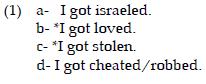
These selection restrictions narrow down the signified to a sudden, negative and painful offense executed by an israeling force upon the 'subject', who is normally a human being taking a goal role. Due to this closedness, signifier and signified become mutually evocative. By virtue of the phonological resemblance between the sign and the name Israel, the reader can establish direct straightforward cognitive connections between the sign and Israel. Taub (2004: 21) stresses the link between resemblance and the reader's cognitive processing and critical reading saying that "there is no such thing as 'resemblance' or 'similarity' in the absence of an observer who makes a comparison: resemblance is not an objective fact about two entities but is a product of our cognitive processing" (Taub 2004: 21). These cognitive connections are likely to stereotype Israel as treacherous, which is obvious even among advocates of Israel. Steinberg (in Lebovic 2024) says in Times of Israel "the usage suggests that Israel inherently represents unjust appropriation and that offensive behavior typifies Israel. It is an antisemitic use of our people's ancient name".
At the level of metaphoric distortion, the idea of Got Israeled is put in a casual, apolitical environment through the use of several techniques in the definition of the entry and in the example section. In the definition, apolitical participants are used, such as 'someone', 'they', and 'you'. In the example section, a casual usage example is given, in which someone is sitting in a table in a restaurant or a coffee shop and allows a person to share the table with him/her but at the end, this person asks him/her to leave because s/he has a meeting. The use of the table metaphor gives a pseudo-objective aspect to the lexicographic entry. The reader, however, can easily connect the sign with the political meaning and establish the inevitable connection with the historical context of the colonization of Palestine due to the resemblance feature of the sign explained above.
In this section, through applying the conceptual framework of hypo-iconicity, the analysis has shown that the sign displays two essential features of iconic sign, which are resemblance and metaphoric distortion. These features boost the critical potential of the sign and allow the reader to build direct straightforward connections between the sign and the political reality of the colonization of Palestine by Israel. In this study, iconicity is used as a distinct term from iconisation. The latter refers to the strategy of pooling attitudes around iconic signs, which is also a strategy of meaning-making aiming to expose the writers' political views and align the reader around them. This will be explained in details in the following section.
6. Iconisation: Ideation and bonding icon
Iconisation is a semiotic tool and an evolving research direction in SFL that examines the role of signs in "solidarity-building and affiliation" (Stenglin 2012: 125). It refers to the process through which a sign (symbol, icon or index) becomes a bonding icon, "a social emblem, which communities rally around or reject" (Stenglin 2012: 125). A bonding icon realizes the bonding through merging ideational and interpersonal meanings (Stenglin 2004). The ideational meanings connect to the field components of register in SFL (cf. Halliday and Matthiessen 2014), such as what the sign is both concretely and symbolically, the social activities associated with it and the underlying social processes (Stenglin 2008, 2012). Such processes can explain how signs are iconized. At the interpersonal level, the bonding is materialized through infusing attitudes to ideational meanings, which results in aligning people into communities and social networks with shared feelings and attitudes (Knight 2010). Turning a sign into a bonding icon is accompanied by a strong interpersonal charge with the amassing of interpersonal attitudes. Martin (2010) claims that ideational meanings are discharged while Stenglin (2012) contends that the ideational is weakened while the interpersonal is intensified and crystallized. The intensification of the interpersonal is mediated through several semiotic resources in verbal and multimodal forms (Wignell, Tan and O'Halloran 2016). Stenglin (2008) explores the expansion of the interpersonal in iconisation through the Appraisal System to gauge the expansion of attitudes (affect, appreciation and judgement) as developed by Martin and White (2005).
To illustrate the iconisation process, flags, for instance, are bonding icons merging ideational and interpersonal meanings. Ideationally, the sign is associated with concrete component parts evoking its historical and cultural anchoring and is associated with different social activities such as hoisting flags during official ceremonies. Interpersonally, values get charged into this sign such as, pride, belonging, patriotism as well as homesickness, affiliating people into communities of shared values called citizens or countrymen.
The sign under examination is a typical bonding icon that merges ideational and interpersonal meanings. Ideationally, despite the surface apolitical definition discussed in the previous section, the sign recontextualizes the colonization of Palestine, the ethical illegitimacy in this colonization, Jewish settlements as well as the issue of violence associated with them. This ideational recontextualization has induced an interpersonal charging and an intensification of attitudes. The large community of internet users are rallied around a set of values such as the condemnation of the offender and sympathy with the victim. This amassing of attitudes has three manifestations:
- The wide resemiotisation of the sign inside the dictionary and in other mediated forms, playing two roles: being simultaneously a manifestation of iconisation and a semiotic tool fostering this process.
- The large-scale reactions to the sign through social media sharing and the large upvoting in Urban Dictionary. Zappavigna (2019) refers to this as an ambient affiliation through which the sign bonds internet users virtually.
- The use of semiotic resources in the definition to underscore the writers' attitude and the attempts to align the reader with it.
The current literature contends that a bonding icon triggers alternative reactions: communities either endorse an icon or reject it. In both situations, the icons are "supercharged and radiate specific values for communities to rally around" (Stenglin 2022: 6). Bond-icons evoke the communities' positive attitudes towards an icon, while anti-cons evoke rejection (Carr 2023, Stenglin 2022, Knight 2010). In both cases, bonding icons transcend differences and lead to unity and conformity. Stenglin (2012) argues that the Olympic torch is a bonding icon uniting people around the values of excellence, friendship and respect associated with the Olympic values to the point that the Nazi origin of the torch is totally eradicated. To my knowledge, there is a scarcity of research on a bonding icon triggering divergent attitudes across communities. The present paper contends that communities are rallied around the bonding icon according to two opposing directions. Pro-Palestine voices endorse the sign and align around the values it promotes. Pro-Israeli voices reject the sign through downvoting it in Urban Dictionary, and organizing social media campaigns for this purpose. The divergence of attitudes towards a bonding icon is expressed thanks to the affordances of online dictionaries and the crowdsourced ones, in particular.
To uncover the semiotic resources used by meaning-makers for the iconisation of the sign, the analysis draws upon a toolkit from SFL to map the construction and aligning of attitudes. According to this theory, every situation of communication is an act of meaning (Halliday and Matthiessen 2014), which fulfills simultaneously three metafunctions: an ideational, an interpersonal and a textual. In the context of iconisation where ideational and interpersonal meanings are compressed, the two first functions are particularly relevant. They are defined as follows:
- The ideational function refers to the construal of experience through a configuration of participants, process types and optional circumstances. The participants are the represented participants who perform different participant roles depending on the process type. For instance, in the sentence, 'John hits Mary', 'John' and 'Mary' are the represented participants assuming the roles of actor and goal respectively. This meaning is mediated through the material process, 'to hit'. In counterpart, in 'John loves Mary', 'John' and 'Mary' are the represented participants assuming the roles of 'senser' and 'phenomenon' respectively. This meaning is mediated through the mental process, 'to love'.
- The interpersonal function is explored from the principle of interactive participants, which refers to the relation between interactants, who are the participants in a conversation or the writer, on the one hand and the reader, on the other (Kress and Van Leeuwen 1996/2021). Different resources mediate this relation in SFL such as, the articulation of positive and negative attitudes, which can be graduated by intensification or weakening (Martin and White 2005).
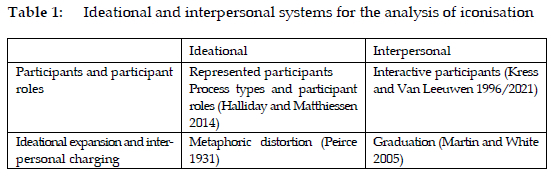
Table 1 introduces the resources used to map the iconisation of the sign under examination. It proposes a two-levelled analysis to gauge the coupling of ideational and interpersonal meanings.
6.1 Represented participants and interactive participants
At a first level, ideationally, focus is laid on the identification of the represented participants, the participants introduced in the definition of the entry and in the example. Emphasis is also put on the roles of represented participants (actor, goal, sayer, senser) and mediating process types (material, mental, and verbal). Interpersonally, emphasis is put on the interactive participants, the writers of the entry, and the readers and how they connect to each other.
6.1.1 Represented participants, their roles and process types
The represented participants can be divided into two broad categories: the israeling participant (oppressor) and the israeled (victim). The oppressor is associated with the third person in the singular and plural, 'someone' is used in 20 instances and 'they' in 17. The victim is frequently associated with the first person singular and the second person plural; 'I' is employed 19 times and 'you' 17. This distribution is meant to identify with the victim, who is either the speaker or the reader. On the contrary, the israeling participant is distanced through the use of the third person to reflect the authors' negative attitude to them. The shift from the third person singular 'he/someone' to the plural 'they' indicates that the israeling act has evolved from the act of a single person to the work of a group of people. In addition to the use of personal pronouns, the two categories of participants are referred to with names. In seven entries, names with apolitical orientation (Elizabeth, Peter, John, Robert and Nick) are used to give a casual dimension to the entries. As the resemiotisations progress in time, proper names with obvious political, cultural and symbolic connotations are used. Names such as, Benjamin, Jacob, Hananya versus Ishmail, Ali, Maryem and Hamad obviously recontextualize the conflict between Jews and Arabs. In this conflict, the writers of the entries are sided by the Palestinians, who are described as the 'rightful owner'. On the contrary, nouns and names such as, 'trespasser' and 'Barbara' (a name in Greek mythology to refer to a foreigner or a stranger) are used to refer to the israeling participant.
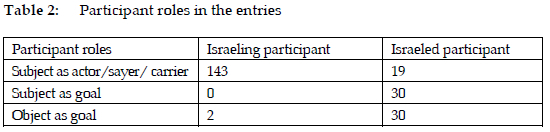
Table 2 shows that the israeling participant has functioned more frequently as the subject of the sentence assuming active participant roles mediated by verbal, material and mental process types (143 versus 19). The material processes with an actor participant role are the most frequent (70 material processes). They are realized by the verbs 'steal' and 'take' (29 processes) aiming to construct the idea of unlawful taking. This culminates in the use of 'to israel' in the active voice, which is exclusively used in the resemiotisations (12 processes). The clear straightforward association of this with the war on Palestine is made through the use of the verb 'to kill' (3 times) as in "when you resist they kill you for it and take everything else you own" (Israeled, 5 November 2023). The Ideological anchoring of the entry is also evident through associating Got Israeled with the victimhood narrative in Jewish communities (Markiewicz and Sharvit 2021). This is mentioned in five entries as in "to act like the victim 24/7, but is able to steal things that belong to someone else" (Israeled, 5 November 2023).
The verbal processes come second in frequency with 63 occurrences. The verbs 'ask' and 'claim' are the most frequent (14 and 15 occurrences respectively). These processes are chronologically sequenced to mean that the israeling act started with asking someone to share something with him/her and then claiming it as one's property as in "when someone asks to share something of yours and then claims it's become theirs and takes it for themselves" (Got Israeled, 28 October 2023).
As opposed to the frequent occurrences of the israeling participant in a subject position with actor and sayer participant roles, the israeled participant assumes these roles only 19 times, which are often associated with the verbs 'share', 'allow' and 'give' (six verbs). The political nature of the entries is also highlighted through the use of the verbs of 'refuse' and 'resist' as in "when you resist, they kill you for it and take everything else you own" (Israeled, 5 November 2023). As Table 2 shows, the israeled participant is more frequently associated with the goal participant role in both subject and object positions. In all the occurrences of subject as goal, the israeled participant is used with the verb 'to israel' in the passive voice or with the mutative 'got'.
6.1.2 Interactive participants
Writers of the entry are portrayed as articulate and biased participants in the different entries by means of several communication strategies. In 19 instances, the writer is identified as the victim as in "I was sitting at my table …. I think I just Got Israeled". The use of pseudonyms such as 'Israeled', 'an Israeled man' indicate the direct involvement of the writer. Another manifestation of the writers' bias is the use of pseudonyms with clear political affiliations such as 'October Revolution' 'FreeFelestin'.
Writers establish direct bonds with the reader. This is illustrated in 17 entries, where he/she addresses the reader directly and identifies him/her as the victim as in "when you allow someone to use a thing you own or sit in a place reserved for you and then they claim it's theirs all along" (Israeled, 21 October 2023). The reader can express his/her attitude towards these entries thanks to upvoting and downvoting. These reactions reflect that the sign triggered divergent attitudes among internet users (almost 600000 reactions from 21 October 2023 to 11 October 2024). It is noticeable that the total number of upvoting exceeds downvoting (387405 versus 201628).
To sum up, the ideational choices (participant roles and process types) indicate that the israeling participant is introduced as the major participant in the construal of experience, who is taking what originally belongs to the israeled participant. However, through the use of personal pronouns, the writers identify with the israeled participant and distance themselves from the israeling one. This strategy leads to the interpersonal charging of the sign with positive attitudes towards the victim and negative ones towards the oppressor. Interpersonally, this charging is translated into positioning the victim as teller of the story. This highlights the causal connection between the two metafunctions; the reality of colonization has amassed positive interpersonal attitudes such as sympathy and compassion towards the victim. This is congruent with the analysis of interactive participants, which also highlights the interpersonal charge of the sign manifested in the reactions of the readers.
6.2 Metaphoric distortion and graduation
At a second level, the analysis of metaphoric distortion reveals the ideational expansion of the sign through the escalating recontextualization of reality as the resemiotisations unfold. The graduation analysis underscores the interpersonal charging of the bonding icon.
6.2.1 Metaphoric distortion
Metaphoric distortion is a central feature of iconic signs. The analysis focusing on the original entries (those written on 21 October 2023) done in section 5 has shown that the 'table metaphor', a casual example used as a metaphoric explanation of Got Israeled, does not prevent the reader from establishing straightforward connections with the colonization of Palestine. This section concentrates on the metaphoric distortions in the resemiotisations to underscore the progressive recontextualizations of this colonization as the resemiotisations progress in time. The analysis of metaphoric distortion covers shifts at three areas:
- Nature of metaphor across resemiotisations
- Participants' identity
- Use of process types
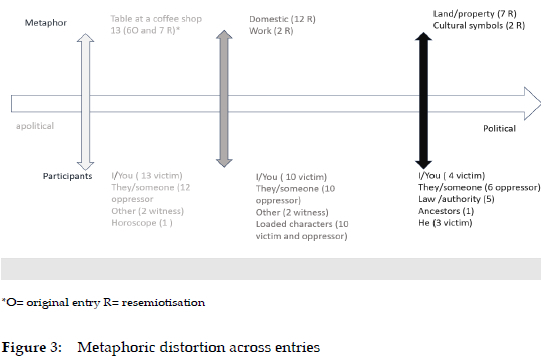
As indicated in Figure 3, the use of metaphors shifts towards a more political orientation as the resemiotisations unfold. The original entries use a casual metaphor of a table in a restaurant or a coffee shop. It is accompanied by a humorous/ sarcastic tone as in "is this an episode of Seinfeld or am I getting israeled?" (Israeled, 21 October 2023) or "my horoscope said that I should be sitting at this table" (Israeled, 22 October 2023). As resemiotisations progress, metaphors relating to the domestic and work domains are used such as israeling one's t‑shirt, pen, ice-cream, bicycle or project. The political orientation becomes more evident in the last resemiotisations. The metaphors used become those of israeling land/ property and cultural symbols such as Falafel and tangerines.
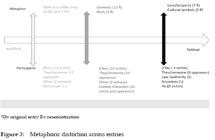
This incremental political shift is also mirrored in the use of participants. In the original entries, the participants are consistently used with 'I' and 'you' representing the israeled and 'someone' and 'they' representing the israeling participants. In the resemiotisations with the domestic/work metaphors, in addition to the participants mentioned above, others like mother, sister and colleagues are used. Most importantly, pairs of participants with cultural connotations are used, such as Ali versus Jacob and Ishmail versus Barbara. These pairs not only reflect the cultural orientation of the entry but also point out the conflict between the two cultures. In the property-related metaphors, the use of participants becomes less consistent ('he' is used for israeling and israeled participants). More importantly, intervening participants denoting power and authority are used to show that the israeling act is helped by power as in "when a person tells you that your property is theirs … and demands you just give this property to them, and if you refuse, they take it by force and the law will somehow be on their (israeling) side" (Israeled, 22 October 2023). The political dimension is, in particular, emphasized in one resemiotisation, which depicts a conversation between a settler and the original owner of the land, in which the former claims the land belonged to his ancestors "my ancestors were here 3000 years ago. If I do not take your house, someone else will" (Israeled, 28 October 2023). This statement is actually identical to a previous utterance in a real-life video reporting a conversation between a Jewish settler and a Palestinian woman in Cheikh Jarrah area in 2021 (AJ+ 2021).
The evolving political orientation is also evident in the use of process types. Though verbs like 'claim' 'take' 'steal' and 'kill' are employed in the original metaphor, their number increases in the domestic and property metaphors (for instance 'claim' evolves from four to seven and 'steal' from one to seven). The verb 'act like a victim' was scarcely used with the table metaphor as opposed to six uses in the other metaphors.
6.2.2 Graduation
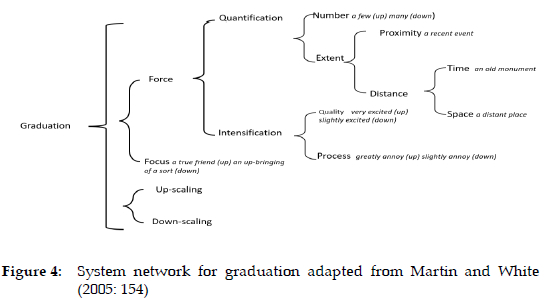
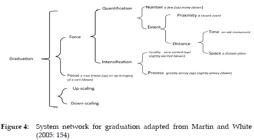
Graduation is a system within the Appraisal Theory of Martin and White (2005: 135-155), which maps evaluation in language. It covers, alongside with graduation, attitude and engagement. Graduation is anchored within SFL's interpersonal metafunction and includes the resources for grading evaluation through up-scaling and down-scaling. As shown in Figure 4, graduation functions along two axes of evaluation, which are force and focus. Scalability along the axis of force covers grading according to intensification and quantification. Graduation along the axis of focus refers to grading according to prototypicality. The first sub-system of graduation includes evaluation relative to the degree of intensity as well as quantity. Assessment of degree of intensification can operate at the level of quality as in 'very kind' and 'quite helpful' and at the level of 'processes' 'this greatly surprised me' and 'you slightly disturbed me'. Graduation in quantification covers amount (size and number) and extent (time and space) as in 'a short break' and 'a large field'. Graduation according to prototypicality (focus) delineates the degree the phenomenon matches the prototypical features of a semantic category as in 'a true lover' (sharpening) and 'kind of lover' (softening).
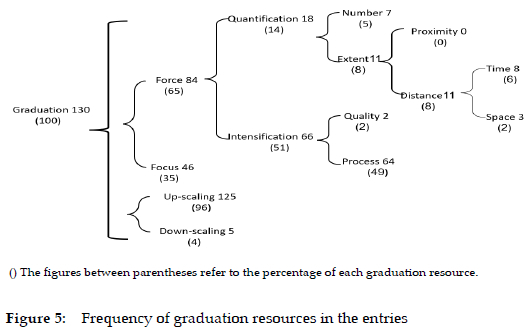
Since graduation is concerned with grading experiences and attitude, this framework can be useful in understanding the iconisation of signs. Graduation can reveal the resources the authors used in charging the sign with values in order to orient the reader. The entries include 130 graduation instances at an average of four graduations per entry. As shown in Figure 5, the direction of grading is predominantly up-scaling. Force-based graduation is more frequent than focus-based one (84 versus 46).
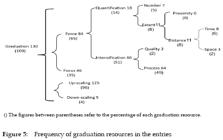
Graduation in terms of force using the sub-systems of intensity and quantification interacts with the up-scaling of attitude, which "frequently acts to construe the speaker/writer as maximally committed to the value position being advanced and hence as strongly aligning the reader into that value position" (Martin and White 2005: 152). Intensification of qualities by grading adjectives and adverbs are typically attitudinal. They are, however, rarely used in the entries under examination, which may be explained by the fact that clearly inscribed attitudes are incongruent with the genre of dictionary entries. On the contrary, intensification by processes is very frequent with 66 instances. This intensification is not typically attitudinal: up-scaled verbs are used to convey the invoked attitude of the authors towards the action of both israeling participants as in 'kick out the rightful owner" "get you out by force" (Israeled, 21 October 2023). Grading of processes is also used to convey the degree of powerlessness of the israeled as in "you can't resist it whatsoever" (To israel, 25 October 2023).
Quantification resources are used to convey the extent of the israeling act in terms of taking the victim's property as in "and take everything else you own" (Israeled, 5 November 2023). Quantification covering extent in time is used to highlight the religious anchoring of the israeling act "when someone asks for something from you and then overtime starts claiming that thing was always theirs" (Israeled, 5 November 2023 emphasis added). The authors draw connection with the Jewish propaganda of promised land as "the act of taking something from someone else for some reason thousands of years ago" (Israeled, 28 October 2023). The use of these quantification resources is concentrated in the entries recontextualizing the religious conflict.
Graduation under focus sub-system amounts to 46 instances representing 35% of all graduation resources. They are attitudinal terms construing the speakers' attitude towards a situation or a fact, which are explicitly attitudinal as in "it can mean causing harm and destruction in a tyrannical way" (To Israel, 25 October 2023 emphasis added) or in "a sickly exaggerated desire to have something that belongs to someone else" (Israeling, 24 October 2023 emphasis added). These graduation resources "indicate maximal investment by the authorial voice in the value position (either negative or positive) being advanced and hence to strongly align the reader into the value position being advanced." (Martin and White 2005: 139)
To sum up, at the ideational level, metaphoric distortion is used to illustrate the shift into more politicized metaphors. This shift underscores the authorial voice, which is realized with the use of graduation resources meant to accentuate the interpersonal charge of the bonding icon. This finding aligns with Stenglin (2008) who emphasizes the coupling of ideational and interpersonal meanings to charge values into the Olympic flame. She demonstrates this through combining the ideational activities of lighting the Olympic flame with the attitudes of affect, appreciation and judgement evoked by these activities. The present study uses the coupling of metaphoric distortion and graduation because these systems are more congruent with the genre of dictionary entries where invoked attitudinal choices are genre-appropriate.
7. Conclusion
This paper has proposed to link Lexicography and CDA by demonstrating that the semantic and lexical descriptions of new dictionary entries should be supplemented with a critical reading. As shown by the study, the ideology-infused entries constitute interpersonally-charged semiotic acts introducing the sign-maker's world view and inducing reactions from the reader. This was illustrated by Got Israeled, a new entry in the crowdsourced Urban Dictionary that was heavily resemiotised inside the dictionary reaching 36 entries.
The sign was analyzed at three levels: coinage, iconicity and iconisation drawing upon Semiotic and Social Semiotic frameworks. The first level of analysis shows that the sign is a motivated sign showing the correspondence between structural features, social anchoring and sign makers' intentions. At the second level, Peirce's (1931) principles of hypo-iconicity underscore the critical potential of the sign through drawing straightforward links with the colonization of Palestine. Third, this paper has exploited the Social Semiotic principle of iconisation to describe the transformation of the sign into a bonding icon rallying people around the writers' world view (Stenglin 2012).
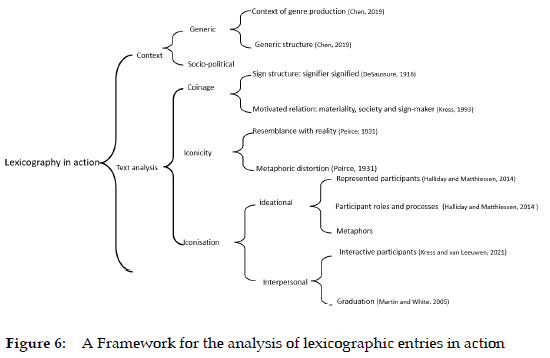
This study has contributed to the current literature on the relatively new area of critical lexicography by introducing a framework for the analysis of signs with a semiotic action. This framework illustrated in Figure 6 represents a two-levelled analysis drawing upon tools from Critical Lexicography (Chen 2019), Semiotics (DeSaussure 1916, Peirce 1931) and Social Semiotics (Halliday and Matthiessen 2014, Martin and White 2005). The first level is a contextual analysis emphasizing the generic structure of the entry, the context of genre production and explores the specific political context of the entry coinage.
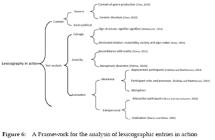
The second level of analysis comprises three steps showing that the potential of signs to exert action can be viewed on a spectrum ranging from the coinage of motivated signs to the design of signs building real and distorted connections with reality (iconicity). At the highest level of this spectrum is iconisation, in which the sign maker exploits ideational and interpersonal resources to turn the sign into a bonding icon. This level is reached when the sign is largely resemiotised in different mediated forms. The aims of resemiotisations are to construct a set of values around the iconized sign.
This framework has been used to analyze dictionary entries but it is applicable to other signs in language and other semiotic systems. Multimodality can promote semiosis in action at the levels of coinage and iconicity as well as iconisation because it can help the expansions of the sign's meaning. This can be a promising topic for future research.
AJ+. 2021. If I Don't Steal [Your Home] Someone Else Will. Israeli Settler Justifies Forcible Takeover. [video]. YouTube, 5 May 2021. https://www.youube.com/watch?v=KNqozQ8uaV8).
References
- Bergenholtz, H. and R.H. Gouws. 2012. What is Lexicography? Lexikos 22: 31-42.
- Bertulessi, C. 2023. Chinese Lexicography and the Critical Analysis of Lexicographical Discourse. Zuccheri, S. (Ed.). 2023. Studies on Chinese Language and Linguistics in Italy: 95-116. Bologna: Bologna University Press.
- Björkvall, A. and A.-M. Karlsson. 2011. The Materiality of Discourses and the Semiotics of Materials: A Social Perspective on the Meaning Potentials of Written Texts and Furniture. Semiotica 187(1-4): 141-165.
- Carr, G. 2023. With Respect to Consent: The Language of Sex Education. Unpublished Ph.D. Dissertation. Sydney: University of Sydney.
- Chen, W.G. 2015. Bilingual Lexicography and Recontextualization: A Case Study of Illustrative Examples in a New English-Chinese Dictionary. Australian Journal of Linguistics 35(4): 311-333.
- Chen, W.G. 2019. Towards a Discourse Approach to Critical Lexicography. International Journal of Lexicography 32(3): 362-388.
-
Chu, Y. 2018. Hypoiconicity in the Architecture of Suzhou: Authentic Resemblance, Diagrammatic Reduction, and Metaphoric Displacement. Social Semiotics 30(1): 114-132. doi:10.1080/10350330.2018.1531548.
» https://doi.org/10.1080/10350330.2018.1531548 - Chu, Y. 2020. On the Hypoiconic Structure of Cartoons. Social Semiotics 32(2): 262-278. https://doi.org/10.1080/10350330.2020.1756587.
- Coleman. J. 2004. A History of Cant and Slang Dictionaries. Oxford: Oxford University Press.
- DeSaussure, F. 1916. Course in General Linguistics. (Edited by Bally, C. and A. Sechehaye in collaboration with A. Riedlinger. 1966. Translated, with an Introduction and Notes by Wade Baskin.) New York/Toronto/London: McGraw-Hill.
- Fairclough, N. 1995. Critical Discourse Analysis: The Critical Study of Language. London: Longman.
- Farias, P. and J. Queiroz. 2006. Images, Diagrams, and Metaphors: Hypoicons in the Context of Peirce's Sixty-six Fold Classification of Signs. Semiotica 162(1-4): 287-308.
- Fuertes-Olivera, P.A. and S. Tarp. 2022. Critical Lexicography at Work: Reflections and Proposals for Eliminating Gender Bias in General Dictionaries of Spanish. Lexikos 32(2): 105-132.
- Gouws, R.H. 2014. Article Structures: Moving from Printed to e-Dictionaries. Lexikos 24: 155-177.
- Halliday, M.A.K. and C.M.I.M. Matthiessen. 2014. Halliday's Introduction to Functional Grammar. Fourth edition. Oxon: Routledge.
- Hodge, R. and G. Kress. 1988. Social Semiotics. Cambridge: Polity.
- Holdcroft, D. 1991. Saussure: Sign, System and Arbitrariness. Modern European Philosophy. Cambridge: Cambridge University Press.
- Hornscheidt, A. 2008. A Concrete Research Agenda for Critical Lexicographic Research within Critical Discourse Studies: An Investigation into Racism/Colonialism in Monolingual Danish, German, and Swedish Dictionaries. Critical Discourse Studies 5(2): 107-132.
- Kachru, B.B. 1995. Afterword: Directions and Challenges. Kachru, B.B. and H. Kahane (Eds.). 1995. Cultures, Ideologies, and the Dictionary: Studies in Honor of Ladislav Zgusta: 417-424. Tübingen: Max Niemeyer.
- Kirkness, A. 2004. Lexicography. Davies, Alan and Catherine Elder. 2004. The Handbook of Applied Linguistics: 54-81. Oxford: Blackwell.
- Knight, N.K. 2010. Wrinkling Complexity: Concepts of Identity and Affiliation in Humour. Bednarek, M. and J.R. Martin (Eds.). 2010. New Discourse on Language: Functional Perspectives on Multimodality, Identity, and Affiliation: 35-58. London: Continuum.
- Kress, G. 1993. Against Arbitrariness: The Social Production of the Sign as a Foundational Issue in Critical Discourse Analysis. Discourse and Society 4(2): 169-193.
- Kress, G. 2010. Multimodality: A Social Semiotic Approach to Contemporary Communication, London: Routledge.
- Kress, G. and T. van Leeuwen. 1996/2021. Reading Images: The Grammar of Visual Design. London: Routledge.
- Kress, G. and T. van Leeuwen. 2001. Multimodal Discourse: The Modes and Media of Contemporary Communication. New York: Hodder Arnold.
- Lebovic, M. 2024. Is Urban Dictionary's New Entry 'to Get Israeled' an Antisemitic Trope? The Times of Israel, 11 January 2024. https://www.timesofisrael.com/is-urban-dictionarys-new-entry-to-get-israeled-an-antisemitic-trope-adl-weighs-in
- Ledin, P. and D. Machin. 2018. Multi-modal Critical Discourse Analysis. Flowerdew, J. and J.E. Richardson (Eds.). 2018. The Routledge Handbook of Critical Discourse Studies: 60-76. London/New York: Routledge.
- Linell, P. 1998. Discourse across Boundaries: On Recontextualizations and the Blending of Voices in Professional Discourse. Text 18(2): 143-157.
- Liu, X. 2015. Multimodal Definition: The Multiplication of Meaning in Electronic Dictionaries. Lexikos 25: 210-232.
- Markiewicz, T. and K. Sharvit. 2021. When Victimhood Goes to War: Israel and Victim Claims. Political Psychology 42(1): 111-126.
- Martin, J.R. 2010. Semantic Variation: Modelling Realisation, Instantiation and Individuation in Social Semiosis. Bednarek, M. and J.R. Martin (Eds.). 2010. New Discourse on Language: Functional Perspectives on Multimodality, Identity, and Affiliation: 1-34. London: Continuum.
- Martin, J.R. and P.R.R. White. 2005. The Language of Evaluation. Appraisal in English. New York: Palgrave Macmillan.
-
Moalla, D. 2023. The Resemiotisation of Chokri Belaid's Talk before his Assassination: Roles of Sign-maker Interest and Re-reading Forces. Social Semiotics 33(4): 808-840. DOI: 10.1080/10350330.2021.1949245.
» https://doi.org/10.1080/10350330.2021.1949245 - Peirce, C.S. 1907. Pragmatism. Houser, N. and C.J.W. Kloesel (Eds.). 1998. The Essential Peirce. Vol. 2: Selected Philosophical Writings (1893-1913): 398-433. Bloomington: Indiana University Press.
- Peirce, C.S. 1931. The Collected Papers of Charles Sanders Peirce. Hartshorne, C., P. Weiss and A.W. Burks (Eds.). 1966. Cambridge: Harvard University Press. [Reference to Peirce's papers will be designated CP followed by volume and paragraph number.]
- Pettini, S. 2023. The Language of Ethnic Conflict in English Online Lexicography: Ethnophaulisms in "powered by Oxford" Lexico.com. Lexikos 33: 299-317.
- Ro, C. 2019. How Linguists Are Using Urban Dictionary. Daily JSTOR, 13 November 2019. https://daily.jstor.org/how-linguists-are-using-urban-dictionary/
- Stenglin, M. 2004. Packaging Curiosities: Towards a Grammar of Three-dimensional Space. Unpublished Ph.D. Dissertation. Sydney: University of Sydney.
- Stenglin, M. 2008. Interpersonal Meaning in 3D Space: How a Bonding Icon Gets its 'Charge'? Unsworth, L. (Ed.). 2008. Multimodal Semiotics: Functional Analysis in Contexts of Education: 50-66. London: Continuum.
- Stenglin, M. 2012. 'Glocalisation': Exploring the Dialectic between the Local and the Global. Bowcher, W.L. (Ed.). 2012. Multimodal Texts from Around the World: Cultural and Linguistic Insights: 123-145. Houndmills, Basingstoke, Hampshire/New York: Palgrave Macmillan.
- Stenglin, M. 2022. Binding and Bonding: A Retrospective and Prospective Gaze. Caldwell, D., J.S. Knox and J.R. Martin (Eds.). 2022. Appliable Linguistics and Social Semiotics: Developing Theory from Practice: 309-324. London: Bloomsbury.
- Strand, T. 2013. Peirce's Rhetorical Turn: Conceptualizing Education as Semiosis. Educational Philosophy and Theory 45(7): 789-803.
- Taub, S.F. 2004. Language from the Body. Iconicity and Metaphor in American Sign Language. Cambridge: Cambridge University Press.
- Urban Dictionary. 2023-2024. Israeled. https://www.urbandictionary.com/define.php?term=Israeled
- Urban Dictionary. 2024. Homepage. https://www.urbandictionary.com/define.php?term=homepage
- Van Leeuwen, T. 2005. Introducing Social Semiotics. London/New York: Routledge.
- Wignell, P., S. Tan and K.L. O'Halloran. 2016. Violent Extremism and Iconisation: Commanding Good and Forbidding Evil? Critical Discourse Studies 14(1): 1-23.
- Zappavigna, M. 2019. Ambient Affiliation and #Brexit: Negotiating Values about Experts through Censure and Ridicule. Koller, V., S. Kopf and M. Miglbauer (Eds.). 2019. Discourses of Brexit: 48-68. London: Routledge.