Prompts for Language Learners: A Practical Guide to Using DeepSeek as a Dictionary
Abstract
Nowadays, AI models are capable of generating lexicographic content that is as good as that produced by traditional dictionaries. Meanwhile, using different prompts can return disparate results. Considering this, this article tests several prompts to demonstrate to language learners how to use a generative AI model as a dictionary. From a practical point of view, learners should improve their prompt crafting and fine-tuning skills in order to obtain well-reasoned and well-structured outputs from AI.
generative ai; language model; deepseek; learner's dictionary; lexicographic productivity; prompt engineering
Abstract
KI-modelle is deesdae daartoe in staat om leksikografiese inhoud te genereer wat net so goed is soos dié wat deur tradisionele woordeboeke geproduseer word. Terselfdertyd kan uiteenlopende resultate verkry word deur verskillende prompe te gebruik. Met inagneming hiervan word daar in hierdie artikel verskillende prompe getoets om aan taalleer-ders te demonstreer hoe om 'n generatiewe KI-model as 'n woordeboek te gebruik. Vanuit 'n prak-tiese oogpunt behoort leerders hul vaardighede in die skep en verfyn van prompe te verbeter om goed beredeneerde en goed gestruktureerde uitsette van KI te verkry.
generatiewe ki; taalmodel; deepseek; aanleerderswoorde-boek; leksikografiese produktiwiteit; prompontwikkeling
1. Introduction
Artificial Intelligence (AI) is not a new concept. However, it was not until the end of 2022 when OpenAI launched ChatGPT that AI had gradually become more involved in the field of lexicography. A couple of studies have explored the possibility of using AI to create dictionary contents. Among the first batch of studies at the interface of lexicography and AI are some detailed comparisons between AI and traditional dictionaries (e.g. Lew 2024, Lew et al. 2024, Ptasznik et al. 2024, Rees and Lew 2024). The results are quite similar: generative AI is capable of producing high-quality contents such as dictionary entries that include definitions and examples. For the moment, AI models outperform both monolingual and bilingual dictionaries in productive lexical tasks (cf. Lew et al. 2024, Ptasznik et al. 2024). Comparisons are also made between different AI models as support tools for language learners in different lexical tasks (cf. Huete-García and Tarp 2024, Li and Tarp 2024). While AI can be used as a useful lexical tool in a range of tasks, its shortcomings have been discussed in several works (e.g. De Schryver 2023, Lew 2023, Fuertes-Olivera 2024).
At the same time, studies have shown that the results generated by AI depend largely on its interaction with users. Users' prompts (i.e. instructions and questions given to an AI model) guide AI to produce relevant outputs, and users, therefore, have to improve and refine their prompts to achieve better results (cf. Lew 2023, Fuertes-Olivera 2024, Li and Tarp 2024, Tarp and Nomdedeu-Rull 2024). In this short article, several prompts instructing AI to undertake some productive lexical tasks will be examined. Rather than evaluating the quality and effectiveness of these prompts, the aims of the present work are fairly practical: to explain how to craft prompts to obtain lexicographic contents; how to modify prompts to achieve more relevant and accurate results; and how to fine-tune prompts to return well-written and well-structured outputs.
2. Materials and methods
For the present study, ten target headwords were randomly selected by choosing the 'Word of the Day' in April from four well-known learner's dictionary sites, namely Cambridge Advanced Learner's Dictionary & Thesaurus (henceforth CaLD), Collins COBUILD Advanced Learner's Dictionary (COBUILD), Longman Dictionary of Contemporary English (LDOCE), and Oxford Advanced Learner's Dictionary (OALD). Among the ten lexical items are three nouns (feng shui, sunflower, and frontispiece), an adverb (consciously), a phrase (have seen better days), and five words with more than one part of speech (elaborate, highlight, dizzy, so-so, and marathon).
Before using an AI chatbot to create lexicographic contents, the ten items are also looked up in the abovementioned learner's dictionaries. Taking a quick glimpse at the entries in these dictionaries, it becomes evident that some principal entry components are the headword, part of speech, pronunciation, definition, examples, and word forms. Other components appearing in learner's dictionaries include etymology, a frequency marker, related words, synonyms, antonyms, collocations, topics, usage notes, and an illustration, depending on each dictionary's microstructure design.
The AI contents were generated between the 23rd and 27th of April 2025. The AI model used was the free version of DeepSeek, a Chinese open-source AI model that has grown in popularity. Compared to its AI rivals mainly from the US, DeepSeek ensures accessibility to Chinese users and excels in both Chinese and English proficiency. Furthermore, DeepSeek has been integrated into the majority of Chinese universities' online platforms. The following section details the tests of crafting and modifying prompts for creating lexicographic contents.
3. Prompts for use
Prompt #1: Define 'X'.
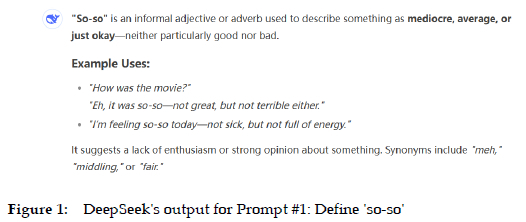
The very first instruction given to DeepSeek simply used an imperative tone to ask the AI model to define a lexical item 'X', with X being a word, phrase, or even morpheme. The command 'define .^' works very well in search engines such as Google and Microsoft Bing, and will return results containing data licensed from a traditional, well-known publisher's dictionary (in these two cases, that of Oxford). However, if Prompt #1 is used with DeepSeek, the responses generated by the AI are quite far from standard dictionary entries, though they do provide a lot of useful information. An example is demonstrated in Figure 1.
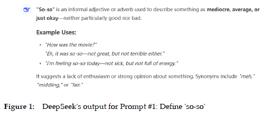
As evident in Figure 1, DeepSeek's response starts with a sentence rather than a headword, and all of the outputs for the ten test items are formatted in this way. Some lexical information is given in the case of so-so, such as parts of speech, an explanation of meaning, three example sentences, and synonyms. But for some words, especially nouns, DeepSeek mixes linguistic and extra-linguistic data in the answers, as this is not specified in the prompt. For example, the responses produced by DeepSeek illustrate some core principles of feng shui (e.g. qi, yin and yang, the five elements, the bagua map, and the commanding position), key features of marathon (e.g. the distance, types, training, and major marathons), and likewise key characteristics of sunflower (e.g. appearance, heliotropism, seeds, cultivation, and symbolism). These outputs of Prompt #1 are very similar to contents provided by an encyclopaedia rather than a dictionary, and the prompt therefore has to be refined to achieve precise and relevant responses, with a particular focus on lexicographic data.
Prompt #2: Define 'X' like a dictionary entry.
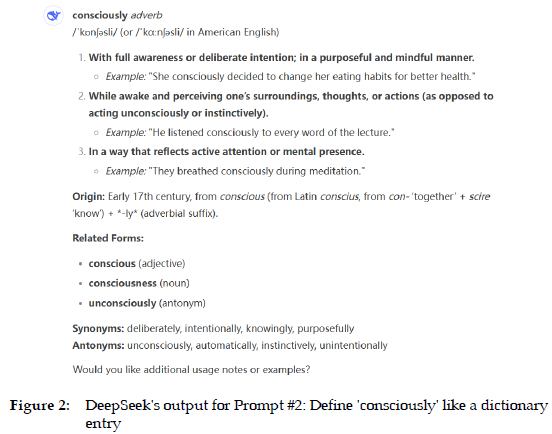
Based on Prompt #1, the current prompt is modified by adding a constraint to command DeepSeek to produce dictionary entry-like contents, as shown in Figure 2.
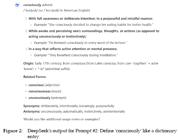
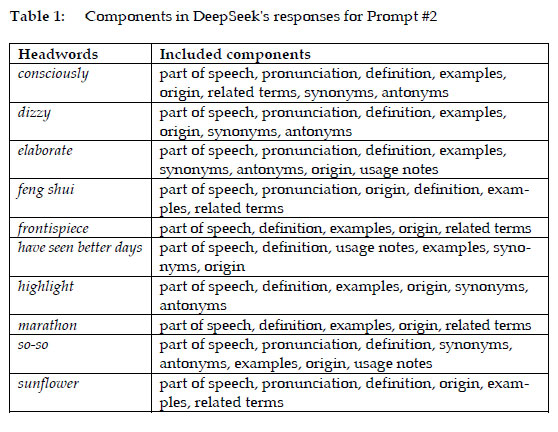
This time, the output generated by DeepSeek looks very similar to a dictionary entry in terms of format. The headword is given in bold, with its part of speech next to it. All senses are numbered. Several other typical entry components are also provided, including the pronunciation, examples, the word origin, related forms, synonyms, and antonyms. However, the structure of DeepSeek's responses is rather fluid. For instance, the parts of speech for some words are placed in brackets, while for others, they are not, and the origin of feng shui appears above its definition. Section names are not consistent either, such as etymology/origin, related terms/forms/see also, and examples /example sentences. Meanwhile, some default entry sections are missing in several responses - for example, the pronunciations of highlight, marathon, and frontispiece are not provided. Table 1 displays the lexicographic components included in DeepSeek's generated answers.
Whereas some standard entry sections are excluded in the answers, DeepSeek (and many other AI models) sometimes generates follow-up questions to provide further information to users. For the chosen words, six out of ten responses contain this type of questions, for example: 'Would you like a pronunciation guide or additional examples?', 'Would you like additional usage notes or related terms?', and 'Would you like additional variations or cultural references?'. Users can simply reply 'Yes' to continue the conversation with DeepSeek. If users want specific information, they have to give detailed instructions in another prompt.
At this point, the languages used in the interaction with AI are noteworthy. In fact, DeepSeek is pre-trained on large datasets in both English and Chinese. If the input is in English, the output by AI will also be in English; likewise, if the instruction is in Chinese, the response will be in Chinese as well. This is important to note as learners may also want to use DeepSeek as a bilingual dictionary. In such case, Prompt #2 can be slightly changed into 'Define "X" like a bilingual dictionary entry'. But again, the user's choice of language matters. Through several tests it became clear that, if the prompt is written in English, the default result will be an English-Spanish entry. Only if a Chinese language instruction is given can DeepSeek understand that the response should be a Chinese-English-bilingual-dictionary-style entry.
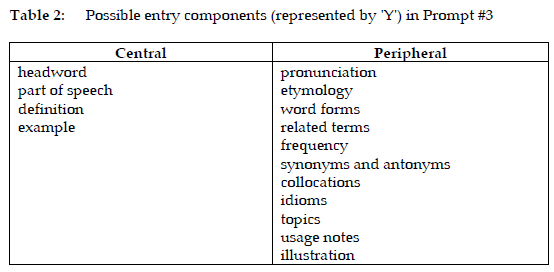
Prompt #3: Define 'X' like a dictionary entry. Include sections like Yi, Y2, Y3,... If the output of Prompt #2 does not meet expectations, the prompt can be further refined by providing specific instructions. At this stage, DeepSeek is asked to include relevant information from various areas, whether lexical, grammatical, semantic, pragmatic, or even cultural. Then 'Y' in the prompt can be replaced with a range of sections - some are central while others are peripheral (cf. Atkins and Rundell 2008) - that may appear in a real dictionary, as listed in Table 2.
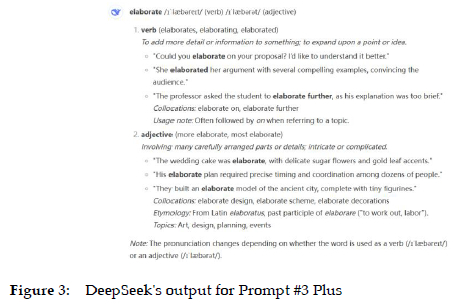
To ensure a well-structured AI 'entry', a good example of a prompt can be found in the addendum of De Schryver's article (2023). A modified version of prompt for this study is demonstrated below (called Prompt #3 Plus), followed by its response shown in Figure 3:
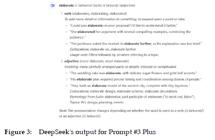
Define 'elaborate' like a dictionary entry: Start with the headword in bold and its pronunciation at the top. Each sense should be in a numbered block. Each block then starts with the part of speech and the morphological forms of the respective sense. This is followed by a sense definition and sense examples that illustrate both the use and the meaning of each particular sense. For the example sentences, make sure to use different sentence structures, referring to different people; vary long and short example sentences. Include other information if relevant, such as etymology, collocations, topics, and usage notes.
Prompt #4: Give me a Z-style dictionary entry for 'X'.
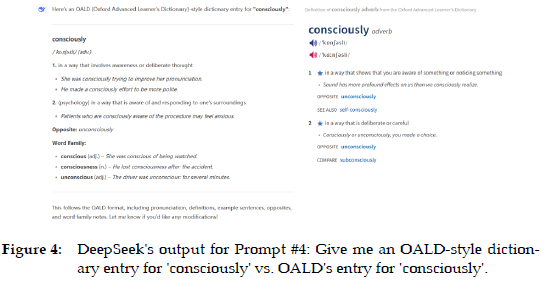
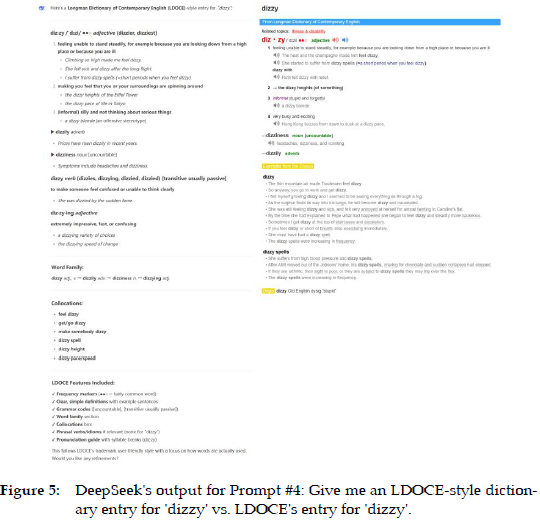
Rather than listing all possible components in the prompt, a more direct approach is to ask AI models, which are normally trained on publicly accessible data, to imitate the entry from those well-known dictionaries, represented by 'Z' in Prompt #4. Figures 4 and 5 illustrate the comparison between DeepSeek-generated content and that of real dictionary entries.
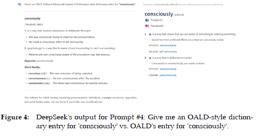
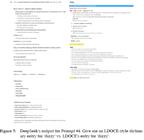
As the figures show, DeepSeek's responses, to a large extent, follow OALD's and LDOCE's respective formats, such as the word's opposite in OALD and the frequency marker in LDOCE. Furthermore, DeepSeek concludes several major features of the named dictionary at the end of its answer, seen in the final sentences in Figure 4 and the bullet points in Figure 5. In addition to obtaining lexicographic information, learners can use DeepSeek to compare the characteristics of dictionary products in the market by employing this prompt.
Prompt #5: Here is an example entry. Produce a similar entry for 'X'.
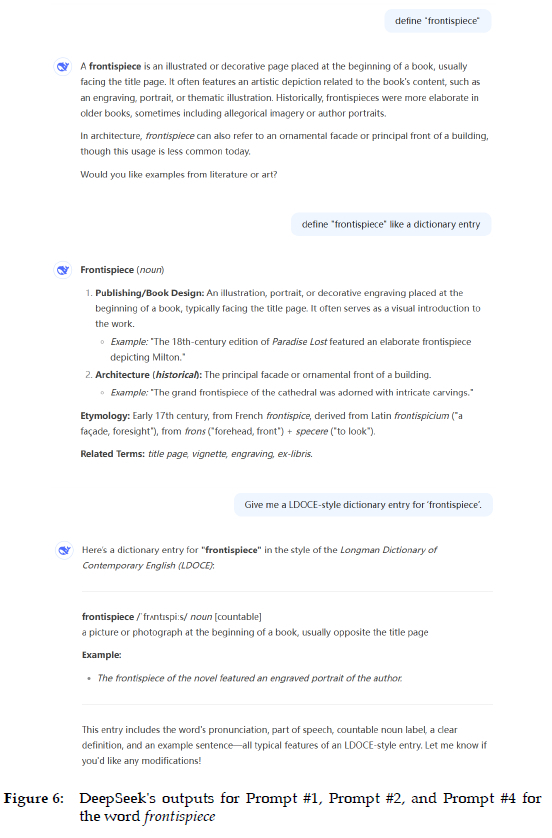
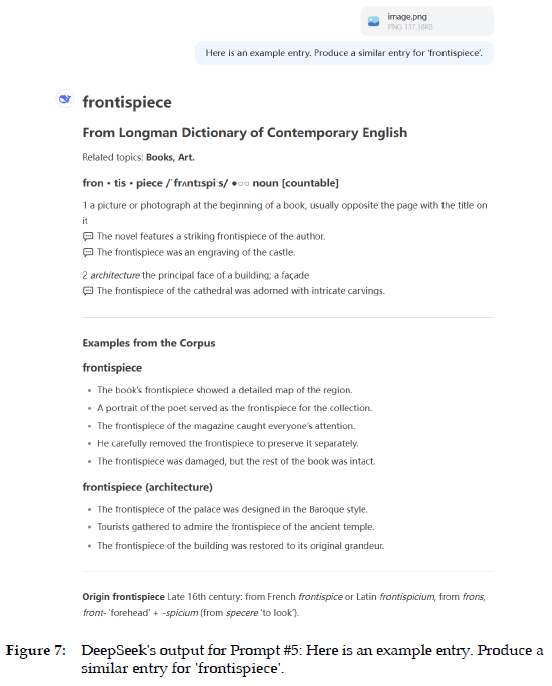
So far, the prompts crafted are all zero-shot ones, that is, in the field of AI, prompts without examples. On the contrary, few-shot prompts refer to those containing some examples (or called one-shot if there is only one example). A study by DeepSeek-AI (2025) recommends that users use zero-shot prompting rather than few-shot, as the latter may degrade performance. However, in this article, few-shot prompts are still tested to examine whether they really produce worse results than the prompts above. Lew (2023) has tailored an impressive example of few-shot prompting, in which ChatGPT is presented with two example entries from COBUILD. Since Lew's study is primarily from a lexicographer's perspective and his prompt may be too long for learners, the instruction has been simplified to Prompt #5 for the purpose of this study. Before the result of using this prompt is considered, the DeepSeek-generated responses to the inquiry about producing an entry for frontispiece, using Prompt #1, Prompt #2, and Prompt #4, are displayed in Figure 6.
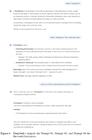
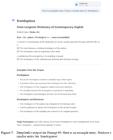
DeepSeek's answer to Prompt #1 provides a lengthy definition of the word - if that can be called a 'definition' - and no other lexical information. The answer to Prompt #2 is much better, with several major entry components, though it lacks the pronunciation and only offers one example for each sense. Similarly, the AI's response to Prompt #4 is not as satisfactory as those in Figures 4 and 5. Based on numerous tests, AI's output changes every time and its format is quite fluid if not specified in the prompt. Therefore, few-shot prompting gives examples to the AI model and ensures users the output in their preferred format. Figure 7 illustrates a conversation with DeepSeek on the topic of producing an entry for frontispiece. Firstly, a screenshot of dizzy from LDOCE (see the right side of Figure 5) is given to DeepSeek. Then Prompt #5 asks the AI model to follow the instruction to carry out the lexical task. At first glance, the output format is much better than that in Figure 6. Although the response is slightly flawed (e.g. the play symbols are replaced and the frequency marker is unchecked), it is well-reasoned in many ways, suggesting that few-shot prompting is still effective in such a task.
It might seem paradoxical for users to ask the AI model to produce a dictionary-style entry when they can more directly look up the lexical item in a dictionary. However, consider a more extreme situation: if a word is not included in the dictionaries they usually use, where can language learners obtain information on its meaning and usage? AI might be a valuable tool in such instances. For example, Yorkiepoo (a cross-breed between a Yorkshire terrier and miniature or toy poodle) is a newly added word in the Oxford English Dictionary (OED), and has not been included in any of the four learner's dictionaries examined. Those who do not have access to the OED, which needs a subscription, can instruct an AI model to create a LDOCE-style or OALD-style entry, for example, for Yorkiepoo. In this case, Yorkiepoo is an existing word in the English lexicon. However, if a non-existent word is tried, DeepSeek (as well as other models) will still generate prolific outputs, which are known as AI hallucinations (cf. Fuertes-Olivera 2024). This raises other challenges.
4. Concluding remarks
The aforementioned prompts attempt to help users maximise the efficiency and accuracy of AI-generated outputs while crafting minimal instructions. However, there are some limitations to this pilot study. Firstly, the ten words examined represent only a small sample. The present study only covers content words, not function words that primarily serve a grammatical function and express little semantic meaning, making them more difficult to define. In addition, the usage of DeepSeek as a bilingual dictionary is not fully explored. DeepSeek's performance in other lexical tasks also needs future research. Furthermore, the 'entries' generated by AI for these words are not all very lengthy and the prompts crafted do not involve complex logical reasoning. The overall interactions with DeepSeek are therefore quite smooth, with no technical problems. It should be noted again that the AI's responses may vary every time prompted. Therefore, users are encouraged to improve their prompting skills by continuously fine-tuning their prompts to ensure better outputs in both content and format.
References
- Atkins, B.T.S. and M. Rundell. 2008. The Oxford Guide to Practical Lexicography. Oxford/New York: Oxford University Press.
- CALD. Cambridge Advanced Learner's Dictionary & Thesaurus. https://dictionary.cambridge.org/ [27 April 2025]
- COBUILD. Collins COBUILD Advanced Learner's Dictionary. https://www.collinsdictionary.com/ [27 April 2025]
- DeepSeek. https://chat.deepseek.com/ [23 April 2025]
- DeepSeek-AI. 2025. DeepSeek-R1: Incentivizing Reasoning Capability in LLMs via Reinforcement Learning. arXiv. https://arxiv.org/abs/2501.12948/.
- De Schryver, G.-M. 2023. Generative AI and Lexicography: The Current State of the Art Using ChatGPT. International Journal of Lexicography 36(4): 355-387.
- LDOCE. Longman Dictionary of Contemporary English. https://www.ldoceonline.com/dictionary/ [27 April 2025]
- Lew, R., B. Ptasznik and S. Wolfer. 2024. The Effectiveness of ChatGPT as a Lexical Tool for English, Compared with a Bilingual Dictionary and a Monolingual Learner's Dictionary. Humanities and Social Sciences Communications 11: 1324.
- Li, Q. and S. Tarp. 2024. Using Generative AI to Provide High-Quality Lexicographic Assistance to Chinese Learners of English. Lexikos 34(1): 397-418.
- OALD. Oxford Advanced Learner's Dictionary. https://www.oxfordlearnersdictionaries.com/ [27 April 2025]
- OED. Oxford English Dictionary. https://www.oed.com/ [28 April 2025]
- Ptasznik, B., S. Wolfer and R. Lew. 2024. A Learners' Dictionary Versus ChatGPT in Receptive and Productive Lexical Tasks. International Journal of Lexicography 37(3): 322-336.
- Rees, G.P. and R. Lew. 2024. The Effectiveness of OpenAI GPT-Generated Definitions Versus Definitions from an English Learners' Dictionary in a Lexically Orientated Reading Task. International Journal of Lexicography 37(1): 50-74.
- Tarp, S. and A. Nomdedeu-Rull. 2024. Who Has the Last Word? Lessons from Using ChatGPT to Develop an AI-based Spanish Writing Assistant. Círculo de Lingüística Aplicada a la Comunicación 97: 309-321.