Eppur si muove: Lexicography is Becoming Intelligent!
Abstract
The paper focuses on an ongoing R project which the author is conducting together with Spanish lexicographers as well as computer scientists from a high-tech company specialized in online dictionaries and language services. The objective is to develop an AI-powered Spanish writing assistant for both native and non-native writers and learners. After briefly discussing the current experiences with digital writing assistants, the paper will detail the concrete project, where the lexicographers' task is, on the one hand, to contribute to the training of the underlying language model, and on the other hand, to outline a model for good communication between the tool and its users. Based on a study of practice in existing writing assistants, the paper will then formulate a set of principles for user communication that will be implemented in the writing assistant. The article gives examples of how this implementation takes place, what new challenges it poses, and how the writing assistant will eventually work. Finally, it discusses the lexicographers' new tasks and outlines some perspectives for future work.
writing assistants; user communication; lexicographical contextualization; integrated dictionaries; glosses; lexicographical data of a new type; incidental learning; intentional learning; lemma-centred lexicographical databases; problem-centred lexicographical databases
 Thumbnail
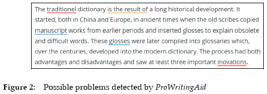 Thumbnail
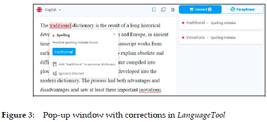 Thumbnail
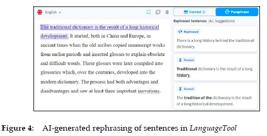 Thumbnail
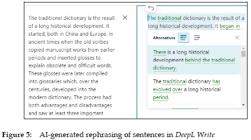 Thumbnail
 Thumbnail
 Thumbnail
 Thumbnail
 Thumbnail
 Thumbnail
 Thumbnail
 Thumbnail
 Thumbnail
 Thumbnail
 Thumbnail
 Thumbnail
 Thumbnail
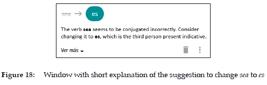 Thumbnail
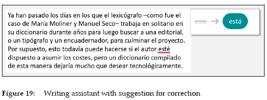 Thumbnail