A Blended Media-Converged Platform for Multimodal Lexicography and Language Teaching
Abstract
Digital lexicography and recent advances in artificial intelligence have created favourable conditions for reconsidering how dictionaries are compiled, consulted and pedagogically exploited. Yet most existing dictionary writing systems remain centred on editorial workflow and publication, without fully implementing the principles of media-converged lexicography or integrating lexicographic and teaching functions within a shared environment. This article presents BILEX (Blended & Intelligent Lexicographic platform; https://bilex.top), a blended media-converged platform developed for a multimodal English-Chinese learner's dictionary. The platform makes three main contributions. First, it provides, to our knowledge, the first operational realisation of media-converged lexicography as a unified shared-database platform integrating compilation, consultation, textbook linkage and administrative feedback, thereby implementing both "convergence" and "interconnection". Second, it proposes and implements an AI-assisted contextual disambiguation solution to data overload: instead of deleting or restructuring lexicographic data, the system identifies the contextually relevant sense and guides the user to it through automatic scrolling and visual highlighting. Third, it dynamically links textbook content to the dictionary database and generates six types of AI-assisted exercises, extending the pedagogical scope of learner's dictionaries beyond consultation. The article discusses the theoretical motivation, system architecture and principal functionalities of BILEX, and argues that the platform offers a model for AI-assisted, rather than AI-replaced, lexicographic practice.
Media-converged Lexicography; Multimodal Dictionary; Artificial Intelligence; Contextualised Lookup; Data Overload; Learner's Dictionary; Language Teaching; Dictionary-textbook Integration
Abstract
Die digitale leksikografie en onlangse vooruitgang in kunsmatige intelligensie het gunstige toestande geskep vir die heroorweeg van die samestelling, raadpleging en pedagogiese benutting van woordeboeke. Tog bly die meeste bestaande woordeboekskryfstelsels gefokus op redaksionele werkvloei en publikasie, sonder om die beginsels van die multimedia-leksikografie ten volle te implementeer of leksikografiese en onderrigfunksies binne 'n gedeelde omgewing te integreer. In hierdie artikel word BILEX ("Blended & Intelligent Lexicographic platform"; https://bilex.top) bekendgestel, 'n gemengde multimedia-platform wat vir 'n multimodale Engels-Chinese aanleerderswoordeboek ontwikkel is. Hierdie platform lewer drie hoofbydraes. Eerstens bied dit, na ons wete, die eerste operasionele realisering van die multimedia-leksikografie as 'n saamgevoegde platform met 'n gedeelde databasis wat samestelling, raadpleging, handboek-skakeling en administratiewe terugvoer integreer, waardeur beide "konvergensie" en "interkonneksie" geïmplementeer word. Tweedens stel dit 'n KI-ondersteunde kontekstuele ondubbelsinnigheidsoplossing vir data-oorlading voor en implementeer dit: in plaas daarvan om leksikografiese data te skrap of te herstruktureer, identifiseer die stelsel die kontekstueel relevante betekenis en begelei die gebruiker met behulp van outomatiese blaai en visuele beligting daarheen. Derdens koppel dit handboekinhoud dinamies aan die woordeboekdatabasis en genereer ses tipes KI-ondersteunde oefeninge, wat die pedagogiese omvang van aanleerderswoordeboeke tot verder as raadpleging verbreed. In die artikel word die teoretiese motivering, stelselargitektuur en hooffunksionaliteite van BILEX bespreek, en daar word aangevoer dat die platform 'n model vir KI-ondersteunde, eerder as KI-vervangde, leksikografiese praktyk bied.
Multimedia-leksikografie; Multimodale Woordeboek; Kunsmatige Intelligensie; Gekontekstualiseerde Naslaanpogings; Data-oorlading; Aanleerderswoordeboek; Taalonderrig; Woordeboek-handboek-integrasie
1. Introduction
The digital turn in lexicography has not only changed the medium of dictionaries; it has altered expectations regarding what dictionaries are and what they can do. Electronic dictionaries are generally no longer confined to functioning as searchable versions of printed works. They increasingly operate as flexible and adaptive information tools that may incorporate multimedia and user-oriented functionality, while recent AI systems extend this development towards interactive lexical assistance (Lew and De Schryver 2014; Lew 2024). However, although current technology permits a high degree of integration, most dictionary writing systems (DWSs) still concentrate on a comparatively narrow set of tasks, notably entry compilation, data management and publication. Meanwhile, the rapid advancement of generative artificial intelligence has opened new possibilities for lexicographic practice, from automated definition and entry drafting (De Schryver 2023; Lew 2023; Rees and Lew 2024) to interactive lexical support in receptive and productive language tasks (Ptasznik et al. 2024; Lew et al. 2024).
This creates a gap between technological possibilities and lexicographic implementation. Systems such as TLex, Lexonomy, LEXICC and DPS have made important contributions to dictionary production, but they remain primarily compilation-oriented. Even where AI has recently been introduced, its role tends to be restricted to textual assistance. What is generally absent is a platform that combines dictionary writing, multimodal representation, contextualised consultation, pedagogical linkage and user-behaviour feedback within a single shared database. This absence becomes particularly significant when viewed from the perspective of media-converged lexicography.
The concept of media-converged lexicography (融媒词典学), first articulated by Zhang (2019), moves beyond the idea of simply enriching dictionaries with media. It refers instead to a deeper integration of resources, modalities, functions and user interaction. In this framework, the dictionary is not simply a digital reference work but a blended multimodal database capable of supporting multiple communicative and pedagogical needs. This theoretical development raises an important practical question: what would a platform look like if the principles of media-converged lexicography were implemented as a working lexicographic system rather than discussed only at the conceptual level?
This article presents BILEX (Blended & Intelligent Lexicographic platform), developed within the project Research on a Media Converged Multimodal English-Chinese Learner's Dictionary Database. BILEX is designed as a unified platform for dictionary compilation, consultation, language teaching and administration. To our knowledge, it is the first platform to combine, within a shared-database architecture, native multimodal lexicographic support, AI-assisted contextual disambiguation, dynamic textbook-dictionary linkage and administrative feedback based on user behaviour. Its distinctiveness lies not only in the coexistence of these components but in the way they are integrated structurally and functionally.
The article is organised as follows. Section 2 outlines the theoretical framework. Section 3 describes the architecture of the platform. Sections 4 to 7 discuss the compilation, consultation, textbook and administration systems. Section 8 reflects on the platform's main contributions, compares it with other systems, and indicates limitations. Section 9 concludes by considering the implications of BILEX for future lexicographic practice.
2. Theoretical framework
The design of BILEX is informed by three lines of inquiry: media-converged lexicography, research on data overload in electronic dictionaries, and work on the pedagogical use of lexicographic resources. These provide the conceptual basis for the platform's structure and functions.
2.1 Media-converged lexicography
Zhang (2019) proposed that dictionary innovation in the digital era should not be understood as the mere addition of media to pre-existing lexicographic forms. Rather, media convergence entails a transformation in the production, organisation and use of lexicographic knowledge. This position was refined in later studies through the distinction between convergence (融合) and interconnection (融通) (Zhang 2022). Convergence refers to the integration of resources, media and lexicographic contents; interconnection refers to the linkage among texts, media, users and usage situations.
This framework was further deepened in Zhang's (2024) account of multimodal dictionary definitions. There, meaning construction is described across five interrelated levels: entity perception, cognitive-sensory processing, psychological cognition, logical media mapping and physical media realisation. BILEX may be understood as a practical attempt to map these levels onto a working lexicographic system. At the level of entity perception, visual and audiovisual representations are generated or attached to lexical meanings. At the level of cognitive-sensory processing, textual, visual and auditory information is presented in coordinated form. At the level of logical media mapping, lexicographic content is stored and structured through XML-based representations that allow relations among modalities to be maintained. At the level of physical media realisation, the resource is made available through web-based interfaces on multiple devices.
The implementation of such a model is not without difficulty. Multimodal alignment requires that generated images, audio and video correspond meaningfully to lexical content rather than serve as merely decorative supplements. Furthermore, some modalities, especially video, are costly in computational terms. In BILEX these problems are addressed through a combination of structured storage, AI assistance and human review. Multimodal elements are encoded as part of the lexicographic structure, but editorial control remains essential.
2.2 Data overload and the need for intelligent access
A second theoretical issue concerns data overload. Gouws and Tarp (2017) showed that the digital environment, though free from the space constraints of print, may actually intensify access problems if too much information is displayed without sufficient user guidance. This problem is especially acute when it comes to learner's dictionaries, where polysemous words often cause difficulties for users.
Several strategies may be used to reduce overload, including collapsing entry sections, reducing the amount of data displayed - for example, by presenting only the most frequent senses - and dynamically reordering entry components. Rascón Caballero (2025) shows that by aligning example types with the degree of systematicity of the linguistic data, lexicographers can manage information density more effectively than by simply reducing or hiding data. BILEX follows a different route in its contextual-disambiguation function. It does not omit less frequent senses or reduce the underlying entry content. Instead, it preserves the integrity of the full entry and uses AI to identify which sense is most relevant in a given context. The system then guides the user to that sense through automatic scrolling and visual highlighting. In this way, it attempts to retain the completeness of the entry while reducing the user's cognitive burden. The solution therefore offers an alternative to data reduction: it retains the complete entry while providing targeted access to the contextually relevant information.
This design choice is also important in relation to current AI tools. Recent research suggests that general-purpose generative AI systems can assist with lexical interpretation and context-sensitive meaning selection, although their performance varies across tasks and inaccurate or hallucinated output remains a concern (Ge and Wang 2024; Lew et al. 2024; Bothma and Gouws 2025). Rather than asking a general chatbot to provide a meaning in context, BILEX performs contextual selection over a curated sense inventory. The system chooses and highlights an existing sense; it does not generate new definitions. This greatly reduces the risk of hallucination and preserves the authority of the lexicographic database.
2.3 Integrating lexicography and language teaching
A third conceptual motivation for BILEX is the pedagogical role of dictionaries. Zhang (2022) points out that a media-converged dictionary may function as a multimodal database with strong teaching potential. Earlier integrated resources such as the LEAD dictionary-cum-writing aid also demonstrate the value of connecting curated lexicographic data with task-oriented pedagogical and writing support (Paquot 2012). If lexical nodes in teaching materials are linked to such a database, teachers can retrieve relevant multimodal information in class, while learners can use the same environment for self-study and interactive practice.
BILEX realises this principle in a more dynamic manner than a static hyperlinking model. It does not merely connect words in a textbook to dictionary entries. It identifies node words automatically, links them to the dictionary database, and supports the generation of six types of AI-assisted exercises based on the content of the text and the associated lexicographic material. The result is a pedagogical cycle in which textbook use, dictionary consultation, exercise generation, and user-behaviour analysis are integrated within a single environment - a cycle described more fully in the following section on system architecture.
3. System architecture
3.1 Shared-database architecture
BILEX is accessible via desktop, tablet and mobile browsers at https://bilex.top. The platform consists of four interconnected subsystems: a compilation system, a consultation system, a textbook system and an administration system. These are all built on a shared multimodal database.
This shared database is the key technical realisation of the principle of interconnection. It allows data to circulate across the four subsystems instead of being confined to separate modules. The shared database coordinates this flow and acts as a central hub. Lexicographic data are created in the compilation system and stored in the database; they are then immediately available for lookup in the consultation system and for node-word linking in the textbook system. At the same time, user queries and learning activities generated in the consultation and textbook systems are recorded in the database. These data are subsequently processed by the administration system to produce feedback, which can inform later revisions in the compilation system. In this way, the four subsystems are connected through a continuous data cycle rather than operating independently.
From a technical perspective, BILEX uses a browser-based client-server architecture with three layers. The front-end layer provides access across desktop, tablet and mobile devices. The back-end layer handles authentication, data transmission, AI services, logging and query processing. The database layer stores lexical entries, multimodal resources, textbook links, and user interaction records. All four subsystems - compilation, consultation, textbook and administration - operate directly on this shared database, rather than on duplicated or exported datasets. Consequently, newly compiled or revised lexicographic content becomes immediately available for consultation and textbook linkage, while user queries and learning interactions are captured for administrative analysis without intermediate conversion.
The system also supports real-time synchronisation between the editing workspace and the preview pane. As entries are edited, their user-facing form is rendered instantly, allowing compilers to monitor how the content will appear during the editing process. Once saved, the same structured data can be called directly by the consultation and textbook systems. In this respect, the shared database not only supports efficient data management; it also functions as the technical core of "interconnection", enabling a continuous feedback loop among compilation, consultation, teaching and analysis.
The theoretical significance of this architecture lies in the fact that interconnection is not left at the level of metaphor. The shared database makes it technically possible for lexicographic compilation, consultation, pedagogical use and feedback analysis to form a continuous loop.
3.2 AI model configuration and agent orchestration
BILEX does not rely on a single fine-tuned or locally trained model. No foundation model was trained from scratch or fine-tuned on the BILEX database. Instead, the platform uses a modular AI-service layer that combines database retrieval, task-specific prompt engineering, calls to externally hosted models or services, structured output parsing and post-processing. In this sense, Dictionary Sprite (BILEX's AI assistant) is an application-level agent rather than a separately trained model.
In the implementation reported in this article, AI-assisted contextual disambiguation is handled by GLM-4.7. Textbook exercise generation and its associated feedback, as well as the compilation-side and consultation-side Dictionary Sprite interfaces, are handled by DeepSeek-V3.2 through the same configurable gateway. Speech synthesis is implemented through the Python edge-tts library. Still-image generation uses Seedream 3.0, whereas video generation uses Seedance 1.0. Because the video-generation pipeline used in BILEX did not produce synchronised narration, the project team developed a Python post-processing module to synchronise the speech track produced through edge-tts with the generated video and merge them into a single audiovisual resource.
The text-model gateway follows an OpenAI-compatible chat-completions interface. Provider endpoints, model identifiers and generation parameters are held in server-side configuration, while authentication credentials are managed on the server. This design allows the model assigned to a particular module to be replaced without changing the application logic and permits newer or better-performing compatible models to be adopted as the available services evolve. In the deployment described in this article, the configured models are GLM-4.7 for contextual disambiguation and DeepSeek-V3.2 for exercise generation, feedback and Dictionary Sprite. Future formal evaluations will archive the exact API model identifier used in each request, the provider endpoint, access date, prompt template, principal generation parameters and representative outputs associated with each tested configuration.
External models have no direct access to the BILEX database. Only task-relevant data are supplied to these services. For contextual disambiguation, the input consists of the user-supplied cotext and the candidate senses retrieved from the relevant BILEX entry, and the required output is a structured sense identifier rather than a newly generated definition. For exercise generation, the input consists of the textbook passage and relevant curated lexical material retrieved from BILEX. The full dictionary database is not transmitted, and BILEX does not use these data to fine-tune the external models. Generated exercises and multimodal resources remain subject to human review.
4. Compilation system
The compilation system is the environment in which the lexicographic database is built, enriched and checked. In BILEX it functions not merely as an editing tool but as the point at which structured lexical data, multimodal resources and AI-assisted support are brought together.
4.1 Interface design
The compilation interface is arranged in three coordinated areas: a task management zone, an editing workspace and a real-time preview zone (see Figure 1).
The task management zone displays assigned entries and their progress status. The editing workspace is based on the open-source Lexonomy editor component1 (Měchura 2017), adapted to the XML hierarchy of the project. Certain components, including headword, pronunciation and part of speech, are pre-processed and pre-populated from existing lexical resources or prior batch processing, reducing the manual burden on compilers. Compilers therefore focus on those parts of the entry that require lexicographic intervention, notably definitions, examples, construction patterns, collocations, usage notes and multimodal correspondences. Sense numbers are generated automatically by the system. The preview zone renders the entry in the form in which it will later appear to users.
The interface design is therefore guided by a division of labour between pre-processed lexical data and human-authored interpretative content. This reduces mechanical effort while preserving human control over semantic and pedagogical decisions.
4.2 AI-assisted multimodal generation
The compilation system supports the generation or upload of images, audio and video. These are treated as integral components of the lexicographic article rather than as supplementary elements. As described in Section 3.2, the current pipeline routes still-image generation, speech synthesis and video generation to separate task-specific services. Where a unified audiovisual resource is required, a project-developed Python module synchronises the synthesised speech with the generated video.
Because automatically generated multimodal content may vary in precision and relevance, BILEX incorporates a review process in which such materials are checked before final acceptance. AI is thus used to assist in content creation, but not to replace editorial evaluation.
The Dictionary Sprite in the compilation environment functions primarily as a quality-assurance assistant. It checks for internal inconsistencies, omissions and possible mismatches between textual and multimodal components, and it may suggest revision. Its role is therefore not that of a generic writing assistant but of an AI-supported editorial checker.
4.3 XML-based entry structure
The database is organised through an XML-based entry structure that captures microstructural relations among lexical components and their multimodal correspondences. A simplified example is given below:2
<entry id="abandon">
<form>
<headword>abandon</headword>
<pronunciation>əˈbændən</pronunciation>
<pos>verb</pos>
</form>
<sense n="1">
<definition>sb abandons a car, house, place, or property (to sb/sth), they leave them behind, either because they are compelled to do so or because they no longer want to keep them</definition>
<example>The kidnapper abandoned his car in the northern suburb of the city.</example>
<multimodal>
<image src="abandon_image_01.jpg"/>
<audio src="abandon_example_01.mp3"/>
<video src="abandon_scene_01.mp4"/>
</multimodal>
</sense>
</entry>
This example illustrates an important theoretical point: image, audio and video are embedded within the sense structure and treated as part of the definitional structure of the entry. This directly corresponds to Zhang's (2024) argument that multimodal elements may form part of the definitional apparatus itself.
5. Consultation system
The consultation system is where the user-oriented value of the shared database is most immediately visible. It is designed to provide detailed lexicographic information while remaining easy to navigate, particularly when learners need to interpret polysemous words in context.
5.1 Interface overview
The consultation interface comprises five coordinated zones: a search zone, a recommended vocabulary zone, a customisation zone, a lexical-semantic network zone and a results display zone (see Figure 2).
The search zone supports text input, voice input and image-based input. The image function does not perform character recognition; instead, it identifies the object shown in the uploaded image and retrieves the corresponding lexical item. The customisation zone allows users to hide or show components such as examples and multimedia, thereby enabling personalised filtering of information and helping to reduce overload. The lexical-semantic network zone supports exploratory consultation and learning by visualising relations such as collocations, synonymic links, and semantic-field associations among headwords.3 The results display zone presents the full entry and supports additional functions such as text-to-speech and selection-based lookup.
The consultation interface is therefore not simply a product front end. It is designed to support both direct lookup and exploratory navigation while maintaining user control over the amount of information displayed.
5.2 AI-assisted contextual disambiguation
One of the platform's most distinctive functions is AI-assisted contextual disambiguation (see Figure 3). The user may input a full sentence (or sentences) and select the target word. The system then analyses the context and maps it onto the most relevant sense in the entry.
Instead of removing other senses or reorganising the entry, the system scrolls to the relevant sense and highlights it in yellow. The full entry remains available, while attention is directed to the relevant information. This provides a way of addressing data overload without suppressing or restructuring the lexicographic content.
The contextual-disambiguation module currently uses GLM-4.7 and is constrained by prompt engineering and database-first logic. Rather than relying on open-ended generation, the system uses a constrained prompting setup that instructs the model to perform only one task: to match the user-supplied cotext with the most plausible sense already encoded in the dictionary entry. This upper-layer linguistic scaffolding is essential to the effective use of a large language model in a lexicographic environment, because it narrows the solution space and reduces the likelihood of hallucinated output.
A typical example is a sentence such as He abandoned himself in sorrow. When the user selects the word abandoned within this context, the system first lemmatises it to the headword abandon, then queries the entry and highlights the most contextually relevant sense - here, 'give oneself to a particular emotion or state' rather than the senses associated with leaving physical objects or places.
An earlier study conducted within the same research project provides preliminary evidence for the feasibility of dictionary-based sense identification assisted by a large language model (Ge and Wang 2024). In that study, polysemous words sampled from the Brown Corpus were manually assigned dictionary senses on the basis of OALD10 and then compared with ChatGPT-4 judgements. Two measures were used: agreement rate, defined as exact matches between the model-selected sense and the human judgement, and acceptability rate, where the model's choice, though not identical, was still considered contextually appropriate. Results were high for content words: nouns showed 93% agreement and 96% acceptability, verbs 95% and 98%, adjectives 96% and 97%, and adverbs 90% and 95%. Lower agreement rates were found for function words, especially conjunctions (74% agreement, 95% acceptability) and articles (71% agreement, 74% acceptability), with prepositions occupying an intermediate position (88% agreement, 93% acceptability).
These findings support the feasibility of prompt-constrained sense selection over a curated dictionary-based sense inventory, especially for content words, while also indicating potential limitations of the approach for more abstract function words. They should not, however, be treated as a direct validation of the current BILEX implementation, because the earlier experiment used ChatGPT-4, whereas BILEX currently uses GLM-4.7 for this task. The earlier results therefore provide design-oriented evidence for the underlying method rather than model-specific evidence for the deployed system. A separate evaluation of the current GLM-4.7 configuration is still required.
Future work will therefore include a dedicated evaluation of the current GLM-4.7 configuration, an extension of the evaluation dataset, the introduction of explicit user feedback and correction mechanisms, and the integration of the present semantic prompting strategy with stronger syntactic analysis, especially for function words.
5.3 AI assistant
The AI assistant Dictionary Sprite uses the configurable text-model gateway described in Section 3.2. In the implementation described in this article, both the compilation-side and consultation-side Dictionary Sprite interfaces are routed to DeepSeek-V3.2. In the consultation system, the assistant prioritises the dictionary database when responding to user questions. If users ask about usage, meaning or examples, the system first retrieves relevant lexicographic material. Only where necessary does it rely on broader model-based reasoning. This database-first design reduces hallucination risk and distinguishes the assistant from a general-purpose LLM interface.
Its role also differs from that of the same assistant in the compilation system. On the user side it functions mainly as a support tool for explanation, clarification and extension. On the editorial side it functions mainly as a checker of quality and consistency. In both cases, however, the structured dictionary database remains the primary point of reference.
6. Textbook system
The textbook system gives BILEX a pedagogical dimension that goes beyond ordinary dictionary consultation. It connects textbook content dynamically to the lexicographic database and supports follow-up language practice based on the same resource.
6.1 Design rationale and text generation
The rationale of the textbook system derives from the idea that a media-converged dictionary may serve as the data core of classroom teaching and autonomous learning (Zhang 2022). In BILEX, this is realised through dynamic linkage between textbook content and dictionary entries.
Node words are, in principle, words already recorded in the dictionary database. When a text is entered into the system, these items are identified automatically and linked to the relevant entries. Teachers may adjust the selection manually where needed. Longer texts are processed in batches and linked quickly under normal conditions.
What matters here is that textbook content becomes a point of entry into the lexicographic database. The user does not move from textbook to dictionary via static reference, but within an integrated environment.
6.2 Dynamic linkage and database-grounded pedagogy
In the linked text interface, node words are highlighted and may be clicked for dictionary access or contextual analysis (see Figure 4).
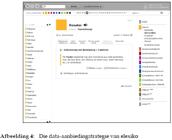
As explained in Section 3.2, all pedagogical materials generated in this environment are grounded in the dictionary database, including its definitions, examples, collocations and other lexical metadata. This is an important distinction from unconstrained general AI generation, which may produce plausible but inconsistent or non-standard language material. By rooting textbook functions in the dictionary database, BILEX aims to preserve internal consistency and lexicographic authority.
6.3 Automated exercise generation and immediate feedback
Below each linked text, the system provides links to six types of automatically generated exercises, all of which include immediate AI-assisted feedback upon submission:
- Situational dialogue: a scenario based on the text is generated, accompanied by a short description and an illustrative image; the learner takes one role and interacts with a counterpart.
- Reading comprehension: questions targeting both literal and inferential understanding.
- Vocabulary dictation: spoken forms are generated for the learner to recognise and transcribe.
- Grammar consolidation: exercises focusing on grammatical structures in the text.
- Vocabulary gap-fill: tasks requiring the learner to supply appropriate lexical items in context.
- Short essay writing: a writing task related to the text, with guidance and an evaluation rubric.
All exercise types provide immediate AI-assisted feedback upon submission. For objective tasks (e.g. dictation, gap-fill, reading comprehension), the system assigns scores automatically and indicates correct answers. For productive tasks, especially short essay writing, it generates an evaluation including a score, comments on linguistic features (such as lexical range, grammatical accuracy and coherence), and suggestions for revision. This immediate feedback allows learners to monitor their performance and make adjustments without waiting for instructor input.
These tasks are generated with LLM assistance, but the system allows later human checking and revision. At the present stage, the project's main focus has been the construction of the database and the implementation of pedagogical functions, informed by preliminary needs analysis. Formal empirical testing of learning outcomes remains a task for future work.
The multimodal character of these exercises extends the principle of media convergence from dictionary representation to language practice.
In addition to the exercise module, the Dictionary Sprite assistant remains accessible on textbook pages for text-related questioning and pedagogical interaction.
7. Administration system
The administration system provides the managerial and analytical layer of the platform. Its functions include task assignment, query statistics and learning-behaviour analysis.
Task assignment supports workflow distribution in the compilation system. Query logs from both the consultation and textbook systems may be visualised through word clouds and frequency tables. These data have clear lexicographic value, since highly queried words may indicate entries in need of revision or clarification. They also have pedagogical value, since repeated queries on particular words, sentences or texts may reveal areas of learner difficulty.
The system also supports user-level and text-level analyses, helping teachers identify learning bottlenecks and adjust instruction accordingly. User-interaction records are stored separately from lexical content for administrative analysis. Before such records are used in formal educational research, they will be anonymised and handled in accordance with relevant institutional ethical and data-protection requirements.
8. Discussion
The significance of BILEX lies not in the existence of isolated functions but in the way several important lexicographic developments are combined within one operational environment. The platform's main contributions, its relation to comparable systems, and its present limitations may now be briefly considered.
8.1 Main contributions
BILEX makes three principal contributions. First, it offers what appears to be the first full operational implementation of media-converged lexicography in a shared-database environment. It is therefore important not only as a platform but as a practical realisation of a theoretical model.
Second, it introduces an AI-assisted contextual disambiguation solution to data overload. Instead of reducing lexicographic content, it preserves the complete entry while guiding the user through sense identification, scrolling and highlighting. This is a lexicographically conservative but technologically innovative response to a long-recognised problem.
Third, it extends learner's dictionaries into a pedagogical environment through dynamic textbook linkage and AI-assisted exercise generation. In this respect, it contributes not only to dictionary system design but also to the theory and practice of learner's lexicography.
8.2 Comparison with existing systems
Table 1 compares BILEX with several representative systems along four dimensions central to the present discussion: unified shared database, native multimodal integration, full-chain AI integration, and textbook integration with exercise generation.
The comparison does not diminish the value of existing systems within their own domains. TLex, for example, remains a strong commercial environment for dictionary compilation and now includes AI-assisted text generation. Yet BILEX differs in combining multimodal support, contextualised consultation, textbook linkage and data feedback within one architecture.
8.3 Limitations and future directions
The present version of BILEX has several limitations. First, large-scale user testing and systematic evaluation have not yet been conducted. The current stage has concentrated mainly on building the database, platform and pedagogical functions, guided by preliminary needs analysis.
Second, the current GLM-4.7 implementation of contextual disambiguation has not yet undergone a dedicated large-scale evaluation. Earlier validation within the same project, conducted with ChatGPT-4 (Ge and Wang 2024), showed lower agreement rates for conjunctions and articles than for nouns, verbs and adjectives. These findings suggest that function words are more difficult for LLM-based sense selection, but whether the same pattern holds for the current GLM-4.7 configuration remains to be tested. Future work will therefore combine model-specific evaluation with stronger syntactic analysis and more fine-grained prompting strategies.
Third, quality control of AI-generated multimodal content still relies heavily on human review. This is appropriate at present, but later versions may benefit from automatic quality-evaluation procedures.
Fourth, the pedagogical value of the textbook system still needs controlled empirical validation. A natural next step will be quasi-experimental research comparing learning outcomes with BILEX and more traditional dictionary resources.
Fifth, the modular use of externally hosted AI services creates a reproducibility challenge because model behaviour may change when providers update particular model versions or endpoint aliases. Although the deployment described in this article uses GLM-4.7, DeepSeek-V3.2, Seedream 3.0 and Seedance 1.0, later deployments may use different models without changes to the platform's core application logic. Future formal evaluations will therefore archive the exact API model identifiers, provider endpoints, access dates, prompt templates, principal generation parameters and representative outputs associated with each tested configuration.
9. Conclusion
This article has presented BILEX, a blended media-converged platform for multimodal lexicography and language teaching. The platform demonstrates three main contributions: it provides an operational implementation of media-converged lexicography in a unified shared-database environment; it offers an AI-assisted solution to data overload through contextual sense highlighting rather than data suppression; and it extends learner's dictionaries into a pedagogical environment through dynamic textbook linkage and AI-assisted exercise generation.
More broadly, BILEX suggests a viable model for lexicography in the age of AI. It does not treat AI as a replacement for the lexicographer. Instead, repetitive, generative and assistive tasks are delegated to AI, while semantic judgement, quality control and theoretical guidance remain with human experts. In this way, technological support is integrated without displacing lexicographic expertise.
The next phase of the project will focus on empirical validation of learning outcomes, model-specific and user-based evaluation of contextual disambiguation, further refinement of the disambiguation workflow, and improved quality control of AI-generated multimodal content.
Endnotes
1. The compilation system's editing workspace is built upon the open-source Lexonomy editor component, available at https://github.com/elexis-eu/lexonomy.
2. The XML example included in this article is simplified for expository purposes.
3. The network is implemented as a dedicated relational table within the shared database, with each node mapped directly to its corresponding headword ID in the main entry table.
Acknowledgements
This work was supported by the National Office for Philosophy and Social Sciences of China under the project Research on a Media Converged Multimodal English-Chinese Learner's Dictionary Database (Project No. 20AYY012), and by the 2025 Collaborative Programme for Humanities and Social Sciences Research of the Shandong Federation of Social Sciences under the project Discourse Analysis of Shanghai Cooperation Organization Countries' Cooperation with China Based on a Multilingual Corpus and Countermeasures for Shandong Province. The authors wish to thank Prof. Liu Changqing for his technical support and guidance throughout the development of the platform.
References
- Bothma, T.J.D. and R.H. Gouws. 2025. Generative Artificial Intelligence (GenAI) as Information Tool for Lexicographic Information Needs. Lexikos 35(2): 276-295.
- De Schryver, G.-M. 2023. Generative AI and Lexicography: The Current State of the Art Using ChatGPT. International Journal of Lexicography 36(4): 355-387.
- Ge, X. and M. Wang. 2024. Research on the Generation and Application of Sense Lists Assisted by Large Language Models (大语言模型辅助下基于词典的义项表生成及应用研究). Corpus Linguistics 11(1): 26-36.
- Gouws, R.H. and S. Tarp. 2017. Information Overload and Data Overload in Lexicography. International Journal of Lexicography 30(4): 389-415.
- IDM France. n.d. DPS User Manual. https://dps.cw.idm.fr/
- Lew, R. 2023. ChatGPT as a COBUILD Lexicographer. Humanities and Social Sciences Communications 10: 704.
- Lew, R. 2024. Dictionaries and Lexicography in the AI Era. Humanities and Social Sciences Communications 11: 426.
- Lew, R. and G.-M. de Schryver. 2014. Dictionary Users in the Digital Revolution. International Journal of Lexicography 27(4): 341-359.
- Lew, R., B. Ptasznik and S. Wolfer. 2024. The Effectiveness of ChatGPT as a Lexical Tool for English, Compared with a Bilingual Dictionary and a Monolingual Learner's Dictionary. Humanities and Social Sciences Communications 11: 1324.
- Monsalve Muñoz, U.C., J.E. Bonilla, R.Y. Rubio López and A.S. Luna Cortés. 2025. LEXICC: The Design and Development of an Online Dictionary Writing System. Lexikos 35(1): 83-108.
- Paquot, M. 2012. The LEAD Dictionary-cum-Writing Aid: An Integrated Dictionary and Corpus Tool. Granger, S. and M. Paquot (Eds.). 2012. Electronic Lexicography: 163-186. Oxford: Oxford University Press.
- Ptasznik, B., S. Wolfer and R. Lew. 2024. A Learners' Dictionary Versus ChatGPT in Receptive and Productive Lexical Tasks. International Journal of Lexicography 37(3): 322-336.
- Rascón Caballero, A. 2025. Avoiding Information Overload - Ways of Exemplifying in Bilingual e-Dictionaries Depending on the Systematicity of the Linguistic Data. Lexikos 35(1): 183-198.
- Rees, G.P. and R. Lew. 2024. The Effectiveness of OpenAI GPT-Generated Definitions Versus Definitions from an English Learners' Dictionary in a Lexically Orientated Reading Task. International Journal of Lexicography 37(1): 50-74.
- TshwaneDJe HLT. 2023. TshwaneLex Suite: Dictionary Compilation Software (version 15). https://tshwanedje.com/
- TshwaneDJe HLT. 2024. TLex OpenAI Integration. https://tshwanedje.com/articles/CODH-video-presentation-TLex-OpenAI-Integration/
- Zhang, Y. 2019. On the Innovation of Dictionary Compilation and Publication in the Context of Media Convergence (论融媒体背景下辞书编纂与出版的创新). Chinese Journal of Language Policy and Planning 4(6): 79-89.
- Zhang, Y. 2022. A Brief Discussion on the Technological Innovation and Theoretical Methodology of Converged Media Dictionary (略论融媒体辞书的技术创新和理论方法). Applied Linguistics 1: 9-16.
- Zhang, Y. 2024. The Theoretical Model of Multimodal Dictionaries and Their Definitions within the Framework of Media Convergence (融媒框架下多模态词典及其释义的理论模式研究). Foreign Language Teaching and Research 56(4): 519-531+639.