'Something Raw and Real': Tracey Derrick discusses her Photography with Michael Godby
Tracey Derrick matriculated at Westerford High School, Cape Town in 1979 and graduated from the University of Cape Town with majors in Psychology and Economics in 1982. During the 1980s Tracey travelled extensively in Europe and North and South America, supporting herself with textile work, media work and teaching. She returned to South Africa and completed a Higher Diploma in Education in 1987. In 1989 she attended the School of Visual Arts in New York and from that time began to both practice photography and, as opportunity arose, conduct photography workshops with children and other groups.
She has been working full-time as a photographer since 1992, the time of South Africa's transition to majority rule. Much of her early work is related in one way or another to the achievement of democracy in southern Africa, for example her project Side by Side (1994) in which she worked with Primrose Talakumeni and Mavis Mthandeki to document the role of women in the first democratic elections; and Still Moving (1994), in which she recorded the hopes for peace at the time of the elections in Mocambique after many decades of oppression and civil war. The achievement of political freedom in South Africa opened up space for Derrick, and other photographers, to explore aspects of spiritual life in this country - for example in The Waters of Life (1995) - and to document aspects of experience in the sub-continent that were overlooked during the struggle for freedom: in The Red Ochre People (1995) Derrick photographed the Himba people in Northern Namibia whose ancient lifestyle is threatened by the construction of dams; in 1997 the United Nations High Commission for Refugees commissioned Hope from Home: Refugees from Africa Living in Cape Town; and also in 1997, she created the essay Basic Necessity: Sex Workers around and about Cape Town. All of these projects took the form of exhibitions, and most were published with educational texts to reach school and community groups. While she quickly gained an international reputation with these projects, Derrick continued to hold photographic workshops throughout this period.
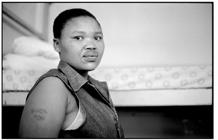
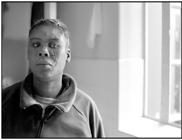
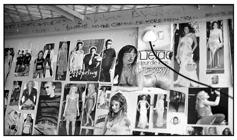
Recent projects, for which Tracey Derrick has achieved worldwide recognition, are Earthworks: The Lives of Farm Labourers in the Swartland and Eye Inside: Women Inmates at the Malmesbury Prison. In these projects Derrick works closely with people in her own neighbourhood, documenting the experiences of people on the margins of the new dispensation. In the Malmesbury Prison project, Derrick returned to her interest in empowering her subjects to take their own photographs and share their stories with the larger society.
Michael Godby: From the outline of your biography above, you appear to have turned quite late to photography. Did you have a career in mind while you were studying? Or immediately thereafter?
Tracey Derrick: I studied a B.A. after school, not really knowing what I wanted to do, but Psychology and Economics felt like possible teaching subjects.
Only while travelling did photography begin to grow on me. I took a manual camera with me from the beginning. I loved travelling and meeting new people, exposing myself to new cultures and experiences.
Sailing on the schooner Nancy in 1984, I learnt rope and leatherwork, and this is where my craft skills began. Later, back in Cape Town while doing my H.D.E. at the University of Cape Town, I became involved in making hammocks. We landed up in New York exhibiting the hammocks and that was when I began taking black and white photographs.
It was in New York in 1988 when I was sneaked into Parsons School of Photography and made my first black and white print that something stirred in me and I knew that I wanted to do more. It felt like a mixing of the physical and visual, a hands-on way of making photographs. A year later I registered for the School of Visual Arts course - and so gained legal access to a darkroom!
Around those years when I was in New York again, I met the photographer Robert Frank and was very privileged to spend time with Brian Graham who was doing his printing - he taught me enormous amounts. Robert's wife, June bought one of our hammocks. I loved Robert Frank's work, his feeling.
Hitching back from Nova Scotia one day, at the end of 1991, I decided that I was ready to come 'home' to Cape Town and concentrate on taking photographs. I needed more focus and meaning in what I was photographing.
MG: Is it fair to say that, on leaving University, you decided on an 'alternative' lifestyle? If so, does your understanding of photography relate to a life somehow on the outside?
TD: I think my decision was to find a lifestyle different to what was presented to me, to what I saw being lived around me. I had no concept of 'alternative': I just knew that I needed to explore and experience life with more choices. I felt constrained by apartheid and I needed the freedom to move where I wanted. So from this background and my experiences of travelling, yes, I think that my photography does relate to life on the outside.
MG: Can we look at that idea a little more closely? Are you saying, as some photographers do, that you were using the medium to explore the world you were living in? And, what did you understand by photography? Did Robert Frank's work make a strong impression on you? Were there other practitioners that defined the medium for you in these early days? And, a somewhat different question, did you think you could make a career or a living from taking photographs in South Africa?
TD: Well yes, after I had made that first black and white print, photography became more meaningful to me, and the camera became a tool for me to explore the world.
In those early years what I understood as photography? Well, looking back on that work today, it's like photo albums - people I didn't know and people I did know, myself moving, transitory, a traveller, no roots, I was still getting a rhythm in the darkroom. I was teaching myself. At one point back in New York, I fell off a roof and broke my heel and landed up in Rotterdam for three months and I took the opportunity to read Beaumont Newhall's 'The History of Photography'. That was when I learnt about Alfred Stieglitz, Paul Strand and Henri Cartier-Bresson - manual hands-on photographers - their work impressed me and still does. After this I met Robert Frank whose work put into perspective my need to take photographs, that I wanted it to be a part of my life, inseparable, like he says 'part and parcel of my everyday life'.
I really didn't know if I could make a living out of my work. I made a decision in 1991 when I came back that I would never compromise my work for money. I never have and it has not been easy.
MG: You seem to be talking about your work as a form of visual diary. But diaries are normally private and photography is normally exhibited publicly. I recognize that there is a strong private dimension in much of your work - on the one hand, family, friends and your dog, Salvador, feature very often and, on the other, you clearly value building relationships with many of your subjects - but, in going public, as it were, for the first time, you seem to have believed that you had something to say beyond your immediate circle. Can you describe what this was?
TD: Yes, my work is very personal. I think I realized that I had things to say about where I chose to live. A way to make public the reasons why I left Cape Town in the first place, a way of informing viewers about our society. Photography has become this means for me, to show where and how we live.
When I came back I met Noluthando Mamputa, and started to spend a lot of time with her in the townships and became comfortable there and slowly started documenting her with her Zionist Christian Church. This was the time of our first democratic elections, and it was a very exciting time in our country. I became a part of that energy by photographing women who had been involved in the historic process and invited Mavis Mthandeki and Primrose Talakumeni to join me and be my apprentices. This work became 'Side by Side', portraits of politically active women.
This experience inspired me so much that I hitched to Maputo in Moçambique to document their first democratic elections. Because I am fluent in Portuguese I was able to communicate closely with Moçambicans about their experiences and circumstances. I stayed in small villages with families and travelled with Moçam-bican refugees returning from Malawi. This work resulted in the exhibition 'Still Moving'.
MG: Perhaps the democratic elections in South Africa and Moçambique gave you a freedom of movement, especially between different communities and cultures that you had experienced only overseas before that time. But isn't your project rather more complex than simply showing that everyone has 'the same needs and desires in life'? So many of your projects seem to seek out people who are either powerless or persecuted: early examples would be the Himba in Namibia, whose ancient lifestyle is threatened by massive dam projects; African refugees in Cape Town; and sex workers in Cape Town. How do you decide on these projects? And are they not as much political as personal?
TD: Certainly my travelling gave me a confidence to move around on my own, especially back here where it was accepted that you just don't go to the townships on your own.
I guess that these projects are personal as well as political in that I decide what to do next by thinking about what would be exciting and different for me. Like going to camp with the Himba, and I had always wanted to speak to sex workers and find out what their lives are like. The refugee project was a commission, but came from my own initiative up in Moçambique. My years in the township came together as exhibitions, first on the Zionists and then the Sangomas. When I have decided on a project, I then do intense research into the people and their lives and then without my seeking it out, the political angle comes in.
Well, political is social and that is the angle I see it from, the people's point of view, if you like. I find myself wanting to challenge social and cultural myths about people and communities that are ostracized and separated because they are perceived to be different. This comes from myself having pushed and experimented with my own life. I cannot judge others: we all have our own realities and ways of being in the world. I think that this is the subtle message in my work. I want to be honest always about what I present.
MG: During all these projects, you were accompanied by your dog, Salvador, who invariably appears in at least one photograph in the series. These pictures seem like a thread through your work and your decision at one point to have an exhibition of the Salvador photographs seems to me to indicate that Salvador pointed to a different dimension in all your human subjects, a dimension of play, of humanity, whatever their social realities may have been. And now you are publishing a book on Salvador.
TD: Salvador was my first experience of responsibility after ten years of travelling. She helped me with my photographs; she brought out another side of people - the humanness, softness, communication without words. I guess she epitomized all the values that I held for myself - without judgment.
One could look at the exhibition of her as a culmination of the political wrapped up in the personal story about my relationship with her during all that work, and about my relationships with people that I photograph. The book is a tribute to her and what she taught me, and it is almost that by showing photographs of Sal, that I show photographs of myself. My book on Salvador is like an edited retrospective of my working life as a photographer.
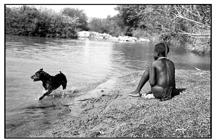
MG: Another exhibition that you did that was also not project-bound but, rather, took images from all your projects and drew connections between them, was 'Liquid Life' that was based, obviously, on the theme of water. Was this similar to the Salvador project for you?
TD: I tend to pressurise myself to always have a new project happening. When my daughter, Tess, was born in 2000, I gave myself a year to be with her and used the time to put 'Liquid Life' together. It was images from various projects around the theme of water but I added new photographs of family and friends for the show. It was about how we cannot live without the wet, our survival depends on it, yet we have huge structures of defense and control to try and keep it at bay.
MG: Your next major project, I think, was 'Earthworks' of 2004, on farm labourers. You had recently moved to the Swartland, so there must be a strong personal dimension here too. Yet the mood in this series is often dark and angry, seeming to agitate for the political and economic rights of this neglected community.
TD: I moved to the Swartland in 1998 onto a farm, on the Kasteelberg mountain. I got to know the workers on the farm I was on and fortunately it had an enlightened owner who was open and fair. Yet all around me I saw abuse and exploitation of workers on the farms, and their living conditions were still so archaic, like no flushing toilets or water on tap inside the houses. These workers came from the apartheid 'dop' system, where wages were paid in cheap lethal, chemical wine. I started to learn about fetal alcohol syndrome (FAS), and to recognize it.
we were living in 2004, ten years after our democratic elections and very little had changed for these people. The communities were still wrestling with problems of land tenure, poor housing, low wages, and racism. Poor education makes it difficult for them to understand the potential of new legislation and with no disposable income they have few opportunities to make real choices in their lives.
This was very personal for me, as I was living right in the middle of it; and I myself was dealing with the farmers as an English speaking person, an 'Engelse mens', as they call me. There was racism and distrust towards me that I had to work very hard to dissolve.
I have now lived in this area for nine years and still there is sensitivity and a fine balance between English and Afrikaans speakers. It certainly is an area of extremes and contrasts in landscape and culture.
MG: Many of your photographs in this series are portraits. In his essay, with Jean Mohr, on French woodcutters, John Berger claimed that one could read qualities of these workers' lives in their faces: exposure, for example, and the anticipation of danger. what do you feel that your portraits tell one of the lives of farm workers? And, while you talk about the problems of alcohol, you are not actually representing them. How did you select your subjects in composing this essay?
TD: I don't specifically select subjects to photograph - when I am out in the field with people, it is the combination of my communication with them and then the light and composition that I feel. Then that 'moment' happens. I am with them and empathise and so I think that they expose something of themselves that they are not even aware of. I am only conscious of something that I feel in my stomach and then I know that I have captured something raw and real - for them and for me, it's very powerful.
I don't work for any organization, so I cannot represent them. I can only show to others my experiences with people and how it makes me feel - for example the farm workers and their exhaustion, alcohol and the effects on their bodies. Sometimes I feel that I want to help them more, my energy reaches out and maybe this is what they feel from me.
MG: we spoke earlier about your rejection of a conformist life-style. In what you are saying here, it would appear that when you work you have no thought of the future circulation of your photographs - of galleries and gallerists - just the expectation that what the experience of the photographic encounter means to you will be apparent to whomever sees the image. Is this a fair interpretation of your working method?
TD: I guess so. I love doing my work and think little about marketing and getting it out there. If I did, I shouldn't be a documentary photographer and certainly shouldn't be spending time with sex workers or in a women's prison for example, producing images that I don't imagine people will hang on their walls.
For my exhibitions, I write an introduction text to each project, explaining what it is about and my experiences, and the photographs have titles to explain more. But I expect people to look and feel and go into each image in their own way.
I feel that my projects have their own lives. It is a huge experience for me to complete them, to make them a whole, and then to present them to the world: at that point they take on their own energy.
MG: Your sense of the authenticity of each image - the idea that a photograph can convey your experience of the photographic encounter, what it felt like to you to engage with the people you are working with - this authenticity seems to be reflected in your darkroom procedure where, unlike some other photographers, you insist on using the full frame of the image, and you control every last detail of the printing process. Would you explain your approach to the production of your work?
TD: I use a manual camera - Canon F1, no flash or filters, straight lens, no tripod. I process my own films, hand-print my work and, yes, I never crop my images. I play very little in the darkroom - my ultimate being the perfect negative that needs no burning in or playing around with. I like to print the whole experience and feeling of that moment and my relationship with it. I want to try to capture real beauty as I find it without resorting to technical tricks: like seeking the essence of the person I'm photographing, the intensity of life - catching fractions of seconds of intensity of moments.
MG: And you do not work in colour because you could not control the process so completely?
TD: Yes, but I do love colour, however. I have a second Canon F1 that always has colour negative film in and that is like my picture postcard film. In the past I really enjoyed shooting slide, which has a richness and depth to each image and there is something special about seeing slides on a slide projector.
MG: Is this a different form of diary? Or is it for commercial work?
TD: My colour camera is more for family events and in that sense a diary. Sometimes the light in the landscape out here in the Swartland just has to be captured in colour. Also yes, commercial work is more in colour. Although this year my 'commercial' work has been teaching adults as well as second year photography students. I have really enjoyed this too - a way for me to share my skills.
MG: Your most recent project has been Eye Inside on women prisoners in Malmesbury Prison. Can you speak about why you chose this subject, what problems confronted you in working in a prison environment, and what you are wanting to say in these photographs?
TD: I wanted to know what it was like inside a women's prison and no one knew about the women's section in the old prison in Malmesbury - they were like a forgotten society. It took me six months to get permission to take my camera into the cells. Once I was in and had been accepted by the gang leader, a warm and intimate experience developed between us.
It wasn't easy for me to be in the middle of such a controlled hierarchy even though the warders opened up as much as they could as they got used to me too. We had some tricky times but all admitted that we had learnt a lot from each other.
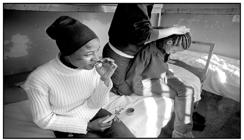
After a year I knew it was time for me to move on and consolidate my photographs, yet I didn't want to leave the women as I seemed to be their only link with the outside world. So I approached Pick 'n Pay which generously supported a teaching programme. With manual cameras from previous projects (I have also used these cameras with Big Issue street vendors), I taught the prisoners basic 35mm photography skills. They were fantastic, two of the women couldn't read or write and the other eight had basic literacy skills, yet they learnt how to use these cameras and produced interesting photographs. They called themselves 'The Rough Diamonds'.
These photographs show my friendship with the women, through that we see their boredom and isolation as well as their community feeling and fun that they create within prison life. This project is a deeply personal record for myself - an acceptance of people living in different circumstances to me and the choices that they make on how they live their lives. Most of the women that I met are there because they needed to put bread on the table for their families or they are caught up in the traditional patriarchal system of gangs and power.
MG: Since it is so recent, perhaps you could talk about the way you edit your work. On what basis do you make selections? Do you look for a cross-section of your experience in the project? Or do you stick with the strongest images? Do you make different selections for different exhibitions or publications?
TD: My friend Seamus has helped me to edit the last five exhibitions: this is something that I cannot do on my own. I find that I am too emotionally involved in each image and struggle to separate myself. I first look for the strongest images, put them together and see how they hang as a whole. Then I make some changes if I need to make the story flow better. And yes, one has to adapt and edit differently for publications and maybe smaller exhibitions.
MG: You have just decided to register for a Masters degree in Photography. Do you anticipate that this might affect your working method?
TD: No, I don't want to change the way in which I work. I am interested in exploring my approach to my work and my subjects, and how I have to develop a relationship with them. I call this approach the 'subject position'. I intend to look at the range of photographic possibilities of subject relations between documentary photographers and to propose how - by establishing a relationship, by truly interacting with the subject rather than functioning as a mere recorder - the photographer can add a layer of credibility, integrity and honesty.
I will spend time with the Bergies of Cape Town, our unique shadows of Cape Town and strive to get beyond the stereotypes of the drunken funny people living in the streets. Everyone knows who the Bergies are - they are familiar characters around us - yet they remain essentially unknown, and I would like to expose their deep history. I am looking forward to this very much.
Her and me - The travels of Salvador
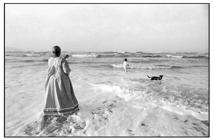
01 The Waters of Life - Zionist baptisms, 1993.
Noluthando Mamputa after continual singing, dancing and drumming through the night, prepares to be baptised and cleansed at Monwabisi Beach, Khayelit-sha.
02 The Red Ochre People - Himba in the Kaokaveld, Epupa Falls, 1997.
It was not until after 1850, only 150 years ago that the first European expeditions were made into the Kaokaveld.
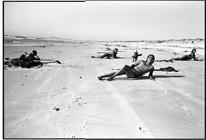
03 Basic Necessity - Sex workers around and about Cape Town, 1998. Basha and the transvestite gang at Milnerton beach.
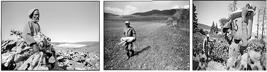
EarthWorks - The lives of farm labourers in the Swartland
04 Oom Paul Heyns, 2002
Died in 2003 of lung cancer, people think he was 52 years old. The workers graveyard of generations was dug up to build a dam, no-one could stop it.
05 Hendrik Syster, 2001
7th generation on the farm I lived on. He is Piet's father-in-law. He thinks he is 50, but he is probably 70+ years old. He has been dry for 15 years and is fir and healthy.
06 Mzwakhe Mngxuma, 2003
This work, is all he, his father and his father's father know. He has a matric from Riebeek Kasteel around the mountain, but how to move forward from here?
Eye Inside - Malmesbury Women's Prison
07 Fuck you, 2005.
Nomadiba - 32 years old, convicted of robbery, sentenced to 1 year and 6 months. Shoplifting tablets from pharmacies, to re-sell on the streets.
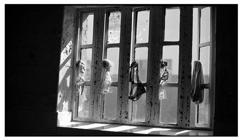
08 The Window, 2005.
Monique - 37 years old, convicted of murder, sentenced to 8 years. After 5 years of abuse by her husband, in a fight she stabbed him in the neck. Self defense.
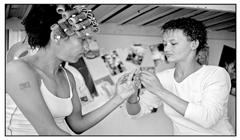
09 Henna nail polish, 2005
Johanna - 31 years old, convicted of robbery and murder, sentenced to 6 years and her boyfriend for life. They robbed and he murdered her employer of 10 years.
Janine - 29 years old, convicted of murder during a 28's gang fight, sentenced to 10 years. 2nd sentence, cut a girlfriend's ear off in a jealousy rage.
10 Wallpaper, 2005.
11 Cell salon, 2005.
Debbie - 26 yeas old, convicted of armed robbery, sentenced to 2 years. 6 cases in 4 months. I was getikked and needed money, would steal anything and everything.
Lula - 29 years old, convicted of fraud, sentenced to 6 years. Auto bank and credit card fraud.
12 Washing Line, 2005.
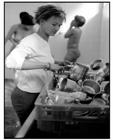
13 Washing up, 2005. Janine - 29 years old
The Waters of Life
The Red Ochre People
Basic Necessity
EarthWorks
Eye Inside