A public health ethics framework for the older community: A South African perspective
Abstract
An ethical framework for dealing with geriatric communities is mostly absent in developing countries. This article presents an ethics framework for public health that can be used to address older persons' communities and their associated vulnerability. A mixed methods approach was used for the design of this framework. A principal component analysis was employed to summarise the information content. The rotated component matrix identified nine determinants from the survey outcome. A five-point Likert scale rated fifty statements relevant to care for older persons. The rating of the mentioned statements confirmed that social determinants nfluence older persons' health. Furthermore, such statements' ratings also highlighted the role of government and support systems in the care of older persons. The evident link between social determinants and ethics was noteworthy, as well as the fact that social determinants contribute towards ethical challenges. It was further confirmed that an ethical framework could contribute towards health and judgements concerning older communities.
ethical challenges; geriatric community; healthcare; older persons; socia determinants
Abstract
'n Etiese raamwerk met die oog op die hantering van ouer gemeenskappe is meestal nie beskikbaar in ontwikkelende lande nie. Hierdie artikel bied 'n etiek-raamwerk vir openbare gesondheid wat gebruik kan word om ouerpersone-gemeenskappe en hul gepaardgaande broosheid te hanteer. Vir die ontwerp van hierdie raamwerk is 'n gemengdemetode-benadering gebruik. 'n Hoofkomponentanalise is aangewend om die inhoud van die inligting op te som. Die gedraaide komponentmatriks het nege faktore geïdentifiseer wat op die uitkoms van die opname/dataversameling gebaseer is. 'n Vyfpunt-Likertskaal is gebruik om stellings wat op die sorg van ouer persone betrekking het, te takseer. Die taksering van die genoemde stellings het bevestig dat sosiale faktore 'n invloed op die gesondheid van ouer persone uitoefen. Voorts het die taksering van die sodanige stellings ook die owerheid en ondersteuningstelsels se rol in ouer persone se versorging beklemtoon. Die voor die hand liggende skakel tussen sosiale faktore en etiek was opmerklik, asook die feit dat sosiale faktore tot etiese uitdagings bygedra het. Daar is verder bevestig dat 'n etiese raamwerk tot die gesondheid van ouer persone en hul versorging kan bydra.
Sleutelwoorde; etiese uitdagings; geriatriese gemeenskap; gesondheidsorg; ouer persone; sosiale faktore
1. Background
Although there is globally a comprehensive body of literature, policies and plans available on older healthcare, this body of knowledge originates mostly from developed countries or international organisations such as the African Union (AU), European Union (EU), World Health Organisation (WHO), and the United Nations (UN). In South Africa, as in other developing countries, there is a limited body of knowledge available on older healthcare or discussion on legislation such as the Older Persons Act, Act No. 13 of 2006 (Republic of South Africa, 2006), as confirmed by- knowledge databases such as Science Direct, ProQuest, Taylor & Francis, and the Sabinet African Journal Collection. An even smaller body of literature reporting on ethical challenges associated with older healthcare is evident from these databases.
According to our interpretation, the need for older health discussions in general and the ethical challenges of older people's health, in particular, are more global than South African discussions (reference removed for review purposes). The situation in Africa may change with the emergence of the AU's draft Policy framework and plan of action on ageing (2022) and the AU's human rights protocol on older persons signed in 2024, which came into effect on 4 November 2024.
This change is needed, as the expected worldwide growth in ageing populations and, hence, older people will contribute to increasing healthcare needs as reported by the WHO (WHO, 2015, 2017, 2020). Developing countries are expected to find it hard to address the healthcare needs of the growing older population, as economic development may not be adequate to deal effectively with this need and its associated challenges. This, in turn, may give rise to more ethical challenges for the older community. The burden on older people increases as the impact of the COVID-19 pandemic on world economies becomes more evident.
For South Africa, Chitiga-Mabugu, Henseler, Mabugu, and Maisonnave (2021) presented two scenarios based on distributional outcomes. Both scenarios show significant evidence of a decline in economic growth and employment. These results will further challenge the negative effect that social determinants may have on the older community. One South African study confirmed isolation and loneliness and even violence and abuse, subject to the livelihood (Abdelatif et al., 2023:10). Another study identified hunger and food insecurity as a major concern during COVID-19 (Maharaj & Dunn, 2021), confirming the vulnerability of older people. Within the African context, Tessema et al. (2021) stated at the start of the pandemic that African countries were not ready for the pandemic due to weak healthcare systems. Consequently, a severe impact was expected on all population groups, especially older persons.
It is accepted that social determinants contribute just as much to a healthy society as good physical health does. Still, the social determinants in South Africa impacting the health of the elderly community are not well delineated, discussed, or addressed (Lategan, 2021:145). Social determinants often identify ethical challenges closely related to the older community's multi-phased health and well-being needs. These needs range from physical, socio-economic, and environmental to socio-cultural and life expectancy needs.
The needs of the older community can be grouped into five categories with personal needs as the core of these categories: resources (human, physical, and financial), social activities (integration in and contribution to community), social networks (family life) and healthcare (to address fragility). Within a defined community, such as the community in which older people live, these needs are experienced collectively and can raise ethical challenges. Prominent ethical challenges linked to older people's health are (a) vulnerability and fragility, (b) abuse and neglect, and upholding dignity, (c) securing a safe environment to live in and (d) providing quality access to healthcare and provision. These challenges can be regarded as the geriatric community's ethical basis for public health (Lategan, 2021:129-130).
It was deemed necessary to address these challenges. Therefore, a public health focus was identified because of its prominent role in healthcare and its emerging role after the COVID-19 pandemic. Public health focuses on promoting quality of health and living through three foci: prevention, promotion, and protection. Brusaferro et al. (2022:94) argue that prediction (surveillance and forecast), precision (identifying the most critical interventions) and participation (ownership of one's health) should be added to the three traditional foci. The additional foci were sparked mainly by health equity.
An evident neglected aspect within South African public health is the absence of a public health ethics framework for the elderly community. As this study focused on public health ethics, these observations lead to the question: What are the important ethical aspects to consider for a public health ethics framework for the elderly community in the South African context? This article reports on this question as reported by a comprehensive study on a public health ethics framework for the elderly population in South Africa (Lategan, 2021).
2. Method
A mixed methods approach was followed based on the Q-methodology and a literature review to answer the above question. The Q-methodology outlines consensus and deviation (Alderson et al., 2018:739-740), which is based on ranking predefined statements (Q-sorting) relevant to the research question of a study. The statements (Q-set) are derived from the literature review and are ranked by the participants (P-set).
The comprehensive literature review formed part of the qualitative research strategy to identify the themes and trends within literature focusing on elderly care. Based on the literature review, a questionnaire was designed to sample information via a five-point Likert scale, where the rating took place according to the "least important" (represented by 1) to "cannot do without this" (represented by 5). The rating of statements can fit the two extremes of the Likert scale, namely "agree" or "disagree", with a moderate or neutral point of being indecisive.
This article reports on the results of the second methodology, namely the rating of statements based on the Likert scale questionnaire. A questionnaire with fifty (50) statements was constructed based on the literature review. This questionnaire presented three indexes:
a. an Index of Social Determinants (Questions 1-20);
b. an Index of Public Health Ethics (Questions 21-35); and
c. an Index of a Public Health Ethics Framework (Questions 36-50).
The different indexes contributed towards the ethics framework's content for caring for older people. Principal component analysis (PCA) was used to summarise the information content.
Six older persons' care institutions were identified, two each in the three South African provinces. The Free State Province, Northern Cape Province, and North West Province were the provinces. At the time the research was conducted, these provinces had the smallest populations compared to the other six South African provinces and represented 29.14% of the population older than 60 years (Republic of South Africa, 2020a; Republic of South Africa, 2020b). Economically, these provinces fall outside the mainstream gross domestic product for provinces in South Africa (Republic of South Africa, 2018).
Twenty-five participants were invited to participate in the study. The invitation was based on the number of participants who voluntarily indicated their willingness to participate in the study. As these institutions were in marginalised provinces, it was critical to juxtapose their opinions against the existing information originating mainly from mainline provinces. Twenty-two participants from six institutions for older persons eventually participated in rating the statements. Older persons were excluded from the research as the focus was gathering in-depth information on public health ethics as perceived by the identified target population: healthcare providers and managers. The frequency of information derived from the questionnaire's participants confirmed two groups: one with medical or healthcare experience (49.9% of respondents) and one with management or administrative experience (45.4% of respondents).
Ethical clearance was received from the Health Sciences Research Committee (HSREC), Faculty of Health Sciences, University of the Free State, Bloemfontein, and approval to conduct the research was obtained from the managers of the various institutions. Informed consent was obtained from all participants before the start of the data collection. The data was sampled from July to August 2020 and analysed from October to December 2020.
In this article refers geriatric community to older people and all involved caring for them and managing their affairs. Older community or older persons' community refers to all people of age. In the original study, "geriatric people" or "geriatric community" was mostly used. Therefore, there were no changes to using "geriatric" in the questionnaires.
3. Results
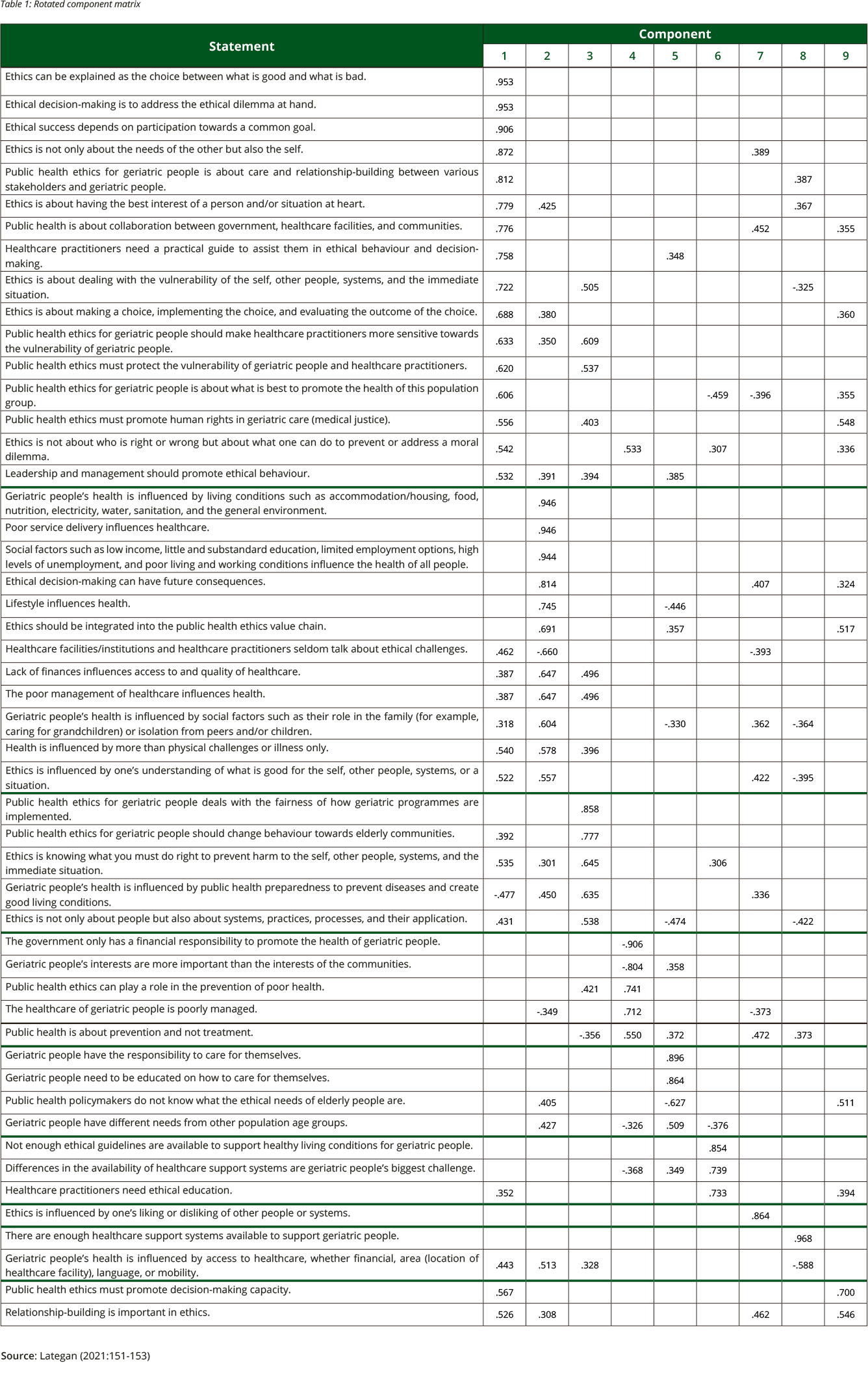
Based on the collected data, the rotated component matrix (cf. Table 1) identified nine determinants from the survey outcome. Variables were assigned to the determinants. The rotated component matrix sorted the variables by the factor they belonged to and by co-variance with the factor.
The first factor highlighted that ethics is defined based on principles. Applied care and professional ethics shaped the understanding of public health ethics. This approach contributed to defining public health ethics as applying ethical principles through a professional ethic, resulting in care and relationship-building.
The factor analysis also assisted with a broader view of ethics. The seventh factor portrayed that ethics is an individual matter and is, therefore, influenced by personal orientation. The ninth factor confirmed that ethics entails more than choosing merely between right and wrong; it also adds value to a given situation and can be applied to real-life situations. The third factor confirmed the positive influence public health ethics could have on older persons.
The influence of social determinants on the health and well-being of the older community cannot be ignored. The second factor confirmed that social determinants do influence older persons, while the eighth factor outlined the influence of social determinants on the health of older persons.
The fourth factor confirmed the value that public health is adding to the health of older persons. This is only doable with the availability of systems, support, and education, as identified by the sixth factor.
Regardless of the vital role, availability, and contribution of public health systems and ethical support, the responsibility of older persons towards their own health cannot be discharged, as confirmed by the eighth factor.
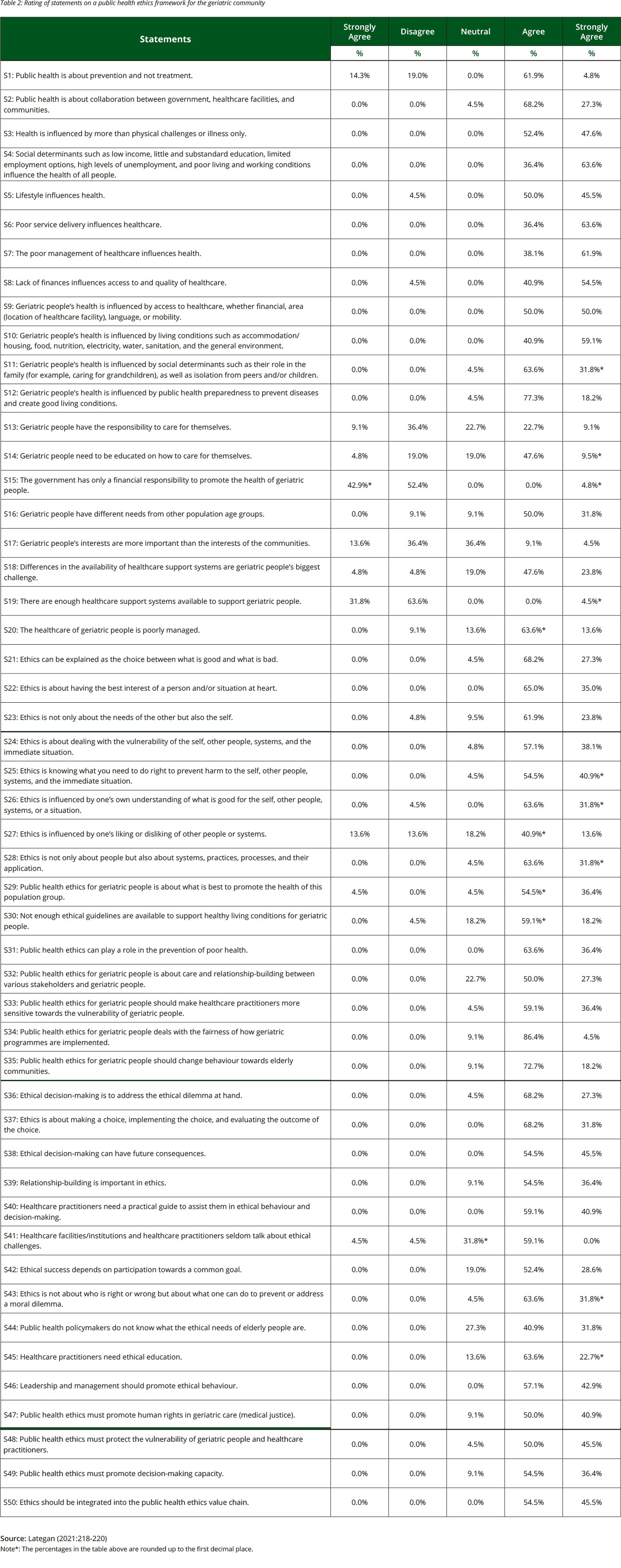
The rating of statements contributed to the following results, as reported in Table 2:
From the Likert scale rating of statements, it is evident that participants had strong opinions when rating the statements. Six statements in the Index on Social Determinants, with twenty statements, had only agreed or strongly agreed ratings (cf. Statements 3, 4, 7, 9, and 10). Four of the statements elicited either disagreed or strongly disagreed from the majority of respondents (cf. Statements 13, 15, 17, and 19). One statement had a high neutral ranking (36.4%) (cf. Statement 17). The rated statements based on a strong opinion (either agree, strongly agree, disagree, strongly disagree) are linked to the influence of social determinants on older persons' health, the government's responsibility towards the geriatric community and systems available to support the geriatric community. According to these ratings, older persons are vulnerable, which means that this community requires sufficient support to maintain its health. This view is further informed by the disagree or strongly disagree statement that older persons' healthcare needs are more important than those of other communities. It should also be noted that 36.4% of respondents had a neutral view of this statement.
The Index on Public Health Ethics, with its fifteen statements, had only two statements with an agree or strongly agree rating (cf. Statements 22 and 31). These ratings confirmed the general orientation of ethics, namely the interest of all people or situations (cf. Statement 22). The link between ethics and social determinants is noteworthy. This observation confirmed that social determinants can evoke ethical challenges (cf. Statement 31). The 22.7% neutral ranking of the statement on care and relationship-building should not be interpreted as an opposing view but rather as unfamiliarity with this interpretation of public ethics (cf. Statement 32).
The fifteen statements of the Index of a Public Health Ethics Framework's rating pattern supported the need for a public health ethics framework for older persons. These ratings contributed to the interpretation that public health ethics is regarded as essential for them and that it can contribute to maintaining the health of this population group. Equally important is the observation that respondents agreed with having a public health ethics framework for older persons, the role that such a framework can play in maintaining health, and the assistance such a framework can offer towards ethical judgements.
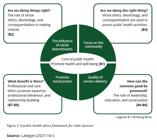
From the literature review and the interpretation of the rating of statements, eight building blocks were identified for a public health ethics framework for older persons. The building blocks, with their focus and benefits, are discussed in the table below:

4. DISCUSSION
Based on the identified building blocks for a public health ethics framework for older persons, the following discussion emanated:
• A foundational understanding of ethics is the choice between right and wrong. Applied to public health ethics, this means the choice between right and wrong in promoting a population's health and well-being. Building Block 1 represents the core of public health, which is health and well-being. Public health focuses on the community and is driven by social justice. Social determinants influence older persons' health. Social determinants, together with social justice, require quality of service. This building block is interlinked with the population it serves (the older community), what impacts the core of public health (social determinants), and the obligation of quality of services as part of social justice. Public health workers should always ask what the core of their activity is and should be mindful of what impacts the core activity.
• Four questions can be associated with ethics. These questions can assist with the alignment of the other seven building blocks to Building Block 1. The questions are:
• Are we doing things right?
• Are we doing the right thing?
• How can the common good be promoted?
• What benefit is there?
• Older persons are vulnerable due to the determinants impacting public health. The growing older persons' community and the demand on the public health system give rise to ethical challenges. To deal with such challenges, we should ask ourselves: Are we doing things right? This question identifies the principles required for dealing with older persons. Building Block 2 fits here as it resonates with the choice between right and wrong. The three schools of ethics will guide us in making this choice. The questions to ask are: What is the motive for the action (virtue ethics)? What are the obligations to perform the activity (deontology)? What will be the result of the action (consequentialism)?
•Building Block 3 engages with the healthcare worker and/or older persons to evaluate whether the best ethical decision has been taken. The question is whether the public health activity will be in their best interest. The three schools of ethics can be used to identify if the best ethical decision has been taken. The questions to ask are: Whose interest was served (virtue ethics)? How was the activity approached (deontology)? What outcome will the activity have (consequentialism)?
•Building Blocks 4-6 promote the common good in public health. Leadership, education, and social justice support public health actions by making the right choices and promoting healthcare equity and equality (social justice).
•Building Blocks 7-8 advance the benefit of ethics. Professional ethics and care ethics will be adding value to public health.
5. Conclusion
This study confirmed the absence of a public health ethics framework for the community of older persons in South Africa - both at a conceptual and implementation level. Although limited information on this community's needs is available, the rating of statements contributed towards profiling a framework for the South African older persons' community. Although limited, the existing bodies of knowledge and information on this topic added to the interpretation of the data to make the framework relevant to the South African context. This framework addressed a specific need within the older persons' community.
It is anticipated that this framework can also be relevant at conceptual and implementation levels in other health systems, as the need to be ethical towards older persons is not limited to the South African situation only.
REFERENCES
-
Abdelatif, N., Naidoo, I., Dunn, S., Mazinu, M., Essack, Z., Groenewald, C., Maharaj, P., Msomi, N., Reddy. T., Roberts, B. & Zuma, K. 2023. Heterogeneity in COVID-19 infection among older persons in South Africa: Evidence from national surveillance data. Frontiers in public health, 16:11:1009309. https://doi.org/10.3389/fpubh.2023.1009309.
» https://doi.org/10.3389/fpubh.2023.1009309 -
African Union (AU). 2016. Protocol to the African Charter on Human and People's Rights on the Rights of Older People in Africa. https://au.int/sites/default/flles/treaties/36438-treaty-0051_-_protocol_on_the_rights_of_older_persons_e.pdf Date of access: 20 November 2024.
» https://au.int/sites/default/flles/treaties/36438-treaty-0051_-_protocol_on_the_rights_of_older_persons_e.pdf -
African Union (AU). 2022. Building forward better well being and living standards in Africa: Draft policy framework and plan of action on ageing. https://au.int/
» https://au.int/ -
Alderson, S., Foy, R., Bryant, L., Ahmed, S. & House, A., 2018. Using Q-methodology to guide the implementation of new healthcare policies. BMJ quality & safety, 27(9):737-742. https://doi.org/10.1136/bmjqs-2017-007380.
» https://doi.org/10.1136/bmjqs-2017-007380 -
Brusaferro, S., Arnoldo, L., Brunelli, L., Croci, R. & Mistretta, A. 2022. Six Ps to drive the future of public health. Journal of public health, 44(1):i94-i96. https://doi.org/10.1093/pubmed/fdac106.
» https://doi.org/10.1093/pubmed/fdac106 -
Chitiga-Mabugu, M., Henseler, M., Mabugu, R. & Maisonnave, H. 2020. Economic and distributional impact of COVID-19: Evidence from macro-micro modelling of the South African economy. South African journal of economics, 89(1). https://doi.org/10.1111/saje.12275.
» https://doi.org/10.1111/saje.12275 - Lategan, L.O.K. 2021. A public health ethics framework for the geriatric community. Bloemfontein: University of the Free State. (Thesis - PhD)
-
Maharaj, P. & Dunn, S. 2021. Profiling ageing in South Africa in the era of the coronavirus pandemic. Conference paper read at the International Population Conference, 5-10 December, India. https://iussp.org/sites/default/files/IPC%202021%20-%20Conference%20Report%20-%20Final.pdf Date of access: 12 November 2024.
» https://iussp.org/sites/default/files/IPC%202021%20-%20Conference%20Report%20-%20Final.pdf - Republic of South Africa (RSA). 2006. Older Persons Act, Act No. 13 of 2006. Pretoria: Government Printing Works.
-
Republic of South Africa (RSA). 2018. If South Africa's provinces were independent states. http://www.statssa.gov.za/?p=11092. Date of access: 20 February 2021.
» http://www.statssa.gov.za/?p=11092 -
Republic of South Africa (RSA). 2020a. Mid-year estimates report: Stats SA. http://www.statssa.gov.za/?p=13453. Date of access: 20 February 2021.
» http://www.statssa.gov.za/?p=13453 -
Republic of South Africa (RSA). 2020b. Press release: Mid-year estimates report: Stats SA. http://www.statssa.gov.za/?p=13453. Date of access: 20 February 2021.
» http://www.statssa.gov.za/?p=13453 -
Tessema, G.A., Kinfu Y., Dachew, B.A., Alene, K., Aregay, A.F., Ayalew, M.B., ... Tesfay, F.H. 2021. The COVID-19 pandemic and healthcare systems in Africa: A scoping review of preparedness, impact and response. BMJ global health, 6:e007179. https://doi.org/10.1136/bmjgh-2021-007179.
» https://doi.org/10.1136/bmjgh-2021-007179 -
World Health Organization (WHO). 2015. World report on ageing and health: Geneva: WHO Press. https://www.who.int/publications/i/item/9789241565042 Date of access: 20 November 2024.
» https://www.who.int/publications/i/item/9789241565042 -
World Health Organization (WHO). 2017. Developing an ethical framework for health ageing: Report of a WHO meeting. Geneva: WHO Press. https://apps.who.int/iris/handle/10665/259932
» https://apps.who.int/iris/handle/10665/259932 -
World Health Organization (WHO). 2020. Statement - Older people are at highest risk from COVID-19, but all must act to prevent community spread. https://www.who.int/europe/news/item/03-04-2020-statement-older-people-are-at-highest-risk-from-covid-19-but-all-must-act-to-prevent-community-spread#:~:text=First%2C%20we%20should%20emphasize%20that,community%20spread%20of%20the%20virus Date of access: 20 November 2024.
» https://www.who.int/europe/news/item/03-04-2020-statement-older-people-are-at-highest-risk-from-covid-19-but-all-must-act-to-prevent-community-spread#:~:text=First%2C%20we%20should%20emphasize%20that,community%20spread%20of%20the%20virus
The article is based on completed research by L.O.K.L. in fulfilment of the doctoral degree in community health. G.J.v.Z. and W.H.K. supervised the study. L.O.K.L. updated the information and drafted the article with inputs from the co-authors. All authors agreed to the final draft of the article.
Acknowledgements
The authors would like to thank Prof. Antoni Szubarga for the data analysis and the participating institutions in the research.
Declaration
This article is based on an overview of a completed PhD study by LOK Lategan. GJ van Zyl and WH Kruger acted as this study's supervisors. Aspects of this study were published in acknowledged journals. The origin and focus of this article, compared to other articles, were communicated to the Koers Editor in November 2022. The declaration was made that aspects such as methodology, data sampling, and participants' context could be duplicated due to the nature of each article.