Fire and mammal herbivory on arthropods in the protected savannas: A systematic review
Abstract
Protected areas in the savannas are key global reserves for biological diversity, including arthropods. Fire and mammal herbivory disrupts the diversity of biological organisms that alternately affects the functioning of the ecosystem. The study presents a global synthesis review of arthropod responses to varying intensities of fires and mammal herbivory in the protected savannas. We hypothesise that the intensity of predetermined fires and mammal herbivory has cascading impacts on abundance, species richness and diversity of terrestrial arthropods in the protected savannas. A minimum selection criteria was used to collate relevant literature from electronic databases of previous studies performed in the subtropical regions of Australia, Brazil and South Africa. Arthropod orders were used to group ecological indicators in 84.6%, while the functional traits were used in 15.4% of the studies. The orders included Hymenoptera (i.e. Formicidae), which was used in 81.8% of the studies selected for this systematic review, while Orthoptera, Araneae and Coleoptera were each used in 45.5%, 36.4% and 36.4% of the studies, respectively. In addition, Hemiptera and Lepidoptera were used as indicators in 27.3%, while Blattodea and Diptera were used in 18.2% of the studies. Collembola and functional groups (herbivores, omnivores and predators) were used as indicators in less than 9.1% of the studies. Fire and mammal herbivory significantly influenced the abundance and species richness of Hymenoptera, Lepidoptera, Orthoptera and multi-taxon. However, the response of arthropods (i.e. abundance and species richness) to the intensities of disturbances did not vary significantly at burnt and grazed plots. CONSERVATION IMPLICATIONS: A similar response to intensities of disturbance suggests that an array of arthropod orders and functional groups (solely or combined) are indistinguishably affected by fire and mammal herbivory. Thus, arthropods could potentially be a viable ecological indicator to ascertain the magnitude of impacts. Policies encouraging the integration of different intensities of fire and mammal herbivory across protected areas should be encouraged to optimise the conservation of arthropods, including the threatened morphospecies
biological conservation; disturbance; ecological indicators; invertebrate assemblages; southern hemisphere
Introduction
Savanna biomes comprise of mixed woodland and grassland ecosystems that cover approximately 20% of the earth's terrestrial surface (Scholes & Archer 1997), 46% of the southern African region and approximately 34.3% of the total land area in South Africa (Low & Rebelo 1996; Van Wilgen 2009a). Extensive fuel loads owing to high plant biomass are one typical characteristic of savanna landscapes making them highly prone to fire during the dry winter season (Friedel, Allan & Duguid 2014; Little, Hockey & Jansen 2015). Fire, therefore, influences the processes of the savanna ecosystem, such as nutrient recycling, seedling recruitment and subsequent plant biomass accumulation, all of which are responsive to different intensities of fire with cascading impacts on biological organisms within the food web (Paolucci et al. 2017; Pryke & Samways 2012; Reinhart, Dangi & Vermeire 2016).
Grazing and nipping of the vegetative and reproductive parts of the plant by either game or domestic animals and arthropods disrupt the community composition of plants and associated organisms in the ecosystem (Ebeling et al. 2018; Gebeyehu & Samways 2003; Zhu et al. 2012). Veld disruption resulting from mammal herbivory and insect herbivory reduces the population of ecological primary producers such as tree, forbes and grass species (Friedel et al. 2014; Little et al. 2015). Hence, the magnitude of plant and arthropod community shifts depends on the intensities of disturbances in the protected grassland, forests and savannas (Van Wilgen 2009a; Wardle et al. 2004).
In general, fire and mammal herbivory are among the most common management practices known as drivers of biodiversity in the grasslands, forests and savanna systems across protected areas worldwide (Borgström et al. 2016; Davis et al. 2014; Little et al. 2015; Van der Waal et al. 2011; Veen et al. 2008). Although fire and mammal herbivory (i.e. solely or combined) encourage coppicing and flushing of ecological primary producers, they interrupt the community composition of plants, vertebrates and invertebrates in the ecosystem (Eby et al. 2014; Rutina & Moe 2014; Van Klink et al. 2015). These practices yield 'top-down' pressures and drive the diversity and community composition of ecological primary producers (Castagneyrol et al. 2017; Fuhlendorf & Engle 2004; Wigley et al. 2014). The change in plant community and diversity yields direct or indirect influences on the diversity of insects and mammals at different levels within a food web (Anderson & Briske 1995; Bond & Parr 2010; Castagneyrol et al. 2017). Furthermore, fire and mammal herbivory also affect the diversity and efficiency of distinct groups of arthropods such as pollinators, coprophages and saprophages (Briones 2014; Chenchouni et al. 2015).
Fire and mammal herbivory disrupts the multitrophic interactions of the above- and below-ground organisms in protected landscapes (Schneider et al. 2016; Seibold et al. 2018; Van Dam & Heil 2011), including vertebrates and invertebrates facilitating different ecological functions in the ecosystem (Breviglieri & Romero 2017; Kehrli & Wratten 2011; Parr, Gray & Bond 2012). Top-down controls in the form of predation, parasitism and herbivory by organisms in higher trophic levels may have contrasting effects on the population of their respective hosts (Vidal & Murphy 2018; Zaugg, Benrey & Bacher 2013). Bottom-up and top-down pressures disrupt food webs and could lead to their potential collapse (Maia et al. 2019; Samways 1993; Schneider et al. 2016; Wilkinson & Sherratt 2016; Zhu et al. 2023). Immense pressures on the threatened and highly vulnerable populations of arthropods may lead to species extinction (Castagneyrol et al. 2017; Scherber et al. 2010; Vidal & Murphy 2018). Protected area managers in savanna systems around the globe thrive to ensure that there is a balance between food resources and habitats to sustain the biodiversity of ecologically important organisms (Grobler 2023; Salvatori et al. 2001; Thoresen et al. 2021; Wigley-Coetsee et al. 2022). Inevitably, the choice of a savanna management technique and the intensity at which they are employed influence the condition and functioning of an ecosystem.
Accidental fires and major shifts in the population of the significant ecological drivers such as the elephants (Loxodonta africana) and rhinos (i.e. Ceratotherium simum, Dicerorhinus sumatrensis, Diceros bicornis and Rhinoceros unicornis) affect the management of protected areas and ultimately influence assemblages of biodiversity and their conservation (Davis et al. 2014; Ferreira et al. 2015; Harrington, Woiwod & Sparks 1999; Van Wilgen 2009b). To document the implications of the shifts, dozens of PAs in the savanna landscapes established the long-term fire and grazing exclosures with different intensities of disturbances to succour in developing the best management plans that do not compromise the diversity of biological organisms (Titshall, O'Connor & Morris 2000; Van Wilgen 2009a; Wigley et al. 2014). Enormous efforts have been invested in monitoring biodiversity and tracking their shifts in response to fire and mammal herbivory in the protected savannas (Siemann et al. 2017; Van Wilgen 2009a); this includes South Africa as the signatory to the Convention on Biological Diversity (abbreviated as CBD, thereafter). Among commonly assessed ecological indicators in the protected savannas are the plants, invertebrates and vertebrates (Siddig et al. 2016).
In terrestrial protected ecosystems of global grasslands and savannas, impacts of fires and mammal herbivory were thoroughly documented and are known to have major impacts on the diversity of arthropods (Joshi et al. 2004; Vidal & Murphy 2018; Zaugg et al. 2013). These management techniques yield either transient or permanent changes in the abundance and composition of sensitive communities of arthropods in both regional and global scales (Davis et al. 2014; Goosey et al. 2019; Harrington et al. 1999). Because of their sensitivity to disturbances, different groups of arthropods (e.g. Araneae, Blattodea, Coleoptera, Collembola, Hymenoptera, Lepidoptera and Orthoptera) were identified as key organisms that may be used as biological indicators to ascertain the magnitude of habitat modifications resulting from climate change, invasion, fires and mammal herbivory (Danks 1992; Farrell et al. 2015; Menta & Remelli 2020; Van Klink et al. 2015). These organisms include the plant, below- and above-ground dwelling arthropods whose diversity is greatly affected by ecological disturbances (Langor & Spence 2006; Samways 1993; Uehara-Prado et al. 2010). Therefore, adequate knowledge of the diversity and sensitivity of these organisms to the varying intensities of fire and mammal herbivory will conjure the influence of the adopted management policies in the conservation of arthropods in different protected savannas. This study used available literature to assess the impact of fire and mammal herbivory on the abundance and species richness of arthropod taxa in the protected savannas.
Research methods and design
We conducted a systematic review of all the relevant peer-reviewed articles sourced from four search engines, namely Google Scholar (https://scholar.google.com/), JStor (https://www.jstor.org/), Scopus from June 2019 to September 2020 (i.e. updated in August 2024). Research articles were pooled to measure the responses of arthropod assemblages to different intensities of fire and mammal herbivory in protected areas (i.e. also known as nature reserves) along the savanna landscapes throughout the globe. To explore the published literature on Google Scholar, JStor, Scopus and Web of Science, we employed a Boolean search strategy, combining search terms or phrases using AND/OR operators within the query boxes on the respective websites. The haphazardly utilised keywords on various search engines included: 'fire', 'mammal herbivory or grazing', 'veld management', 'arthropods diversity', 'arthropod assemblages', 'savanna landscape' and 'protected areas'. We therefore refined our search using the Boolean operators, 'fire' OR 'mammal herbivory' AND 'arthropod assemblages' NOT 'plants, birds or mammals', to focus on studies that assessed arthropods on burnt and grazed plots within protected areas with savanna vegetation type in South Africa and elsewhere in the world (Sexton & Emery 2020).
Selection criteria and data collection
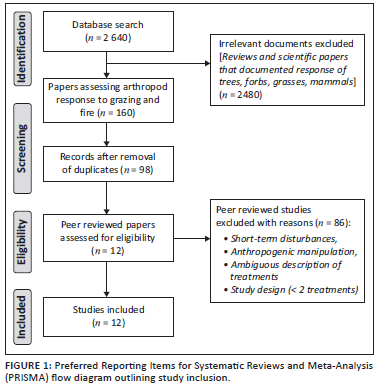
The selection of articles for this review was conducted following a systematic approach in line with the Preferred Reporting Items for Systematic Reviews and Meta-Analyses (PRISMA) guidelines (Moher et al. 2015; Parums 2021). The search engines yielded a total of 2640 research articles (i.e. book chapters, theses and peer-reviewed research papers) that assessed the impact of fires and mammal herbivory on biological indicators such as trees, grasses, forbs, mammals and arthropods (Borgström et al. 2016; Burkepile et al. 2016; Levick, Baldeck & Asner 2015; Wigley et al. 2014) at various landscapes. This large dataset suggests the high global relevance of the topic among scholars and conservation communities in general. Following the removal of research articles because of their incongruency with the defined scope of focus, a total of 160 articles were found to be eligible for further screening. Thus, 2480 research articles were discarded because of their irrelevance or incongruency with the defined scope of focus. Research reviews and scientific article that documented the response of non-targeted ecological indicators (trees, forbs, grasses, mammals) were excluded. Furthermore, studies that assessed a distinctive group of ecological indicators known as arthropods (e.g. either solely or combined) to ascertain the impact of varying intensities of fire and mammal herbivory in forests, grasslands, shrublands ecosystems or unprotected savannas were omitted for this review. Of the screened research articles, 98 were further assessed for eligibility while 62 were omitted as a result of duplication. Apart from the duplication of research articles across different search engines, published scientific reports and thesis chapters were reproduced as peer-reviewed scientific articles (Figure 1).
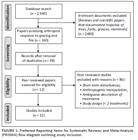
Of the eligible studies, 86 peer-reviewed articles were excluded because of the use of disturbance intensities and field manipulation techniques that did not coincide with the baseline requirements for the current systematic review. Ambiguity in the treatments and study design resulted in the disqualification of such peer-reviewed scientific articles. For example, studies that assessed the arthropod diversities following post-accidental or once-off prescribed fires (Ferrenberg et al. 2006; Haddad et al. 2015; Lavigne & Lockwood 1989) and those involving the use of mechanical techniques such as manual clearing of vegetation to simulate mammal herbivory (Cizek et al. 2012; Parker et al. 2023) were excluded. Furthermore, this review excluded studies that assessed arthropod diversity in the protected savannas where domestic grazers (e.g. cattle and sheep), either alone or in combination with game herbivores were used (Ferreira, Le Roex & Greaver 2019; Gebeyehu & Samways 2003; Goosey et al. 2019; Wilkerson, Roche & Young 2013; Wilkinson & Sherratt 2016). Studies on the response of arthropods to three grazing treatments at the Kenyan Long-term Exclosure Experiment (KLEE) were omitted from this systematic review because of the inadequacy of distinctive explanation in the intensity of grazing by herbivores (e.g. domestic, game and combined) on the grazing exclosures (Warui et al. 2005; Wilkerson et al. 2013). Fundamentally, studies that documented the temporal response or recovery of arthropods to fires or intensive mammal herbivory were excluded (Calcaterra et al. 2014; Jerrentrup et al. 2014; Yekwayo et al. 2018; Zhu et al. 2020). Lastly, we excluded studies that reported the differences in arthropod responses to two treatments only (i.e. such as 'treatment and control') rather than intensities of fire or mammal herbivory (Figure 1). Although a pool of studies assessed the influence of fire and mammal herbivory on arthropods assemblages, one or few attributes not coinciding with the baseline requirement(s) of the systematic review resulted in the disqualification of some studies.
Experiments conducted in the long-term exclosures, where no boundaries were erected to encourage heavy grazing by mega- and meso-herbivore (e.g. hereafter referred to as heavily grazed), boundaries were erected to exclude mega-herbivores only in the minimally grazed and all grazers (e.g. mega- or meso-herbivores) in the ungrazed areas were included in this study. Alternatively, experimental burnt plots, where intentional burns were carried out annually, biennially, triennially, quadrennially or quinquennially (i.e. a minimum of three treatments), were considered for this systematic review (Biggs et al. 2003; Van Wilgen 2009a). The continent or country in which the assessments were conducted was recorded. The techniques used to collect the arthropods and the collection periods were noticed.
The systematic review considered articles that compared the abundance, species richness and diversity in the periodically burnt plots and grazed exclosures of the protected savanna ecosystems. Data in the response of arthropods to fire (e.g. unburnt, annually, biennially, triennially, quadrennially or quinquennially burnt plots) and mammal herbivory (e.g. ungrazed, minimally and heavily grazed) were gathered from the text, tables and/or figures of each study included in this review. For each experiment, the influence of fire and mammal herbivory on the abundance, species richness, diversity and community composition of arthropods was documented. Taxon-specific, multi-taxon and functional group responses to intensities fire and mammal herbivory were recorded to ascertain the sensitivity of taxonomic groups to disturbances. Emulating from Wang and Tang (2019), the means, standard errors or deviations and sample sizes were extracted from the text, tables or digitised graphs. To extract the means and standard errors or deviations from the digitised graphs, GetData Graph Digitizer (version 2.26, https://getdata-graph-digitizer.software.informer.com/) was used.
Statistical analyses
All statistical analyses were performed using the software IBM SPSS Statistics, SPSS Inc., version 26. Normal quantile plots were used to verify the normality in the distribution of the data. The abundance and species richness of different ecological indicators at the fire and grazed plots conform to a normal distribution. Data for the arthropod order(s) or functional group(s) that were used as indicators in a single study were omitted during statistical analysis because of a lack of variance. To assess the influence of fire and mammal herbivory on the abundance and species richness of arthropod groups, a two-way analysis of variance (ANOVA) was used. Two-way ANOVA was followed by the pairwise tests to measure the statistical differences in the abundance and species richness among groups of arthropods (i.e. orders) and intensities of disturbances in the protected areas.
Ethical considerations
Ethical clearance to conduct this study was obtained from the University of the Free State, Interfaculty Animal Research Ethics Committee in the Zoology and Entomology Department (Bloemfontein Campus) (No. UFS-AED2018/0078).
Results and Discussion
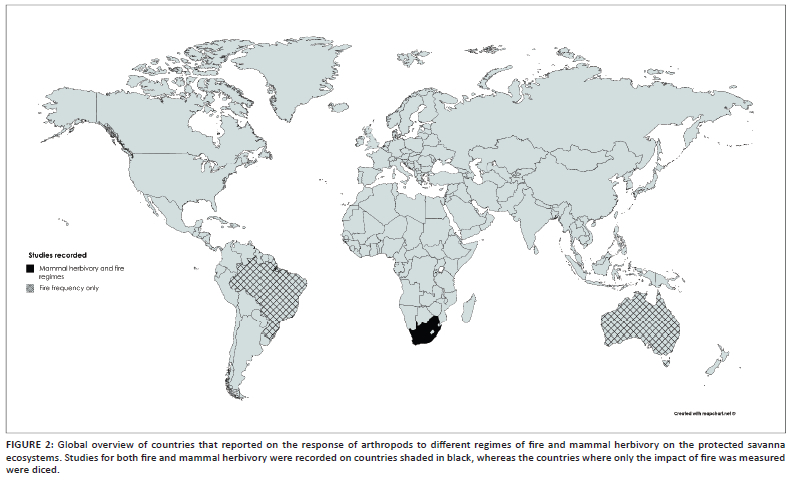
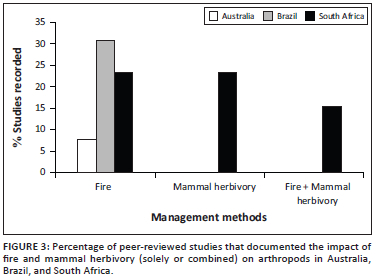
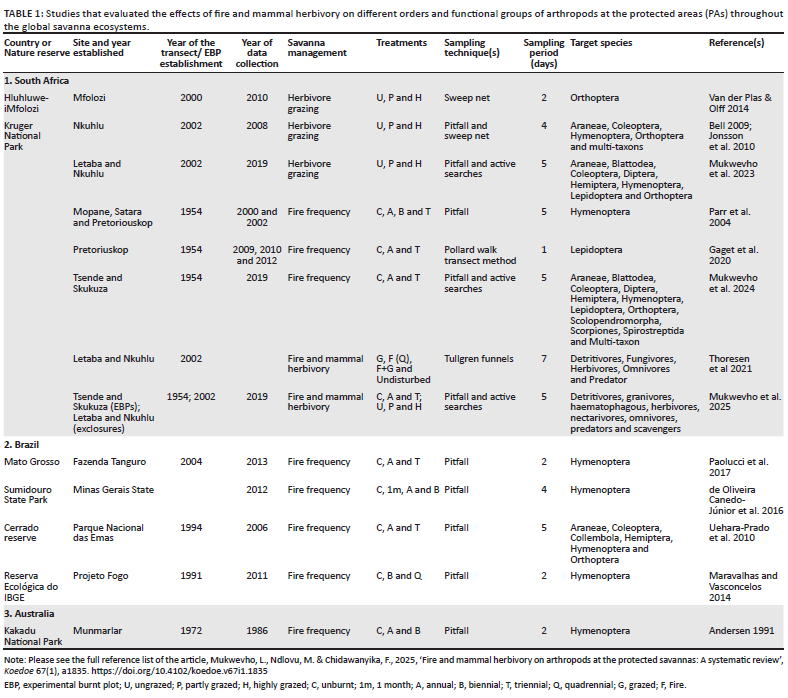
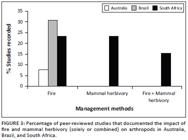
Studies that were included in this review were conducted in the tropical and subtropical regions of Oceania, South America and Africa, respectively (Figure 2). Although recorded studies were conducted in different ecozones, study regions were along the savanna landscapes (Figure 2). Of these studies, 61.5% reported on the long-term impact of fire, 23.1% reported on the impact of mammal herbivory, while 15.4% reported the combined impacts of fire and mammal herbivory on arthropod assemblage and diversity at the protected savannas (Figure 3; Table 1). Of the studies that assessed the impact of fires on arthropod assemblage and diversity, 50% were conducted in Brazil, while 37.5% and 12.5% were conducted in South Africa and Australia, respectively. All studies that reported the intensities of herbivory in the long-term experimental exclosure were conducted in the protected areas of South Africa, namely the Kruger National Park (67%) and Hluhluwe iMfolozi National Park (33%). Lastly, studies on the combined impact of fire and mammal herbivory were conducted at Kruger National Park, South Africa (Figure 4; Table 1).
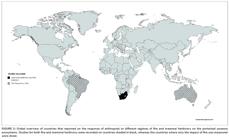
The results demonstrated that the response of arthropods to intensities of fire and mammal herbivory was conducted in limited regions resonate with those presented in a review by González-Megías, Gómez and Sánchez-Piñero (2004), Nghiyalwa et al. (2021) and Oikonomou et al. (2023), which included studies from three continents. Therefore, trivial documentation on the long-term response of arthropods to the intensities of fires and mammal herbivory could be associated with the economics (e.g. a lack of adequate funding to erect infrastructures, remunerate specialists or field assistants, transport and purchase other consumables) of maintaining the fire plots and grazing exclosures and conservation needs of each region (Biggs et al. 2003; Pekor et al. 2019; Penman et al. 2020). The dominance of studies assessing the post-effects of accidental fires and temporal grazing compared to those assessing the long-term effects is inevitable (Bieber et al. 2023; Moretti, Obrist & Duelli 2004). Studies outlined costs associated with fencing of exclosures and protected areas to control access as a major factor compromising access to protected areas and experimental plots while jeopardising the integrity of conservancy and ongoing experiments (Linden et al. 2023). Humans and megaherbivores pose direct damage to erected fences and parks incur high costs during follow-up repairs and reconstruction to ensure restricted access (Cabral de Mel et al. 2023; Pekor et al. 2019; Wilkinson et al. 2021). Furthermore, accidental fires may jeopardise the management plan of the experimental burnt plots in the protected savanna ecosystems, where firebreaks are not consistently maintained (Biggs et al. 2003; Scholtz et al. 2022).
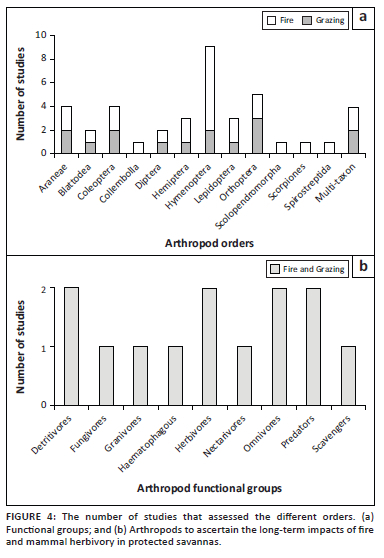
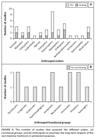
Among the groups of arthropods assessed as ecological indicators were Araneae, Blattodea, Coleoptera, Collembola, Diptera, Hemiptera, Hymenoptera, Lepidoptera and Orthoptera. Of the studies documented, 63.6% assessed one focal order of arthropods as an ecological indicator, while 36.4% assessed more than four orders of arthropods to ascertain the impacts of fire or mammal herbivory in the protected areas (Figure 3). Furthermore, two studies assessed the response of functional groups of arthropods (i.e. Detritivores, Fungivores, Granivores, Herbivores, Nectarivores, Omnivores, Predator and Scavengers) as ecological indicators to ascertain the impact of fire and mammal herbivory in the protected area of Kruger National Park, South Africa (Mukwevho et al. 2025; Thoresen et al. 2021). A group of arthropods, namely Hymenoptera (i.e. Formicidae), was assessed as an ecological indicator in 81.8% of the studies recorded. Other extensively studied orders of arthropods include Orthoptera, Araneae, Coleopterans and Hemiptera and Lepidoptera with 45.5%, 36.4%, 36.4%, 27.3% and 27.3%, respectively, used as ecological indicators in fire and grazed experiments. The remaining orders of arthropods, namely Blattodea, Collembola and Diptera were used as ecological indicators in 9.1% - 18.2% of the studies recorded. Lastly, 66.7% of the studies that assessed the effect of mammal herbivory on arthropods monitored the response of multi-taxon, while only 25% of the studies assessed more than one order of arthropods to ascertain the impact of fire regimes (Figure 4; Table 1).
The broad use of the Hymenoptera (i.e. Formicidae or ants) as ecological indicators in dozens of studies included in this review manifests its global importance as a widely distributed focal group that is extremely sensitive to ecological disturbances in the forests, savannas and grasslands (Andersen 2019; Hoffmann 2010; Parr & Bishop 2022; Ribas et al. 2012). The wide use of Hymenoptera as an ecological indicator compared to Coleoptera, Araneae and other focal orders was contrary to the patterns reported by Solascasas, Azcárate and Hevia (2022), which demonstrated that beetles were the commonly assessed ecological indicators in the temperate grasslands with up to 49% of the studies reporting on the response of this focal order to disturbances. Although studies assessing the impact of fires and mammal herbivory on functional groups of arthropods are minimal, the use of multi-taxon by a considerable number of studies in the savanna ecosystems presents the robustness of results reported in these ecosystems (Samways, McGeoch & New 2010). Thus, the inclusion of all arthropods (i.e. regardless of their orders or functional groups) provides a comprehensive representation of their response to anthropogenic disturbances, fires and mammal herbivory.
This study reported the impacts of fire and mammal herbivory on the abundance, biomass, species richness, diversity and assemblage composition of arthropods in the protected savanna and grassland ecosystems. All studies that measured the intensity of mammal herbivory on arthropods assessed the abundance and species richness of different focal groups. Of the studies that measured the impact of fires, a total of 75% assessed the abundance, 62.5% assessed the species richness and 25% assessed the diversity of arthropods. Lastly, a single study assessed the abundance, species richness and biomass of different functional groups of arthropods in a protected area where fire was integrated with mammal herbivory (Figure 4). The use of the matrices such as the abundance, biomass, species richness and diversity was not unique to this study but was used in multiple systematic reviews to ascertain the impact of anthropogenic activities and landscape management in the grasslands, savannas, forests and agroecosystems (Reis et al. 2024; Wang & Tang 2019).
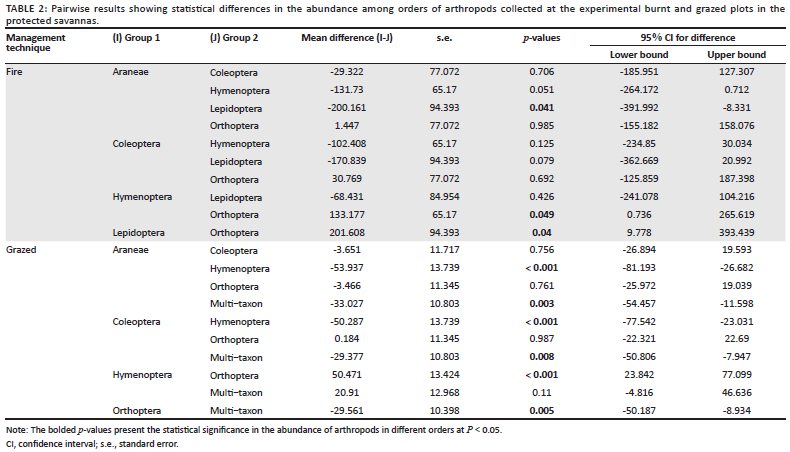
Studies showed that the abundance of arthropods significantly varied among orders at the burnt (F3, 32 = 3.722, P < 0.001) and grazed (F4, 108 = 6.637, P < 0.001) plots with the highest numbers recorded from the Hymenoptera compared to Araneae, Coleoptera, Collembola, Hemiptera and Orthoptera. Although the abundance of arthropods did not statistically vary among the intensities of fires (F2, 32 = 1.990, P < 0.148), and mammal herbivory (F2, 108 = 1.082, P < 0.343), numbers were higher at the undisturbed (i.e. unburnt, and ungrazed) compared to those recorded in the burnt or grazed plots. Lastly, the abundance of arthropods was not significantly influenced by the interaction between arthropod orders and intensity of disturbances at the burnt (F6, 32 = 0.076, P = 1.000) and grazed (F8, 108 = 0.273, P = 0.973) plots. For both fire and grazed experiments, the abundance of Hymenoptera varied compared to other orders of arthropods. While Orthoptera and Lepidoptera showed positive response to fires, only multi-taxon responded to mammal herbivory (Table 2). The uniformity in the response by different orders of arthropods used as bioindicators ascertains the resilience of unique groups to fires and mammal herbivory. Several reviews and research article reported the resilience of different groups of arthropods (e.g. Araneae, Coleoptera, Hymenoptera, Orthoptera and multi-taxon) to ecological disturbances in the protected areas (Anderson et al. 2011; Spiller et al. 2018; Yekwayo et al. 2018; Zhu et al. 2020). Arthropods with sterling dispersal abilities (i.e. Lepidoptera and Orthoptera) or those with underground nests (i.e. Hymenoptera) endure fire or mammal herbivory. Although a subset of the insect community inhabiting the ecosystem during burning or life stages that may be indulged together with plant materials during mammal herbivory, influx and continual reproduction may result in the accelerated recovery of such species. Irrespective of the beneficial implications of fires and mammal herbivory in the vegetation community and condition, the management techniques yield direct impacts (i.e. killing of individual arthropods) in the abundance of arthropods, especially the less mobile immatured and adults inhabiting the vegetation in the savanna landscapes (Van Noordwijk et al. 2012).
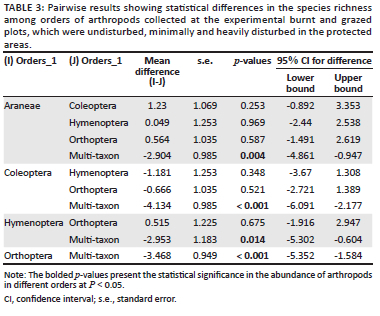
The species richness of arthropod focal orders was significantly influenced by mammal herbivory (F4, 108 = 5.665, P < 0.001) but not by the intensities of fires (F5, 37 = 1.983, P = 0.136) in the protected savannas. Results also showed that the response of different focal orders did not significantly vary among intensities of disturbances at the Experimental Burnt Plots (EBPs) (F5, 37 = 2.113, P = 0.117) and grazed exclosures (F2, 37 = 11.107, P = 0.400). Lastly, the species richness of arthropods was not significantly influenced by the interaction between arthropod orders and intensities of disturbances in the EBPs (F10, 37 = 1.429, P = 0.244) and grazed (F8, 108 = 11.646, P = 0.464) treatments. This study demonstrated that the response of arthropod species was not significantly different among focal orders at the burnt and grazed plots, but the response of multi-taxon was significantly different compared to individual groups (Table 3). However, the response of multi-taxon to the intensity of disturbances was analogous to that of individual focal groups at the EBPs and grazed plots. The results demonstrate that the species richness of different focal orders (i.e. Araneae, Coleoptera, Hymenoptera, Orthoptera and Lepidoptera) were equally sensitive to fires and mammal herbivory.
The sensitivity of these focal groups shows that different groups of arthropods could be successfully used as ecological indicators to ascertain the impact of fire and mammal herbivory. Furthermore, using multi-taxon improved the species representation at the burnt and grazed plots. Results reported in this study contradict those of Calcaterra et al. (2014), who reported that the broadly researched focal group of ants is among the biological indicators that may not be solely relied on because of their prompt recovery rate at approximately 6 months after fires (Andersen 1997; Andersen & Majer 2004; Andersen & Muller 2000; Peck, McQuaid & Campbell 1998; Tiede et al. 2017). The results reflect a similar recovery pattern among arthropod focal groups sampled at the protected savanna, which demonstrates the significant impact of fire and mammal herbivory at the protected savannas. Thus, implementation of integrated approaches at the protected reserves not only encourages the persistence of resilient morphospecies but also sustains the population of threatened and rare species in the natural ecosystem. Therefore, an integrated approach sustains the population of arthropods within food webs and those facilitating ecologically important functions such as pollination and decomposition (Durigan et al. 2020; Kemp & Ellis 2017). The integrated management approaches at demarcated sections of the protected areas may have far-reaching effects on the community structure and assemblages of arthropod in the savanna ecosystems. Arthropod community response is, therefore, a critical component of understanding the influence of land use and management interventions on the savanna ecosystems (Hoffmann 2010; Van Wilgen et al. 2017). Furthermore, the groups of arthropods are key organisms that facilitate the ecological processes, and their diversity will influence the rates at which the processes are facilitated in the protected savanna ecosystems.
Conclusion
The sensitivity of arthropod groups to the savanna management techniques (e.g. fire and mammal herbivory) differs and extreme pressure compromises the abundance while boosting the species richness of arthropods in the protected areas. Fire and mammal herbivory affect the composition of the ecological primary producers in the ecosystems (e.g. plants), which alternately affect arthropods within the food webs. The direct and indirect impacts of fire and mammal herbivory pose a threat to rare and threatened insects. Elimination of arthropods affects the overall functioning of a savanna ecosystem. This review showed that the resilience of arthropods varies among orders; however, all groups were equally impacted by fire and mammal herbivory. Policies encouraging the maintenance of undisturbed, minimally and heavily disturbed sections within protected areas optimise the conservation of arthropods. More studies on the impact of fire and mammal herbivory need to be conducted in different landscapes to enhance the knowledge to ascertain the contribution of policies in the conservation of these biological organisms. Although multiple studies assessed the impact of annual and triennial prescribed fires, resources need to be devoted towards assessing the impact of biennial and quadrennial burning cycles on arthropods. Furthermore, studies need to also document the impact of late summer and late winter burns on arthropods. Continuous assessments would be relevant for the continuous cataloguing of arthropods and for monitoring a possible shift in the communities of arthropods. A noticeable shift in biodiversity would lead to rapid change in the policy and integrated management approaches to optimise the conservation of arthropods in the changing environments.
Competing interests
The authors reported that they received funding from the Institutional Research Theme (IRT: Biodiversity Conservation and Development) of the University of Mpumalanga, National Research Foundation of South Africa and the University of the Free State, which may be affected by the research reported in the enclosed publication. The authors have disclosed those interests fully and have implemented an approved plan for managing any potential conflicts arising from their involvement. The terms of these funding arrangements have been reviewed and approved by the affiliated university in accordance with its policy on objectivity in research.
Authors' contributions
L.M. and F.C. assisted with a substantial contribution to the conception, study design, acquisition of data, analysis, interpretation and drafting of the manuscript. M.N. was involved in drafting the manuscript. All authors, L.M., M.N. and F.C. read and approved the final article.
Funding information
The authors reported that the study was funded by the Institutional Research Theme (IRT: Biodiversity Conservation and Development) of the University of Mpumalanga, National Research Foundation (Grant no. 119N4588) of South Africa and the University of the Free State (Grant no. 119DD2789).
Data availability
The authors confirm that the data supporting the findings of this study are available within the article.
Disclaimer
The views and opinions expressed in this article are those of the authors and are the product of professional research. It does not necessarily reflect the official policy or position of any affiliated institution, funder, agency or that of the publisher. The authors are responsible for this article's results, findings and content.
References
Acknowledgements
The authors would like to thank Prof. Victor Mlambo at the School of Agriculture at the University of Mpumalanga for the inputs that significantly improve the readability and technical aspects of the manuscript. Gratitude is given to Dr Tinyiko Shivambu from the University of South Africa for his useful comments on the earlier version of the manuscript. The University of Mpumalanga, Institutional Research Theme (IRT: Biodiversity Conservation and Development), the University of Free State and the National Research Foundation of South Africa are thanked for their financial support.
Literature search
-
Andersen, A.N. & Majer, J.D., 2004, 'Ants show the way down under: Invertebrates as bioindicators in land management', Frontiers in Ecology and the Environment 2, 291-298. https://doi.org/10.1890/1540-9295(2004)002[0292:ASTWDU]2.0.CO;2
» https://doi.org/10.1890/1540-9295(2004)002[0292:ASTWDU]2.0.CO;2 -
Andersen, A.N. & Muller, W.J., 2000, 'Arthropod responses to experimental fire regimes in an Australian tropical savannah: Ordinal-level analysis', Austral Ecology 25, 199-209. https://doi.org/10.1111/j.1442-9993.2000.tb00020.x
» https://doi.org/10.1111/j.1442-9993.2000.tb00020.x -
Andersen, A.N., 1991, 'Responses of ground-foraging ant communities to three experimental fire regimes in a savanna forest of tropical Australia', Biotropica 23, 575-585. https://doi.org/10.2307/2388395
» https://doi.org/10.2307/2388395 -
Andersen, A.N., 1997, 'Using ants as bioindicators: Multiscale issues in ant community ecology', Conservation Ecology 1(1), 8. https://doi.org/10.5751/ES-00014-010108
» https://doi.org/10.5751/ES-00014-010108 -
Andersen, A.N., 2019, 'Responses of ant communities to disturbance: Five principles for understanding the disturbance dynamics of a globally dominant faunal group', Journal of Animal Ecology 88, 350-362. https://doi.org/10.1111/1365-2656.12907
» https://doi.org/10.1111/1365-2656.12907 -
Anderson, A., McCormack, S., Helden, A., Sheridan, H., Kinsella, A. & Purvis, G., 2011, 'The potential of parasitoid Hymenoptera as bioindicators of arthropod diversity in agricultural grasslands', Journal of Applied Ecology 48(2), 382-390. https://doi.org/10.1111/j.1365-2664.2010.01937.x
» https://doi.org/10.1111/j.1365-2664.2010.01937.x -
Anderson, V.J. & Briske, D.D., 1995, 'Herbivore-induced species replacement in grasslands: Is it driven by herbivory tolerance or avoidance?', Ecological Applications 5, 1014-1024. https://doi.org/10.2307/2269351
» https://doi.org/10.2307/2269351 -
Bell, D., 2009, 'Indirect effects of mammalian herbivores on invertebrates in a river gradient of the Kruger National Park, South Africa', in SLU, Department of Wildlife, Fish and Environmental Studies. https://stud.epsilon.slu.se/12246/1/bell_d_171101.pdf
» https://stud.epsilon.slu.se/12246/1/bell_d_171101.pdf -
Bieber, B.V., Vyas, D.K., Koltz, A.M., Burkle, L.A., Bey, K.S., Guzinski, C. et al., 2023, 'Increasing prevalence of severe fires change the structure of arthropod communities: Evidence from a meta-analysis', Functional Ecology 37, 2096-2109. https://doi.org/10.1111/1365-2435.14197
» https://doi.org/10.1111/1365-2435.14197 -
Biggs, R., Biggs, H., Dunne, T., Govender, N. & Potgieter, A., 2003, 'Experimental burn plot trial in the Kruger National Park: History, experimental design and suggestions for data analysis', Koedoe 46, 1-15. https://doi.org/10.4102/koedoe.v46i1.35
» https://doi.org/10.4102/koedoe.v46i1.35 - Bond, W.J. & Parr, C.L., 2010, 'Beyond the forest edge: Ecology, diversity and conservation of the grassy biomes', Biological Conservation 143, 2395-2404.
-
Borgström, P., Strengbom, J., Viketoft, M. & Bommarco, R., 2016, 'Aboveground insect herbivory increases plant competitive asymmetry, while belowground herbivory mitigates the effect', PeerJ 4, e1867. https://doi.org/10.7717/peerj.1867
» https://doi.org/10.7717/peerj.1867 -
Breviglieri, C.P.B. & Romero, G.Q., 2017, 'Terrestrial vertebrate predators drive the structure and functioning of aquatic food webs', Ecology 98, 2069-2080. https://doi.org/10.1002/ecy.1881
» https://doi.org/10.1002/ecy.1881 - Briones, M.J.I., 2014, 'Soil fauna and soil functions: A jigsaw puzzle', Frontiers in Environmental Science 2, 7.
-
Burkepile, D.E., Thompson, D.I., Fynn, R.W., Koerner, S.E., Eby, S., Govender, N. et al., 2016, 'Fire frequency drives habitat selection by a diverse herbivore guild impacting top-down control of plant communities in an African savanna', Oikos 125, 1636-1646. https://doi.org/10.1111/oik.02987
» https://doi.org/10.1111/oik.02987 - Cabral de Mel, S.J., Seneweera, S., Dangolla, A., Weerakoon, D.K., Maraseni, T. & Allen, B.L., 2023, 'Attitudes towards the potential use of aversive geofencing devices to manage wild elephant movement', Animals 13, 2657.
-
Calcaterra, L.A., Di Blanco, Y., Srur, M. & Briano, J., 2014, 'Fire effect on ground-foraging ant assemblages in northeastern Argentina', Journal of Insect Conservation 18, 339-352. https://doi.org/10.1007/s10841-014-9642-8
» https://doi.org/10.1007/s10841-014-9642-8 - Castagneyrol, B., Bonal, D., Damien, M., Jactel, H., Meredieu, C., Muiruri, E.W. et al., 2017, 'Bottom-up and top-down effects of tree species diversity on leaf insect herbivory', Ecology and Evolution 7, 3520-3531.
-
Chenchouni, H., Menasria, T., Neffar, S., Chafaa, S., Bradai, L., Chaibi, R. et al., 2015, 'Spatiotemporal diversity, structure and trophic guilds of insect assemblages in a semi-arid Sabkha ecosystem', PeerJ 3, e860. https://doi.org/10.7717/peerj.860
» https://doi.org/10.7717/peerj.860 -
Cizek, O., Zamecnik, J., Tropek, R., Kocarek, P. & Konvicka, M., 2012, 'Diversification of mowing regime increases arthropods diversity in species-poor cultural hay meadows', Journal of Insect Conservation 16, 215-226. https://doi.org/10.1007/s10841-011-9407-6
» https://doi.org/10.1007/s10841-011-9407-6 - Danks, H., 1992, 'Arctic insects as indicators of environmental change', Arctic 159-166.
-
Davis, S.C., Burkle, L.A., Cross, W.F. & Cutting, K.A., 2014, 'The effects of timing of grazing on plant and arthropod communities in high-elevation grasslands', PLoS One 9, e110460. https://doi.org/10.1371/journal.pone.0110460
» https://doi.org/10.1371/journal.pone.0110460 -
de Oliveira Canedo-Júnior, E., Gonçalves Cuissi, R., de Almeida Curi, N.H., Ramos Demetrio, G., Lasmar, C.J., Malves, K. et al., 2016, 'Can anthropic fires affect epigaeic and hypogaeic Cerrado ant (Hymenoptera: Formicidae) communities in the same way?', Revista de Biología Tropical 64(1), 95-104. https://doi.org/10.15517/rbt.v64i1.18239.
» https://doi.org/10.15517/rbt.v64i1.18239 - Durigan, G., Pilon, N.A., Abreu, R.C., Hoffmann, W.A., Martins, M., Fiorillo, B.F. et al., 2020, 'No net loss of species diversity after prescribed fires in the Brazilian Savanna', Frontiers in Forests and Global Change 3, 13.
-
Ebeling, A., Rzanny, M., Lange, M., Eisenhauer, N., Hertzog, L.R., Meyer, S.T. et al., 2018, 'Plant diversity induces shifts in the functional structure and diversity across trophic levels', Oikos 127, 208-219. https://doi.org/10.1111/oik.04210
» https://doi.org/10.1111/oik.04210 -
Eby, S., Burkepile, D.E., Fynn, R.W., Burns, C.E., Govender, N., Hagenah, N. et al., 2014, 'Loss of a large grazer impacts savanna grassland plant communities similarly in North America and South Africa', Oecologia 175, 293-303. https://doi.org/10.1007/s00442-014-2895-9
» https://doi.org/10.1007/s00442-014-2895-9 - Farrell, K.A., Harpole, W.S., Stein, C., Suding, K.N. & Borer, E.T., 2015, 'Grassland arthropods are controlled by direct and indirect interactions with cattle but are largely unaffected by plant provenance', PLoS One 10, e0129823.
-
Ferreira, S.M., Greaver, C., Knight, G.A., Knight, M.H., Smit, I.P. & Pienaar, D., 2015, 'Disruption of rhino demography by poachers may lead to population declines in Kruger National Park, South Africa', PLoS One 10, e0127783. https://doi.org/10.1371/journal.pone.0127783
» https://doi.org/10.1371/journal.pone.0127783 -
Ferreira, S.M., Le Roex, N. & Greaver, C., 2019, 'Species-specific drought impacts on black and white rhinoceroses', PLoS One 14, e0209678. https://doi.org/10.1371/journal.pone.0209678
» https://doi.org/10.1371/journal.pone.0209678 - Ferrenberg, S.M., Schwilk, D.W., Knapp, E.E., Groth, E. & Keeley, J.E., 2006, 'Fire decreases arthropod abundance but increases diversity: Early and late season prescribed fire effects in a Sierra Nevada mixed-conifer forest', Fire Ecology 2, 79-102.
-
Friedel, M., Allan, G.E. & Duguid, A., 2014, 'Do we know enough about vegetation dynamics to manage fire regimes in central A ustralia?', Ecological Management & Restoration 15, 128-132. https://doi.org/10.1111/emr.12104
» https://doi.org/10.1111/emr.12104 - Fuhlendorf, S. & Engle, D., 2004, 'Application of the fire-grazing interaction to restore a shifting mosaic on tallgrass prairie', Journal of Applied Ecology 41, 604-614.
-
Gaget, E., Parr, C.L. & Sirami, C., 2020, 'Effects of fire frequency on savanna butterfly diversity and composition: A preliminary study' Koedoe: African protected area conservation and science 62(1), 1-9. https://hdl.handle.net/10520/ejc-koedoe-v62-n1-a19
» https://hdl.handle.net/10520/ejc-koedoe-v62-n1-a19 -
Gebeyehu, S. & Samways, M.J., 2003, 'Responses of grasshopper assemblages to long-term grazing management in a semi-arid African savanna', Agriculture, Ecosystems & Environment 95, 613-622. https://doi.org/10.1016/S0167-8809(02)00178-0
» https://doi.org/10.1016/S0167-8809(02)00178-0 - González-Megías, A., Gómez, J.M. & Sánchez-Piñero, F., 2004, 'Effects of ungulates on epigeal arthropods in Sierra Nevada National Park (southeast Spain)', Biodiversity & Conservation 13, 733-752.
-
Goosey, H.B., Smith, J.T., O'Neill, K.M. & Naugle, D.E., 2019, 'Ground-dwelling arthropod community response to livestock grazing: Implications for avian conservation', Environmental Entomology 48, 856-866. https://doi.org/10.1093/ee/nvz074
» https://doi.org/10.1093/ee/nvz074 - Grobler, M.J., 2023, 'Flame and Fodder: How fire and grazing shape arthropod communities in the Okvango Delta', Master of Science in the Department of Biological Sciences, University of Cape Town.
-
Haddad, C.R., Foord, S.H., Fourie, R. & Dippenaar-Schoeman, A.S., 2015, 'Effects of a fast-burning spring fire on the ground-dwelling spider assemblages (Arachnida: Araneae) in a central South African grassland habitat', African Zoology 50, 281-292. https://doi.org/10.1080/15627020.2015.1088400
» https://doi.org/10.1080/15627020.2015.1088400 - Harrington, R., Woiwod, I. & Sparks, T., 1999, 'Climate change and trophic interactions', Trends in Ecology & Evolution 14, 146-150.
-
Hoffmann, B.D., 2010, 'Using ants for rangeland monitoring: Global patterns in the responses of ant communities to grazing', Ecological Indicators 10, 105-111. https://doi.org/10.1016/j.ecolind.2009.04.016
» https://doi.org/10.1016/j.ecolind.2009.04.016 - Jerrentrup, J.S., Wrage-Mönnig, N., Röver, K.U. & Isselstein, J., 2014, 'Grazing intensity affects insect diversity via sward structure and heterogeneity in a long-term experiment', Journal of Applied Ecology 51, 968-977.
-
Jonsson, M., Bell, D., Hjältén, J., Rooke, T. & Scogings, P.F., 2010, 'Do mammalian herbivores influence invertebrate communities via changes in the vegetation? Results from a preliminary survey in Kruger National Park, South Africa', African Journal of Range & Forage Science 27(1), 39-44. https://doi.org/10.2989/10220111003703468
» https://doi.org/10.2989/10220111003703468 - Joshi, J., Otway, S.J., Koricheva, J., Pfisterer, A.B., Alphei, J., Roy, B.A. et al., 2004, 'Bottom-up effects and feedbacks in simple and diverse experimental grassland communities', in W.W. Weisser & E. Siemann (eds.), Insects and Ecosystem Function, Ecological Studies, vol 173, pp. 115-135, Springer, Berlin, Heidelberg.
-
Kehrli, P. & Wratten, S.D., 2011, 'A perspective on the consequences for insect herbivores and their natural enemies when they share plant resources', International Scholarly Research Notices 2011, 480195. https://doi.org/10.5402/2011/480195
» https://doi.org/10.5402/2011/480195 - Kemp, J.E. & Ellis, A.G., 2017, 'Significant local-scale plant-insect species richness relationship independent of abiotic effects in the temperate Cape Floristic Region biodiversity hotspot', PLoS One 12, e0168033.
-
Langor, D.W. & Spence, J.R., 2006, 'Arthropods as ecological indicators of sustainability in Canadian forests', The Forestry Chronicle 82, 344-350. https://doi.org/10.5558/tfc82344-3
» https://doi.org/10.5558/tfc82344-3 - Lavigne, R. & Lockwood, J., 1989, 'Insect response to the 1988 fires in Yellowstone National Park', The UW National Parks Service Research Station Annual Reports 13, 186-192.
-
Levick, S.R., Baldeck, C.A. & Asner, G.P., 2015, 'Demographic legacies of fire history in an African savanna', Functional Ecology 29, 131-139. https://doi.org/10.1111/1365-2435.12306
» https://doi.org/10.1111/1365-2435.12306 - Linden, E., Rittenhouse, C.D., Peel, M.J., Ortega, I.M. & Smit, I.P., 2023, 'Vegetation changes following large-scale fence removal across a protected area network within the Kruger to Canyons Biosphere Reserve, South Africa', Ecosystems 26, 768-783.
-
Little, I.T., Hockey, P.A. & Jansen, R., 2015, 'Impacts of fire and grazing management on South Africa's moist highland grasslands: A case study of the Steenkampsberg Plateau, Mpumalanga, South Africa', Bothalia-African Biodiversity & Conservation 45, 1-15. https://doi.org/10.4102/abc.v45i1.1786
» https://doi.org/10.4102/abc.v45i1.1786 - Low, A. & Rebelo, A., 1996, Vegetation of South Africa, Lesotho and Swaziland, Department of Environmental Affairs and Tourism, Pretoria. ISBN 0-621-17316-9.
-
Maia, L., França, F., Nascimento, A.R. & Faria, L.B., 2019, 'Do community and food-web metrics temporally change in tropical systems? Responses from a four-trophic level food web', Arthropod-Plant Interactions 13, 895-903. https://doi.org/10.1007/s11829-019-09710-2
» https://doi.org/10.1007/s11829-019-09710-2 -
Maravalhas, J. & Vasconcelos, H.L., 2014, 'Revisiting the pyrodiversity-biodiversity hypothesis: long-term fire regimes and the structure of ant communities in a Neotropical savanna hotspot', Journal of Applied Ecology 51(6), 1661-1668. https://doi.org/10.1111/1365-2664.12338
» https://doi.org/10.1111/1365-2664.12338 - Menta, C. & Remelli, S., 2020, 'Soil health and arthropods: From complex system to worthwhile investigation', Insects 11, 54.
-
Moher, D., Shamseer, L., Clarke, M., Ghersi, D., Liberati, A., Petticrew, M. et al., 2015, 'Preferred reporting items for systematic review and meta-analysis protocols (PRISMA-P) 2015 statement', Systematic Reviews 4, 1-9. https://doi.org/10.1186/2046-4053-4-1
» https://doi.org/10.1186/2046-4053-4-1 - Moretti, M., Obrist, M.K. & Duelli, P., 2004, 'Arthropod biodiversity after forest fires: Winners and losers in the winter fire regime of the southern Alps', Ecography 27, 173-186.
-
Mukwevho, L., Dalu, T. & Chidawanyika, F., 2023, 'Long-term mammal herbivory on arthropod assemblages at Kruger National Park, South Africa' PLoS One 18(6), e0286396. https://doi.org/10.1371/journal.pone.0286396
» https://doi.org/10.1371/journal.pone.0286396 -
Mukwevho, L., Dalu, T., Ndlovu, M. & Chidawanyika, F., 2025, 'Consequences of fire and grazing to conservation of arthropod functional diversity in a protected Afrotropical savanna', Biological Conservation 301, 110885. https://doi.org/10.1016/j.biocon.2024.110885
» https://doi.org/10.1016/j.biocon.2024.110885 -
Mukwevho, L., Ndlovu, M., Chikowore, G., Dalu, T., Mutamiswa, R. & Chidawanyika, F., 2024, 'Responses of Ground-Dwelling Arthropods to Long-Term Prescribed Fire Regimes in a Savanna-Protected Area', Rangeland Ecology & Management 95, 46-55. https://doi.org/10.1016/j.rama.2024.04.008
» https://doi.org/10.1016/j.rama.2024.04.008 - Nghiyalwa, H.S., Urban, M., Baade, J., Smit, I.P., Ramoelo, A., Mogonong, B. et al., 2021, 'Spatio-temporal mixed pixel analysis of savanna ecosystems: A review', Remote Sensing 13, 3870.
-
Oikonomou, D., Vrahnakis, M., Yiakoulaki, M., Xanthopoulos, G. & Kazoglou, Y., 2023, 'Grazing as a management tool in mediterranean pastures: A meta-analysis based on a literature review', Land 12, 1290. https://doi.org/10.3390/land12071290
» https://doi.org/10.3390/land12071290 -
Paolucci, L.N., Schoereder, J.H., Brando, P.M. & Andersen, A.N., 2017, 'Fire-induced forest transition to derived savannas: Cascading effects on ant communities', Biological Conservation 214, 295-302. https://doi.org/10.1016/j.biocon.2017.08.020
» https://doi.org/10.1016/j.biocon.2017.08.020 - Parker, D.M., Stears, K., Olckers, T. & Schmitt, M.H., 2023, 'Vegetation management shapes arthropod and bird communities in an African savanna', Ecology and Evolution 13, e9880.
- Parr, C.L. & Bishop, T.R., 2022, 'The response of ants to climate change', Global Change Biology 28, 3188-3205.
-
Parr, C.L., Gray, E.F. & Bond, W.J., 2012, 'Cascading biodiversity and functional consequences of a global change-induced biome switch', Diversity and Distributions 18, 493-503. https://doi.org/10.1111/j.1472-4642.2012.00882.x
» https://doi.org/10.1111/j.1472-4642.2012.00882.x -
Parr, C.L., Robertson, H.G., Biggs, H.C. & Chown, S.L., 2004, 'Response of African savanna ants to long-term fire regimes', Journal of Applied Ecology 630-642. https://doi.org/10.1111/j.0021-8901.2004.00920.x
» https://doi.org/10.1111/j.0021-8901.2004.00920.x - Parums, D.V., 2021, 'Review articles, systematic reviews, meta-analysis, and the updated preferred reporting items for systematic reviews and meta-analyses (PRISMA) 2020 guidelines', Medical Science Monitor: International Medical Journal Of Experimental and Clinical Research 27, e934475-1.
-
Peck, S.L., McQuaid, B. & Campbell, C.L., 1998, 'Using ant species (Hymenoptera: Formicidae) as a biological indicator of agroecosystem condition', Environmental Entomology 27, 1102-1110. https://doi.org/10.1093/ee/27.5.1102
» https://doi.org/10.1093/ee/27.5.1102 - Pekor, A., Miller, J.R., Flyman, M.V., Kasiki, S., Kesch, M.K., Miller, S.M. et al., 2019, 'Fencing Africa's protected areas: Costs, benefits, and management issues', Biological Conservation 229, 67-75.
-
Penman, T.D., Clarke, H., Cirulis, B., Boer, M.M., Price, O.F. & Bradstock, R.A., 2020, 'Cost-effective prescribed burning solutions vary between landscapes in eastern Australia', Frontiers in Forests and Global Change 3, 79. https://doi.org/10.3389/ffgc.2020.00079
» https://doi.org/10.3389/ffgc.2020.00079 -
Pryke, J.S. & Samways, M.J., 2012, 'Importance of using many taxa and having adequate controls for monitoring impacts of fire for arthropod conservation', Journal of Insect Conservation 16, 177-185. https://doi.org/10.1007/s10841-011-9404-9
» https://doi.org/10.1007/s10841-011-9404-9 - Reinhart, K.O., Dangi, S.R. & Vermeire, L.T., 2016, 'The effect of fire intensity, nutrients, soil microbes, and spatial distance on grassland productivity', Plant and Soil 409, 203-216.
-
Reis, N.L., López-Bedoya, P.A. & Louzada, J.N., 2024, 'Research trends and knowledge gaps in the ecology of dung beetles (Coleoptera: Scarabaeidae) in savannas', Annals of the Entomological Society of America 117(4), 209-219. https://doi.org/10.1093/aesa/saae016
» https://doi.org/10.1093/aesa/saae016 - Ribas, C.R., Campos, R.B., Schmidt, F.A. & Solar, R.R., 2012, 'Ants as indicators in Brazil: A review with suggestions to improve the use of ants in environmental monitoring programs', Psyche: A Journal of Entomology 2012, 636749.
-
Rutina, L.P. & Moe, S.R., 2014, 'Elephant (Loxodonta africana) disturbance to riparian woodland: Effects on tree-species richness, diversity and functional redundancy', Ecosystems 17, 1384-1396. https://doi.org/10.1007/s10021-014-9801-5
» https://doi.org/10.1007/s10021-014-9801-5 - Salvatori, V., Egunyu, F., Skidmore, A., De Leeuw, J. & Van Gils, H., 2001, 'The effects of fire and grazing pressure on vegetation cover and small mammal populations in the Maasai Mara National Reserve', African Journal of Ecology 39, 200-204.
-
Samways, M.J., 1993, 'Insects in biodiversity conservation: Some perspectives and directives', Biodiversity & Conservation 2, 258-282. https://doi.org/10.1007/BF00056672
» https://doi.org/10.1007/BF00056672 - Samways, M.J., McGeoch, M.A. & New, T.R., 2010, Insect conservation: A handbook of approaches and methods, Oxford University Press, Oxford, New York.
-
Scherber, C., Eisenhauer, N., Weisser, W.W., Schmid, B., Voigt, W., Fischer, M. et al., 2010, 'Bottom-up effects of plant diversity on multitrophic interactions in a biodiversity experiment', Nature 468, 553-556. https://doi.org/10.1038/nature09492
» https://doi.org/10.1038/nature09492 - Schneider, F.D., Brose, U., Rall, B.C. & Guill, C., 2016, 'Animal diversity and ecosystem functioning in dynamic food webs', Nature Communications 7, 1-8.
-
Scholes, R. & Archer, S., 1997, 'Tree-grass interactions in savannas', Annual review of Ecology and Systematics 28, 517-544. https://doi.org/10.1146/annurev.ecolsys.28.1.517
» https://doi.org/10.1146/annurev.ecolsys.28.1.517 -
Scholtz, R., Donovan, V.M., Strydom, T., Wonkka, C., Kreuter, U.P., Rogers, W.E. et al., 2022, 'High-intensity fire experiments to manage shrub encroachment: Lessons learned in South Africa and the United States', African Journal of Range & Forage Science 39, 148-159. https://doi.org/10.2989/10220119.2021.2008004
» https://doi.org/10.2989/10220119.2021.2008004 - Seibold, S., Cadotte, M.W., Macivor, J.S., Thorn, S. & Müller, J., 2018, 'The necessity of multitrophic approaches in community ecology', Trends in Ecology & Evolution 33, 754-764.
-
Sexton, A.N. & Emery, S.M., 2020, 'Grassland restorations improve pollinator communities: A meta-analysis', Journal of Insect Conservation 24, 719-726. https://doi.org/10.1007/s10841-020-00247-x
» https://doi.org/10.1007/s10841-020-00247-x - Siddig, A.A., Ellison, A.M., Ochs, A., Villar-Leeman, C. & Lau, M.K., 2016, 'How do ecologists select and use indicator species to monitor ecological change? Insights from 14 years of publication in Ecological Indicators', Ecological Indicators 60, 223-230.
-
Siemann, E., Dewalt, S.J., Zou, J. & Rogers, W.E., 2017, 'An experimental test of the EICA hypothesis in multiple ranges: Invasive populations outperform those from the native range independent of insect herbivore suppression', AoB Plants 9(1), plw087. https://doi.org/10.1093/aobpla/plw087
» https://doi.org/10.1093/aobpla/plw087 - Solascasas, P., Azcárate, F.M. & Hevia, V., 2022, 'Edaphic arthropods as indicators of the ecological condition of temperate grassland ecosystems: A systematic review', Ecological Indicators 142, 109277.
-
Spiller, M.S., Spiller, C. & Garlet, J., 2018, 'Arthropod bioindicators of environmental quality', Revista Agro@ mbiente On-line 12(1), 41-57. https://doi.org/10.18227/1982-8470ragro.v12i1.4516
» https://doi.org/10.18227/1982-8470ragro.v12i1.4516 -
Thoresen, J., Vermeire, M.-L., Venter, Z., Wolfaard, G., Krumins, J.A., Cramer, M. et al., 2021, 'Fire and herbivory shape soil arthropod communities through habitat heterogeneity and nutrient cycling in savannas', Global Ecology and Conservation 25, e01413. https://doi.org/10.1016/j.gecco.2020.e01413
» https://doi.org/10.1016/j.gecco.2020.e01413 -
Tiede, Y., Schlautmann, J., Donoso, D.A., Wallis, C.I., Bendix, J., Brandl, R. et al., 2017, 'Ants as indicators of environmental change and ecosystem processes', Ecological Indicators 83, 527-537. https://doi.org/10.1016/j.ecolind.2017.01.029
» https://doi.org/10.1016/j.ecolind.2017.01.029 - Titshall, L., O'Connor, T. & Morris, C., 2000, 'Effect of long-term exclusion of fire and herbivory on the soils and vegetation of sour grassland', African Journal of Range and Forage Science 17, 70-80.
-
Uehara-Prado, M., Bello, A.D.M., Fernandes, J.D.O., Santos, A.J., Silva, I.A. & Cianciaruso, M.V., 2010, 'Abundance of epigaeic arthropods in a Brazilian savanna under different fire frequencies', Zoologia (Curitiba) 27, 718-724. https://doi.org/10.1590/S1984-46702010000500008
» https://doi.org/10.1590/S1984-46702010000500008 -
Van Dam, N.M. & Heil, M., 2011, 'Multitrophic interactions below and above ground: En route to the next level', Journal of Ecology 99, 77-88. https://doi.org/10.1111/j.1365-2745.2010.01761.x
» https://doi.org/10.1111/j.1365-2745.2010.01761.x -
Van der Plas, F. & Olff, H., 2014, 'Mesoherbivores affect grasshopper communities in a megaherbivore-dominated South African savannah', Oecologia 175(2), 639-649. https://doi.org/10.1007/s00442-014-2920-z
» https://doi.org/10.1007/s00442-014-2920-z -
Van der Waal, C., Kool, A., Meijer, S.S., Kohi, E., Heitkönig, I.M., De Boer, W.F. et al., 2011, 'Large herbivores may alter vegetation structure of semi-arid savannas through soil nutrient mediation', Oecologia 165, 1095-1107. https://doi.org/10.1007/s00442-010-1899-3
» https://doi.org/10.1007/s00442-010-1899-3 - Van Klink, R., Van der Plas, F., Van Noordwijk, C., Wallisdevries, M.F. & Olff, H., 2015, 'Effects of large herbivores on grassland arthropod diversity', Biological Reviews 90, 347-366.
-
Van Noordwijk, C.G.E., Flierman, D.E., Remke, E., WallisDeVries, M.F. & Berg, M.P., 2012, 'Impact of grazing management on hibernating caterpillars of the butterfly Melitaea cinxia in calcareous grasslands', Journal of Insect Conservation 16(6), 909-920. https://doi.org/10.1007/s10841-012-9478-z
» https://doi.org/10.1007/s10841-012-9478-z -
Van Wilgen, B.W., 2009a, 'The evolution of fire and invasive alien plant management practices in fynbos', South African Journal of Science 105, 335-342. https://doi.org/10.4102/sajs.v105i9/10.106
» https://doi.org/10.4102/sajs.v105i9/10.106 -
Van Wilgen, B.W., 2009b, 'The evolution of fire management practices in savanna protected areas in South Africa', South African Journal of Science 105, 343-349. https://doi.org/10.4102/sajs.v105i9/10.107
» https://doi.org/10.4102/sajs.v105i9/10.107 - Van Wilgen, B.W., Witt, A.B., Beale, T. & Kiambi, S., 2017, 'A preliminary assessment of the extent and potential impacts of alien plant invasions in the Serengeti-Mara ecosystem, East Africa', Koedoe: African Protected Area Conservation and Science 59, 1-16.
-
Veen, G., Blair, J.M., Smith, M.D. & Collins, S.L., 2008, 'Influence of grazing and fire frequency on small-scale plant community structure and resource variability in native tallgrass prairie', Oikos 117, 859-866. https://doi.org/10.1111/j.0030-1299.2008.16515.x
» https://doi.org/10.1111/j.0030-1299.2008.16515.x - Vidal, M.C. & Murphy, S.M., 2018, 'Quantitative measure of fitness in tri-trophic interactions and its influence on diet breadth of insect herbivores', Ecology 99, 2681-2691.
-
Wang, C. & Tang, Y., 2019, 'A global meta-analyses of the response of multi-taxa diversity to grazing intensity in grasslands', Environmental Research Letters 14, 114003. https://doi.org/10.1088/1748-9326/ab4932
» https://doi.org/10.1088/1748-9326/ab4932 - Wardle, D.A., Bardgett, R.D., Klironomos, J.N., Setälä, H., Van der Putten, W.H. & Wall, D.H., 2004, 'Ecological linkages between aboveground and belowground biota', Science 304, 1629-1633.
-
Warui, C.M., Villet, M.H., Young, T.P. & Jocqué, R., 2005, 'Influence of grazing by large mammals on the spider community of a Kenyan savanna biome', Journal of Arachnology 269-279. https://doi.org/10.1636/CT05-43.1
» https://doi.org/10.1636/CT05-43.1 -
Wigley-Coetsee, C., Strydom, T., Govender, D., Thompson, D.I., Govender, N., Botha, J. et al., 2022, 'Reflecting on research produced after more than 60 years of exclosures in the Kruger National Park', KOEDOE-African Protected Area Conservation and Science 64, 1674. https://doi.org/10.4102/koedoe.v64i1.1674
» https://doi.org/10.4102/koedoe.v64i1.1674 -
Wigley, B.J., Coetsee, C., Fritz, H. & Bond, W.J., 2014, 'Herbivores shape woody plant communities in the Kruger National Park: Lessons from three long-term exclosures', Koedoe: African Protected Area Conservation and Science 56, 1-12. https://doi.org/10.4102/koedoe.v56i1.1165
» https://doi.org/10.4102/koedoe.v56i1.1165 -
Wilkerson, M.L., Roche, L.M. & Young, T.P., 2013, 'Indirect effects of domestic and wild herbivores on butterflies in an A frican savanna', Ecology and Evolution 3, 3672-3682. https://doi.org/10.1002/ece3.744
» https://doi.org/10.1002/ece3.744 -
Wilkinson, C.E., McInturff, A., Kelly, M. & Brashares, J.S., 2021, 'Quantifying wildlife responses to conservation fencing in East Africa', Biological Conservation 256, 109071. https://doi.org/10.1016/j.biocon.2021.109071
» https://doi.org/10.1016/j.biocon.2021.109071 -
Wilkinson, D.M. & Sherratt, T.N., 2016, 'Why is the world green? The interactions of top-down and bottom-up processes in terrestrial vegetation ecology', Plant Ecology & Diversity 9, 127-140. https://doi.org/10.1080/17550874.2016.1178353
» https://doi.org/10.1080/17550874.2016.1178353 -
Yekwayo, I., Pryke, J.S., Gaigher, R. & Samways, M.J., 2018, 'Only multi-taxon studies show the full range of arthropod responses to fire', PLoS One 13, e0195414. https://doi.org/10.1371/journal.pone.0195414
» https://doi.org/10.1371/journal.pone.0195414 -
Zaugg, I., Benrey, B. & Bacher, S., 2013, 'Bottom-up and top-down effects influence bruchid beetle individual performance but not population densities in the field', PLoS One 8, e55317. https://doi.org/10.1371/journal.pone.0055317
» https://doi.org/10.1371/journal.pone.0055317 -
Zhu, H., Li, H., Yang, Z., Ahungu, A.B., Fei, S., Luo, W. et al., 2020, 'Intensive grazing enhances grasshopper fitness and abundance in a meadow steppe', Agriculture, Ecosystems & Environment 300, 107012. https://doi.org/10.1016/j.agee.2020.107012
» https://doi.org/10.1016/j.agee.2020.107012 -
Zhu, H., Wang, D., Wang, L., Bai, Y., Fang, J. & Liu, J., 2012, 'The effects of large herbivore grazing on meadow steppe plant and insect diversity', Journal of Applied Ecology 49, 1075-1083. https://doi.org/10.1111/j.1365-2664.2012.02195.x
» https://doi.org/10.1111/j.1365-2664.2012.02195.x -
Zhu, Y., Veen, G., Heinen, R., Wang, D., Jiang, M., Jin, H. et al., 2023, 'Large mammalian herbivores affect arthropod food webs via changes in vegetation characteristics and microclimate', Journal of Ecology 111, 2077-2089. https://doi.org/10.1111/1365-2745.14163
» https://doi.org/10.1111/1365-2745.14163

Accepted: 13 June 2024
Published: 22 Aug. 2025