Seaport logistics providers' effect on trade
Abstract
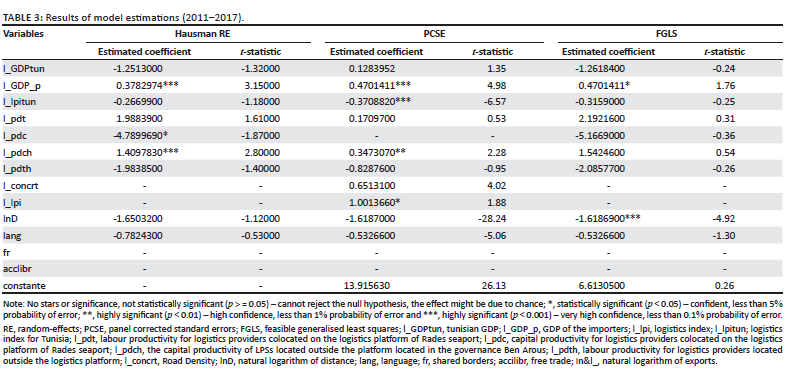
BACKGROUND: This study investigates the role of logistics clusters, specifically logistics providers (LP), on international trade, focusing on Rades Port in Tunisia. We aim to assess how the co-location of logistic service providers (LSPs) affects port connectivity and trade flows, and how the competence and productivity of logistics services contribute to export performance OBJECTIVES: The research analyses the effect of logistics clusters, particularly the co-located seaport logistics providers, on trade dynamics, focusing on exports from Rades port to its eight main importers METHOD: The gravity model incorporates variables such as importer gross domestic product (GDP), distance, and measures of capital productivity of LSPs, both those co-located within LP and those operating outside RESULTS: The results confirm a positive correlation between the GDP of importing countries and trade volumes, highlighting the role of economic size in driving exports. Interestingly, the capital productivity of LSPs co-located within the LP is found to negatively impact trade, suggesting potential inefficiencies or overconcentration. In contrast, a 10% increase in the capital productivity of LSPs located outside the platform corresponds to a 14% increase in trade. Additionally, a 10% reduction in geographical distance between countries leads to a 16% increase in exports, reinforcing traditional gravity model expectations CONCLUSION: The findings have important implications for logistics and port policy. Policymakers should reconsider how logistics clusters are managed and supported, as simple co-location may not guarantee improved performance. Enhancing service quality and ensuring competitive dynamics within LPs may be more critical for trade facilitation CONTRIBUTION: The study offers novel insights into how logistics infrastructure and organisational factors influence trade from a major North African port
port; logistics providers; trade; localisation economies; gravity model; cluster
 Thumbnail
 Thumbnail