Transdisciplinary approaches to integrating inclusivity and sustainability in teacher education
Abstract
Research in Southern Africa has shown that teacher education is currently fragmented into discrete modules or policy priorities. This status poses a recognised challenge in education as it sets up Education for Sustainable Development (ESD) and inclusive education as competing agendas that are typically addressed separately. In response, this study investigated how transdisciplinary research in education, understood as the co-production of knowledge among researchers, policymakers, and practitioners, can help to address the interconnected challenges of inclusivity, sustainability and teacher preparedness in complex teaching and learning settings. The study focused on the Sustainability Starts with Teachers programme in Malawi, Tanzania and Eswatini to provide an empirical and reflective account of implementing a transdisciplinary approach in teacher education. A formative interventionist design, located in a critical realist philosophy and operationalised through a nested case study methodology in interviews and workshops, was used to investigate how teacher educators enact inclusion-oriented ESD. Through bioecological and sociocultural theoretical analysis, the results showed that collaborative and context-responsive engagement supports teacher educators in aligning policy aspirations with classroom realities. This alignment entails that inclusivity and sustainability are intertwined because inclusive pedagogies strengthen the equity of sustainability initiatives while sustainability education enhances the transformative potential of inclusive teaching. TRANSDISCIPLINARY CONTRIBUTION: The key outcome of the study was the Sustainable Inclusive Pedagogical Proficiency Process (SIP3) model. The SIP3 model actualises transdisciplinary collaboration to drive systemic educational change through interconnected processes of social and ecological transformation
critical realism; education for sustainable development; inclusive education; Southern Africa; teacher education; transdisciplinary research
Introduction
Inclusive education, Education for Sustainable Development (ESD) and teacher education have long been central pillars of educational research and policy, particularly in the global commitment to Sustainable Development Goal 4 (SDG 4), which calls for inclusive and equitable quality education and lifelong learning opportunities for all.12
Similarly, teacher education programmes across multiple continents tend to separate content on inclusion, sustainability and pedagogy into discrete modules or policy strands.3,4,566
This study emerges from this problem space. Although scholars such as Lawrence7891
In this study, transdisciplinary societal problem-solving refers to the collaborative process through which researchers, teacher educators and policymakers jointly identify educational challenges and work together to design context-sensitive pedagogical responses.10
The main research question is: how can a transdisciplinary research approach enhance teacher education by integrating ESD and inclusive education to advance sustainable and equitable teaching practices?
Three sub-questions further shape the study:
1. How do teacher educators enact the integration of ESD and inclusive education in their diverse institutional and classroom contexts?
2. In what ways does transdisciplinary collaboration shape methodological, conceptual and pedagogical transformation in teacher education?
3. How can a coherent framework connect empirical practice with reflective transdisciplinary inquiry for strengthening inclusive and sustainable teacher education?
The significance of this study lies in demonstrating that transdisciplinary engagement can act simultaneously as a research method and a professional development process. Disciplinary boundaries have constrained teacher education by presenting inclusion and sustainability as separate agendas and not as interconnected imperatives. The transdisciplinary approach adopted here enabled educators to co-create new understandings, collectively interrogate existing practices and conceptualise pedagogical innovations responsive to their sociocultural contexts. Therefore, this study contributes to three scholarly conversations:
1. Empirical insights into teacher educators' practices across three Southern African contexts.
2. Methodological insights into how transdisciplinarity can function as a formative intervention.
3. Theoretical insights into how bioecological and sociocultural perspectives can articulate the relationship between macro-level structures and micro-level pedagogical agency.
This review critically examines the existing literature to clarify these concepts, their historical and theoretical underpinnings, and their intersections and tensions. The review also synthesises debates around transdisciplinarity and identifies how these theoretical tenets shaped the intervention in this study.
Inclusive education: Competing definitions and evolving perspectives
Inclusive education has undergone significant conceptual evolution. Early interpretations equated inclusion with the mainstreaming of learners with disabilities, i.e. placing learners with special educational needs into regular classrooms with minimal structural or pedagogical change. This approach emerged from integrationist models that sought to physically relocate learners without transforming learning environments. However, as scholars have long argued, mainstreaming typically leaves systemic inequalities intact by focusing on learner placement and not restructuring schooling cultures, pedagogies and resources.111
In Southern African debates, inclusive education is framed not as a remedial support strategy but as a fundamental rethinking of the educational enterprise. O'Donoghue and Rončević612
This definition underpins this study and guides its focus on how teacher educators reinterpreted and enacted inclusive principles beyond narrow mainstreaming practices.
Education for sustainable development: From environmentalism to transformative learning
Education for Sustainable Development has similarly expanded in scope. The earlier focus of ESD centred on ecological awareness and conservation but now encompasses social justice, economic equity, democratic participation and global citizenship.392
Teacher education: The process of integration and tension
Teacher education is where inclusive education and ESD converge in practice. Even so, the literature highlights the lack of coherence between these agendas in teacher training programmes. Stevenson et al.41521,2,4,5
Transdisciplinarity: A praxis for integrating fragmented agendas
The complexity of integrating inclusion and sustainability in teacher education requires theoretical and methodological approaches that transcend disciplinary boundaries. Transdisciplinarity is recognised as a promising praxis for navigating this complexity. Transdisciplinarity is defined as the co-production of knowledge across academic, professional and community domains to address societal problems.7,88107
Theoretical framework
This study adopts an integrated theoretical framework grounded in Bronfenbrenner's bioecological systems theory1314
Bronfenbrenner's bioecological theory131
While Bronfenbrenner provided a way of understanding where and how systemic pressures operate, Vygotsky's sociocultural theory14
The combination of these two theories was essential for the study's contribution. Bronfenbrenner enabled the research to identify and analyse the broader ecological and structural forces (policy constraints, cultural norms and institutional histories) that influence the attempts of teacher educators to bring together inclusion and sustainability. Meanwhile, Vygotsky allowed the study to trace how change occurred at the micro-level through social interaction, guided reflection and co-construction of knowledge in the transdisciplinary process.
This dual perspective resonated with the study's aim of understanding not only what teacher educators do but also how transdisciplinary research itself becomes a mechanism for societal problem-solving.101314
Research methods and design
Study design
This qualitative study employed a transdisciplinary research design grounded in a formative interventionist approach,1516,171518
The design unfolded through five overlapping phases aligned with Engeström's1519
1. In the initial inception phase, I worked with teacher educators in Malawi, Tanzania and Eswatini to establish the object of joint inquiry, clarify contradictions in their existing ESD Change Projects, and surface the assumptions they held about inclusive education and sustainability. This early phase generated baseline empirical data on practices, understandings and institutional conditions, while also initiating the first layer of reflective engagement as participants began questioning their taken-for-granted practices.
2. In the situational analysis phase, the nested case design enabled systematic analysis across micro-level experiences of teacher educators and macro-level institutional and policy structures shaping their pedagogical work. This phase produced empirical accounts (through interviews and workshop observations) of how inclusivity and sustainability were interpreted and enacted. At the same time, these empirical contradictions became the basis for methodological reflection, as participants analysed how their institutional systems either enabled or constrained inclusive and sustainable pedagogical practices.
3. The practical orientation phase deepened the integration of empirical and reflective work by supporting participants in redesigning or strengthening aspects of their ESD Change Projects. Here, transdisciplinary collaboration played a formative role as empirical findings from their own sites were brought into dialogic reflection with theoretical tools from Bronfenbrenner1314
4. This was followed by the formative intervention phase, in which redesigned practices were implemented, tested and further refined in collaborative workshop sessions. This phase marked the highest degree of methodological reflexivity as teacher educators collectively analysed their emerging practices, interrogating how new forms of agency and capability were being developed, and how these shifts aligned with broader socioecological and sociocultural structures.
5. Finally, the consolidation phase involved recursive reflection across cases. This stage drew together empirical evidence and methodological insights to generate an empirical-reflective account. This phase allowed for abductive and retroductive reasoning within a critical realist perspective,16,17
Setting
The research was conducted across teacher education institutions in Malawi, Tanzania and Eswatini, selected purposively to represent diverse sociocultural, geographical and policy contexts shaping teacher education reform in Southern Africa. These institutions comprised a mix of public universities and teacher training colleges. Some were located in urban centres and others in rural areas. This choice reflected the differentiated educational ecosystems in which teacher educators work. Across the three countries, the participating institutions offered a range of teacher preparation pathways, including certificates and diplomas for early career teachers, bachelor's degrees for primary and secondary educators, and, in the case of the universities, postgraduate qualifications at master's level and above. This variation was significant for the study because it enabled an examination of how inclusive and sustainable pedagogies are conceptualised and enacted in programmes of differing duration, qualification level and institutional mandate.
The institution in Malawi aligned with the country's typical structure of 1-year certificate programmes housed in primary teacher training colleges. Their curricula generally included inclusive education as a compulsory component embedded in broader education studies modules, although not always offered as a standalone course. Tanzania's participating institution reflected the system of training teachers for bachelor's degrees and, increasingly, for master's-level qualifications. In these settings, inclusive education is incorporated in foundational education units and not as an independent subject, while ESD tends to appear in some courses or in cross-cutting curriculum themes. Eswatini's institution offered a 3-year diploma programme preparing teachers for primary and secondary school levels. As in the other countries, inclusive education was typically positioned as part of core education studies but not always formalised as its own module; ESD appeared more sporadically through environmental education or life-skills components and not through programme-wide integration.
The diversity of institutional types was essential for the study's transdisciplinary focus. Working across rural and urban universities and colleges allowed the research to investigate how contextual factors, such as resource availability, community expectations, staffing profiles and policy pressures, influenced the efforts of teacher educators to integrate inclusive education and ESD. In rural institutions, challenges related to limited infrastructure, limited access to specialised support services and broader community vulnerabilities shaped pedagogical possibilities. In urban institutions, the pressures of larger class sizes, higher policy visibility and broader programme offerings created different forms of complexity. This variation provided empirical material for understanding how teacher educators negotiated the integration of inclusion and sustainability within the constraints and affordances of their institutional environments.
All institutions were engaged in efforts to strengthen inclusive and sustainable pedagogies through their involvement in the Sustainability Starts with Teachers programme. This effort meant that participants were not passive recipients of the research process but were already positioned in institutional cultures grappling with how best to address systemic challenges related to equity, quality and sustainability. The multi-context design, therefore, allowed comparative analysis not only across national education systems but also across institutional mandates, programme structures, qualification levels and geographic settings. This diversity was crucial for understanding how ESD and inclusive education principles are interpreted, operationalised, and, in some cases, reimagined across Southern African teacher education landscapes.
Study population and sampling strategy
The study population consisted of teacher educators working in the diverse teacher training systems of Malawi, Tanzania and Eswatini. These were lecturers directly responsible for preparing future teachers at certificate, diploma and degree levels. A purposive sampling strategy19
The teacher educators involved in the study brought varied professional backgrounds and qualifications, thereby reflecting the different teacher education pathways in each national context. Most lecturers held at least a bachelor's degree in education or a related field, while many possessed master's degrees, and several were pursuing or had completed further postgraduate studies. Their teaching experience ranged from early-career lecturers in their first 3 years of service to senior educators with more than a decade of experience, including department heads and programme coordinators. This variation enriched the data by allowing the study to capture perspectives across different stages of academic identity development, from novice lecturers navigating new curricula to experienced educators shaping programme-level reforms.
Participants' prior exposure to inclusive education also varied. Some had been teaching aspects of inclusive pedagogy for several years in core education studies modules, while others encountered inclusive education more indirectly through broader curriculum theory or educational foundations courses. Inclusive education was not always taught as a standalone subject in the participating institutions, meaning many lecturers addressed inclusivity through cross-cutting themes embedded in other modules. As a result, the number of years for which participants had explicitly taught inclusive education ranged from one to over 10 years, depending on institutional curriculum structures and individual teaching portfolios. In addition to inclusive education or ESD-related content, participants also taught subjects such as curriculum studies, educational psychology, environmental education, science education, social studies and teaching methodology courses. This breadth of teaching responsibilities was important because it revealed the multiple entry points through which inclusive and sustainable pedagogies could potentially be integrated across teacher education curricula.
The variation in participants' roles enabled the study to analyse the experiences of teacher educators across the three levels of the nested case design. Those positioned at the micro-level were typically lecturers with direct teaching responsibilities, whose engagement centred on classroom practices, student supervision and the development of inclusive and sustainability-oriented learning activities. Participants operating at the meso-level included senior lecturers, departmental leaders or programme coordinators involved in curriculum planning, institutional decision-making or staff development processes. Their insights demonstrated the organisational and structural dynamics that influenced how inclusive and sustainable teaching practices were adopted or resisted in departments. At the macro-level, a smaller number of participants held roles that connected them with national policy directives or regional programmes. These individuals acted as conduits between institutional practices and broader policy, quality assurance and ministerial expectations. Therefore, the final sample captured the complexity and diversity of the experiences of teacher educators across institutional hierarchies and national contexts.
Intervention
The formative interventionist approach15
Building on the diagnostic phase, the workshops moved into collaborative experimentation, in which participants co-designed and tested pedagogical strategies for integrating ESD and inclusive education. The strategies identified as new emerged from a collective analysis of the contradictions in existing practice. For example, teacher educators noted that lecture-based teaching usually reproduced exclusionary dynamics and failed to connect with sustainability realities in local communities. In response, they co-developed approaches such as community-based learning, learner-centred problem-posing pedagogy, participatory assessment and local resource-driven curriculum adaptation. These strategies were considered new not because they were globally novel but because they represented a departure from prevailing instructional norms in their institutions.
Participants themselves validated their novelty by comparing them with their established teaching routines, institutional guidelines and previous curriculum documentation.
The implementation of these strategies occurred between workshop cycles, during which participants trialled them in their classrooms or professional responsibilities. These trials produced a second layer of empirical data as teacher educators documented outcomes, challenges and unexpected shifts. Subsequent workshops then functioned as collective reflection spaces, where participants shared their experiences, analysed the effectiveness of the strategies and explored how contextual factors, such as class size, language diversity, resource constraints or community relationships, shaped the success of their innovations. This reflective process echoed Vygotsky's ZPD by enabling educators to move beyond their existing pedagogical understandings through socially mediated dialogue with colleagues.
Although the workshop content followed a consistent structure across Malawi, Tanzania and Eswatini, the contexts differed in meaningful ways. The rural college in Malawi, for example, placed greater emphasis on community engagement strategies because of its proximity to village schools and diverse learner populations. Tanzanian participants prioritised curricular alignment as a result of strong national curriculum directives, while Eswatini's participants focused on integrating inclusive and sustainable pedagogies into subject methodology courses. Despite these contextual differences, all three sites shared similar structural constraints such as limited resources, pressure to meet national examination requirements and fragmented institutional approaches to inclusion and sustainability. These similarities allowed for cross-case learning during collective reflection sessions, while contextual differences ensured that strategy development remained grounded in local realities, not just imposed templates.
Data generation and analysis
The data generation between 2021 and 2022 aligned with the implementation period of the Sustainability Starts with Teachers programme in Malawi, Tanzania and Eswatini. Two data sources were used to capture the complexity of the experiences of teacher educators and to triangulate perspectives across individuals, institutions and national contexts. The primary dataset consisted of 12 semi-structured interviews with teacher educators (five from Malawi, four from Tanzania and three from Eswatini). These interviews explored participants' understandings of inclusive education and ESD, their curriculum responsibilities, their experiences in the intervention workshops and the institutional conditions that shaped their work. In addition to interviews, the study generated extensive participatory observation data, which included field notes from all nine workshops, involving approximately 24 participants across the three countries.
All data were transcribed and analysed by using a thematic analysis approach guided by both deductive and inductive reasoning.201314
Inductively, additional codes were developed in response to patterns emerging from the data. These codes reflected the ecological, social and pedagogical dimensions of teacher learning, which were central to the study.
Guided by a critical realist orientation,1721221,23,24
Ethical considerations
Ethical approval for this study was granted by the Rhodes University Education Faculty Research Ethics Committee (Approval Number: 2021-4989-6408). The research adhered to established ethical guidelines for educational research, which emphasise voluntary participation, informed consent, transparency and protection of participants' dignity and privacy.
These guidelines were particularly relevant given the participatory and reflexive nature of the study, in which teacher educators were co-researchers in the design and analysis of pedagogical strategies. All participants provided informed consent prior to data generation. However, ethical engagement extended beyond formal consent procedures. Consistent with participatory and transdisciplinary research practice, the study employed continuous and iterative negotiation of consent, acknowledging that participants' levels of comfort and involvement could shift as collaborative workshops unfolded. Participants were invited to review interview transcripts and preliminary thematic interpretations as part of a member-checking19 process to ensure accurate representation of their experiences and to grant them agency in how their voices were used in the research.
Given the small and identifiable nature of some institutional contexts, particular care was taken to ensure anonymity. All data presented in this article use anonymised index codes. For example, I2-M refers to Interview Participant #2 in Malawi, and W3-M to Workshop Participant #3 in Malawi. This anonymisation approach aligns with ethical recommendations for research conducted in small educational communities in which personal identifiers may be easily inferred.
Results
When addressing interconnected domains such as inclusive education, ESD and teacher education, analytical clarity is required not only at the conceptual level but also in relation to observable pedagogical practices and outcomes. In this study, findings are therefore presented as empirically grounded themes that show how teacher educators enacted inclusion-oriented ESD in practice, what changed through the transdisciplinary process, and where constraints persisted. The findings draw on interview data and workshop reflections across three national cases: Malawi, Tanzania and Eswatini. Five themes emerged from the analysis:
1. Reframing inclusion through transdisciplinary pedagogies
2. Education for Sustainable Development as a catalyst for empowerment and context-responsive practice
3. Interdependence of teacher education, inclusion and sustainability
4. Structural and resource constraints shaping practice
5. Transformative outcomes of the transdisciplinary process
Reframing inclusion through transdisciplinary pedagogies
Prior to engagement in the transdisciplinary workshops, many participants described inclusive education primarily in narrow and learner-deficit terms. They equated inclusion with accommodating learners with disabilities or special needs through individual adjustments. This baseline understanding was evident in early workshop discussions and initial interviews, in which inclusion was framed as an add-on responsibility rather than as a guiding pedagogical principle. Through transdisciplinary dialogue and collaborative reflection, participants began to reframe inclusion as a systemic and pedagogical process involving curriculum design, classroom interaction and institutional culture. This shift was articulated by a Malawian teacher educator who described inclusion as 'making sure every learner feels at home and restructuring the environment, the curriculum, and the practices accordingly' (I3-M). This reframing was not merely conceptual. It was accompanied by specific pedagogical adaptations.
In Malawi, teacher educators described adapting learning resources and peer learning arrangements to enable participation: 'In our classes, we involve every learner regardless of their disabilities. For example, one of our visually impaired students records lessons on an iPad so she can review them later' (I1-M). In Tanzania, reframing occurred through lesson planning practices in teacher education modules, in which inclusion was embedded from the outset rather than addressed retrospectively: 'We make sure that when student teachers plan lessons, they include activities that any learner can do regardless of ability. Inclusion is not an afterthought. It's how we teach from the beginning' (I2-T). In Eswatini, participants emphasised social belonging and participation, particularly for learners facing material or socio-economic exclusion: 'Inclusive education is about creating belonging. Even if a learner has no material resources, they must feel they are part of the learning community' (I1-E).
From a sociocultural perspective,14
Education for sustainable development as a catalyst for empowerment and context-responsive practice
Across all three contexts, participants understood ESD not simply as environmental content but as a practical pedagogical approach linking classroom learning to community challenges. This understanding was evidenced through concrete examples of teaching and learning activities, rather than abstract claims. In Malawi, ESD was enacted through community-linked projects embedded in teacher education: 'We make briquettes [cooking charcoal] from waste paper, which reduces littering and gives learners a skill they can use to earn a living' (W7-M). Here, empowerment was evident in skill development, local environmental problem-solving and income generation potential, rather than in attitudinal change alone. In Tanzania, ESD was framed as enabling teachers to address social and ecological challenges through education: 'ESD helps teachers become agents of change who can challenge harmful practices like deforestation and gender exclusion' (I3-T). In Eswatini, ESD practices emphasised school-community connectivity, with teacher educators designing projects that addressed local needs: 'ESD builds bridges between school and community through local problem-solving projects' (I4-E). Analysed through Bronfenbrenner's bioecological model,13 these examples show how ESD practices linked micro-level classroom activities with meso- and macro-level community systems. The data indicate that transdisciplinary collaboration, particularly the involvement of community knowledge and peer dialogue, enabled ESD to function as a context-responsive pedagogical process, rather than as a decontextualised curriculum theme.
Interdependence of teacher education, inclusion and sustainability
Participants articulated that inclusion and sustainability could not be meaningfully addressed without changes in teacher education. This recognition emerged through reflection on their own roles as teacher educators, rather than through abstract policy discourse. A Malawian participant stated: 'Teachers influence change … education systems need to be restructured, so that everybody is welcomed, and that begins with how teachers are trained' (I3-M). Similarly, a Tanzanian educator noted: 'Without teachers who understand sustainability and inclusion, SDG 4 is just a slogan' (I1-T). In Eswatini, participants described a growing awareness that both agendas share a common pedagogical foundation: 'We realised that inclusion and sustainability are two sides of the same coin, both are about participation and responsibility' (I2-E).
Theoretically, this theme reflects the formative interventionist nature of the study. Using Vygotsky's sociocultural theory,1413
Structural and resource constraints shaping practice
Progress in this study refers specifically to participants' increased pedagogical clarity and locally enacted practices, not to systemic resolution of structural constraints. Despite pedagogical innovation at the classroom and programme levels, participants reported persistent barriers. In Malawi, infrastructure and assistive resources remained limited: 'Our schools lack ramps and assistive materials for learners with mobility and visual challenges' (I1-M). In Tanzania, national curriculum frameworks constrained local innovation: 'Even when we innovate locally, the national framework dictates what we must teach and how we assess; it leaves no room for context' (I4-T). In Eswatini, participants highlighted capacity and funding gaps: 'We need more trained specialists in inclusive education and better funding for inclusive teacher training' (I3-E). When one uses Bronfenbrenner's model,13
Transformative outcomes of the transdisciplinary process
In this study, transformative learning is understood as a shift in professional assumptions, pedagogical identity and relational orientation, rather than as immediate structural change. Evidence of transformation emerged through participants' reflections on collaboration, responsibility and professional self-understanding. A Malawian workshop participant reflected: 'No one can work in isolation; we need each other to make education work. Even the community must be involved' (W3-M). In Tanzania, a participant described a change in ethical orientation: 'The project taught us that inclusion is about collaboration, not charity' (I5-T).
In Eswatini, a participant reflected on a shift in teaching purpose: 'I have learned that sustainability starts with how we teach, how we make learners think about others and the environment' (I5-E).
These statements indicate personal change at the level of professional values and identity, alongside a professional change in pedagogical practice. Participants also reported observable outcomes in their teaching contexts, including increased peer mentoring among student teachers, inclusive lesson planning and community-based sustainability activities such as tree planting. From a Vygotskian perspective,14
Discussion
The findings of this study indicate that ESD, inclusive education and teacher education were experienced by participants as practically interconnected in their professional work, rather than as entirely separate reform agendas. This interconnection was most visible at the level of pedagogical decision-making, in which teacher educators described adapting lesson design, assessment practices and community engagement activities to address both inclusion and sustainability concerns simultaneously. In this respect, the study provides context-specific empirical support for arguments made by O'Donoghue and Rončević62
The study does not claim a systemic transformation of education systems. Instead, it demonstrates how localised pedagogical practices, developed through transdisciplinary engagement, enabled teacher educators to navigate systemic challenges such as social exclusion, environmental vulnerability and curriculum rigidity. These challenges, as documented in the findings, were not experienced merely as pedagogical problems but as structural and ecological conditions shaping practice, consistent with broader analyses of Southern African education systems.1
The constructs integrated in this study are inclusive pedagogy (understood as practices that promote participation, belonging and access for diverse learners) and ESD-oriented pedagogy (understood as teaching that links learning to social, economic and environmental sustainability challenges). The findings show that these constructs were not treated as parallel ambitions by participants but became interdependent in practice, particularly in lesson planning, assessment design and community engagement activities. Viewed through Bronfenbrenner's ecological framework,13
The study shows that inclusion and sustainability shared a common pedagogical logic in practice: both required cooperation, adaptability and responsiveness to contextual constraints. This finding aligns with Rončević and Rieckmann's24
Central to the study's findings is the role of teacher educators as mediators between policy expectations and pedagogical practice. In Bronfenbrenner's schema,13
This mediating work reflects Vygotsky's conception of learning as socially mediated,1416
Beyond its empirical insights, the study contributes to debates on transdisciplinarity as both a methodological and an epistemological approach. Methodologically, the formative interventionist design152216,1710
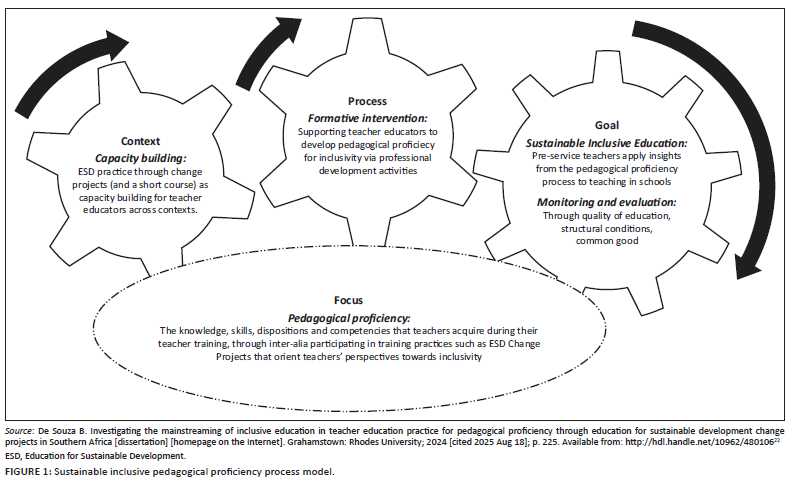
One outcome of this analytical process was the development of the Sustainable Inclusive Pedagogical Proficiency Process (SIP3) model. This model is propounded in detail in my doctoral thesis.22Figure 1, should be understood not as a predictive theory but as an analytical abstraction derived from recurring patterns in the data. The model synthesises observed relationships between individual pedagogical agency, institutional structures, and broader sustainability and inclusion goals. Consistent with Bronfenbrenner's bioecological model,13
The implications of these findings extend beyond the immediate cases, while remaining appropriately bounded. The study suggests that transdisciplinary approaches offer practical value for addressing the entangled challenges of inequality, sustainability and teacher preparation in Southern Africa.1,2,6741,2,5
Conclusion
This study addresses the fragmentation of inclusive education, ESD and teacher education in SDG 4 by showing, in practice, how these areas are interconnected rather than separate. Evidence from Malawi, Tanzania and Eswatini demonstrates that teacher educators negotiate inclusion and sustainability together under policy, institutional and resource constraints. The study shows how a transdisciplinary research approach can act as a context-sensitive enabler of integration. Through collaborative workshops, reflective dialogue and local experimentation, educators developed more coherent strategies for inclusive lesson planning, community-linked ESD and adaptive teaching. Theoretically, the study identifies social mediation, bioecological alignment and professional agency as key mechanisms that enable this integration. The study contributes to the limited body of transdisciplinary educator research in Southern Africa by providing empirical and practice-based evidence that counters overly abstract accounts in the literature. Key implications include the need for institutional, policy and resourcing support, as well as recognition that low-cost practices, such as peer collaboration, community projects and reflective workshops, can be effective and scalable. While limited in scope and duration, the study shows that transdisciplinary approaches offer a pragmatic pathway towards more inclusive and sustainable teacher education.
This article is based on data from a larger study. Two other articles were published from the same thesis. The first article focusing on sustainability-oriented teacher education for inclusive education in Southern Africa has been published in the Journal of Education (University of KwaZulu-Natal), Issue 102. The second article focusing on education for sustainable development in teacher development for inclusive education in Malawi has been published in the African Journal of Teacher Education and Development, Issue 4. One other article was published based on the same study data, i.e. the data were not featured in the thesis. This article focuses on examining the role of Education for Sustainable Development (ESD) in strengthening inclusive education in teacher education: A Vygotskian analysis of change projects from Malawi and Eswatini has been published in the Journal of Education (University of KwaZulu-Natal), Issue 96.
Competing interests
The author reported that they received funding from the National Research Foundation, Canon Collins Trust, and additional funds were provided by the SARChI Chair in Global Change and Social Learning Systems at Rhodes University through the Sustainability Starts with Teachers programme, which may be affected by the research reported in the enclosed publication. The author has disclosed those interests fully and has implemented an approved plan for managing any potential conflicts arising from their involvement. The terms of these funding arrangements have been reviewed and approved by the affiliated university in accordance with its policy on objectivity in research.
CRediT authorship contribution
Ben de Souza: Conceptualisation, Data curation, Formal analysis, Funding acquisition, Investigation, Methodology, Project administration, Resources, Software, Supervision, Validation, Visualisation, Writing - original draft, Writing - review & editing. The author confirms that this work is entirely their own, has reviewed the article, approved the final version for submission and publication, and takes full responsibility for the integrity of its findings.
Funding information
This work was supported by the doctoral scholarships awarded to the author by the National Research Foundation, Canon Collins Trust, and the SARChI Chair in Global Change and Social Learning Systems at Rhodes University through the Sustainability Starts with Teachers programme.
Data availability
The data that support the findings of this study are openly available in the Rhodes University research repository at https://doi.org/10.21504/RUR.26426032.v1.
Disclaimer
The views and opinions expressed in this article are those of the author and are the product of professional research. They do not necessarily reflect the official policy or position of any affiliated institution, funder, agency or that of the publisher. The author is responsible for this article's results, findings and content.
References
Acknowledgements
This article is based on research originally conducted as part of Ben de Souza's doctoral thesis titled 'Investigating the mainstreaming of inclusive education in teacher education practice for pedagogical proficiency through Education for Sustainable Development change projects in Southern Africa', submitted to the Faculty of Education, Rhodes University in 2024. The thesis was supervised by Heila Lotz-Sisitka. The supervisor was not involved in the preparation of this manuscript and was not listed as a co-author. The manuscript has since been revised and adapted for journal publication. The original thesis is publicly available at: http://hdl.handle.net/10962/480106.
Literature review
-
1. De Souza B. Examining the role of education for sustainable development (ESD) in strengthening inclusive education in teacher education: A Vygotskian analysis of change projects from Malawi and Eswatini. J Educ. 2024;96:98-116. https://doi.org/10.17159/2520-9868/i96a06
» https://doi.org/10.17159/2520-9868/i96a06 -
2. Rončević K, Rieckmann M. Education for sustainable development and inclusive education with particular consideration of learners with special needs: A scoping literature review. Front Educ. 2025;10:a1593060. https://doi.org/10.3389/feduc.2025.1593060
» https://doi.org/10.3389/feduc.2025.1593060 -
3. Evans TL. Transdisciplinary collaborations for sustainability education: Institutional and intragroup challenges and opportunities. Policy Futur Educ. 2015;13(1):70-96. https://doi.org/10.1177/1478210314566731
» https://doi.org/10.1177/1478210314566731 -
4. Stevenson RB, Lasen M, Ferreira JA, Davis J. Approaches to embedding sustainability in teacher education: A synthesis of the literature. Teach Teach Educ. 2017;63:405-417. https://doi.org/10.1016/j.tate.2017.01.013
» https://doi.org/10.1016/j.tate.2017.01.013 -
5. Sorkos G, Hajisoteriou C. Sustainable intercultural and inclusive education: Teachers' efforts on promoting a combining paradigm. Pedagogy Cult Soc. 2021;29(4):517-536. https://doi.org/10.1080/14681366.2020.1765193
» https://doi.org/10.1080/14681366.2020.1765193 -
6. O'Donoghue R, Rončević K. The development of education for sustainable development materials for inclusive education in South African curriculum settings. ZEP. 2020;43(1):20-26. https://doi.org/10.25656/01:20444
» https://doi.org/10.25656/01:20444 -
7. Lawrence RJ. Advances in transdisciplinarity: Epistemologies, methodologies and processes. Futures. 2015;65:1-9. https://doi.org/10.1016/j.futures.2014.11.007
» https://doi.org/10.1016/j.futures.2014.11.007 -
8. Klein JT. Discourses of transdisciplinarity: Looking back to the future. Futures. 2014;63:68-74. https://doi.org/10.1016/j.futures.2014.08.008
» https://doi.org/10.1016/j.futures.2014.08.008 -
9. Tilbury D. Higher education for sustainability: A global overview of commitment and progress. High Educ World [serial online]. 2011 [cited 2025 Aug 18];4(1):18-28. Available from: https://www.scribd.com/document/715962888/8-i-2-he-for-sustainability-tilbury
» https://www.scribd.com/document/715962888/8-i-2-he-for-sustainability-tilbury -
10. Polk M. Achieving the promise of transdisciplinarity: A critical exploration of the relationship between transdisciplinary research and societal problem solving. Sustain Sci. 2014;9:439-451. https://doi.org/10.1007/s11625-014-0247-7
» https://doi.org/10.1007/s11625-014-0247-7 -
11. Liasidou A. Inclusive education and critical pedagogy at the intersections of disability, race, gender and class. J Crit Educ Policy Stud [serial online]. 2012 [cited 2025 Dec 30];10(1):168-184. Available from: https://www.jceps.com/wp-content/uploads/PDFs/10-1-12.pdf
» https://www.jceps.com/wp-content/uploads/PDFs/10-1-12.pdf -
12. Qvortrup A, Qvortrup L. Inclusion: Dimensions of inclusion in education. Int J Inclus Educ. 2018;22(7):803-817. https://doi.org/10.1080/13603116.2017.1412506
» https://doi.org/10.1080/13603116.2017.1412506 -
13. Bronfenbrenner U. Making human beings human: Bioecological perspectives on human development [homepage on the Internet]. Thousand Oaks, CA: Sage; 2005 [cited 2025 Aug 18]. Available from: https://psycnet.apa.org/record/2004-22011-000
» https://psycnet.apa.org/record/2004-22011-000 -
14. Vygotsky LS. Mind in society: Development of higher psychological processes [homepage on the Internet]. Cambridge, MA: Harvard University Press; 1978 [cited 2025 Aug 18]. Available from: https://www.hup.harvard.edu/books/9780674576292
» https://www.hup.harvard.edu/books/9780674576292 -
15. Engeström Y. From design experiments to formative interventions. Theory Psychol. 2011;21(5):598-628. https://doi.org/10.1177/0959354311419252
» https://doi.org/10.1177/0959354311419252 - 16. Shipway B. A critical realist perspective of education. Abingdon: Routledge; 2010.
- 17. Bhaskar R. Enlightened common sense: The philosophy of critical realism. Abingdon: Routledge; 2016.
- 18. Leavy P. Essentials of transdisciplinary research: Using problem-centred methodologies. Abingdon: Routledge; 2016.
- 19. Cohen L, Manion LC, Morrison K. Research methods in education. 8th ed. London: Routledge; 2018.
-
20. DeJonckheere M, Vaughn LM, James TG, Schondelmeyer AC. Qualitative thematic analysis in a mixed methods study: Guidelines and considerations for integration. J Mixed Methods Res. 2024;18(3):258-269. https://doi.org/10.1177/15586898241257546
» https://doi.org/10.1177/15586898241257546 -
21. Albright J. Transdisciplinarity in curricular theory and practice. In: Wyse D, Hayward L, Pandya J, editors. The SAGE handbook of curriculum, pedagogy and assessment [homepage on the Internet]. London: SAGE Publications, 2016 [cited 2025 Aug 18]; p. 525-541. Available from: https://www.researchgate.net/publication/290395220
» https://www.researchgate.net/publication/290395220 -
22. De Souza B. Investigating the mainstreaming of inclusive education in teacher education practice for pedagogical proficiency through education for sustainable development change projects in Southern Africa [dissertation] [homepage on the Internet]. Grahamstown: Rhodes University; 2024 [cited 2025 Aug 18]. Available from: https://doi.org/10.21504/10962/480106
» https://doi.org/10.21504/10962/480106 -
23. De Souza B. Sustainability-oriented teacher education for inclusive education in Southern Africa. J Educ (Univ KwaZulu-Natal). 2025;102:130-145. http://doi.org/10.17159/2520-9868/i102a07
» http://doi.org/10.17159/2520-9868/i102a07 -
24. De Souza B. Education for sustainable development in teacher development for inclusive education in Malawi. Afr J Teach Educ Dev. 2025;4(1):a131. https://doi.org/10.4102/ajoted.v4i1.131
» https://doi.org/10.4102/ajoted.v4i1.131

Accepted: 12 Jan. 2026
Published: 05 Feb. 2026