Co-designing a framework for a persuasive educational technology tool for motivating female students for enrolment into Science, Technology, Engineering and Mathematics disciplines
Abstract
Goal five of the United Nations Sustainable Development Goals calls for increased female participation in socioeconomic growth and development. Achieving this goal requires promoting females' participation in fields such as science, technology, engineering and mathematics (STEM) which facing a dire shortage of personnel. However, existing efforts to increase female participation in STEM professions in Nigeria are limited in two ways: firstly, they are not focused on young females between the ages of 11 and 18. Secondly, most existing studies are not focused on the affective aspect of learning. Given the claims in existing literature that females' disinterest in STEM professions is affective rather than cognitive, this article employs the attitude-change approach, also known as the persuasion approach, to motivate females to pursue STEM pathways. We conducted an empirical study among young female students, STEM teachers and STEM professionals from Nigeria. Based on the empirical study, a framework indicating the key components that educational technology designers should consider when developing technologies to motivate young females in Nigeria to pursue STEM professions is presented. TRANSDISCIPLINARY CONTRIBUTION: This study is unique in that it combines strategies from various fields. The framework's persuasive strategies are drawn from the field of psychology, the innovative pedagogies are drawn from the field of education and the design science research approach is drawn from the field of information systems. This implies that increasing female participation in socioeconomic growth requires transdisciplinary research. This also has implications for how other United Nations Sustainable Development Goals can be met through transdisciplinary research
female students; STEM; education; attitude change; persuasion; technology
Introduction
The need for individuals to take up science, technology, engineering and mathematics (STEM) jobs to keep up with the increasing demands of today's world is evident in research.1,23456
With the increasing number of female students enrolling in school,789
Females' preference for non-STEM professions over STEM professions has been attributed to factors such as their perceived inability to succeed in STEM disciplines1011121314
As a result, there is advocacy for researchers to focus on the affective aspect of learning to motivate female students to take up STEM disciplines in school so as to increase the number of students skilled in STEM.1516
Problem identified
Despite the strong advocacy for research to focus on the affective aspect of learning to promote females' participation in STEM fields, no research in Nigeria aimed at increasing female participation in STEM fields has employed the attitude and behaviour change process, also known as the persuasion approach.17
Persuasion is 'an interactive process through which a given message alters an individual's perspective by changing the beliefs, or attitudes that underlie that perspective without using deception or coercion'.181920
At present, studies outside Nigeria have designed PTs to motivate positive learning behaviour among students.212223242526
•The 8-step framework failed to provide persuasive cues that designers can employ.27
•The Functional Triad framework provided persuasive cues but failed to describe how the persuasive cues can be converted to actual system features.26
•The PSD framework described how to convert persuasive design principles into actual system features but was not domain specific.28
Given these issues, context-specific PT frameworks are required. According to Murillo-Muñoz et al.29
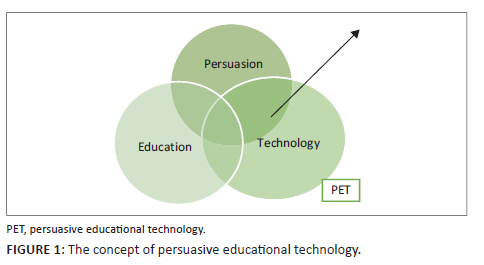
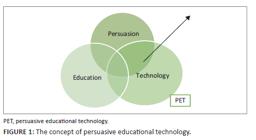
As illustrated in Figure 1, the concept of PET is based on three components: persuasion, education and technology.3031323331Figure 1 shows the relationship between the concepts of PET.
This work offers three main contributions to STEM education for females in Nigeria. Firstly, at a theoretical level, this work develops a new framework, informed by the Design Science Research (DSR) approach, that provides information regarding important components that PT designers can consider when designing PTs for promoting STEM enrolment among junior secondary school female students in Nigeria. Secondly, at an empirical level, this work establishes the factors that influence junior secondary school female students' enrolment in STEM classes. There are limited studies that have empirically investigated the factors that affect the enrolment of female students in STEM at the junior secondary school level.34
In an attempt to increase females' participation in STEM fields, researchers have designed STEM instructional approaches and educational technologies to increase their participation in STEM fields. As regards the instructional approaches, this study realised that the researchers assumed that females have some personal qualities that need to be corrected for them to be able to participate in STEM fields,35353637383940,41
This study argues that it is imperative to consider the broader social context of this issue by looking at the sociocultural context surrounding female students.4243,4142434643,44,454748495046,5152535455
As regards educational technology, the tools designed were mainly computer-assisted learning tools consisting of software packages designed to develop STEM skills like improving mathematics computation.56,5758596061
Although the contributions of these studies are acknowledged, there is room for more research work. There is a need for instructional pedagogy designers to consider the external factors that influence students' participation in STEM disciplines and education technology designers should be based on theory and practice of attitude and behavioural change process to help females build positive attitudes to challenge practices around them, rather than assume that females possess undeveloped cognitive capabilities; a misconception that needs to be corrected. In summary, the research gap identified in literature aimed at increasing females' enrolment in STEM fields is that there is little focus on the affective capabilities of students. There is a need to focus on the affective capabilities of students to help challenge both external and individual characteristics that influence professional choices of females. No research has been conducted which focuses on an attitude change approach to increase females' enrolment in STEM disciplines in Nigeria. Hence, this study proposes a PET approach to motivate female students in Nigeria to take on STEM pathways.
The conceptual framework of the study
This article draws on Lents'6263,64
This article also draws on the Theory of Reason Action (TRA)65
The article also leans on the Behavioural Learning Theory (BLT)6666
From the BLT the researcher realised that humans have a natural ability to learn and therefore an external stimulus such as a motivational push can eventually begin to trigger humans' natural ability to learn different things when the learning process is rightly stimulated. This was similar to Pavlov's experiment where the dog's natural ability to salivate was successfully paired with the ringing of a bell and the same result was obtained. This theory implies that a motivational push in PET can serve as an external stimulus to female students to participate in STEM professions.
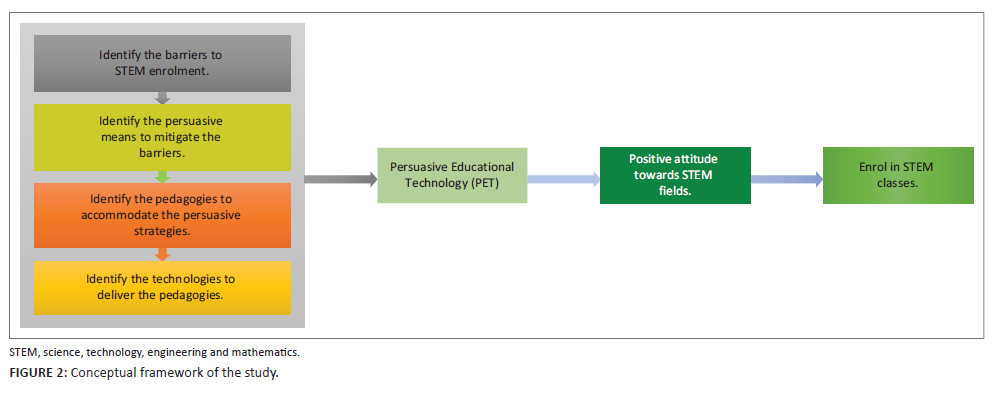
These theories were mentioned because they provided a foundation for arguing that certain external factors work to influence students' attitudes towards STEM professions, and it is their attitudes towards STEM that determine whether they choose to partake in STEM fields in the future. To counter the effects of these factors, students need to be subtly persuaded to change the attitudes built from these influences. Hence, a PET tool is argued as a suitable tool to help increase the number of females participating in STEM professions. As illustrated in Figure 2, to design such PETs, designers need to be aware of four key components. These components are:
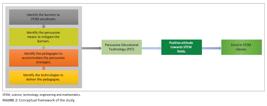
• Barriers to enrolling in STEM pathways: Designers must be aware of the barriers that hinder female students' enrolment into STEM disciplines. This is because very little can be accomplished concerning solving a problem if the causes of the problem are not first identified. None of the existing frameworks mentioned in Section 1 of this article identified the limitations or barriers to the desired behaviour that they are affecting their audience towards.67
• Persuasive knowledge: Designers must be informed of the persuasive strategies that young females in Nigeria are more susceptible to. This is because what motivates one individual may not motivate another and what motivates in one domain may not motivate in another.68
• Pedagogical knowledge: Designers must know of the teaching and learning approaches that can accommodate the persuasive strategies and are suited to teaching STEM subjects. This is because the curriculum, learning objectives, ways in which instructional contents are sequenced and how ideas are interconnected differ for every discipline. The existing frameworks mentioned in Section 1 were generic and therefore did not provide any context-specific considerations.
• Technology knowledge: Designers must know the technologies that can accommodate the teaching and learning strategies for the effective delivery of the instructional content. The technologies should also be those that female students will embrace, those that will accommodate, and those that persuasion communications can be integrated into. Again, the existing frameworks mentioned in Section 1 did not provide any technologies for designers to use. Figure 2 presents the conceptual framework that guides the design of the actual PET4STEM framework.
Research methods and design
This study targets female students in junior secondary classes in Nigeria. This is the class where students choose one of three possible academic paths to follow - science, arts or commercial studies. The rationale behind selecting this population is that this is the phase in their education where their choices define their career path. Subsequent transitions such as from senior secondary classes to undergraduate or from undergraduate to postgraduate levels allow them to further specialise within the broader discipline. There has been a huge advocacy for females to be targeted at a young age to nurture their participation in STEM fields.13
Research approach and strategy
This study used a qualitative research approach that targets gaining deep insights into the phenomenon being studied from a small number of information-rich participants.69
The research strategy employed was the DSR strategy. Design Science Research is a research strategy that focuses on the creation of socio-technical artifacts to change existing societal circumstances into desired ones.7070
Phase 1: The first phase was based on interviews with 15 junior secondary school female students to investigate the four components discussed earlier. The basis for using interviews is that it allows the researcher to collect self-reported data from the students that accurately represent their perceptions. Interviews also allowed the researcher to observe their expressions, gestures and tone of their voices to better understand their responses. The data gathered from the students were used to design an initial framework.
Phase 2: The second phase was based on interviews with five STEM teachers. The reason for interviewing the teachers is to find out if they agreed with the responses of the girls and if they wanted anything to be added or removed from the framework. Again, an interview was the best means to collect this information because it allowed the researcher to interact with the teachers and observe their true expressions. Their responses were used to update the initial framework and design an intermediate framework.
Phase 3: The third phase was based on interviews with five STEM experts working in different STEM fields in Nigeria. The rationale behind interviewing the professionals was to find out if the four components of the framework were relevant and if they agreed with the responses of the girls and the teachers. Their responses were used to design a penultimate framework.
Phase 4: Then a focus group session was conducted with the same junior secondary school female students (n = 15) to discuss the penultimate framework with them. A focus group was chosen as the method of data collection here because it allowed the researcher to identify and extract relevant and interesting reactions beyond what was obtained in the interview. The information gathered was used to redesign the final PET4STEM framework.
Sampling method
The sampling techniques employed were convenience, purposive and key informant sampling. Convenience sampling was used to select three government secondary schools in Nigeria. The reason for using convenience sampling to select the three schools is that it is a very easy and economical sampling technique.717273
The rationale behind selecting 15 female students is that the qualitative approach used in this study is not aimed at selecting a representative case for broad generalisations but rather the empirical data collection is to gain deeper insights into the situation so that the idea that is conceptualised or components that are identified can be generalised or further explored across similar cases.
The justification for the adequacy of the sample size (n = 25) is based on literature6974,75,767778798081
Participants' profiles
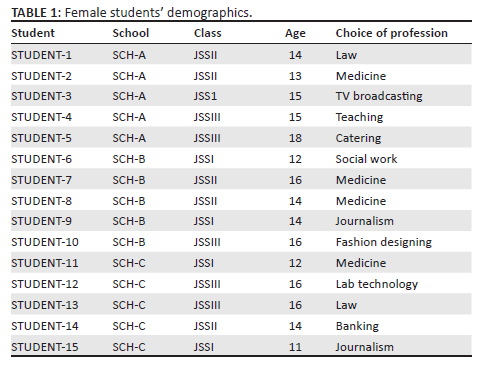
The female students' age ranged between 11 and 18 years. For confidentiality purposes, their schools are represented as SCH-A, SCH-B and SCH-C. Table 1 presents the demographics.
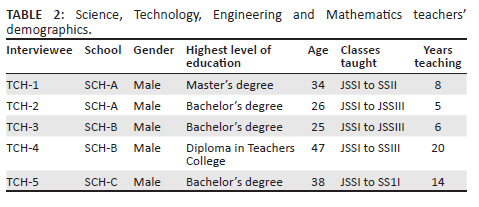
In regards to the teachers, two were from school-A, two from school-C and one from school-C. Their age ranged between 25 and 47. One of the teachers has a master's degree, three have a bachelor's degree and one has a diploma. All the teachers have teaching experience above 4 years. All the teachers were males. For confidentiality purposes, the teachers are represented as TCH-1, TCH-2 and so on. Table 2 presents the demographics.
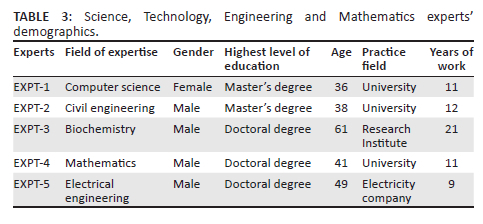
Out of the STEM experts, three are university lecturers, one was from a research institute and one works in an electricity distribution company. Their age ranged from 36 to 61. Two of the experts have master's degree, while three have doctoral degrees. All the experts have work experience of above 8 years. This is presented in Table 3. For confidentiality purposes, the experts are represented as EXPERT-1, EXPERT-2, EXPERT-3 and so on.
Data analysis
Semi-structured interviews and a focus group session were conducted among junior secondary school female students, STEM teachers and STEM experts in Nigeria and what was gathered was analysed using content analysis and was used to develop the PET4STEM framework that provides designers with more specific design considerations that will equip them to make junior secondary school female students view STEM subjects differently and consequently enrol in STEM pathways. The rationale behind using content analysis was that it allowed the systematic coding and categorisation of large amounts of textual data, retrieved from the interviews, and a focus group, to determine trends, frequency, relationship and discourse of communication.82
• Familiarising with the data: A considerable amount of time was spent reading the transcripts repeatedly. This step allowed for an initial understanding of the data which are essential for a more detailed analysis.82
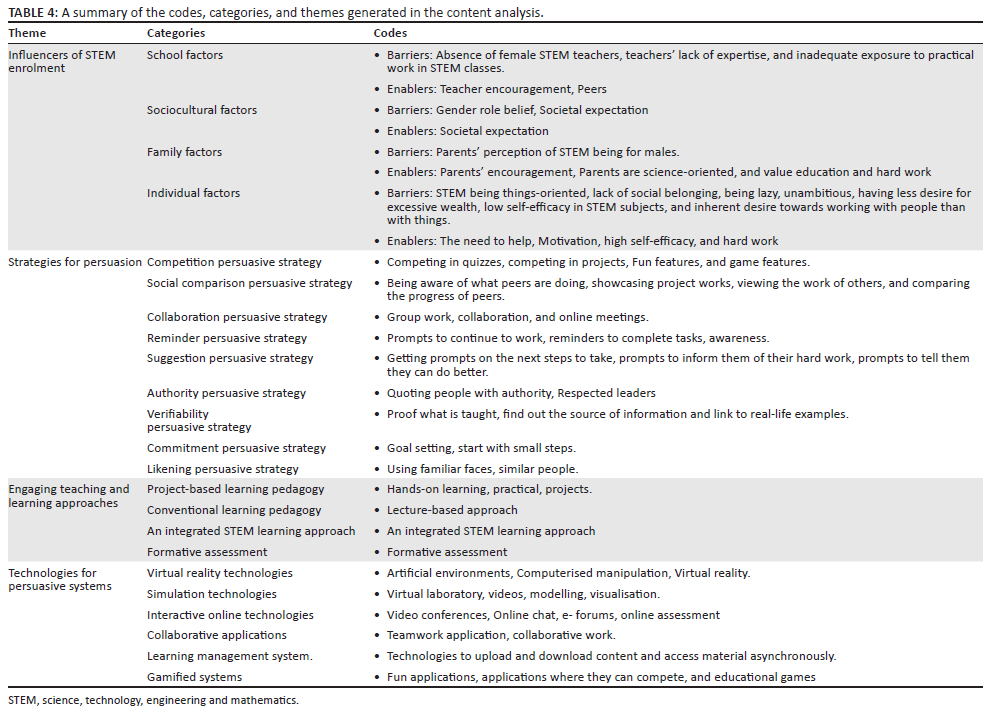
• Coding the data: After a good understanding of the data, then coding was performed. The idea behind coding is to reduce the size and complexity of the initial transcript while retaining the contextual meaning of the original data.82Table 4.
• Moving from codes to categories. Next, the researcher and the data analyst separately reviewed the codes and came up with a separate list that grouped the codes into categories. The two lists were then compared to come up with a consolidated set of categories that were of contextual meaning to the study. The categories generated are summarised in Table 4.
• Moving from categories to themes. Generating themes was guided by the components of the conceptual framework.82Table 4.
• Producing reports: After grouping categories into themes, the researcher came up with an argument to respond to the research question of the study. The report is presented in the results and discussion section. Table 4 is a summary of the codes, categories and themes generated in the content analysis.
Ethical considerations
Ethical approval was obtained from the University of South Africa's Research Ethics Committee. Ethical clearance number is 2022/CSET/SOC/013.
Results and discussion
The findings are presented with a focus on the four key components that PET designers should be aware of: (1) barriers that prevent young females in Nigeria from opting for STEM pathways, (2) the persuasive strategies that can be used to motivate them to opt for STEM pathways, (3) the pedagogical approaches that can accommodate the strategies and (4) technologies that can deliver the pedagogies. Each of these is discussed one after the other.
Barriers to female students choosing Science, Technology, Engineering and Mathematics disciplines
The series of interviews and a focus group session conducted with the research participants lead to the identification of the barriers to junior secondary school female students' enrolment into STEM disciplines. With this, designers will be aware of the specific barriers that they should be addressing. The barriers identified were grouped under the school, sociocultural, family and individual factors.
• School factors: The school factors are: Absence of female STEM teachers, teachers' lack of expertise in teaching STEM subjects and insufficient educational materials for practical works in STEM classes. These factors have also been found to be barriers in prior studies.41,83
• Sociocultural factor: The sociocultural factor includes societal beliefs about STEM fields being for men. This factor has also been found to be a barrier in prior studies.47,84
• Family factor: The family factor is the parental perception that STEM is for men. Not many pieces of literature reported this; Ikkatai et al.85
• Individual factors: The individual factors are: The females' perception that STEM fields are things oriented; the females' lack a sense of social belonging in STEM fields; and the females' lack of motivation to partake in STEM fields. This finding is in agreement with those of earlier studies.47,86
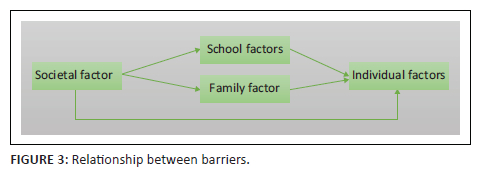
The crux of the barriers to females' participation in STEM fields can be argued to be the societal belief about STEM fields being for men as indicated strongly by one of the female students: 'In my understanding, I think men are supposed to do that job because our culture doesn't want us to do that career' (SCH-B, Student-10, JSSIII). Many of the individual factors can be linked to their societal belief about STEM fields being for men. For instance, the perception that STEM fields are things-oriented can be argued to be built from the way society portrays these fields. The media show advertisements of male engineers working with heavy machinery;47478783Figure 3 presents the relationship between the barriers to female students' participation in STEM fields.
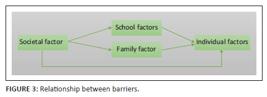
As illustrated in Figure 3, the societal factor influences the school and family factors which then influence the individual characteristic. Also, the societal factor can directly influence individual characteristics. This illustration is significant as designers should be aware that they should not be focusing on just individual characteristics.
The argument presented above is supported by Meece et al.8889
This explains why among the 15 female students interviewed only five wanted a career in STEM. The others wanted a career in journalism, law, catering, banking and social work. They chose professions that they felt resonated with their identity within their milieu as indicated explicitly by a student:
'[S]ome of them since from their upbringing the society has already shown them that this is for boys and this is for girls, you should choose this and not go to that.' (SCH-B, Student-6, JSSI)
They recognise the fact that society views them to be more interpersonal and inherently caring so they channel their interest to professions where they feel they can interact with people and make people happy. As indicated by one of the students who wants to be a journalist 'I cannot be doing engineering work when people need doctors in the hospital to help the sick' (SCH-A, Student-2, JSSII). They would rather save their people from the hands of bad politicians than develop phones. This was similar to the five females who indicated that a career in STEM wanted to be medical doctors.
This argument also applies to those who chose non-STEM professions. All five want to be medical doctors where they can interact with people and help care for them. This argument is supported by studies90,91
Even though these factors are argued to develop from a sociocultural belief about STEM fields being for men, it is pertinent to identify means to mitigate against all the factors identified from the interview sessions. Hence, the next subsection discusses the persuasive strategies, pedagogical approaches and technologies to mitigate against each of these factors.
The absence of female STEM teachers
To mitigate against the effect of the absence of female STEM teachers through a PET, students should be helped to discern that there are females involved in teaching STEM. The persuasive strategies that should be employed to achieve this are:
• Social facilitation persuasive strategy: This strategy involves providing means for discerning other users who are performing the desired behaviour.26
• Social role persuasive strategy: This strategy involves designing a persuasive system to mimic the social behaviours of humans.26
• Similarity persuasive strategy: This strategy involves persuading people by imitating them in some specific ways.26
Pedagogies that can accommodate these strategies are:
• An inquiry-based learning environment where different learning scenarios trigger students to ask questions and share ideas with these teachers and STEM personnel.92
• A problem-based learning environment where students respond to open-ended questions and will need to explore different solutions and seek support from these teachers and STEM personnel towards searching and arriving at a reasoned solution can also accommodate these persuasive strategies.93
A technological platform that can accommodate these proposed pedagogies for this barrier is Learning Management Systems (LMS) and Interactive online learning applications with chat, video conferences and forum features.
Teachers' lack of expertise in teaching STEM subjects
To mitigate against the influence of teachers' lack of expertise in teaching STEM subjects through a PET, students should be taught using enhanced instructional methods. The persuasive strategies that should be employed to achieve this are:
• Reduction persuasive strategy: This strategy involves breaking down complex activities into manageable steps to make the activity attractive.26
• Simulation persuasive strategy: This strategy involves providing real-world experience through a virtual environment.26
• Tunnelling persuasive strategy: This strategy involves making a persuasive system provide means for action that brings its users closer to the target behaviour.26
• Self-monitoring persuasive strategy: This strategy involves providing means for users to track their performance.26
• Suggestion persuasive strategy: This strategy involves providing suggestions to individuals while they are engaging in the desired behaviour to make the activity easier.26
• Collaboration persuasive strategy: This strategy involves enabling users to collaborate in the behaviour change process.26
• Expertise persuasive strategy: This strategy involves providing competent information.26,64
• Reliability persuasive strategy: This strategy involves making systems readily available to users.26,64
Pedagogies that can accommodate the proposed strategies for this barrier are:
• Design-based learning approach.93
• A project-based learning environment where topics are being taught in chunks as mini projects.94
Technologies that can accommodate the proposed pedagogies are:
• Virtual labs where students can conduct virtual projects individually and in groups.
• Simulation technologies where students can watch simulated videos.
• Interactive online learning applications with conferences for students to upload pictures of their live projects and discuss what they have done. Video presentation features can also be integrated for students to present their works as a group or individually and then discuss what they have learned.
Insufficient educational materials for practical work in STEM class
To mitigate against the influence of insufficient educational materials for practical work in STEM classes using a PET, students should be involved in practical activities via a persuasive system. The persuasive strategies that should be employed to achieve this are:
• Simulation persuasive strategy: This strategy involves designing a persuasive system to provide real-world experience through a virtual environment.26
A pedagogy that can accommodate the proposed strategy is:
• A project-based learning environment: Topics and skills can be taught as projects and projects should be connected to the students' lives.
Technologies that can accommodate this pedagogy are:
•Virtual reality technologies with technologies like virtual laboratories can accommodate these strategies, where students can practice basic computer programming.
•Simulation technologies where students can watch simulated videos can also support these strategies.
Societal and parental beliefs about STEM fields being for men
To mitigate against societal and parental beliefs about STEM fields being for men through a PET, awareness should be created that STEM fields are for everyone. The persuasive strategies that should be employed to achieve this are:
• Authority persuasive strategy: This strategy involves referring to people in the role of authority when trying to persuade an individual.26
• Verifiability persuasive strategy: This strategy involves providing means for the person that is been persuaded to be able to verify the information that they are getting.26
• Third-party endorsement: This strategy involves providing endorsement from respected sources to support the persuasive message being communicated.26
• Collaboration persuasive strategy: To implement this strategy for this barrier, designers can organise quiz competitions or hands-on project competitions where students and their parents work together. This will allow parents to see what their daughters can do while boosting the morale of the girls.
• Role model persuasive strategies: This strategy involves using mentors who will help people set goals and find opportunities for networking with others.26
Creating awareness that STEM fields are for everyone does not require any specific pedagogy, but technologies that can accommodate the proposed strategies are:
•Interactive web-based learning applications where students can follow events, access links, send emails and read blog posts.
•Gamified applications, interactive online applications or virtual laboratory applications can accommodate any of these pedagogies to implement the collaborative persuasive strategy.
The perception that STEM fields are things oriented
To mitigate against the effect of the perception that STEM fields are things-oriented through a PET, different STEM learning activities that go with the interests of female students should be developed. The persuasive strategies that should be employed to achieve this:
• Personalisation persuasive strategies: This strategy involves providing personalised content and services to users.26
• Tunnelling persuasive strategy: To implement this strategy for this barrier, designers should share ideas about STEM jobs that relate to students' interests or offer hints that would lead students to connect concepts taught in the classroom to their everyday activities like cooking, sewing, cleaning, washing, childcare.
• Reduction persuasive strategy: To implement this strategy for this barrier, designers should break down all the job roles in STEM fields and emphasise those that are less physically strenuous and are more indoors. These align with the students' cultural beliefs.
Pedagogies that can accommodate the proposed strategies are:
•A project-based, inquiry-based and problem-based learning pedagogy can support the collaboration persuasive strategies.94,45
Technologies that can accommodate this pedagogy are:
•Interactive web-based learning applications where students can follow events, access links, send emails and read blog posts.
•Virtual labs where students can conduct virtual projects individually and in groups can also accommodate these pedagogies.
The lack of social belonging
To mitigate against the effect of lack of social belonging through a PET, a female-inclusive learning environment should be created. The persuasive strategies that should be employed to achieve this are:
•Social facilitation persuasive strategy: To implement this strategy for this barrier, designers can create a network of females in STEM disciplines in secondary school, undergraduate and postgraduate levels and practitioners so that students can interact with them.
•Social proof or social learning persuasive strategy: This strategy involves enabling users to learn by viewing the activities of other users.26
•Likening persuasive strategy: This strategy involves making a persuasive system have a look and feel that appeals to its users.64
These persuasive strategies do not require a pedagogy to implement but a technology that can accommodate these strategies is:
• Interactive online learning: Learning management systems, chat applications, forums and conference applications.
The lack of motivation to choose STEM disciples
To mitigate against the influence of the lack of motivation through a PET, female students should be encouraged to set goals for themselves and to persevere in attaining the goals. The persuasive strategies that should be employed to achieve this are:
•Commitment and consistency persuasive strategy: This involves leading a user to make a small initial commitment, and then this small commitment will lead to bigger action.64
•Social facilitation persuasive strategies: Designers can let students see successful women in STEM within Nigeria and from around the world to inspire them to become ambitious.
•Self-monitoring persuasive strategy: Designers should integrate features that track students' data to determine areas they may need assistance and areas where they excel.
•Competition persuasive strategy: This strategy involves allowing users to compete to achieve their target.26
•Reward persuasive strategy: This strategy involves providing virtual rewards to users as they progress in the task.26
•Scarcity persuasive strategy: This strategy involves showing the scarcity or needs for something to increase interest in it.26,64
Pedagogies that can accommodate these strategies are:
•A project-based learning environment can accommodate the commitment and consistency of persuasive strategies: Students can be asked to write down step-by-step objectives to accomplish a task. This serves as small voluntary agreements that will lead to achieving a bigger goal.
•A formative assessment method can support this strategy where periodic feedback on student progress is provided.
•A context integration learning pedagogy can accommodate the tunnelling strategy where elements from other subjects or other STEM subjects that interest students are used to make the content of other STEM subjects more relevant.
•A collaborative learning environment can accommodate competition and reward persuasive strategies where students are grouped into teams to compete against each others' teams and earn rewards for their team.
•The inquiry-based and problem-based learning environment can accommodate learning scenarios where the need for STEM skills is discussed.92
Technologies that can accommodate these pedagogies are:
•LMSs and interactive online learning applications can accommodate context integration learning.
•Gamified educational learning applications can accommodate collaborative learning pedagogy.
•Interactive online learning applications with chat, video conferences and forum features.
•Simulation technologies can also support these pedagogies for students to watch simulated models of the impact of the shortage of technology and engineering skills.
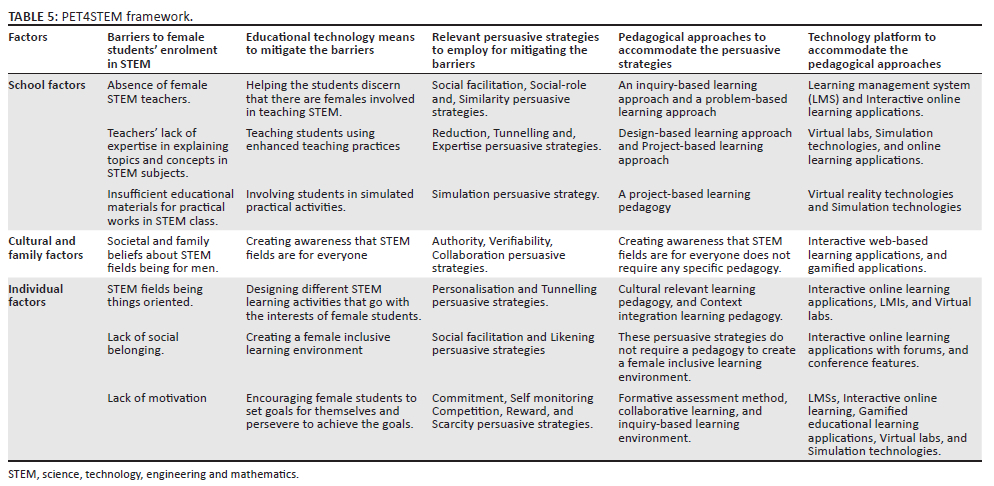
•Virtual labs where students can conduct virtual projects individually and in groups. Table 5 presents the framework in a diagram.
Limitation
This study, like all research studies, has limitations. The researchers acknowledge that the number of female students and STEM teachers recruited for the study could have been more. However, the qualitative approach used in this study is not aimed at pursuing a large sample size for broad generalisations to be made but rather the empirical data collection is to gain deeper insights into the situation so that the idea that is conceptualised can be generalised across similar cases. According to Polit and Beck96
Conclusion
In this work, we identified the barriers to female students' enrolment in classes leading to STEM professions in Nigeria. We then proposed persuasive strategies, pedagogical approaches and technological platforms to employ to mitigate each identified barrier. How the strategies can be implemented in a PET were suggested and were based on information gathered from female students, STEM teachers and STEM experts. This was done to make the content suited to female students and to STEM subjects. This framework may not have exhausted all the persuasive strategies, pedagogical approaches or technologies in the literature, but in practical terms, one PET cannot integrate all of what was suggested in the framework. What is advised is that a PET selects a couple of barriers they want to address and then implements the suggestions from the framework.
It is worth noting that, although non-transdisciplinary research (TDR) has been effective for societal problems that have relatively little ambiguity, they have become less effective in the context of complex societal problems such as the low participation of women in STEM fields. According to Lawrence et al.9595
Competing interests
The authors declare that they have no financial or personal relationships that may have inappropriately influenced them in writing this article.
Authors' contributions
A.M.A. conceived, planned and conducted the experiments. B.C. verified the analytical methods and supervised the findings of this work. Both authors discussed the results and contributed to the final manuscript.
Funding information
This research received no specific grant from any funding agency in the public, commercial or not-for-profit sectors.
Data availability
The data that support the findings of this study are available from the corresponding author, A.M.A, upon reasonable request.
Disclaimer
The views and opinions expressed in this article are those of the authors and do not necessarily reflect the official policy or position of any affiliated agency of the authors.
References
Acknowledgements
The authors would like to acknowledge the participants for their participation in the study.
Literature review
- 1.Umar Y. STEM education as a catalyst for national development: Problems and prospects in Nigeria. Int Learn Sci Math J. 2019;14(3):48-59.
- 2.Sulai ME, Erasmus IS. Science, technology, engineering and mathematics (STEM) education: A tool for national development. Int J Educ Res. 2022;8(1):117-126.
-
3.World Economic Forum. Global Gender Gap Report 2020. Geneva. 2020. [cited 2022 Nov 19] Available from https://www3.weforum.org/docs/WEF_GGGR_2020.pdf
» https://www3.weforum.org/docs/WEF_GGGR_2020.pdf - 4.International Labour Organization. World employment and social outlook: Trends 2022. Geneva; ILO publishing, 2022.
-
5.Bacovic M, Andrijasevic Z, Pejovic B. STEM education and growth in Europe. J Knowledge Econ. 2022;13(3):2348-2371. https://doi.org/10.1007/s13132-021-00817-7
» https://doi.org/10.1007/s13132-021-00817-7 - 6.Reading M. A Smart move: Future-proofing Australia's Workforce. Adelaide; Price Waterhouse Coopers (PWC). 2015, p. 1-23.
- 7.Ekine A, Abay NA. Enhancing girls' participation in science in Nigeria: A driver for national development and social equality. Vancouver; Creative Commons publishing, 2017.
-
8.UNESCO. Science, technology and innovation: Total R&D personnel by sex, per million inhabitants, per thousand labour force, per thousand total employment (in Full-time equivalents - FTE and Headcounts - HC) [homepage on the Internet]. [cited 2020 Nov 24] 2020. Available from: http://data.uis.unesco.org/
» http://data.uis.unesco.org/ - 9.National Bureau of Statistics. Statistical report on women and men in Nigeria. Oxford; Oxford University Press, 2019.
- 10.Dada JO. Factors affecting women's enrolment in construction education in Nigeria. J Construct Project Manag Innov. 2017;7(1):1892-1907.
-
11.Awofala A, Lawani A. Increasing mathematics achievement of senior secondary school students through differentiated instruction. J Educ Sci. 2020;4(1):1-19. https://doi.org/10.31258/jes.4.1.p.1-19
» https://doi.org/10.31258/jes.4.1.p.1-19 -
12.Korpershoek H, King RB, McInerney DM, Nasser RN, Ganotice FA, Watkins DA. Gender and cultural differences in school motivation. Res Pap Educ. 2021;36(1):27-51. https://doi.org/10.1080/02671522.2019.1633557
» https://doi.org/10.1080/02671522.2019.1633557 - 13.Organisation for Economic Co-operation and Development. PISA 2018 results combined executive summaries. Vol. i, ii & iii. Program for International Student Assessment (PISA); Washington, 2018.
-
14.Hanson SL, Krywult-Albańska M. Gender and access to STEM education and occupations in a cross-national context with a focus on Poland. Int J Sci Educ. 2020;42(6):882-905. https://doi.org/10.1080/09500693.2020.1737341
» https://doi.org/10.1080/09500693.2020.1737341 -
15.Card D, Payne AA. High school choices and the gender gap in STEM. Econ Inq. 2021;59(1):9-28. https://doi.org/10.1111/ecin.12934
» https://doi.org/10.1111/ecin.12934 -
16.Stelter RL, Kupersmidt JB, Stump KN. Establishing effective STEM mentoring relationships through mentor training. Ann N Y Acad Sci. 2021;1482(1):224-243. https://doi.org/10.1111/nyas.14470
» https://doi.org/10.1111/nyas.14470 -
17.Abdullahi AM, Orji R, Nwokeji JC. Personalizing persuasive educational technologies to learners' cognitive ability [homepage on the Internet]. In: 2018 IEEE Frontiers in Education Conference (FIE). San Jose, CA: IEEE; 2018. p. 1-9. Available from: ieeexplore.ieee.org/document/8658733
» ieeexplore.ieee.org/document/8658733 -
18.Miller GR, On being persuaded: Some basic distinctions 2002. Thousand Oaks, CA: SAGE Publications, Inc. [cited 2021 Dec 11]. Available from: https://doi.org/10.4135/9781412976046
» https://doi.org/10.4135/9781412976046 -
19.Steinmayr R, Weidinger AF, Schwinger M, Spinath B. The importance of students' motivation for their academic achievement - Replicating and extending previous findings. Front Psychol. 2019;10:17-30. https://doi.org/10.3389/fpsyg.2019.01730
» https://doi.org/10.3389/fpsyg.2019.01730 - 20.Cialdini RB. Harnessing the science of persuasion a conversation with Mark Morris. Harv Bus Rev. 2001;10(1):72-79.
-
21.Star JR, Chen JA, Taylor MW, Durkin K, Dede C, Chao T. Studying technology-based strategies for enhancing motivation in mathematics. Int J STEM Educ. 2017;1(7):1-19. https://doi.org/10.1186/2196-7822-1-7
» https://doi.org/10.1186/2196-7822-1-7 -
22.Orji F, Vassile J, Greer J. Evaluating a persuasive intervention for engagement in a large university class. Int J Artif Intell Educ. 2021;31(3):1-26. https://doi.org/10.1007/s40593-021-00260-4
» https://doi.org/10.1007/s40593-021-00260-4 -
23.Murillo-Munoz M, Vazquez-Briseno M, Cota C, Nieto-Hipólito J. A framework for design and development of persuasive mobile systems. IEEE. 2018;3:59-66. https://doi.org/10.1109/CONIELECOMP.2018.8327176
» https://doi.org/10.1109/CONIELECOMP.2018.8327176 - 24.Fogg B. Creating persuasive technologies: An eight-step design process. In: Elshafie Dare, Anna Hiwatig, and Mart Benny, Persuasive'09. ACM, Stanford; 2009, p. 6-18.
- 25.Fogg B. The functional triad. In: King Trines, Susan Stefan, Lund More, Persuasive technology. Morgan Kaufmann Publishers Inc. Massachusetts; 2003, p. 23-29.
-
26.Oinas-kukkonen H, Harjumaa M. Persuasive systems design: Key issues, process model, and system features. Commun Assoc Inform Syst. 2009;24(1):24-28. https://doi.org/10.17705/1CAIS.02428
» https://doi.org/10.17705/1CAIS.02428 - 27.Wiafe I. A Unified framework for analysing, designing and evaluating persuasive technologies. Cyprus; EuroPlot publishing, 2016.
- 28.Sari H, Othman M, Sulaiman H. A systematic framework for designing persuasive mobile health applications using behavior change wheel. In: Peng SL, Son LH, Suseendran G, editors, Intelligent Computing and Innovation on Data Science. Singapore: Springer; 2020, p. 687-694.
-
29.Murillo-Muñoz F, Navarro-Cota C, Juárez-Ramírez R, et al. Characteristics of a persuasive educational system: A systematic literature review. Appl Sci. 2021;11(21):10089. https://doi.org/10.3390/app112110089
» https://doi.org/10.3390/app112110089 -
30.Mintz J, Aagaard M. The application of persuasive technology to educational settings. Educ Technol Res Dev. 2012;60(3):483-499. https://doi.org/10.1007/s11423-012-9232-y
» https://doi.org/10.1007/s11423-012-9232-y - 31.Cialdini R. Influence: The psychology of persuasion. New York: Harper Collins; 2007.
- 32.Oyibo K, Orji R, Vassileva J. Investigation of the persuasiveness of social influence in persuasive technology and the effect of age and gender. 2017.
- 33.Orji R, Mandryk RL, Vassileva J. Gender and persuasive technology: Examining the persuasiveness of persuasive strategies by gender groups. In: Lorre D, Kasto H, Tore S, editors, Persuasive technology. Cambridge; Cambridge University press, 2014, p. 48-52.
-
34.Ugwuanyi C, Okeke C, Asomugha C. Prediction of learners' mathematics performance by their emotional intelligence, self-esteem and self-efficacy. J Educ Sci. 2020;15(3):492-501. https://doi.org/10.18844/cjes.v15i3.4916
» https://doi.org/10.18844/cjes.v15i3.4916 -
35.Prieto-Rodriguez E, Sincock K, Blackmore K. STEM initiatives matter: Results from a systematic review of secondary school interventions for girls. Int J Sci Educ. 2020;42(7):1144-1161. https://doi.org/10.1080/09500693.2020.1749909
» https://doi.org/10.1080/09500693.2020.1749909 -
36.Summers JJ, Bauman S. Encouraging mathematics participation through improved self-efficacy: A school counselling outcomes study. Educ Res Eval. 2010;16(6):529-549. https://doi.org/10.1080/13803611.2011.555101
» https://doi.org/10.1080/13803611.2011.555101 - 37.Mäkelä I, Fenyvesi K, Merjovaara O, Matias Mäki-Kuutti V, Marja Kankaanranta CH, Christodoulou P. Pedagogical framework, design principles, recommendations, and guidelines for a STEM learning environment design: Amsterdam; Elsevier publishing, 2020.
-
38.Feng SL, Tuan HL. Using ARCS model to promote 11th graders' motivation and achievement in learning about acids and bases. Int J Sci Math Educ. 2005;3:463-484. https://doi.org/10.1007/s10763-004-6828-7
» https://doi.org/10.1007/s10763-004-6828-7 -
39.Chittum JR, Jones BD, Akalin S. The effects of an afterschool STEM program on students' motivation and engagement. Int J STEM Educ. 2017;4, 11. https://doi.org/10.1186/s40594-017-0065-4
» https://doi.org/10.1186/s40594-017-0065-4 -
40.Brown R, Brown EA. Estimating the effect of a teacher training program on advanced Placement® outcomes. Int J Comp Sci Educ Sch. 2019;2(4):3-21. https://doi.org/10.21585/ijcses.v2i4.35
» https://doi.org/10.21585/ijcses.v2i4.35 -
41.Mostoli N, Rostamy-Malkhalifeh M, Shahverani A, Behzadi MH. Using the Malmquist Index in evaluation process to enhance mathematical literacy in high school students. Int J Assess Tools Educ. 2019;6(4):636-655. https://doi.org/10.21449/ijate.623080
» https://doi.org/10.21449/ijate.623080 - 42.Bahar A, Adiguzel T. Analysis of factors influencing interest in STEM career: Comparison between American and Turkish High School students with high ability. J STEM Educ. 2016;17(3):64-68.
- 43.Eze B, Adamu D. Survey of factors affecting enagement of female students in science and technology-related courses - A case Study of the Fedal Polytechic, Ilaro. J Women Technol Educ Employment. 2020;1(1):56-60.
-
44.Ugwuanyi C, Okeke C. Determinants of university students' interest in science, technology, engineering and mathematics education in Nigeria: A case of a structural equation modelling. Int J Mech Prod Eng Res Dev. 2020;10(3):6209-6218. https://doi.org/10.24247/ijmperdjun2020590
» https://doi.org/10.24247/ijmperdjun2020590 -
45.Marosi N, Avraamidou L, Galani A. Culturally relevant pedagogies in science education as a response to global migration. SN Soc Sci. 2021;1(147):20. https://doi.org/10.1007/s43545-021-00159-w
» https://doi.org/10.1007/s43545-021-00159-w -
46.Mujtaba T, Reiss M. The millennium development goals agenda: Constraints of culture, economy, and empowerment in influencing the social mobility of Pakistani girls on mathematics and science related higher education courses in universities in Pakistan. Can J Sci Math Technol Educ. 2015;15(1):51-68. https://doi.org/10.1080/14926156.2014.992556
» https://doi.org/10.1080/14926156.2014.992556 -
47.Kelley TR, Knowles JG. A conceptual framework for integrated STEM education. Int J STEM Educ. 2016;3:11. https://doi.org/10.1186/s40594-016-0046-z
» https://doi.org/10.1186/s40594-016-0046-z -
48.Cheryan S, Ziegler SA, Montoy AK, Jiang L. Why are some STEM fields more gender balanced than others? Psychol Bull. 2017;143(1):1-35. https://doi.org/10.1037/bul0000052
» https://doi.org/10.1037/bul0000052 - 49.Olajide B, Ogunnowo RO, Ojakorotu V. Female youths in science and technology in Nigeria: Undoing unrecognition through public policy. Ile-Ife: Ife Centre for Psychological Studies/Services; 2019, p. 13705-13721.
-
50.Kniveton BH. The influences and motivations on which students base their choice of career. Res Educ. 2004;72:47-59. https://doi.org/10.7227/RIE.72.4
» https://doi.org/10.7227/RIE.72.4 -
51.Kuzhabekova A, Almukhambetova A. Factors affecting the decision of female students to enrol in undergraduate science, technology, engineering and mathematics majors in Kazakhstan. Int J Sci Educ 4. 2020;42(6):1-21. https://doi.org/10.1080/09500693.2020.1742948
» https://doi.org/10.1080/09500693.2020.1742948 -
52.Rahman LHNA, Ramli NAM, Mohtar LE. Influence of students' STEM self-efficacy on STEM and physics career choice. AIP Publishing; 2018;1923(1). https://doi.org/10.1063/1.5019490.
» https://doi.org/10.1063/1.5019490 -
53.Hoffman AJ, McGuire L, Rutland A, et al. The relations and role of social competencies and belonging with math and science interest and efficacy for adolescents in informal STEM programs. J Youth Adolesc. 2021;50(2):314-323. https://doi.org/10.1007/s10964-020-01302-1
» https://doi.org/10.1007/s10964-020-01302-1 -
54.Osagie RO, Alutu AN. Factors affecting gender equity in the choice of science and technology careers among secondary school students in Edo State, Nigeria. Int Educ Stud. 2016;9(10):231-236. https://doi.org/10.5539/ies.v9n10p231
» https://doi.org/10.5539/ies.v9n10p231 - 55.Cox TD, Ogle B, Campbell LO. Investigating challenges and preferred instructional strategies in STEM. J Postsecond Educ Disabil. 2018;32(1):49-61.
-
56.Karam R, Pane J, Griffin BA. Examining the implementation of technology-based blended algebra. Curriculum at scale. Educ Technol Res Dev. 2017;65(2):399-425. https://doi.org/10.1007/s11423-016-9498-6
» https://doi.org/10.1007/s11423-016-9498-6 - 57.Agu PA, Samuel IR. Effect of simulation instructional package on basic science and technology students' achievement and retention in federal capital territory, Abuja, Nigeria. Int J Innov Educ Res. 2018;6(3):1-7.
- 58.Audu EE, Ojekudo Nathaniel A. Application of real-world simulation: A bridge between theory and practice in higher education in Nigeria. IOSR J Res Method Educ. 2016;6(4):59-70.
-
59.Sevari K, Falahi M. The effectiveness of math educational software on creativity and academic achievement. Psychol Behav Sci Int J. 2018;8(4):555741. https://doi.org/10.19080/PBSIJ.2018.08.555741
» https://doi.org/10.19080/PBSIJ.2018.08.555741 -
60.Mellor KE. The safer chemical design game. Gamification of green chemistry and safer chemical design concepts for high school and undergraduate students. Green Chem Lett Rev. 2018;11(2):103-110. https://doi.org/10.1080/17518253.2018.1434566
» https://doi.org/10.1080/17518253.2018.1434566 - 61.Escueta M, Quan V. Education technology: An evidence-based review. Toronto: National Bureau of Economic Research. 2017.
-
62.Lent RW, Brown SD. Social cognitive career theory at 25: Empirical status of the interest, choice, and performance models. J Vocat Behav. 2019;115(4):14-20. https://doi.org/10.1016/j.jvb.2019.06.004
» https://doi.org/10.1016/j.jvb.2019.06.004 -
63.Duttaa A, Kundua M, Chanb F, et al. Social-cognitive career theory variables as mediators for the relationship between deep learning and goal persistence in African American college students with disabilities. J Vocat Rehabil. 2019;50:183-192. https://doi.org/10.3233/JVR-180999
» https://doi.org/10.3233/JVR-180999 -
64.Chan CC. Factors affecting career goals of Taiwanese college athletes from the perspective of social cognitive career theory. J Career Dev. 2020;47(2):193-206. https://doi.org/10.1177/0894845318793234
» https://doi.org/10.1177/0894845318793234 - 65.Ajzen I, Fishbein M. Understanding attitudes and predicting social behavior. Englewood Cliffs; Stanford University Press, 1980.
-
66.Araiba S. Current diversification of behaviorism. Perspect Behav Sci. 2019;43(1):157-175. https://doi.org/10.1007/s40614-019-00207-0
» https://doi.org/10.1007/s40614-019-00207-0 -
67.West RE, Ertmer P, McKenney S. The crucial role of theoretical scholarship for learning design and technology. Res Dev. 2020;68(1):593-600. https://doi.org/10.1007/s11423-020-09770-9
» https://doi.org/10.1007/s11423-020-09770-9 -
68.Petty RE, Cacioppo JT. The elaboration likelihood model of persuasion. Adv Exp Soc Psychol. 1986;19(1):123-205. https://doi.org/10.1016/S0065-2601(08)60214-2
» https://doi.org/10.1016/S0065-2601(08)60214-2 -
69.Marshall B, Cardon P, Poddar A, Fontenot R. Does sample size matter in qualitative research?: A review of qualitative interviews in is research. J Comp Inform Syst. 2013;54(1):11-22. https://doi.org/10.1080/08874417.2013.11645667
» https://doi.org/10.1080/08874417.2013.11645667 - 70.Vom Brocke J, Hevner A, Maedche A. Introduction to design science research. In: Brocke JV, Hevner A, Maedche A, editors, Design science research cases. New York: NY, 2020. p. 1-13.
-
71.Farrugia B. WASP (Write a Scientific Paper): Sampling in qualitative research. Early Hum Dev. 2019;133:69-71. https://doi.org/10.1016/j.earlhumdev.2019.03.016
» https://doi.org/10.1016/j.earlhumdev.2019.03.016 -
72.Berndt AE. Sampling methods. J Hum Lactation. 2020;36(2):224-226. https://doi.org/10.1177/0890334420906850
» https://doi.org/10.1177/0890334420906850 - 73.Gill SL. Qualitative sampling methods. J Hum Lactation. 2020;36(4):3.
-
74.Hobrook AL, Krosnick JA, Moore D, Tourangeau R. Response order effects in dichotomous categorical questions presented orally: The impact of question and respondent attributes. Public Opin Q. 2007;71:325-348. https://doi.org/10.1093/poq/nfm024
» https://doi.org/10.1093/poq/nfm024 - 75.Malhotra NK. Marketing research: An applied orientation. 6th ed. Pearson Publication; New York: NY, 2010.
-
76.Morse JM. Determining sample size. Qual Health Res. 2000;10(1):3-5. https://doi.org/10.1177/104973200129118183
» https://doi.org/10.1177/104973200129118183 - 77.Denzin NK, Lincoln YS. Handbook of qualitative research. Thousand Oaks, CA: Sage; 1994.
- 78.Creswell JW. Qualitative inquiry & research design: Choosing among five approaches. 2nd ed. Thousand Oaks, CA: Sage; 2007.
- 79.Angkananon K, Wald M, Gilbert L. Issues in conducting expert validation and review and user evaluation of the technology enhanced interaction framework and method. In: The Eighth International Conference on Internet and Web Applications and Services; Venice, 2013. p. 124-128.
-
80.Aagaard J. Drawn to distraction: A qualitative study of off-task use of educational technology. Comput Educ. 2015;87:90-97. https://doi.org/10.1016/j.compedu.2015.03.010
» https://doi.org/10.1016/j.compedu.2015.03.010 - 81.Tshuma N. A critical realist exploration of the culture of resistance in educational technology integration practices at a South African University. Rhodes University; Makhanda, 2018.
-
82.Stemler S. An overview of content analysis. Practical assessment, research, and evaluation, 2001;7(7):17. https://doi.org/10.7275/z6fm-2e34
» https://doi.org/10.7275/z6fm-2e34 - 83.Eraikhuemen L, Oteze IK. An empirical study of the perception of undergraduates of Nigerian females' participation in science, technology and mathematics. J Int Womens Stud. 2015;16(3):33-41.
- 84.Aderemi H, Hassan M, Siyanbola W, Taiwo K. Trends in enrollment, graduation and staffing of science and technology education in Nigeria tertiary institutions: A gender participation perspective. Acad J. 2013;8(21):2011-2020.
-
85.Ikkatai Y, Inoue A, Kano K. Parental egalitarian attitudes towards gender roles affect agreement on girls taking STEM fields at university in Japan. Int J Sci Educ. 2019;41(6):2254-2270. https://doi.org/10.1080/09500693.2019.1671635
» https://doi.org/10.1080/09500693.2019.1671635 - 86.Sovansophal K, Shimizun K. Factors affecting students' choices of science and engineering majors in higher education of Cambodia. Int J Curriculum Dev Prac. 2019;21(1):69-82.
-
87.Carteret M. Cultural differences in family dynamics [homepage on the Internet]. 2010. Available from: https://www.dimensionsofculture.com/2010/11/culture-and-family-dynamics/
» https://www.dimensionsofculture.com/2010/11/culture-and-family-dynamics/ - 88.Meece JL, Glienke BB, Askew K. Gender and motivation. In: Fan J, Stan E, Josetta LL, editors, Handbook of motivation at school. Oxford, 2009, p. 704.
-
89.Spelke ES. Sex differences in intrinsic aptitude for mathematics and science? A critical review. Am Psychol. 2005;60(9):950-958. https://doi.org/10.1037/0003-066X.60.9.950
» https://doi.org/10.1037/0003-066X.60.9.950 -
90.Garba S. Under representation of women in surgery in Nigeria: By choice or by design? Oman Med J. 2012;27(1):66-69. https://doi.org/10.5001/omj.2012.15
» https://doi.org/10.5001/omj.2012.15 -
91.Riaz B, Sherwani NZF, Inam SHA, et al. Physician's gender preference amongst females attending obstetrics/gynecology clinics. Cureus. 2021;13(4):e15028. https://doi.org/10.7759/cureus.15028
» https://doi.org/10.7759/cureus.15028 - 92.Gholam A. Inquiry-based learning: Student teachers' challenges and perceptions. J Inquiry Action Educ. 2019;10(2):112-133.
-
93.Qamariyah N, Rahayu S, Fajaroh F. The effect of implementation of inquiry-based learning with socio-scientific issues on students' higher-order thinking skills. J Sci Learn. 2021;4(3):210-218. https://doi.org/10.17509/jsl.v4i3.30863
» https://doi.org/10.17509/jsl.v4i3.30863 - 94.Qisthi N, Arifani Y. The application of project based learning via Instagram to improve efl students speaking skill. In: Borneo International Conference on Education and Social Sciences; Borneo, 2020, p. 201-209.
-
95.Lawrence MG, Williams S, Nanz P, Renn O. Characteristics, potentials, and challenges of transdisciplinary research. One Earth. 2022;5(1):44-61. https://doi.org/10.1016/j.oneear.2021.12.010
» https://doi.org/10.1016/j.oneear.2021.12.010 -
96.Polit DF, Beck CT. Generalization in quantitative and qualitative research: Myths and strategies. Int J Nurs Stud. 2010;47(11):1451-1458. https://doi.org/10.1016/j.ijnurstu.2010.06.004
» https://doi.org/10.1016/j.ijnurstu.2010.06.004

Accepted: 01 June 2023
Published: 11 July 2023