Beyond neoliberal policies: Blind spots in the Staffing South Africa's Universities Framework
Abstract
Attracting the next generation of academics is important for ensuring that the higher education system is sustainable and continues to produce the much-needed graduates who will respond to the growing needs of the knowledge economy. Deeply rooted in the decolonial and transformation struggles in the Global South, academic staffing and recruitment questions are central to representation and diversity in the academy. In this article, I critique what I see as the rising neoliberal logic in South African higher education that frames national thinking and policies on attracting and retaining the next generation of academics in the country. While some policies and legislative frameworks have been proposed in response to this challenge, I particularly focus on the Staffing South Africa's Universities Framework (SSAUF) which has served as an integrated policy framework that guides the country's vision on attracting, retaining and supporting the next generation of scholars. I especially reveal three interconnected and intersectional blind spots that are prevalent in the policy, i.e. (1) the misframed and misrecognised conceptual understanding of early career academics and emerging scholars, (2) the lack of systemic and adequate pathways for postdoctoral research fellows to access higher education as permanent staff members and (3) the ideological (and decolonial) missed opportunities in the policy. TRANSDISCIPLINARY CONTRIBUTION: I provide an interdisciplinary critique of ways in which the higher education policy is socially constructed and enacted in the academe, and the glaring blind spots that have real and material implications for early career scholars in South Africa.
Staffing South Africa's Universities Framework; early career academics; higher education; transformation; academic
Introduction
Staffing in higher education is important in that it allows one to map, trace and monitor the different types of academics who are employed as well as the targeted support and intervention they need to thrive. As part of the growing calls for higher education and transformation in the Global South, staffing has become central to the broader call for higher education representation, inclusion and diversity.12,3,4
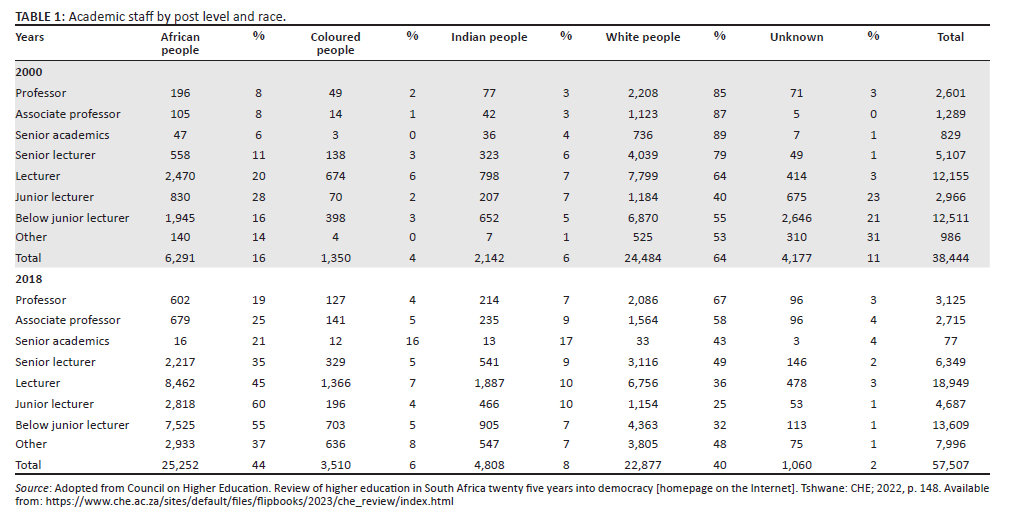
The dominant discourses on transforming the demographic profile of South Africa's academic community largely revolve around two competing challenges: equity versus quality concerns.5,677Table 1, we see how the bulk of the professoriate (full professor and associate professor) in South Africa remains White people.
Looking at Table 1, a few observations can be made. Firstly, White people academics continue to dominate the professoriate levels in South African higher education. In 2000, 85% of all full professors in the system were White people (compared to 8% African peoples), and by 2018, that number had declined to about 67% (compared to 19% African peoples). The same pattern is seen in the associate professor levels, with White people academics sitting at 87% of all associate professors in the sector in 2000 (compared to only 8% of African peoples), and by 2018, they had declined to 58% (compared to 19% African peoples).78,9
Another major concern with transforming the demographic profile of academics in South Africa was the racist assumption that the increase in other racial groups in the system would result in a decline in 'quality' and 'standards' in the sector.10was tantamount to competence, and therefore access to senior positions by non-whites would lead to the collapse of the public university as we know it.10,1112,1314Being at Home: Race, Institutional Culture and Transformation at South African Higher Education Institutions, and Khunou, Haswana, Khoza-Shangase and Canham's12Black Academic Voices: The South African Experience'. Tabensky and Matthews1415
In their book, Khunou, Phaswana, Khoza-Shangase and Canham1216
I have always felt like I have been sitting on one bum for the greater part of my academic life. I felt I didn't belong. For a long time, I felt like an outsider looking in: a stranger in a land that was not my own … my experience of the academic world is that it can be an unfriendly space where there are entrenched practices that are not in the policies of the universities, but reside with certain individuals…the real power lies with the micro individuals and not necessarily within the structure of the institution. These individuals are also known as part of the Big Five in certain corners, and are located in different structures of the university. These same individuals also serve as gatekeepers, creating zones of comfort for others based on clearly criteria known only by the few.
In this article, I attempt to provide an interdisciplinary intervention focusing on the Staffing South Africa's Universities Framework (SSAUF) and its significant blind posts as a national tool for attracting and retaining the next generation of academics in the country. I argue that there is deeply rooted neoliberal logic that shapes and influences the policy. This prevents the SSAUF from making an effective contribution to the staffing of the universities in South Africa.
South African higher education: Context and policies
The South African higher education policy framework has struggled to respond to the emergent calls for transforming and decolonising the sector.5,17,18116619,20,21
Various policy and legislative frameworks recognise and articulate the importance of transforming academic staffing in the South African higher education sector. These include the following:
•Education White Paper 3 - A Programme for Higher Education Transformation (1997)22
•The Draft National Plan for Higher Education in South Africa (2001)23
•The Report of Stakeholder Summit on Higher Education Transformation (2010)24
•The National Development Plan (2012)25
•The White Paper for Post-School Education and Training: Building An Expanded, Effective And Integrated Post-School System (2013)26
•The Staffing South Africa's Universities Framework (2015)27
•The Commission of Inquiry into Higher Education and Training (2017)28
•The Study on Building a Cadre of Emerging Scholars for Higher Education in South Africa (2018)29
•Report of the Ministerial Task Team on the Recruiting, Retention and Progression of Black South African Academics (2019)30
Cloete, Buntin and van Schalkwyk11
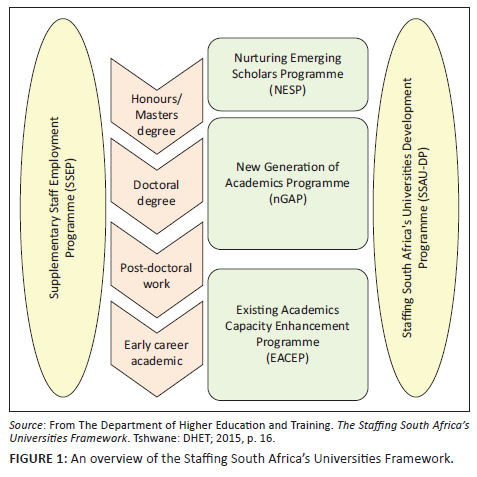
Introducing the SSAUF, the Minister of Higher Education, Science and Innovation Dr Blade Nzimande argues that its introduction was meant to respond to the two pressing policy challenges facing the higher education sector - i.e. an ageing White people professoriate and the pressing need to strengthen the quality of the academic staffing.3131Figure 1 gives an overview of the SSAUF.
The SSAUF comprises three core programmes and an additional two programmes meant to supplement the three. These are the Nurturing Emerging Scholars Programme (NESP), the New Generation of Academics Programme (NGAP) and the Existing Academic Capacity Enhancement Programme (EACEP). The two additional programmes are the Supplementary Staff Employment Programme (SSEP) and the Staffing South Africa's Staffing South Africa's Universities Development Programme (SSAU-DP).
The NESP is meant to identify students in the early phases of their studies (i.e. at the honours level). This programme is designed to attract talented students and has a 3-year focus that includes a master's degree scholarship and an additional 1-year academic internship in one of the public universities in South Africa. The NGAP programme, arguably the most influential and impactful of the three core SSAUF programmes, is designed to recruit new (and youthful) academics against the pressing needs of the different disciplines in the universities. The minimum requirement is a master's degree. The NGAP scholars are often contractually tied to a 6-year period, where the 80/20 workload split applies, with 80% of their academic workload dedicated to the completion of the doctoral qualification, and 20% used to gain some experience through co-teaching and co-supervision. The EACEP programme is largely internally orientated and meant to support existing staff to obtain their doctoral studies. One of the two additional supplementary programmes, the SSEP enables universities to recruit specific skills on a needs basis and only temporarily. It is meant to support and bring in retired academics or distinguished professors who can help fill the vacuum of supervision or research capacity. The SSAU-DP is meant to be cut across the different programmes, providing targeted support in all the different programmes and helping the different categories or types of scholars get the necessary support they need.
Overall, the SSAUF is an inclusive and well-integrated programme designed to attract and retain different types of academics into the South African higher education system. Largely designed to resolve the ageing academy in South Africa, and the need to transform the staffing demographic profile of the universities, the programme is ambitious in its orientation with a few blind spots that need to be resolved so that the policy could have a more meaningful impact.
Conceptualising ECAs in the academy
There is no consensus in the literature on what constitutes an 'early career academic' in higher education.32,33,3435,36,37383940
In the South African context, the ECA category is broad and complex. ECAs in South Africa include PhD graduates within the first 5 years of their graduation. It also includes young scholars who have completed their master's degree qualifications and are currently registered for their doctoral degree. The ECA category also includes those who are registered for their master's degree and are already being mentored and trained to assume teaching and learning responsibilities in the department. Like the ECA entry into the academy in the international literature, the ECA's journey in South Africa also has multiple pathways and entry into higher education, with some deciding to do their postgraduate qualifications part-time, while others balance work and family responsibilities. I agree with Bosanquet, Mailey, Matthews and Lodge,404134
Philosophical orientations
In the 'Prison notebooks', the late Italian philosopher Gramsci42422,3443
The organic crisis in South African higher education combines with the neoliberal university to produce new forms of marginality in the sector.
Globally, the neoliberal order was signified and represented through the then Regan and Thatcher administrations that promoted privatisation, deregulation and globalisation, and rejected the idea of the public good of education, seeing it instrumentally as a private good beneficial to one's own well-being.44,45,46
On the blind spots in the programmes
Although the SSAUF is a progressive policy document that attempts to confront and tackle the never-ending challenges of the diverse and inclusive staffing in South African higher education, especially bringing in the historically marginalised academics, three significant blind spots persist in the framework. These are: (1) the misframed and misrecognised conceptual understanding of ECAs and emerging academics, (2) the lack of systemic and adequate pathways for postdoctoral fellows to access higher education as permanent staff members in the South African academe and finally (3) the ideological missed opportunities in the policy itself.
One of the significant policy gaps in the conceptualisation of the SSAUF programmes is the deeply embedded neoliberal gaze in the social construction of the programmes. The programmes have an orientation towards what I would call traditional ECAs, who are often young, are in their early 20s/30s, have just completed their master's degree qualification and are supported to complete their doctoral qualifications. While this makes sense from a political-economic perspective in terms of the perceived return on investment in supporting, funding or mentoring youthful ECAs and emerging scholars as the feeder programme for attracting the need for a new generation of academics in higher education, this tends to isolate and marginalise 'older' ECAs who tend to languish in the bottom rankings of the higher education sector with little support. These scholars, often first-generation students who leave the academy after obtaining an undergraduate degree, usually work during their undergraduate studies and are forced to leave the sector after graduating to help support and provide for their families.47,4849African people time when it comes to 'older' ECAs who are African people women and who have to balance raising a family, employment precarity and academic responsibilities. She troubles the taken-for-granted assumption of a continuous trajectory for an academic career, suggesting that conception often betrays black women academics who often return to higher education 'late':
The concept of "African people time" has mostly negative connotations, perceived as a culturally entrenched tendency to a relaxed attitude to time. It is often likened to tardiness and lack of punctuality [Mbiti 1969]. The flip side of the coin is that African people time might represent a different consciousness with respect to time … the time of womanhood, of motherhood, and blackness as an academic takes its cues from the shadows that signal the shifting positions of the black woman, the mother and the academic that casts it. Whereas academia upholds the illusion of the congruency of the standard chronology of a career with the chronology of a person's life, African people time might acknowledge the reality that career time is out of joint … That it comprises a biologically determined child-bearing age. African people time might be sensitive to the child-like development of the older African people woman who comes back to further her education in her adult years.49
In the aforementioned quotation, Msimanga narrates on what has recently been termed the 'motherhood penalty', in how women are increasingly seen as less dedicated, less passionate and less committed to their academic responsibilities primarily because they are not trusted to deliver in the workplace because of their motherhood responsibilities.49
The second blind spot in the SSAUF is the lack of a systemic and coherent pathway between the postdoc journey and obtaining permanent employment in higher education. In one article, I argue that the national policies on attracting, training and retaining the next generation of academics in South Africa have two competing discourses and narratives when it comes to postdocs, i.e: (1) the pipeline discourse that seeks to suggest that postdoc fellowships are a necessary stepping stone to learning the skills, attributes and competencies that will help them to obtain a permanent post in the academy (author); and (2) discourse from postdocs shows that they see themselves as precarious workers whose only function is to help the neoliberal university metrics. Articulating the pipeline narrative, Minister Nzimande argues that:
The challenge is multi-faceted, having to do with the slow pace of transformation, regeneration and change, the ageing workforce, developments in higher education worldwide that demand ever greater levels of expertise from staff, the relatively under qualified academic staff workforce, and low numbers of postgraduate students representing an inadequate pipeline for the recruitment of future academics.31
In her seminal article 'How to Exploit Postdocs', Stephan50515275354
From the little publicly available data, we know that in 2020, there were at least 2 867 postdocs in South African higher education, averaging about 110 postdocs per 26 public higher education institutions, even though this is never the case as some universities have more resources, investments and infrastructure to attract more postdocs than others. Most interesting was that between 2012 and 2017, the postdocs who are South African citizens declined from 46% to 39%.7the postdoc because of their varied, complex and diverse nature. It should also be noted that the nature of the work and responsibilities of a postdoc also depends on the host, mentor or supervisor, with supervisors with grants and research chairs often involving their postdocs in some of their own work, training and mentoring them on the different research activities and projects they are involved in.
Van Benthem, Nadim Adi, Corkery, Inoue and Jadavji55
The final blind spot that I see in the SSAUF is an ideological and decolonial one. The emergence of the #FeesMustFall and #RhodesMustFall in 2015/2016 offered us an opportunity to rethink the very purposes of higher education and its role in challenging and dislodging racialised (and structural) coloniality in society.6,51,5254,55,564356
Conclusion
South African higher education is in an organic crisis as it struggles to adequately respond to the ethical calls for institutional transformation and decolonisation. The SSAUF, introduced in 2015 as a panacea to the ageing White people professoriate in the country, and the need to attract, retain, mentor and support an emerging black academic population, continues to be a real struggle in the sector. While the SSAUF is a progressive policy that articulates, diagnoses and, to some extent, attempts to respond to the staffing pressures that the higher education system is facing, there are still glaring blind spots in the policy. In this article, I have proposed three blind spots that act as a policy gap in the SSAUF: (1) the misframed and misrecognised conceptual understanding of ECAs and emerging academics; (2) the lack of systemic, adequate and real pathways for postdocs to access the higher education as permanent staff members and (3) the ideological missed opportunities in not enacting a decolonial agenda in the framework. Based on the aforementioned discussion, the following specific recommendations were made:
•This intervention was a broader policy analysis of the SSAUF in general. Future research could offer a closer analysis of the different programmes within the SSAUF, and the extent to which the NGAP, NESP and EACEP programmes have made a quantitative staffing contribution in transforming the demographic profile of academics in the country. This research could also look at the retention capabilities of the different SSAUF programmes.
•There seems not to be a national policy and framework dedicated to capturing the experiences of 'older' ECAs and postdocs. The academics continue languishing at the bottom of the higher education rankings and hierarchy. A policy intervention is required to support their needs. This includes capturing academics by age, their experiences and the particular kinds of support and interventions that they need.
•The literature on postdocs' narratives, voices or experiences is dominated by the global North, particularly insights from the United Kingdom, United States, Canada and Australia.53,57
Competing interests
The author declares that no financial or personal relationships inappropriately influenced the writing of this article.
Author's contributions
M.N.H., is the sole author of this research article.
Ethical considerations
Ethical clearance to conduct this study was obtained from the University of Johannesburg Faculty of Education Research Ethics Committee (No. Sem 1-2023-051).
Funding information
This work is based on the research supported by the National Institute for the Humanities and Social Sciences (NIHSS), grant number CRP22/1105. The opinions, findings, conclusions or recommendations expressed are those of the author and are not to be attributed to the NIHSS.
Data availability
Data sharing is not applicable to this article as no new data were created or analysed in this study.
Disclaimer
The views and opinions expressed in this article are those of the author and are the product of professional research. It does not necessarily reflect the official policy or position of any affiliated institution, funder, agency, or that of the publisher. The author is responsible for this article's results, findings, and content.
Acknowledgements
This article is dedicated to the memory of the late social justice and public intellectual, Professor Sechaba Mahlomaholo (23 May 1958 -13 January 2024), may his memory be a blessing to us all.
References
- 1.Cloete N, Bunting I, Van Schalkwayk F. Analyses of the academic staffing of SA public universities. Stellenbosch: SCISTIP; 2022.
-
2.Heleta S. Decolonisation of higher education: Dismantling epistemic violence and Eurocentrism in South Africa. Transform High Educ. 2016;1(1):1-8. https://doi.org/10.4102/the.v1i1.9
» https://doi.org/10.4102/the.v1i1.9 -
3.Heleta S. Decolonizing knowledge in South Africa: Dismantling the 'pedagogy of big lies'. Ufahamu J Afr Stud. 2018;40(2):47-65. https://doi.org/10.5070/F7402040942
» https://doi.org/10.5070/F7402040942 -
4.Kumalo S. Explicating abjection-historically white universities creating natives of nowhere? Crit Stud Teach Learn. 2018;6(1):1-17. https://doi.org/10.14426/cristal.v6i1.132
» https://doi.org/10.14426/cristal.v6i1.132 - 5.Badat S. Transforming South African higher education, 1990-2003: Goals, policy initiatives and critical challenges and issues. Pretoria: CHE; 2004.
-
6.Breetzke GD, Hedding DW. The changing demography of academic staff at higher education institutions (HEIs) in South Africa. High Educ. 2018;76:145-161. https://doi.org/10.1007/s10734-017-0203-4
» https://doi.org/10.1007/s10734-017-0203-4 -
7.Council on Higher Education. Review of higher education in South Africa twenty five years into democracy [homepage on the Internet]. Tshwane: CHE; 2022 [cited 2023 Oct 10]. Available from: https://www.che.ac.za/sites/default/files/flipbooks/2023/che_review/index.html
» https://www.che.ac.za/sites/default/files/flipbooks/2023/che_review/index.html - 8.Maluleka P. Teaching in the time of crisis: A decolonial take of my experiences of online teaching at a rural university in South Africa. Afr Perspect Res Teach Learn. 2021;5:78-94.
-
9.Mbatha N, Satimburwa N, Msiza V, Zondi T. The academentia of ECAs: Navigating academic terrain through critical friendships as a life jacket. Educ Res Soc Change. 2020;9(1):31-44. https://doi.org/10.17159/2221-4070/2020/v7i2a3
» https://doi.org/10.17159/2221-4070/2020/v7i2a3 -
10.Lewin T. Early career women academics: A case study of working lives in a gendered institution [homepage on the Internte]. PhD unpublished. Bloemfonetin: University of the free State; 2019 [cited 2023 Oct 10]. Available from: https://scholar.ufs.ac.za/server/api/core/bitstreams/b4c7c6e4-f27b-4aed-824b-e7a86677e4cb/content
» https://scholar.ufs.ac.za/server/api/core/bitstreams/b4c7c6e4-f27b-4aed-824b-e7a86677e4cb/content -
11.The Presidency of the Republic of South Africa. National policy development framework 2020 [homepage on the Internet] [cited 2023 Oct 10]. Available from: https://www.gov.za/sites/default/files/gcis_document/202101/national-policy-development-framework-2020.pdf
» https://www.gov.za/sites/default/files/gcis_document/202101/national-policy-development-framework-2020.pdf - 12.Khunou G, Phaswana ED, Khoza-Shangase K, Canham H. Black academic voices: The South African experience. Cape Town: HSRC Press; 2019.
-
13.Mahabeer P, Nzimande N, Shoba M. Academics of colour: Experiences of emerging Black women academics in curriculum studies at a university in South Africa. Agenda. 2018;32(2):28-42. https://doi.org/10.1080/10130950.2018.1460139
» https://doi.org/10.1080/10130950.2018.1460139 - 14.Tabensky PA, Matthews S. Being at home: Race, institutional culture and transformation at South African higher education institutions. Pietermaritzburg: UKZN Press; 2015.
-
15.Hlengwa A. How are institutions developing the next generation of university teachers? Crit Stud Teach Learn. 2019;7(1):1-18. https://doi.org/10.14426/cristal.v7i1.170
» https://doi.org/10.14426/cristal.v7i1.170 - 16.Nathane M. Sitting on one bum: The struggle of survival and belonging for a blakc african woman in the academy. In: Khunou G, Phaswana ED, Khoza-Shangase K, Canham H, editors. Black academic voices: The South African experience. Cape Town: HSRC Press; 2019, p. 178-194.
- 17.Badat S. Differentiation and disadvantage: The historically black universities in South Africa: Report to the Desmond Tutu Educational Trust. Education Policy Unit, Bellville: University of Western Cape; 1994.
- 18.Badat S. Trepidation, longing, and belonging: Liberating the curriculum at universities in South Africa. Tshwane: University of Pretoria; 2017.
-
19.Alasow JG. What about 'Rhodes (University) must fall'? Daily Maverick 23 March 2015 [cited 2023 Oct 10]. Available from: https://www.dailymaverick.co.za/opinionista/2015 03 23 what about-rhodes university must fall/
» https://www.dailymaverick.co.za/opinionista/2015 03 23 what about-rhodes university must fall/ -
20.Maxwele C. Black pain led me to throw Rhodes poo [homepage on the Internet]. Business Day Live 2016 [cited 2023 Oct 10]. Available from: https://www.businesslive.co.za/bd/opinion/2016-03-16-black-pain-led-me-to-throw-rhodes-poo/
» https://www.businesslive.co.za/bd/opinion/2016-03-16-black-pain-led-me-to-throw-rhodes-poo/ -
21.Valela N. The Rhodes to perdition: Why Rhodes was never ready for the BSM [homepage on the Internet]. Daily Maverick 26 March 2015 [cited 2023 Oct 10]. Available from: https://www.dailymaverick.co.za/opinionista/2015-03-26-the-rhodes-to-perdition-why-rhodes-was-never-ready-for-the-bsm/
» https://www.dailymaverick.co.za/opinionista/2015-03-26-the-rhodes-to-perdition-why-rhodes-was-never-ready-for-the-bsm/ - 22.The Department of Education. Education White Paper 3 - A Programme for higher education transformation. Pretoria: DoE; 1997.
- 23.The Department of Education. The draft national plan for higher education in South Africa. Pretoria: DoE; 2001.
- 24.The Department of Higher Education and Training. The report of stakeholder summit on higher education transformation. Tshwane: CEPD; 2010.
- 25.South African Government. The National Development Plan. Tshwane: GCIS; 2012.
- 26.The Department of Higher Education and Training. The White Paper for post-school education and training: Building an expanded, effective and integrated post-school system. Tshwane: DHET; 2013.
- 27.The Department of Higher Education and Training. The Staffing South Africa's Universities Framework. Tshwane: DHET; 2015.
- 28.The Department of Higher Education and Training. The Commission of inquiry into higher education and training. Tshwane: DHET; 2017.
- 29.The Department of Science and Technology. The study on building a cadre of emerging scholars for higher education in South Africa. Tshwane: DSI; 2018.
- 30.The Department of Higher Education and Training. Report of the ministerial task team on the recruiting, retention and progression of Black South African academics. Tshwane: DHET; 2017.
-
31.Department of Higher Education and Trainining. SSAUF [homepage on the Internet]. Tshwane: DHET; 2017 [cited 2023 Oct 10]. Available from: http://www.ssauf.dhet.gov.za
» http://www.ssauf.dhet.gov.za -
32.Osbaldiston N, Cannizzo F, Mauri C. 'I love my work but I hate my job' - Early career academic perspective on academic times in Australia. Time Soc. 2019;28(2):743-762. https://doi.org/10.1177/0961463X16682516
» https://doi.org/10.1177/0961463X16682516 -
33.Timperley C, Sutherland KA, Wilson M, Hall M. He moana pukepuke: Navigating gender and ethnic inequality in early career academics' conference attendance. Gend Educ. 2020;32(1):11-26. https://doi.org/10.1080/09540253.2019.1633464
» https://doi.org/10.1080/09540253.2019.1633464 -
34.van Hilten A, Ruel S. The Chihuahua and the space princess writing in the margins: Antenarratives of two (older) women early career academics. Gender Work Organ. 2022;1(1). https://doi.org/10.1111/gwao.12910
» https://doi.org/10.1111/gwao.12910 -
35.Hemmings B, Kay R. Research self-efficacy, publication output, and early career development. Int J Educ Manag. 2010;24(7):562-574. https://doi.org/10.1108/09513541011079978
» https://doi.org/10.1108/09513541011079978 -
36.Laudel G, Glaser J. From apprentice to colleague: The metamorphosis of early career researchers. High Educ. 2008;55:387-406. https://doi.org/10.1007/s10734-007-9063-7
» https://doi.org/10.1007/s10734-007-9063-7 -
37.Price E, Coffey B, Nethery A. An early career academic network: What worked and what didn't. J Further Educ Train. 2014;39(1):680-698. https://doi.org/10.1080/0309877X.2014.971106
» https://doi.org/10.1080/0309877X.2014.971106 -
38.Gale H. The reluctant academic: Early-career academics in a teaching-orientated university. Int J Acad Dev. 2011;16(1):215-277. https://doi.org/10.1080/1360144X.2011.596705
» https://doi.org/10.1080/1360144X.2011.596705 - 39.Anderson D, Johnson R, Saha LJ. Changes in academic work. Canberra: Commonwealth of Australia; 2002.
-
40.Bosanquet A, Mailey A, Matthews KE, Lodge JM. Redefining 'early career' in academia: A collective narrative approach. High Educ Res Dev. 2017;36(5):890-902. https://doi.org/10.1080/07294360.2016.1263934
» https://doi.org/10.1080/07294360.2016.1263934 -
41.Spina N, Smithers K, Harris J, Mewburn I. Back to zero? Precarious employment in academia amongst 'older' early career researchers, a life-course approach. Br J Sociol Educ. 2022;43(4):534-549. https://doi.org/10.1080/01425692.2022.2057925
» https://doi.org/10.1080/01425692.2022.2057925 - 42.Gramsci A. The prison notebooks. London: The Electric Book Company; 1999.
- 43.Ndlovu-Gatsheni SJ. Epistemic freedom in Africa: Deprovincialization and Decolonization. London: Routledge; 2018.
- 44.Hlatshwayo MN. Social capital and first-generation South African students at Rhodes University. MA unpublished. Grahamstown: Rhodes University; 2016.
-
45.Tight M. The neoliberal turn in Higher Education. Higher Educ Q. 2019;73(1): 273-284. https://doi.org/10.1111/hequ.12197
» https://doi.org/10.1111/hequ.12197 - 46.Harvey D. A brief history of neoliberalism. Oxford: Oxford University Press; 2005.
-
47.Olssen M, Peters MA. Neoliberalism, higher education and the knowledge economy: From the free market to knowledge capitalism. J Educ Policy. 2005;20(3):313-345. https://doi.org/10.1080/02680930500108718
» https://doi.org/10.1080/02680930500108718 -
48.Vincent L, Hlatshwayo MN. The that bind: The ambiguous role played by social capital in black working class first-generation South Africa students' negotiation of university life. S Afr J High Educ. 2018;32(3):118-138. https://doi.org/10.20853/32-3-2538
» https://doi.org/10.20853/32-3-2538 -
49.Msimanga A. Too late to come back? The paradox of being a 50-year-old 'early career' black female academic. S Afr J High Educ. 2013;28(6):2013-2026. https://doi.org/10.20853/28-6-5697
» https://doi.org/10.20853/28-6-5697 -
50.Stephan P. How to exploit postdocs. Bioscience. 2013;63(4):245-246. https://doi.org/10.1525/bio.2013.63.4.2
» https://doi.org/10.1525/bio.2013.63.4.2 -
51.Kerr P. Career development or career delay? Postdoctoral fellowships and the de-professionalizing of academic work in South African universities. Br J Sociol Educ. 2022;43(4):550-565. https://doi.org/10.1080/01425692.2022.2045902
» https://doi.org/10.1080/01425692.2022.2045902 - 52.Jaeger AJ, Dinin JA. The postdoc landscape: The invisible scholars. London: The Academic Press; 2017.
- 53.Holley K, Kuzhabekova A, Osbaldiston N, et al. Global perspectives on the postdoctoral scholar experience. In: Jaeger AJ, Dinin JA, editors. The postdoc landscape: The invisible scholars. London: The Academic Press; 2017, p. 203-226.
- 54.Simmonds S, Bitzer E. The career trajectories of postdcocs in their journeys of becoming researchers. In: Du Preez P, Simmonds S, editors. A scholarship of doctoral education: On becoming a researcher. Stellenbosch: African Sun Media Press; 2018, p. 273-294.
-
55.Van Blenthem K, Adi AM, Corkery CT, Inoue J, Jadavji NM. The changing postdoc and key predictors of satisfaction with professional training. Stud Grad Postdoct Educ. 2020;11(1):123-142. https://doi.org/10.1108/SGPE-06-2019-0055
» https://doi.org/10.1108/SGPE-06-2019-0055 - 56.Gordon L. Shifting the geography of reason. Cambridge: Cambridge Scholars Publishing; 2007.
-
57.Ålund A, Emery N, Jarrett B, et al. Academic ecosystems must evolve to support a sustainable postdoc workforce. Nat Ecol Evol. 2020;4(6);777-781. https://doi.org/10.1038/s41559-020-1178-6
» https://doi.org/10.1038/s41559-020-1178-6

Accepted: 06 Mar. 2024
Published: 31 May 2024